




Abstract
Objectives:
To determine whether urinary symptoms are significantly improved with a shorter duration of stent placement without an increase in complications.
Methods:
A total of 100 patients were prospectively randomized to two groups, either a 3-day (n = 59, Group 1) or 7-day (n = 41, Group 2) stent placement group depending on date of operation. Patients submitted Ureteral Stent Symptom Questionnaires both while stents were in situ and 2 to 3 days after removal.
Results:
Group 2 reported greater urinary symptoms (p < 0.001) and pain (p < 0.001) with stents in situ compared with Group 1. Urinary symptoms (p < 0.001), pain (p = 0.003), and general health (p = 0.02) were more severe in Group 2 after stent removal as well. The analysis also revealed that urinary symptoms, pain, and general health improved after stent removal compared with stent in situ (p < 0.001). There were no significant differences in work-related functioning between two groups. There was one complication in Group 1 requiring bilateral stent replacement. There were no significant differences in emergency department visits, unplanned clinic visits, or hospitalizations between Groups 1 and 2.
Conclusions:
Patients with stent removal at 3-day group had better reported urinary, pain, and general health score compared with 7-day group. Patients after stent removal had improved urinary symptoms, pain symptom, and general health compared with ureteral stent in situ. There was no statistically significant difference in complications between the groups.
Introduction
Ureteroscopy is a common procedure performed for stone treatment. 1 During ureteroscopy the ureter is subject to manipulation that may be associated with postoperative edema, contributing to ureteral obstruction. 2 Therefore, urologists often place indwelling ureteral stents to promote ureteral dilation and allow passage of smaller stones, debris, and blood clots. 3 However, ureteral stents are not without side effects. Ureteral stent placement is associated with a number of early complications. 4 Early complications include pelvic and flank pain, bladder irritative symptoms, hematuria, bacteriuria, and fever. 5
At present there is controversy as to whether ureteral stents are necessary after ureteroscopy. 6,7 However, a review of these trials demonstrate heterogeneity and prompt further investigation to routinely discourage use of ureteral stents after ureteroscopy. Furthermore, surveys of urologists reveal that 64% of urologists always place a stent. 8 Because there are no current guidelines for the optimal timing of stent removal, practice patterns can vary from days to weeks. 9 Despite the large number of studies on ureteroscopy and stents, there is currently limited literature available on optimal duration of stent placement.
American Urologic Association (AUA) guidelines recommend that the duration of ureteral stenting postoperatively is 3 to 7 days after routine, uncomplicated ureteroscopic stone intervention. 10 Small retrospective studies have shown that stent removal before 14 days is associated with fewer adverse events. 11 Our aim was to determine if urinary symptoms were significantly improved with a shorter duration of stent placement without an increase in complications. Using a validated questionnaire for stent-related symptoms we assessed the effect of stent dwell time on patient-reported side effects.
Methods
After Institutional Review Board approval, patients were recruited between 2018 and 2021. Surgical intervention was performed by a single surgeon at an academic medical center. Informed consent was obtained at the time of enrollment in the clinic. At baseline visit, patients reported pain levels 0 to 1 on the Wong–Baker scale and without lower urinary tract symptoms. Patients were prospectively randomized by operative day into 3-day (Group 1) or 7-day (Group 2) stent dwell time. Randomization was performed by a nonmedical third party based on the day of the week the operation was scheduled. Patients who underwent the procedure on Monday or Friday were sorted into Group 1, and those scheduled on Tuesday, Wednesday, and Thursday were sorted into Group 2. Patients were excluded from analysis if they had complicated ureteroscopy necessitating indwelling stent placement without a dangle or were pre-stented. Preoperatively, patients were thoroughly counseled on postoperative expectations after ureteroscopic stone removal and stent placement.
Ureteroscopy was performed with both a 7F semirigid ureteroscope for optical dilation and treatment of distal stones (Karl Storz, Tuttlingen, Germany) as well as an 8F flexible ureteroscope (Olympus America, Center Valley, PA) for proximal or intrarenal stones. Ureteral access sheaths (11F–13F) were used in all cases to facilitate flexible ureterorenoscopy. All patients in this series underwent uncomplicated semirigid and flexible ureterorenoscopy with indwelling stent placement on a dangle. In our practice, we remove dangle strings only after complex ureteroscopic cases. Uncomplicated ureteroscopy was defined as ureteroscopic treatment for a urinary tract stone, with the absence of: ureteral trauma, visible residual fragments necessitating further lithotripsy procedures, significant bleeding, perforation, prior urinary tract infection, or pregnancy. 12 Postoperatively, patients were instructed on the date to return for their stent removal by the nursing staff in clinic. All patients were discharged on an opioid-free regimen with 2 weeks of tamsulosin, 3 days of antibiotics, Tylenol, ibuprofen, oxybutynin, and valium prescribed as needed.
Patients submitted Ureteral Stent Symptom Questionnaire (USSQ) both while the ureteral stent was in situ and after stent removal. USSQ stent in situ responses were filled out on postoperative day 2. USSQ poststent removal responses were completed 2 days after stent removal. Group 1 completed the poststent removal survey on postoperative day 5. Group 2 completed the poststent removal survey on postoperative day 9. Adverse events were defined as emergency department (ED) visits, readmission, or stent replacement.
The primary outcome was to compare urinary scores between patients with 3-day stent dwell time and 7-day stent dwell time. The secondary outcomes included comparing urinary scores, pain scores, and general health scores between groups with stents in situ and after removal, and complications rates between patients with 3-day stent dwell time and 7-day stent dwell time.
Statistical analysis
Patient demographics and USSQ index score including urinary symptoms, pain, general health index, everyday functioning, and work functioning were summarized as median (interquartile range [IQR]) or count (percentage) for continuous and categorical variables, respectively. Comparisons were made between the 3- and 7-day groups using Wilcoxon rank sum test or Fisher's exact test as appropriate. Univariate and multivariable mixed models were carried out for urinary index score, pain index score, and general health index score as the three outcomes of interest with within-subject correlation considered. Covariates such as age at operation, gender, stent duration, and time were included in the multivariable analysis. The interaction term between time and stent duration was not included in the model owing to nonsignificant effect on the outcomes.
Sample size was calculated based on the results of prior ureteral stent studies. 13 A sample size of n = 100 patients (∼50 per group) was sufficient for 80% power to detect a 20% difference in each USSQ domain score. Assuming a 30% dropout score, a total of 130 patients were enrolled.
The analysis was conducted by SAS 9.4 (SAS Institute, Inc., Cary, NC) and RStudio (Posit Software, PBC; version 4.1.2, Boston, MA). All tests were two-sided, and values of p < 0.05 were considered significant.
Results
From 2018 through 2021, 133 patients who underwent ureteroscopic stone removal consented to participate in our study. Thirty-three were screen failures (Fig. 1). One hundred patients were included, with 59 patients in Group 1 and 41 patients in Group 2. There were no differences between the two groups with respect to age, gender, race, American Society of anesthesiologists status, prior stone episodes, prior procedures, stone burden, stone location, stone size, or laterality (Table 1).
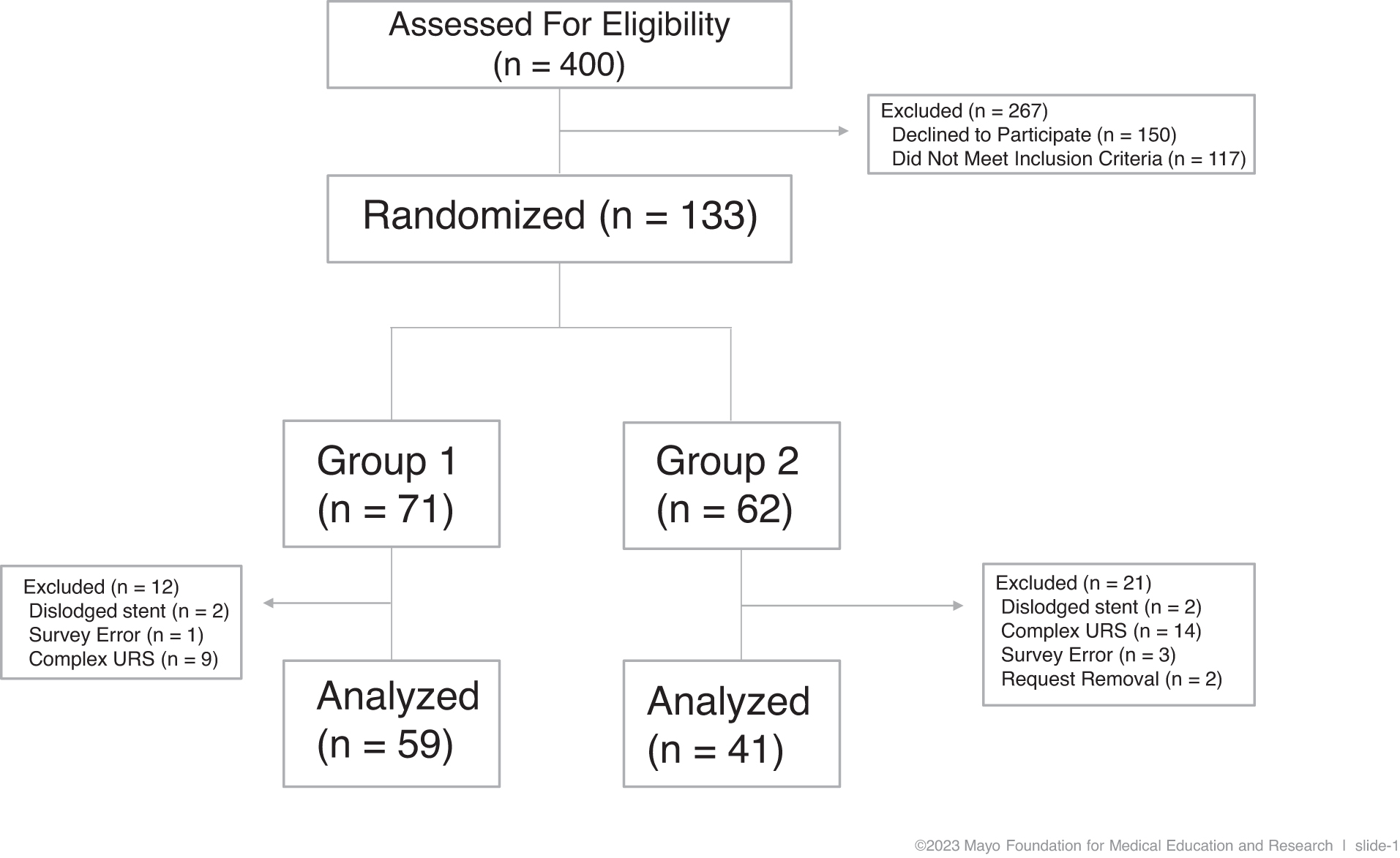
Flow chart of patient selection. Inclusion criteria were age older than 18 years who underwent uncomplicated ureteroscopy. Patients were excluded if ureteroscopy was complex, stents were removed before assigned date, survey erroneously completed, or for patient request. URS = ureteroscopy.
Descriptive Analysis of Patient Demographic and Clinical Characteristics By 3-Day vs 7-Day Stent
IQR = interquartile range.
Primary outcome
Urinary symptoms were less severe in Group 1 after stent removal compared with Group 2 with median (IQR) as 20.0 (16.0–24.5) vs 29.0 (23.0–34.0) (p < 0.001; Tables 2 and 3). Similarly, the multivariable analysis demonstrated that urinary symptoms had similar pattern with estimated mean difference (standard error [SE]) as 7.8 (1.27) between Group 2 and Group 1 after adjusting age at procedure, gender, and time effect (Fig. 2). Multivariable analysis also demonstrated that urinary symptoms were improved for patients after stent removal compared with indwelling stent with estimated mean difference (SE) as 7.7 (0.82) (p < 0.001; Table 4; Fig. 3).

The estimated mean of urinary index score for both 3- and 7-day groups from the multivariable mixed model. Color images are available online.
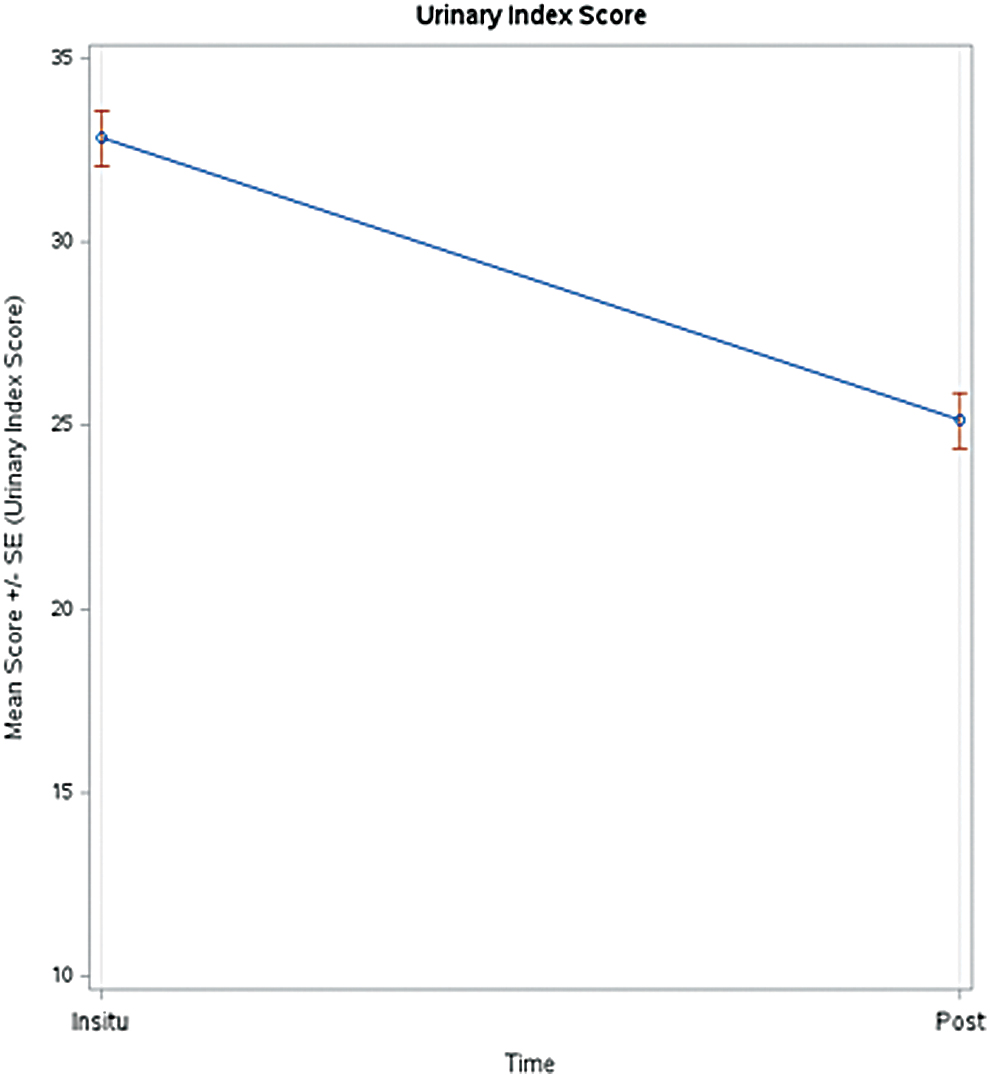
The estimated mean of urinary index score for both stent in situ and poststent removal from the multivariable mixed model. SE = standard error. Color images are available online.
Ureteral Stent Symptom Questionnaires Scores with Stent In Situ
Bold values denote statistical significance, p < 0.05.
Values are given as median (IQR).
Ureteral Stent Symptom Questionnaires Scores After Stent Removal
Bold values denote statistical significance, p < 0.05.
This table evaluates USSQ scores by each category after stents are removed. The scores are reported as median (IQR).
USSQ = Ureteral Stent Symptom Questionnaires.
Estimated Mean Difference from the Multivariable Mixed Model
Bold values denote statistical significance, p < 0.05.
The multivariable mixed model evaluates urinary symptoms, stent-related pain, and general health. For the above USSQ categories, estimated means were compared between 7-day group and 3-day groups. For urinary symptoms, stent pain and general health, the 7-day stent group had worse reported scores compared with 3-day stent group averaged across stents being indwelling and after removal for the above USSQ categories. Patients had improved symptoms for all the scores after stent removal compared with an indwelling stent.
SE = standard error.
Secondary outcomes
Patients in Group 2 reported more severe stent-related pain (p < 0.001, p = 0.003) and worse general health (p = 0.02, p = 0.02) with stents in situ and after stent removal (Tables 2 and 3). Multivariable analysis also demonstrated that Group 2 had more stent-related pain (p = 0.001) and worse general health overall compared with Group 1 (p = 0.003). It also showed that stent-related pain and general health improved after stent removal compared with stent in situ (p < 0.001; Table 4). There was no significant difference in patients who underwent bilateral stent placement between Groups 1 and 2 (11 (18.6%) vs 5 (12.2%), p = 0.42). Group 1 patients had improved work performance after stent removal compared with Group 2 (p = 0.04) but not with stent in situ (0.07). Younger age was associated with more stent-related pain in univariate model and multivariable models. Gender was not associated with statistically significant difference in outcomes in either group.
There was one complication in Group 1 necessitating bilateral stent replacement. Four patients who underwent unilateral ureteroscopy, two sorted into Group 1 and two sorted into Group 2, experienced early stent dislodgement. These occurred owing to accidental manipulation of the stent dangle between 2 and 5 days postoperatively. None of these patients required stent replacement, and adequate symptom management was achieved with medications. There was no significant difference in ED visits, unplanned clinic visits, or hospitalizations between Groups 1 and 2.
Discussion
Ureteral stents are associated with morbidity. Approximately one third of patients reported stent-associated symptoms after stent placement after uncomplicated ureteroscopy. 14 Patients with stent discomfort may experience different degrees of symptoms. To assess the patient's perception of stent-related symptoms, we utilized a standardized questionnaire. The USSQ has been shown to be a validated survey that can accurately assess symptoms associated with stent pain. 15 There are limited studies evaluating the appropriate duration of stent placement after ureteroscopy. To date, there has not been a study to evaluate patient symptoms when comparing 3 vs 7 days of stent dwell time.
Our findings indicate that the 3-day stent group had improved urinary symptoms and less pain averaged with both the stents in place and after stent removal compared with the 7-day group. The improved reported pain and urinary symptoms in the 3-day group could be influenced by a patient's perception that the symptoms being associated with the stent are closer to concluding. This might reflect improved patient satisfaction with earlier stent removal.
There have been several studies that compare indwelling stents with no stent after ureteroscopy. Cevik et al. 16 performed a randomized trial with 60 patients who had either 3 weeks indwelling stent placement or no indwelling stent after ureteroscopy. All patients underwent semirigid ureteroscopy to treat ureteral stones, without flexible ureterorenoscopy or access sheath use. Patients who did not have stents placed used more narcotics in the first 5 days after the operation. Twenty percent of the no-stent group required ED visits, and 23% had delayed discharge compared with 10% of the indwelling stent group. The stented group had more stent-related irritative symptoms and had more pain after postoperative day 5. 16 This study suggests that the side effects begin to outweigh the benefits of stent placement after postoperative day 5. Chen et al. 17 randomized 60 patients to 3 days stent duration vs no indwelling stent after ureteroscopy.
All patients in this series had stone volume <10 mm, used only semirigid ureteroscopy, and no ureteral access sheath was used. They found that patients with 3 days indwelling stent were more likely to have discomfort than those without a stent. 17 Most studies comparing indwelling stent vs no stent after ureteroscopy do not utilize ureteral access sheaths. Our practice favors the use of an access sheath to minimize intrarenal pressure and mitigate stone extraction during ureteroscopy. In this study, all patients underwent ureteral access sheath placement and flexible ureterorenoscopy. Other studies have found that routine use of a stent after ureteroscopy with a ureteral access sheath led to lower pain scores and a reduced likelihood of seeking medical assistance. 18
One patient experienced an adverse event in our study. The patient underwent extensive, yet uncomplicated, bilateral ureteroscopic stone removal for multiple renal calculi. The total stone burden was ∼1.8 cm. The stents were removed as planned in the office after 3 days. Approximately 10 hours after stent removal, the patient was admitted for intractable bilateral flank pain and acute kidney injury. The patient ultimately required bilateral indwelling stent placement for 7 days with symptomatic resolution. We could therefore consider an extended stent dwell time for patients who undergo more aggressive bilateral ureteroscopy.
Our rates of postprocedure complications were less than a prior reported study, which showed that 33% of all patients experienced a poststent removal event within 30 days of their procedure. 15 The majority of the adverse events, however, were described as patient phone calls. The discrepancy in results between Paul et al. 14 and our group may be owing to several facets. The modality of data collection in our study captures each patient's experience undergoing any procedural intervention rather than subselection by adverse events alone. In addition, there may be a difference in protocols for performing stent removal, which may impact patient symptomatology. Furthermore, patient counseling before surgical intervention on expectations may have an effect.
Our study has several limitations. Our patients were from one geographical location and treated by a single surgeon, which could reflect selection bias. Although patients filled out validated questionnaires at requested times after the operation, there could be recall bias. Moreover, we did not segregate unilateral and bilateral cases, which will be a consideration for future investigation, as these may represent distinct perioperative experiences. Despite these constraints, the strength of this study is strong subject participation.
We conclude that patients prefer a short duration of indwelling stent placement with similar complication rate. To further validate our findings, a multicenter, prospective randomized control trial would be prudent.
Footnotes
Authors' Contributions
D.J.H. designed, coordinated research, and drafted the article. J.N. collected data and enrolled subjects. C.G. assisted with project design and coordinating research. L.M. and C.V.D.W. performed data analysis. P.M. conceived of the study and participated in research coordination. The authors read and approved the final version of the article.
Author Disclosure Statement
The authors declare that they have no competing interests.
Funding Information
No outside funding was used to conduct this research.