




Abstract
Introduction:
The field of urology is predominantly male; however, there has been an increasing number of women in the workforce. Peak reproductive years frequently overlap with residency training and early attending career timelines. Exposure to ionizing radiation is a common occupational hazard in many procedural specialties. The use of radiation, for example, in interventional cardiology and interventional radiology, has shown little adjustments in practice patterns, with no adverse outcomes reported among pregnant physicians in their fields in the setting of appropriate radiation safety measures. The impact of radiation exposure during pregnancy for urologists is largely unknown. Our objective was to determine attitudes and practices of urologists related to radiation exposure and to characterize the experience of urologists who have previously been pregnant.
Methods:
An anonymous online survey was distributed through relevant society membership bases, which included the Endourological Society and the Society for Women in Urology, and social media. Demographics, practice patterns, and changes to practice patterns were recorded for respondents. Statistical analysis was performed in R studio.
Results:
There were 384 respondents, 255 of whom identified as women. Of these, 164 had been previously pregnant. Female respondents were younger, completed training more recently, and were more likely to have adjusted their caseload due to radiation concerns compared with their male counterparts. Of women who had been pregnant, few had access to policies for who to notify (19%), policies for safety precautions (22%), custom-fitted lead (35%), and maternity lead (20%). Most women (66%) relied on their own research for guidance on radiation safety during pregnancy, while some (41%) also used information from colleagues or mentors. Forty-six percent of women would have taken greater precautions during pregnancy than they did.
Conclusions:
Access to the appropriate tools to safely navigate pregnancy is inconsistent among practicing urologists. Evidence-based guidelines are needed to better empower pregnant urologists.
Introduction
Although urology as a field has historically been male dominated, more women than ever are entering the urologic workforce. 1,2 Just within the last decade, the proportion of practicing urologists who identify as female has increased from 7.7% in 2014 to 11.6% in 2022. 1 This trend is projected to continue, with women comprising 35% of matched applicants in the 2022 urology match. 2 Peak reproductive years frequently overlap with residency training and early attending years. 1,3 This shift in demographic means that more women than ever will be practicing urology while pregnant.
Exposure to ionizing radiation is a known occupational hazard in urology, one that poses an even greater concern to a developing fetus. 4 However, there is a lack of guidance, and no official practice standards from the American Urological Association, on what, if any, additional measures a pregnant urologist should take to safely mitigate potential risk of radiation exposure.
Other fields with significant radiation exposure, such as interventional cardiology and interventional radiology (IR), have created guidelines regarding radiation exposure to pregnant physicians. 5 –7 They show little adjustments in practice patterns and no adverse outcomes among pregnant physicians in their fields in the setting of appropriate radiation safety measures and use of “as low as reasonably achievable” (ALARA) principles. However, the impact of radiation exposure during pregnancy for urologists is largely unknown. 4
Our objective was to determine attitudes and practices of urologists related to radiation exposure, and to characterize the experience of urologists who have previously been pregnant.
Methods
After obtaining Institutional Review Board exemption, an anonymous online survey was created using Qualtrics. The survey (available in Supplementary Appendix SA) was distributed through relevant society membership bases, which included the Endourological Society and the Society for Women in Urology, as well through social media, which included Facebook and Twitter. The survey was open from March 20, 2023 to April 30, 2023.
The survey was modeled after a similar survey administered to interventional radiologists. 8 Our survey was open to all urologists at any stage in their career and was divided into two sections. The first section was open to all respondents, regardless of gender or child-bearing status. This set of questions asked about demographics, gender breakdown of their practice, number of children (biological, adopted, and step), how concern for radiation exposure has impacted their career choices and frequency of dosimeter use. The second section was for respondents who had previously been pregnant at some point during their urologic career, from medical school to attending status.
Questions included at what stage during their career pregnancy occurred, access to institutional policies and guidelines during pregnancy, access to personal protective equipment (PPE), dosimeter doses, alterations in practice patterns during pregnancy and at which stage these occurred, and any adverse outcomes. In addition, respondents with more than one pregnancy were able to distinguish between alterations in first vs subsequent pregnancies. Additional comments were solicited at the end of the survey in a free-text format.
Statistical analysis was performed in R studio. To compare responses between men and women, Welch two-sample t-test and chi-square analysis were used for continuous and categorical variables, respectively. Descriptive statistics were recorded for responses from women who had previously been pregnant. Welch two-sample t-test and chi-square analysis were again performed for continuous and categorical variables, respectively, to compare first vs subsequent pregnancies.
Qualitative analysis was performed for the free responses provided by respondents. Comments were systematically categorized into subthemes using inductive coding. Common overarching themes were then identified.
Results
Overall, there were 384 respondents. It was not possible to calculate a response rate as there was no denominator, given the distribution methods. Of the respondents, 133 (34.6%) identified as men and 251 (65.4%) identified as women; no respondents had a nonbinary gender identity.
Table 1 shows the comparison of demographics, practice patterns, reproductive history, and impact on work stratified by gender. Female respondents were younger (year born: 1983 ± 8 vs 1978 ± 10.4, p < 0.0001) and had finished training more recently than their male counterparts (2016 ± 7.8 vs 2011 ± 10.6, p = 0.0001). Men were more likely to have completed a fellowship, with most men having completed training in endourology (51%). Most male and female respondents were based in the United States.
Comparison of Demographics, Practice Patterns, Reproductive History and Impact on Work Based on Gender (Men vs Women)
AUA = American Urological Association; FPMRS = female pelvic medicine and reconstructive surgery; IQR = interquartile range; MIS = minimally invasive surgery; SD = standard deviation.
There were no differences in practice settings between genders or number of male urologists in their practice. Female respondents were significantly more likely to have more female urologists in their practice [3 (1:4) vs 2 (0:4), p = 0.03]. In addition, there were no differences in concern regarding radiation exposure, satisfaction with level of protection, or routine usage of a dosimeter. However, women were significantly more likely to have decreased their hours or changed their practice pattern due to concern of radiation exposure (17% vs 7%, p = 0.01). Regarding reproductive history, women were more likely to have fewer biological children (p = 0.008), and to have their first child at an older age compared with men (p = 0.006).
Of female respondents, 164 (65%) had been previously pregnant. Table 2 demonstrates that among these women, few had access to policies for who to notify (19%), policies for safety precautions (22%), custom-fitted lead (35%), and easy access to maternity lead (20%). Most women did not know their dosimetry doses (67%). Of those who did know their doses, most were under the limit (50/53, 94%) and none exceeded the limit; three women (6%) reported they were at the limit. The most common forms of additional PPE used during pregnancy were maternity or double lead (62%), followed by use of a fetal dosimeter (26%), no change (21%), and use of a shield (11%); respondents could select multiple types of PPE.
Access to Resources and Personal Protective Equipment, Impact on Practice, and Adverse Outcomes Among Pregnant Urologists
PPE = personal protective equipment.
Most women (66%) relied on their own research for guidance on radiation safety during pregnancy, while some (41%) also used information from colleagues or mentors. In retrospect, 46% of women would have taken greater precautions during pregnancy than they did, while 51% would not have changed precautions taken during pregnancy.
There were 105 women (64%) who reported more than one pregnancy. During subsequent pregnancies, women were less likely to change their caseload (66% vs 78%, p = 0.042). In addition, they reported being less likely to initiate any changes to their practice during subsequent pregnancies (Fig. 1).

Comparison of practices in first vs subsequent pregnancies.
Thematic analysis from the open-answer comment section yielded 6 major themes and 20 subthemes (Fig. 2). The most common subthemes were “improved knowledge and guidelines are needed,” “access to proper PPE is lacking,” “reduced radiation exposure [during pregnancy],” and “personally used additional PPE and/or ALARA principles.” In addition, fear of “early disclosure of pregnancy” was a common concern, and lack of access to appropriate PPE was frequently cited as a reason.
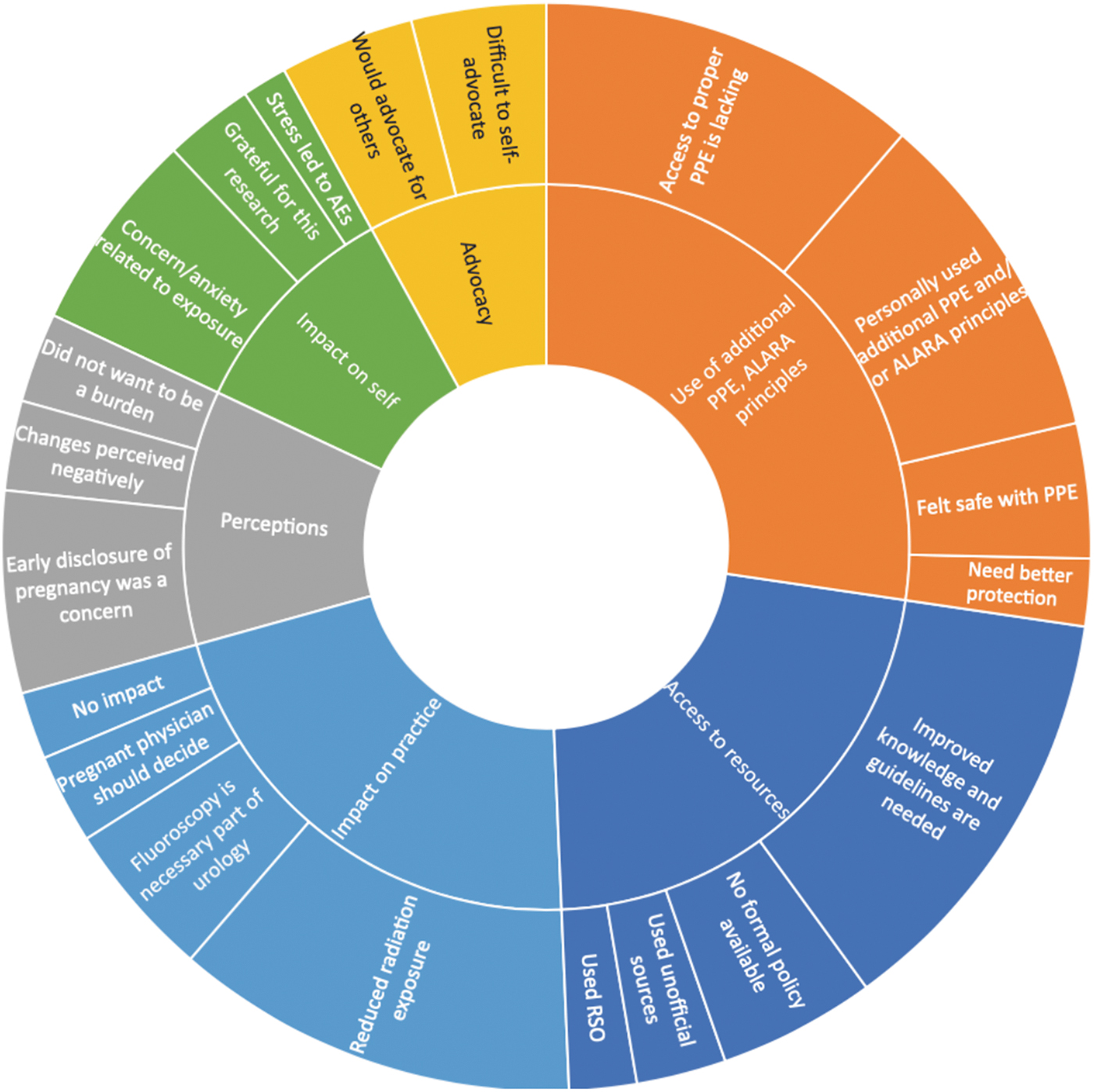
Thematic analysis of open answer comments.
Discussion
Our data demonstrate a lack of two modifiable factors for pregnant urologists: access to formal policies or guidelines and easy access to appropriate PPE. In this study, we found only 22% of respondents had access to policies for safety precautions and 19% had access to policies for who to notify of pregnancy. These results are in line with prior studies, where a survey of urology program directors found that only 21% of maternity leave policies address lead safety for pregnant residents. 9 Residency is a particularly vulnerable time, where negative perceptions of residents who become pregnant during surgical training persist and residents may be even more hesitant to disclose pregnancy. 10
The lack of access to formal guidelines or policies is striking, as urology is not the only field to use radiation during procedures. The Society for Cardiovascular Angiography and Intervention consensus statement cites undetectable dosimeter readings for badges worn under the lead apron. They reassure against the need to cease performing procedures using radiation during pregnancy so long as appropriate precautions are taken. They also acknowledge the nuance of this topic and offer guidance on how individuals can assess their own situation and risk. 5
Similarly, a joint statement published by the Society of Interventional Radiology and the Cardiovascular and Interventional Radiological Society of Europe advocates for a dose that is ALARA throughout the gestation with a limit of 5 mSv for U.S.-based physicians and monthly dosimeter monitoring, as well as a facility-specific safety policy. They also note that there is no need to preclude pregnant workers from these procedures in the setting of appropriate safety measures. 8 Key safety measures include proper-fitting lead aprons, access to personal dosimetry data, and fluoroscopic work practices that use ALARA principles. 5 –7 Urologists should have access to similar best practice statements, to help create standard guidance.
Data exist within urology but have not been formalized into best practice guidelines. One study measured the radiation exposure of an endourologist while performing radiation-based procedures (percutaneous nephrolithotomy, ureteroscopy). They found that while wearing appropriate PPE, the radiation exposure during procedures was no greater than the background radiation which is encountered in daily home life. 11 The dose to the endourologist's abdomen and developing fetus was well under the 1 mSv limit recommended by the International Commission on Radiological Protection. This aligns with prior findings from orthopedics and IR. 12,13
Although the results from our survey are U.S. centric, there are respondents from other countries as well where guidelines are better expounded where policies surrounding pregnancy and fluoroscopy may differ. A survey of European academic endourologists found that of the 12 countries represented, 10 of these have formal policies related to radiation exposure among pregnant clinicians. Interestingly, three countries require the pregnant clinician to be exempt from radiation duties, whereas the other seven allow the clinician to decide. 14 Many of the countries recommend limiting exposure during the first trimester, cite a maximum radiation dose of 1 mSv, and recommend a lead thickness of ≥0.25 mm. They also advocate for a universal policy to guide pregnant urologists.
Although PPE is repeatedly cited as a necessity for pregnant physicians, we found that only 35% of respondents had access to custom-fitted lead and 20% had easy access to maternity lead. Interestingly, 62% reported using either double lead or maternity lead while pregnant. The low number reporting ease of access raises concern that although lead is consistently one of the key items of PPE to use during pregnancy, it may be difficult to find for most urologists. This may ultimately result in the need to disclose pregnancy before the pregnant person is ready, as evidenced by open-answer responses in this survey. Mandatory maternity lead access should be a requirement in all training programs, to help ensure access to our trainees.
In a similar survey of IR physicians, 85% of women reported that they would take the exact same precautions that they did during their pregnancy. 8 This contrasts with our findings, where only 51% reported they would do exactly as they did, and 46% reported they would take greater precautions. We hypothesize that the urologists' lack of access to both formal guidelines and appropriate PPE adds to anxiety surrounding radiation exposure in pregnancy and feelings of inadequacy regarding measures taken.
This is in comparison with IR, where pregnant clinicians had access to guidelines and PPE, and subsequently felt reassured. This was also seen in our open-answer responses, where it was reported that additional fluoroscopy training, such as that mandated by specific states, helped clinicians to feel reassured about radiation exposure. However, more research is needed to fully understand this relationship. Interestingly, women in our study were less likely to adjust their work practices in subsequent pregnancies. It is possibly due to women implementing more radiation-conscious practices during their first pregnancy and continuing with those practices indefinitely.
In our study, female respondents were significantly more likely to reduce their work hours or change their scope of practice due to concern for radiation exposure. A recent analysis found that although there was no difference in mean clinical hours worked, women performed fewer inpatient and surgical procedures, and were likely to earn less than their male counterparts. 15 It is possible that a shift in caseload due to radiation concerns during pregnancy could potentially contribute to less profitable clinical hours and the gender pay gap, although this factor has not been adequately studied.
Many respondents provided additional commentary in the open-answer section. The need for, and lack of, access to open-access information and appropriate PPE was repeatedly stated. Comments also commonly included concern that accessing appropriate PPE carried the risk of disclosing a pregnancy before when the pregnant urologist was ready, whether it be due to fear of miscarriage or retaliation from colleagues.
One commenter stated, “I did not request a fetal dosimeter until much later in my pregnancy than I should have because of concerns about confidentiality. I wish there had been clearer policies on how to request this before I was ready to tell my colleagues about my pregnancy (around 18 weeks).” This theme was seen repeatedly in respondents' comments and demonstrates an unfortunate shortcoming in occupational safety for pregnant urologists.
There are multiple limitations in this study, which include an over-representation of female respondents and U.S.-based respondents, as well as the relatively small sample size when compared with the number of practicing urologists. The over-representation of female respondents is not surprising, as it is likely women would be more invested in this topic and therefore more likely to respond to a survey. However, the results stand to benefit men as well, given our study showed men also have radiation concerns that may be ameliorated with improved access to guidelines. The small sample size is often a limitation in studies conducted as anonymous online surveys. Although this may limit application to all urologists, a need was still identified based on the responses from participants.
Conclusions
Unfortunately, access to both radiation safety information specific to pregnancy and appropriate PPE is low among practicing urologists who have been pregnant. As the number of women entering the urologic workforce continues to increase, it is crucial that the field addresses these shortcomings to better empower pregnant urologists. The creation of formal guidelines and best practices is recommended as a tangible next step to help ensure the well-being of future pregnant urologists.
Footnotes
Acknowledgments
This abstract was previously published in Journal of Endourology Volume 37, Issue s1: Abstracts of the 40th World Congress of Endourology: WCE 2023. doi: 10.1089/end.2023.36001.abstracts
Authors' Contributions
J.L.W. designed conceptualization, methodology, formal analysis, writing—original draft preparation; C.A.S. contributed to conceptualization, writing—review and editing; M.J.S. assisted with conceptualization, methodology, writing—review and editing.
Author Disclosure Statement
No competing financial interests exist.
Funding Information
No funding was received for this study.
Supplementary Material
Supplementary Appendix S1
Abbreviations Used
References
Supplementary Material
Please find the following supplemental material available below.
For Open Access articles published under a Creative Commons License, all supplemental material carries the same license as the article it is associated with.
For non-Open Access articles published, all supplemental material carries a non-exclusive license, and permission requests for re-use of supplemental material or any part of supplemental material shall be sent directly to the copyright owner as specified in the copyright notice associated with the article.
