




Abstract
Introduction:
Previous data have demonstrated the feasibility of robot-assisted radical prostatectomy (RARP) performed with the Dexter robotic system. This study aimed to assess the early functional and oncological outcomes of RARP performed at our center using Dexter.
Methods:
Forty-seven consecutive patients underwent RARP ± lymph node dissection at our institution between April 2022 and May 2023. Prospectively collected medical records from routine care were retrospectively analyzed. RARP was performed using a standard transperitoneal anterior approach with the Dexter system. We assessed intraoperative safety and performance outcomes, as well as postoperative safety, early oncological outcomes, and functional recovery at 3 months of follow-up.
Results:
All procedures were successfully completed, without any intraprocedural complications, conversions to open surgery, or major technical failures. The median operative time was 198 minutes (interquartile range [IQR]: 163–232), and the median length of stay was 2 days (IQR: 2–3). Positive surgical margins were observed in 8/47 cases (17%). Two patients (4%) had rising prostate-specific antigen levels during follow-up. Urinary continence was achieved for 94% of patients at 3 months postoperatively and 52% had recovered sexual function. The study’s limitation includes its retrospective design and the varying levels of robotic expertise among surgeons transitioning to the Dexter system.
Conclusion:
This study highlights the oncological safety and encouraging functional outcomes of RARP performed with the Dexter system.
Introduction
Robot-assisted radical prostatectomy (RARP) has largely replaced open surgery and conventional laparoscopic radical prostatectomy (LRP) over the past two decades, establishing itself as the standard surgical treatment for localized and locally advanced prostate cancer in many countries. This intricate surgical procedure has evolved over time to achieve three main goals: effective cancer treatment, preservation of urinary continence, and recovery of sexual function. 1 In the initial decade of robotic-assisted surgery practice, evidence supporting superior functional outcomes after RARP was notably lacking. However, as practice and techniques evolved, the enhanced flexibility of instruments facilitated better dissection and preservation of the neurovascular bundle, resulting in improved functional outcomes, particularly potency. 2,3 Systematic review and meta-analysis have substantiated the improved functional outcomes associated with RARP at 12 months postsurgery compared with open or LRP. 2,4
Despite compelling clinical evidence of these benefits, the adoption of robotic-assisted surgery varies across European countries, largely because of economic factors. 5,6 High costs associated with robotic systems have raised concerns from health care authorities, particularly in countries such as France, where the lack of reimbursement has limited its widespread integration. 7,8 A substantial proportion of prostatectomies in France are still performed using standard laparoscopy (27.6%), also likely because of the country’s early and extensive adoption of minimally invasive technics before the robotic era. Nevertheless, cost-effectiveness studies focusing on patient outcomes have favored RARP over laparoscopic procedures. 9
With ongoing technological advancements, novel multiport robotic surgical systems, such as the Dexter robotic system, are introduced into clinical practice, potentially widening accessibility. 10,11 Acquired by our hospital in March 2022, the Dexter system is a modular platform with an open, sterile, and ergonomically designed surgeon console and two patient carts, each equipped with a robotic arm. The system integrates a robotic endoscope arm that accommodates any three-dimensional (3D) endoscopic camera, controllable from the surgeon console. The Dexter system has been approved in Europe for gynecological, general, and urological procedures in nonobese adults. The system has been described before. 12 –15 Our multidisciplinary team and urology department could easily integrate Dexter in routine workflows, with surgeons progressively increasing robotic utilization during their learning curves.
In 2023, our team published the first series of RARP procedures performed with the Dexter system. 16 The initial 10 surgeries, safely performed by three surgeons, marked the initial phase of our experience. Since then, all urologic surgeons in our hospital have adopted the Dexter system for RARP, with systematic safety and performance data collected in our patients’ medical records. This study aims to evaluate the safety of these procedures and report the early oncological and functional outcomes associated with RARP using the Dexter system during its first year of implementation.
Materials and Methods
This study was conducted retrospectively using data collected from medical records for clinical purposes. In France, such retrospective studies do not require Ethics Committee approval. The data analyzed were treated according to all applicable ethical standards and data protection regulations.
All patients eligible for RARP ± extended pelvic lymph node dissection (ePLND) at Hôpital de Saintes (Saintes, France) between April 2022 and May 2023 were included. In this cohort, ePLND was performed in men with a preoperative risk superior to 5% for nodal involvement. 17 Patients with very high-risk prostate cancer (prostate-specific antigen [PSA] >40 ng/mL) have been excluded from the analyses because of the multimodal treatment approach decided prior to surgery. All patients’ records were validated during a multidisciplinary consultation meeting, where the indication for lymph node dissection was determined based on the risk of lymph node invasion according to the Memorial Sloan Kettering Cancer Center. 17 All procedures were performed by experienced laparoscopic surgeons who had minimal or no prior experience with robotic surgery before undergoing the manufacturer’s competency-based training program.
Dexter (Distalmotion, Switzerland) is an open system integrated with our existing operating room equipment, including a 3D Rubina® endoscopic system (Karl Storz GmbH, Germany) and an Erbe VIO 300D electrosurgical system (Erbe Elektromedizin GmbH, Germany; Fig. 1).
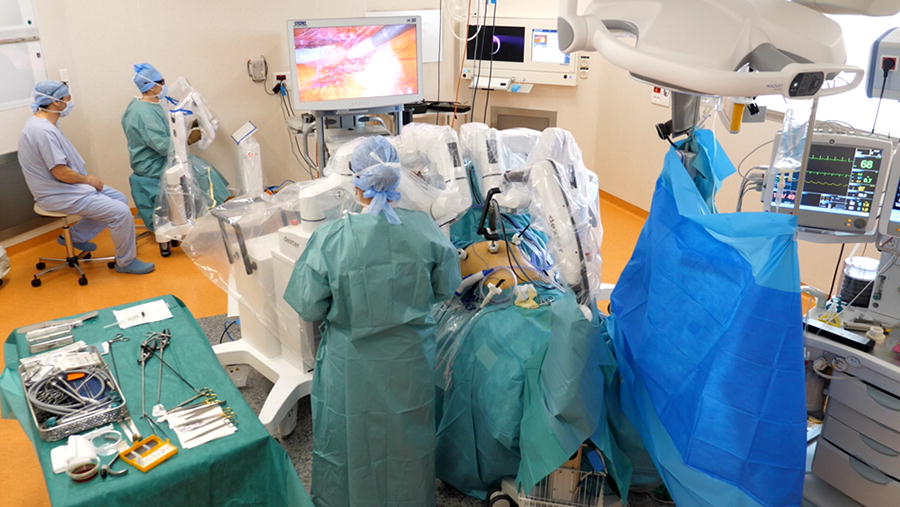
Dexter system setup in our OR. From the sterile surgeon console (background upper left quadrant of the photo), the surgeon is controlling the two robotic arms. OR = operating room.
Patients were positioned in the supine position with a 15°–20° Trendelenburg angulation. A 10-mm endoscopic port was placed in the midline above the umbilicus, and two 10-mm robotic ports were placed under visualization on a transverse line. The endoscope port and the two robotic instrument ports were placed at least 8 cm apart, with a minimum distance of 12 cm between the two instrument ports. A 5-mm laparoscopic trocar for the assistant was placed in the left hemiabdomen. 16 RARP was performed using a standard transperitoneal anterior approach 18 including bladder detachment, endopelvic fascia opening, dissection of the bladder neck, vas deferens and seminal vesicles, Denonvilliers’ fascial release, bilateral nerve sparing, dorsal venous complex transection, apical dissection, and ureterovesical anastomosis. The robotic instruments used for the procedure were the bipolar Maryland, monopolar scissors, and needle holders.
The operative time, defined as the time between the first skin incision and the last skin suture, was routinely collected. After discharge, the patients were followed up at 6 weeks and 3 months postoperatively to measure their PSA levels. Urinary continence was assessed through patient interviews and defined as 100% if no pads or occasional security pads were used. Postoperative potency was defined as the ability to achieve and maintain a satisfactory erection, either spontaneously or with the assistance of a phosphodiesterase type 5 inhibitor, alprostadil topical cream, or injection, in contrast to a complete absence of erectile function.
For descriptive statistics, the median and interquartile range (IQR) were used to present continuous data, whereas categorical variables were reported as numbers and percentages.
Results
During our first year of practice, we performed RARP on 50 patients. Three patients with very high-risk prostate cancer (PSA >40 ng/mL) were excluded from the analyses because they underwent a multimodal treatment approach. Table 1 describes the patients’ characteristics. Patients had a median age of 67 years (IQR: 62–70) and a median body mass index of 26.4 kg/m2 (IQR: 24.2–30.4). Most patients (51%) were categorized as intermediate risk using the D’Amico classification, whereas 34% were low risk and 15% were high risk. The median preoperative PSA level was 8.2 ng/mL (IQR: 6.0–11.3). Eight patients (17%) had International Society of Urological Pathology grade group ≥3 tumors on prostate biopsy. On preoperative MRI, four patients (8.5%) had suspicion of extraprostatic disease.
Baseline Characteristics of 47 Patients Treated with RARP with the Dexter System
ASA = American Society of Anesthesiologists; BMI = body mass index; ISUP = International Society of Urological Pathology; IQR = interquartile range; PSA = prostate-specific antigen; RARP = robot-assisted radical prostatectomy.
All procedures were completed successfully without any intraoperative device-related complication nor conversion to open surgery. Overall perioperative performance data are reported in Table 2, the median operative time was 198 minutes (IQR: 163–233), and 19 patients (40.4%) underwent ePLND. The median fluid loss was 310 mL (IQR: 190–600). The Dexter system functioned as expected without any device malfunctions. The median length of stay was 2 days (IQR: 2–3), and 28 (60%) patients were discharged on the postoperative day 1. The urethral catheter was removed between postoperative days 7 to 10 depending on the surgeons’ preference. Six different surgeons performed the prostatectomies in this study. Each operating surgeon performed a variable number of cases, and individual median operative time is reported in Table 3.
Intra- and Perioperative Characteristics
ISUP = International Society of Urological Pathology.
Intraoperative Performance per Surgeon
ePLND = extended pelvic lymph node dissection; S1 = surgeon no 1.
Postoperatively, 15 patients (32%) had capsular invasion or seminal vesicle involvement (
Estimated functional urinary recovery at 6 weeks showed that 77% of the patient had already fully recovered urinary continence and 94% had recovered by 3 months. The 3-month patient interview revealed that 52% had regained their sexual function either spontaneously or with chemical stimulation.
Discussion
The Dexter system is a compact and modular platform that allows easy storage and rapid installation in our relatively small OR. It allows the surgeon to remain sterile while operating at the draped console, enabling them to intervene at the patient’s bedside if necessary. The robot facilitates a rapid transition to laparoscopic operating mode, providing an inherent safety advantage for the patient in cases where an urgent conversion to laparoscopy is required. Furthermore, this unique feature allows surgeons to leverage the flexibility and speed of laparoscopy for surgical steps that do not require the added precision of a robotic platform. Our senior surgeons, who were highly skilled in laparoscopy and unfamiliar with robotic surgery before the implementation of Dexter, were able to adopt the system easily for delicate dissection and suturing steps of the procedure, gradually transitioning to performing surgeries entirely robotically. Since our initial experience with the Dexter robot in RARP previously published, 16 various urologic procedures have been successfully carried out in our center. 19 –21
In this retrospective study, we report on the safety of performing RARP with the Dexter robotic system, including oncological and functional outcomes at 3 months postoperatively, achieved by all the surgeons in the team during Dexter’s first year of implementation. Since the first 10 cases, 16 we have observed a notable reduction in procedure times with more surgeons adopting the system. In particular, the median operating time decreased from 230 minutes for the first 10 cases 16 to 198 minutes for the first 47 cases performed by six different lead surgeons. The improvement in performance is also reflected in the reduction of the overall median fluid loss from 655 mL for the first 10 cases to 310 mL for the first 47 cases. These improvements reflect the experience acquired during the first year of implementing the robotic program in our hospital. However, these results are limited by the relatively low number of cases per surgeon, which prevents us from fully assessing the learning curve and determining the number of cases required to reach optimal performance with Dexter in terms of operative times. Nevertheless, the observed operative times were comparable with those reported in the literature for surgeons at the beginning of their learning curve with a robotic system or transitioning to a different robotic system. 22,23
It has been suggested that a volume–outcome relationship may exist among high-volume surgeons. 24 Although it may seem reasonable to refer patients to high-volume centers, it may not be entirely practical in certain regions. Our hospital, a community facility, acquired the Dexter robot to provide improved care for urology oncology patients. In its first year of use, the Dexter robot was utilized for nearly all prostatectomies, with all members of the surgical team receiving training. The open surgeon console facilitated better interaction between team members and lead operators during each procedure, which was a great help in the training process.
We observed a relatively high rate of ≥T3 cancer (32%) and a notable proportion of patients with more aggressive ISUPs than expected (47%). However, these findings did not appear to impact postoperative PSA levels or medium-term follow-up outcomes. These high rates may indicate a tendency to underestimate cancer severity, as previously discussed, 12 which highlight the importance be cautious in nerve preservation and lymph node dissection indications. The primary area for improvement is the need to exercise caution when interpreting MRI findings. Further data are required to draw definitive conclusions. Meanwhile, a systematic review of MRIs by a dedicated specialized radiologist is advisable.
RARP has been associated with an increased adoption of same-day discharge surgery, even though the overall number of annual cases remains low in France. 8 In our study, the number of patients discharged within 1 day of the surgery is encouraging and promising of cost-efficient implementation of a robotic surgery program. In our cohort, 77% of the patients had already recovered continence at 6 weeks and up to 94% had recovered by 3 months. This indicates that the surgical performance of the Dexter system delivers quality functional outcomes for patients. A recent meta-analysis comparing RARP to conventional LRP demonstrated moderate to high certainty evidence that RARP provides better continence at 3 and 6 months postoperatively. 25 This improvement may be attributed to superior dissection and preservation of neurovascular bundle during RARP. Although most men recover continence at 12 months postop (defined as no use of pads), early urinary continence rates previously reported in the literature vary, with up to 70% to 80% of men requiring pads at 6 weeks and 20% to 40% at 6 months after RARP. 26 In a recent report from Alfano et al, 27 only 61% of the patients were continent at the first follow-up, 4 weeks after surgery with a new multiport robotic system.
The main limitation of our study was that the number of surgeries per operating surgeon is relatively small. It is reasonable to accept that all surgeons were still in their learning phase of Dexter and do not allow to identify the number of cases when a surgeon may reach skills performance.
Conclusion
We presented the first case series of 47 consecutive RARP procedures performed using the Dexter system during our first year of practice. Surgeons with no prior robotic experience quickly adapted to the system, as it allowed for seamless integration with existing setups and laparoscopic trocars positioning. We successfully evaluated perioperative, early oncological, and functional outcomes in a representative cohort of patients who underwent RARP using the Dexter system, operated by various surgeons in a robotic naive center. Therefore, we are confident that our study provides valuable insights into the clinical outcomes after the introduction of the Dexter robotic system in surgical centers. These initial results require confirmation in larger cohorts with longer follow-up periods, and oncological and functional outcomes should be further investigated.
Footnotes
Authors’ Contributions
H.R. and T.F. collected the data. G.H., A.F., N.A.B., D.E., and H.M. revised the article. D.T. had full access to all the data in the study, performed the analyses, and takes full responsibility for the integrity and accuracy of the data.
Disclaimer
Dexter Robotic System™, Dexter System™, and Dexter™ are registered trademarks of Distalmotion in the United States and European Union as well as certain other jurisdictions.
Author Disclosure Statement
D.T. certifies that all conflicts of interest, including specific financial interests and relationship and affiliations relevant to the subject matter or materials discussed in the article, are as follows: D.T., G.H., and D.E. are consultants at Distalmotion. All other authors have no conflict of interest to disclose.
Funding Information
This study was not funded.