




Abstract
The objective of this study was to characterize antimicrobial resistance in Enterococcus spp. recovered from a commercial beef processing plant. Samples were obtained from conveyers used for moving carcasses before the start of operation (CC), 2 h after operation has started (DC), and from ground beef (GB). Randomly selected isolates from each positive sample (13 from CC; 28 from DC; 26 from GB) were confirmed to genus and species levels using PCR and the API 20 Strep kit (BioMérieux Canada, Inc., St. Laurent, Canada). A total of 199 isolates comprising 39, 84, and 76 from CC, DC, and GB, respectively, were used for antimicrobial resistance testing, major resistance genes detection, and genetic analysis. Enterococcus faecalis (87%) was the most common species found followed by Enterococcus faecium (10%). The majority of enterococci were highly associated with DC samples. About 42% of E. faecium from DC samples were resistant to quinupristin–dalfopristin. Resistance to lincomycin was observed in >90% of E. faecalis from all the three sample sources. The tetracycline-resistant enterococci (52%) were significantly higher in DC samples. Intermediate resistance to erythromycin was significantly higher in enterococci from CC and DC samples. The tetracycline and quinupristin–dalfopristin resistance in enterococci was highly correlated with the presence of tet(M) and vat(E) genes. The erm(B) gene was found in about 50% of the E. faecium isolates from GB samples and was also present in >12% of the E. faecalis isolates from all the three sample sources. Enterococci from individual sample sources were genetically similar. A number of E. faecalis from CC, DC, and GB were clustered together at >85% similarity level. These findings suggest that antimicrobial-resistant Enterococcus spp. are prevalent during commercial beef processing and can transfer between various locations in the plant and that a pool of resistance genes can be found in these enterococci.
Introduction
It is generally assumed that carcasses entering the processing area are clean, but studies have shown that carcass-breaking equipment can recontaminate the meat (Gill and McGinnis, 2000; Gill et al., 2001). Therefore, it is important to analyze bacteria isolated from samples taken from postintervention stages of meat processing. Various factors such as low temperature, human-derived bacteria, use of disinfectants, and improperly cleaned processing equipment may affect the nature of bacterial populations.
Enterococci were chosen to monitor the AMR during commercial beef processing because of their abundance and their ability to survive environmental stresses (Rince, 2000). More importantly, enterococci are the leading causes of nosocomial infections (Kayser, 2003), have the ability to transfer resistance genes via genetic mobile elements, and are known to be intrinsically resistant to several antibiotics (Kak and Chow, 2002; Courvalin, 2006).
Information about the prevalence of AMR genes in enterococci would enhance our understanding about dynamics of AMR in general and in the commercial meat processing environment in particular. Previously we have reported that antimicrobial-resistant Escherichia coli were prevalent at various stages of commercial beef processing (Aslam and Service, 2006). Therefore, the objective of this study was to determine the prevalence of AMR and major AMR genes in Enterococcus spp. recovered from a commercial beef processing plant and characterize those isolates to assess their relatedness.
Materials and Methods
Sampling
Swab samples were obtained from conveyers used for moving carcasses before the start of operation (CC, 52 samples), 2 h after operation has started (DC, 52 samples), and from ground beef (GB, 40 samples). Conveyer samples were collected randomly during multiple visits to a beef processing plant from multiple conveyers. These sampling procedures have been established previously and are considered valid for evaluating the hygienic condition of equipments used for processing (Gill et al., 2001). Samples were transported to the laboratory on ice and processed within 4 h after collection. The sample collection and processing procedures have been described previously (Aslam and Service, 2006).
Isolation and confirmation of Enterococcus spp.
Enterococci were isolated on KF Streptococcus agar after incubation at 35°C for 48 h. Up to three presumptive colonies (39, 84, and 76 from CC, DC, and GB, respectively) from each positive sample (13 from CC; 28 from DC; 26 from GB) were randomly selected. Phenotypic confirmation of enterococci was made by testing growth in nutrient broth containing 6.5% NaCl, at pH 9.0 with incubation at 35°C for 72 h. The catalase test, gram staining, and production of a black complex in Bile Esculin agar (35°C for 24 h) were also performed. Enterococci were identified to genus level in a PCR using primer set targeting tuf gene as described previously (Jackson et al., 2004). Enterococcus species were screened using API 20 Strep kit and in a PCR with primer sets targeting genes for Enterococcus faecalis, and Enterococcus faecium as described previously (Johnston and Jaykus, 2004). During each PCR assay appropriate positive and negative controls were used.
Antimicrobial susceptibility testing
Antimicrobial susceptibility of isolates was determined by microdilution broth method with the Sensititre automated system (Trek Diagnostics, Westlake, OH) using Gram-positive NARMS custom plates. E. faecalis strains ATCC 29212 and ATCC 51299 were used as quality control organisms. The results were interpreted according to the Clinical Laboratory Standard Institute guidelines (CLSI, 2004). When no Clinical Laboratory Standards Institute interpretive criteria were available, NARMS guidelines were followed.
PCR detection of AMR genes
The presence of genes conferring resistance to tetracycline [tet(M), tet(K)], and to macrolides, lincosamines, and streptogramins [erm(A), erm(B), erm(C), vatD, vatE, and sat4] was screened by PCR using specific primers, reaction, and amplification conditions described previously (Soltani et al., 2000; Werner et al., 2003; Rizzotti et al., 2005).
RAPD analysis of enterococci
Random amplification of polymorphic DNA (RAPD) analysis of enterococci was performed using bacterial cells as a template with primer D8635 (5′ GAGCGGCCAAAGGGAGCAGAC 3′) according to the amplification conditions described previously (Andrighetto et al., 2001; Aslam and Service, 2006). Sterile water and DNA from E. faecalis ATCC 29212 and E. faecium ATCC 35667 strains were used as negative and positive controls, respectively, during each RAPD analysis. Amplified DNA fragments were separated on agarose gel and stained with ethidium bromide. A 100-bp DNA ladder (Invitrogen Canada Inc., Burlington, Canada) was included on the gel as a size marker.
Data analysis
All data were entered into Excel Spreadsheet (Microsoft, Bellevue, WA) that was used to create tables and estimates of prevalence of AMR and resistance genes among various sample sources. The association test of Cochran–Mantel–Haenszel and Fisher exact test was used to determine the AMR relationship between sample sources using the FREQ procedures of the Statistical Analysis System (2000). The statistical significance was set at a p-value of ≤0.05.
DNA patterns obtained using RAPD method were analyzed with BioNumerics software version 5.10 (Applied Maths, Ghent, Belgium). Similarities between the DNA patterns based on Pearson's correlation were determined, and a dendrogram was constructed using the unweighted pair-group method using arithmetic averages (UPGMA) to reflect similarities in the matrix. Isolates were grouped into RAPD types that were considered genetically similar (≥85% similarity) based on the DNA patterns.
Results
Enterococci recovery rate was 25%, 48%, and 65% from CC, DC, and GB samples, respectively. Among the 199 isolates, E. faecalis (87.03%) was the most common spp. found collectively from all the three sample sources followed by E. faecium (10.6%) and other (3.06%) species (Fig. 1). More than 83% of the enterococci from each of CC, DC, and GB samples were E. faecalis and E. faecium and accounts for 7.7%, 14.3%, and 7.9% in CC, DC, and GB samples, respectively.
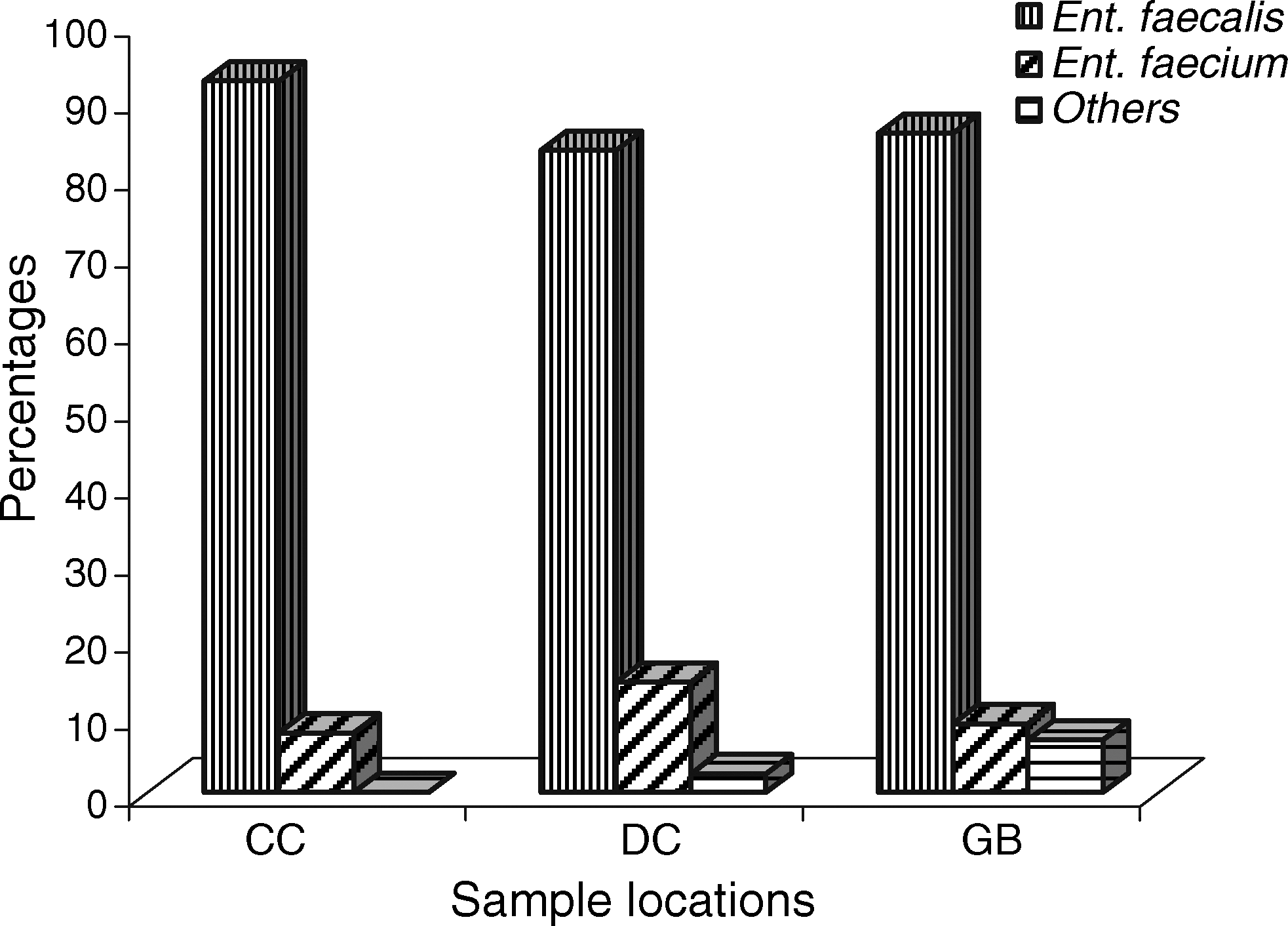
Prevalence of Enterococcus spp. among various sample sources obtained from a commercial beef processing plant. Conveyer samples before (CC) and after (DC) start of the operation, and ground beef (GB).
The results of the antimicrobial susceptibility testing are presented in Table 1. The most common resistance was against quinupristin–dalfopristin, lincomycin, and tetracycline. Intermediate resistance to ciprofloxacin, a category I antimicrobial, and to erythromycin, a category II antimicrobial, was also found. Vancomycin resistance was not found in any isolate.
Percentages were calculated by dividing resistant isolates with total isolate from individual sample and rounded to the nearest full number.
Categories of antimicrobials for their importance in human medicine.
Significantly different and associated with sample source.
Significantly different among sample sources.
CC, conveyer samples before start of the operation; DC, conveyer samples after start of the operation; GB, ground beef; CHL, chloramphenicol; CIP, ciprofloxacin; DAP, daptomycin; ERY, erythromycin; FLV, flavomycin; KAN, kanamycin; LIN, lincomycin; LZD, linezolid; NIT, nitrofurantoin; PEN, penicillin; SYN, quinupristin–dalfopristin; TET, tetracycline; TGC, tigecycline; TYLT, tylosin; VAN, vancomycin.
Enterococci resistant to lincomycin, a category II antimicrobial, were evenly distributed among all the three sample sources, and no significant association to a particular sample source was found. However, enterococci resistant to quinupristin–dalfopristin, a category I antimicrobial, were more commonly found in CC and DC sample sources (p < 0.05). Resistance to this antibiotic was significantly higher in E. faecium isolates from DC samples, and none of the E. faecium from CC and GB shows this resistance. Intermediate resistance to erythromycin was common in enterococci from CC and DC samples. Tetracycline-resistant enterococci were significantly different among the three sample sources and were highly associated with DC samples (p < 0.05).
The majority of E. faecalis and E. faecium isolates from all the three sample sources were multiple (two to three antimicrobials), antimicrobial resistant (Table 2). One E. faecalis isolate from DC sample was multiple, antimicrobial resistant with DAP-ERY-LIN-PEN-SYN-TET-TYLT phenotype. The majority of E. faecium isolates from DC (75%) and GB (100%) samples were resistant to lincomycin and were significantly associated with these sample sources (p < 0.05).
Percentages were calculated by dividing resistant isolates with total a number of isolates for individual species and rounded to the nearest full number. Superscript roman numerals represent categories of antimicrobials for their importance in human medicine.
Presence of resistant genes significantly correlated with resistant phenotypes.
Significantly different and associated with sample source.
Significantly different among sample sources.
R, complete resistance; I, intermediate resistance.
Complete resistance to ciprofloxacin was found in about 5% and 15% of E. faecalis from CC and GB samples, respectively, and in 33% and 25% of the E. faecium isolates from CC and DC samples, respectively. Intermediate, resistant ciprofloxacin E. faecium isolates were significantly associated with CC and DC samples (p < 0.05). Complete resistance to erythromycin was found in about 9% of the E. faecium isolates from DC samples only. Tetracycline resistance in E. faecalis isolates was significantly different among sample sources, and this resistance was associated with isolates from DC samples (p < 0.05). E. faecium isolates from GB samples showed significantly higher resistance to tetracycline. However, overall enterococci from GB samples showed lower resistance.
None of the isolates was positive for vat(D) and sat4 genes (data not shown). The majority of enterococci resistant to quinupristin–dalfopristin were positive for the vat(E) gene (Table 2). About 33% of the E. faecium isolates from DC samples carried this gene, and none of the E. faecium isolates from CC and GB carried this gene. All the isolates positive for tet(M) genes were tetracycline resistant (Table 2). Only one tetracycline-susceptible E. faecalis isolate from DC sample carried the tet(K) gene. The erm(B) gene was found in E. faecalis isolates from all the three sample sources and in E. faecium isolates from DC (16% isolates) and GB (50% isolates) samples. Few of the vat(E) and erm(B) genes were present in quinupristin–dalfopristin and erythromycin susceptible isolates, respectively. The erm(A) and erm(C) genes were not found in any of the tested isolates.
A total of 34 AMR pheno- and genotypic patterns were observed in enterococci from all the three sample sources (data not shown). Nine patterns were shared among all the sample sources, and the most common pattern was lincomycin–quinupristin–dalfopristin–tetracycline–tet(M). A pattern designated as susceptible was found in 19% of E. faecium and 28.6% of other Enterococcus spp. The other Enterococcus spp. showed a diverse array of AMR pheno- and genotype patterns that include ciprofloxacin resistance (14.3%), tetracycline resistance (14.3%), lincomycin -susceptible (14.3%), and harboring erm(B)-tet(M) (14.3%) and vat(E) (14.3%) genes. These patterns were unique to other species, except for ciprofloxacin resistance (4.8%) pattern that was also found in E. faecium.
The RAPD analysis of Enterococcus spp. showed that 49 E. faecalis isolates from all the three sample sources were clustered at 85% similarity level with ≤2 bands difference (Fig. 2). This cluster included about 49% (19/39), 17% (14/84), and 21% (16/76) of E. faecalis from CC, DC, and GB samples, respectively. E. faecium and other Enterococcus spp. were clustered into species-specific groups. The majority of enterococci obtained from individual samples were genetically similar, and a highly diverse enterococci population was from DC samples, whereas a fewer RAPD types were found in CC samples.
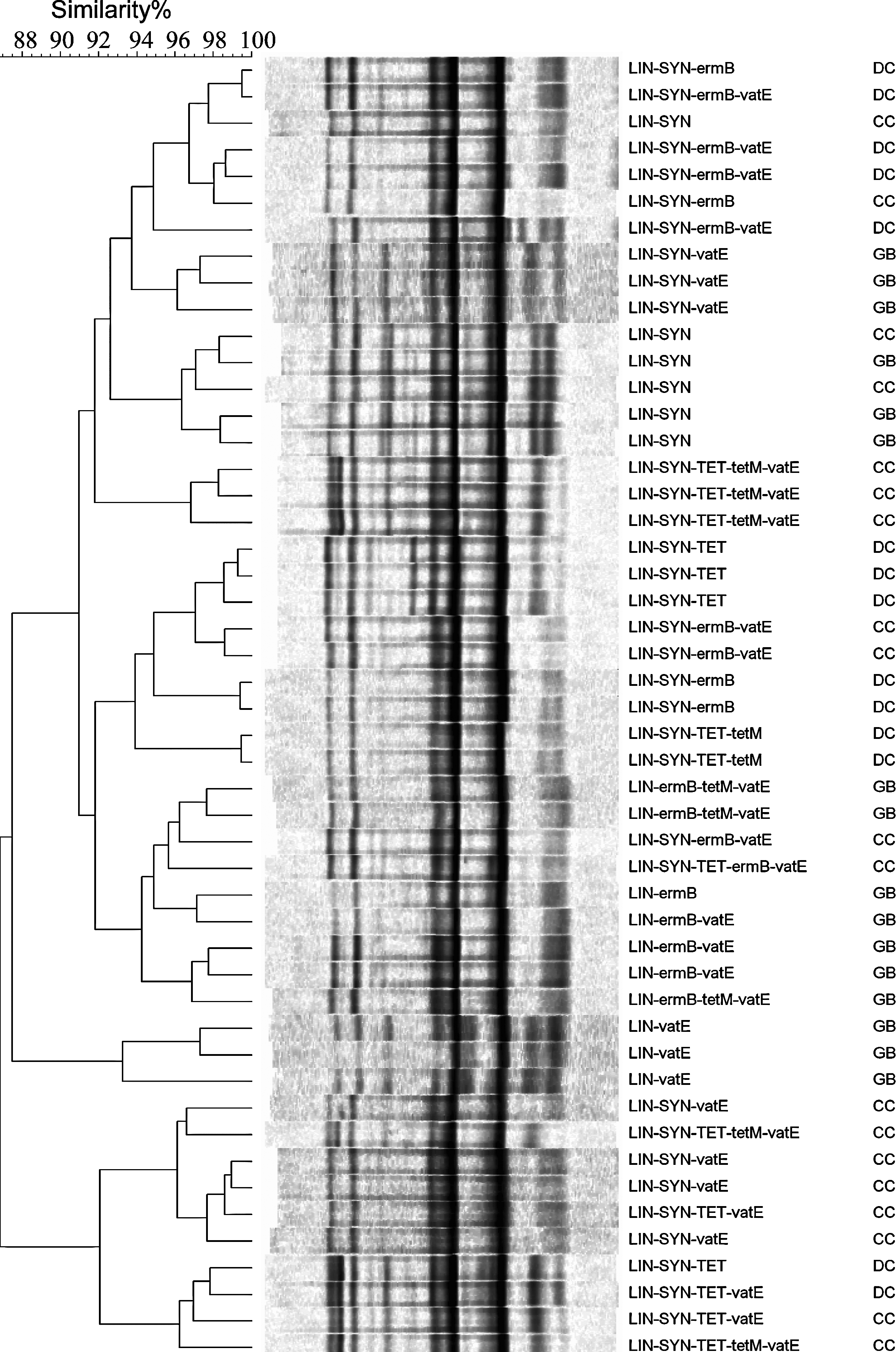
Dendrogram showing related RAPD types of antimicrobial resistant Enterococcus faecalis isolated from conveyer samples taken before (CC) and after start of the operation (DC), and ground beef (GB).
Discussion
A number of previous studies have documented the prevalence of AMR in enterococci from animals and various types of meats (Hayes et al., 2003; Hershberger et al., 2005). This is the first of its kind report characterizing AMR in enterococci from a beef processing plant. A previous study of similar scope reported the prevalence of AMR and genetic determinants of AMR in enterococci from pork production chain (Rizzotti et al., 2005). Information regarding the characterization of AMR in Enterococcus spp. from meat processing plants will have implications for meat safety.
Carcasses entering the processing are generally clean (Barkocy-Gallagher et al., 2003), but meat processing equipments, particularly conveyers used for transporting carcasses, can contaminate the meat and its products (Gill et al., 2001). In this study, the major focus was to recover enterococci from clean conveyers and from the conveyors after the meat processing operation has started. The samples were also collected from the GB because this product was shipped to the retail market for consumer consumption.
The enterococci recovery rate was higher from DC samples, and E. faecalis was the most common species found among all the three sample sources. E. faecalis causes endocarditis and is intrinsically resistant to lincomycin and quinupristin–dalfopristin. A small number of enterococci from all three sample locations were E. faecium. This species is important from human health point of view because it has been involved in nosocomial infections (NNIS System, 2003). E. faecalis and E. faecium were the only two species found in CC samples. Since the conveyers were cleaned before the start of operation, it is expected that these common Enterococcus spp. might have survived hygienic and sanitation procedures.
The data showed that a higher proportion of enterococci from DC samples were resistant to various antimicrobials. Significant association of antimicrobial-resistant Enterococcus spp. to the DC samples suggest that conveyers can be contaminated with enterococci originating from incoming carcasses. Human-derived E. faecium might have also contributed to the antimicrobial-resistant population on conveyers. These resistant enterococci can become a resident population and serve as a continuous source of meat contamination along with the antimicrobial-resistant bacteria. Enterococcus spp. were also recovered from samples obtained from clean conveyers before the start of operation. This suggests that the bacterial population harbored by the conveyers are not easily destroyed by the disinfectants or hygienic procedures applied in the meat processing plants.
As resistance to streptogramin and lincosamines was the most prevalent among the isolates, we focused on the vat(D and E) gene (formerly called satA and G) known to encode resistance to streptogramin A in enterococci and the erm(B) gene encoding resistance to streptogramin B together with lincosamines and macrolide (López et al., 2008). These genes are mostly found in clinical, resistant isolates in hospitals representing important public health concerns. Quinupristin–dalfopristin is a streptogramin approved for treatment of infections caused by E. faecium or staphylococcus aureus. Resistance to quinupristin–dalfopristin was not found in E. faecium isolates from CC and GB sample sources, whereas E. faecium isolates from DC samples were resistant to this antimicrobial. Only 2 (16%) of the E. faecium isolates from DC samples that were resistant to quinupristin–dalfopristin also carried the vat(E) gene, suggesting other mechanisms of quinupristin–dalfopristin resistance might have been involved (Donabedian et al., 2006). It has been suggested that E. faecium resistant to quinupristin–dalfopristin may not contain any of these resistance mechanism (Hershberger et al., 2004). Nevertheless, spread of enterococci harboring these genetic elements may limit effectiveness of quinupristin–dalfopristin therapy in humans.
Vancomycin-resistant enterococci (VRE) are considered important public health problems, and the VRE harboring van(A, B) genes have been recovered from meat and meat processing plants (Rizzotti et al., 2005; Messi et al., 2006). In this study, VRE were not recovered from any of the samples; however, human-derived strains may contribute to VRE contamination in meat processing plant.
The majority of tetracycline enterococci were positive for tet(M) genes, and tetracycline resistance was highly correlated with the presence of this gene. This is the most common tetracycline resistance determinant located chromosomally and carried by Tn916-Tn1545 conjugative transposons or plasmids (Kak and Chow, 2002; Huys et al., 2004). In addition, the tetracycline-resistant enterococci isolates harboring tet(M) in association with erm(B) gene has been reported (Cauwerts et al., 2007). The possible existence of a combination of such resistance genes and the nonexpression of resistance genes in certain conditions might explain the difference of correlation between observed resistance phenotype and the detection of genes in the samples.
In this study, enterococci were genetically characterized by a RAPD method. Data showed that enterococci from individual samples were genetically similar; however, a number of RAPD types were shared among samples and sample sources. A major cluster comprising E. faecalis isolates from all the three sample sources suggests that genetically similar enterococci can transfer between various locations in the meat processing plants. This finding is also supported by the presence of the AMR pattern lincomycin–quinupristin–dalfopristin–tetracycline–tet(M) in all the three sample sources. Previously, a study has also suggested similar modes of bacterial contamination during commercial beef processing (Aslam et al., 2004). However, the presence of many unique RAPD types in individual sample sources suggests introduction of strains from other sources as well.
In conclusion, significant antimicrobial-resistant enterococci were present in conveyers used for moving carcasses in a commercial beef processing plant. Intermediate resistance was found for ciprofloxacin and erythromycin, categories I and II antimicrobials, respectively, for their importance in human medicine. E. faecium isolates from DC samples were resistant to quinupristin–dalfopristin with the vat(E) genes. The tetracycline resistance was mostly because of the presence of the tet(M) gene. The erm(B) gene highly correlated with intermediate resistance to erythromycin, and ermA and ermC genes were not found in any Enterococcus spp. from CC, DC, and GB samples. A number of genetically similar E. faecalis RAPD types were shared between various sample sources, suggesting their common source.
Footnotes
Acknowledgments
We thank Loree Verquin for clerical support and the commercial beef processor for access to their facilities.
Disclosure Statement
No competing financial interests exist.