




Abstract
In this study, the isolation and antimicrobial resistance of Campylobacter jejuni and Campylobacter coli strains from chickens and humans in Bahir Dar, Ethiopia, were analyzed. Two hundred and ten human and 220 chicken samples were analyzed between October 2007 and April 2008. Seventeen human and 160 chicken Campylobacter species were isolated. The overall prevalence of thermophilic campylobacters was 8% and 72.7% in humans and chickens, respectively. In humans, 94.1% of the isolates were C. jejuni and 5.9% were C. coli. C. jejuni was a predominant species of thermophilic campylobacters in all categories of patients. In chicken, 92.5% of thermophilic campylobacters isolated were C. jejuni and 7.5% were C. coli. Among the 16 isolates of C. jejuni in humans, 18.8%, 12.5%, 12.5%, 18.8%, 25%, and 22.2% were resistant to ampicillin, ciprofloxacin, erythromycin, nalidixic acid, streptomycin, and tetracycline, respectively, whereas among the 148 C. jejuni isolates from chicken, 17.5%, 14.9%, 12.2%, and 13.5% were resistant to ampicillin, erythromycin, streptomycin, and tetracycline, respectively. Among the 12 isolates of C. coli in chicken, 16.6%, 8.3%, and 16.6% were resistant to ampicillin, streptomycin, and tetracycline, respectively. The overall level of resistance was not significantly different in C. jejuni and C. coli isolates of both humans and poultry. The detection of resistant isolates for commonly used antimicrobials may cause a threat to humans and chickens by limiting therapeutic options.
Introduction
In Ethiopia, there are few reports on the prevalence and antimicrobial susceptibility of campylobacters isolated from humans (Asrat et al., 1999; Beyene and Haile-Amlak, 2004) and only one study from food animals (Kassa et al., 2007). Therefore, the aim of this study was to collect data for strains of Campylobacter spp. isolated from poultry and humans in Northwest Ethiopia and to analyze the resistance pattern of the isolates for the common antimicrobial drugs.
Materials and Methods
Study area
This study was conducted in Northwest Ethiopia, Bahir Dar municipality, 580 km away from Addis Abba.
Specimen collection, isolation, and identification of strains
Human stool sample was collected from 164 patients who attended Felege Hiwot Hospital during sampling days and presented enteric signs that included at least diarrhea, stomach cramps, nausea, vomiting, and fever. Age, sex, and place of residence for patients submitting samples were recorded. Patients below 18 years of age were recorded as young and 18 years and above as adult. During a 7-month period between October 2007 and April 2008, a total of 220 cloacal samples were taken from chicken in Bahir Dar town. Moistened, sterile, cotton wool swabs were used to collect the cloaca contents from chickens. Stool and swabs with samples were immediately placed in sterile universal bottles containing 10 mL of freshly prepared Cary Blair broth. Universal bottles with samples were immediately placed in a cool box and transported under ice to the laboratory. Each universal bottle with a cloacal swab was opened aseptically and the cloacal swabs were streaked onto modified charcoal cefoperazone deoxycholate agar for primary isolation of thermophilic campylobacters. The cultures were incubated in microaerophilic atmosphere, which was achieved in anaerobic jars (Oxoid, Basingstoke, UK) without catalyst using CampyGen1gas generating kits (Oxoid) at 42°C for 24 h. Thermophilic campylobacters were identified by their characteristic appearance on culture media, Gram staining reaction, and biochemical pattern for oxidase, catalase, hippurate hydrolysis, and H2S production tests. The study was ethically approved by the regional health bureau.
Susceptibility testing
The disk diffusion method was performed as recommended by the National Committee for Clinical Laboratory Standards (NCCLS, 2000). The following antibiotic-impregnated discs (bioMérieux, Marcy-l'Etoile, France) were used: ampicillin (10 μg), ciprofloxacin (5 μg), erythromycin (15 μg), nalidixic acid (30 μg), streptomycin (10 μg), and tetracycline (30 μg). Briefly, well-isolated colonies of the same morphological type were selected from an agar plate culture and transferred into trypticase soy broth (Becton Dickinson, Sparks, MD). After incubation at 42°C for 24 h under microaerobic conditions, a sterile cotton swab was dipped into the suspension and streaked on the entire surface of a Mueller–Hinton agar (Oxoid) with 5% sheep blood. The inoculum was allowed to dry for 5 min. Antibiotic discs were placed on the plate and after 48 h of microaerobic incubation at 42°C, the diameter of the inhibition zone was measured with calipers. Escherichia coli ATCC 25922 and Staphylococcus aureus ATCC 25923 were used as reference strains. The isolates were classified as sensitive, intermediate, and resistant according to the guidelines prepared by Clinical Laboratory Standards Institute (NCCLS, 2000).
Statistical analysis
Data were analyzed using Epi Info version 6 statistical software. Comparisons were made using chi-square test. A p-value of <0.05 was considered as statistically significant difference.
Results
The overall prevalence of thermophilic campylobacters was 8% and 72.7% in humans and chickens, respectively. In humans, 94.1% of the isolates were Campylobacter jejuni and 5.9% were Campylobacter coli. C. jejuni was a predominant species of thermophilic campylobacters in all categories of patients. In chicken, 92.5% of thermophilic campylobacters isolated were C. jejuni and 7.5% were C. coli. In humans, a significant (p < 0.05) infection rate was found in young (12%) than in adults (4%). In chickens, the colonization rate of thermophilic campylobacters increased with age (Fig. 1).
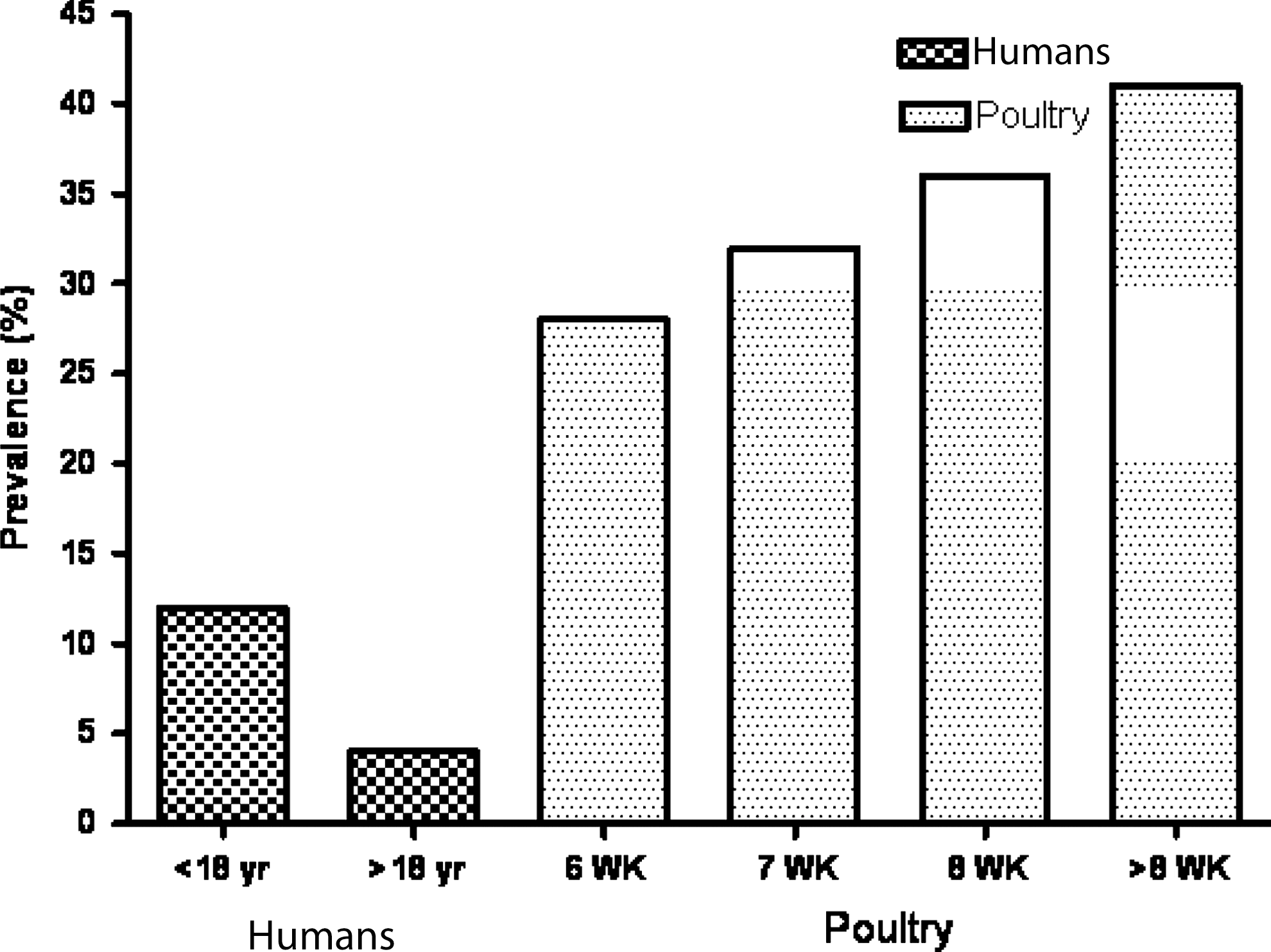
Prevalence of thermophilic campylobacters in different age groups of humans and poultry. The prevalence of thermophilic campylobacters was significantly higher in young individuals than in adults, whereas isolation rate of Campylobacter spp. in chicken was found to increase with age.
The results of antimicrobial susceptibility testing for C. jejuni and C. coli isolated from humans and chickens for six chosen antimicrobial agents are presented in Table 1. All isolates from human were resistant to all tested antimicrobials and all isolates from chickens were sensitive to ciprofloxacin and nalidixic acid (C. jejuni) and also erythromycin (C. coli). The level of resistance to any antibiotic examined in this study never exceeded 25% for either C. jejuni or C. coli both in humans and chickens. Among the 16 isolates of C. jejuni in humans, 18.8%, 12.5%, 12.5%, 18.8%, 25%, and 22.2% were resistant to ampicillin, ciprofloxacin, erythromycin, nalidixic acid, streptomycin, and tetracycline, respectively, whereas among the 148 C. jejuni isolates from chickens, 17.5%, 14.9%, 12.2%, and 13.5% were resistant to ampicillin, erythromycin, streptomycin, and tetracycline, respectively. Among the 12 isolates of C. coli in chickens, 16.6%, 8.3%, and 16.6% were resistant to ampicillin, streptomycin, and tetracycline, respectively. The overall level of resistance was not significantly different in C. jejuni and C. coli of both human and animal isolates. Two (12.5%) and eight (5.4%) of the C. jejuni isolates in humans and chickens, respectively, were resistant to two or more antimicrobial agents. The overall level of resistance was not statistically different (p > 0.05) in C. jejuni and C. coli isolates of both humans and poultry.
S, sensitive; I, intermediate; R, resistant.
Cef, ciprofloxacin; AM, ampicillin; E, erythromycin; NA, nalidixic acid; S, streptomycin; Te, tetracycline.
Discussion
This study has demonstrated a high prevalence of thermophilic campylobacters in humans and chickens in the study area. Such a high isolation rate of thermophilic campylobacters in humans and chickens has also been reported in other studies (Asrat et al., 1999; Magistrado et al., 2001; Sandberg et al., 2002; Ringoir and Korolik, 2003; Saleha, 2004; Kassa et al., 2007). The predominant Campylobacter species in humans and chickens was C. jejuni, which is the main etiology of Campylobacter enteritis in man. This indicates that Campylobacter infection may be one of the major causes of enteritis in man in Ethiopia. These findings are in agreement with the report by other researchers in different areas who observed a significant higher infection rate of C. jejuni than C. coli in human samples (Altekruse et al., 1999; Asrat et al., 1999; Coker et al., 2002). Findings from this study, which are similar to findings in previous studies, suggest that C. coli is not a common pathogen of campylobacteriosis in the two species studied. The significant high isolation rate of C. jejuni from chickens observed in this study signifies the role of chickens as carriers for the infection to man.
The established high prevalence of thermophilic campylobacters (8%) in humans in Bahi Dar is significant, especially in this era of HIV/AIDS. Elsewhere the incidence of campylobacteriosis in the general population has been reported to be 39 times less than the infection rate in patients with HIV/AIDS (Altekruse et al., 1999). Because the study area is reporting the highest number of HIV/AIDS in Ethiopia (data from Ethiopia AIDS Resource Center), it is likely that Campylobacter cases in the area will increase, unless serious control and preventive measures are taken. It is thus very important that thermophilic campylobacters be considered in a different perspective because of its close association with HIV/AIDS, which is a new pandemic and of economic significance in developing countries.
In this study, the prevalence of thermophilic campylobacters was significantly higher in young individuals (12%) than in adults (4%), which is a similar finding to other studies (Blaser, 1997; Asrat et al., 1999). Poor hygiene and sanitation, closeness to animals, malnutrition, and low immunity because of first exposures are likely the possible factors that could contribute to high infection rates in young individuals in the study area. The health status and age of the host and C. jejuni-specific humoral immunity from previous exposure influence clinical outcome after infection (Calva, 1991; Altekruse et al., 1999).
Although the minimum age of birds was 6 weeks, the isolation rate of Campylobacter spp. in chickens was found to increase with age, a finding that was similar to previous observations (Kazwala et al., 1992). Chickens can become colonized with Campylobacter within 1–7 days of hatching and the bacterial burden may reach up to 1.2 × 10⁷ CFU/g as the age increases (Saleha et al., 1998). In this study, Campylobacter infection rate in chickens increased with age. In 6-week-old chicks, the infection rate was 28% and it was 36% at 8 weeks and 41% at the age of >8 weeks.
Though C. enteritis is a self-limiting disease, different antimicrobial agents are recommended for treating infected individuals. In this study a significant proportion of isolates from humans were resistant to ampicillin (18.8%), ciprofloxacin (12.5%), erythromycin (18.8%), nalidixic acid (12.5%), streptomycin (25%), and tetracycline (22.2%), which signifies a possibility of transfer of acquired resistance and the need for continuous surveillance of resistance pattern in the area. Information on the antibiotic susceptibility patterns of clinical human Campylobacter isolates is lacking for Ethiopia. Therefore, it is not possible at the moment to compare the antibiotic susceptibility of the human isolates with previous studies. However, the highest resistance pattern for the aforementioned drugs might be associated with the wide use of these drugs for treating most of the enteric cases in the area.
All isolates from chickens were susceptible to ciprofloxacin and nalidixic and a significant proportion of isolates were resistant to ampicillin (17.5%), erythromycin (14.9%), streptomycin (12.2%), and tetracycline (13.5%). The relatively low percentages of resistance in chickens to most antimicrobial agents tested in this study may be the result of low or no usage of these agents as growth promoters or in treatment in the Ethiopian animal farm setting. To our knowledge, oxytetracycline and/or a combination of penicillin with streptomycin are the most frequently used antibiotics for treatment of infection in different animal farm setting in Ethiopia. However, the situation could deteriorate more rapidly in the study area, where there is an expansion of poultry farms and widespread and uncontrolled use of antibiotics. Therefore, continued surveillance of resistance pattern is necessary to guide rational use of antimicrobial agents in poultry farms because studies have suggested an association between antimicrobial use in food animals and the development of resistance in human isolates in developed countries.
Footnotes
Acknowledgments
The authors are thankful to all staff members of the Felege Hiwot Hospital, Bahir Dar, Ethiopia, and the Bahir Regional Laboratory for their keen support during sample collection and laboratory work. This work was supported by Addis Ababa University, School of Graduate Studies, Addis Ababa, Ethiopia.
Disclosure Statement
No competing financial interests exist.