




Abstract
The occurrence of Salmonella in food of animal origin in Chiang Mai province was investigated by using a cross-sectional study during several phases of the pork production chain (cutting, transport, and retail) and of the environment in the cutting unit of a slaughterhouse. In total, 173 pork samples were obtained during the cutting phase, 173 samples from transported pork, 200 samples from retail products, and 300 samples from the slaughterhouse environment. Salmonella was detected in 55.5% of freshly cut pork, 70.5% of transported pork, and 34.5% of retail products. The five most prevalent Salmonella serotypes identified were Rissen (45.3%), Typhimurium (16.3%), Krefeld (10.6%), Stanley (6.3%), and Lagos (6.0%). Carcass contamination prior to cutting and in the slaughterhouse environment appeared to be important sources of Salmonella in transported pork and retail products. As Salmonella was also found during early stages of the slaughter process, attention should focus on all stages of the pork production chain to reduce contamination level and consumer risk of infection.
Introduction
S
The purpose of this study was to estimate Salmonella prevalence in freshly cut pork, after transport, and in the retail industry and to investigate the associations of Salmonella contamination among these stages and in the environment of the cutting area in a modern pork production facility in the largest province of northern Thailand, Chiang Mai.
Materials and Methods
From January to May 2005, in the Chiang Mai province of northern Thailand, sampling was carried out from 20 fattening pig herds and their environment in a slaughterhouse with a capacity of approximately 80 pigs per day and from several retail supermarkets.
For the pig herds, sample size was calculated as described by Dorn-in et al. (2009) to determine overall prevalence and to determine within-herd prevalence. For this calculation, a Salmonella prevalence of 55% as shown by Patchanee et al. (2002) was assumed. A sample size of 173 fattening pigs was considered sufficient to determine the overall prevalence of Salmonella at the individual pig level when allowing for an error level of ± 3.5% and a 95% confidence level (Table 1).
Retail pork from the same occasions of meat during deboning and transported meat.
At each farm, 7–10 pigs with a weight of 90–100 kg were randomly selected and identified by spray marking. At the slaughterhouse, the animals were reidentified by their ear tattoo and the spray mark. They were stunned by low-voltage electricity, followed by bleeding, scalding, dehairing, evisceration, and carcass splitting. Potable water, which was chlorinated (50–100 ppm), was used for washing the carcasses before they were stored in a chilling room (≤4°C) overnight; tag numbers were secured on the forelegs of the carcass for identification purposes throughout handling. Simultaneously, five sample sites including belly, tenderloin, jowl, shoulder, and loin of each individual carcass were marked by sterile tags. After being chilled overnight, carcasses including tags were delivered on the following morning between 8 and 9 AM by slaughterhouse staff to the cutting room. Samples from each carcass were collected and identical samples from five sample sites were pooled to provide each freshly cut pork sample. In total, samples from 7 to 10 carcasses per day were collected. After being cut, all pork processed on the same day was placed into plastic bags and returned to the chilling room. From these bags, the pork products were packed and wrapped on small foam trays on the same afternoon and then stored in the chilling room for 1 or 2 days. The products were sent to the retail trade depending on the demand of the retailers and displayed in a glass case with refrigeration. The pork samples were sent to the laboratory by a factory truck, which was also used for the transport of other products to the retail market. When the trays arrived at the laboratory, samples were collected and pooled from the sites indicated above and termed the transported pork sample.
On the same day of cut pork sampling, swabs were taken from the environment in the cutting room, including from the cutting board, plastic curtain, knife, shackle, and hands of staff. Samples were collected prior to cutting (8:00–8:30 AM), during cutting (8:30–11:00 AM), and after cleaning and disinfection (C&D) of the premises (11:00–12:00 AM). In detail, a sterile moistened (0.85% saline solution) cotton swab was held with a sterile forceps and the surface was swabbed 10 times from top to bottom by applying firm pressure to the surface. Swabs were placed into 50 mL sterile buffered peptone water (BPW) in media storage bottles with caps and shaken by hand for 2 min. The bottles were kept in an ice box and transferred to the laboratory.
The carcasses could not be followed individually to the retail trade, and therefore, retail pork samples were collected based on the batch of pigs slaughtered on the same day (ID; see Table 1). These retail pork samples included meat on the bone, belly pork, spareribs, jowls, loins, minced pork packs, pork shoulders, hams, and tenderloins.
Laboratory testing for Salmonella was conducted following ISO 6579 (2002), with slight modifications: 25 g pork sample or 50 mL BPW (for swab samples) was used for examination within 2 h after collection. All 25 g pork samples were suspended and homogenized in 225 mL BPW. The pork samples in BPW and 50 mL BPW (for swab samples) were incubated at 37°C ± 1°C for 18–24 h (preenrichment [PE]). An aliquot of 0.1 mL PE was transferred to modified semisolid Rappaport Vassiliadis and incubated at 42°C ± 1°C, whereas another 1 mL sample of PE was transferred to 9 mL tetrathionate broth (TTB) and incubated at 37°C ± 1°C. After 18–24 h of incubation, a loop of selective enrichment medium was plated on two selective agars, namely, brilliant green phenol red lactose saccharose and xylose lysine tergitol 4 agar, and incubated at 37°C ± 1°C for 18–24 h. Suspected colonies were confirmed by biochemical tests (triple sugar iron, motility indole lysine decarboxylase, and urea agar) and serological testing by slide agglutination according to the Kauffman–White Scheme (Popoff and Le Minor, 2001). The manufacturer's instructions were followed for agglutination testing (Sifin, Berlin, Germany). Salmonella overall prevalence was calculated by the total number of positive samples divided by the total number of samples.
In total, 846 samples from 20 sampling batches (ID) were analyzed. Four groups of samples were available: (1) 173 samples of freshly cut pork; (2) 173 samples of transported pork; (3) 200 samples of retail pork, including 10 meat on the bone, 29 belly pork, 9 spareribs, 23 jowls, 33 loins, 33 packs of minced pork, 13 pork shoulders, 21 hams, and 29 tenderloins; and (4) 300 environment samples from the cutting area, comprising 60 samples from cutting boards, 60 samples from plastic curtains, 60 samples from knives, 60 samples from shackles, and 60 samples from the hands of staff.
Results
Freshly cut pork and transported pork
The prevalence of Salmonella during cutting and after transport was 55.5% (95% confidence interval [CI]: 40.21–69.04) and 70.5% (95% CI: 57.42–82.89), respectively (Table 1). Three batches (ID 8, 11, and 17) out of 20 were 100% positive for salmonellae in cut and transported pork. In 11 batches (ID 1, 3, 4, 6, 7, 9, 10, 12, 13, 15, and 18), the proportion of Salmonella-positive findings increased along the processing chain from freshly cut to transported pork, and in 6 batches (ID 2, 5, 8, 11, 14, and 17), the proportion of positive freshly cut pork was found to be at the same level as that for transported pork.
Retail products
Out of 200 samples, 69 tested positive for Salmonella (34.5%; 95% CI: 22.02–46.97%). For two batches (ID 8 and 17), 100% of the samples were positive (Table 1). The highest percentage of salmonellae-positive retail samples (70%) was found in meat on the bone products and the lowest in jowl samples (17.4%) (Fig. 1).
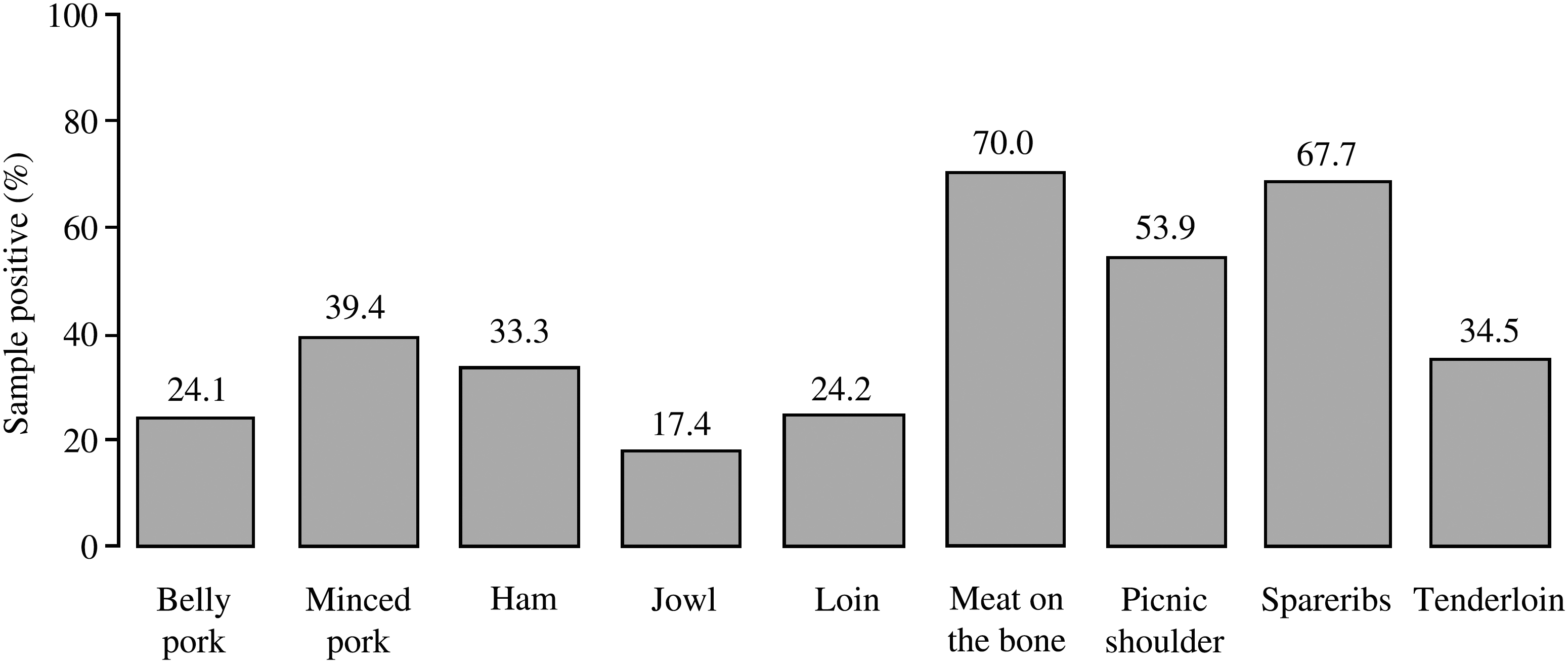
Distribution of Salmonella-positive retail products.
Environment samples
The highest percentage of positive samples was found during the working period (25%). Before cutting and after C&D, Salmonella-positive results totaled 3.0% and 16.0%, respectively (Table 2). Samples from hands, knives, and shackles were less frequently positive than samples from the cutting boards. No contamination was found on plastic curtains during any batch of sampling.
C&D, cleaning and disinfection.
Salmonella serovars
From 846 available samples, 331 samples were positive. The three most frequent serogroups were C (45.0%), B (34.1%), and D (13.9%), whereas serogroup A was not found in this study. Salmonella Rissen (45.3%) was the most predominant serotype in every sample type, followed by Salmonella Typhimurium (16.3%), which was detected on knives (ID 13) and also in freshly cut pork and transported pork. Some Salmonella serovars (Anatum, Gloucester, Krefeld, and Tumodi) were found only in pork samples (Table 3).
Environmental samples (B, cutting board; S, hands of staff; H, shackle; K, knife).
Meat samples (no. of positive samples).
Retail pork sampled on the same occasions as meat sampled during deboning and transport.
Salmonella spp. in serogroup F-67.
Others.
Salmonella Rissen and Salmonella Lagos were identified on the hands of staff, whereas Salmonella Typhimurium was also found on knives in the environment samples before cutting. These serovars were also found on pork samples. Salmonella serotypes Panama, Stanley, and Weltevreden were detected in the environment after the carcasses had arrived in the cutting room. Salmonella serotypes Rissen, Stanley, Typhimurium, and Weltevreden, and Salmonella in serogroup F-67 remained in the environment after C&D. Salmonella serotypes Lagos, Rissen, and Typhimurium were detected throughout the process, even prior to cutting, whereas Salmonella Stanley and Salmonella Weltevreden appeared later, during the preparation of the freshly cut meat (Table 4).
Discussion
A previous study of the same production chain showed that 13.3% of the pig carcasses going to cutting after overnight chilling at 4°C were contaminated with Salmonella (Chantong, 2005). This study has now demonstrated that subsequent contamination rates during cutting and transportation increase considerably, from 55.5% in freshly cut pork to 70.5% in transported pork. This is in contradiction to findings in the Netherlands reported by Berends et al. (1998), who have not detected any difference between the percentage of Salmonella-positive retail-ready pork in butchers' shops and supermarkets compared with those at the end of the cutting line, indicating that local conditions may play a role in Salmonella transfer.
In the slaughterhouse chosen for this study, freshly cut pork was returned to the chilling room, usually before the lunch break, where it mingled with pork from other carcasses, prior to packing in the afternoon of the same day. Thus, transference of Salmonella serovars may have occurred from freshly cut pork to subsequent phases in this chain as reflected by the 15% increase in the contamination rate. However, the agents have to be transferred before being able to multiply, possibly passing from the previously cut meat to the other carcasses.
Pork samples collected from supermarkets came from pigs on the day of slaughter. Because we could not follow the carcasses individually to retail markets, these results may not directly correspond to results from samples taken during cutting and from transported pork. Indeed, the prevalence of bacterial contamination in retail samples was 34.5%, which is lower than that in our samples from previous stages. In a study carried out in Bangkok, an 84% prevalence rate of Salmonella in 100 g pork has been reported (Vindigni et al., 2007). However, Padungtod and Kaneene (2006) have found 20% prevalence in pork, which is lower than results from our study. The sampling time, place, and technique may have had significant effects on the prevalence observed; the aforementioned authors tested 10 g per sample as opposed to the 25 g tested in our study.
Bangtrakulnonth et al. (1999) have found a Salmonella prevalence ranging from 6.3% to 54.6% in pork products from retail markets and supermarkets. One reason for the higher Salmonella prevalence obtained might be attributable to the type of product (heated vs. raw in our study) investigated. From our study, the results indicate that cutting leads to a higher risk of Salmonella contamination compared with the other samples.
The proportion of Salmonella-positive environment samples during cutting (25%) was high compared with the samples before and after cutting (3.0% and 16.0%, respectively); Swanenburg et al. (2001) have also detected the highest prevalence of Salmonella during cutting. In our study, the most frequently contaminated samples were swabs from cutting boards (55%), hands, and knives (40% and 30%, respectively). No contamination was detected on the plastic curtain and only one shackle sample was positive; both sampling sites became positive only shortly after being in contact with pork. Contamination rates of the slaughterhouse environment before any slaughtering activity were 25% (Botteldoorn et al., 2003) and 7.9% (Hald et al., 2003), with Salmonella-positive samples totaling 16% after C&D; these rates indicated that the time for sampling with respect to the C&D process was in fact not suitable, as delayed killing was taking place. The Salmonella serovars identified from environment samples before cutting clearly suggest incomplete disinfection and/or endemicity at the processing plant. Such sites might act as new sources for the contamination of products eventually bound for the retail trade.
The most frequently isolated serotypes were Salmonella Rissen (45.3%) and Salmonella Typhimurium (16.3%). These findings are in accord with the results of Chantong (2005), who has found contamination levels of 43% of Salmonella Rissen and 16.3% of Salmonella Typhimurium in carcasses before water spraying, and 37.5% of Salmonella Rissen and 16.7% of Salmonella Typhimurium after overnight chilling. Salmonella serotypes Anatum, Gloucester, Krefeld, and Tumodi have not been detected in the environment. Some Salmonella serotypes, such as Rissen, Lagos, and Typhimurium, have been found both on pork and in the environment. These serovars were also present in the environment before the cutting process, with Salmonella Rissen being the most prevalent serotype in the cutting environment, possibly being transmitted directly from the pigs. Padungtod and Kaneene (2006) and Dorn-in et al. (2009) have found that Salmonella Rissen is the most common serotype found in pigs and the environment of pig farms, whereas Salmonella Derby, which is also associated with pigs in Thailand (Bangtrakulnonth et al., 2004), has not been detected in our study.
Conclusions
Cutting and transportation may represent important sources of contamination by Salmonella. The first source of contamination can be explained by contamination of carcasses before their arrival in the cutting room and the second source by contamination from the environment of the slaughterhouse. Moreover, we have found that Salmonella contamination during the processing of pork products is unavoidable when slaughter work is conducted routinely (Berends et al., 1997) and the cutting process is run continuously. Measures to reduce contamination during cutting and packaging, such as personal hygiene and plant sanitation programs, should be applied more vigorously. A comprehensive quality safety and assurance scheme, such as Hazard Analysis Critical Control Point or Good Manufacturing Practice, which also includes staff educational programs, should help to increase the level of awareness of food hygiene at the farm and abattoir level even more effectively (Borch et al., 1996; Legnani et al., 2004; van der Gaag et al., 2004).
The risk of contamination of pork and pork products might depend on highly contaminated pigs at the preharvest stage (Dorn-in et al., 2009) and at the slaughtering stage (Chantong, 2005). Our results show the effects of postharvest processing on the retail product. However, we can confirm that contamination is transmitted from earlier stages and carried over (Fries et al., 2006); thus, Salmonella control strategies from farm to table should focus on all stages of the pork production chain to reduce contamination levels and consumer risk.
Footnotes
Acknowledgments
The authors thank the local staff of the slaughterhouse for cooperation in this study and the Faculty of Veterinary Medicine personnel involved in the laboratory activities. Financial support from the Veterinary Public Health Center for Asia Pacific, Chiang Mai University, Freie Universität Berlin, and the German Academic Exchange Service Deutscher Akademischer Austausch Dienst (DAAD) is gratefully acknowledged.
Disclosure Statement
No competing financial interests exist.