




Abstract
Salmonella is the most common bacterial cause of foodborne outbreaks in the United States. Starting in June 2007, investigation of a cluster of Salmonella Montevideo cases with indistinguishable pulsed-field gel electrophoresis (PFGE) patterns resulted in the identification of an outbreak associated with contact with chickens purchased from a single hatchery. Nine Minnesota cases from May through August 2007 were part of this outbreak. Cases with the outbreak PFGE pattern of Salmonella Montevideo continued to occur in Minnesota after August, but none of these cases reported chicken contact. The majority of these cases resided in the same town in rural Minnesota. Routine interviews revealed that all cases from these counties purchased groceries from the same local grocery store, with two specifically reporting consuming items from the grocery store delicatessen in the week before illness. As a result, an investigation into the delicatessen was initiated. Illness histories and stool samples were collected from all delicatessen employees, and food and environmental samples were collected. None of the employees reported experiencing recent gastrointestinal symptoms, but the outbreak PFGE subtype of Salmonella Montevideo was identified from stool from two food workers. Food and environmental samples collected tested negative for Salmonella. One of the positive employees reported having chickens at home, but the animals did not test positive for Salmonella. The positive food workers were excluded from work until they had two consecutive negative stool cultures for Salmonella. There was no evidence of ongoing transmission thereafter. This was an outbreak of Salmonella Montevideo infections that began as an animal-contact-associated outbreak which subsequently resulted in a foodborne outbreak associated with infected food workers. These outbreaks illustrate the complex epidemiology of salmonellosis.
Introduction
I
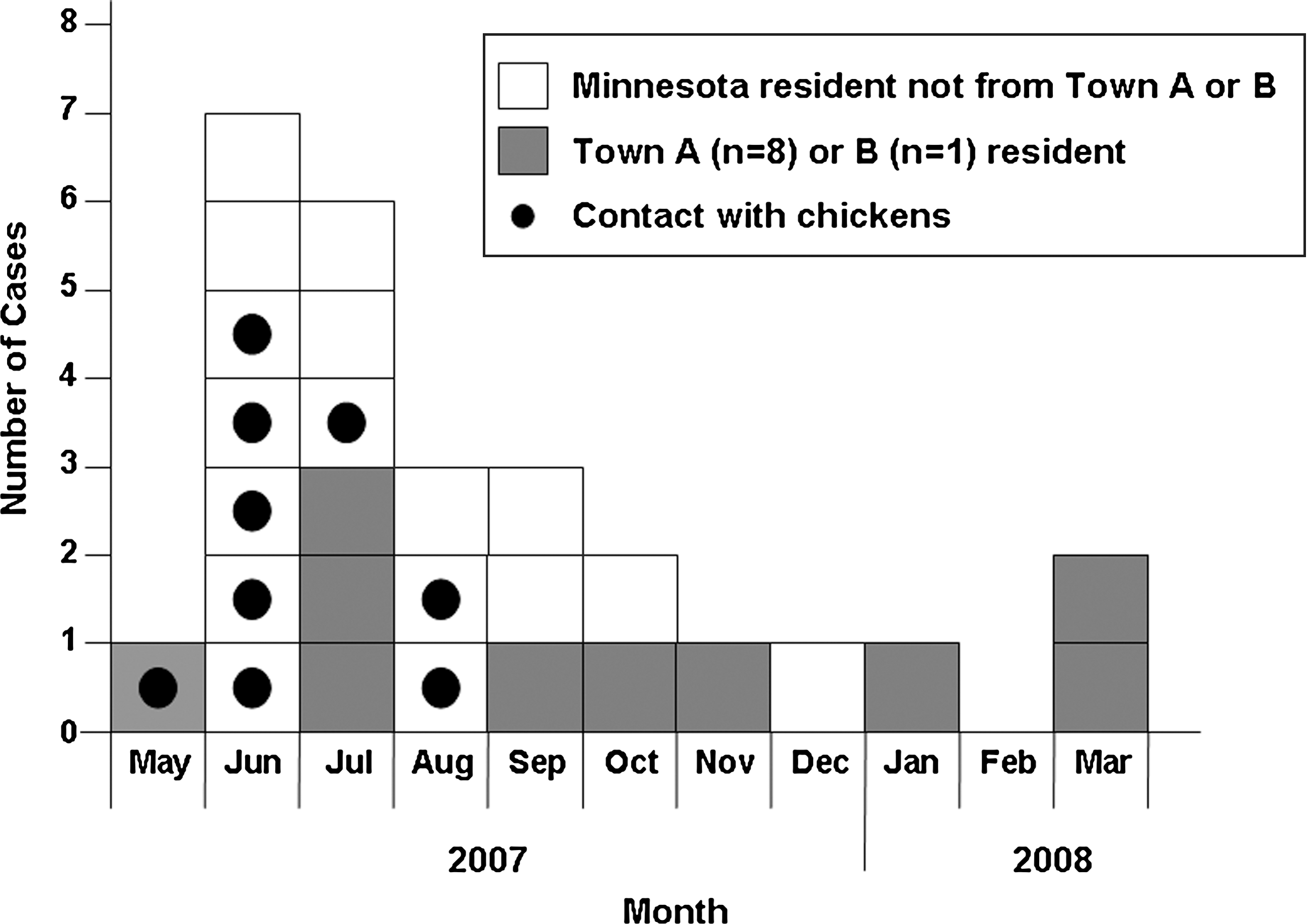
Cases of Salmonella Montevideo SMON42 infection in Minnesota, May 2007 to March 2008, by month of specimen collection (Town B is a small town next to Town A).
Materials and Methods
Clinical laboratories are required to submit all Salmonella isolates to the MDH Public Health Laboratory (PHL) for confirmation, serotyping, and routine PFGE subtyping using the enzyme XbaI (Ribot et al., 2006; Boxrud et al., 2007; Murray et al., 2007). As of March 2008, SMON42 had been isolated from nine residents of Town A (n = 8) or a neighboring town (Town B, n = 1) since July 2007 who did not report chicken contact (Fig. 1). Interviews revealed that all eight cases who could be reached for interview shopped at the same grocery store in Town A. Two of the most recent cases specifically reported consuming foods prepared at the grocery store's delicatessen in open-ended food histories.
On March 31, 2008, Minnesota Department of Agriculture (MDA) and MDH representatives visited the grocery store to conduct an inspection and begin interviewing employees. Twenty-two samples of cheese, turkey, ham, corned beef, roast beef, and salami were collected from the delicatessen and tested by MDA, along with 14 environmental swabs from the slicers, cutting boards, scale, wrapping station, hot and cold cases, and coolers. Environmental and food samples were tested at the MDA Laboratory using an enzyme-linked fluorescent assay on the VIDAS immunoanalyzer. All delicatessen employees were required to submit two stool specimens to the MDH PHL for Salmonella culture (Murray et al., 2007). Food workers who tested positive for Salmonella were restricted from their work duties and required to submit stool samples until two consecutive specimens collected at least 24 hours apart tested negative for Salmonella. All food workers were interviewed with a standard questionnaire about their job responsibilities (particularly food handling), history of gastrointestinal symptoms since June 2007, and chicken contact since June 2007.
Employees from MDH and the Minnesota Board of Animal Health visited the home of one grocery store employee who reported owning chickens to obtain samples from the birds and their environment. Samples from 25 chickens were collected and combined into five tubes for Salmonella testing. Dust and litter samples from the chicken's environment were also collected for testing (Murray et al., 2007).
Results
From June 2007 to March 2008, nine SMON42 cases in Town A or B residents were identified. The median age of cases was 53 years (range, 22 to 76 years), and five (56%) were men. Eight (89%) case isolates were from stool and one (11%) was from urine. Illness onset dates ranged from July 2007 to March 2008. Three (38%) cases were hospitalized, for a median duration of 4 days (range, 2 to 6 days). Onsets for the two cases who specifically reported consuming foods prepared at the grocery store's delicatessen were in January and March 2008, respectively; foods consumed included a turkey and/or tuna sandwich, and rotisserie chicken and turkey, respectively. Because of the time lag, other cases were not re-interviewed about consumption of food from the delicatessen.
All 14 delicatessen employees were interviewed. Two of these employees were culture-positive for SMON42; no other types of Salmonella were isolated. One positive food worker reported having a diarrheal illness with fever in August 2007. This employee visited a healthcare provider and was found to have bacterial gastroenteritis, but no stool specimen was collected at that time. The other positive food worker reported not being ill with gastrointestinal symptoms since June 2007, but did have a spouse who experienced diarrhea a few weeks in duration in July 2007. Four additional employees reported gastrointestinal illness during the time period investigated, but all were culture negative. All food and environmental samples collected from the delicatessen were negative for Salmonella.
One positive employee (and five delicatessen employees overall) reported having chickens at home. The chickens originated from a local feed store that received birds from the hatchery implicated as the source of the chicken contact outbreak (CDC, 2009). However, the employee claimed that the chickens were purchased a few years prior. All chicken and environmental samples were culture-negative for Salmonella.
Discussion
This was an outbreak of Salmonella Montevideo infections associated with consumption of food items from a grocery store delicatessen. The outbreak was identified through routine surveillance activities at MDH conducted in the wake of a chicken contact outbreak of salmonellosis caused by the same PFGE subtype of Salmonella Montevideo.
Based on the epidemiologic and environmental health findings, we conclude that this outbreak occurred as the result of Salmonella Montevideo infection in one or more infected food workers at the delicatessen. All food and environmental samples collected from the delicatessen were negative for Salmonella. After the two positive employees were restricted from their duties in food service, no additional cases in the community or the surrounding area were identified.
We also conclude that the Salmonella Montevideo was most likely introduced into the delicatessen by one or more food workers who were infected through contact with chickens. We were unable to test chickens at most of the delicatessen workers' homes and therefore did not demonstrate a direct link between infected chickens and infected delicatessen workers. However, an outbreak due to the same PFGE subtype of Salmonella Montevideo associated with a specific hatchery was clearly documented (CDC, 2009); chickens from this hatchery were sold in Town A, and one cultured-confirmed infection in a Town A resident was associated with chickens from the implicated hatchery. Multiple delicatessen employees reported having chickens at home, and some of these reported experiencing gastrointestinal illness during the delicatessen outbreak period. One or more of these employees could have been infected with the outbreak strain of Salmonella Montevideo but were culture-negative by the time the delicatessen outbreak was detected and employees tested.
This outbreak illustrates the complex epidemiology of salmonellosis. Multiple routes of transmission can occur during what appears to be an uninterrupted string of Salmonella cases with indistinguishable PFGE patterns. It is important to continue investigation into the source of illness, or to consider an alternate route of transmission, if an outbreak appears to be ongoing. Additionally, our report adds to the growing number of investigations that have implicated infected food workers as the source of foodborne outbreaks (Hedberg et al., 1991; Ethelberg et al., 2004; Medus et al., 2006; CDC, 2008). Testing of employees, regardless of illness history, is an important means to end transmission of salmonellosis to patrons and other employees in restaurant or delicatessen outbreaks.
Footnotes
Acknowledgments
The authors would like to thank PHL staff and Acute Disease Investigation and Control Section staff at the MDH who participated in this study. These investigations were supported in part with funding provided through a cooperative agreement (U50/CCU511190) with the Centers for Disease Control and Prevention as part of the Emerging Infections Program, Foodborne Diseases Active Surveillance Network (FoodNet).
Disclosure Statement
No competing financial interests exist.