




Abstract
Unpasteurized (raw) milk can be purchased in 39 U.S. states, with direct consumer purchase for human consumption permitted in 29 of those 39 states. Raw milk (n = 21; cow, 14; goat, 7) was purchased in 12 states, and Coxiella burnetii, the agent of Q fever, was detected in 9 of 21 (42.9%) samples tested by polymerase chain reaction. Viability of the pathogen was demonstrated by isolation of the agent in tissue culture. The demonstration of viable C. burnetii in commercially available raw milk poses a potential public health risk.
Introduction
In the last decade, raw milk has been associated with multiple outbreaks of Escherichia coli O157:H7, Salmonella, Campylobacter jejuni, and Listeria monocytogenes (e.g., CDC, 2002, 2007; Mazurek et al., 2004; Denny et al., 2008). In spite of these outbreaks, consumers purchase and drink raw milk for perceived health benefits that range from nutrition and digestibility to the prevention of allergies and heart disease (Leedom, 2006; Oliver et al., 2009).
Coxiella burnetii, the causative agent of Q fever in people, is enzootic in cattle, sheep, and goats throughout most of the world (Lang, 1991; Kazar, 2005). In cattle, C. burnetii colonizes mammary glands and can be excreted in milk for months after infection (Lang, 1991). DNA of C. burnetii was detected in >90% of bulk milk tanks in a recent study (Kim et al., 2005), demonstrating the ubiquity of this pathogen in U.S. dairy herds; however, this milk was pasteurized before consumption, and the viability of C. burnetii was not assessed.
Q fever is typically an acute febrile illness with nonspecific clinical signs, but hepatitis and atypical pneumonia are seen in severe cases, and a small percentage of infected people will develop chronic infection with culture-negative valvular endocarditis (Kazar, 2005). C. burnetii is highly infectious via the respiratory route, but the infectivity of C. burnetii via the oral route is poorly understood. Seroconversion after ingestion of foods containing C. burnetii has been shown in humans (Babudieri, 1959; Benson et al., 1963; Krumbiegel and Wisniewski, 1970), and cattle, rodents, guinea pigs, and dogs have been infected via oral exposure to high doses (Derrick, 1937; Parker et al., 1949; Babudieri, 1959; Ac et al., 1968). These data suggest that C. burnetii can escape the gastrointestinal tract and produce infection sufficient to stimulate systemic immunity, with an unknown potential for the development of disease.
Although consumption of raw milk containing live C. burnetii could pose a public health risk, and the bacterium has been identified in bulk milk tank samples (Kim et al., 2005), no information is available regarding the presence of C. burnetii in raw milk that is sold to consumers. To determine whether raw milk sold in the United States contains C. burnetii, raw milk from dairies in twelve states was legally purchased and tested for the presence of C. burnetii DNA. The pathogenic potential of positive samples was further characterized using both genotyping (plasmid profile) and viability testing.
Materials and Methods
Unpasteurized cow and goat milk was purchased from legal, commercially available sources. A total of 21 samples, 7 from goat milk dairies and 14 from cattle milk dairies, were included in this study. Somatic cells from milk were concentrated using low-speed centrifugation (Renshaw et al., 2000); briefly, 50 mL of milk was centrifuged for 15 minutes at 1700 g, resulting cell pellets were gently resuspended in 10 mL of phosphate-buffered saline, and then samples were centrifuged a second time. These cell pellets were resuspended in 200 μL of phosphate-buffered saline and extracted using the DNeasy Tissue Kit (Qiagen, Valencia, CA), with DNA eluted in 200 μL of buffer. Samples were screened using a sensitive and specific real-time polymerase chain reaction (PCR) assay for the IS1111a element of C. burnetii (Thompson et al., 2003; Loftis et al., 2006). Positive samples were characterized further using a real-time PCR assay that detects the general, QpH1, and QpRS plasmids of C. burnetii (Thompson et al., 2003).
Isolation of viable C. burnetii was attempted, using two consecutive passages in mice, followed by in vitro culture, in accordance with a Centers for Disease Control and Prevention (CDC)–approved Institutional Animal Care and Use Committee (IACUC) protocol. For isolation attempts, somatic cells from 100 mL of milk were concentrated into 1.0 mL volume, concentrates were heated at 62°C for 5 minutes to reduce viability of other bacteria, and this material was inoculated intraperitoneal (I.P.) into four to five mice (0.2 mL each). Mice were monitored for infection using PCR of the blood (days 8 and 10) and spleen (day 10) and passage of spleen homogenates to naïve mice (day 10). These infected mice were sacrificed after 10 days, and spleens were collected aseptically and tested for the presence of C. burnetii DNA; spleen cells were passed into RK13 cells (ATCC number CCL-37) in vitro.
Results
Between May 2007 and January 2008, 21 unpasteurized milk samples were purchased from 20 different dairies in 12 U.S. states (Fig. 1), including 7 goat milk dairies and 13 cattle milk dairies. All of the milk was purchased commercially from legal operations. Two samples were labeled as pet food; the remaining samples were directly marketed for human consumption. Of the 21 raw milk samples, 9 (42.9%) contained DNA from C. burnetii (Fig. 1), including 2 samples of cow milk purchased from the same dairy ∼1 month apart. One of 7 samples of goat milk (14.3%) and 8 of 14 (57.1%) samples of cow milk tested positive. In all, C. burnetii was detected in milk from eight dairies in seven states, including samples from the western, southern, and southeastern United States.
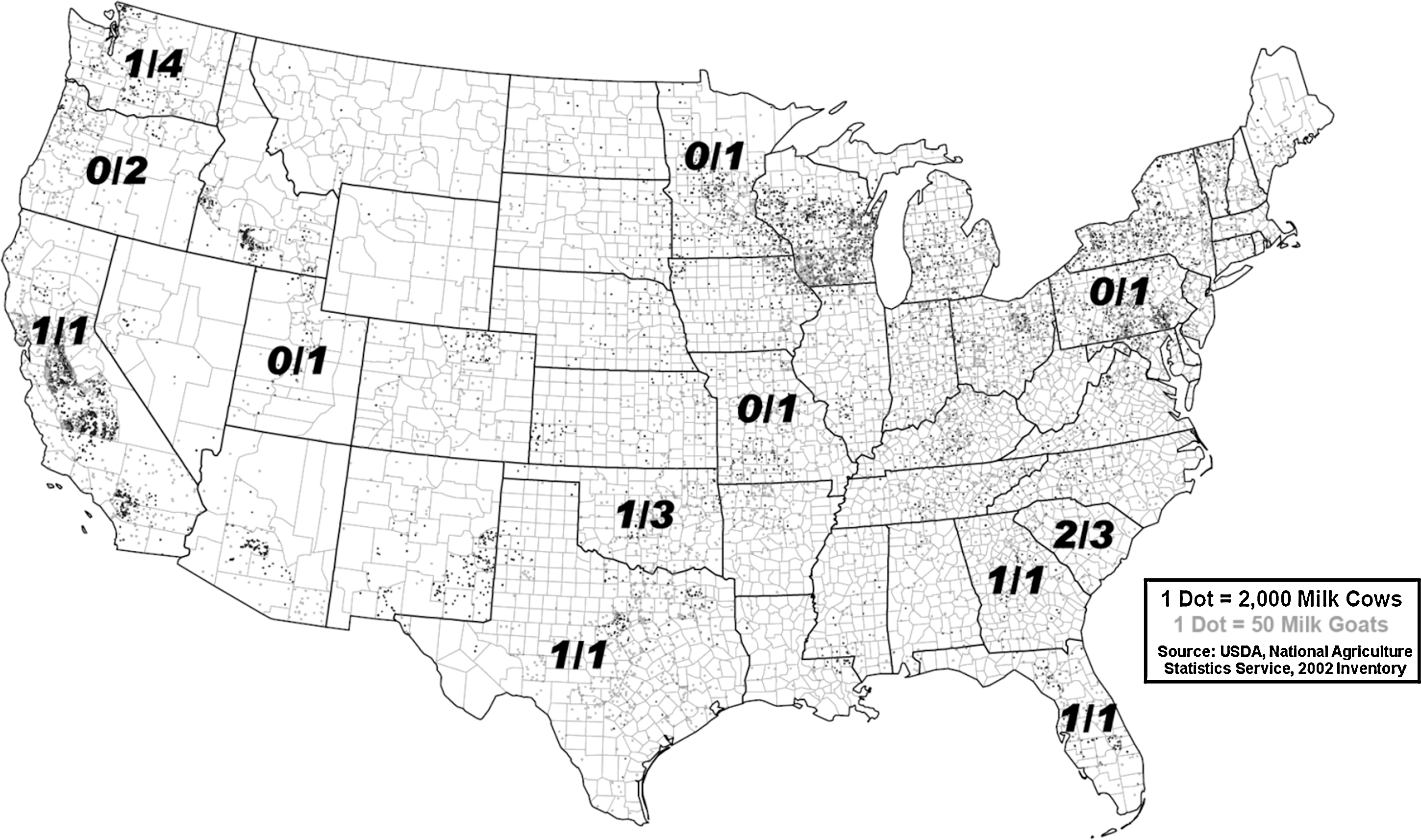
Summary of raw milk testing results, by state, overlaid on the 2002 U.S. Department of Agriculture (USDA) National Agriculture Statistics Service (NASS) inventory of dairy cattle and goats in the United States. Data are shown as the number of dairies from which Coxiella burnetii was detected over the number of dairies from which raw milk was obtained.
Real-time PCR-based plasmid genotyping was successful for seven of nine positive raw milk samples (Table 1); genotyping failed for the two samples with the highest IS1111a CT values, suggesting that low concentration of C. burnetii DNA was the cause of failure. Among the seven genotyped samples, four different combinations of plasmids were detected. The only sample containing plasmid QpRS was the one positive goat milk sample. Five of six cow milk samples contained C. burnetii plasmid QpH1, including two samples of milk purchased from the same dairy; all but one of these also had evidence of the general plasmid. The remaining cow sample had evidence of the general plasmid but not QpH1 or QpRS.
Average threshold cycles using the IS1111a real-time polymerase chain reaction screening assay.
Samples A and N were purchased from the same dairy, ∼1 month apart.
No plasmids were detected; strain is likely plasmidless, although no specific assays were available for plasmid types QpDG and QpDV.
Insufficient Coxiella DNA was obtained from this sample to permit plasmid determination.
Contamination with Staphylococcus xylosus caused lysis of tissue culture cells within 24 hours.
N/D, not determined.
Isolation was attempted for positive samples C, E, F, I, L, and N (Table 1). Isolation was not attempted on samples J and T, which had low concentrations of C. burnetii DNA, or on sample A, which was from the same farm as N. Two of four mice inoculated with sample E and four of five mice inoculated with sample N became infected with C. burnetii, which was successfully passed into naïve mice and isolated in vitro using RK13 cells. Isolation was unsuccessful from the other samples, but small amounts of C. burnetii DNA were detected in the spleens of mice after passage of samples F and L. In vitro culture of mice infected with sample L yielded an isolate of Staphylococcus xylosus, which causes mastitis in cattle; the rapid growth of S. xylosus lysed the RK13 cells and may have prevented isolation of C. burnetii from this sample.
Discussion
C. burnetii was detected in a proportion of commercially available raw milk, confirming that individuals who purchase and drink raw milk in the United States may be exposed to this pathogen. Nine of 21 (42.9%) raw milk samples (from 8/20 dairies; 40%) from seven states contained DNA of C. burnetii. This proportion is lower than that reported for bulk milk tank samples from U.S. dairies that pasteurize milk (Kim et al., 2005), but the small sample size prevents direct comparison of these studies.
The samples were genetically diverse, as documented by the presence of four different plasmid profiles. Plasmid QpRS, which has been associated with chronic Q fever cases and endocarditis, was only detected in one goat milk sample, but plasmid QpH1, which has been associated with acute cases of Q fever (Samuel et al., 1985), was found in five different commercial samples of raw cow milk. Further work may be warranted to compare the frequency of these plasmids in goat-associated versus cattle-associated strains of C. burnetii.
Isolates of C. burnetii were obtained from two of the PCR-positive raw milk samples from dairy cattle, confirming not only the presence of this pathogen, but also its viability in commercially sold raw milk.
Conclusions
This study demonstrates that consumers in the western, southern, and southeastern United States may be exposed to C. burnetii by the consumption of raw milk. Ingestion of foods, including raw milk, containing C. burnetii can result in seroconversion in humans (Babudieri, 1959; Benson et al., 1963; Krumbiegel and Wisniewski, 1970); however, the pathogenesis of Q fever after oral exposure in humans is unknown, limiting our ability to assess the public health risk of this finding. Further study is needed to determine the infectivity and pathogenicity of C. burnetii after ingestion, as well as in cases of aspiration of milk (producing a respiratory exposure). Additionally, most of the published research concerning the pathogenicity of C. burnetii predates pasteurization and thus predates the HIV/AIDS pandemic, chemotherapy, and other medical immunosuppressive treatments; further work is needed to determine if the risk of infection might be higher in immunocompromised individuals. Lastly, C. burnetii is classified as a select agent and a CDC Category B bioterrorism agent, with current research on the agent requiring specialized high-containment biosafety level-3 facilities. The presence of the agent in commercially available raw milk raises questions regarding feasibility and effectiveness of control efforts for regulating select agents such as C. burnetii.
Footnotes
Acknowledgments
The authors extend their special gratitude to all of our colleagues, family, and friends who helped us locate and purchase raw milk for this study. The authors also thank Teresa Wolfe, Joshua Self, Amanda Candee, Nicole Patterson, and Amy Denison for their technical support.
Disclaimer
The findings and conclusions in this report are those of the authors and do not necessarily represent the views of the CDC or the Department of Health and Human Services.
Disclosure Statement
No competing financial interests exist.