




Abstract
In this study, total aerobic mesophilic bacteria (TAMB), total coliform (TC), yeasts and moulds (YM), and Escherichia coli, Salmonella, and Staphylococcus aureus counts of wheat seeds and sprouts germinated for 9 days under different relative humidity (RH) (90% and 95%) and temperatures (18°C, 20°C, and 22°C) were determined. The disinfection capabilities of sodium hypochlorite (NaOCl) (100, 200, and 400 ppm) and hydrogen peroxide (H2O2) (3% and 6%) on wheat seeds/sprouts were also investigated. It has been found that native TAMB, TC, YM, and E. coli population significantly increased (p < 0.05) with the germination; however, no Salmonella and S. aureus were detected on the seeds and/or sprouts. Again, increasing the temperature and RH resulted in a rapid proliferation of microorganisms. On the other hand, E. coli population could be completely eliminated by the treatment of different concentrations of NaOCl or H2O2 before the germination of wheat seeds. Again, increasing the NaOCl and H2O2 concentrations resulted in additional reductions of TAMB, TC, and YM population; and the highest reductions in sprouts were observed when the seed was soaked in 400 ppm NaOCl for 30 minutes followed by tap water wash and germination for 9 days. Population reduction of 1.46 log colony-forming unit (cfu)/g of TAMB, 1.97 log cfu/g of YM, and 0.84 log cfu/g of TC in sprouts was achieved when compared with the control. The chemical sanitization did not negatively affect the germination capability of the seeds. Therefore, soaking the seeds in 400 ppm of NaOCl for 30 minutes followed by a germination environment of 18°C and 90% RH was found to be the most appropriate germination condition for wheat sprouts with reduced microbial population.
Introduction
It was recommended by Food and Drug Administration that seeds be decontaminated before germination (Caetano-Anolles et al., 1990; NACMCF, 1999), as total microbial count and amounts of organic materials from which microbes benefit are lower in seeds than in sprouts (Hara-Kudo et al., 1997; NACMCF, 1999). For the decontamination of seeds before germination, numerous studies have been performed to investigate the effectiveness of a wide range of methods, such as treatment with chemicals or organic compounds (Piernas and Guiraud, 1997; Lang et al., 2000; Singh et al., 2003; Jin and Lee, 2007; Luksiene et al., 2007), irradiation (Rajkowski and Thayer, 2000; Bari et al., 2004; Waje and Kwon, 2007; Waje et al., 2009), heat treatment (Jaquette et al., 1996; Piernas and Guiraud, 1997; Weiss and Hammes, 2005), high pressure (Penas et al., 2008, 2010), and/or their combinations. However, no single treatment was effective on the variety of pathogens present in the seeds and/or their sprouts. The objective of the research is to improve the microbial quality and safety conditions of the wheat sprouts by determination of the most appropriate germination conditions and sanitization with hydrogen peroxide (H2O2) or sodium hypochlorite (NaOCl).
Materials and Methods
In this research, a two-stage study was conducted: In the first stage, wheat seeds were germinated at different temperatures (18°C, 20°C, or 22°C) and relative humidities (RH, 90% or 95%); and in the second stage, the wheat seeds were subjected to disinfection with different concentrations of NaOCl (100, 200, or 400 ppm) or H2O2 (3% or 6%), and then they were germinated under the microbiologically safest germination conditions detected at the first stage (Fig. 1).
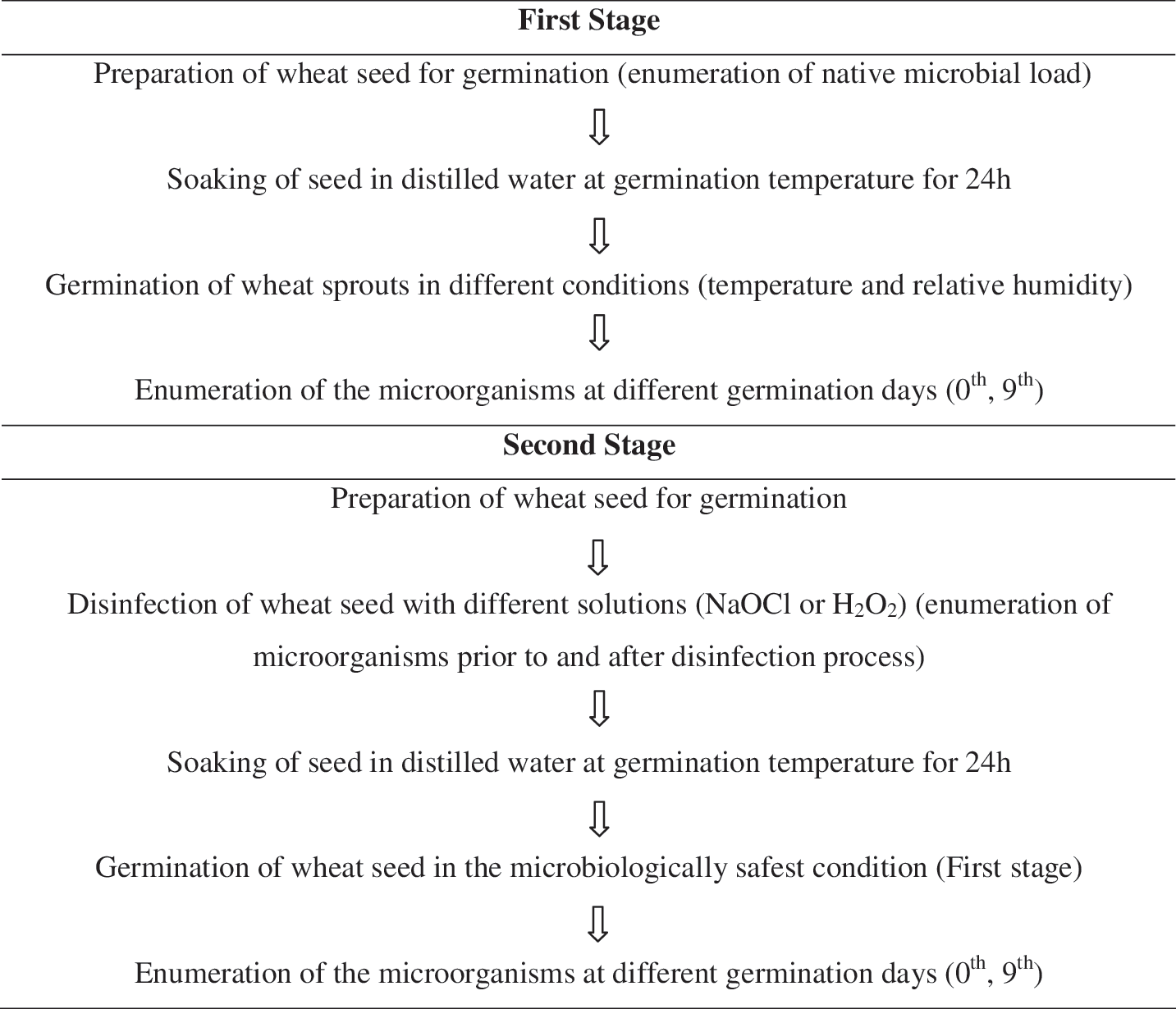
Process flow chart indicating the preparation steps of the wheat and sprout samples.
Wheat samples
The wheat (Triticum aestivum) variety (Konya 2002) used for sprout production was obtained from the Research and Development Center of Ministry of Agriculture, Konya-Turkey. It was washed with tap water at ∼10°C for 5–10 minutes to remove foreign materials such as stem, anther, sand, rod, soil, and so on.
Disinfection process
The wheat samples (200 g) were aseptically weighed and transferred into 500 mL jars containing 200 mL of different solutions of the chemicals including 100, 200, or 400 ppm for NaOCl and 3% or 6% for H2O2; and the control sample received only tap water. Then, they were submerged in these solutions at room temperature for 30 minutes, and the disinfected seeds were rinsed with tap water at ∼10°C for 3 minutes to remove the residual disinfectants from the seeds. Before sprouting, all the seeds were soaked in glass jars filled with distilled water at 18°C, 20°C, or 22°C (germination temperature) for 24 hours.
Germination process
The germination was carried out according to the method described by Yang et al. (2001) with some modifications. The previously soaked seeds were placed on the pans coated with aluminum foil and covered between cellulose filter papers (40 × 40 cm), and germination was carried out in an incubator (Nüve ID 501, Turkey) set to different RH (90% or 95%) and temperatures (18°C, 20°C, or 22°C) for 9 days. Sterilized distilled water (300 mL) was daily sprayed onto the upper filter paper during the germination to maintain the desired RH and to prevent drying of the sprouts. The disinfected seeds were then germinated at the lowest microbial load occurring conditions (at 18°C and 90% RH for 9 days).
Microbiological analysis
Twenty-five grams of aseptically harvested seeds and sprouts after germination were weighed, placed into 225 mL Ringer solution, and homogenized with a Stomacher (IUL, Nr 1147/470, Spain) for 4 minutes. Then, decimal dilutions were prepared using Ringer solutions (Merck, Darmstadt, Germany); and total aerobic mesophilic bacteria (TAMB), total coliform (TC), yeasts and moulds (YM), Staphylococcus aureus, E. coli, and Salmonella counts were determined by the following methodologies shown in Table 1 for the seed/sprout samples. Disinfected grains and tap water were also analyzed. Microbial counts were expressed as the log number of cfu (log cfu)/mL. All the analyses were performed in duplicate (Roberts and Greenwood, 2003).
TAMB, total aerobic mesophilic bacteria; TC, total coliforms; YM, yeast and moulds.
Effect of chemicals on germination ability
To evaluate the effects of H2O2 and NaOCl on germination capability of the wheat seeds, a total of 20 sprouts were randomly selected and separated from their seeds, and the sprout lengths were measured using a ruler at the end of the germination process. Then, the average sprout lengths were recorded as mm.
Statistical analysis
The data obtained from microbiological analyses were evaluated with Windows based SAS 8.0 statistical analysis software. Mean values of the data were treated with one- and multiway analysis of variance, and the differences were determined with Duncan's multiple range tests at 5% significance level.
Results and Discussion
Effects of the germination conditions on the microbial load
The study was conducted to determine the optimum germination conditions (% RH and temperature) to keep the microbial loads of wheat sprouts at minimum levels and to focus on the microorganisms as an indicator of the hygienic conditions and health risks. It has been reported that the major sources of pathogenic bacteria and fungi on sprouts were most likely the seeds (NACMCF, 1999); that is, the untreated seeds may contain high levels of microorganisms. In this study, TAMB, YM, TC, and E. coli counts of untreated wheat seeds were determined as 2.40, 1.74, 1.81, and 1.39 log cfu/g, respectively. Martinez-Villaluenga et al. (2008) detected mesophilic bacteria counts of untreated broccoli and radish cultivars at the levels of 7.24–9.70 and 8.05–9.37 log cfu/g, respectively; and TC numbers also showed a wide range of values (from 4.78 to 9.82). In another study, it was found that TAMB, TC, and YM loads of untreated rice seeds ranged between 7.43–7.45, 3.08–3.69, and 4.41–4.76 log cfu/g, respectively (Piernas and Guiraud, 1997).
Table 2 shows the microbial loads of soaked wheat seeds and their sprouts produced by germinating for 9 days. Soaking of wheat seeds caused increases in these numbers >2 log cfu/g. For instance, TAMB, YM, TC, and E. coli numbers reached the levels of 5.35, 4.60, 4.56, and 3.36 log cfu/g, respectively, after the soaking, as can be seen in Table 2. Moreover, germination also resulted in proliferations of microorganisms, which was significant (p < 0.05). The lowest TAMB numbers (8.00and 8.06 log cfu/g) were detected in the wheat sprouts produced at 90% RH-18°C and 90% RH-20°C. Increasing the RH from 90% to 95% led to a significant (p < 0.05) increase in TAMB counts at 18°C and 20°C. However, significant (p > 0.05) difference was not observed with increasing RH at 22°C. The TAMB counts of wheat sprouts ranged from 8.00 to 10.08 log cfu/g (Table 2).
Means with the same letters on the same column are not significantly different (p > 0.05) from each other for the same microorganism group.
Means with the same letters on the same line are not significantly different (p > 0.05) from each other for the same microorganism group.
The presence or absence of presumptive Salmonella ssp. was shown as (+) or (−) 25 g−1, respectively.
RH, relative humidity.
In this study, the lowest and highest TC loads of wheat sprouts were detected by the levels of 6.29 and 9.10 cfu/g at 18°C-90% RH and 22°C-95% RH combinations, respectively. Again, increase of the germination temperature from 18°C to 20°C and 22°C at 90% RH level resulted in higher TC counts in the sprouts but not at 95% RH (Table 2).
A major factor affecting YM counts of wheat sprouts was RH. Increasing the temperature did not cause an additional increase in the YM counts as long as the RH did not change. YM count of the sprouts was 8.00 log cfu/g for all temperature levels at 90% RH (Table 2).
E. coli number in the seeds was significantly increased by the soaking process at different temperatures (p < 0.05). After germination, the lowest E. coli levels were 5.15 and 5.69 log cfu/g, and these numbers were detected at 18°C for 90% and 95% RH conditions, respectively (Table 2).
Many researchers have carried out studies focusing on microbial safety conditions of the sprouts. Some investigated the microbial qualities of commercial sprout products such as soybean and alfalfa (Abadias et al., 2008); alfalfa, mung bean and radish (Robertson et al., 2002), and mung bean sprouts (Gabriel et al., 2007) marketed in various countries, whereas others germinated different kinds of seeds and reported the changes of their native microbial load during germination (Piernas and Guiraud, 1997; Stewart et al., 2001; Martinez-Villaluenga et al., 2008). Additionally, Yang et al. (2001) attempted to optimize wheat germination conditions, thus aiming at a maximized production of the antioxidant components.
Microbiology of tap water
Microbial counts of tap water were determined to reveal whether a cross-contamination might have occurred in wheat seeds during the washing process. No microorganism was detected in the tap water except TAMB with a level of 1.06 log cfu/mL. Therefore, it could be concluded that the tap water used to rinse the disinfection chemicals did not have a significant effect in increasing the microbial load of the wheat seed samples.
Disinfection capabilities of NaOCl and H2O2
Disinfection capabilities of NaOCl and H2O2 at different concentrations and microbial reduction rate observed in wheat seeds and sprouts are shown in Table 3. In this study, both disinfectants showed the most efficient inhibition on E. coli present in the wheat seeds. E. coli was completely eliminated from the seeds at all concentrations of NaOCl and H2O2. Native E. coli load was around 1.32 log cfu/g before the disinfection process, and it was lower than 1 log cfu/g in all the treatments (Table 3). Lang et al. (2000) found that sequential lactic acid and hypochlorite treatments of E. coli O157:H7 inoculated alfalfa seeds at 42°C resulted in a substantial reduction in E. coli O157:H7 number; but after germination, E. coli O157:H7 inoculated seeds and inoculum cells reached relatively high numbers.
Means with the same letters on the same column are not significantly different (p > 0.05) from each other for the same microorganism group.
Means with the same letters on the same line are not significantly different (p > 0.05) from each other for the same microorganism group.
Disinfection of seeds with 400 ppm NaOCl showed the largest effect on TAMB, YM, and TC loads of germinated sprouts and resulted in a significant (p < 0.05) decrease (Table 3). Although the treatment of wheat seeds with 400 ppm NaOCl caused only 0.29 log reduction in TAMB count compared with the control, an effective reduction was observed after the germination process. This result might be due to the adaptation problem of the bacteria to the environment after the NaOCl treatment. It has been demonstrated that chlorine-based sanitizers affect the cells in various ways such as increasing the membrane permeability, inhibiting enzyme systems, and having irreversible damaging effects on the DNAs of bacterial cells. Again, additional reductions were observed in YM and TC population with increasing concentrations of NaOCl (Table 3). Also, the disinfection effects of 200 ppm NaOCl and 6% H2O2 varied; 200 ppm NaOCl significantly decreased YM (1.74 cfu/g) and TC (0.54 cfu/g) loads (p < 0.05). Again, 6% H2O2 resulted in a significant (p < 0.05) decrease in TAMB (0.95 cfu/g) and YM (1.03 cfu/g) counts as compared with the control group; but 100 ppm NaOCl and 3% H2O2 concentrations did not show a significant (p > 0.05) effect on TAMB, YM, and TC counts of the sprouts (Table 3).
The inhibition capabilities of both disinfectants increased with the increase of their concentrations. Treatment of wheat seeds with 400 ppm NaOCl showed the best inhibition on all the studied microorganisms compared with H2O2 and other NaOCl concentrations. Lee et al. (2007) completely eliminated coliform bacteria from rice seeds by sanitizing the seeds with 24,000 ppm H2O2 and 250 ppm active chlorine. In their study, H2O2 concentration exceeding 10,000 ppm caused reductions higher than 1 log in TAMB loads of rice seeds. Piernas and Guiraud (1997) reduced TAMB load of rice seeds with 1000 ppm NaOCl and 70% ethanol by 2–4 logs, but 10% higher concentrations of ethanol inhibited the germination of seeds by >50%. In another study, treatment of alfalfa seeds with 20,000 ppm active chlorine at 25°C and 5% lactic acid at 15°C for 15 minutes reduced E. coli O157:H7 counts by 6.6–6.9 and 3.0–6.6 logs, respectively; and no inhibition on alfalfa germination was observed by any in the disinfection process (Lang et al., 2000).
Effects of disinfection on the seed germination
Some researchers investigated the effects of disinfectant treatments on seed germination by the seed germination method (Piernas and Guiraud, 1997; Lang et al., 2000; Singh et al., 2003; Luksiene et al., 2007). In this study, mean sprout lengths were determined to evaluate the germination of disinfected and untreated seeds. In the results, tested concentrations of chemicals did not negatively affect the sprout lengths. However, treating of wheat seeds with 100 and 200 ppm NaOCl and 3% and 6% H2O2 individually meant that wheat sprout lengths were significantly (p < 0.05) longer as compared with the control sprout lengths (the data are not presented). Only, the treatment of wheat seeds with 400 ppm NaOCl did not result in a significant change (p > 0.05) in the mean sprout length. For instance, mean sprout lengths of control and disinfected seeds with 400 ppm NaOCl were 72 ± 10 and 74 ± 7 mm, respectively.
Conclusion
Seed sprouts have become popular due to their higher content of nutritive and functional components compared with their seeds. Nevertheless, the concern for these products has been the focus of microbial contamination, especially for some foodborne pathogens due to the sprouting processes; highly warm and humid conditions during the production. This work showed the microbiologically safest wheat germination conditions and disinfection capabilities of NaOCl or H2O2 before germination. In the results, an increase in RH and temperature encouraged growth of the microorganisms during the sprouting. An important point confirmed in this study was the complete elimination of E. coli in the seeds and sprouts of wheat with NaOCl or H2O2 treatment. It was also shown that the most efficient disinfection was obtained with the treatment of the seeds with 400 ppm NaOCl without causing a significant inhibition on the seed germination determined by sprout length. Lower NaOCl and H2O2 concentrations failed to fully eliminate the microorganisms that rapidly proliferated during germination. Therefore, it might be suggested that the lowest possible RH and temperatures should be applied to produce microbiologically safe sprout production, and the treatment of seeds with NaOCl and H2O2 disinfectants would be advantageous to overcome the microbial concerns of these products.
Footnotes
Acknowledgments
This study was supported by Scientific Research Project Unit of Erciyes University with the code FBT 06-47. We would like to thank Erciyes University for providing funds for this study.
Disclosure Statement
No competing financial interests exist.