




Abstract
This study aims to further the scientific understanding of the microbial quality and safety of grated cheese. Samples of grated cheese product (n = 20) were obtained from markets in the central region of Brazil and submitted to microbiological analysis using conventional and alternative (Petrifilm™ and RIDA® plates) methodologies. Based only on the criteria from the Brazilian Health Ministry, all samples were considered adequate for consumption. However, most samples presented foreign substances and high levels of contamination by other hygiene indicator microorganisms, indicating failures in processing and possible risks to consumers. Despite the hygienic quality of the samples, the obtained results showed good correlation indexes and similarities between the conventional and the alternative methodologies, indicating their viability for the quality control of grated cheese.
Introduction
In Brazil, grated cheese destined for human consumption must fit the microbiological criteria described in RDC 12 from ANVISA (Sanitary Vigilance Agency, Ministry of Health) (Brasil Ministério da Saúde, 2001). This regulation describes the maximum level of coliforms at 45°C (103 most probable number [MPN]/g) as well as the maximum level of coagulase-positive staphylococci (103 colony forming units (CFU)/g); this regulation also requires the absence of Salmonella spp. in 25 g of an analyzed grated cheese sample. However, because of production characteristics and the possibility of contamination, it is important to research other hygiene indicator microorganisms and pathogens.
Producing grated cheese hygienically guarantees the microbial quality of the product and extends its shelf life (Londoño and Abreu, 2002). Therefore, it is essential to perform quality control for this product. To perform quality control, it is crucial to make microbiological evaluations at specific stages of production, and it is especially important to test the final product. With this purpose in mind, food industries employ alternative tools, such as Petrifilm™ (3M Microbiology, St. Paul, MN) and Rida™ (R-Biopharm Group, Darmstadt, Germany) plates, to monitor microbiological contamination during the processing of foods. These methodologies are ready-to-use systems in which the diluted samples are directly plated, saving time for culture media and laboratory utensils preparation. Also, they are claimed as rapid methods, once they provide final results in less time than the conventional protocols.
This study aims to evaluate the microbial quality of grated cheese sold in the Federal District, Brazil, to verify its adequacy for human consumption; the obtained results are compared with the official limits established by ANVISA and other microbiological criteria. In addition, the adequacy of Petrifilm™ and Rida™ plates for evaluating the microbiological quality of grated cheese was evaluated.
Materials and Methods
Sampling and processing
A total of 20 samples of grated cheese produced by different dairy industries (18 inspected by the Federal Inspection Service and 2 inspected by the District Inspection Service) were obtained directly from markets in the central region of Brazil, specifically Brasília. All samples were within the viable date established by their manufacturers. After collection, the samples were submitted to microbiological analysis under aseptic conditions.
An aliquot (10 g) of each sample was transferred to a sterile bag, added to 90 mL of 0.2% peptone water, and homogenized in a stomacher for 5 min. Then, the samples were diluted up to 1:1000 in 10-fold increments using saline (0.85%). The obtained dilutions were used in the microbiological analysis.
Microbiological analysis
All samples were submitted to the enumeration of mesophilic aerobes (n = 20), psychrotrophs (n = 14), total coliforms and thermotolerant coliforms (n = 20), Staphylococcus aureus (n = 20), and molds and yeasts (n = 7); samples were also analyzed for the presence of Salmonella spp. (n = 20). All culture media were from Oxoid (Basingstoke, England), unless otherwise indicated.
For mesophilic aerobes, selected dilutions were plated in duplicate using plate count agar pour plates. This step was followed by incubation at 35°C for 48 h. The colonies were then enumerated, and the results were expressed in CFU/g (Downes and Ito, 2001). Samples were also plated on Petrifilm™ AC plates, which were incubated and evaluated as described for the conventional methodology.
For total coliforms, the multiple tubes technique (MTT) was employed by selecting dilutions, which were then transferred in triplicate to a 2% brilliant green bile lactose broth and incubated at 35°C for 24–48 h. The tubes that presented microbial growth and gas formation were recorded as positive and used to estimate contamination using the MPN table, with the results expressed as MPN/g. Aliquots of the cultures that tested positive for total coliforms were transferred to Escherichia coli broth (EC) and tryptone broths, followed by incubation at 45°C for 24–48 h to estimate contamination by thermotolerant coliforms. Again, the tubes that presented microbial growth and gas formation were recorded as positive and used to estimate contamination using the MPN table, with the results expressed as MPN/g (Downes and Ito, 2001). Nine samples were also plated on Petrifilm™ EC (3M Microbiology) to enumerate total coliforms and Escherichia coli. These samples were incubated at 35°C for 24–48 h, and the results were expressed as CFU/g.
Yeasts and molds were enumerated using Rida®Count Yeast and Mold (R-Biopharm Group) plates incubated at 25°C for 5 days, after which the colonies were enumerated and the results were expressed as CFU/g. Psychrotrophic organisms were enumerated after surface plating on plate count agar and incubation at 7°C for 10 days; the colonies were enumerated and the results were expressed as CFU/g (Downes and Ito, 2001).
S. aureus were enumerated using Petrifilm™ STX (3M Microbiology) plates after incubation at 35°C for 24 h; DNAse disks were used to identify typical colonies and the obtained results were expressed as CFU/g (Viçosa et al., 2010). Salmonella spp. was detected by adding 25 g of each sample to 225 mL of 1% saline peptone water; these samples were incubated at 37°C for 24 h. The aliquots were then transferred to Rappaport-Vassiliadis broth incubated at 42°C for 24 h, after which the cultures were streaked on brilliant-green phenol-red lactose sucrose agar and incubated at 35°C for 24 h. When present, the Salmonella spp.-suspected colonies were submitted to biochemical tests using triple sugar iron agar and lysine iron agar (both at 35°C for 24 h) as well as serological tests using flagellar and somatic polyvalent antisera (Probac, São Paulo, Brazil) (Downes and Ito, 2001).
Detection of foreign particles
Ten samples (n = 10) were randomly selected to research foreign particles. These samples were analyzed under stereoscopic magnification at 20 × and 40 × (Brasil Ministério da Agricultura, 1997). Foreign particles were characterized as any macroscopic contaminant that would not be suitable for cheese, such as fragments of packaging, ashes, hairs, and dirt.
Data analysis
The obtained counts for the hygiene indicator microorganisms were compared with the Brazilian standards for grated cheese (Brasil Ministério da Saúde, 2001). The results of the aerobes and coliforms tests obtained by the conventional methodology and the Petrifilm™ plates were compared by calculating the frequencies of coincident results and linear regression (p < 0.05) to verify their equivalence. All analyses were conducted using Statistica 7.0 software (StatSoft, Inc., Tulsa, OK).
Results and Discussion
Considering the microbiological criteria for grated cheese established by the Brazilian legislation (Brasil Ministério da Saúde, 2001), all samples would be considered adequate for human consumption. The results obtained considered distinct microbiological criteria, which are presented in Table 1.
Hoffmann et al. (2005) evaluated the microbiological quality of grated cheese from different producers, which were obtained from retail trade in the city of São Jose do Rio Preto (SP, Brazil). They found that 10% of the samples presented coagulase-positive staphylococci at higher levels than the limit established by the Brazilian legislation (Brasil Ministério da Saúde, 2001). Pimentel et al. (2002) did not isolate Salmonella spp., S. aureus, and coliforms at 45°C from grated cheese commercialized at Belo Horizonte, Brazil. A study of an outbreak of acute gastroenteritis at an air force base (Jelastopulu et al., 2006) identified the etiological agent as S. aureus, and the vehicle was grated cheese that was mixed with beef and served for lunch in the military unit. In a study conducted in the city of Cuiabá (MT, Brazil), 65% of samples were found to be inadequate for human consumption because of higher counts of coliforms. These counts were higher than the current Brazilian limit of 103 MPN/g (Martins, pers. comm.). The obtained results in the present study are distinct when compared with previous works (Pimentel et al., 2002; Hoffmann et al., 2005), demonstrating a variety of microbiological profiles of grated cheese in accordance with the variety of producers and regions of commercialization as well as the demand for a proper characterization of this product.
Despite not being considered an official microbiological parameter by the Brazilian legislation, the enumeration of aerobes is an important indication of the hygienic quality of the production and manipulation of grated cheese. Two samples in the present study presented mesophiles at levels higher than the standard limit of 106 CFU/g (Table 1); this value is usually considered indicative of spoilage and poor hygienic production conditions (Doyle and Beuchat, 2007). Several spoilage microorganisms were present among the mesophiles, and postenumeration levels higher than 106 CFU/g suggest that these products will have a shortened shelf-life. High mesophilic counts should be carefully evaluated because mesophilic pathogen contamination of foods is indicative of the health risks to consumers (most pathogens isolated from foods are mesophiles). In the samples from the present study, a minimum score of 2.5 × 10³ CFU/g and a maximum score of 1.48 × 10⁶ CFU/g of mesophilic aerobes were found.
For coliforms, levels higher than 102 MPN/g are indicative of poor hygienic conditions during production. By these guidelines, only one sample in the present study failed considering total coliform contamination. However, thermotolerant coliform counts are a better indication of hygienic conditions during production than total coliform counts, and none of the samples in the present study presented thermotolerant coliform levels higher than 103 or 102 MPN/g (Table 1).
Psychrotrophs are not usually considered as microbiological criteria for grated cheese because of the production characteristics and storage parameters, which are not favorable for the contamination by and growth of these organisms. However, testing for this group of microbes is increasingly used by dairy industries as a microbiological parameter because of the significance of the proteases and lipases produced by its members (Martins et al., 2006; Pinto et al., 2006). Levels of psychrotrophs higher than 105 are enough to compromise the shelf life of the product and cause rancidity. Six samples (30%) had counts above this level (Table 1), including one sample that was fractionated in the original packaging, suggesting that it was inadequate for consumption. This particular sample presented a rancid odor consistent with the deterioration processes of lipolysis.
High levels of yeasts and molds can be indicative of high moisture within the composition of grated cheese, which can increase the development rate of these organisms. Yeast and molds were considered as a microbiological parameter to verify the quality of grated cheese in Brazil until 1997 (Brasil Ministério da Agricultura, 1997), when the limit was 5 × 10⁵ CFU/g. Considering this criterion, two samples in the present study were considered inadequate for consumption. The packaging material for the two psychrotroph-positive samples did not indicate the type or types of cheese in the composition; however, the packaging for the 18 remaining (psychrotroph-negative) samples indicated that the grated cheese consisted of only Parmesan-type cheese. Molds are the most important spoilage agent of hard and semihard cheeses (Filtenborg et al., 2000), and molds can produce mycotoxins, which pose a health risk for consumers (Doyle and Beuchat, 2007; Torkar and Vengust, 2008). Moreover, the growth of fungi in cheese can reduce the amount of lactic acid, allowing the development of pathogens such as enterotoxigenic S. aureus (Bullerman, 1980). However, the obtained results did not reflect this situation, as low levels of S. aureus were presented even in the samples with higher counts of yeast and molds. The development of yeasts and molds also affects the organoleptic characteristics of grated cheese.
Foreign particles were found in 3 of the 10 analyzed samples, indicating that rigorous hygiene and control during the manufacture and production of grated cheese are necessary.
A comparison of the mesophilic aerobe and total coliform results obtained by Petrifilm™ plates with the results obtained by conventional methodologies (pour plating and MTT) showed a similarity between these methods. The samples analyzed for total coliforms presented low levels of contamination as detected by both methods (Petrifilm™ EC and MTT). The correlation between the results for mesophilic aerobes is presented in Figure 1. It was observed that 45% (nine samples) had higher counts of mesophilic aerobes by Petrifilm™ AC, 35% (seven samples) had higher counts by the conventional methodology, and 20% (four samples) had similar counts by both methods. Despite these differences, the results obtained by the two methodologies presented a significant correlation (p < 0.001), leading to the necessity of further studies to identify their equivalence for the microbiological analyses of grated cheese. In addition, Petrifilm™ plates presented a limitation for use at lower dilutions: the presence of food residues made difficult the proper visualization of formed colonies.
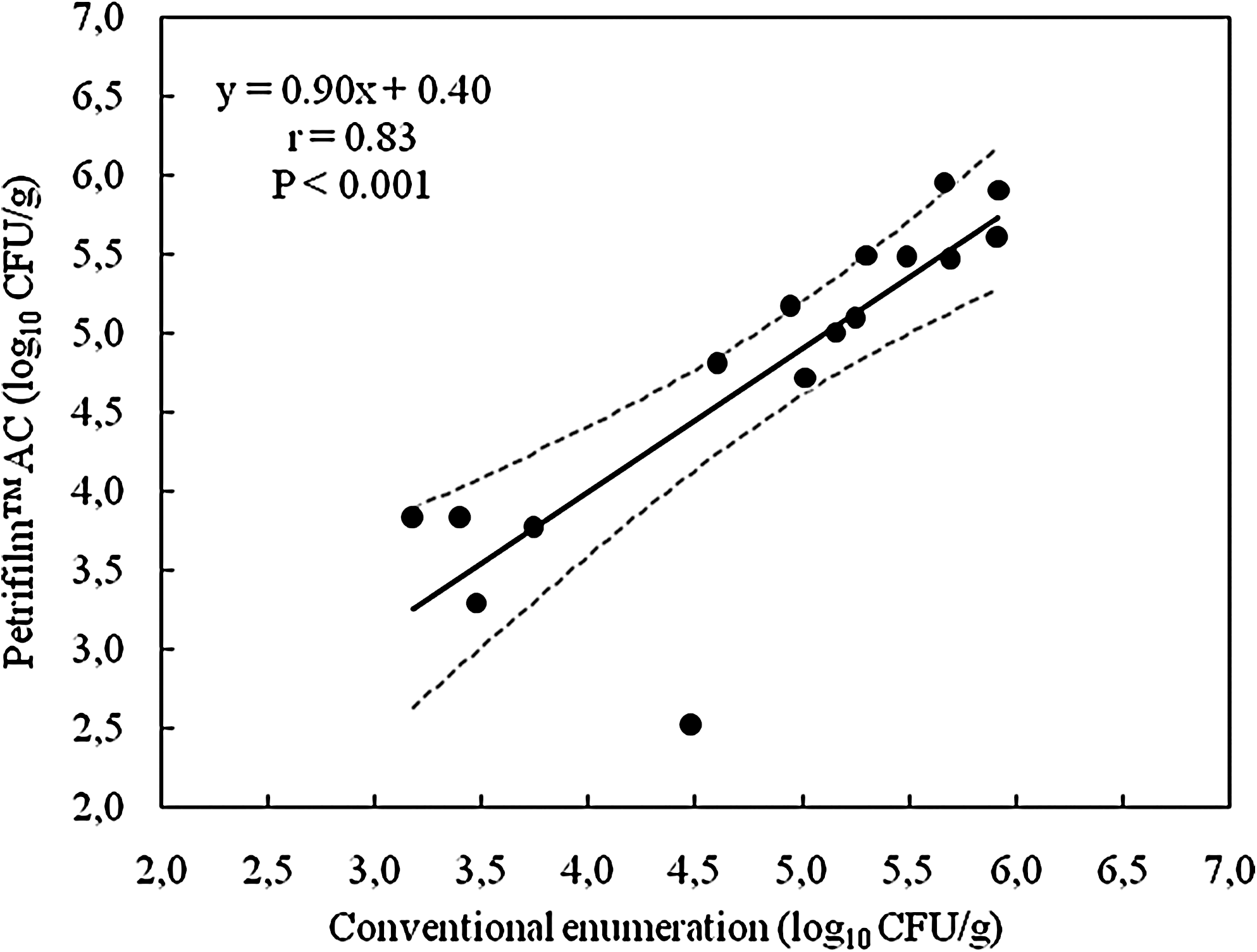
Correlation between mesophilic aerobe counts of grated cheese obtained by conventional methodology, plate count agar, and Petrifilm™ AC. r, correlation index; p = level of significance.
The results indicate that commercialized, grated cheese purchased in the Federal District is considered adequate for consumption when the official microbiological criteria are only considered. However, the samples presented high levels of hygiene indicators that are not considered in the Brazilian legislation, and these hygiene indicators imply failures in production and inspection that are not detected using the official microbiological criteria. The alternative methods used in the present microbiological analysis provide good performance in the microbiological evaluation of grated cheese; these methods require further studies to verify their limitations and potential applications. The results obtained in this study indicate the significance of proper hygienic control during the production of grated cheese to avoid final product contamination by spoilage and pathogenic microorganisms.
Footnotes
Acknowledgments
This study was supported by CAPES and CNPq. L.A. Nero was supported by CNPq and FAPEMIG.
Disclosure Statement
No competing financial interests exist.