




Abstract
Recent epidemiological evidence has demonstrated that pork is an important source of yersiniosis in humans. Identifying risk factors and potential interventions in swine production that may decrease the risk of pork production contamination during harvest and processing is an important step before controlling Yersinia spp. Therefore, management strategies and production processes that might be associated with fattening pigs testing seropositive for pathogenic Yersinia spp. were investigated in 80 fattening pig farms. Although >70 farm characteristics were included in the risk assessment, there were only a few that seemed to be connected with serological prevalence: housing on a fully slatted floor and the use of municipal water were observed more often in herds with low serological Yersinia prevalence, whereas recurring health problems and a low daily weight gain compared with the mean of the herds included in the study were found in herds with a high prevalence. Besides, the Yersinia prevalence seemed to be inversely proportional to the herds' serological Salmonella status collected in accordance with German legislation. Additionally, the development of the serological Yersinia status of selected herds was assessed over a period of a year to gain knowledge of the dynamics of Yersinia infections in fattening pig herds. Three out of four serological negative herds maintained a low level of Yersinia prevalence, whereas one herd shifted between negative status and a prevalence of 100%. The reason for these considerable fluctuations could not be explained, and there was no direct association with the analyzed risk factors. Further research should be carried out to prove the given risk factors, especially the possible relation to the Salmonella prevalence before implementing a combined zoonoses surveillance and control program.
Introduction
Rodents, lagomorphs, and birds are the major reservoir of Y. pseudotuberculosis (Bockemuhl and Roggentin, 2004). Pigs were also identified as regular carriers of the agent, but variations have been observed in the prevalence in slaughtered pigs from different countries. Depending on the region, up to 17% of the slaughtered pigs turned out to be bacteriologically positive (Laukkanen et al., 2008; Ortiz Martinez et al., 2009, 2010). Studies on the prevalence of Y. pseudotuberculosis in German pigs are rare. Weber and Lembke (1981) were able to isolate the agent from the feces of five samples of 631 healthy slaughter pigs, whereas a prevalence of 6% was reported from tonsils (Weber and Knapp, 1981). Information about the current epidemiological situation in Germany is missing. Human outbreaks have not yet been reported. There is a lack of studies about the prevalence of Y. pseudotuberculosis in pork.
Serological testing is preferable to bacteriological methods on the basis of practicability, time-saving aspects, and costs. It can be used as a monitoring tool, indicating exposure to Yersinia spp. at one point during production. There is a strong association between positive tonsil culture and seropositivity (Nielsen et al., 1996; Nesbakken et al., 2003), whereas serological results did not correlate to bacteriological findings in feces (von Altrock et al., 2006).
Virulence of pathogenic Yersinia spp. (Y. pestis, Y. pseudotuberculosis, and pathogenic Y. enterocolitica) is strictly associated with the presence of the 70-kb virulence plasmid, called pYV (Cornelis et al., 1998). This plasmid encodes the secretion of Yersinia outer membrane protein (YOPs), whereby investigations into antibodies based on YOPs present a broad diagnostic tool to detect pathogenic Yersinia infected pigs on the farm (Hensel et al., 2004).
Y. pseudotuberculosis as well as Y. enterocolitica are not detectable in all pigs, and also antibodies against Yersinia spp. cannot be found in all pig herds (von Altrock et al., 2006). Identifying farm factors associated with the occurrence of Yersinia infections in pigs is the first step toward controlling these pathogens in the pork production chain.
The objective of the current study was to find those herd factors associated with the detection of antibodies against pathogenic Yersinia antigens in fattening pigs and to prove these herd-related factors with a follow-up study.
Materials and Methods
Sample collection and analysis
Serological results of two studies were taken to identify risk factors for the prevalence of Yersinia spp. in fattening pig herds. Altogether, 80 conventional housed fattening herds from Lower Saxony, Germany, were included in the analysis.
During a preliminary investigation (ZiPP I=zoonoses in pork production I) in 2004, 30 fattening pig herds were visited, and blood samples were taken from 30 pigs in each herd shortly before slaughter.
Between July 2007 and June 2009, additionally 1500 blood samples from 50 fattening herds (30 pigs each) were taken during the exsanguination process in the slaughterhouse (ZiPP II).
The Yersinia status of these 50 herds was taken to select five herds with a high serological prevalence and four serological negative herds. The development of the Yersinia status of these herds was assessed by four subsequent sampling rounds (SRs). During each round, again 30 blood samples were taken during the slaughtering process. Testing was done ∼3 months apart, so that each herd was monitored for 1 year.
Detecting antibodies against Yersinia was performed by using a commercial enzyme-linked immunosorbent assay (ELISA) test based on recombinant YOPs. The Pigtype® Yopscreen ELISA was applied according to the manufacturer's instructions (Labordiagnostik Leipzig). A basic cut-off of optical density (OD%) 20 was used.
Collection of questionnaire data
Data on herd management practices were collected from all 80 herds by means of a questionnaire. The status of the Salmonella prevalence (according to the German regulation on swine Salmonella control) was obtained from a database only from 50 herds participating in the ZiPP II project, because the law was first enacted in 2007.
A standardized risk-factor questionnaire was adopted from another study (SALINPORK) (Lo Fo Wong et al., 2004) and modified to include 74 questions on herd size, housing conditions, management practice, feeding practice, and production parameters (Table 1). In total, 30 herds were visited, and herd owners were interviewed in person. Owners of those 50 herds, from which samples had been taken at the slaughterhouse, were interviewed by the veterinary surgeon from the herd management service. At the time of questioning, the Yersinia status of the herds was unknown.
Only 50 herds.
Statistical method
The number of serological positive pigs and the within-herd prevalences from both studies were compared with each other. The distribution of the prevalences and other quantifiable characteristics from the questionnaire were compared by means of Wilcoxon's rank-sum test. The distribution of the dichotomous results (categories yes/no) from the questionnaire was compared by using Pearson's chi-square test for homogeneity. Serological results were then combined with the information from the questionnaire. Since the serological prevalence within the herds represented a bimodal distribution, the herds were divided into those with low within-herd prevalence (≤20% of the tested pigs were positive) and those with high within-herd prevalence (>20% were positive). Since sampling time, interviewer and some characteristics of the herds from ZiPP I and ZiPP II differ significantly, those effects were accounted in a multivariate logistic regression model:
To test the influence of the studies and the dichotomous characteristics, odds ratios and Wald chi-square tests were performed. For comparing the herds' Salmonella categories with the Yersinia prevalence, statistical analysis was performed for each category (category I: ≤20% serological Salmonella positive, category II: >20% up to 40% serological Salmonella positive, category III: >40% serological Salmonella positive) in a first step. In a second step, those herds that fell into the categories II and III were merged into one category, because of the limited number of herds (n=8). Statistics were mainly calculated by using SAS v. 9.1. Only the multivariate logistic regression model was calculated in R (v. 2.13.0) by using function gml() (R.DevelopmentCoreTeam, 2011). Differences in the frequency distribution were considered statistically significant if p≤0.05.
Results
Altogether, 64.1% (n=1.540) of the tested pigs were serological Yersinia positive (ZiPP I: 63.7% [n=574], ZiPP II: 64.4% [n=966]). The average within-herd prevalence was 66.9% in ZiPP I and 64.4% in ZiPP II. The within-herd prevalence varied from 0% to 100%. About 16.3% (n=13) of all herds had no serological reactors. Most herds had a seroprevalence above 90% (52.5%, n=42) (Fig. 1). Twenty-five percent (n=20) of the investigated herds were merged into the category “within-herd prevalence ≤20%,” and 75% (n=60) of the herds belong to the category “within-herd prevalence >20%.”
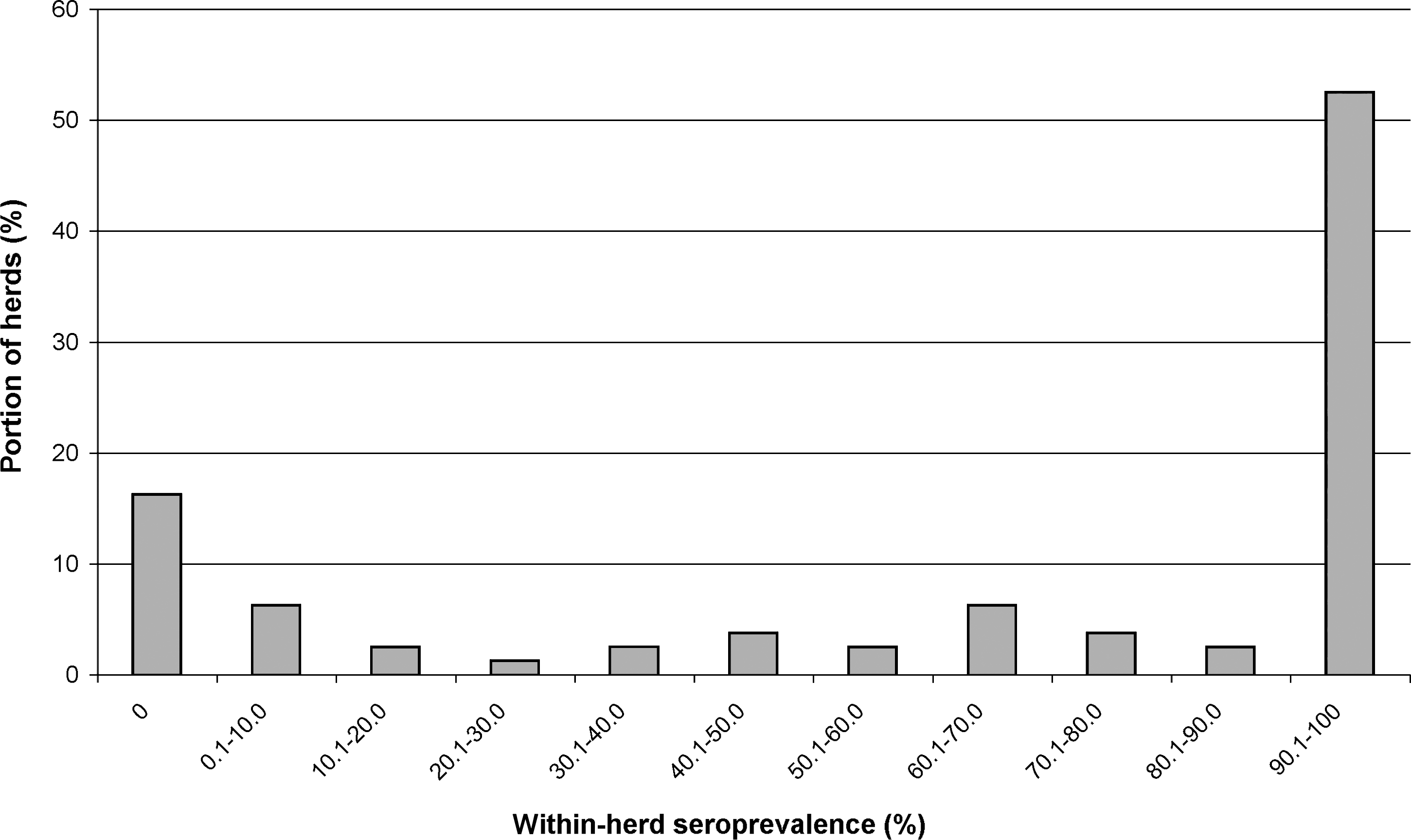
Frequency distribution of within-herd Yersinia seroprevalence of 80 fattening pig herds.
The comparison of the recorded herd characters from both studies showed that feeding particularly differed significantly in both studies. In herds of ZiPP I, liquid feed (63% vs. 16%), powder feed (90% vs. 68%), and acid supplementation in feed or water (60% vs. 26%) was significantly used more often than in those of ZiPP II. Additionally, farmers of ZiPP II herds more often exclusively watered their pigs with municipal water than farmers of ZiPP I herds (37% vs. 60%). The mean herd size of ZiPP I was significantly larger than in ZiPP II (1322 vs. 910), but the mean daily weight gain of the fattening pigs was less in ZiPP I (685 vs. 726 g).
Although more than 70 parameters were gathered from each herd for risk analysis, only four herd factors were associated with the serological prevalence of Yersinia spp. (Table 2). Further comparison concerning these four factors showed no statistical influence of ZiPP I/ZiPP II when included into the multivariate logistic regression model (Table 2). Herds that had been housed on fully slatted floors and which offered municipal water to the fattening pigs mainly indicated low within-herd Yersinia prevalence. In contrast, in herds with high within-herd prevalence, recurring health problems were recorded more often, and the daily weight gain was inferior to those herds with low Yersinia prevalence.
Used multivariate logistic regression model in R: outcome <-glm (YersiniaPrevalence ∼ ZiPPStudy+X, family=binomial).
OR, odds ratio; CI, confidence interval; ZiPP, zoonoses in pork production.
Besides, herds with a low serological Yersinia prevalence were significantly more often classified in Salmonella status II (moderate Salmonella prevalence) or III (unsatisfactory Salmonella prevalence) (Table 3).
The development of the serological Yersinia status during the follow-up study is shown in Figures 2 and 3. Three of the four primarily negative herds remained at a very low level with a maximum of three positive samples (10%) at one SR. Remarkable results were gained from herd 28, where the serological prevalence shifted between that of a negative status and a prevalence of 100% (Fig. 2). The herds that had been categorized as highly positive remained so during the whole year. The lowest prevalence reached was 46.7% reactors (Fig. 3).
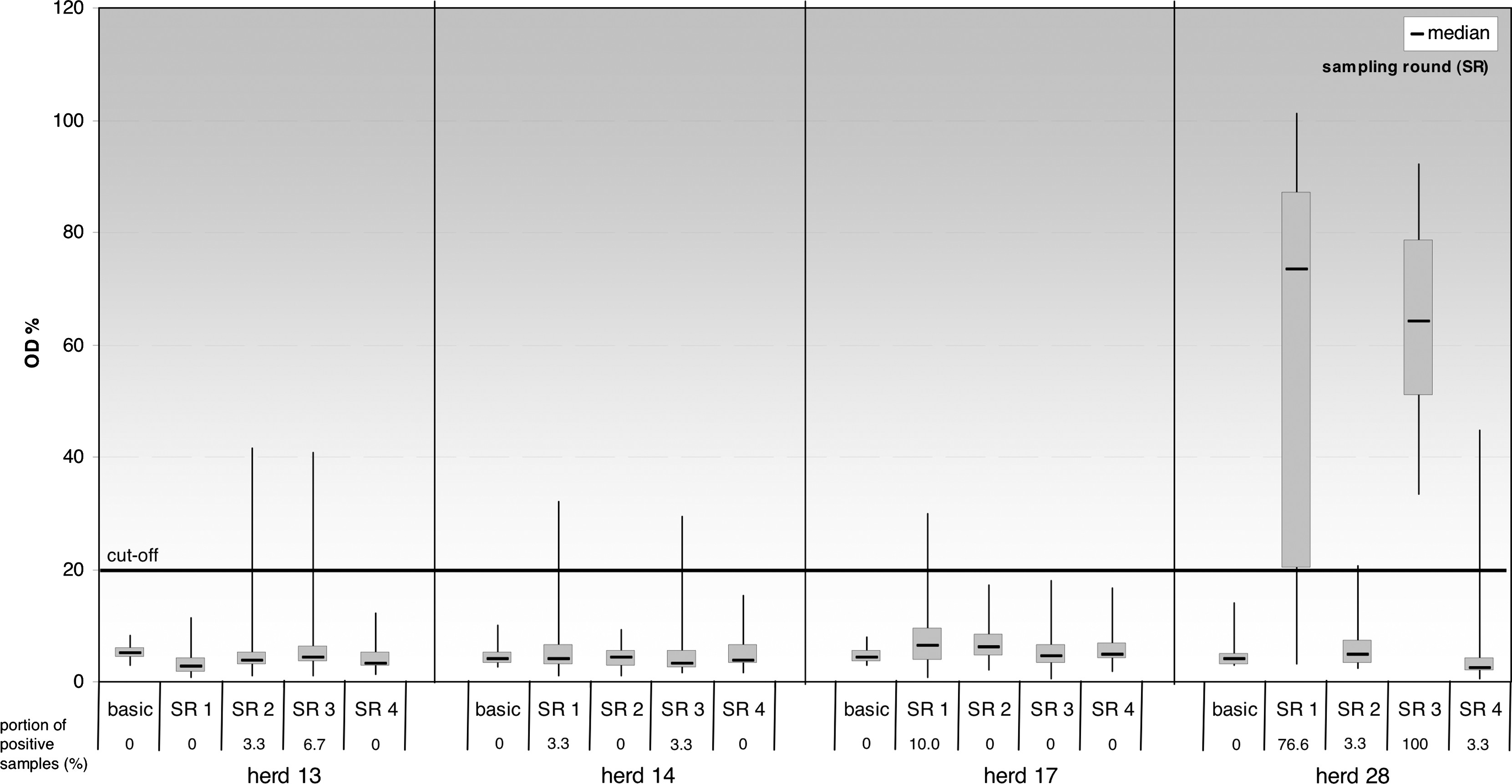
Box- and whisker-plots of the serological results from the repeated investigation of initially negative pig herds.
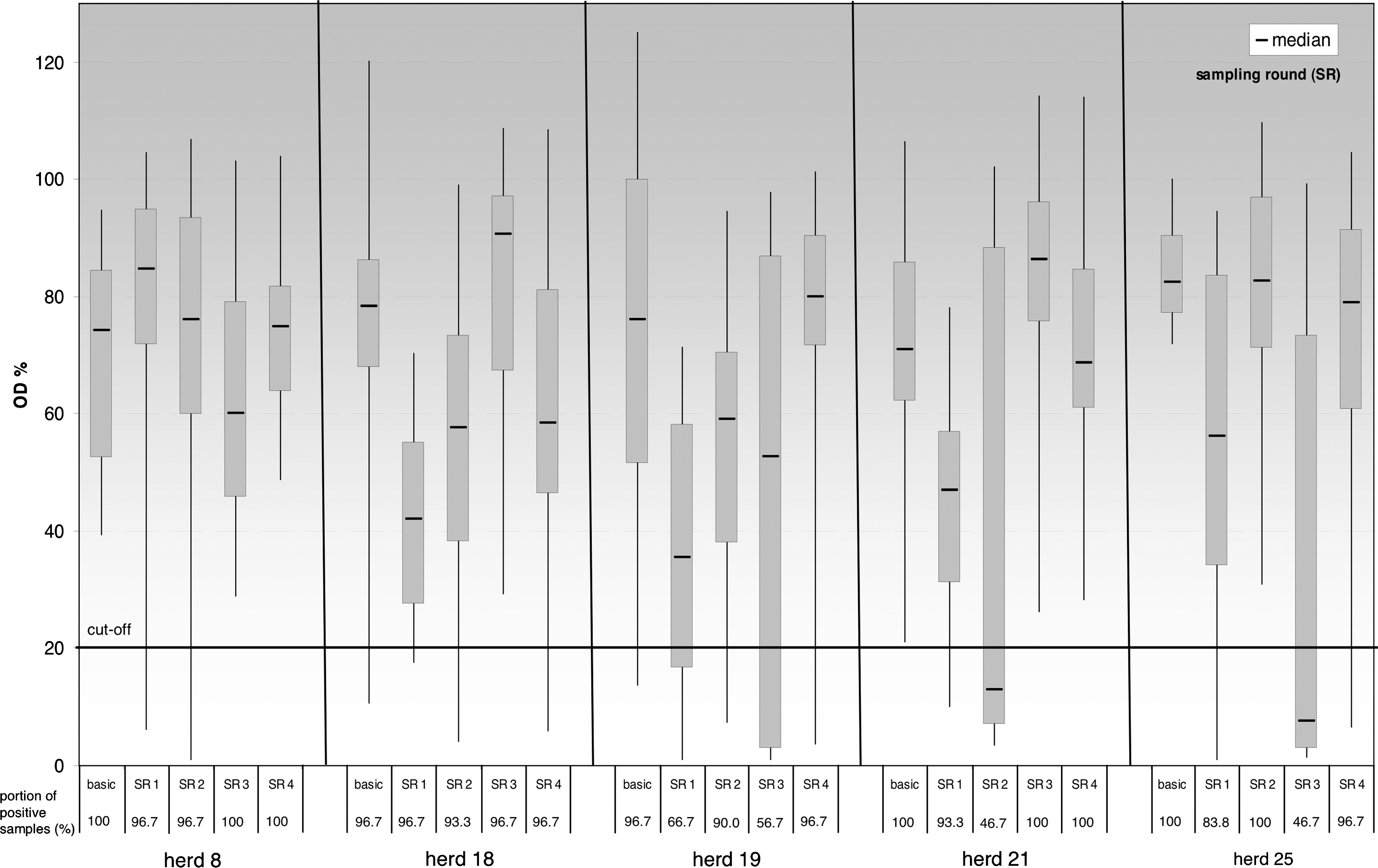
Box- and whisker-plots of the serological results from the repeated investigation of initially high positive pig herds.
To verify the risk factors analyzed in the main study, the occurrence of those herd characteristics were especially regarded in the follow-up study (Table 4). The presence of fully slatted floor is the only factor that consistently occurred in herds with a constant low serological prevalence, whereas the other factors cannot be assigned to a certain serological status.
Not reported.
Discussion
The purpose of the current study was to find factors on herd level influencing the serological prevalence of Yersinia spp. in fattening herds and to prove the consistency of these factors by carrying out repeated serological investigations in some selected herds.
Bacteriological findings in feces of finishing pigs on 20 farms showed that 80% of these farms had at least one animal infected with Y. enterocolitica (Pilon et al., 2000). These findings correlate with the serological results in the presented study, in which 83.7% of the herds were Yersinia positive. Relating to the number of infected pigs, there were 64.2% serological positive animals. In a Canadian study, 66% of the pigs sampled at a slaughterhouse showed serological evidence of previous infection (Thibodeau et al., 2001). Bacteriological findings of pathogenic Y. enterocolitica in tonsils of slaughtered pigs in Germany confirm these data (Fredriksson-Ahomaa et al., 2001).
The applied ELISA cannot distinguish between infections with pathogenic Y. enterocolitica, Y. pestis, or Y. pseudotuberculosis. Y. pestis, the etiological agent of plague, is not found in Europe, but pigs as carriers of Y. pseudotuberculosis were described. Their prevalence increases, especially in production systems where pigs come into contact with the outside environment, such as during organic production (Laukkanen et al., 2008). However, pathogenic Y. enterocolitica was found more frequently in pigs and especially in conventional housed pigs (Nowak et al., 2006). It can be assumed that the presented serological findings were mainly the result of infection with Y. enterocolitica, although an infection with Y. pseudotuberculosis cannot be completely ruled out.
Y. enterocolitica is transmitted by infected feces or picked up from the floor of a contaminated pen (Fukushima et al., 1983). In contrast to herds kept on a fully slatted floor, which had a rather low rate of positive serological testing, herds kept on a partially slatted and solid floor more often had a high rate of prevalence. This result might be explained by the constant contact to the feces on these types of floors, a condition that might be aggravated by the analyzed risk factors “recurring health problems in the herd” and “comparatively low daily weight gain.” A low daily weight gain might be the consequence of recurring health problems, because illness causes inadequate feed intake and weight loss, for example, diarrhea. Diarrhea might lead to an increased shedding of the agent, thus causing a spread of the infection on the farm. Unfortunately, the information concerning the cause of health problems was invalid for analytical purposes. Virtanen et al. (2011) detected a relation between higher carriage and shedding prevalence of Y. enterocolitica with the use of tetracycline. They also speculated that the need for tetracycline on farms reflected the lower health status of pigs on these farms, which was consequently associated with the Y. enterocolitica prevalence.
Further, herds exclusively using municipal water showed a rather low within-herd prevalence. Using this water was also discovered to be a protective factor for carriage and fecal shedding of Y. enterocolitca in pigs (Virtanen et al., 2011). Unfortunately, in both studies, contamination of water from own wells or other sources was not bacteriologically proved. Case-controlled studies in humans have identified the drinking of untreated water as a risk factor for Y. enterocolitica infection, but strains mainly belong to biotype A (Sharma et al., 2003), which do not carry the virulence plasmid and are considered as nonpathogenic. A coherence between drinking untreated water from wells and streams and a infection with Y. pseudotuberculosis was described in Japan (Fukushima, 1992; Inoue et al., 1988). Nevertheless, the findings of Laukkanen et al. (2009) might also be connected with drinking water. They found “drinking from a nipple” and “wet feeding” to be risk factors associated with a high bacteriological prevalence of Y. enterocolitica in slaughtered pigs (Laukkanen et al., 2009). Although “wet feeding” was also included in the presented analysis, it could not be demonstrated as a risk factor.
The serological prevalence of Yersinia seemed to be inversely proportional to the serological Salmonella status of the herd. Especially regarding the parallelism concerning the infection route, the association between Salmonella status and Yersinia prevalence was surprising. However, the statistical analysis could give misleading results, because of the very small sample sizes (n=6 and n=2). Competitive exclusion of one pathogenic Yersinia serotype by another has been observed in pigs (Fukushima et al., 1984). Nonetheless, there are no hints in the literature of displacement of Salmonella spp. by Yersinia spp. during colonisation. For this, the result has to be proved in further studies, because of the consequences of a possible introduction of a combined zoonotic control programme for Salmonella and Yersinia.
In the presented study, only fattening herds were investigated that were found to have a higher prevalence of antibodies to Yersinia than conventional farrow-to finish herds (Skjerve et al., 1998). The suggested beneficial effect of integrated or closed herds might have been included in the question relating to the number of suppliers, but there was no association with seropositivity. Skjerve et al. (1998) also demonstrated under-pressure ventilation and manual feeding of slaughter pigs to be protective factors, whereas using own vehicles for transporting animals to the abattoir, keeping clean and unclean sections in herds separate, using straw, and daily observations of a cat with kittens increased the risk. Other farm factors associated with high bacteriological prevalence of Y. enterocolitica were the absence of coarse feed, bedding, the production capacity, and no access of pest animals to pigsty (Laukkanen et al., 2009).
Not all these factors were requested in the presented study, but the use of own transport for slaughter pigs, contact with other farm animals or pets on the farm, and herd size were not apparent risk factors.
The follow-up study was performed to prove the stability of an initially appointed Yersinia status and to prove the results of the risk factor study in a first overview. All initially positive herds stayed at a high positive level, and three of the four initially negative herds remained at a low level. These results argue for a relatively steady status in the herds, as a result of which the initially recorded herd factors also did not change.
The results of a serological investigation of 16 specific pathogen-free breeding herds also indicated that it is possible to establish a cluster of pig herds free from Y. enterocolitica O:3, and to keep the herds free from such infections for many years (Nesbakken et al., 2007). The hygienic measures in those closed herds is far stricter than in the investigated fattening herds, for example, isolation from other herds, showering of personnel before entering the housing. Besides, the herd size was relatively low with 20 to 150 breeding sows in comparison with the number of fattening pigs in the examined herds. Therefore, those factors do not seem to be the reason for the serological status. Regarding the analyzed influencing factors on the Yersinia status, the only consistent factor was the “fully slatted floor” in the negative herds 13, 14, and 17, which was not reported in the five positive herds. Moreover, this herd factor did not exist in the initially negative herd 28. All pigs came from the same farrow-to-feeder farm for years, they were housed in the same units, and changes in the initial documented herd factors were not performed; thus, it remained unclear as to why there was a repeated shift from high to low seropositivity.
Conclusion
The presented study demonstrates herd factors that seem to have an influence on the serological prevalence of Yersinia spp. in fattening herds. Nevertheless, the results of the additional follow-up study show that there should have been other factors which were not taken into consideration. Although the low number of involved herds in the follow-up study does not countervail against a statistical proof, the results require further investigations into the introduction and spread of Yersinia spp. in fattening herds.
Footnotes
Acknowledgments
The authors gratefully acknowledge Martin Beyerbach, Department of Biometry, Epidemiology, and Information Processing, University of Veterinary Medicine, Hannover, for the description of the statistical methods and for assistance with the statistical analysis. They thank Andreas Briese, Bri-C Veterinaerinstitut, Sarstedt, for his valuable contributions in the verification of the presented data. They wish to thank Frances C. Sherwood-Brock, English Editorial Office, University of Veterinary Medicine, Hannover Foundation, for her help with proofreading the manuscript. The study was financially supported by the Federal Agency for Agriculture and Food on behalf of the German Federal Ministry for Food, Agriculture, and Consumer Protection.
Disclosure Statement
No competing financial interests exist.