




Abstract
Cattle are asymptomatic reservoirs for Escherichia coli O157, a major foodborne pathogen. The organism generally colonizes the hindgut of cattle and is shed in the feces at low concentrations. The objective of this research was to evaluate a multiplex, real-time polymerase chain reaction (mqPCR) assay for quantification of E. coli O157 in cattle feces using stx1, stx2, and rfbE gene targets. Primer efficiency and analytical sensitivity of the assay were evaluated with a single or pooled (five strain) culture of E. coli O157. In pure culture, the minimum detection limit of the assay was 1.4×10³ CFU/mL and 3.6×10³ CFU/mL for the single and five-strain mixture of E. coli O157, respectively. Diagnostic sensitivity was analyzed using DNA extracted from cattle feces spiked with E. coli O157. In feces spiked with the pooled mixture of five E. coli O157 strains, the minimum detection limit was 3.6×10⁴ CFU/g. We also evaluated the assay with feces from cattle experimentally inoculated with E. coli O157 by comparing the results to a culture-based method. For the majority of samples tested, the concentration of E. coli O157 detected by the real-time and culture methods was within one log difference. However, the assay could only be evaluated for cattle shedding high concentrations of E. coli O157. In conclusion, the mqPCR quantifying E. coli O157 in cattle feces using stx1, stx2, and rfbE gene targets may have use in detecting and quantifying super shedders, but is not applicable for quantification in animals shedding low concentrations (102 to 103 CFU/g feces).
Introduction
E
Traditionally, detection of E. coli O157 in cattle fecal samples has been done using enrichment and culture in selective media (with antibiotics), with an intermediate step of immunomagnetic bead separation (IMS; Omisakin et al., 2003; Vali et al., 2007; Fox et al., 2008; Jacob et al., 2010; Walker et al., 2010). After isolates are obtained in pure culture, they are usually tested for agglutination with an anti-O157 antigen and confirmed by PCR for virulence genes (Bai et al., 2010). The IMS method is sensitive; however, it does not allow for quantification of the organism. Occasionally, a technique using most probable number (MPN) calculations has been used after IMS for quantification of E. coli O157 (Fox et al., 2007; Stephens et al., 2007). In addition, direct or spiral plating methods have often been used to categorize super shedders or directly enumerate E. coli O157 in cattle fecal samples (Fox et al., 2007, 2008; Arthur et al., 2009; Jacob et al., 2010). The culture-based methods are time consuming and expensive, and are generally logistically cumbersome for a large number of samples.
Molecular methods to quantify E. coli O157 could overcome many of the limitations of culture-based assays, particularly high-throughput capabilities. Multiplex real-time polymerase chain reaction (mqPCR) assays have previously been developed to detect E. coli O157 from food matrices (Fitzmaurice et al., 2004; Wang et al., 2007) and fecal samples (Ibekwe and Grieve, 2003; Sharma and Dean-Nystrom, 2003; Fitzmaurice et al., 2004); however, their applications have been limited. Genes that have been targeted include stx1 and stx2, eae, or a serotype O157-specific rfbE gene (Fortin et al., 2001; Sharma and Dean-Nystrom, 2003; Bertrand and Roig, 2007). However, no assay has previously utilized rfbE, stx1, and stx2 concurrently, which would detect the O157 antigen, as well as either or both Shiga toxin genes, in a single assay for quantification. The objective of this research was to evaluate an mqPCR assay to quantify E. coli O157 in cattle fecal samples using stx1, stx2, and rfbE genes as targets.
Materials and Methods
Primer and probe design
The primers and probes chosen for inclusion in this assay were based on unique sequences in the stx1 subunit A (stx1A), the stx2 subunit A (stx2A), and the rfbE gene from the E. coli O157:H7 EDL 933 strain. These three gene sequences were used in Beacon Designer software from PREMIER Biosoft with the Taqman design function to identify potential primer and probe candidates. The possible candidates were evaluated against stx1A (165), stx2A (335), and rfbE (19) sequences available at the time of assay development. The primer and probe candidates with the most matched sequences were selected for further analysis (Table 1) including their ability to amplify in the multiplexed condition.
Bacterial strains and development of standard curves
All media used in these experiments were Difco brand (BD) unless otherwise noted. A single strain of E. coli O157 (ATCC 43894), which is positive for stx1 and stx2, was used in pure culture and spiked fecal sample experiments. The strain was grown from frozen stock on blood agar plates (Remel) overnight at 37°C. A single colony of the strain was grown in Luria-Bertani (LB) broth for 16–17 h, and then 100 μL was inoculated into 10 mL LB, incubated for 4–5 h, boiled for 10 min, and centrifuged at 9,000 RCF for 5 min to obtain crude DNA template. To test primer and probe efficiencies and generate standard curves for the three gene targets in the mqPCR, the E. coli O157 strain was grown as described above and serially diluted 10-fold in ddH2O for DNA extraction. In addition, known 10-fold concentrations of the strain were spiked into cattle feces, thoroughly mixed with sterile wooden sticks, and subjected to DNA extraction using the QIAamp DNA Stool Mini Kit (QIAgen). Fecal samples spiked with known concentrations were also enriched for 6 h at 37°C (Bai et al., 2011). DNA was extracted using the GeneClean DNA extraction kit (MP Biomedicals) and evaluated by mqPCR.
A five-strain mixture of E. coli O157 (FRIK 920; FRIK 1123; FRIK 2000; 01-2-8970; 01-2-12329) originally isolated from cattle feces (Kim et al., 1999; Sargeant et al., 2003) and made resistant to 50 μg/mL nalidixic acid (Nal R E. coli O157:H7) was grown individually and then pooled together. All five isolates were positive for stx2, and four of the five were positive for stx1. Standard curves were generated for pooled bacterial culture and for spiked feces as described above, except DNA was extracted with either QIAamp DNA Stool Mini Kit or GeneClean kit.
The initial concentrations of E. coli O157:H7 strains used as pure cultures or for spiking fecal samples were determined by spread-plating inocula from 10-fold dilutions of the single or pooled cultures on sorbitol-MacConkey agar plates.
Evaluation of mqPCR with non-O157 STEC
Pure cultures of six non-O157 STEC (O26, O45, O103, O111, O121, and O145) were grown individually as described for the O157 strain, and pooled together with and without ATCC 43894. Crude DNA template was prepared by the boiling method described earlier. One microliter of each pooled culture (six non-O157 strains or six non-O157 strains + O157 strain) was used as a template in the mqPCR assay to evaluate the specificity of rfbE target.
Real-time PCR running conditions
Working concentrations of all primers and probes were 10 pM/μL. The real-time PCR reaction contained 1 μL of the working concentration of all primers and probes, mixed with 12.5 μl of 2×BioRad iQ supermix, 2.5 μL ddH2O, and 1 μL of DNA template to make a total reaction volume of 25 μL. The amplification protocol used was 95°C for 10 min, followed by 45 cycles of 95°C for 15 sec, 56°C for 20 sec, and 72°C for 40 sec. Optimal primer and probe concentrations were determined by evaluating different dilutions of each primer/probe combination for each of the gene targets. Assays were run using the Bio-Rad iQ5 or ABI-7500 (Applied Biosystems by Life Technologies) real-time PCR machine in a 96-well plate format. Samples used to generate standard curves and evaluate efficiency were run in triplicate while all other sample types were run in duplicate.
Feces spiked with single or pooled E. coli O157:H7 cultures
The feces for spiking with single and pooled cultures of E. coli O157 were obtained from Holstein steers maintained on a forage-based diet. Fecal samples were tested and confirmed to be E. coli O157 culture negative (Jacob et al., 2010).
Feces from steers experimentally inoculated with pooled cultures of E. coli O157
Feces from Holstein bull calves (n=15) that were inoculated orally, via a stomach tube, with the same five-strain mixture of NalR E. coli O157:H7 described above were collected. DNA was extracted using the QIAamp DNA Stool Mini kit from samples collected 2, 5, and 7 days after inoculation. A subset of these samples (n=13) from cattle shedding known concentrations of the organism (as determined by culture-based enumeration; Jacob et al., 2008) was subjected to the mqPCR assay for quantification of E. coli O157. Only samples (n=13) with an E. coli O157 concentration enumerable by direct plating were considered for comparison with mqPCR in this study. In addition, we included fecal samples from cattle that were culture negative (n=13) or shown to be low shedders (n=12) of E. coli O157 (<103 CFU/g feces). The concentration of E. coli O157 was determined by averaging the Ct values obtained from all three gene targets and using the average standard curve, and using individual Ct values generated from each gene target.
Results
Real-time analyses with pure cultures
The initial concentration of E. coli O157 in pure culture, used to generate standard curves, was 1.4×10⁷ CFU/mL; the minimum detection limit of the assay was 1.4×10³ CFU/mL (Fig. 1A). The initial concentration of the pooled five-strain mixture of E. coli O157 used to generate standard curves was 3.6×10⁷ CFU/mL; the minimum detection limit of the assay was 3.6×10³ CFU/mL (Fig. 1B). The correlation coefficients were >0.99 for both the single-strain and the five-strain pooled mixture of E. coli O157. The PCR efficiencies were within 97–101% (slope −3.3 to −3.4) and 90–96% (slope −3.4 to −3.6) for the single and five strains, respectively (Table 2).
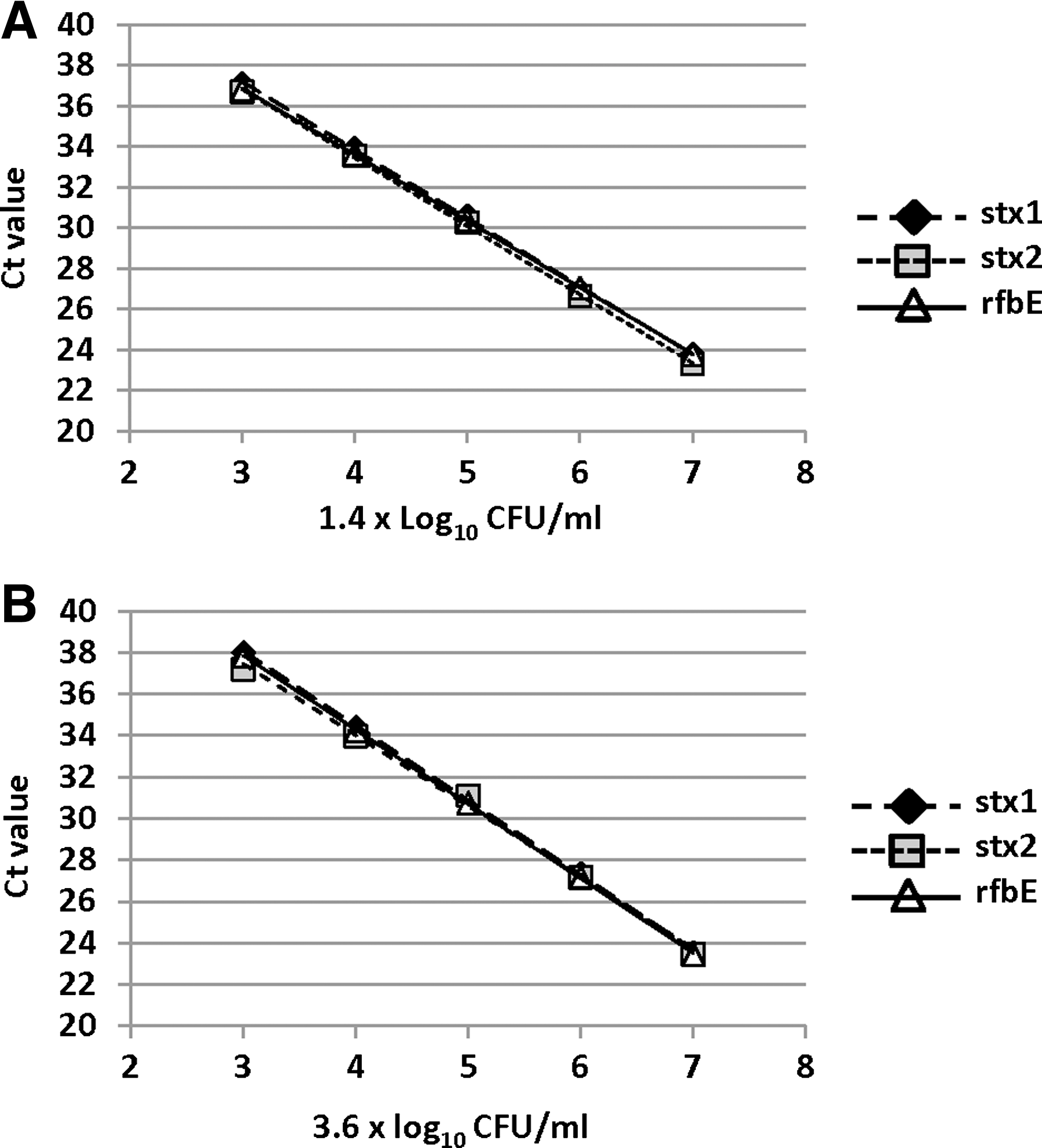
Standard curves generated for the multiplex real-time polymerase chain reaction detecting stx1, stx2, and rfbE genes of Escherichia coli O157 grown in pure culture. The initial concentration of E coli O157:H7 ATCC 43894
Pure culture or inoculated feces with a single strain of E. coli O157:H7 ATCC 43894.
Pure culture or inoculated feces with five strains (FRIK 920; FRIK 1123; FRIK 2000; 01–2-8970; 01-2-12329).
PCR, polymerase chain reaction.
When pure cultures of six non-O157 STEC were pooled and evaluated by real-time PCR without the addition of E. coli O157, we obtained no detectable rfbE concentration, with stx1 and stx2 being present at slightly higher Ct values (0.3 Ct higher for stx1, 0.4 Ct higher for stx2) than the pooled sample containing six non-O157 STEC and E. coli O157 (Table 3).
Pure cultures of six non-O157 Shiga toxin–producing E. coli serotypes (O26, O45, O103, O111, O121, and O145).
Pure cultures of six non-O157 Shiga toxin–producing E. coli serotypes (O26, O45, O103, O111, O121, and O145) plus E. coli O157:H7 (ATCC 43894).
Real-time analyses of cattle feces spiked with a single or pooled cultures of E. coli O157
Feces spiked with single- or five-strain pooled culture of E. coli O157:H7 contained 5.7×10⁷ CFU/g and 3.6×10⁷ CFU/g, respectively. The predicted minimum detection limits of the assays were 5.7×10³ CFU/g and 3.6×10⁴ CFU/g for the GeneClean extraction using single- and five-strain pooled cultures of E. coli O157 inocula, respectively (Table 2). In addition to the GeneClean extraction, QIAamp DNA extraction was also evaluated on feces inoculated with five strains of E. coli O157. The predicted minimum detection limit with QIAamp DNA extraction was 3.6×10⁵ CFU/g, which is one-log higher than the GeneClean kit. Standard curves resulted in correlation coefficients of >0.99 for single-strain spiked feces, and >0.98 and >0.93 for five-strain spiked feces extracted by GeneClean and QIAamp, respectively. The PCR amplification efficiencies ranged from 93% to 101% (slope=–3.4 to −3.6) for one-strain spiked feces, and 83–91% (slope=–3.4 to −3.8) and 89–91% (slope=–3.5 to −3.6) for five-strain spiked feces with GeneClean and QIAamp DNA extractions, respectively (Table 2). When a single-strain culture of E. coli O157 was spiked into cattle feces and enriched for 6 h, the detection limit of the assay was 2.5×101 CFU/g of feces with an amplification efficiency of 95–98% (−3.4 slope) and 0.99 correlation coefficient.
Real-time analyses of feces from cattle experimentally inoculated with E. coli O157
Table 4 contains the E. coli O157 concentration of each of the fecal samples as determined by culture-based method, the three individual gene targets, and the average of the three gene targets in the mqPCR assay. In the 13 samples from calves experimentally inoculated with NalR E. coli O157, the E. coli O157 concentrations ranged from 3.7 to 5.2 log10 CFU/g of feces (Table 4). When the average of three genes was used to determine the E. coli O157 concentration, the range obtained from the mqPCR assay was 2.9–5.2 log10 CFU/g of feces. For 10 of 13 fecal samples tested, the mean concentrations of E. coli O157 determined by mqPCR (calculated by the average of three genes) assay were higher than the mean concentration of E. coli O157 determined by plating (Table 4) and the median difference in concentration was 0.4 log10 CFU/g of feces. The range of stx1 genes obtained from fecal samples was 2.9–5.2 log10 CFU/g feces, with 9 of 13 samples with a higher concentration than that determined by culture methods; the median difference in the concentration of E. coli O157 was 0.4 log10 CFU/g of feces. The range of stx2 genes was 3.8–5.8 log10 CFU/g feces; 11 of the 13 fecal samples had a higher concentration of stx2 genes than E. coli O157 as determined by culture with a median difference of 0.9 log10 CFU/g of feces. The range of rfbE genes detected in fecal samples was 2.0–5.0 log10 CFU/g feces (Table 4). The median difference in the concentration of E. coli O157 as detected by rfbE and culture was −0.2 log10 CFU/g of feces with 4 of 13 samples being a higher concentration with mqPCR.
Collection day represents the number of days following oral inoculation of calves with E. coli O157.
Determined by spread plating onto selective medium.
DNA was extracted using the QIAamp DNA Stool Mini Kit.
Ct values are averages of replicates.
For all fecal samples that were negative for E. coli O157 after selective enrichment and IMS, we obtained no positive signal for rfbE, stx1, or stx2 (data not shown). For the 12 fecal samples collected from cattle experimentally inoculated with E. coli O157 and considered to be low shedders after enumeration, the concentration ranged from 1.5 to 3.4 log10 CFU/g of feces as determined by culture methods. Briefly, 11 of 12 samples were negative for rfbE and stx2, while all 12 samples were negative for stx1. For the sample where a positive signal was detected, the concentration of E. coli O157 obtained by culture was the highest (3.4 log10 CFU/g of feces), yet the Ct values for rfbE and stx2 were both 38.2. This was the only sample where a positive signal was detected.
Discussion
This study describes a three-gene mqPCR designed to quantify E. coli O157 in cattle feces and potentially be useful in identifying the super shedders (e.g., >104 CFU/g). The predicted detection limit of E. coli O157 with DNA extracted directly from cattle feces is approximately 104–105 CFU/g feces. Although this detection limit is high for routine quantification of E. coli O157 from cattle feces, it was not unexpected given PCR technology would require ∼104 gene copies per gram of feces (∼10 gene copies per reaction) for reliable amplification. Sample matrix (cattle feces) complexity and the DNA extraction efficiency can also alter assay sensitivity. Because of these limitations, the most practical application of the assay may be in cattle shedding high concentrations of E. coli O157 (i.e., super shedders). If used to categorize fecal samples as E. coli O157 positive or negative, a 6 h enrichment step, similar to what is used for culture-based detection methods, increased the sensitivity of the assay to approximately 10 CFU E. coli O157/g feces (Table 2). Our previous (Bai et al., 2010) and current study indicate that the sensitivity of conventional and real-time PCR to detect major genes of E. coli O157, including stx1, stx2, and rfbE, increased approximately 1,000 times upon a 6 h enrichment of spiked fecal samples. This sensitivity is higher than the detection limit of approximately 102 CFU/g reported for the traditional culture-based (enrichment with IMS) method (LeJeune et al., 2006). When we evaluated the mqPCR assay in calves experimentally inoculated with five strains of E. coli O157, we were evaluating samples that generally happen to have lower concentration of E. coli O157 than our predicted detection limit (Table 4). We determined the concentration of E. coli O157 in each fecal sample based on the Ct values of the three gene targets individually and by the average of all three Ct values. There were differences in the outcome concentrations between culture-based and molecular methods in our study; however, the concentrations detected by the two methods were generally within one log10 difference.
There are several explanations for the differences observed between the culture-based and the real-time PCR assay. An obvious disadvantage of real-time PCR is its inability to distinguish between viable and dead cells, which may influence the perceived concentration of E. coli O157. There are methods to ensure detection of only live cells when using real-time PCR (Wang and Mustapha, 2010), but we have not incorporated that technology into our assay. Also, small variability could be due to uneven distribution of the organism in the fecal sample taken for culture and molecular-based methods. In addition, although we designed the primers and probes based on the available E. coli O157 sequence, the assay could have amplified products that are not specific to E. coli O157. For example, stx1 and stx2 genes are present in a number of other STEC and possibly fecal samples used in our studies may have contained non-O157 STEC strains (Pearce et al., 2004; Renter et al., 2007). Higher concentrations of the stx genes from other serotypes could have shifted our perceived average concentration of E. coli O157 genes higher than what was actually present, which may explain why the three genes average and stx2 concentrations were generally higher than the E. coli O157 concentration determined by culture-based method in our study. Likewise, rfbE could be expressed in organisms other than E. coli O157 positive for stx1 and stx2 (Al-Saigh et al., 2004). In addition, although we initially screened calves for the presence of naturally occurring E. coli O157, it is possible that cattle possessed this organism at the time of challenge, albeit undetected. These isolates would likely be picked up by our molecular method; however, because of the selectivity of the media (addition of nalidixic acid) we may not have recovered them with culture methods.
Several other real-time assays have been developed for the quantification of E. coli O157; ours is unique in that it targets three genes, rfbE, stx1, and stx2. Jinneman et al. (2003) developed an mqPCR assay that could detect stx1, stx2, and uidA, encoding the β-glucuronidase enzyme; the sensitivity and specificity of this assay were high based on pure cultures of E. coli O157 but applicability of the assay in a complex matrix, such as cattle feces, was not determined. Fitzmaurice et al. (2004) also targeted the two Shiga toxin genes; however, evaluation of the assay was also limited to pure cultures. Other assays have evaluated rfbE, eae, stx1, and stx2 in different combinations in pure culture and in spiked cattle feces (before or after enrichment), and have achieved a similar detection limit as our assay (Sharma and Dean-Nystrom, 2003; Bono et al., 2004; Sharma, 2006); ours is the only assay to be evaluated from cattle that were shedding the organism. Ibekwe and Grieve (2003) developed an assay to detect stx1 and eae in environmental samples, which included cattle feces. We chose to quantify the specific Shiga toxin genes (stx1 and stx2) and an O157 specific gene, rfbE, to obtain the relative concentration of all O157 strains (regardless of H7) in fecal samples. High-throughput molecular methods have many advantages to laboratories processing a large number of samples for E. coli O157 detection and/or quantification. One important advantage is minimizing the logistical constraints of a high volume of samples. In addition, it may be possible to process samples faster and with higher sensitivity than conventional, culture-based methods. Still, there are several important disadvantages to molecular detection and quantification of E. coli O157 directly from cattle feces. In molecular methods, there is no sample isolate obtained for future or follow-up work (i.e., pulsed-field gel electrophoresis), unless the positive sample is subjected to culture-based method for isolation. In conclusion, we have evaluated an mqPCR for quantification of E. coli O157 in cattle feces using stx1, stx2, and rfbE gene targets. Although the assay offers several advantages over culture-based methods in assessing E. coli O157, including high-throughput applicability with minimal logistical constraints, the sensitivity of the assay in cattle feces is low. Likely, the only application of such an assay would be in identifying and quantifying super-shedder animals.
Footnotes
Acknowledgments
The authors wish to thank Taghreed Mahmood and Neil Wallace at Kansas State University for their assistance with this project. The study was funded in part by a grant from the U.S. Department of Agriculture (2008-35201-04679).
Disclosure Statement
No competing financial interests exist.