




Abstract
Background:
In addition to medical antimicrobial usage, the use of antimicrobials in food animals contributes to the occurrence of resistance among some bacterial species isolated from infections in humans. Recently, several studies have indicated that a large proportion of Escherichia coli causing infections in humans, especially those resistant to antimicrobials, have an animal origin.
Methods:
We analyzed the correlation between the prevalence of antimicrobial resistance in E. coli isolates from blood stream infections in humans and in E. coli isolates from poultry, pigs, and cattle between 2005 and 2008 for 11 countries, using available surveillance data. We also assessed the correlation between human antimicrobial usage and the occurrence of resistance in E. coli isolates from blood stream infections.
Results:
Strong and significant correlations between prevalences of resistance to ampicillin (r=0.94), aminoglycosides (r=0.72), third-generation cephalosporins (r=0.76), and fluoroquinolones (r=0.68) were observed for human and poultry E. coli isolates. Similar significant correlations were observed for ampicillin (r=0.91), aminoglycosides (r=0.73), and fluoroquinolone resistance (r=0.74) in pig and human isolates. In cattle isolates, only ampicillin resistance (r=0.72) was significantly correlated to human isolates. When usage of antimicrobials in humans was analyzed with antimicrobial resistance among human isolates, only correlations between fluoroquinolones (r=0.90) and third-generation cephalosporins (r=0.75) were significant.
Conclusions:
Resistance in E. coli isolates from food animals (especially poultry and pigs) was highly correlated with resistance in isolates from humans. This supports the hypothesis that a large proportion of resistant E. coli isolates causing blood stream infections in people may be derived from food sources.
Introduction
Campylobacter and Salmonella are well-known causes of human foodborne infections. These pathogens develop resistance in their animal reservoirs, and the resistant strains are transmitted to humans, where they may develop infections that are difficult to treat (Helms et al., 2003; Varma et al., 2005; Aarestrup et al., 2008). Recently, a number of studies have suggested that Escherichia coli, especially antimicrobial-resistant strains, might transfer from food animals and cause infections in humans (Johnson et al., 2007; Warren et al., 2008; Sheldon, 2010). E. coli is the most frequent gram-negative rod isolated from blood cultures in clinical settings (EARSS, 2008). Although bloodstream infections represent only a small fraction of all infections caused by Escherichia coli, they are often associated with significant mortality (de Kraker et al., 2010).
Isolates of E. coli are frequently and increasingly resistant to most antibiotics, including ampicillin, quinolones, aminoglycosides, and third-generation cephalosporins (EARSS, 2008). This resistance development complicates the treatment of both common community-acquired infections, such as E. coli urinary tract infections, and more serious blood stream infections.
E. coli is a part of the normal flora of most animal species, including humans. Therefore, it can be very difficult to determine whether E. coli infections are caused by isolates acquired from the established normal flora or from food. Further, there might be a long time from intake of food with a pathogenic E. coli isolate and the onset of infection, making it very difficult or impossible to detect food sources using classical epidemiological studies of foodborne outbreaks. With intervention studies it would be very difficult to control and study the food intake of individual humans and follow them until onset of infections.
Studies have shown (1) that multi-resistant E. coli can be frequently found in food animals (DANMAP, 2009), (2) widespread carriage of multi-resistant E. coli in the community with no healthcare association (Woodford et al., 2004; Rogers et al., 2011), and (3) indications that most resistant E. coli in the bowel of people are derived from food animals (van den Bogaard and Stobberingh, 2000; Johnson et al., 2007; Warren et al., 2008). To further investigate the potential association between antimicrobial resistance in E. coli from food animals (i.e., poultry, pigs, and cattle) and from humans, we took advantage of the fact that several countries have integrated antimicrobial resistance-monitoring programs of animals, food, and humans. Using their data, we analyzed the correlation between the prevalence of antimicrobial resistance detected in E. coli isolates from human blood infections with that from poultry, pigs, and cattle. We also assessed the correlation of human antimicrobial usage in 11 European countries with the occurrence of resistance in E. coli isolates in blood stream infections.
Materials and Methods
Data collection
E. coli resistance data from human infections
Data on antimicrobial resistance of E. coli isolates from humans, between 2005 and 2008, were obtained from the European Antimicrobial Resistance Surveillance System (EARSS) database (available at
The comparison between the range of the breakpoints used by countries reporting to EARSS and the EUCAST MIC Distribution Reference Database showed that, assuming that the EARSS data follow the EUCAST distribution, independently of the breakpoints used by the countries (within the given range), there were very few or no isolates expected to show the MIC values between the different used breakpoint range limits. More specifically, the breakpoints used by the assessed countries for ciprofloxacin were either >1 μg/mL or alternatively >2 μg/mL. Although we have no information on the MIC distributions in these data, EUCAST ciprofloxacin MIC distribution data show that only 0.4% of the 17,877 isolates from 82 data sources presented MIC=2 μg/mL. This means that it is unlikely that a country using a breakpoint of >2 μg/mL missed any resistant isolates that would be detected by use of a breakpoint >1 μg/mL. The same comparison was done for the remaining antimicrobials and all showed similar results, where variation of the adopted breakpoint, within the range of reported breakpoints, had no or minor impact on the resistance prevalences reported by each country.
E. coli resistance data from food animals
Data on antimicrobial resistance on commensal E. coli isolates from poultry, pigs, and cattle between 2005 and 2008 were obtained from two published reports on antimicrobial resistance in zoonotic and indicator bacteria from animals and food in the European Union (EFSA, 2010a, 2010b). Detailed guidelines on sampling, harmonization, and data reporting performed by the European Food Safety Authority can be found in the published reports. Susceptibilities to ampicillin, fluoroquinolones (ciprofloxacin), aminoglycosides (gentamicin), and third-generation cephalosporins (cefotaxime) reported as MIC were analyzed in this study. Using MIC distributions for these antimicrobials, we applied clinical breakpoints similar to the lower limit of the range of breakpoints adopted to classify the susceptibility status of the human isolates. Breakpoints applied to the resistance data were >8 μg/mL for ampicillin, >1 μg/mL for ciprofloxacin, >2 μg/mL for gentamicin, and >1 μg/mL for cefotaxime. We assumed that all data used from food animals were reliable as all the participating countries managed the quality control acceptance threshold of the proficiency tests organized by the European Union Reference Laboratory.
Antimicrobial usage data
Data on antimicrobial consumption in ambulatory care (non-hospital data) were collected from the European Surveillance of Antimicrobial Consumption (ESAC) database, available at
Statistical analysis
For each country and antimicrobial, summary data from poultry, pigs, cattle, and human isolates from 2005 to 2008 were analyzed. The analysis was done by antimicrobial and only data from countries reporting both human and food animal data were used. Spearman correlation coefficients (r) were calculated to assess the correlation between the resistance prevalences reported in food animals (poultry, pigs, and cattle) and human isolates, as well as the correlation between antimicrobial consumption (DDD/1000 inhabitants per day) and E. coli resistance prevalence in humans. For each antimicrobial, a regression line was fitted when a regression model assessing the potential impact of the resistance prevalence found in food animals (independent variable) on the resistance prevalence in the human population (dependent variable) showed significance of the predictor. Fisher transformation was used to determine significance of the correlation coefficients and significance was assumed for p-value <0.05. For the purposes of statistical analysis, the sample size was the number of countries involved.
Results
Between 9 and 11 countries reported resistance data for both human and food animal isolates, depending on the antimicrobial evaluated. The following countries had antimicrobial resistance data available from both animal and human isolates: Austria, Denmark, Finland, France, Germany, Italy, the Netherlands, Norway, Spain, Sweden, and Switzerland. For each antimicrobial, reported resistance prevalences were based on over 100,000 E. coli isolates from blood stream infections. Reported resistance prevalences on food animals were based on about 4000 poultry isolates, 4500 pig isolates, and 3500 cattle isolates.
The reported resistance prevalence varied according to the antimicrobial evaluated; resistance to ampicillin was frequently reported in both human and animal isolates, whereas resistance to fluoroquinolones and third-generation cephalosporins showed much lower prevalences. Occurrence of resistance to fluoroquinolones was more common among E. coli isolates from humans than from animals, except in Spain, where higher resistances to fluoroquinolones, ampicillin, aminoglycosides, and third-generation cephalosporins were reported for E. coli from poultry. Resistance to third-generation cephalosporins was more frequently reported in E. coli from humans and poultry, than from pigs and cattle. Wide ranges in the resistance prevalences were reported for all antimicrobials for both human and food animal isolates, illustrating the between-country variation on the prevalences of resistant E. coli isolates. The prevalences of resistant isolates, for poultry, pigs, cattle, and human E. coli isolates, are shown in Figure 1.
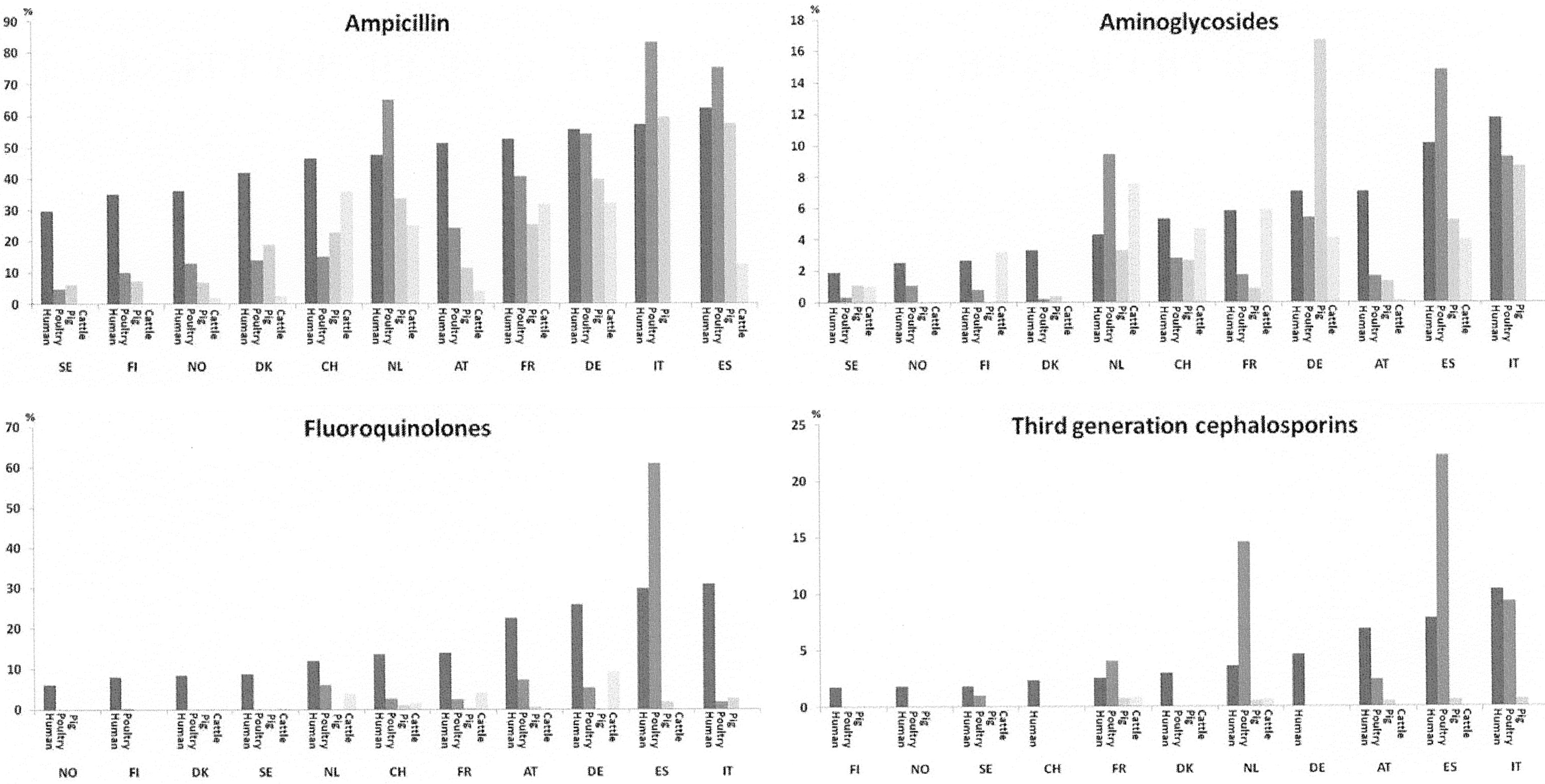
Prevalence of resistance to selected antimicrobials among Escherichia coli isolates from humans, poultry, pigs, and cattle, in European countries between 2005 and 2008.
Data on both antimicrobial consumption and resistance in human E. coli isolates were available from a total of 10 countries. The average DDD/1000 inhabitants/day by each antimicrobial and country is shown in Figure 2. According to these data, France and Italy presented the highest usage rates of aminoglycosides, ampicillin, and third-generation cephalosporins, among the evaluated countries. Nordic countries and the Netherlands reported the lowest usage rates for third-generation cephalosporins and fluoroquinolones.
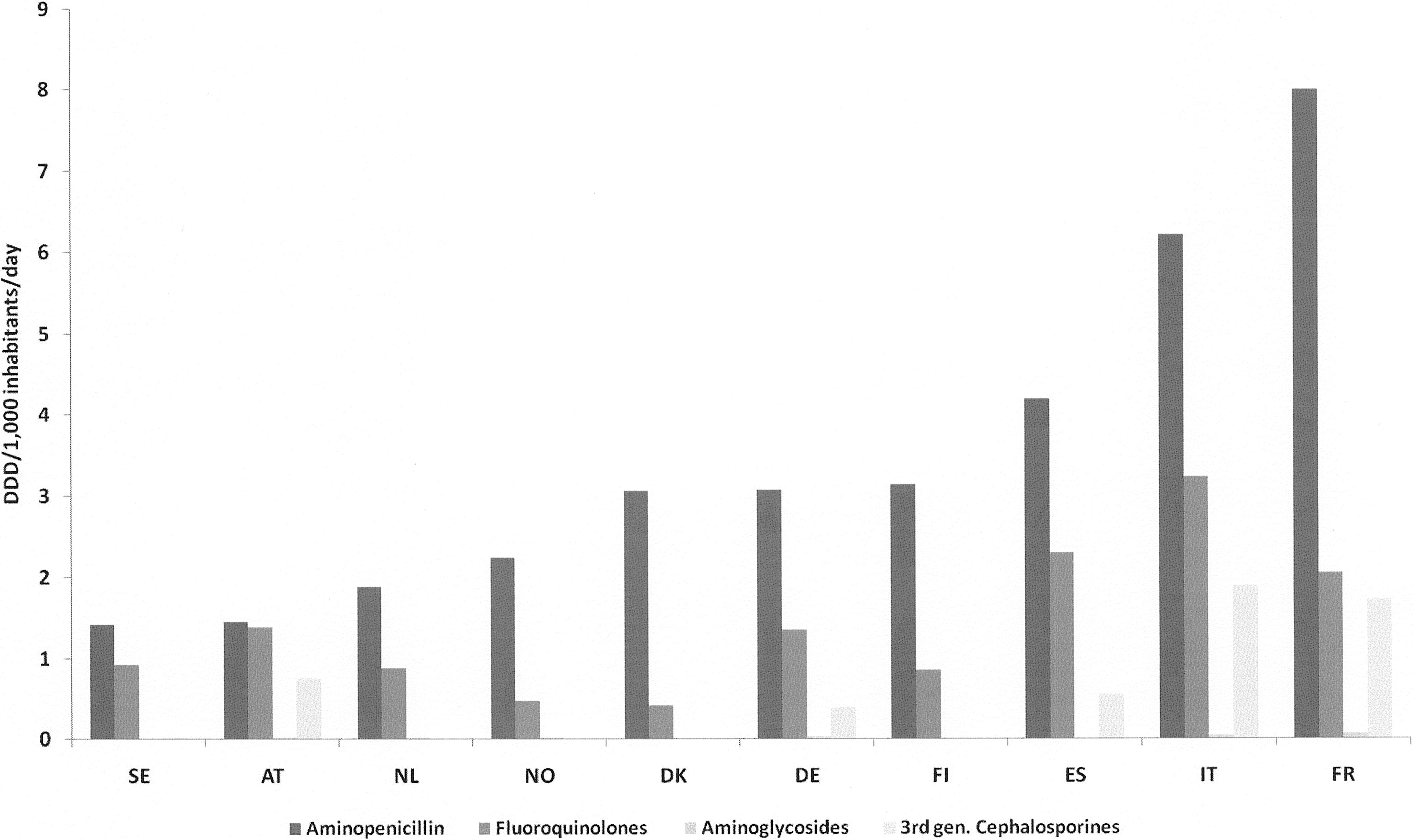
Average antimicrobial consumption (DDD/1000 inhabitants/day) in ambulatory care, in European countries between 2005 and 2008. DDD, defined daily doses.
Strong and significant correlations between resistance prevalences to ampicillin (r=0.94), fluoroquinolones (r=0.68), aminoglycosides (r=0.72), and third-generation cephalosporins (r=0.76) were detected in E. coli isolates from humans and poultry (p<0.05). Similar correlations with ampicillin (r=0.91), aminoglycosides (r=0.73), and fluoroquinolones (r=0.74) were found for pig isolates. In cattle only with ampicillin (r=0.72) was there a significant correlation. All estimated correlations are shown in Table 1. Figures 3 and 4 show regression lines and 95% confidence intervals describing the association between the resistance prevalences in E. coli isolates from poultry and humans and from pigs and humans, respectively, where each data point represents a country. Regression lines could be fitted for resistance to ampicillin and aminoglycosides in poultry and to ampicillin and fluoroquinolones in pigs, all with p<0.05.
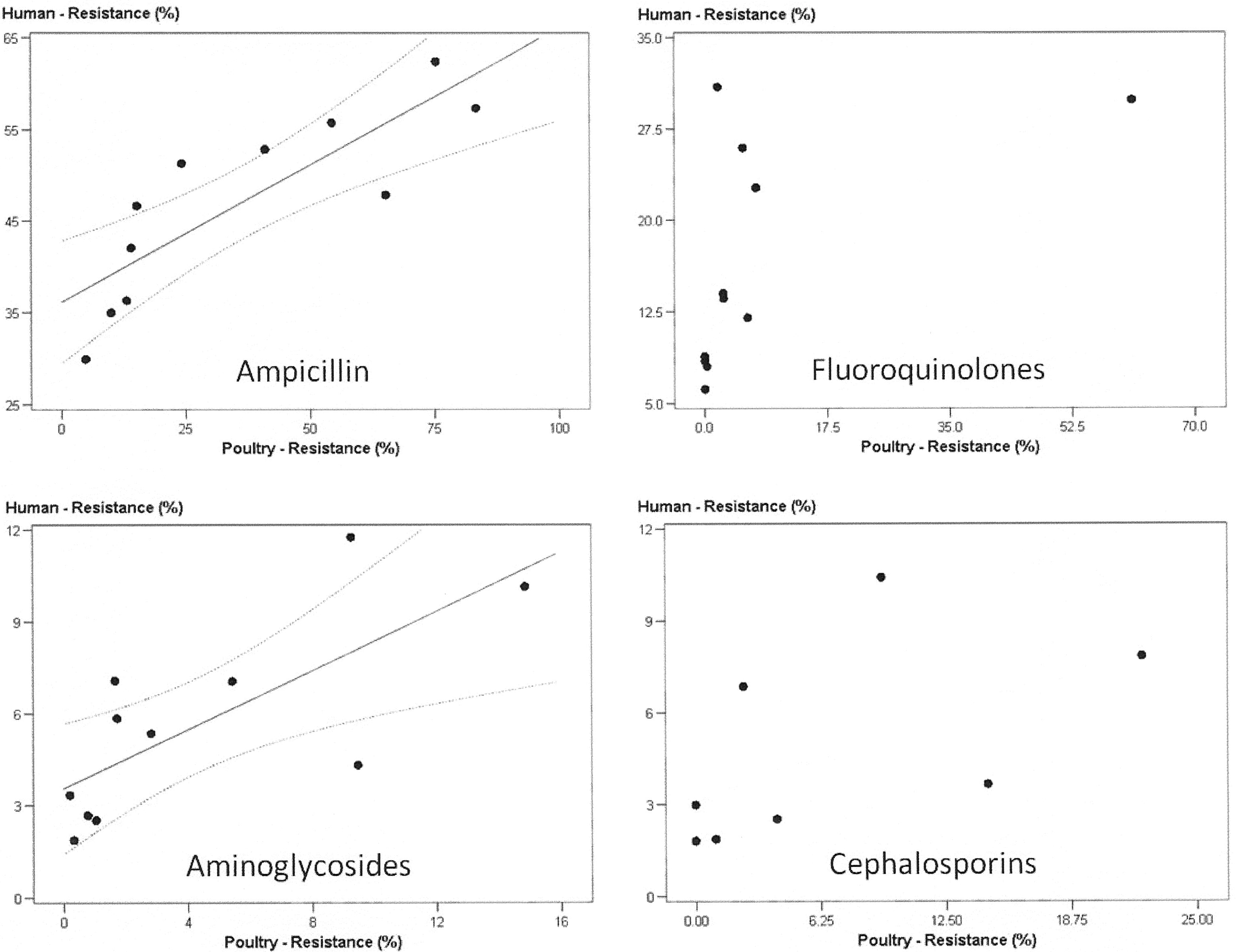
Association between antimicrobial resistance prevalences in E. coli isolates from humans and from poultry, in European countries between 2005 and 2008. Regression line and 95% confidence interval was included when a regression model assessing the potential impact of the resistance prevalence found in poultry on the resistance prevalence in the human population fitted.
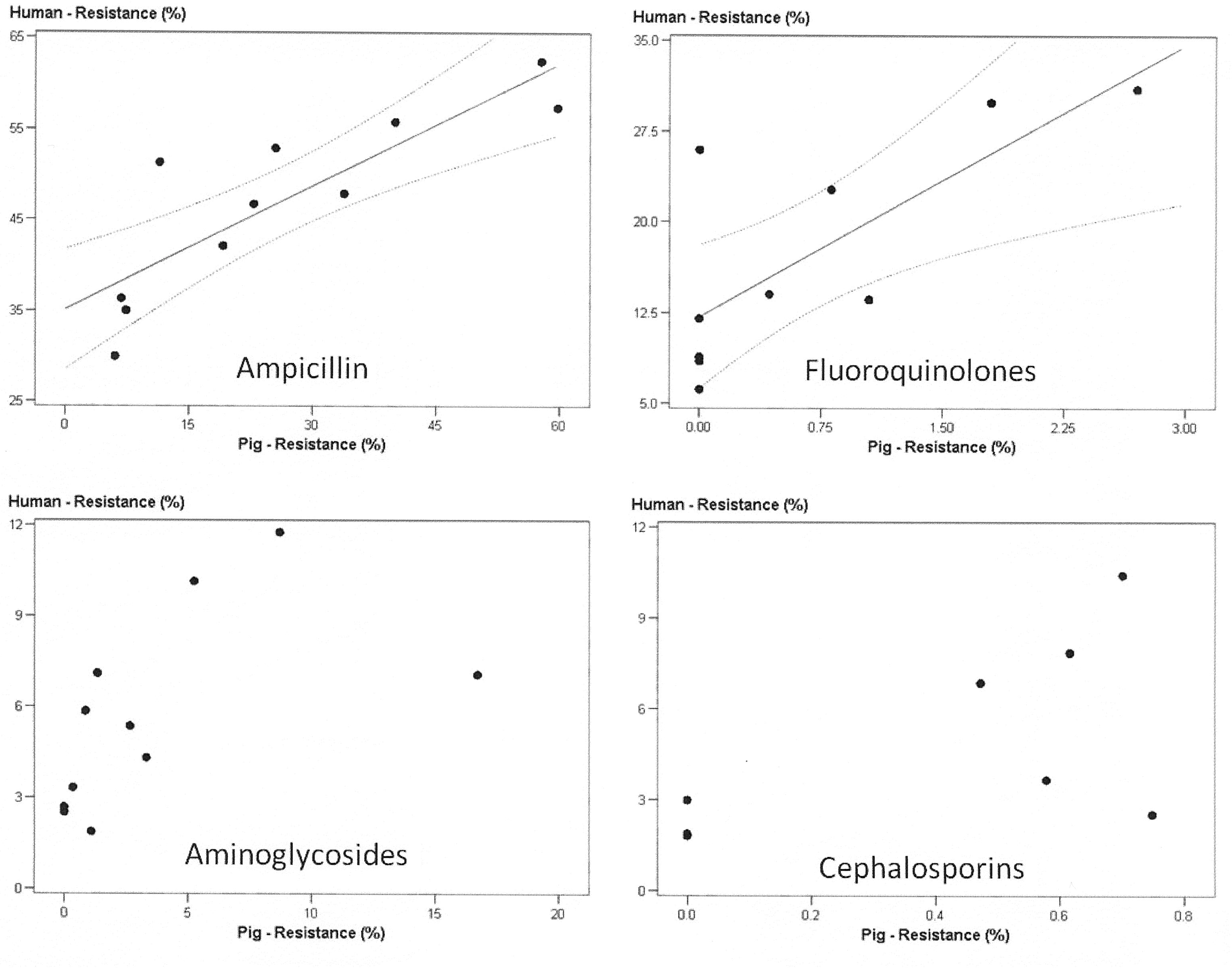
Association between antimicrobial resistance prevalences in E. coli isolates from humans and from pigs, in European countries between 2005 and 2008. Regression line and 95% confidence interval was included when a regression model assessing the potential impact of the resistance prevalence found in pigs on the resistance prevalence in the human population fitted.
When usage of antimicrobials in humans was examined in comparison to antimicrobial resistance, only the correlations between fluoroquinolones (r=0.90) and third-generation cephalosporins (r=0.75) were significant (Table 1).
Discussion
E. coli is one of the most common bacterial causes of serious infections in people, and increasing resistance, particularly to critically important antimicrobials, is a major concern (Kennedy et al., 2008; de Kraker et al., 2010). Patients with resistant strains causing blood stream infections had much higher mortality rates as well as higher excess hospital lengths of stay (de Kraker et al., 2010). Our results show that there is a strong correlation between the antimicrobial resistance observed in E. coli strains from food animals, particularly from poultry and pigs, and the resistance prevalences seen in strains causing blood stream infection in people. Within this scenario, these findings suggest that food animals are a potential source of a substantial proportion of the resistant E. coli or the genes encoding for this resistance, which may be taken up by resident E. coli flora in cases of life-threatening blood stream infections in people. Our findings are similar to those in the studies of Johnson et al. (2006), which suggested that resistant E. coli colonizing the intestinal tract of people and then causing infections in people is mainly derived from poultry
Foodborne transmission is thought to be a major route for human acquisition of resistant pathogenic enteric bacteria or potential resistance gene-donor nonpathogenic bacteria (Aarestrup et al., 2008). Several studies and types of investigations have demonstrated foodborne transmission of antimicrobial resistance from animals to humans, including epidemiological and outbreak investigations, field studies, case reports, spatial/temporal associations, and molecular typing (Garau, et al., 1999; Li et al., 2007; Carattoli, 2008). These studies have shown that food animals may be involved in the E. coli spread to humans. In this study we only assessed significant correlation between resistance found in E. coli from poultry, pigs, and cattle and the resistance in E. coli from humans, but other food sources are likely to be relevant in the epidemiology of antimicrobial-resistant E. coli.
Our study does not take into account the amount of food imported and consumed in each country. In Denmark, imported poultry has much higher levels of resistant E. coli than locally produced poultry (DANMAP, 2009). Food imports may help explain why some countries with lower antimicrobial resistance in food products have higher rates of resistance in human isolates and vice versa. Another limitation of this study is the absence of data on the prevalence of the different E. coli phenotypes and resistance genes. Investigations on the phylogenetic distribution and virulence genotypes associated with antimicrobial resistant E. coli from humans and poultry products found that antimicrobial-resistant human isolates were similar to poultry isolates (Johnson et al., 2007). In Denmark, the prevalence of ESBL-producing bacteria in food animals has increased over the past years, followed by an increasing prevalence of ESBL-producing bacteria in humans (DANMAP, 2007).
Unnecessary (i.e., growth promotion) or excessive use of antimicrobial agents that are considered critically important for humans has been observed and reported in animal husbandry (aquaculture and agriculture) in recent years (McEwen and Fedorka-Cray, 2002; Grave and Wegener, 2006). There is a large body of scientific evidence showing that usage of antimicrobial agents selects for the presence of resistant bacteria in food animals and this poses a risk to human health (WHO, 2007; Aarestrup et al., 2008). There are several potential human health consequences of the emergence of antimicrobial resistance in foodborne bacteria, including increased number of infections, increased frequency of treatment failures, reduction in treatment choice after diagnosis, and increased infection severity (Cohen, 1994; Wise et al., 1998; de Kraker et al., 2010). Therefore, surveillance of resistance among bacteria of animal origin is essential to assess its human health consequences and develop risk management strategies.
The relationships found between these prevalences may be an indication of the transference of resistant bacteria via the food chain, but could also be a consequence of similar within country selective pressures in the discrete reservoirs. While there is already a great amount of data on ambulatory and hospital usage of antimicrobials in most countries, veterinary usage monitoring is still often lacking or vastly incomplete. There are exceptions, with Denmark, the Netherlands, Sweden, and Norway being examples of countries with veterinary antimicrobial consumption-monitoring programs established for years. Most of the remaining EU countries are currently obtaining their first estimates on the figures of veterinary antimicrobial sales; so, hopefully, appropriate data will be available soon. A descriptive study assessing the sales of veterinary antibacterial agents between European countries illustrates the fact that current data are relatively sparse and not available in many countries (Grave et al., 2010). When analyzing these data, we could not see any clear correlation between animal and human antimicrobial usage patterns, which supports the hypothesis of foodborne transference of resistant bacteria.
Using the available human consumption data, we also identified significant correlations between usage rates in humans and occurrence of resistance to fluoroquinolones and cephalosporins in E. coli isolates from humans. This finding is in line with other studies assessing correlations between antimicrobial usage and occurrence of resistant bacteria (Goossens et al., 2005; van de Sande-Bruinsma et al., 2008). While the association between usage and resistance development has in general been clearly documented, there is still a serious need for large epidemiological studies with participation of several countries. Both EMA (European Medicines Agency) and ESAC are currently working to establish reliable monitoring protocols for human and veterinary antimicrobial consumption in Europe.
In summary, we found a strong correlation between the prevalence of resistance to a number of antimicrobials in E. coli isolates from blood stream infections in humans and E. coli isolates from poultry and pigs, respectively. These findings exclude antimicrobial usage as the only explanatory variable for the observed resistances in E. coli from humans. They suggest that, in addition to the contribution of antimicrobial usage in people, a large proportion of resistant E. coli isolates causing blood stream infections in people are likely derived from food animal sources.
Footnotes
Disclosure Statement
No competing financial interests exist.