




Abstract
Between April and May 2010, several medical microbiological laboratories in the Netherlands notified a total of 90 cases of Salmonella enterica serovar Typhimurium with the same antibiogram type (resistant for ampicillin, tetracycline, and co-trimoxazol) and the same multiple locus variable number tandem repeats analysis pattern (03-16-09-NA-311) or single locus variants. Date of illness onset ranged from end of March to mid-May with a peak in the second week of April. Almost half of the cases were hospitalized. Cases completed a questionnaire about food items and other risk factors in the 7 days before illness onset. A matched case–control study was performed. Consumption of “ossenworst” (matched odds ratio 48.2 [95% confidence interval (CI): 3.9–595.9]) and filet américain (8.5 [95% CI: 1.0–73.6]) were found to be significant risk factors for illness. Eighty percent of the cases had eaten at least one or both raw meat products. The producer of the ground beef that was used to produce the “ossenworst” was identified, but no microbiological evidence was found. Consumers should be made more aware of the presence of raw meat in ready-to-eat products and of the potential risk in eating these products. Vulnerable persons such as young children, elderly, and persons with poor health should be discouraged from eating these products. Detection of this outbreak was mainly based on the antibiogram pattern that had identified possible cases 10 days before detailed typing results from the reference laboratory became available, thus facilitating early case findings.
Introduction
S
On April 27, 2010, the regional laboratory for medical microbiology in the city of Haarlem alerted the regional public health service Kennemerland about an increase in cases with gastroenteritis where Salmonella was identified. They had observed 38 Salmonella Group B isolates since January 1, 2010, of which 26 isolates were identified in April, with 22 of these 26 isolates resistant for amoxicillin and co-trimoxazol. Half of the cases were hospitalized. An increase in cases was also seen in neighboring areas. After identifying the serovar as Salmonella enterica serovar Typhimurium, isolates were sent to the National Salmonella Centre at the Institute of Public Health and the Environment (RIVM) to undergo further subtyping. Salmonella Typhimurium is subtyped by multiple-locus variable-number tandem repeats analysis [MLVA (Lindstedt et al., 2004)]. The MLVA type of the submitted isolates was identical and new to the Salmonella database (03-16-09-NA-311). Concurrent to the outbreak, this strain was also found in a chicken marinade product among the nonhuman Salmonella in the surveillance database. In response to this marked regional increase in Salmonella Typhimurium cases in April 2010, a national investigation was started. The objective of this national study was to determine the magnitude of the outbreak, identify potential risk factors, and formulate appropriate control measures.
Materials and Methods
Case definition
Cases were defined as persons in the Netherlands with symptoms of gastroenteritis between March 15, 2010 and May 31, 2010 from whom Salmonella Typhimurium of outbreak MLVA type (03-16-09-NA-311) or a single locus variant was isolated. A strain was defined as different from the outbreak strain if at least two loci of the MLVA pattern were different.
Epidemiological investigation
To generate hypotheses, a semi-structured questionnaire exploring relevant food exposures in the 7 days before the onset of symptoms was administered by telephone or face-to-face to 14 of the first identified cases. Data were obtained relating to food consumption and place of purchase and other possible exposures such as contact with petsor a person with diarrhea. Information regarding clinical symptoms, date of onset of illness, and date of hospitalization was also obtained. The results of this trawling questionnaire led to the hypothesis that cases were more likely to have consumed raw beef products than were controls. Fish consumption and contact with animals were unlikely as sources of infection. The identification of the outbreak strain in a chicken marinade product led to a second hypothesis, namely that cases had consumed a common ingredient such as meat spices, used in different meat products including beef and chicken. A matched case–control study was conducted to test both hypotheses by using a shortened questionnaire for cases who had not yet been interviewed, and a similar version for the controls. In the Netherlands, postcodes consist of four digits and two letters. An average of eight control addresses per case were selected from the area with the same postcode as the cases, with an anticipated response of 25%. The letter indicated which person in the household should preferably answer the questionnaire based on specified age and gender. On May 12, 485 control questionnaires were sent out by mail with the possibility of returning the questionnaire in a return envelope or of completing the questionnaire online. The questionnaire collected information on exposures and gastrointestinal symptoms. For cases, exposure referred to the week before the first day of illness. For the controls, the reference period was the third week of April 2010 (April 19–25, 2010). Controls had to be free from gastrointestinal symptoms during that week. Questions on specific food products and their place of purchase were mainly targeted at meat products, cold cuts, fruit (juice), and raw vegetables. An urgent inquiry was sent out on May 3, 2010 to the European Union Member States via Epidemic Intelligence Information System (EPIS) (managed by the European Centre for Disease Prevention and Control). Members were asked to report any increase in the number of cases of Salmonella Typhimurium with the outbreak MLVA type and pulsed-field gel electrophoresis [PFGE (Hunter et al., 2005)] pattern or any other case possibly linked to the Dutch outbreak. Six European Union countries replied and reported that they had not seen cases with this MLVA type in 2010.
Microbiological investigation and trace-back
Recent human, food, and animal Salmonella Typhimurium isolates were typed by MLVA using nomenclature described by Larsson et al. (2009). The National Salmonella Centre database was searched for matches of nonhuman Salmonella isolates with the outbreak MLVA strain. The New Food and Consumer Product Safety Authority (nieuwe Voedsel en Waren Autoriteit [nVWA]) traced back incriminated sources identified by outbreak investigation. The suspected supermarket chain A and its central butcher were contacted to acquire samples of beef products and meat additives and spices used to prepare raw beef products (“ossenworst,” filet américain). Ossenworst is originally a specialty from Amsterdam and can be purchased as cuts of raw minced beef sausage or as a wrapped ready-to-eat small sausage. Filet américain is made from finely chopped or minced raw beef. The nVWA tested the samples for Salmonella spp. using the modified semi-solid Rappaport-Vassiliadis (MSRV)-method (Anonymous, 2002; Wit, 2009). The slaughterhouse supplying the supermarket was contacted for more information about the slaughtered cattle, the delivered products, and the other companies it supplied.
Statistical analysis
Data were directly entered into an internet questionnaire program (Questback) by the case interviewers and some controls, or uploaded later based on the received paper questionnaires. Statistical analysis was performed in SAS 9.2. Univariate and multivariate matched odds ratios (ORs) were computed using conditional logistic regression. Variables with a p-value<0.10 in the univariate analysis were entered into the multivariate analysis. A final model was determined by stepwise backward elimination of variables, until all variables in the model had reached significance (p<0.05), adjusted for age and gender, and the model was significant.
Results
Descriptive epidemiology
A total of 90 cases of Salmonella Typhimurium with the outbreak MLVA pattern (03-16-09-NA-311 [n=82] or single locus variants [n=8]) were identified. An antibiogram was available for 81 cases, all of which were resistant to ampicillin. Of these, 79 were also resistant to tetracycline and 78, to co-trimoxazol. PFGE was performed on a selection of isolates with the MLVA outbreak strain. The PFGE pattern had not been observed earlier in the Netherlands. Date of illness onset ranged from March 25 to May 13, 2010 (Fig. 1). For 17 cases, the date of illness onset remained unknown. One case reported an illness onset of 1–2 months earlier without further specification, and one case was asymptomatic. All age groups were represented with a peak in the 10–19 year age group (Fig. 2). The male to female ratio was 1:1.3. Cases resided in 16 different public health service regions, but were clustered in the north-western part of the Netherlands (Fig. 3). Most cases (97%) reported diarrhea; 72%, fever; 57%, bloody stools; and 47%, vomiting. A total of 46% of the cases were hospitalized. Sixteen percent of the cases had another person nearby with diarrhea in the week before illness onset. Two cases had a suspected nosocomial secondary infection and were not interviewed further.
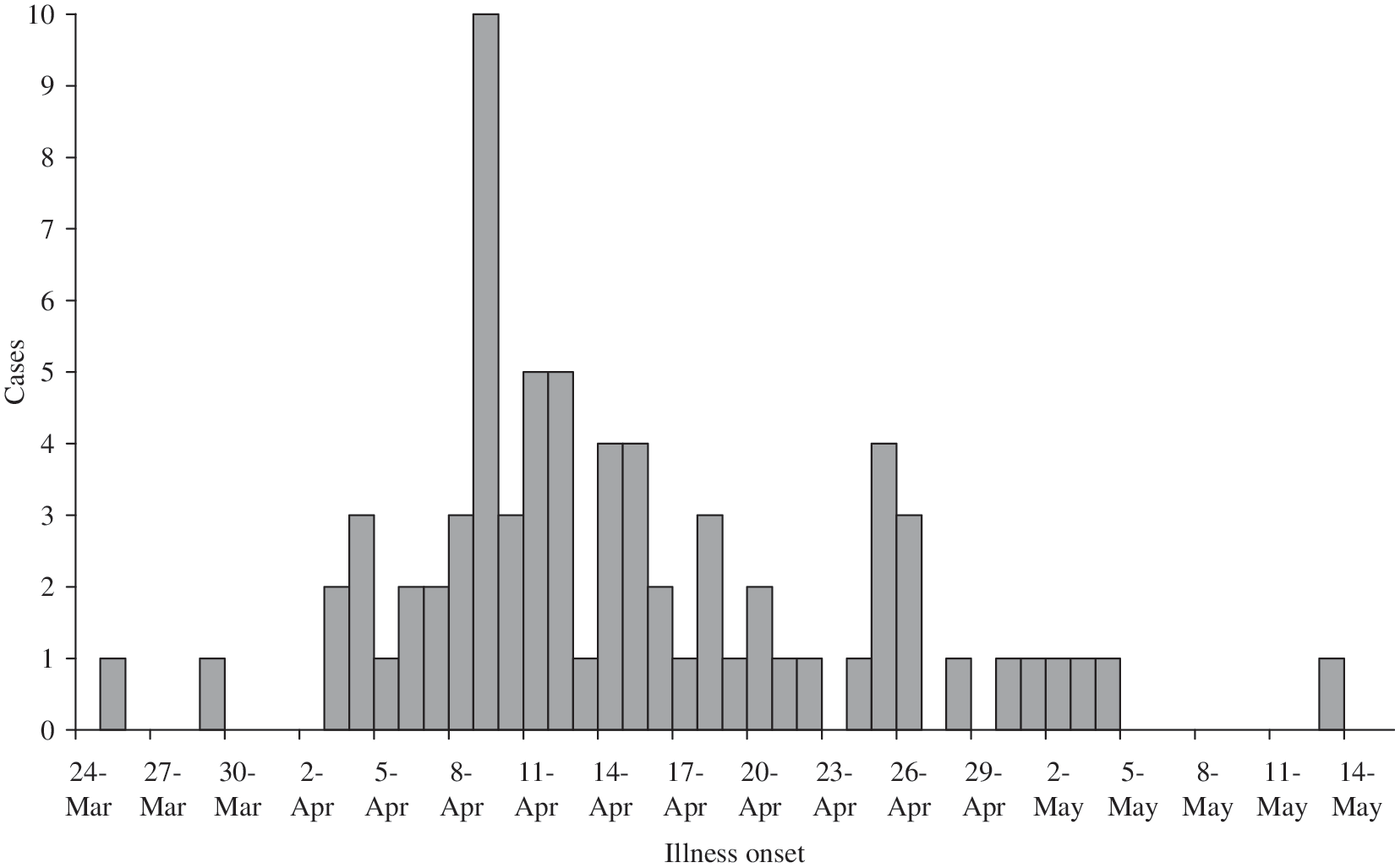
Cases of the Salmonella Typhimurium outbreak by day of illness onset (n=73), March–May 2010, The Netherlands.

Age and sex distribution of the cases of the Salmonella Typhimurium outbreak (n=90), March–May 2010, The Netherlands.
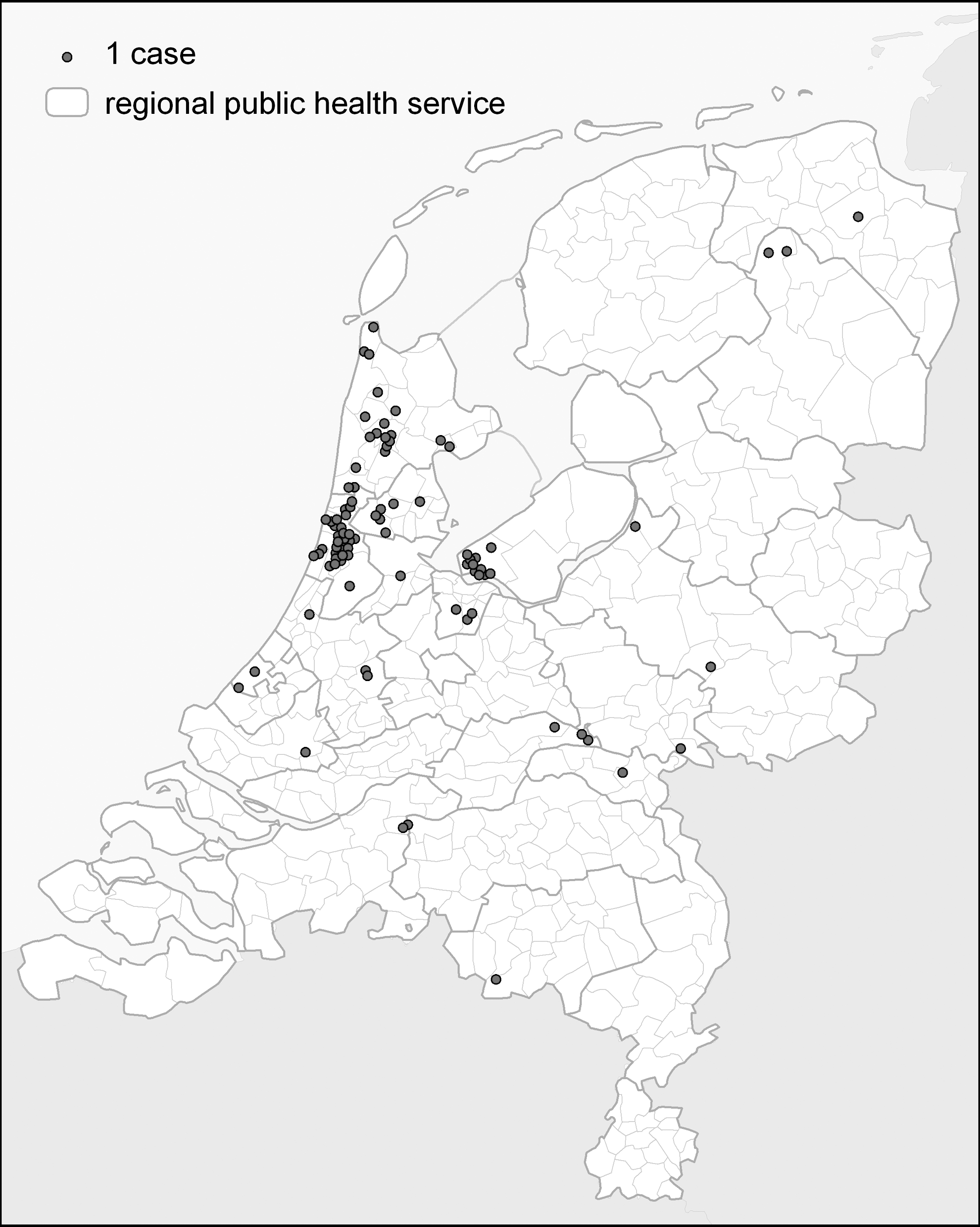
Place of residence of the cases of the Salmonella Typhimurium outbreak (n=90), March–May 2010, The Netherlands.
Epidemiological investigation
Overall, a questionnaire was completed for 73 cases (81%) and 73 controls (15%). In total, 51 controls could be matched with regard to address to 35 cases, varying between one and three controls per case. Supermarket chain A, which has most branches in the northwest of the country, was visited the most frequently in the 7 days before illness as reported by the cases (65%). For controls in the same area, this supermarket chain was less often frequented and was visited by 49% of these respondents in the reported week. Calculation of univariate ORs resulted in ten food items with a p-value below 0.10 (Table 1). Four of these food items, namely ossenworst, filet américain, cooked sausage, and chocolate sprinkles, were eaten by>50% of the cases, whereas none of them were eaten by>50% of the controls. Ossenworst (OR 48.2 [95% confidence interval (CI): 3.9–595.9]) and filet américain (OR 8.5 [95% CI: 1.0–73.6]) were the only two food items reaching significance in the final multivariate model. In all cases where information about consumption of ossenworst or filet américain was available, 80% had eaten ossenworst and/or filet américain, compared with 25% of the controls. Seventy-two percent of the cases younger than 10 years had eaten one or both products, compared with 84% of the remaining cases.
Matched on address, adjusted for age and gender.
CI, confidence interval; OR, odds ratio.
Food microbiological investigation and trace-back
A total of 134 samples of meat products and meat additives were tested between April 29 and May 21, 2010. None of them tested positive for Salmonella. In June, the nVWA compiled a list of 104 butchers, supermarkets, and other companies that had received beef from the same batches, produced on four different slaughter dates in March. The cattle slaughtered on these dates originated from about 40 farms. Four cases who did not purchase meat in supermarket chain A could be attributed to having consumed raw beef products from the same batches bought elsewhere. The spices and additives used in the Salmonella positive chicken marinade were compared with the spices and additives used for the ossenworst and filet américain, but no link was found.
Discussion
The Salmonella Typhimurium strain causing this outbreak was characterized by a unique MLVA and PFGE profile with a specific antibiogram. Detection of this outbreak was mainly based on the antibiogram pattern that facilitated early case findings. Due to this specific antibiogram, the regional public health services could already start to interview possible cases 10 days before detailed typing results from the reference laboratory were available.
The case–control study identified two raw beef products, ossenworst and filet américain, as independent risk factors for illness. This effect was strongest for ossenworst. Even the majority of the cases younger than 10 years had eaten one or both products. In the week of March 29–April 3, 2010, ossenworst was for sale as a special offer in supermarket chain A. In the week of April 18–24, both ossenworst and filet américain were for sale as special offers in this supermarket chain. Strikingly, a peak in cases was seen at both times about 1 week after the special offer. The nVWA identified the beef producer that delivered the ground beef which was used to produce the ossenworst sold by supermarket chain A. Microbiological testing of the incriminated batches was not possible, as batches of these raw products are processed into ossenworst within 2 days after slaughter, with a subsequent maximum shelf life of 12 days. Further trace-back to farm and animal level was not done, as this was considered too resource-intensive to counterbalance the expected results. Since the MLVA outbreak strain with the same antibiogram was identified in a chicken marinade product, it cannot be excluded that chicken drumsticks may also have been a source. However, the contribution to the outbreak is considered low, as chicken drumsticks were not significant in the multivariate analysis and are heated before consumption.
Outbreaks caused by consumption of raw beef products are regularly observed in the Netherlands. In the last few years, several outbreaks due to Salmonella or Shiga toxin-producing Escherichia coli O157 in raw beef products have been identified (Kivi et al., 2007; Doorduyn et al., 2008; Greenland et al., 2009; Whelan et al., 2010). In August–September 2010, a Salmonella Typhimurium outbreak (53 identified cases) was again detected, and a raw beef product was implicated. Another outbreak of Salmonella Typhimurium in May 2010, involving 16 cases in the north of the Netherlands, was more likely caused by raw milk products. In a large case–control study on sporadic human Salmonella Typhimurium infections, consumption of undercooked meat was an important risk factor (Doorduyn et al., 2006). Routine inspection of samples of filet américain showed 0.2%–0.7% of the tested specimens to be contaminated with Salmonella (2006–2009, 875–1065 samples tested per year) (Aalten et al., 2010). In 2009, 271 samples of ossenworst were routinely tested by the nVWA, all of which were negative.
There are limitations to this investigation. First, the lack of available left-overs for sampling due to the short shelf life of ready-to-eat raw meat products made it impossible to microbiologically link the incriminated batches to the cases. Second, recall bias may have been introduced, as the interval between the recall period and interview was up to 2 months. However, since this applies for both cases and controls and it is unlikely that this bias would have been selective for raw meat products, the impact of this bias is thought to be low. This outbreak investigation was based on laboratory surveillance. Therefore, only cases that tested positive for Salmonella were found, which will mainly be the cases with a more severe or long-term course of illness. The hospitalization rate of this outbreak (46%) was higher than the 24% hospitalization rate normally observed in surveillance, and was the reason that the outbreak came to the attention of the health authorities early.
Conclusions
The outbreak of Salmonella Typhimurium between April and May 2010 in the Netherlands was most likely caused by the consumption of raw beef products, namely ossenworst and filet américain. This report confirms previous observations demonstrating that contaminated raw meat products can cause large outbreaks. Continuous intensive monitoring and control of all stages of meat production from farm to finished product is essential. Regular testing and traceability of food products could facilitate prompt intervention in distribution chains. Of equal importance is consumer awareness of the risks of eating raw meat products such as ossenworst and filet américain. Vulnerable persons, such as young children and the elderly, should be discouraged from consuming these ready-to-eat products. Numerous channels are available to inform consumers, such as the website of the Netherlands Nutrition Centre Foundation (
Footnotes
Acknowledgments
The authors acknowledge the patients and controls, the public health service officers, physicians, and microbiologists whose collaboration made this investigation possible. They thank Martijn van Luit and Kim van der Zwaluw for their technical assistance with MLVA- and PFGE-typing. Further, they thank Dick Veenendaal (regional laboratory for medical microbiology, Haarlem) for detecting the outbreak, Ben Wit (nVWA, Zutphen) for coordinating the laboratory research, and Rob Riesmeijer (Centre for Infectious Disease Control, RIVM, Bilthoven) for his assistance in managing the outbreak.
Disclosure Statement
No competing financial interests exist.