




Abstract
A systematic review was conducted to identify and summarize primary research studies that describe the prevalence of Salmonella spp. in pork from slaughter to cooler in the member states of the European Union (EU), Australia, Canada, Hong Kong, Japan, Korea, Mexico, New Zealand, Taiwan, and United States (i.e., a process map). Relevant studies documented Salmonella spp. prevalence at more than one processing point using the same cohort of pigs or the same production line for the post-cooler component. Literature searches retrieved 6811 citations. Sixteen publications, describing 44 studies, evaluated the presence of Salmonella on pork carcasses. The carcass sampling points evaluated were as follows: stun, bleed, kill, scald, dehair, singe, polish, bung removal, evisceration, split, stamp, final wash, immediately after chill, and 18–48 h after chilling. Seventy-eight comparisons of Salmonella spp. prevalence between points along the processing line were reported. The median prevalence of Salmonella spp.-positive carcasses evaluated in the cooler was 0%. The median prevalence of Salmonella spp. after bleeding was 32%. Fifty-nine of the 78 point-to-point comparisons were associated with either no change or a decrease in Salmonella prevalence as the carcass moved closer to the cooler. Nineteen point-to-point changes showed an increase in Salmonella prevalence as the carcass moved toward the cooler; of these, six reported a greater than 10% increase in Salmonella prevalence. The majority of increases were associated with post-evisceration and splitting. These findings suggest that the processing procedures in place generally result in decreased prevalence of Salmonella spp. as the carcasses move toward the cooler.
Introduction
S
Methods
Protocol, review questions, and eligibility criteria
The review protocol was managed by the principle investigator (Dr. O'Connor) and outlined in a proposal to the two funding agencies, the National Pork Board and the American Meat Institute Foundation. This protocol was not registered, as there are currently no groups organized to register food safety or veterinary science reviews. The review's aim was to describe changes in Salmonella prevalence on the carcass from slaughter to cooler. The specific review questions were refined based on a series of discussions in early 2007. Included in the discussions were Dr. A. O'Connor, Dr. J. Dickson (Professor of Microbiology at Iowa State University [ISU]), Dr. J. McKean (University Professor and Extension Swine Veterinarian at ISU), and Dr. S. Larsen (National Pork Board). As a result of those discussions, it was decided that the population of interest was pork during the production process from slaughter to cooler in the member states of the European Union (EU), Australia, Canada, Hong Kong, Japan, Korea, Mexico, New Zealand, Taiwan, and United States. These countries were considered relevant as they were thought likely to have similar modern slaughter facilities. The outcome of interest was the change in Salmonella prevalence in pork during the production process. The processing points were based on a article by Alban and Stark (2005). We did not impose date restrictions as it was unclear how various slaughter and processing procedures would relate to the review without reading the articles. Consequently, it was decided to consider the relevance of identified articles published prior to 1970 on an individual basis. We intended to only use publications in English because funds for translation were not available. Because the entire pork production process was of interest, the review was split into two specific areas: (1) slaughter to cooler and (2) cooler to shipping. The final review questions for the two areas were as follows:
Literature search and information sources
Dr. O'Connor and a master's level student in epidemiology (T.D.) who had conducted several prior systematic reviews on Salmonella in pork designed the search terms for each question separately. The slaughter-to-cooler search combined the population string “Hog or hogs or swine or pig or pigs or gilts or sows or market-weight or finishers or boars or porcine or piglet” with processing point terms as follows “lairage, lairage-time, pens, pre slaughter, swine housing, animal housing, preslaughter handling, housing, holding pen, preslaughter holding, environment, holding, abattoir pen, abattoir pens, preharvest holding, preslaughter holding, preslaughter holding pen, preslaughter holding pens, stun, stunning, slaughter, bleed, bleeding, haemorrhage, scald, scalding, scraping, dehair, dehairing, flaming, singeing, singe, evisceration, carcass halving, carcass opening. Searches for the slaughter-to-cooler review were conducted from inception to October 2010 on the following databases: PubMed (1956 to Oct. 2010), Agricola (1970 to Oct. 2010), CAB Abstract (1910 to Oct. 2010), AGRIS (1975 to Oct. 2010), MEDLINE (1950 to Oct. 2010), BIOSIS (1926 to Oct. 2010), Food Science Technology Abstracts (FSTA) Retrospective (1969–1989), Biological abstract (1980–1989), and Biological & Agricultural Index and FSTA (1989–2007). The reference lists of the final relevant manuscripts were also hand searched for relevant citations. The tables of contents from the Proceedings of The International Symposium on Epidemiology and Control of Salmonella in Pork (1996–2010), International Pig Veterinary Society (1996–2010), American Association of Swine Veterinarians/Practitioners (1996–2010), and the Annual Reciprocal Meat Conference (for cooler-to-shipping review, 1999–2006) were hand searched for relevant citations. The original searches were conducted in February 2007 (slaughter-to-cooler) and February 2008 (cooler-to-shipping). The cooler-to-shipping search yielded so few usable studies that review was discontinued after the literature search and relevance screening (see results below). However, in October 2010 as the review neared publication, the slaughter-to-cooler search was updated, but the time period was limited to 2006–2010. The rationale for the overlap was to check the new 2006 and 2007 publications that had been missed in the 2007 search due to a lag in database updates and to verify that the October 2010 search identified the same set of literature.
Study selection and relevance screening
The purpose of the review was to develop a process map of Salmonella in pork. Studies were considered relevant, and therefore eligible for the review, if they documented Salmonella prevalence at more than one processing point using the same cohort of pigs or same production line. We limited the review to multiple point studies, as this review focused on developing a process map for carcass production. It is known that Salmonella prevalence varies greatly between groups of hogs; therefore, single point studies provide estimates of point prevalence. Such information has been reviewed elsewhere (Fosse et al., 2009). Studies designed to assess interventions or conducted in artificial production settings were not considered relevant.
After identifying the citations, three levels of relevance screening were employed for the slaughter-to-cooler review. Two reviewers evaluated each citation independently. Two research staff and two graduate students in the principal investigator's research group, conducted the first and second level of screenings based on the title and abstract. Conflicts were resolved by seeking the opinion of the principle investigator. For the third screening level, based on the full manuscript, the reviewers were either a master's or doctoral level student in the epidemiology of food safety or the principle investigator. Conflicts were resolved by discussion between the two reviewers.
For the slaughter-to-cooler review, the screening questions at the first level were as follows: • Does the abstract and/or title report primary research? • Does the abstract mention the isolation of Salmonella from pork at slaughter? • Was the study conducted in an abattoir based in the member countries of the EU, the United Kingdom (UK), Scandinavian countries, and developed countries on the Pacific Rim?
The third question includes some geographic errors (i.e., separate listing of UK from EU) because, in the testing stage for relevance screening questions, this question was a source of inconsistency. This wording reduced disagreement while correctly capturing studies within the scope, which was defined above. Citations for which both reviewers responded “no” to any question were excluded from further consideration. The second level of screening removed citations for which the full text was not available in English. For the slaughter-to-cooler review, the third level of relevance screening was based on the full manuscript, and the questions were as follows: • Does the manuscript report the evaluation of Salmonella on carcasses? • Does the manuscript describe sampling at more than one processing point? • Does the manuscript describe a prevalence study (i.e., not an assessment of an intervention)?
Citations for which both reviewers responded “no” to any question were excluded. Data were extracted from the remaining studies.
For the cooler-to-shipping review, the same three levels of screening were employed. The only change was that, instead of focusing on carcasses, relevant outcomes were any pork product such as loin, hams, trim, or ground pork.
Data collection process
For all relevant studies, the outcome of interest was Salmonella prevalence expressed as a percentage (number of Salmonella positive/number of tested, i.e., r/n*100) or Salmonella quantity such as log of colony-forming units (CFU) at the processing points. Too few studies reported quantifiable data such as CFU to provide summaries. If studies reported r/n, we extracted those data and calculated the Salmonella prevalence. When studies only reported the percent positive without reporting the denominator, these data were also extracted only if it was clear that the number of carcasses sampled was at least more than three. The choice of three as the cutoff for inclusion in the analysis was arbitrarily made by the principal investigator. The following processing points were used: stun, bleed, kill, scald, dehair, singe, polish, bung removal, evisceration, split, stamp, final wash, immediately after chill, and 18–48 h after chilling. When the point of processing was unclear, Dr. McKean was consulted. Regardless of how the authors described the data, we always reported data as occurring after the processing point. For example, if the original author described the sample as being collected pre-kill, we referred to such a sample as a bleed sample, meaning the post-bleeding but pre-killing sample point.
Data were extracted by one of the master's or doctoral level students, and then the principal investigator verified the extracted data. Wherever possible, data are extracted as plant or site specific: that is, if a manuscript reported multiple visits separately or data from two plants, the data from both visits are treated as separate and counted as two studies from a single manuscript.
Risk of bias in individual studies
As we were not comparing interventions, biases associated with interventions (such as allocation, masking, and loss to follow-up) were not assessed. Further, we did not exclude manuscripts based on potential quality measures for prevalence surveys such as random selection of carcasses from the study population for three reasons. First, our prior experience, suggested that few, if any, of the publications would include such information and such a criterion would exclude all publications. Second, our experience is that random selection methods are very difficult to execute in abattoirs. Third, we could not anticipate that haphazard or convenient selection would introduce a unidirectional bias.
A second potential source of bias was the diagnostic test employed by each study. Obviously, the sensitivity and specificity of the culture methods varied between studies. The use of paired data within the plants was employed as an indirect method of adjusting for these differences between studies. For example, a method with low sensitivity would have the same low sensitivity at all processing points in the plant but would still correctly capture the trend, if not the magnitude, of Salmonella prevalence across the system (i.e., increasing, decreasing, or remaining stable).
Summary measures and synthesis of results
The distribution of the prevalence of Salmonella was reported for processing points that had at least three studies reporting data on that processing point. Descriptive data reported were the minimum, the 25th quartile, median, the 75th quartile, and maximum prevalence for each processing point. Scatter line plots and box-and-whisker plots were used to describe the data. For the box-and-whisker plots, the box represented 50% of observations (i.e., the bottom and top ends of the boxes are the 25th and 75th quartiles, respectively). The whiskers presented the full range of data. When the whiskers are missing, the range is the same as the 25th or 75th quartile. The box-and-whisker plots were overlaid with a jitter plot of all the data points used in calculation of the box and whisker plot.
Further descriptive analysis included determination of the direction and frequency of point-to-point changes in Salmonella prevalence along the processing line. Point-to-point changes referred to the change in prevalence from one point to the next in the study-sampling scheme. For example, a study that sampled at bleed, singe, and chill would have two point-to-point changes: the change in prevalence from bleed to singe, and the change in prevalence from singe to chill.
Results
Results of slaughter-to-cooler
A total of 6811 citations were identified by the searches for the slaughter-to-cooler review. The vast majority of articles and eventually relevant articles were found in PUBMED, CAB, and Agricola. After removing the vast majority of articles during the three screenings, we identified 16 manuscripts that described sampling of carcasses at more than one processing point in a swine abattoir. In these manuscripts, eight were identified in PUBMED, CAB, and AGRICOLA; one was unique to CAB; one was unique to AGRICOLA; one was found in the Proceedings of the 1st International Symposium on the Ecology of Salmonella in Pork Production; two were found in the Proceedings of the 3rd International Symposium on the Epidemiology and Control of Salmonella in Pork; two were found in the Proceedings of the 6th International Symposium on the Epidemiology and Control of Foodborne Pathogens in Pork; and one was found in the Proceedings of the 20th International Pig Veterinary Society Congress. A further 16 manuscripts that may have had potentially useful information could not be retrieved (Table 1).
Sixteen manuscripts reported data using a design that sampled at more than one processing point, and the characteristics of the manuscripts are presented in Table 2. However, only data from 12 manuscripts were included in the descriptive analyses. Among the four excluded studies, one reported sampling only one or two animals at each processing point, and these data were excluded from the analysis because the estimates of prevalence could only be 0%, 50%, or 100% (Giovannacci et al., 2001). Another study was excluded because, although it reported 0% prevalence at the processing points, the number sampled was not reported (Rho et al., 2001). Two other articles that reported conducting studies that collected at several points along the processing line did not provide results; this is likely because the studies were identified in conference proceedings and the authors may have been reserving the data for later publication (Sørensen et al., 1999; Widders et al., 1996).
These 12 manuscripts reported data from 44 studies, and are included in the box-and-whisker plot (Fig. 1) and descriptive information (Table 3). Figure 1 shows the distribution of Salmonella prevalence for processing points with more than three observations at the following points: bleed, scald, dehair, singe, polish, evisceration, split, stamp, wash, and 18–48 h of chilling. One article reported prevalence after the first and second dehairing machines. We used the data after the second dehairing machine, as it constituted “after dehairing” in such environments (Davies et al., 1999). One article identified by the search was published in 1961 (Kampelmacher et al., 1961). The article assessed the impact of singing, scalding, and mechanical and hand depilation. Although, the hand depilation data was likely not relevant, other information suggested the processes used were not strikingly different than current processing approaches. The 1961 article reported using scald temperature of 62°C and a singe of 1–12 s in a cylinder at 1200–1400°C, similar to the processes reported by Pearce et al. (2004), who studied a plant that employed a scald at 61±1°C and a 1200°C singe for 15 s. Therefore, data from this manuscript were considered relevant. One manuscript reported data from 10 small abattoirs, which differed based on wash temperatures and skinning (yes/no). The data were not reported by plant; therefore, we used the combined data as reported by the authors (Algino et al., 2009). Finally, one manuscript (Pearce et al., 2004) provided inconsistent results about the prevalence based on the positive number and number sampled. The reported prevalence of Salmonella after evisceration was 7% and the sample number apparently 20, suggesting 1.4 positive samples. In this situation, we used one positive sample instead of 1.4 as the positive number, and the estimated prevalence was therefore reported as 5%. Similar differences occurred at scalding (n=24) and dehairing (n=53). The authors reported a 1% prevalence post-scalding, the equivalent of 0.24 positive samples, which was rounded to one positive sample, and therefore 4%. At dehairing, the authors reported 7% prevalence (3.7 positive samples), which was rounded to four positive samples (7%). These discrepancies were likely to have a minor impact on data evaluation.
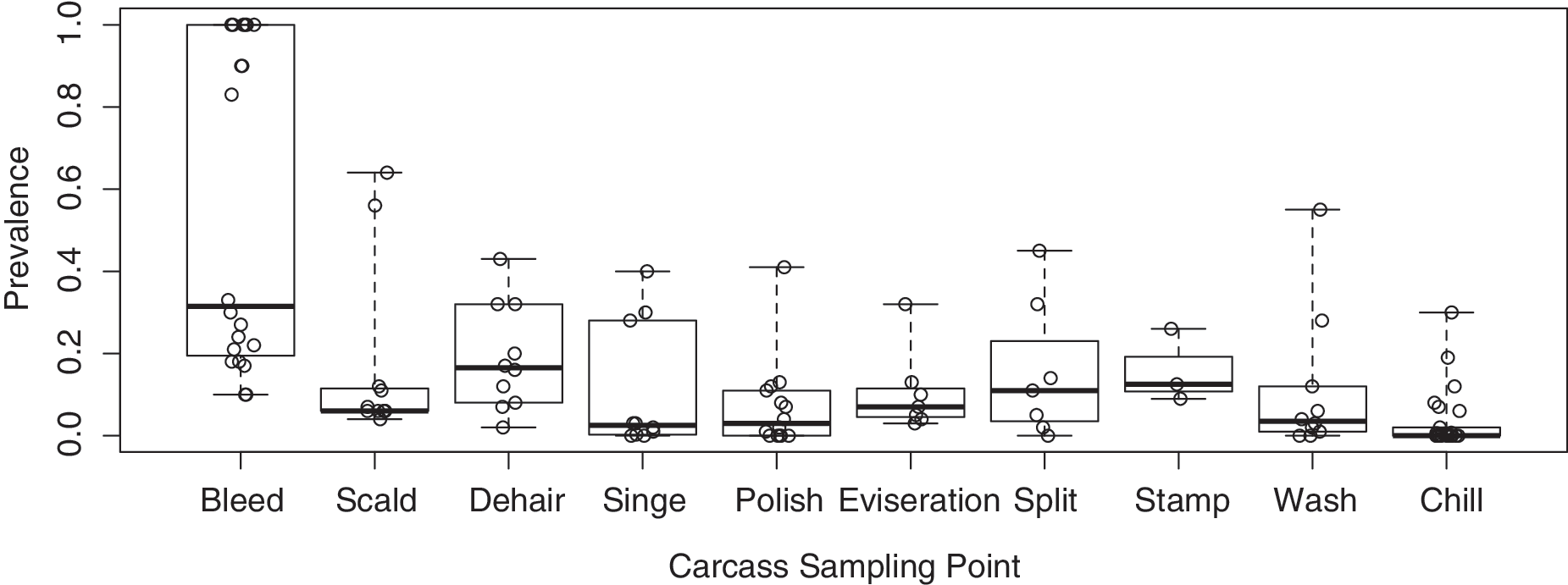
Box-and-whisker plot describing the distribution of prevalence estimates of Salmonella-positive samples for studies at each carcass sampling point. Processing points evaluated were stun, bleed, kill, scald, dehair, singe, polish, bung removal, evisceration, split, stamp, final wash, immediately after chill, and 18–48 h after chilling. However, if fewer than three studies evaluated one point, descriptive statistics were not calculated.
Processing points evaluated were stun, bleed, kill, scald, dehair, singe, polish, bung removal, evisceration, split, stamp, final wash, immediately after chill, and 18–48 h after chilling. However, if fewer than three studies evaluated one point, descriptive statistics were not calculated.
NA, not available.
There were 78 possible point-to-point changes for the prevalence of Salmonella spp. on the carcasses. These data are presented for each study in Figure 2. Nineteen point-to-point changes showed an increase in Salmonella prevalence as the carcass moved toward the cooler, and of these 19, six showed a greater than 10% increase in Salmonella prevalence from the prior sampling point.
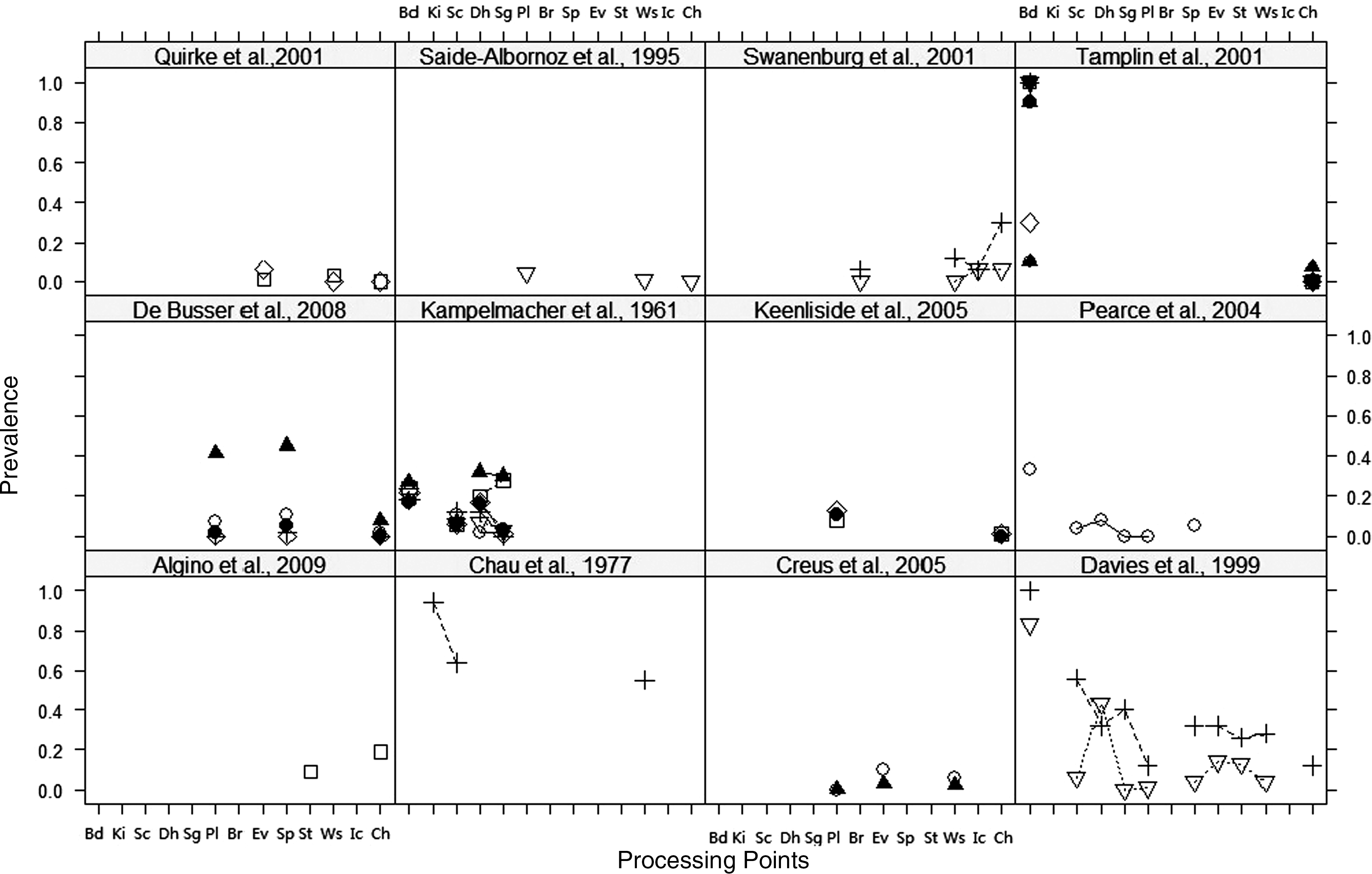
A lattice plot of the 12 manuscripts that evaluated Salmonella prevalence on carcasses at more than one processing point during slaughter. Different symbols within plots indicate data from a different study but same manuscript. Bl, bleed; Ki, kill; Sc, scald; h, dehair; Sg, singe; Pl, polish; Br, Bung removal; Ev, eviscerate; Sp, split; St, stamp; Ws, wash; Ic, immediately in cooler; Ch, 18–24 h post-chilling.
Some processing points appeared associated with an increase in prevalence. Five studies reported data that enabled comparison of the post-evisceration state with a prior processing point. Consistently, these five studies reported an increase in the prevalence of Salmonella at the post-evisceration sampling point compared to the prior processing point: 1.4% (1/70) post-polish to 4% (2/50) post-evisceration (Davies et al., 1999), 12% (3/25) post-polish to 32% (8/25) post-evisceration (Davies et al., 1999), 0% (0/120) post-polish to 2.5% (3/120) post-evisceration (Creus et al., 2005), 0% (0/120) post-polish to 10% (12/120) post-evisceration (Creus et al., 2005), and 0%(0/48) post-polish to 5% (1/20) post-evisceration (Pearce et al., 2004).
Nine studies reported data that would enable comparison of post-wash with a prior processing point. In these studies, two studies reported an increase in prevalence: 6% (3/50) bung removal to 12% (6/50) post-wash (Swanenburg et al., 2001); and 25.7% (77/300) post-stamp to 28% (7/25) post-wash (Davies et al., 1999). Six studies reported a decrease in prevalence of 7.1% (15/210) post-evisceration to 2.9% (6/210) post-wash (Quirke et al., 2001), 13.1% (28/209) post-evisceration to 0% (0/209) post-wash (Quirke et al., 2001), 2.5% (3/120) post-evisceration to 1.6%(2/120) post-wash (Creus et al., 2005), 10% (12/120) post-evisceration to 5.8% (7/120) post-wash (Creus et al., 2005), 12.5% (25/200) post-stamp to 3.7% (2/54) post-wash (Davies et al., 1999), and 4.4% (12/270) post-polish to 1.1% (3/270) post-wash (Saide-Albornoz et al., 1995). One study reported unchanging prevalence of 0.0% (0/50) bung removal to 0.0% (0/50) post-wash (Swanenburg et al., 2001).
Twenty-five studies reported data that would enable comparison of post-chilling with a prior processing point. Only one study reported an increase in prevalence from 6% (3/50) immediately post-chilling to 30% (15/50) 18–48 h post-chilling (Swanenburg et al., 2001). Three studies from two manuscripts reported unchanging prevalence (De Busser et al., 2008; Swanenburg et al., 2001), and the remaining studies reported decreased Salmonella prevalence after chilling with the greatest change as 100% (100/100) bleeding to 0.0% (0/122) post-chilling (Tamplin et al., 2001).
Results of cooler-to-shipping
For the review of cooler-to-shipping, 999 citations were identified by the searches. Two manuscripts were available in English that described sampling of pork after chilling at more than one point in a swine abattoir from the same cohort of pigs (Banks and Board, 1983; Giovannacci et al., 2001). Two manuscripts also reported the prevalence of Salmonella spp. on carcasses and then at one sampling point in the processing chain after the cooler (Rho et al., 2001; Saide-Albornoz et al., 1995). Extracted information from these four studies is reported in Table 4. None of these studies described the stages of processing employed by the study plants. Given the lack of data, we decided to not pursue this aspect of the review any further.
ND, not determined.
Discussion
The slaughter-to-cooler review identified 44 studies that evaluated the prevalence of Salmonella on carcasses. The aggregated data across the studies suggest that the processes employed from slaughter to the cooler are associated with steady decreases in Salmonella prevalence. This slaughter-to-cooler review provides publicly available empirical evidence for the efficacy of the procedures employed in pork abattoirs to control Salmonella (Fig. 1). The mean and median Salmonella prevalence tended to decrease during processing, even in a variety of settings, providing evidence that the measured processes are robust. This information could be used to convey to the consumer the efficacy of the measures taken to control Salmonella from slaughter to the cooler. It is perhaps not unexpected that evisceration was commonly associated with increases in prevalence, but later steps in the processing line appear to counteract this step. This, therefore, suggests that the evisceration point is the one where new interventions may be developed that could produce substantial impact on Salmonella prevalence of pork carcasses.
For the cooler-to-shipping review, insufficient data were available to make reasonable conclusions. This paucity of publically available information has previously been noted. Berands et al. (1998) noted that information about cutting plants was rare, “practically all of which is published in confidential reports in Dutch or in specialized books of limited circulation” (Berends et al., 1998a). If industry or consumers are interested in a public document that summarizes the ecology of Salmonella post-chilling in pork, then more data availability is needed.
It is important to note several potential biases in this review. First, it was noted that what seemed like a large number of potentially relevant publications in this review were excluded because of the inability to obtain a full copy of the manuscript. We traditionally have not kept track of studies that could not be found, and similar data is not published in other reviews. However, it is noteworthy that we found 16 relevant publications, and there existed equally as many potentially relevant publications that could not be found despite significant search attempts. Obviously, it is unclear whether their results are relevant, or if they would change the inferences from the quoted manuscripts.
Second, a large number of non-English articles were identified by the search, but we were unable to consider these results due to lack of funds for translation. In the cooler-to-shipping review, 999 articles were identified as potentially relevant after the first level screening, and 461 (46%) were excluded because the manuscript was not available in English. It is not possible to conclude whether the non-English articles were truly relevant to the review or not. However, we note that Berands et al. (1998b) did use two Dutch language articles that may have been relevant.
Third, the use of a diverse group of studies that reflect variation in processing practices may be another issue, which may be considered a strength or weakness. If the unit of concern were the particular plant, then the approach employed is a weakness. However, our aim was to provide an overall summary of how systems work by using available empirical data; therefore, the diversity is a strength. Additional data or studies containing more sampling points would strengthen the review inferences; however, these were not available. An alternative approach would be to model the system; however, this has already been done. Our aim was to document the processing system using a different approach. Alban and Stark (2005) modeled the swine processing system, utilizing “author best guess” or a single article as the parameter estimate. The data we provide here may actually be used to parameterize risk assessments because it comprehensively summarizes available data.
Fourth, as mentioned previously, the sensitivity and specificity of the culture methods varied between studies. We chose to use paired data within the plants as an indirect method of adjusting for these differences. For example, a method with low sensitivity would have the same low sensitivity at all processing points in the plant therefore correctly capturing the trend, if not the magnitude, of Salmonella prevalence change (i.e., increasing, decreasing, or remaining stable). If the manuscripts had reported the sensitivity of employed culture methods, a transformation from apparent prevalence to a true prevalence would have provided a more direct adjustment.
Finally, we did not calculate a sample size-based weighted average for the prevalence of Salmonella at each processing point or attempt to calculate a regression slope to describe the change in prevalence from bleed to chill because some studies failed to provide a numerical sample size for each sampling point; therefore, we were limited to describing the quartiles of carcasses positive for Salmonella. The variation of percentage of carcasses positive for Salmonella is likely of greater public health relevance than quartile analyses. We hypothesize that studies that were conducted but reported 0% at all points would be considered less interesting and therefore less likely to be published. Such a bias would mean that overall means would be biased upwards—hence, our preference for reporting descriptive information. Equally, it might be argued that the selected sample size or testing methodology was insufficient for task, and therefore had nothing to add.
Conclusion
The aggregated data across the 16 studies suggest that the processes employed in abattoirs from slaughter to the cooler are associated with steady decreases in Salmonella prevalence. Evisceration was commonly associated with increases in prevalence, but later steps in the processing line appear to mitigate this effect. Therefore, evisceration is a point in the processing point where development of effective new interventions would have a substantial effect of Salmonella on pork carcasses. This information could be used to convey, to consumers, the effectiveness of the measures taken to control Salmonella from slaughter to the cooler, and to prioritize future research efforts.
Footnotes
Acknowledgments
Thank you to Yimin Liu for assistance with data extraction and analysis, Dr. Dickson for assistance with review question formulation, and Abigail Bradbury for assistance with the literature search. This study was supported by funding from the U.S. National Pork Board and the American Meat Industry Foundation.
Disclosure Statement
No competing financial interests exist.