




Abstract
Raw milk is increasingly appreciated by consumers but can be contaminated by a variety of zoonotic pathogens. Therefore, preventive measures, such as on-farm hazard analysis critical control point (HACCP) programs, must be applied to protect consumers. The aim of the present study was the comparison of a multiplex real-time polymerase chain reaction (PCR) assay with a culture-based approach in an on-farm quality assurance program for the detection of Escherichia coli O157, Salmonella spp., and Listeria monocytogenes in bulk tank milk, in-line milk filters, manure, and feces. Results revealed that the real-time PCR was more sensitive in detecting E. coli O157 than the culture method in filters (48% vs. 4% positive), manure (93% vs. 7% positive) and feces (60% vs. 4% positive). The two methods were equally efficient in detecting L. monocytogenes (8% of filters), while Salmonella spp. was not detected in any sample. In conclusion, the real-time PCR, by reducing analysis time to two working days, can be proposed as a useful tool in the raw milk primary production setting as a rapid and user-friendly screening method.
Introduction
I
In the United States, intrastate sale of raw milk is authorized in only 29 states, with some limitations and heterogeneous microbial standards (NASDA, 2008; Oliver et al., 2009). However, in the EU, there is general acceptance of this product, and its production and sale are regulated by EU Directives (852/2004, 853/2004, 854/2004, 1663/2006). The regulations define microbiological criteria and assign responsibility to milk production holdings according to an “on-farm” HACCP program.
Single Member States transpositions of EU Regulations establish more specific criteria (Table 1) with frequent testing (at least once/twice per month) (Italian Republic, 2007). However, HACCP for raw milk production in dairy farms needs monitoring tests for the critical control point (CCP) management. The traditional approach to microbiological control relies on culture-based methods, such as those from the International Organization for Standardization (ISO), which takes several days to be completed. Prolonged analysis time introduces additional risks for consumers if the pathogen presence is recognized only after the food has been put on the market. Indeed, effective contamination control and disease prevention takes great advantage from the application of the so-called “rapid methods,” such as those based on real-time polymerase chain reaction (PCR). Moreover, the most recent applications make use of multiplex protocols, capable of identifying more than one pathogen at the same time, with consistent savings of analysis time and cost (Amagliani et al., 2010; Omiccioli et al., 2009a,b). In multiplex real-time PCR, multiple sets of primers and dual-labeled probes with different fluorophores are used for the simultaneous amplification of more than one target in the same amplification vessel. It has been recently applied to foodborne pathogens detection in meat products (Suo et al., 2010), ground beef (Fratamico et al., 2011), pork (Kawasaki et al., 2010), and cattle feces (Jacob et al., 2012).
Italian Republic, 2007.
EU Regulation (EC) No. 853/2004.
n=number of sample units analyzed that are chosen separately and independently; c=maximum allowable number of sample units giving values between m and M; m=lower limit; M=upper limit. The rest of values must be <m. Values at or above M are unacceptable.
The objective of the present study was to evaluate a multiplex real-time PCR system for the simultaneous identification of the three pathogenic species E. coli O157, Salmonella spp., and L. monocytogenes in samples obtained during the self-monitoring program of a bovine dairy farm authorized to sell raw milk directly to consumers. The reliability of the real-time PCR was assessed in comparison with official standard methods. Moreover, sampling frequency was increased to weekly, instead of monthly samples to investigate if more frequent inspections could affect pathogen prevalence in raw milk and farm environmental samples.
Methods
Dairy farm and sample collection
A dairy farm (140 head of cattle, including 80 lactating cows) located in Central Italy (Marche region), licensed to sell raw bovine milk through automatic distributors was selected for this study. Criteria of selection included animal number, which was the highest within the Marche region, and breadth of distribution area through automatic vending machines. Samples of raw bovine milk (i.e., BTM), in-line milk filters, manure, and feces were collected weekly from July to September 2009 and from March to July 2010. In each sampling, the following amounts were collected: five aliquots of 100 mL of milk, separately analyzed, from a bulk tank with a 1000-L capacity; one filter; a total of 100 g of feces from rectal ampulla of five cows; and a total of 100 mL of manure from different points of a storage pit. All samples were refrigerated for transportation to the laboratory and examined within 24 h.
Microbiological analysis
Culture methods
BTM samples were examined through validated enzyme-linked fluorescence assay (ELFA) methods for the presence of E. coli O157 (VIDAS E. coli O157 ECO; bioMérieux, Marcy l'Etoile, France) (AFNOR, 2000), Salmonella spp. (VIDAS Salmonella SLM) (AFNOR, 2005), and L. monocytogenes (VIDAS Listeria monocytogenes II LMO2) (AFNOR, 2004). In detail, five primary enrichment cultures (PA) for each species were prepared by separately homogenizing 5 sample units (s.u.) of 25 mL of milk in 225 mL of Buffered Peptone Water at 37±1°C for 18±2 h, for Salmonella spp.; Half Fraser Broth at 30±1°C for 24±2 h, for L. monocytogenes; and mTSB at 41.5±1°C for 6—7 h, for E. coli O157. For selective enrichment cultures, volumes of 0.1 mL (Salmonella spp. and L. monocytogenes) and 1 mL (E. coli O157) from each PA replicate were mixed in pools (pools of 5 s.u.) and added to 50 mL of Salmonella Xpress medium (BioMérieux), at 41.5±1°C for 24±2 h, for Salmonella spp.; Fraser broth, at 37±1°C for 24±2 h, for L. monocytogenes; and 45 mL of CT-MAC, at 37±1°C for 18±2 h, for E. coli O157. After incubation, analyses were completed through the VIDAS system. Detection of Campylobacter (VIDAS Campylobacter CAM), coagulase-positive Staphylococcus (UNI EN ISO 6888-2:2004), and standard plate count (SPC) at 30°C on Milk Agar (UNI EN ISO 4833:2004) were also carried out.
Suspected positive isolates were subjected to confirmation tests. For E. coli O157, primary culture–enriched samples were plated on MacConkey Agar with Sorbitol, Cefixime, and Tellurite (CT SMAC; Biolife, Milan, Italy); they were subsequently biochemically identified by API ID 32 E (bioMérieux) and serotyped by monovalent sera anti-O157 (Siemens Healthcare, Marburg, Germany) and anti-H7 (Statens Serum Institut, Copenhagen, Denmark). Confirmation of L. monocytogenes was accomplished by streaking culture enriched samples in Fraser broth on OXFORD Agar and ALOA Agar (Biolife), with subsequent Gram staining, API Listeria (bioMérieux), and biochemical assays (catalase and β-haemolysis). Confirmation tests were carried out according to the UNI EN ISO 6579:2008 for Salmonella spp. and ISO 10272-1:2006 for Campylobacter. Coagulase-positive Staphylococcus colonies were identified as Staphylococcus aureus through the methyl red-Voges Proskauer test.
By using the same methods, a portion of 25 g of each filter sample was tested for the same pathogens, except for Staphylococcus aureus, where SPC on Plate Count Agar (PCA) (Biolife) was used; manure (25 g) and feces (1-g aliquots from pools of 5 s.u.) were analyzed for E. coli O157 only.
Molecular method
The same BTM, filters, manure, and feces samples were examined in parallel by using a multiple platform designed to provide the simultaneous detection of Salmonella spp., L. monocytogenes, and E. coli O157. The method consisted in a multiplex real-time PCR assay based on dual-labeled probes (MultipathogenFLUO kit; Diatheva, Fano, Italy). Four hundred microliters of the enrichment cultures prepared for microbiological analysis with reference protocols (namely, Buffered Peptone Water, for Salmonella spp.; Half Fraser Broth, for L. monocytogenes; and mTSB, for E. coli O157) was subjected to column-based DNA extraction with the GenElute Mammalian Genomic DNA Purification Kit (Sigma-Aldrich, St. Louis, MO), according to manufacturer's instructions. Extracted samples (5 μL) were then analyzed by a four-plex real-time PCR assay (MultipathogenFLUO kit) targeting specific sequences of Salmonella spp., L. monocytogenes, and E. coli O157, in the presence of a noncompetitive internal amplification control (IAC) (Omiccioli et al., 2009a).
Proficiency testing of molecular method
Simulated bovine sample units (representing tissue, feces, fluid, and swabs) containing varying concentrations of a non-toxigenic strain of E. coli O157 were supplied as freeze dried units by the Veterinary Laboratories Agency (VLA, Sutton Bonington, UK). The samples were reconstituted in mTSB according to instructions, and were parallel analyzed with both reference method and the real-time PCR. After DNA extraction from aliquots of 400 μL of enriched cultures, real-time PCR with MultipathogenFLUO kit was carried out on each sample unit.
Statistical analysis
Agreement between culture methods and real-time PCR was estimated by use of the kappa statistic and the Landis and Koch classification (1977). For statistical analysis, 2×2 comparison tables were constructed for each pathogen (L. monocytogenes and E. coli O157) in each kind of sample (filters, manure, and feces).
Results and Discussion
At the beginning of our study, a proficiency test of the real-time PCR method with certified material of simulated bovine s.u., artificially contaminated with E. coli O157, was conducted, in parallel with the reference protocol. The experiment provided evidence of complete concordance of results between the two assays, although confirmation with a wider sample number should be desirable (Table 2).
Neg., negative result; Pos., positive result.
Six different aliquots of each enrichment culture have been separately analyzed.
The multiplex real-time PCR makes use of dual-labeled probes for the detection of all three pathogens (MultipathogenFLUO kit). It provides 100% selectivity and good sensitivity corresponding to 10 cells for each target species. As reported (Omiccioli et al., 2009a), the system enabled the detection of as few as 1 CFU of each pathogen in 125 mL of milk (separately analyzed as 5 s.u. of 25 mL each), which is a sensitivity level appropriate for an absence/presence test, in accordance with the equivalence of results of alternative methods required by the EU Commission Regulation 2073/2005.
The column-based kit chosen for DNA isolation was able to provide PCR-grade nucleic acids, with sufficient purity, avoiding false negative results. This condition was confirmed by the presence of the IAC-related signal (yellow channel), correctly amplified and detected in each sample.
All 27 BTM samples, analyzed through culture-based protocols, were negative when tested for Salmonella spp., L. monocytogenes, E. coli O157 and Campylobacter. Staphylococcus aureus levels, always below 100 CFU/g, were in accordance with national guidelines (Italian Republic, 2007) that are transpositions of EU Regulations 852/2004 and 853/2004. SPC levels ranged from a minimum of 1.4×10³ CFU/mL to a maximum of 9.1×10⁵ CFU/mL, with geometric averages below the limit of ≤100,000 indicated by the EU Regulation 853/2004 (Table 1). Multiplex real-time PCR after culture-enrichment of BTM samples in selective reference media confirmed the negative results for Salmonella spp., L. monocytogenes, and E. coli O157 (Table 3). These results indicated that the analyzed milk could enter the food chain for direct human consumption.
VIDAS: VIDAS E. coli O157 ECO; VIDAS Salmonella SLM; VIDAS Listeria monocytogenes II LMO2: (bioMérieux).
SPC, standard plate count at 30°C (rolling geometric average over the entire sampling period).
Additional samples were collected in the same farm, with the purpose of monitoring the microbiological conditions according to the HACCP approach (EU Regulation 852/2004). Salmonella spp. and Campylobacter were absent from the in-line milk filters, while L. monocytogenes was found in two samples (8% prevalence), both with culture and real-time PCR. Seven samples were initially positive for E. coli O157 (VIDAS E. coli O157 ECO), although only one was subsequently confirmed (4%); 12 samples gave positive results (48%) for E. coli O157 in real-time PCR (Table 3). Filter contamination could be explained considering that bacteria may accumulate during filtration of large amounts of milk, thus increasing the chances of detection (Van Kessel et al., 2008; Oliver et al., 2009; Ruzante et al., 2010). In this study, a weekly sampling frequency was adopted, which was probably helpful, especially for L. monocytogenes, which is intermittently shed in the feces. Therefore, filter testing could be considered a more sensitive measure of pathogen presence than milk analysis. SPC levels ranged from a minimum of 3.4×10⁵ CFU/mL to a maximum of 3×10⁹ CFU/mL, without any relationship with pathogen presence (Fig. 1).
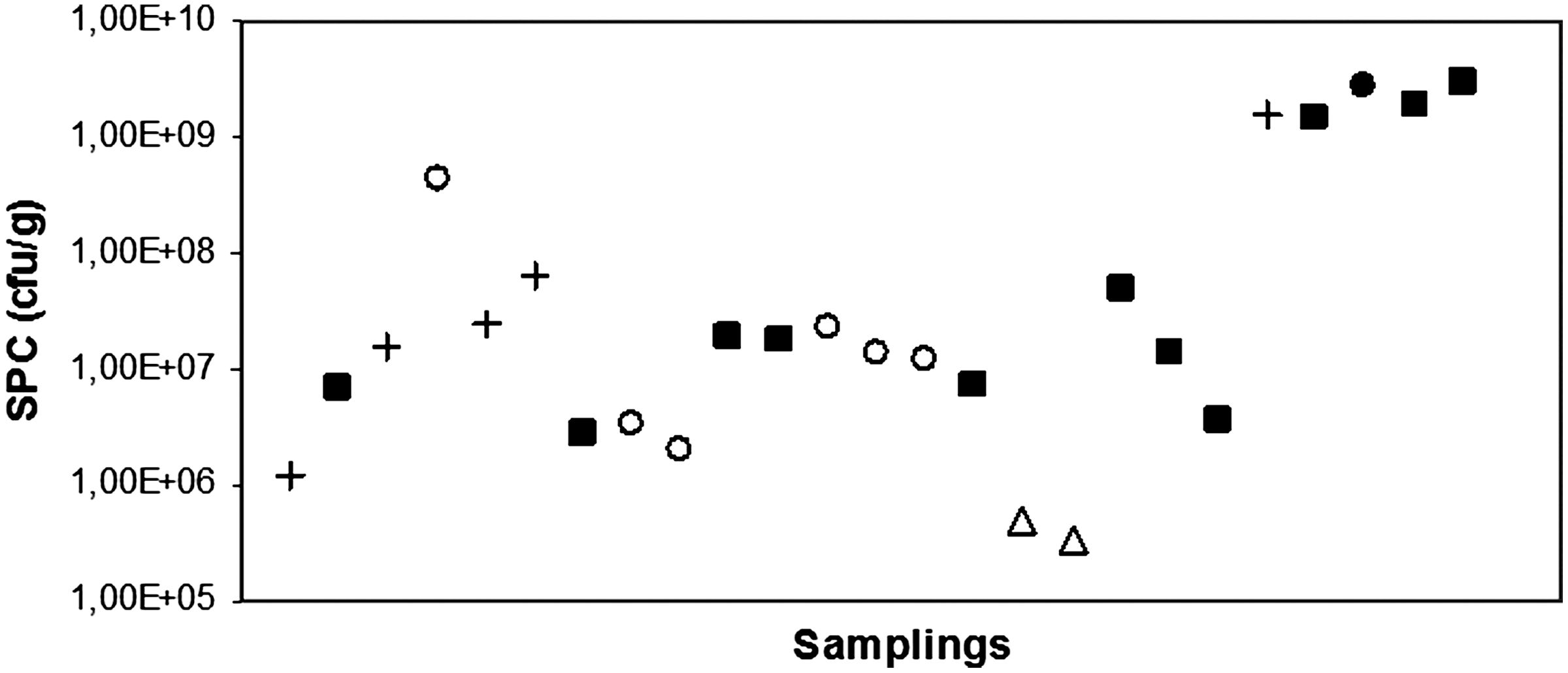
Relationship between standard plate count (SPC) at 30°C and pathogen presence in filters. Negative samples (▪); Listeria monocytogenes–positive samples (Δ); Escherichia coli O157 polymerase chain reaction (PCR) (+); VIDAS E. coli O157 ECO and PCR (○); VIDAS E. coli O157 ECO–confirmed and PCR-positive samples (●).
Culture-based protocol gave presumptive positives for E. coli O157 in 14 manure and 17 feces samples. Two (7%) manure and two (4%) feces samples proved to be confirmed positives after confirmation tests, while 27 (93%) manure and 28 (60%) feces samples tested positive in real-time PCR (Table 3).
Similar results were also reported by other authors (Hassan et al., 2000; Van Kessel et al., 2008; Warnick et al., 2003) who monitored dairy farms in the United States.
Positive results in manure and feces should be ascribed to the presence of intestinal carriers of E. coli O157 within the farm that, although shedding the pathogen in their feces, do not produce contaminated milk. Indeed, as reported before (Van Kessel et al., 2004, Jayarao and Wang, 1999), the presence of pathogenic bacteria in milk is most frequently the result of fecal contamination, rather than direct udder infection.
A relevant decline of positive rates was noticed comparing results of VIDAS E. coli O157 ECO with those obtained after confirmation. However, the inclusion of an immunoconcentration step could be useful to increase method sensitivity (Silvestro et al., 2004).
Discrepancies in positive rates between culture-based and real-time PCR test results, with higher prevalence resulting from the real-time PCR approach, have also been demonstrated by other authors (Karns et al., 2007; Van Kessel et al., 2011). Accordance of results between culture methods and real-time PCR was expressed by the Cohen's Kappa index and evaluated according to Landis and Koch (1977). The agreement was “perfect” (kappa=1) for L. monocytogenes in filters, and “slight” for E. coli O157 in filters (kappa=0.0864), manure (kappa=0.0109), and feces (kappa=0.0586). The “slight agreement” found for E. coli O157 could be attributed to the higher sensitivity of the real-time PCR compared to the culture method.
In the present study, the introduction of a culture-enrichment step ensures that positive results were obtained most probably from viable cells.
The comparison of culture-based and real-time PCR protocols should also take into account their different duration: while the microbiological methods, including confirmation tests, required several days to be completed, the procedure of DNA extraction followed by real-time PCR gave definite results in only two working days. The shortening of the time needed for analysis is particularly advantageous, especially with highly perishable foods requiring continuous monitoring, such as raw milk.
Conclusion
The monitoring of primary production at the farm level requires constant analysis and prompt responses, necessary to recognize possible milk contamination and, in the case of positive results, to put into effect rapid corrective measures. Italian regulation (Italian Republic, 2007) does not specify analysis methods. However, according to the precautionary principle, PCR-positive milk will be held from the raw milk market until a subsequent analysis with negative result confirms the absence of pathogens. Effective prevention should include GHP during milking, with particular regard to milking equipment sanitation, filter replacement, and personnel hygiene, and other control activities against carrier insects, contact with wild animals, and monitoring of wastewaters and sewage.
Multiplex real-time PCR used in the present study proved to be appropriate for a control program (i.e., HACCP) of a raw milk farm, allowing also an increase in sampling frequency. Real-time PCR detection showed higher sensitivity than culture-based methods in detecting E. coli O157 (67 vs. 5 samples) during microbiological monitoring of the farm environment, thus possibly providing more effective prevention at pre-harvest level. Both methods were equally efficient at detecting L. monocytogenes, while no conclusion can be drawn about Salmonella spp. since it was never detected in any sample. Moreover, results obtained suggest that the simple microbiological testing of raw milk intended for direct human consumption does not guarantee its safety for public health.
In conclusion, the application of real-time PCR for routine HACCP tests is feasible and represents a valuable tool, reducing both turnaround time and workload, and providing more sensitive assessment of pathogen presence in the raw milk primary production setting. Multiplex real-time PCR also performed efficiently with complex samples (i.e., feces). The method can be transferred to diagnostic laboratories, where high throughput is an important aspect, and used as a rapid and user-friendly screening method.
Footnotes
Acknowledgments
This work was funded by the Ricerca Corrente (grant 2008 IZSUM 03/08 RC).
Disclosure Statement
No competing financial interests exist.