




Abstract
Enterococci are part of the indigenous microbiota of human gastrointestinal tract and food of animal origin. Enterococci inhabiting non-human reservoirs play a critical role in the acquisition and dissemination of antimicrobial resistance determinants. The aim of this work was to investigate the antimicrobial resistance in Enterococcus faecalis and Enterococcus faecium strains recovered from artisanal food of animal origin. Samples of goat cheese (n=42), cow cheese (n=40), artisanal salami (n=30), and minced meat for the manufacture of hamburgers (n=60) were analyzed. Phenotypic and genotypic tests for species-level identification of the recovered isolates were carried out. Minimum inhibitory concentration (MIC) study for in vitro quantitative antimicrobial resistance assessment was performed, and 71 E. faecalis and 22 E. faecium were isolated. The recovered enterococci showed different multi-drug resistance patterns that included tretracycline, erythromycin, ciprofloxacin, linezolid, penicillin, ampicillin, vancomycin, teicoplanin, gentamicin (high-level resistance), and streptomycin (high-level resistance). VanA-type E. faecium were detected. β-lactamase activity was not observed. Artisanal foods of animal origin act as a non-human reservoir of E. faecalis and E. faecuim strains, expressing multi-resistance to antimicrobials. In conclusion, the implementation of a continuous antimicrobial resistance surveillance in enterococci isolated from artisanal food of animal origin is important.
Introduction
E
One trait of this genus is the resistance to a wide number of antimicrobials; this genus shows intrinsic and acquired antimicrobial resistance (Franz et al., 2003). The acquired resistance genetic determinants can be horizontally transferred intragenus or to phylogenetically related genus (de Niederhäusern et al., 2011). Enterococci can acquire resistance to tetracyclines, erythromycin, glycopeptides (vancomycin-resitant enterococci [VRE]), and aminoglycosides (high-level resistance [HLR]), showing a minimum inhibitory concentration (MIC) of ≥500 μg/mL for gentamicin (HLGR) and a MIC of ≥2,000 μg/mL for streptomycin (HLSR) (Cetinkaya et al., 2000).
In Europe, enterococci with HLR to aminoglycosides have been recovered from dairy and meat products as well as strains with multiple antimicrobial resistance, including vancomycin (Messi et al., 2006; Ogier and Serror, 2008). There is scarce scientific information in Latin America regarding antimicrobial resistance in enterococcal strains from artisanal food of animal origin. Its detection is relevant since artisanal food is consumed in its place of origin and in big cities nearby, possibly being the vehicle for spread of resistant strains (Giraffa, 2002). This transmission route has been suggested for non-artisanal food of animal origin enterococcal strains in previous European and American studies (Donabedian et al., 2003; Lester et al., 2006; Vignaroli et al., 2011). Recently, our group supported evidence that strengthens the possibility of antimicrobial resistance dissemination involving artisanal food enterococcal strains through the food chain. Our study proved HLGR in vivo transfer from Argentinian artisanal food of animal origin Enterococcus faecalis to human E. faecalis (Sparo et al., 2012).
In Argentina and Brazil, E. faecalis and E. faecium are the most prevalent species among human and food enterococci. However, in our country, there is no conclusive information in this regard, since the available reports were focused on food of non-animal origin and human infections (Ronconi et al., 2002; Toledo et al., 2004; Gomes et al., 2008; Gales et al., 2009). Reports on the incidence of antimicrobial-resistant enterococci recovered from Argentinian animal products have not been published yet.
The aim of this study was to investigate antimicrobial resistance in E. faecalis and E. faecium strains recovered from artisanal food of animal origin manufactured in the south-east region of the Province of Buenos Aires, Argentina.
Materials and Methods
Samples collection and processing
During the period January–December 2010, artisanal foods of animal origin samples from the south-east region of the Province of Buenos Aires, Argentina, were analyzed. Samples were collected by simple random sampling. Artisanal meat and dairy products were purchased from 25 agricultural and livestock establishments that produce the following: goat cheese (CQ1–CQ7), cow cheese (VC1–VC5), fermented meat products (SA1–SA3), and hamburgers (PC1–PC10).
From each artisanal establishment, the following samples were taken: n=6 goat cheese, n=8 cow cheese, n=10 craft dry-fermented sausages (salami), and n=6 minced meat for the manufacture of hamburgers. In total, 172 samples (42 goat cheese, 40 cow cheese, 30 salami, and 60 minced meat) were processed. The samples were sent (refrigerated at 4°C) to the Microbiology Laboratory and processed immediately.
Ten grams of samples were diluted in 90 mL of peptone water (0.1% w/v) for its homogenization by mechanic stirring. In products with high-fat content, 1% v/v Tween 80 was added. Aliquots of serial decimal dilutions from homogenized food were spread in bile esculin azide (BEA) agar plates and incubated for 24 h at 35°C. Colonies that showed black pigmentation on the BEA agar were individually picked up and incubated for 24 h at 35°C in brain-heart infusion (BHI) broth to carry out their characterization (ICMSF, 2000). From the decimal dilutions of the homogeneized food, viable counts were carried out in a fluorogenic selective and differential medium for enterococci (fGCTC) incubating for 24 h at 35°C (Sparo et al., 2008).
Phenotypic characterization
Phenotypic characterization was performed by Gram staining, catalase production, hydrolysis of pyrrolidonyl-beta-naphthylamide, and growth in BHI broth with 6.5% NaCl. Species-level characterization was carried out by hydrolysis tests (arginine, pyruvate and methyl-α-
Genotypic characterization
For genus level confirmation, polymerase chain reaction (PCR) was carried out according to Ke et al. (1999) without modifications. Two primers derived from highly conserved regions of enterococcal tuf gene were employed: Ent1 (5′-TACTGACAAACCATTCATGATG-3′) and Ent2 (5′-AACTTCGTCACCAACGCGAAC-3′).
Multiplex PCR for species confirmation was performed following the protocol described by Jackson et al. (2004). Two primers based upon sodA gene were employed: E. faecalis FL1 (5′-ACTTATGTGACTAACTTAACC-3′) and FL2 (5′-TAATGGTGAATCTTGGTTTGG-3′); and E. faecium FM1 (5′-GAAAAAACAATAGAAGAATTAT-3′) and FM2 (5′-TGCTTTTTTGAATTCTTCTTTA-3′).
Antimicrobial susceptibility testing
Determination of MIC was performed by the agar dilution method, following recommendations from the Clinical and Laboratory Standards Institute (CLSI, 2010). The following antimicrobials were tested: penicillin, ampicillin, tetracycline, gentamicin, streptomycin, erythromycin, ciprofloxacin, linezolid, vancomycin, and teicoplanin. E. faecalis ATCC 29212 and E. faecalis ATCC 51299 were used as control strains. Production of β-lactamase was determined using nitrocefin discs (BBL USA, Becton Dickinson, Cockeysville, MD) according to manufacturer's instructions.
PCR for detection of vanA gene
PCR for detection of vanA gene was carried out according to Dutka-Malen et al. (1995). Primers A1 (5′-GGGAAAACGACAATTGC-3′) and A2 (5′-GTACAATGCGGCCGTTA-3′) were used.
Results
Enterococci were isolated from 77 samples of artisanal meat and dairy products: n=40 minced meat samples, n=13 craft dry-fermented sausages, n=16 cow cheeses, and n=8 goat cheeses. Viable counts were as follows: 2.2×10⁴ to 9.5×10⁴ CFU/g (minced meat), 4.1×10⁵ to 1.7×10⁶ CFU/g (cow cheeses), 6.3×10⁵ to 2.4×10⁶ CFU/g (craft dry-fermented sausages), and 6.1×10⁶ to 2.8×10⁷ CFU/g (goat cheeses). Phenotypic and genotypic characterization showed that 70% of the recovered strains were E. faecalis and E. faecium. Table 1 shows the distribution of these strains among the studied artisanal food of animal origin.
At species level, E. faecium strains (7/22) were more resistant than E. faecalis strains (12/71). Table 2 shows the antimicrobial resistance phenotypes of recovered E. faecalis and E. faecium. The rest of the isolated strains did not show HLGR, HLSR, or resistance to any of the other antimicrobials assayed.
AMP, ampicillin; CIP, ciprofloxacin; ERY, erythromycin; GEN, gentamicin; LZD, linezolid; PEN, penicillin; STR, streptomycin; TEI, teicoplanin; TET, tetracycline; VAN, vancomycin.
HLR to aminoglycosides was observed in 16.9% of isolated artisanal food E. faecalis. HLSR (MIC>2,000 μg/mL) and HLGR (MIC>500 μg/mL) were detected in 8.5% of E. faecalis recovered from minced meat (4/6) and salami (2/6). High-level gentamicin resistant (MIC>500 μg/mL) isolates (5.6%) were recovered from minced meat (2/4), cow cheese (1/2), and goat cheese (1/2). In addition, HLSR (MIC>2,000 μg/mL) was detected in 2.8% of E. faecalis strains from minced meat (1/2) and salami (1/2). Multi-resistant E. faecalis were not recovered from the analyzed meat and dairy products.
HLGR (MIC>500 μg/mL) and HLSR (MIC>2,000 μg/mL) were detected together in 18.2% of HLR to aminoglycoside E. faecium from salami (3/7), cow cheese (2/7), and goat cheese (2/7).
Multiple antimicrobial resistance profiles were observed in 31.9% of E. faecium isolates from salami (51.8%), cow cheese (24.1%), and goat cheese (24.1%). Ciprofloxacin (MIC>4 μg/mL), erythromycin (MIC>8 μg/mL), tetracycline (MIC>16 μg/mL), vancomycin (MIC>32 μg/mL), and teicoplanin (MIC>32 μg/mL) were detected in 31.9% of the recovered E. faecium. Linezolid resistance (MIC>8 μg/mL) was observed in 13.6% of E. faecium isolates.
Vancomycin-resistant E. faecalis strains were not detected. However, VanA-type E. faecium were identified by phenotipic and genotypic methods (Fig. 1). Interestingly, the VRE strains were high-level gentamicin and ampicillin resistant as well.
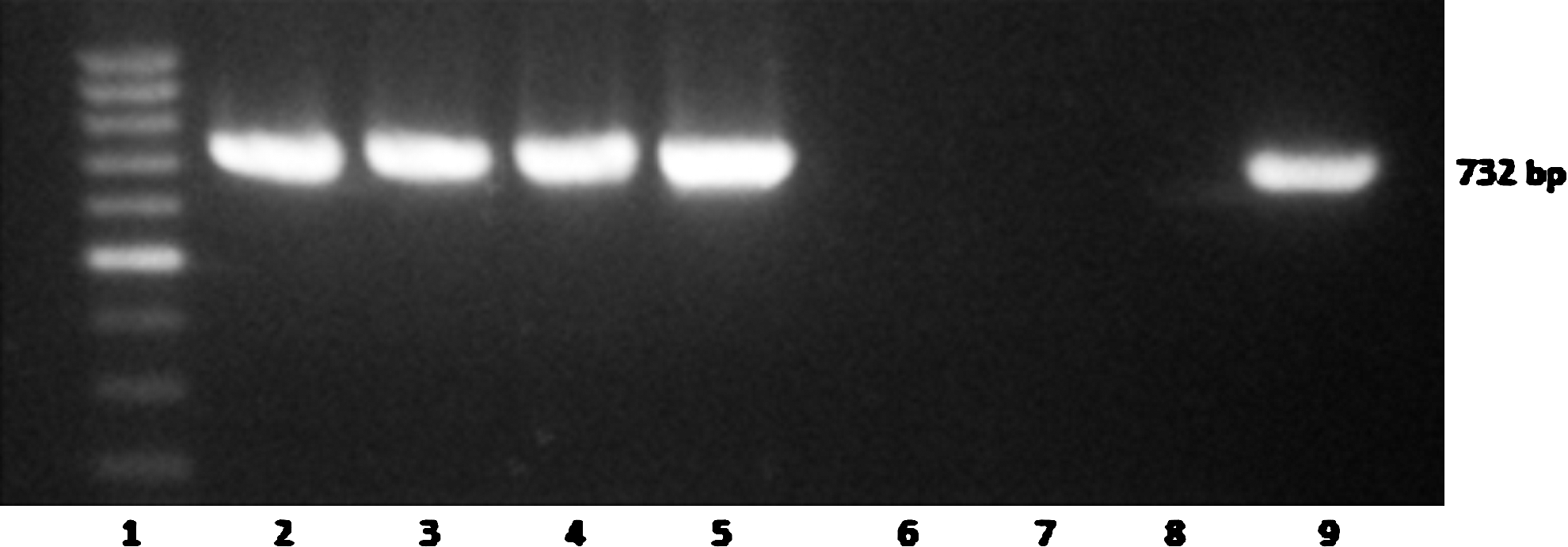
Polymerase chain reaction (PCR) for vanA gene detection in reference and artisanal food enterococcal strains. Lane 1, molecular weight marker; lane 2, Enterococcus faecium MS17 (salami); lane 3, E. faecium MS49 (goat cheese); lane 4, E. faecium MS73 (salami); lane 5, E. faecium MS88 (cow cheese); lane 6, E. faecalis MS10 (minced meat); lane 7, E. faecalis MS33 (goat cheese); lane 8, E. faecalis American Type Culture Collection (ATCC) 29212 (negative control); lane 9, E. faecium ATCC 51559 (positive control).
No β-lactamase activity was detected in any of the studied strains. Nevertheless, there were detected ampicillin (MIC>16 μg/mL) and penicillin (MIC>16 μg/mL) resistance in 18.2% of E. faecium isolates.
Discussion
The importance of studying antimicrobial resistance profiles of E. faecalis and E. faecium recovered from food relies in three main aspects. These species are the most prevalent among human and food enterococcal isolates (Ronconi and Merino, 2000; Bhardwaj et al., 2008). Besides, horizontally transferable high-level vancomycin and teicoplanin resistances (VanA type) has already been found in food enterococci (Messi et al., 2006). Finally, it has been proven that intragenus horizontal transfer of resistance determinants between food and human enterococci is possible (Sparo et al., 2012).
In this study, artisanal food samples from the south-eastern region of the Province of Buenos Aires, Argentina, were analyzed. In this district, there are high rates of manufacture and consumption of these artisanal products, comprising 50% of agro-industrial production and 60% of employment level (Ghezán and Acuña, 2007; Petrantonio et al., 2007).
E. faecalis was found in a higher proportion than E. faecium in salami and minced meat samples. However, a higher incidence of E. faecium strains was observed in goat and cow cheese samples. Other authors from different countries published similar results to those found in our study (McGowan et al., 2006; Cariolato et al., 2008; Martin et al., 2009; Tuncer, 2009; Ribeiro et al., 2011).
One of the most frequently detected resistance determinants among our E. faecium strains was tetraycline. It is known that acquired tetracycline resistance is prevalent in food enterococci (Huys et al., 2004). Recently, Riboldi et al. (2009) and Sánchez Valenzuela et al. (2009) found lower proportions of tetracycline-resistant enterococci in Brazilian food (6.3%) and artisanal meat products from Spain (8.7%).
In addition, our results showed a higher incidence of erythromycin resistance than those published (9%) by Gomes et al. (2008). Likewise, in this study, co-expression of tetracycline resistance and erythromycin resistance was detected. Tetracycline and erythromycin resistance combination was reported to a lesser extent (20%) by other authors (Templer and Baumgartner, 2007).
Ciprofloxacin resistance was also prevalent among our artisanal food strains. Lower frequencies were informed by Baumgartner et al. (2001) and Barbosa et al. (2009) in food enterococci from Switzerland (25.5%) and Portugal (16.5%). Also, in E. faecium strains, resistance (13.6%) was detected for a relatively new drug, linezolid. In Lithuania, a lower prevalence of linezolid-resistant enterococci (3%) was reported (Ruzauskas et al., 2009). Nevertheless, a higher frequency of linezolid resistance (20%) was found in enterococci recovered from Spanish food (Martin et al., 2005).
Our strains showed resistance to clinically relevant antimicrobials, including beta-lactams, aminoglycosydes, and glycopeptides. The results obtained in the present study disagree with the reported absence of ampicillin- and penicillin-resistant enterococci isolated from food of animal origin (Sánchez Valenzuela et al., 2008, 2009; Riboldi et al., 2009).
HLGR, HLSR, and HLGR/HLSR were observed in this study. HLGR was found in a much lower proportion (0.6%) in E. faecalis from Brazilian poultry (Fracalanzza et al., 2007). The same authors reported the absence of HLGR/HLSR in E. faecalis recovered from meat and dairy products. High-level resistance to aminoglycosides, particularly HLGR, is a cause of human public health concern. This resistance leads to the loss of the synergistic effect between aminoglycosides and cell-wall–active agents such as ampicillin or gentamicin. These combinations are widely used for severe infections such as enterococcal endocarditis (Adhikari, 2010).
Vancomycin and teicoplanin resistances were detected in the studied E. faecium isolates (VanA type). Genotypic identification of the vanA determinant in our E. faecium strains recovered from artisanal food is worrisome, since it enables the possibility of intergenus transfer, as has been recently reported (de Niederhäusern et al., 2011). Lower resistance frequencies were found in dairy enterococci (8%) recovered from Costa Rica and in retail food (22%) from Turkey (Araya et al., 2005; Koluman et al., 2009). Also, a multi-center study of enterococci recovered from health-care–associated infections in Argentina reported vancomycin-resistant human E. faecium strains that were mostly VanA phenotype. Likewise, this clinical isolates showed HLGR, HLSR, ampicillin, ciprofloxacin, and erythromicin resistances (Corso et al., 2007).
Nowadays, more than 80% of E. faecium isolates in hospitals from Latin America are vancomycin resistant, and most of them (>90%) show ampicillin resistance as well. In addition, epidemiological changes in enterococcal infections have occurred. E. faecalis predominance as an etiological agent of human infections turned into a significant increase of health-care–associated infections caused by multi-resistant E. faecium (Panesso et al., 2010).
Conclusion
The study of environmental enterococcal isolates allows the assessment of their possible role as a reservoir of resistance genes and enables us to wonder about their capability of effecting horizontal transfer of these determinants to human pathogen microorganisms that share the same habitat. To our knowledge, this is the first publication of multi-drug-resistant enterococci recovered from artisanal food of animal origin manufactured in Argentina. Our results showed that artisanal food of animal origin can act as a non-human reservoir for multi-resistant enterococci, including VanA-type E. faecium strains. The potential spread of these multi-resistant bacteria through the food chain is a major concern in human public health due to their transmission and the possibility of intestinal translocation, causing invasive infections that are very difficult to treat. Organized monitoring of antimicrobial resistance in enterococci recovered from artisanal foods of animal origin is essential for preserving the therapeutic value of antimicrobials.
Footnotes
Acknowledgments
We thank Lic. Mónica Ceci and Dr. Miguel Ángel García Allende from Centro de Estudios Bioquímicos-Tandil, for their collaboration and support provided to carry out this research.
Disclosure Statement
No competing financial interests exist.