




Abstract
Swine are the primary reservoir for foodborne illness associated with Yersinia enterocolitica. The use of antimicrobials in animal agriculture has been hypothesized as having a potential role in the increase in prevalence of zoonotic pathogens. The objective of this study was to compare the frequency of Y. enterocolitica fecal shedding in swine reared on farms with conventional antimicrobial use policies to farms that were antimicrobial free (ABF). Swine farms were selected from three regions in the United States. In each region, farms were categorized based on antimicrobial use policy. Fecal samples were collected from pigs on-farm within 48 h of harvest. The overall proportion of Y. enterocolitica and ail-harboring Y. enterocolitica–positive pigs was 10.9% and 4.0%, respectively. There were increased odds (odds ratio [OR] 6.8, 95% confidence interval [CI] 3.46–13.28) for a pig to be Y. enterocolitica positive if it was reared on an ABF farm as compared to a conventional farm. There was no significant association between farm antimicrobial use policy and isolation of an ail-harboring Y. enterocolitica from an individual pig (OR 1.8, 95% CI 0.90–3.61). The association of antimicrobial use policy with Y. enterocolitica shedding in feces should be interpreted cautiously, as antimicrobial use cannot be separated from other management factors (e.g., confinement or outdoor housing), which may be associated with risk of Y. enterocolitica in swine.
Introduction
Y
Not all Y. enterocolitica are considered pathogenic to humans. Several virulence genes have been identified that are associated with human clinical isolates (Drummond et al., 2012). Among these, ail, a chromosomally located gene, has been used as a marker for human pathogenic potential (Miller and Falkow, 1988). The ail gene is attractive not only because of its presence in human clinical isolates, but also because it is not susceptible to loss during microbiological culture, as has been reported with plasmid-located virulence genes (Portnoy and Martinez, 1985).
Pigs are considered the primary reservoir for Y. enterocolitica associated with foodborne illness in humans (Kapperud et al., 1991). Limited studies have suggested that on-farm management practices are associated with isolation of Y. enterocolitica from swine (Nowak et al., 2006; Wesley et al., 2008; Laukkanen et al., 2009; Martínez et al., 2011; Virtanen et al., 2011; von Altrock et al., 2011). In addition to risk factors associated with biosecurity or hygiene (e.g., water source, access to wildlife, pests, or other domestic species), risk factors associated with antimicrobial use policy have also been identified (Nowak et al., 2006; Virtanen et al., 2011; von Altrock et al., 2011). With increasing scrutiny of agricultural antimicrobial use, there is a critical need to understand the implications of reduced antimicrobial use on the prevalence of zoonotic pathogens. In the United States, antimicrobial-free pork production is primarily located within niche markets that sell their product based on several credence attributes (antibiotic–free production, pasture/outdoor production, heritage breeds of swine) and/or product quality (Honeyman et al., 2006). Based on 2006 estimates, these farms may produce up to 750,000 total pigs annually (Honeyman et al., 2006), while in the same year the total United States pig crop was estimated at 105.6 million pigs (USDA, 2009).
The objective of this study was to compare Y. enterocolitica prevalence in swine reared on farms with conventional antimicrobial use policies to swine reared on antimicrobial-free farms.
Materials and Methods
Farm selection criteria
Between March 2003 and August 2004, a convenience sample of swine farms was selected from three regions in the United States. Region 1 represented North Carolina (sampled March 2003–March 2004), Region 2 represented Ohio and Michigan (sampled July 2003–August 2004), and Region 3 represented Iowa and Wisconsin (sampled January 2003–May 2004). Criteria for entry were willingness to allow sampling of pigs on-farm within 48 h of harvest. Antimicrobial-free (ABF) farms were defined as those farms that self-reported not using any antimicrobials for any purpose in pigs older than 5 weeks of age. The 5-week cutoff for antimicrobial use was selected because it was the criterion for qualification for farms that participated in the most prevalent niche marketing program in the United States that marketed pigs as antimicrobial-free. Pigs that were treated with antimicrobials out of medical necessity were separated from herd mates. These separated pigs were excluded from the study. Conventional farms were defined as those that had at least some antimicrobial use in pigs 5 weeks of age or older. There were 30 ABF and 25 conventional farms included in the study. (Region 1: 10 ABF and 10 conventional, Region 2: 7 ABF and 9 conventional, and Region 3: 13 ABF and 6 conventional).
Sampling
On-farm, fecal samples were collected 48 h before harvest from a convenience sample of pigs identified by the farm as destined for harvest. Thirty pigs was the target number of samples per identified harvest group. This sample size was selected because 30 pigs is sufficient to detect at least one positive animal with 95% probability if the prevalence is 10% (assuming a perfect diagnostic test). If fewer than 30 pigs were destined for harvest, all pigs in the group were sampled. The distribution of the number of pigs sampled per farm was the following: 5–19 pigs, nine farms; 20–29 pigs, 17 farms; 30–35 pigs, 28 farms; 100 pigs, 1 farm.
Microbiological methods
Fecal samples were cultured as previously described (Funk, 1998). Briefly, 10 g of feces were added to 90 mL phosphate-buffered saline and were cold enriched at 4°C for 21 days. Post cold enrichment, the fecal–phosphate-buffered saline solution was plated onto Cefsulodin-Irgasan-Novobiocin Agar (Becton, Dickinson and Company, Sparks, MD) and incubated at 25°C for 48 h. Colonies with typical morphology of Y. enterocolitica were then biochemically tested using urea broth (Becton, Dickinson and Company). Urease-positive isolates were confirmed as Y. enterocolitica (16S rRNA) and assessed for presence of the chromosomally encoded ail gene using a multiplex polymerase chain reaction as described by Wannet et al. (2001). The full pathogenicity of Y. enterocolitica requires presence of both a virulence plasmid (pYV) and chromosomally encoded virulence factors (e.g., ail). The unstable nature of the pYV plasmid during culture raises questions about the diagnostic value of targeting plasmid-encoded sequences (Bhaduri et al., 1991; Kapperud, 1991). Given the use of a 21-day cold enrichment, the likelihood of plasmid loss was deemed reasonably high. This was the justification for targeting the chromosomally located ail gene as a marker of potential virulence.
Serogrouping
All Y. enterocolitica isolates (confirmed using 16S rRNA polymerase chain reaction) were serotyped by slide agglutination with a commercial kit containing O:1,2, O:3,O:5, O:8, O:9 (Denka Seiken, Tokyo, Japan) according to manufacturer instructions.
Statistical methods
Descriptive data regarding the proportion of Y. enterocolitica and ail-harboring Y. enterocolitica–positive fecal samples by farm, region, and farm type (ABF or conventional) were tabulated. Univariate statistics (chi-square) was used to compare the proportion of pigs shedding Y. enterocolitica and ail–harboring Y. enterocolitica in their feces by region and by farm antimicrobial use category (ABF or conventional) using Stata v.11 (StataCorp., College Station, TX). To assess the association between farm type and risk for an individual pig to be Y. enterocolitica positive on the farm, two separate multilevel multivariable logistic regression models were constructed using MLwiN 1.1 (Multilevel Models Project, Bristol, UK). The two models evaluated the dependent variables Y. enterocolitica culture–positive fecal sample and ail-harboring Y. enterocolitica–positive fecal sample, respectively. The only independent variable included in the model was farm type (ABF [1] or conventional [0]). For the variance structure, the lowest level was pig, the second level was farm, and the third level was region. For assessment of the proportion of variance attributable to the levels of model organization, the value of π2/3 was assigned to the lowest level (Snijders and Bosker, 1999).
Results
A total of 1441 pigs from 55 farms were sampled. The average number of pigs sampled per ABF farm was 26.4 (range 5–35) and for conventional farms was 28.1 (range 25–100).
The overall proportion of fecal samples that were culture positive for Y. enterocolitica and ail-harboring Y. enterocolitica was 10.9% (157/1441; 95% confidence interval [CI] 9.3%–12.6%) and 4.4% (64/1441; 95% CI 3.1%–5.2%), respectively. The total number of farms with at least one pig fecal culture positive for Y. enterocolitica or ail-harboring Y. enterocolitica was 24 (43.7%) and 17 (30.9%), respectively. Thirty-one farms (56.4%) had no Y. enterocolitica isolated. For those farms from which at least one Y. enterocolitica was isolated, the proportion of pigs with a positive fecal sample ranged from 3.1% to 88.9% and from 3.1% to 52.0% for farms from which at least 1 ail-harboring Y. enterocolitica was isolated. The overall serogroup distribution was as follows: not typable, 36 isolates; O:3, 68 isolates; O:5, 43 isolates, O:8, four isolates; and O:9, six isolates. Distribution of serogroups by farm antimicrobial use policy and presence of the ail gene is shown in Table 1.
The number in parentheses indicates the number of isolates that were ail-harboring Y. enterocolitica.
In the univariable analysis, there was a significant difference in the proportion of Y. enterocolitica and ail-harboring Y. enterocolitica–positive fecal samples by region (Fig. 1). Regions 2 and 3 had higher overall proportion of Y. enterocolitica–positive samples of 16.8% and 16.1%, respectively as compared to Region 1 (2.5%, chi-square 69.3, p<0.0001). For ail-harboring Y. enterocolitica, the proportion of positive samples differed by region (0.5%, 3.6%, and 8.5% for Regions 1, 2, and3, respectively [chi-square 43.0, p<0.0001]). Also in the univariable analysis, there was a significant difference in the proportion of Y. enterocolitica and ail-harboring Y. enterocolitica–positive fecal samples by farm antimicrobial-use policy (Fig. 2). Conventional antimicrobial-use farms had a 3.3% overall Y. enterocolitica prevalence, while ABF farms had an overall prevalence of 18.9% (chi-square 81.9, p<0.0001). For ail-harboring Y. enterocolitica, the overall proportion of positive pigs was 2.4% and 5.6% for conventional and ABF farms, respectively (chi-square 9.1, p=0.003).
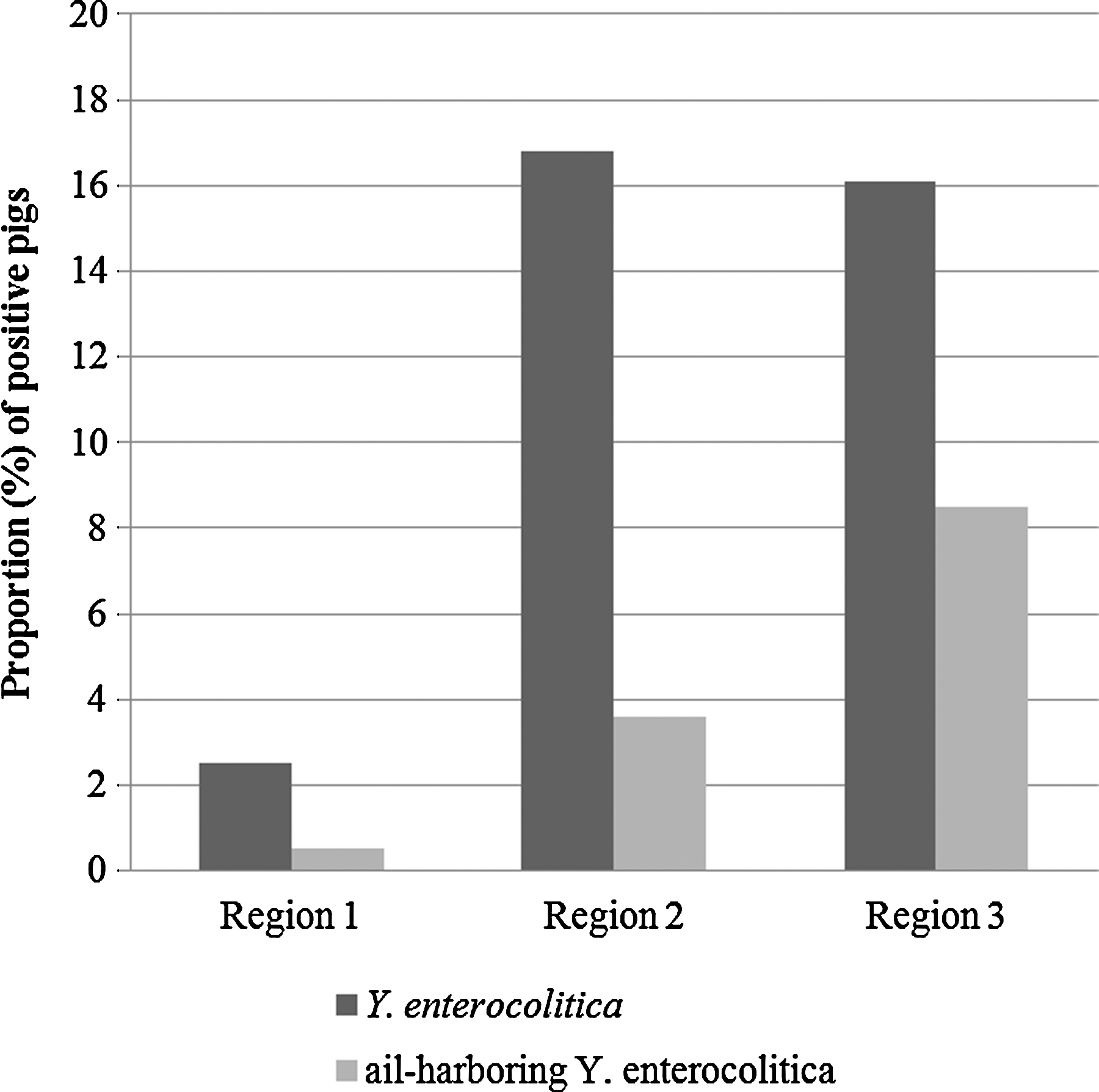
Proportion of pigs from which a Yersinia enterocolitica or ail-harboring Y. enterocolitica was isolated by region.
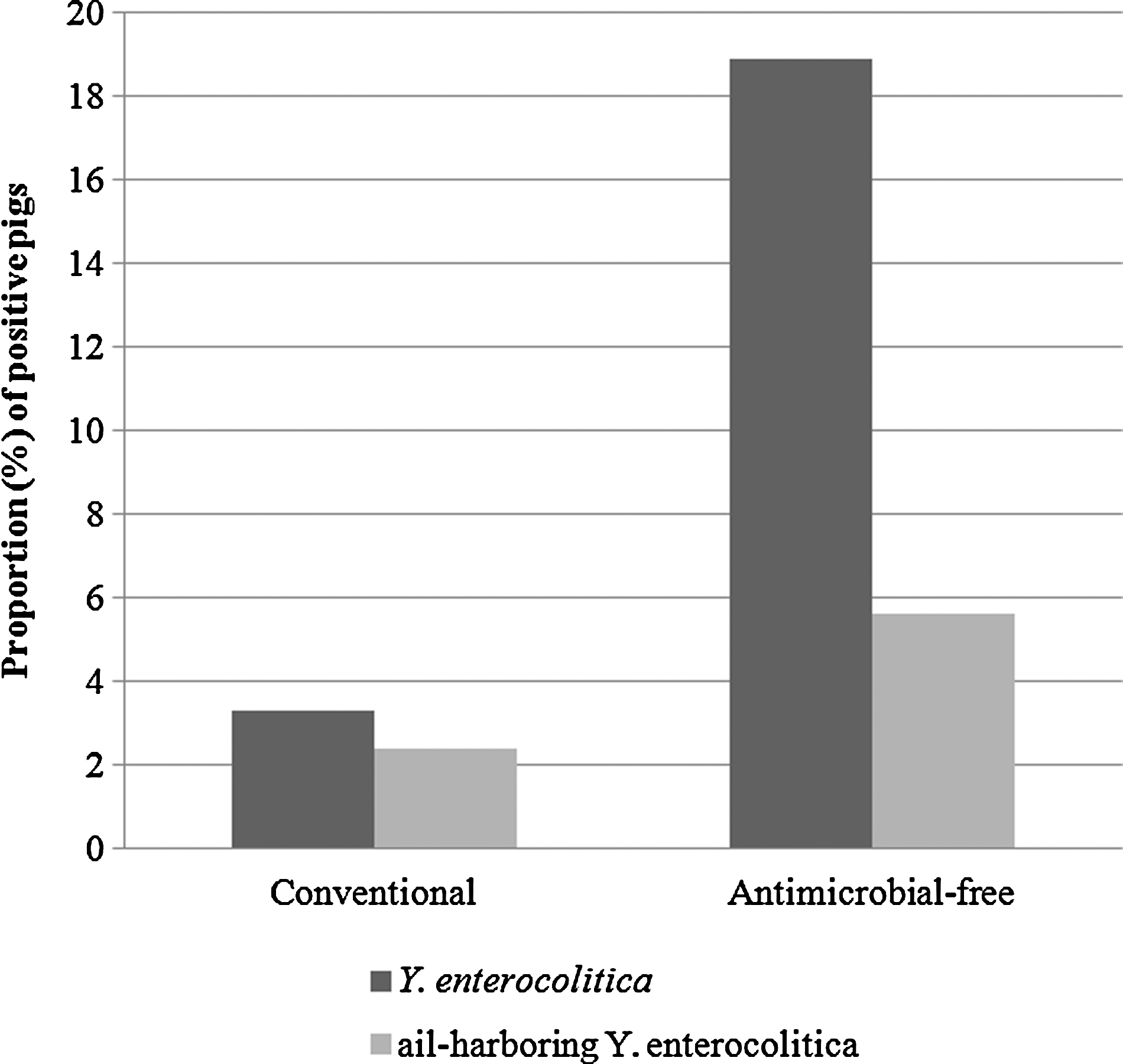
Proportion of pigs from which a Yersinia enterocolitica or ail-harboring Y. enterocolitica was isolated by farm type (antimicrobial free or conventional antimicrobial use).
The results of the multivariable logistic regression models are shown in Table 2. Pigs from ABF farms were at greater odds to be Y. enterocolitica positive (odds ratio 6.8, 95% CI 3.5–13.3). There was not a significant association between farm antimicrobial use policy and the odds of isolating an ail-harboring Y. enterocolitica from an individual pig (odds ratio 1.8; 95% CI 0.9–3.6). The variance structure of both models suggested that the largest proportion of the variance was located at the farm level, followed by pig and region (Table 2).
95% Confidence intervals that do not contain the value 1 are significant at p≤0.05.
The variance for all models at the pig level was given the value of π2/3. Therefore, only the proportion of variance associated with the pig level is reported.
Discussion
The overall proportion of pigs with positive fecal samples on-farm within 48 h of marketing reported in this study is within the range of prevalence rates reported previously in North America. Individual animal prevalence has been estimated to range from approximately 3.6% to 25% (Funk et al., 1998; Bhaduri and Wesley, 2006; Bowman et al., 2007; Farzan et al., 2010), and from 48% to 92% farm prevalence (Bowman et al., 2007; Farzan et al., 2010). Isolation rates of Y. enterocolitica from swine have been reported as greater when the tonsil or oropharyngeal region are sampled, suggesting that the prevalence in this study is underestimated (Thibodeau et al., 1999; Gürtler et al., 2005). Feces were selected for investigation in the study as a consequence of the overall project goal of evaluating multiple foodborne pathogens concurrently in the sample population. Despite the limitation of fecal culture for estimation of Y. enterocolitica prevalence, we have no reason to believe that there would be any bias in isolation of Y. enterocolitica between pigs residing on farms of different antimicrobial-use policies, although it may have limited statistical power to discern a difference in the proportion of pigs shedding ail-harboring Y. enterocolitica between the farms with different antimicrobial use due to low prevalence estimates. Further, Y. enterocolitica serotypes identified (O:3, O:5, O:8, and O:9) are serotypes associated with human disease globally (Drummond et al., 2012), although the serotype distribution of Y. enterocolitica isolated from human cases in the United States is difficult to identify from published surveillance data (Scallan et al., 2011; Ong et al., 2012).
In this study, we evaluated two different outcomes, Y. enterocolitica and ail-harboring Y. enterocolitica, using the presence of the ail gene as a measure of the potential for causing human disease. Full pathogenicity of Y. enterocolitica requires both chromosomal and plasmid-mediated virulence genes (Revell and Miller, 2001). The use of the ail gene is not a perfect predictor of potential pathogenicity in humans, and the ail gene has been detected in Y. enterocolitica of Biotype 1A, which are considered nonpathogenic (Drummond et al., 2012). Tadesse et al. (2012) have characterized the isolates in this study and found that more than 80% of the ail-harboring isolates are aesculin negative, indicating these isolates are not members of Biotype 1A, and therefore more likely to be pathogenic to humans. Others have reported the prevalence of ail-harboring Y. enterocolitica in swine (Gürtler et al., 2005; Bhaduri and Wesley, 2006; Bowman et al., 2007; Funk et al., 1998; Wesley et al., 2008).
Our finding in the univariable analysis that there were regional differences in Y. enterocolitica fecal shedding is in agreement with those of Wesley et al. (2008), which found regional differences with increased risk of Y. enterocolitica isolation in swine reared in the central region of the United States as compared to noncentral states. Conversely, in the multivariable model, the contribution of the regional level of organization to the variance structure was minimal in both models, with the greatest proportion of the variance structure located at the farm level. This finding suggests that farm-level risk factors (beyond antimicrobial use policy) may be most important for on-farm control of Y. enterocolitica and that the regional association seen in the univariable model can be in part explained by risks at other levels of organization (i.e., farm and pig). Future studies for risk factors associated with Y. enterocolitica may be best designed to prioritize identification of farm-level risk factors.
The association between antimicrobial use and Y. enterocolitica in swine are likely complex. In a Finnish study (Virtanen et al., 2011), organic production and the use of amoxicillin were both associated with decreased risk of fecal shedding of pathogenic (ail and virF harboring) Y. enterocolitica at slaughter (a discordant finding in itself, as organic farms would not use any antimicrobial), while use of tetracycline was associated with increased risk of fecal shedding. In the same study (Virtanen et al., 2011), when carriage of Y. enterocolitica was the outcome of interest (defined as swine being positive in either tonsil or fecal samples), organic production was still protective, and weekly use of antimicrobials was associated with increased risk of Y. enterocolitica carriage in swine. Von Altrock et al. (2011) conversely found no association with antimicrobial use and Y. enterocolitica serological status in swine. Nowak et al. (2006) reported that conventional farms had a higher proportion of samples positive for virulent (defined as ail-harboring) Y. enterocolitica as compared to pigs reared in organic systems. Another critical difference between the Nowak et al. (2006) study and the results presented here is that conventional farms received pigs from many different farrowing farms, while organic farms tended to be “closed farms” rearing their own pigs in a farrow-finish production system. This further complicates the interpretation of antimicrobial use policies as a risk for Y. enterocolitica.
As with other observational studies, a primary limitation is what the farm categorization based on antimicrobial use policies is truly measuring. Caution is warranted in interpreting the positive association between a farm's antimicrobial use policy and Y. enterocolitica prevalence found in this study. One potential explanation is that conventional antimicrobial-use policy results in decreased shedding of Y. enterocolitica in swine feces, perhaps through direct antimicrobial effect on Yersinia, yet there is great hazard in this interpretation. Although our selection criteria were related to antimicrobial use, the associations seen in this study may be related to other farm-level management practices that are associated with antimicrobial use policies in U.S. niche pork markets (Honeyman et al., 2006). The majority of ABF farms in this study were housed outdoors, while the majority of conventional-use farms were housed in total confinement. Therefore, the ABF categorization of farms is a proxy measure of housing status, as well as other management practices that are often associated, and inseparable within the study population, with farm antimicrobial use policy (e.g., genetics, nutrition, exposure to other animal species, etc.). Outdoor access may increase the risk of swine for exposure to Y. enterocolitica shed by wildlife (Shayegani et al., 1986; Wobeser et al., 2009). This explanation may be supported by the finding that the majority of Y. enterocolitica found in ABF farms did not harbor the ail gene and had more isolates that were not typable to the serogroups commonly associated with human illness. Evaluating antimicrobial use policy between ABF and conventional farms in observational studies will always be limited by this challenge. Future research regarding the impact of antimicrobial use policy on zoonotic pathogens (and antimicrobial resistance) should pursue an alternative study design to understand antimicrobial use policy in the absence of other management practices. Nonetheless, since in real-world application these practices often define different approaches to swine production, it may well be reflective of the risk under the broad categorization of conventional and alternative swine production as currently conducted in the United States.
We found no association between farm antimicrobial use policy and fecal shedding of ail-harboring Y. enterocolitica. These results are in agreement with a previous study in U.S. swine that found no association between feed antimicrobial use and detection of ail-harboring Y. enterocolitica in swine (Wesley et al., 2008). Also, these investigators (Wesley et al., 2008) did not find an association between ail-harboring Y. enterocolitica and other risk factors potentially explained by housing type (exposure to the outside during the finishing phase; contact with pests, wildlife, or other domestic species). These results do suggest that there is not a large effect due to antibacterial use policy (or production system) on the risk of fecal shedding potentially pathogenic Y. enterocolitica in swine.
Conclusions
Antimicrobial use-policy, which is inseparable with many other farm-level management factors, was associated with fecal shedding of Y. enterocolitica in this study, with market-ready pigs on ABF farms being at greater risk of shedding Y. enterocolitica as compared to conventional (antimicrobial-using) farms. Farm antimicrobial-use policy was not associated with the odds of shedding an ail-harboring Y. enterocolitica, with detection of the ail-gene being a proxy measure of potential to cause disease in humans. This suggests no differential risk to public health from farms differing in antimicrobial use policies as defined in this study. Future studies to understand risk factors for Y. enterocolitica on farms should focus on farm-level risk factors, and if antimicrobial use policy is of interest, study designs should be conducted within populations controlled for other farm-level risk factors.
Footnotes
Acknowledgments
This work was supported by a research grant funded by the United States Department of Agriculture (2002-51110-01508). We thank the producers who participated in this research.
Disclosure Statement
No competing financial interests exist.