




Abstract
Pigs are the most important reservoir of Yersinia enterocolitica infections in humans. Knowledge of farm management practices that contribute to the transmission of this bacterial species in pigs is essential to understand how to control this foodborne pathogen in food production. The prevalence of Y. enterocolitica, and other results obtained from an age trend analysis were used to estimate the on-farm risk of transmission of specific management practices for this pathogen in 30 pig farms in Finland. Log-linear analysis revealed that rearing pigs in pens without or with sparse amounts of bedding and buying piglets from more than one farm were the variables that contribute most to the occurrence of Y. enterocolitica. The study also found that using an all-in/all-out management system and supplying water of municipal origin were factors that might reduce the prevalence of Y. enterocolitica, and therefore the risk of transmission of Y. enterocolitica in pig farms.
Introduction
The contamination of carcasses in slaughterhouses originates from pigs that have already been infected on farms. Pathogenic Y. enterocolitica have been isolated from asymptomatic pigs on farms (Bhaduri et al., 2005; Wesley et al., 2008). The pathogen has a prevalence range of 60–100% in fattening farms of Finland, Latvia, Estonia, Russia, The United Kingdom, Italy, Spain, and Belgium (Laukkanen et al., 2009; Ortiz-Martinez et al., 2009; Ortiz-Martinez et al., 2010; Ortiz-Martinez et al., 2011). Farm contamination has been associated with different factors in management practices that affect production conditions. Laukkanen et al. (2009) found that high prevalence of Y. enterocolitica was associated with the absence of bedding, and Fukushima et al. (1983) suggested that contaminated pen floors were a source of infection on farms. However, knowledge of the risk and risk-protective factors that are involved in the infection of pigs has been rather limited to date (EFSA, 2011).
The purpose of this study was to investigate the production management practices on farms as risk factors for the introduction and spread of Y. enterocolitica in pig farms. Data of the prevalence, seroprevalence, age trends, and management practices at farm level were evaluated.
Materials and Methods
Sample collection
Farms were selected by the willingness of farmers to participate in this study. Thirty conventional farms were studied: 18 farrow-to-finish, eight fattening, and four farrowing (farms that only sell piglets) farms. The size of farms ranged from 20 to 2000 sows in farrowing and farrow-to-finish farms, and from 120 to 1500 slaughter pigs in fattening farms. In total, 1500 pigs reared in 714 pens and of different ages were sampled (Table 1). The mean number of pens sampled per farm was 26.8±4.5. Fecal and blood samples were collected from 159 pens, exclusively feces were taken in 553 pens, and in two pens only blood was collected.
Totals of 1481 fresh fecal samples and 334 blood samples were collected, both feces and blood from 315 pigs, only feces from 1166 pigs, and only blood from 19 pigs. Fecal samples were picked up from the floor using a clean plastic glove. The surface of the feces was removed to exclude contamination. Blood samples were drawn by venipuncture.
In addition, 105 environmental samples and 15 water samples were collected in 17 farms (Table 2). Environmental samples were taken from feed, dust, straw, and mud, and swabs from different surfaces of 117 pens, 26 pens with pigs, and 91 pens without pigs. Sterile cotton-wool swabs were rubbed over the surface of pen walls, floors, feeding and drinking cups, drinking nipples, and also from the bottom of boots, at the end of the sampling visit and before cleaning, according to the protocol issued by the European Commission (EC, 2001). Fifteen water samples, 10 L each, were collected from 14 farms.
Fecal and environmental samples were placed in sterile plastic bags and swabs were placed into 90 mL of peptone–mannitol broth (PMB) and vigorously shaken. All samples were transported to the laboratory under refrigeration, and the analyses were performed within 24 h of sampling.
Isolation of Y. enterocolitica and the determination of Yersinia antibodies
Ten grams of fecal samples, environmental samples, and the filter papers through which the 10 L of water samples had been filtered were taken. Each 10-g sample was mixed into 90 mL of PMB, and 100 μL was immediately plated onto cefsulodin–irgasan–novobiocin agar (Oxoid, Cambridge, UK). For the swabs samples, 100 μL of PMB were directly plated onto cefsulodin–irgasan–novobiocin agar. Y. enterocolitica was isolated using the methodology previously described by Virtanen et al. (2012) and Laukkanen et al. (2010). The pathogenicity of the isolates was confirmed by using polymerase chain reaction that detected the chromosomal ail (Nakajima et al., 1992) and the virF (Kaneko et al., 1995) located in the virulence plasmid pYV.
The determination of antibodies against pathogenic Yersinia outer proteins was carried out in serum samples by using a commercially available enzyme-linked immunosorbent assay (ELISA) kit (Pigtype Yopscreen, Labor Diagnostik, Leipzig, Germany), according to manufacturer's instructions. The optical density (OD) was measured by a spectrophotometer (Multiskan Ascent, Thermo Fisher Scientific Inc., Waltham, MA), and an OD value of 0.2 was used as a cut-off value.
Data analyses
Data were analyzed using Excel (Microsoft Corp., Redmond, WA) and the statistical software package SPSS 17.0 (SPSS Inc., Chicago, IL). The pen was considered the experimental unit, as was defined by Christensen and Gardner (2000). A pen was regarded as positive when any fecal or blood sample tested positive. Seroprevalences were calculated assuming sensitivity and specificity of 100% as the values indicated in the manufacturer's validation report. The exact binomial 95% confidence intervals (CI) formula described by Agresti and Coull (1998) was used.
Epidemiological data were gathered by using an on-farm interview and by observation at the time of sampling. Variables studied are shown in Table 3. The Spearman test was performed to identify whether the independent variables were correlated (r>0.8, p<0.01). The Pearson chi-square (χ 2) test was used, and variables with a p-value<0.2 were included in the multivariate analysis.
The all-in/all-out (AIAO) was used in the weaning units of two farrow-to-finish farms and one farrowing farm, and in the fattening units of five fattening farms. When the origin of a farm's water was the municipal water supply, it was registered as “municipal water,” whereas when the origin was from drill, ring, or spring wells it was registered as “own water.” One farrowing, three farrow-to-finish, and three fattening farms used water of municipal origin. The type of bedding material was categorized as straw-type bedding (straw, hay, or silage), shavings or sawdust, peat, or any combination of them in 23.6%, 12.0%, 1.3%, and 6.8% of pens, respectively. In 400 pens there was no bedding. The amount of bedding was categorized as “absent,” “sparse” (32.4% of pens), or “plenty,” a thick layer of bedding (7.2% of pens). The number of piglet replacement suppliers was recorded as “none,” “one supplier,” or more than one supplier. Three fattening farms purchased piglets from only one supplier, whereas five farms obtained the piglets from more than one supplier. All farrow-to-finish and farrowing farms did not buy piglets. Whether adjacent pens had open slatted walls and hence the potential for direct contact between pigs of neighboring pens was ascertained. Later on, the status of the adjacent pen was assessed, when sampled, as positive or negative for any of the samples collected.
A log-linear analysis model selection and a general log-linear analysis were used to examine the relationship between variables and control the response rate. In both steps, a main-effects Poisson mode was performed. The log-linear analysis tests the relationship between variables by placing all the variables into one multiway contingency table, and then identifying which variables contributed most significantly to the distribution of data. Parameter estimates represent log-odds ratios.
The Kruskal-Wallis test denoted by the test statistic H(x), where x is the degrees of freedom and the Jonckheere-Terpstra (J-T) tests, were used to investigate the effect of animal age. Post hoc tests for Kruskal-Wallis to determine where the differences lay were performed. The relationship between the spread of Y. enterocolitica in the feces and the count of antibodies was evaluated by using the Wilcoxon signed-rank test.
Results
A total of 347 of 1481 (23.4%, 95% CI 21.3–25.6) fecal samples contained Y. enterocolitica, with all isolates positive for ail and virF gene, and 182 of 334 (54.5%, 95% CI 49.2–59.8) of serum samples tested positive for the presence of antibodies against Yersinia. The prevalence of positive pens was 26.6% (95% CI 23.5–29.6). These results are presented in Table 4.
A pen was considered positive when any fecal, blood, or environmental sample was positive.
CI, the exact binomial 95% confidence interval.
From 159 pens where both fecal and blood samples were collected, 40 were found positive for feces and 102 for blood. Y. enterocolitica was isolated in 102 of 553 pens where only fecal samples were studied, and no antibodies were found in any of the pens where exclusively blood samples were taken.
The risk of finding seropositive pigs increased in those pens in which Y. enterocolitica was isolated from fecal samples. In all farms, 38 of 40 positive pens in which fecal samples were positive were also serum positive (p<0.01, OR 16.3, 95% CI 3.8–70.8). In individual animals, the ELISA OD values were significantly (z-score 15.33, p<0.01) higher in pigs that excreted Y. enterocolitica than in pigs that did not (mean 52.9 versus mean 25.8). Figure 1 shows the 95% CI of ELISA OD values of pigs grouped by age that excreted and did not excrete Y. enterocolitica.
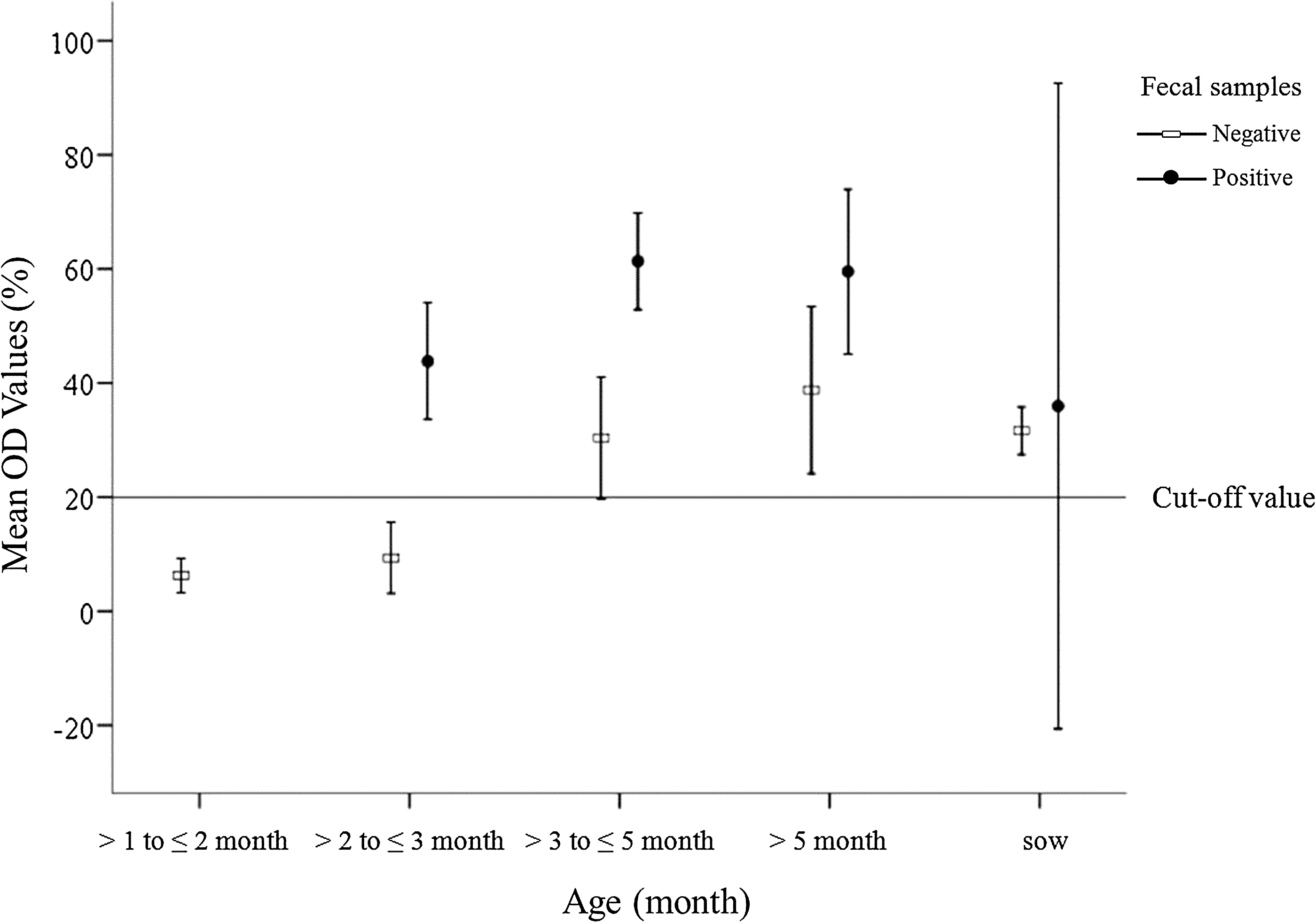
Comparison of serological values of the 315 pigs from which blood and fecal samples were taken, grouped by age, that either did excrete or did not excrete ail and virF Yersinia enterocolitica in their fecal samples. Errors bars illustrate the 95% confidence interval for the mean of enzyme-linked immunosorbent assay optical density (OD) values.
Nine of 105 environmental samples were positive for Y. enterocolitica (Table 2). Eight positive samples were detected on one farrowing farm: three feed samples, one rodent fecal sample, swabs of three drinking cups, and one boot. One positive swab was collected from a feeding cup in a farrow-to-finish farm. No Y. enterocolitica was isolated from the water samples.
Six of all management practices studied in the univariate analysis (Table 5) were related to the presence of Y. enterocolitica in fecal samples (p<0.2), and subsequently, they were introduced in the multivariate analysis. The amount of bedding used was highly correlated with the type of bedding material used (Spearman test, r=0.95, p<0.01). Therefore, the interaction of type and amount of bedding was introduced as a variable in the multivariate analysis. From 215 pens with sparse bedding, 48% had only straw-type and 17% had a combination of straw-type with peat or shavings or sawdust. Pens on farms that followed an AIAO management system used municipal water, purchased piglets from none or only one supplier, and whose adjacent pens were negative were more likely to present lower prevalence of Y. enterocolitica in fecal samples.
Fecal samples collected in 714 pens from 30 pig farms in Finland.
When considering origin of water as municipal or own.
When considering origin of water as municipal or own (drill well, ring well, or spring well).
The log-linear model selection identified a final model that fit the data adequately according to the goodness-of-fit test (Lχ 2=186.2, p>0.05) (Table 6). The nonuse or sparse use of bedding material (straw-type or shavings or sawdust) was observed to be significant (p<0.01) risk factors for the presence of Y. enterocolitica in fecal samples in the parameter estimation. The presence of an adjacent pen negative for any of the samples was identified as a protective factor (p<0.01). Farms with none or only one piglet replacement supplier (p<0.01) and farms with water of municipal origin (p<0.05) also had significant estimates values.
Parameter estimate represents the log-odds ratios, and z-score compares effects between parameters (the bigger z-value the bigger the effect, ignoring the sign). The model was defined as: constant+all-in/all-out+adjacent pen+supplier+water+type of bedding material x amount of bedding.
This parameter is set to zero because it is redundant.
AIAO, all-in/all-out management system, categories: 0—nonuse, 1—use; Water—origin of farm's water, categories: 0—municipal water, 1—own drill well, 2—own ring well, 3—own spring well, 4—own water, unknown well type; B.M.—type of bedding material, categories: 0—no bed, 1—straw-type (straw, hay, or silage), 2—peat, 3—sawdust or shavings, 4: straw-type+peat, 5—straw-type+sawdust or shavings; B.A.: amount of bedding, categories: 0— absent, 1—sparse, 2—plenty; Supplier: number of suppliers that provide new pigs, categories—0: none, 1—one supplier, 2—more than one supplier; Adjacent: status of the adjacent pen with open walls, categories—0: negative, 1—positive.
The results of evaluating the sows by their production phase (to be bred, pregnant, or farrowed) were not significantly different from evaluating the sows as one group. The percentage of positive fecal samples was significantly affected by age in all farms, H(5)=134.06, p<0.01. The J-T test indicated a significant trend in age distribution, and the post hoc tests revealed significant differences between groups of pigs. A peak of excretion of Y. enterocolitica in animals older than 2 months up to 3 months old was observed (Table 7). Similarly, in farrow-to-finish farms significant differences in prevalence values were observed (H[5]=56.68, p<0.01). Figure 2 shows the excretion tendency and the evolution of seroprevalence by age. There were also significant differences in seroprevalence values between age groups in all farms (H[4]=21.21, p<0.01), and in farrow-to-finish farms (H[4]=17.49 p<0.01) (Table 7).
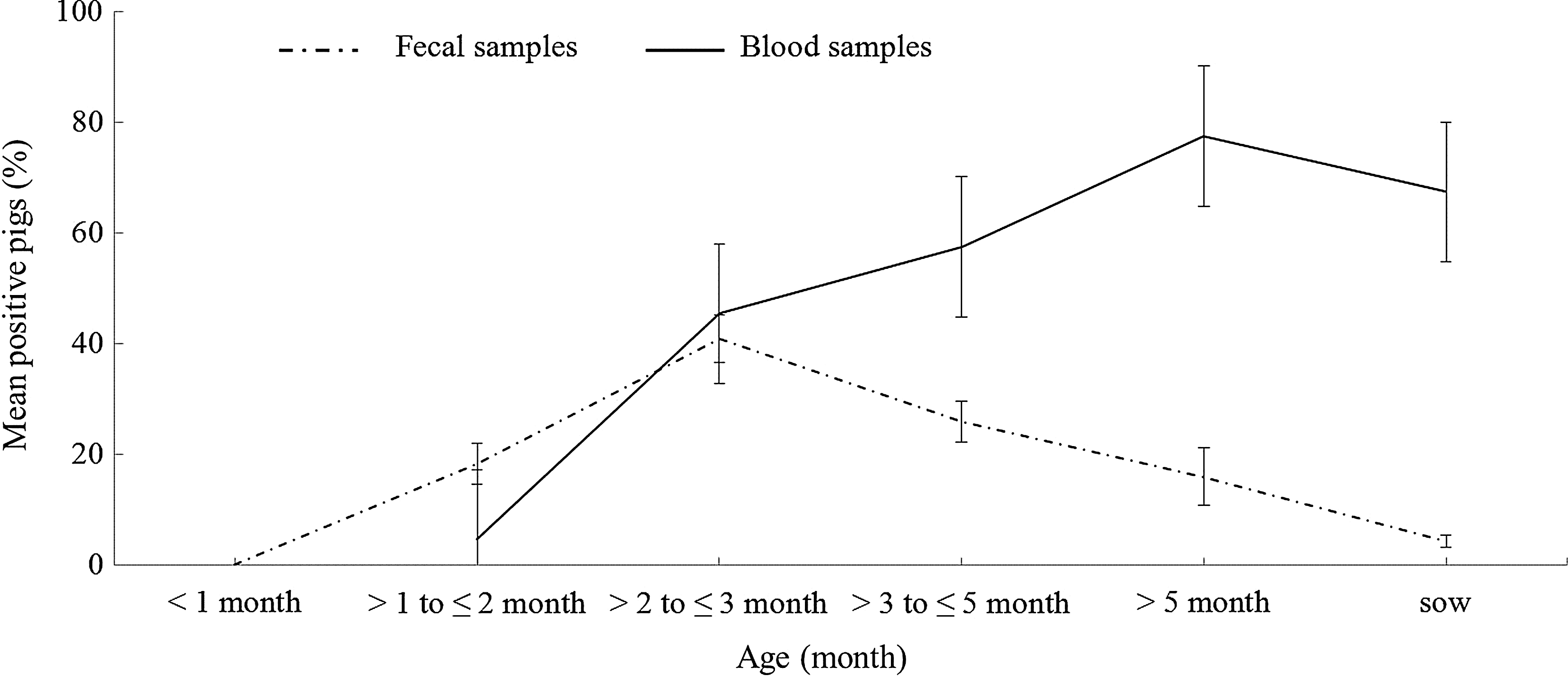
Trends of mean percentage of 1481 pigs testing positive for ail and virF Yersinia enterocolitica in their feces and of 334 pigs presenting antibodies against pathogenic Yersinia in their blood samples. Pigs were sampled in 30 pig farms in Finland, and grouped by age for the analyses. Error bars illustrate the standard error of the mean.
Significant differences (p<0.01) between groups, based on post hoc tests for Kruskal-Wallis analysis.
SD, standard deviation.
Discussion
Prevalence data of Y. enterocolitica in pigs and the log-linear analysis revealed the nonuse or sparse use of bedding in the forms of straw-type, shavings, or sawdust and also a high number of suppliers of new animals to be important factors in the introduction and the spread of Y. enterocolitica in farms. Other identified factors such as the use of water from municipal origin and the use of an AIAO system were associated with a decreased likelihood of Y. enterocolitica infection in pigs.
The highest prevalence of Y. enterocolitica in fecal samples was associated with the absence or sparse amounts of bedding. Similarly, it has also been reported that a low prevalence of Y. enterocolitica in organic farms was affected by a generous use of bedding (Virtanen et al., 2011), and that absence of bedding in lairage pigs destined for slaughter was associated with a high prevalence of pathogenic Y. enterocolitica (Laukkanen et al., 2009). However, the slurry manure removal system used in many conventional farms of Finland requires having pens with slatted floors. As a consequence, farmers cannot provide such pens with plenty of bedding, regardless of its importance as a risk factor, because to do so would block the drainage system. In pens with plenty of bedding, isolates of Y. enterocolitica were found more often when the bedding material was straw-type than when it was peat or shavings or sawdust. This might be because the straw-type provides Y. enterocolitica with a more organic enriching environment for survival than wood-derived bedding material. Further studies that evaluate the ability of Y. enterocolitica to survive and multiply in different materials would be beneficial for a better understanding of the effect of bedding type.
Higher numbers of pens with pigs as carriers of Y. enterocolitica were observed when the farms purchased new piglets from more than one supplier. In a previous study, it was demonstrated that piglets from infected breeding farms introduce and spread Y. enterocolitica throughout fattening units of pig farms (Virtanen et al., 2012). This present study found that in farrowing farms, 60% of pigs belonging to the group of older than 2 up to 3 months old excreted Y. enterocolitica in their feces (i.e., when they were introduced into the fattening units of the new farms). These results suggest the importance of limiting the number of suppliers that provide new piglets to reduce the risk of introduction of Y. enterocolitica in fattening pig herds.
The use of municipal water was found to be a protective factor against the presence of Y. enterocolitica compared to those farms that used water from their own wells. Water from a farm's own or private well is usually not treated, and to do so would probably reduce the number of Y. enterocolitica. These results were similar to those reported by Virtanen et al. (2011) and von Altrock et al. (2011) who found that there was a lower probability of pigs being carriers of Y. enterocolitica and lower within-farm prevalence of Yersinia when farms used municipal water. However, in the present study, Y. enterocolitica could not be isolated in any of the water samples studied.
Pens were less likely to be Y. enterocolitica positive, when farms practiced AIAO (p<0.05). AIAO is a factor that directly prevents the dissemination of Y. enterocolitica through contacts between different batches of pigs, and it indirectly ensures the reduction of Y. enterocolitica to admissible levels through cleaning and disinfection.
Adjacent pens allow snout-to-snout contacts between pigs when there are open-slatted walls separating the pens. Open walls could also permit the movement of feces from one pen to another, and therefore, they facilitate the transmission of Y. enterocolitica. Moreover, a protective effect was observed when adjacent pens were negative for Y. enterocolitica. The incidence of close pig-to-pig interactions such as snout-to-snout contacts between pigs has been associated with the increase of fecal shedding of Y. enterocolitica (Virtanen et al., 2011) and with the spread of Y. enterocolitica (Laukkanen et al., 2009).
In the present study, fecal excretion and seropositivity were associated, though we should take care in interpreting this result, because the serological tests are not completely equivalent to the isolation of Y. enterocolitica, as they are delayed in comparison to the time of infection (Fredriksson-Ahomaa et al., 2011). The manufacture validation report of the ELISA indicates a period of 14 days postinfection, at which time antibodies cannot be detected (Pigtype Yopscreen, Labor Diagnostik, Leipzig, Germany).
Significant differences in prevalence between phases of production were detected, with a peak of excretion of Y. enterocolitica occurring in pigs at the age of older than 2 up to 3 months. Other studies (Fukushima et al., 1983; Gürtler et al., 2005; Wehebrink et al., 2008) reported diverse values of Y. enterocolitica prevalence among different age groups in fecal samples, but most did not report whether these differences were significant. For example, Y. enterocolitica was isolated with peak numbers of positive animals occurring when they were between 91 and 133 days old (Fukushima et al., 1983). A higher prevalence was reported in 20-week-old fattening pigs than in pigs of 14 weeks of age but no occurrence in sows or piglets, in a study carried out in four farms (Gürtler et al., 2005). The presence of Y. enterocolitica was only detected in the feces of growing and finishing pigs of fattening herds (Wehebrink et al., 2008) and in pigs older than 80 days in a study in two herds (Nesbakken et al., 2006).
For the first time, significant differences in seroprevalence values were observed between age groups in this study. The number of seropositive animals increased with age, except for sows. Blood samples from pigs younger than 1 month were not sampled; thus, we could not evaluate whether they had been exposed and had maternal antibodies against Yersinia (67% of sows were seropositive) or if they have not been exposed (4% of sows excreted Y. enterocolitica in their feces).
Conclusions
This study suggests that low amounts of bedding and the purchase of new animals from more than one supplier are the factors that most contribute to the occurrence of Y. enterocolitica on farms in Finland. Using the AIAO management system when introducing new pigs and using water of municipal origin were also identified as management practices that may reduce the prevalence of Y. enterocolitica, and therefore the risk of transmission between and within pig farms. Significant differences in the tendency of infection with Yersinia between pigs of different ages were observed, with a peak of excretion of Y. enterocolitica in pigs older than 2 up to 3 months old.
Footnotes
Acknowledgments
This study was supported by research funding from the Ministry of Agriculture and Forestry, Finland (2849/502/2008) and carried out at the Centre of Excellence in the Microbial Food Safety Research, Academy of Finland (118602, 141140). Erika Pitkänen and Anu Seppänen are gratefully acknowledged for their technical assistance.
Disclosure Statement
No competing financial interests exist.