




Abstract
In this study, the effects of pH on the growth, relative expressions of bontA and botR genes, and neurotoxin formation of foodborne pathogens Clostridium botulinum type A were systematically studied throughout its growth stage. As in the previous reports, no C. botulinum growth was observed at extremely acidic pH. However, the effect of alkaline pH on the growth and neurotoxin production of C. botulinum was first revealed in this study. The maximum growth rate at pH 9.0 was similar to that at other pH values, although the lag phase at pH 9.0 was 16 h longer than that at pH 8.0. The peak of bontA mRNA expression at pH 9.0 was only 15.5% compared with that at pH 7.0. However, the neurotoxin concentration quantified in the cultures did not differ significantly. BotR is a known regulatory protein of bontA. The quantitative relationship between bontA and botR at different growth stages was first determined in this study. The mRNA levels of bontA were found to be positively correlated with those of botR, and the ratio of the mRNA transcript varied with pH. All these findings provide important physiological information on C. botulinum and thereby contribute to the improvement of food safety.
Introduction
C
Environmental conditions are important limiting factors on the growth and toxin production of C. botulinum in food. The effects of temperature, pH, CO2, and NaCl concentrations on the growth and toxin production of different C. botulinum types have already been studied (Lövenklev et al., 2004; Sharkey et al., 2005; Couesnon et al., 2006; Artin et al., 2010). Previous studies on the effect of pH were only performed with an acidic environment and mainly to determine the variations in the growth and toxin production of C. botulinum at the designated acidic pH range (pH 4–7) (Ito et al., 1976; Graham et al., 1997; Daifas et al., 1999; Kimura et al., 2008). In the present study, we compared the growth curves, mRNA expression levels of bontA and botR, and neurotoxin secretion throughout the entire growth period of C. botulinum under different pH values. The studies provide important physiological information on C. botulinum and thereby contribute to the improvement of food safety.
Materials and Methods
C. botulinum strain, culture, and sampling
C. botulinum type A1 strain 230611, which was HA toxin cluster strain, was isolated from a case of foodborne botulism in China during the 1970s. Overnight cultures of proteolytic C. botulinum type A strain 230611 were grown in a trypticase–peptone–glucose–yeast extract broth medium flushed with the appropriate gas mixture (10% CO2, 10% H2, and 80% N2). Hydrochloric acid with a concentration of 0.5 M was used to acidify the trypticase–peptone–glucose–yeast broth. The initial pH values of the media prepared were 5.0, 6.0, 7.0, 8.0, 9.0, and 10.0. Cultures were grown at 37°C in an anaerobic workstation under the same atmospheric conditions and each in triplicate. Replicate tubes for real-time reverse-transcription polymerase chain reaction (qRT-PCR) assays and enzyme-linked immunosorbent assays (ELISAs) were withdrawn from both pH values as explained subsequently. One milliliter (1 mL) of the culture from each withdrawn tube was used for optical density measurements at 600 nm (OD600) to conduct growth curves. The times at which cultures were tested were based on the growth cycle (pH 6.0 from 17 h to 36 h, pH 7.0 from 15 h to 28 h, pH 8.0 from 12 h to 29 h, and pH 9.0 from 28 h to 55 h).
RNA extraction and RT
For RNA extraction, three replicates incubated at each pH value were withdrawn every hour at exponential and stationary time intervals. The total RNA was extracted using a TRIzol kit (Biomed Co., China) according to the manufacturer's instructions. A second DNase treatment with DNase I (RNase free) was conducted after RNA isolation to ensure the complete elimination of DNA contamination for qRT-PCR assays. RNA concentrations were determined by measuring the absorbance at 260 nm with a SynergyHT spectrophotometer (Biotek Corp., USA). An A260/A280 ratio of 1.8–2.2 was used as a purity criterion for all samples. All RNA specimens were stored at −70°C until use. The first-strand cDNA was synthesized using an EasyScript™ cDNA synthesis Supermix (TransGen Biotech Co., China) in a 20-μL final volume containing 300 ng random hexamers and 1 μg RNA. The cDNA synthesis reaction mixtures were incubated at 25°C for 10 min and then at 42°C for 30 min. The reactions were terminated by heating at 85°C for 5 min. Negative RT controls were produced under identical reaction conditions without RT.
qRT-PCR
External standard curves were used in qRT-PCR to compare the relative expression levels between bontA and botR at exponential and stationary time intervals with each pH value. qRT-PCR amplification was conducted using a quantitative PCR kit (Roche, USA) according to the manufacturer's instructions. qRT-PCR specific primer pairs and a Taqman probe were designed based on bontA, botR, and 16S rRNA using a Beacon Designer, as listed in Table 1. The cDNA solutions of each sample were diluted 100- and 1000-fold before PCR amplification. One microliter (1 μL) of each dilution of the cDNA of each sample was used as a template for qRT-PCR with a final volume of 20 μL and a concentration of 0.5 μM for each primer. One run for each primer pair encompassing all samples with two replicates of each dilution was conducted in a LightCycler 2.0 real-time thermal cycler (Roche, USA). Each run comprised the following procedure: initial denaturation and polymerase activation at 95°C for 30 s; 45 cycles of denaturation at 95°C for 5 s; combined annealing and extension at 55°C for 15 s; fluorescence measurement at the end of the extension; and a cooling step at 72°C for 10 s. At the end of each run, a melting curve was produced by ramping the temperature from 60°C to 90°C while monitoring the fluorescence. The specificity of qRT-PCR was further confirmed by the conventional PCR and gel electrophoresis of the selected samples. Standard curves for each target gene and 16S rRNA (reference) were constructed using specific primers. The DNA was serially diluted 10-fold to achieve a standard curve spanning five log units. For each cDNA sample, the cycle threshold (CT) values of the target gene and 16S rRNA were converted to relative amounts of cDNA using external standard curves and the LightCycler 4.05 gene real-time analysis software. The absolute amounts of the cDNA of each target gene were normalized against those of 16S rRNA to yield the relative expression of each gene. Three-time replicates were done for each sample in qRT-PCR.
Type A neurotoxin ELISA
Type A neurotoxin production was monitored by capture ELISA at time points corresponding to the exponential and stationary growth phases at pH 6.0 (17, 20, 23, 26, 29, 32, 36 h), 7.0 (15, 18, 21, 24, 26, 28, 36 h), 8.0 (12, 16, 19, 22, 26, 29, 36 h), and 9.0 (28, 32, 34, 36, 40, 44, 48 h). In brief, three replicate tubes were withdrawn at each time point and pH value. Moreover, 1 mL of culture from each tube was centrifuged at 15,000×g at 4°C for 5 min and diluted 30- to 100-fold to fall into the linear OD450 measurement range. A diluted bovine serum albumin buffer was used as a negative control. Plates were coated with rabbit anti-boNT/A polyclonal antibody (Abcam Ltd., Hong Kong), and incubated overnight at 4°C. The plates were washed three times at 3 min intervals with phosphate buffered saline Tween (PBST), and then blocked with bovine serum albumin (BSA) at 37°C for 2 h. Then, diluted samples or controls were added, maintaining the temperature at 37°C for 2 h. The samples were washed, and a horse boNT/A polyclonal antibody (Abcam Ltd., Hong Kong) was added and incubated at 37°C for 2 h. The samples were rewashed and horseradish–peroxidase conjugated rabbit anti-horse secondary antibody (Sigma Chemical Co.) was added and incubated at 37°C for 1 h. Then, AB buffer was added and the mixture was incubated for 10 min. The reaction was stopped with 2 M H2SO4. The OD450 of each sample was determined using a SynergyHT spectrophotometer (Biotek Corp., USA). The relative values of total type A neurotoxin production was corrected according to the dilution rate and expressed as OD450 units. Three-time replicates were done for each sample in type A neurotoxin ELISA.
Statistical analysis
One-way analysis of variance with Tukey's honestly significant difference test was used to test the hypothesis that bontA and botR show similar expression patterns as a function of time, as well as to describe the relationship between pH and the growth parameters or maximum relative expression levels of individual genes. SPSS 15.0.1 software was used to conduct the statistical analysis.
Results
Growth curve of C. botulinum type A at different pH values
C. botulinum type A (str. 230611) was cultivated under different initial pH values (5.0, 6.0, 7.0, 8.0, 9.0, and 10.0) to determine the effects of pH. The growth curves were determined throughout the entire growth period. The pH values at the different growth stages were remarkably close to that of the initial state (difference<0.5) and decreased by 1.0 lower than the initial state only during the decline phase. Bacterial growth was decreased or inhibited under an initial pH either of 5.0 or 10.0. At pH 8.0, the bacterial culture had a lag phase of 12 h and achieved the maximum cell density level (OD600 of 3.3) after 26 h. The lag phase of C. botulinum type A was 15 h at pH 6.0 and 17 h at pH 7.0. At pH 9.0, the lag phase was 28 h, which is 16 h longer than at pH 8.0 (Fig. 1). However, the time from the end of the lag phase to the maximum level of cell density varied only slightly: 7 h at pH 8.0 and 6 h at pH 9.0. Moreover, the maximum growth rate (OD600) was also nearly the same for cells grown under pH values 6.0–9.0.
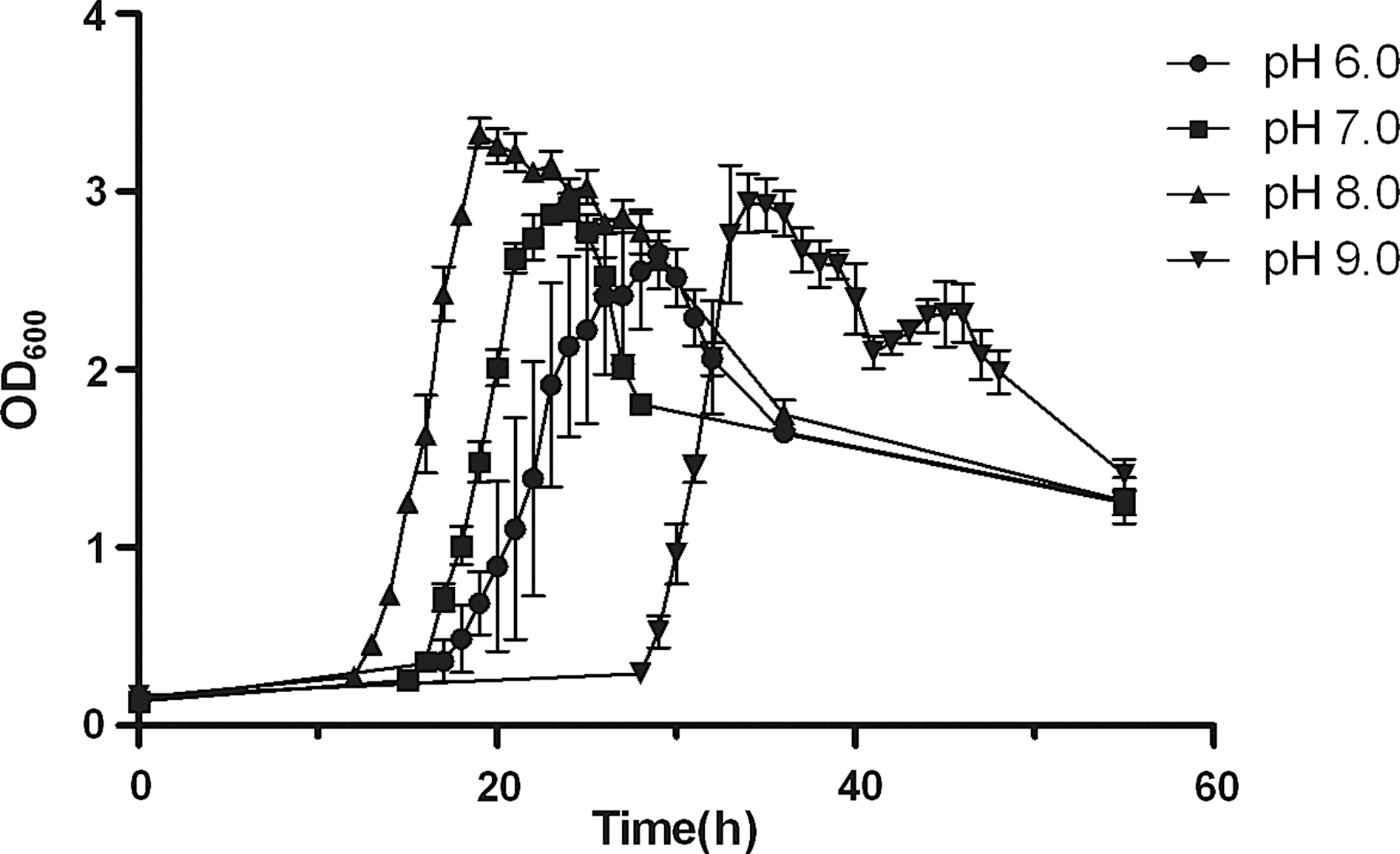
Growth curve of Clostridium botulinum strain 230611 under different initial pH values. Means and standard deviations are based on three independent experiments. Error bars show standard deviations.
Relative expression patterns of bontA with different initial pH values
qRT-PCR was used to measure the relative expression of bontA at different growth periods under initial pH values 6.0, 7.0, 8.0, and 9.0. Averages and standard deviations were reported based on three independent measurements. The comparisons between the growth and expression curves of bontA showed that the gene expression was initiated in the midexponential phase, peaked in the transition between the exponential and stationary phases, and fell during the midstationary phase (Fig. 2A). The expression peaks of bontA were affected by the initial pH (Fig. 2B). At pH 7.0, the peaks of bontA gene expression were at their highest (p<0.01). Expressions were lower under the other pH values, especially under pH 9.0, at which the gene expression peak was only 15.5% of that at pH 7.0. The suitable pH for bontA expression is thus at pH 7.0, indicating that environmental acidity or alkalinity affects the expression of the bontA gene of C. botulinum.

Relative expression curves of
Comparison of relative expression levels of bontA and botR at different pH values
The relative expression of botR was also detected by qRT-PCR in a method similar to that of bontA. A similar expression profile was also noted for botR, although the expression of bontA was greater than that of botR throughout the entire growth period (Fig. 2C). The peaks of botR relative expression levels were at 0.20, 0.59, 0.40, and 0.07 under initial pH values 6.0, 7.0, 8.0, and 9.0, respectively. At an initial pH of 9.0, the peak of expression was only 11.2% of that at pH 7.0 (Fig. 2D). The peak of botR expression was similar to that of the bontA gene, but a greater difference was observed between expressions at pH 7.0 and 9.0. The relative expressions of bontA and botR throughout the growth period (6.0, 7.0, 8.0, and 9.0) under different pH values were compared and analyzed (Fig. 3). The results showed that the expression of bontA was positively correlated with the expression of botR at the different growth stages, with Pearson correlation coefficient between 0.92 and 0.99 (Fig. 3).

Comparison of the relative expression curves of bontA and botR at pH values 6.0
Neurotoxin assay
Neurotoxin concentration secreted in the cultures at different initial pH values were determined by capture ELISA. The comparisons between the growth and neurotoxin concentration curves showed that the neurotoxin concentration was added in the midexponential phase, sharply increased in the transition between the exponential and stationary phases, and was relatively stable during the midstationary phase (Fig. 4). Also, the concentrations of neurotoxin in culture were affected by the initial pH (Fig. 4). The highest concentration of neurotoxin was found to be lowered at pH 6.0 and 8.0 with respect to pH 7.0. The comparisons between the concentrations of neurotoxin in cultures and bontA RNA expression showed that the transcription and secretion of neurotoxin A was correlated with the initial pH value. Interestingly, however, the highest concentration of neurotoxin at pH 9.0 (at 44 h, OD450=0.547) was nearly the same with that at pH 7.0 (at 28 h, OD450=0.616).
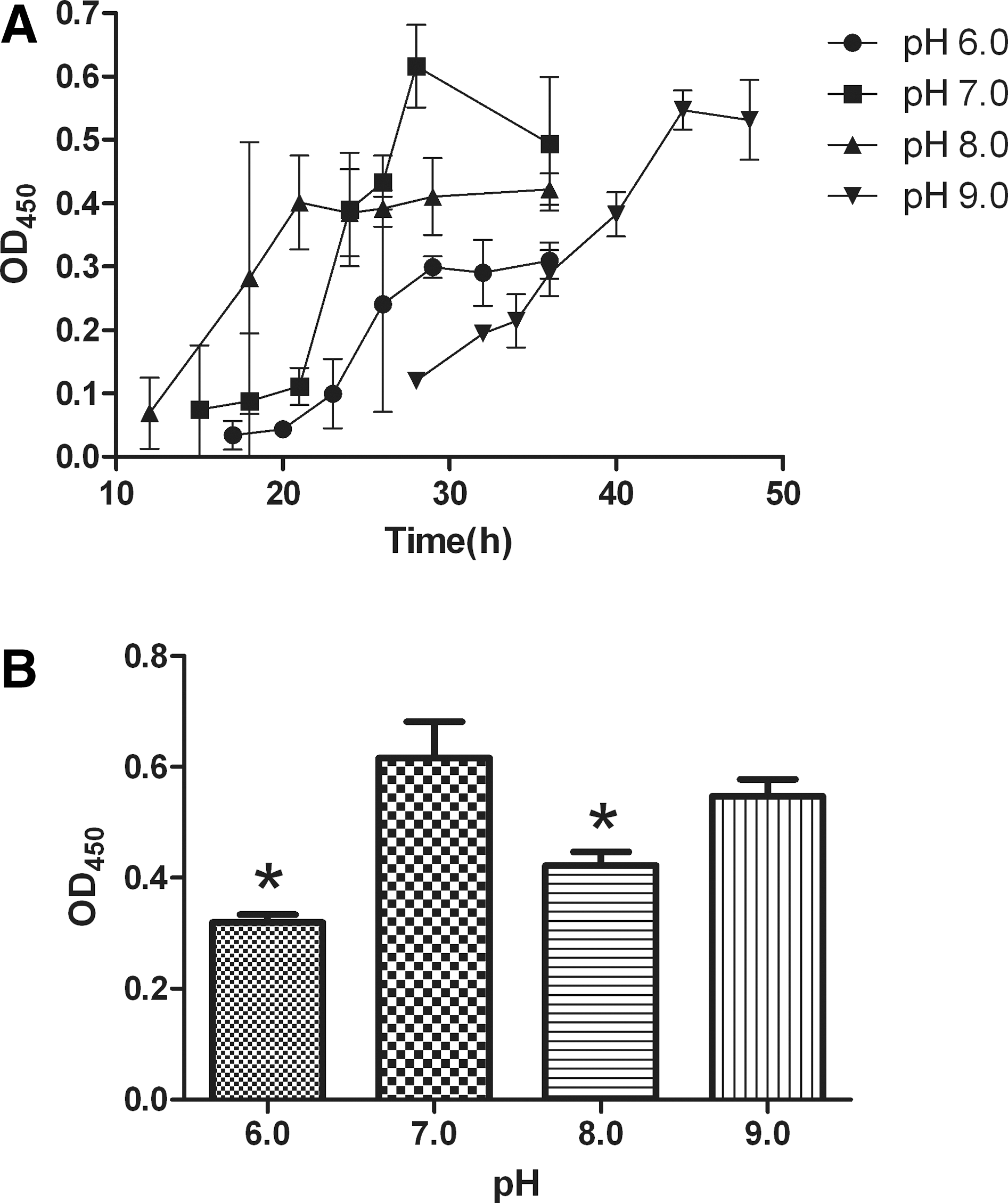
Effect of pH on OD450 values for type A neurotoxin in culture supernatants of proteolytic Clostridium botulinum strain 230611.
Discussion and Conclusions
In the present study, the effects of pH on the growth, relative expressions of bontA and botR, and neurotoxin formation of proteolytic C. botulinum type A strain 230611 were systematically studied during its growth cycle. Our work showed that C. botulinum cannot grow at an acidic or extremely alkaline environment (pH≤5.0 and≥10.0). Findings were similar to that of previous reports in which the outgrowth of C. botulinum spores was inhibited and no toxin was detected at pH 4.9 or below (Ito et al., 1976; Kimura et al., 2008). At pH 9.0, the neurotoxin concentration secreted in the cultures did not decrease, indicating that the risk of botulism may not actually be decreased with increasing pH and should thus be given increased attention in the field of food preservation.
BontA and botR expressions by C. botulinum type A strain 230611 were found to be related to the growth phase. At all pH values investigated (6.0, 7.0, 8.0, and 9.0), the relative expressions of bontA and botR mRNA reached a maximum in the transition between the late exponential phase and early stationary phase and decreased during the midstationary phase. The mRNA expression peaks of bontA and botR were highest (p<0.01) at pH 7.0. Acidic or alkaline conditions inhibit the transcription of BoNT. These data support the findings that the gene of the botulinum neurotoxin is temporally expressed during late-log and early-stationary phase (Bradshaw et al., 2004; Shin et al., 2006; Rao et al., 2007), and that neurotoxin formation depends on pH.
This study quantitatively determined the relative expressions of bontA and botR under different pH values (6.0, 7.0, 8.0, and 9.0) during the C. botulinum growth period and analyzed the relationship between bontA and botR expressions. Previous studies on the overexpression and partial inhibition of botR showed that the gene is a positive regulator of the BoNT of C. botulinum A (Marvaud et al., 1998; Raffestin et al., 2005). Through quantitative detection and analysis, a detailed quantitative relationship between the expressions of bontA and botR was observed. Furthermore, the ratio of the mRNA expression peaks of bontA and botR was 13.9, 7.7, 6.1, and 9.9 at pH 6.0, 7.0, 8.0, and 9.0, respectively. The findings of this study suggested the involvement of other factors in bontA regulation in response to pH.
At an initial pH of 9.0, growth and neurotoxin expression were very distinct compared with other pH values. For example, at pH 9.0, growth and neurotoxin expression increased to 16 h later than that at pH 8.0. However, the time from the end of the lag phase to the maximum level of cell density and maximum growth rate under pH 9.0 were very close to those at other pH values. Previous studies showed that the mean lag time of C. botulinum varies under different incubation temperatures, heat treatments, and sodium chloride concentrations (Stringer et al., 2011). In the present study, the effect of pH on the lag time of C. botulinum was determined and analyzed. At pH 9.0, the peak of bontA mRNA expression was only 15.5% of that at pH 7.0, which showed that the transcription of bontA was notably inhibited at pH 9.0. Similarly, the peak of botR expression at pH 9.0 was only 11.2% of that at pH 7.0. As a positive regulating factor of bontA, botR functioned in the signal transduction initiating the inhibition of alkaline pH. However, the neurotoxin concentrations in cultures under pH 7.0 and 9.0 showed no significant difference. Improvements in the subsequent translation and transportation of the neurotoxin at pH 9.0 are some of the probable causes. Connan et al. (2012) have identified at least 39 putative regulatory genes and at least three two-component systems. Further comparisons of the expressions of other genes between pH 9.0 and other pH values using other methods, such as micro-array or RNA-seq, may help uncover new factors that are important in neurotoxin expression.
Footnotes
Acknowledgments
This work is supported by National Natural Science Foundation of China (No. 81072677) and National Science and Technology Major Project for Creation of Major New Drugs of China (No. 2013ZX09304101).
Disclosure Statement
No competing financial interests exist.