




Abstract
In summer 2011, two outbreaks of a unique, multidrug-resistant strain of Salmonella enterica serovar Typhimurium phage type 120 (DT120) occurred mainly in the Midlands, England. The first outbreak occurred among guests attending a wedding in July 2011 (‘Wedding outbreak’), followed by a more geographically dispersed outbreak in August and September 2011 (‘Midlands outbreak’). Fifty-one cases were confirmed. Detailed epidemiological and environmental health investigations suggested that pork was the most likely source of both outbreaks. All human samples and one pork sample showed the specific multiple-locus variable-number tandem-repeat analysis (MLVA) profile 3-11-12-NA-0211, with at most two loci variations. Trace-back investigations suggested a link to a butcher's shop and a pig farm in the East Midlands. The investigations highlight the utility of molecular analysis (MLVA) in supporting epidemiological investigations of outbreaks caused by S. Typhimurium DT120. Safe handling and cooking of pork by food business operators and consumers are key interventions to prevent future outbreaks.
Introduction
N
A major challenge in Salmonella control is that over 2500 serovars (or serotypes) have been described within the genus Salmonella, and thus robust subtyping methods are needed for routine surveillance and outbreak detection (Grimont et al., 2007). Characterization of the organism into serovars is based on variations in surface antigens. Other methods such as antimicrobial resistance profiles, phage typing and molecular methods such as pulsed-field gel electrophoresis are used in national reference laboratories, but do not always provide robust strain discriminatory power (Peters et al., 2007). Multiple-locus variable-number tandem-repeat analysis (MLVA), a relatively recent addition to subtyping methods, is a technique for analyzing variation in tandemly repeated DNA sequences in the organism. MLVA offers reliable, quick, and reproducible results with good strain discrimination and has been proposed as a complementary tool in supporting Salmonella outbreak investigations (Ramisse et al., 2004; Ross et al., 2011).
We describe two linked outbreaks of Salmonella that occurred in England in 2011. The first (“Wedding outbreak”) occurred among guests attending a wedding in the West Midlands in July 2011. The second (“Midlands outbreak”) occurred between August and September 2011 and was more geographically dispersed. We discuss the key findings of the two linked outbreaks, the wider implications for Salmonella control, and the use of MLVA in supporting investigations of outbreaks caused by S. Typhimurium.
Materials and Methods
Wedding outbreak
Public health authorities were notified in week 27 of 2011 of an outbreak of gastroenteritis among guests attending a wedding in the previous week. The wedding was catered by four commercial food business operators (FBO), with a limited quantity of food supplied by the guests. An outbreak investigation was jointly carried out by public health and the local authority officials.
A retrospective cohort study was carried out. All 80 guests were contacted by e-mail and were asked to complete a questionnaire. A case was defined as a wedding guest who developed gastroenteritis symptoms during or in the week following the event. In view of the suboptimal response to the questionnaire, data were analyzed as a case–control study. Odds ratios with corresponding 95% confidence intervals were calculated by univariate analysis. Some food items were left over and included the hog roast, apple sauce, rice, and dhal (a traditional Indian dish). Samples of each were tested at the Public Health England Food Water and Environmental Laboratory. Environmental Health Officers investigated the hog-roast catering company.
Midlands outbreak
An exceedence in laboratory-confirmed salmonellosis was noted in week 39 in the West Midlands followed by the East Midlands in week 40. A substantial proportion of cases were caused by Salmonella enterica serovar Typhimurium definitive phage type 120 (S. Typhimurium DT120) with resistance to ampicillin, streptomycin, sulphonamides, tetracyclines, and trimethoprim (ASSuTTm).
An Outbreak Control Team was convened in week 40 with representation from Public Health England, the local National Health Service, Local Authority Environmental Health, and the Food Standards Agency.
A case was defined as a patient with compatible gastrointestinal illness and no history of foreign travel in the 2 weeks prior to illness onset with confirmed S. Typhimurium DT120 with ASSuTTm resistance profile from a specimen submitted after August 1, 2011. During the investigation, the definition was refined to include only cases with at most two loci variation of the MLVA profile 3-11-12-NA-0211. Cases with two loci variations were only included if there were strong epidemiological links (Boxrud et al., 2007). Where more than one individual was affected per household, only the first was included due to the difficulties in determining if subsequently affected individuals were secondary or co-primary cases.
Six Salmonella surveillance questionnaires completed by cases as part of the standard national food poisoning surveillance arrangements were reviewed for key exposures. As this provided too little information to make any judgments on the likely source(s), the national 29-page Salmonella trawling questionnaire was used for a subset of cases (n=15). Following hypothesis generation, a short outbreak-specific questionnaire was developed and used for later cases (n=10). All questionnaires captured information on demographics, symptoms and onset, travel, and exposures of interest in the 5 days prior to onset. Ten cases could not be contacted and therefore only limited data were available for these. A line listing of all cases with full epidemiological information was maintained and regularly updated throughout the investigation. Data were descriptively analyzed.
Stool samples from symptomatic cases were tested by local microbiology laboratories. Phage and antimicrobial resistance typing was undertaken by the Gastrointestinal Bacteria Reference Unit, Colindale, London. All S. Typhimurium DT120 samples with the ASSuTTm resistance profile were further typed by MLVA according to a previously described protocol (Lindstedt et al., 2004). The MLVA profiles were assigned based on the fragment size amplified from each of the five loci, with “NA” used to denote when a locus was not present (Larsson et al., 2009).
Environmental investigations included inspection of implicated food business operators, environmental sampling, and trace-back investigations as appropriate.
Results
Wedding outbreak
Forty-one guests (51%) completed the questionnaire, of whom 24 reported symptoms (58.5% responder attack rate). There was a strong association between the consumption of hog roast and illness (odds ratio 4.4, 95% confidence interval 4.3–118.3, p=0.0002).
S. Typhimurium DT120 was isolated from stool samples from five cases. The cooked hog-roast meat was found to contain the outbreak strain of S. Typhimurium DT120. All other food samples tested negative for bacterial pathogens. The investigation of the catering company supplying the hog roast revealed multiple breaches in food safety systems. The catering company was unable to provide evidence confirming that the hog roast was adequately cooked prior to consumption. Another significant finding was that records for the cooking of the hog roast were not available, a legal requirement under the hazard analysis and critical control points guidance. Control measures implemented included increased cooking time, the use of longer thermometers to penetrate thicker flesh to monitor temperature, and increased training and awareness regarding serving hog roast at events. The FBO was successfully prosecuted by the local authority for breaches in food safety.
Midlands outbreak
Between August and September 2011, 45 cases were reported, of which 41 met the outbreak case definition (Fig. 1). In the same period in the preceding 5 years, only seven non-travel DT120 cases with the ASSuTTm resistance profile were reported from England and Wales (Public Health England, unpublished data). Four household cases were excluded.

Epidemic curve of Salmonella Typhimurium DT120 multidrug-resistant (ASSuTTm) cases, July–September 2011, England and Wales.
Thirty-six cases were reported from the Midlands. Five were reported from the rest of England and Wales. Of these, two reported traveling to the Midlands during the incubation period, and one was a contact of a confirmed case. The other two had no known direct links to the region.
The median age of cases was 42 years (range 0–76 years). Males (n=19) and females (n=22) were almost equally affected. Fourteen (34%) were admitted to the hospital. No deaths were recorded.
Thirty-two cases had an indistinguishable MLVA profile 3-11-12-NA-0211. Nine cases showed variation at one locus. The single case with two loci variation was strongly linked in time, place, and exposure history and was therefore included in the analysis.
Pork consumption was the most common risk factor. Among the 31 cases with an available food history, 26 (84%) reported having eaten pork in the 5 days prior to illness onset. In comparison, 21, 20, and 17 cases reported eating beef, chicken, and eggs, respectively, in the same period.
Sixteen reported having bought their pork products either directly from a local Midlands butcher (butcher B) or from an establishment supplied by butcher B. The remaining 15 cases had no known links to butcher B, although a connection could not be excluded as butcher B supplied in excess of 500 establishments.
The DT120 strains causing the “Wedding outbreak” and the “Midlands outbreak” had an unusual ASSuTTm resistance pattern and were within two-loci variations of MLVA profile 3-11-12-NA-0211. As it was considered likely that the two outbreaks shared a common source-vehicle transmission pathway, a food trace-back investigation was triggered. Trace-back investigations confirmed that the links between the two outbreaks were farm A and butcher B (Fig. 2). The pig served at the “Wedding outbreak” was supplied by farm A and slaughtered by butcher B. Furthermore, farm A was a regular supplier of butcher B during the outbreak period. Environmental health inspection of butcher B's premises revealed no significant food safety concerns. Ten environmental swabs were taken from surfaces in close proximity to meat preparation and storage areas such scales, cutting blocks, Vacuum pack machines, slicers, and a refrigerator. In addition, one cooked ham and three raw pork products were also sampled. All swabs and meat samples were negative for bacterial pathogens.
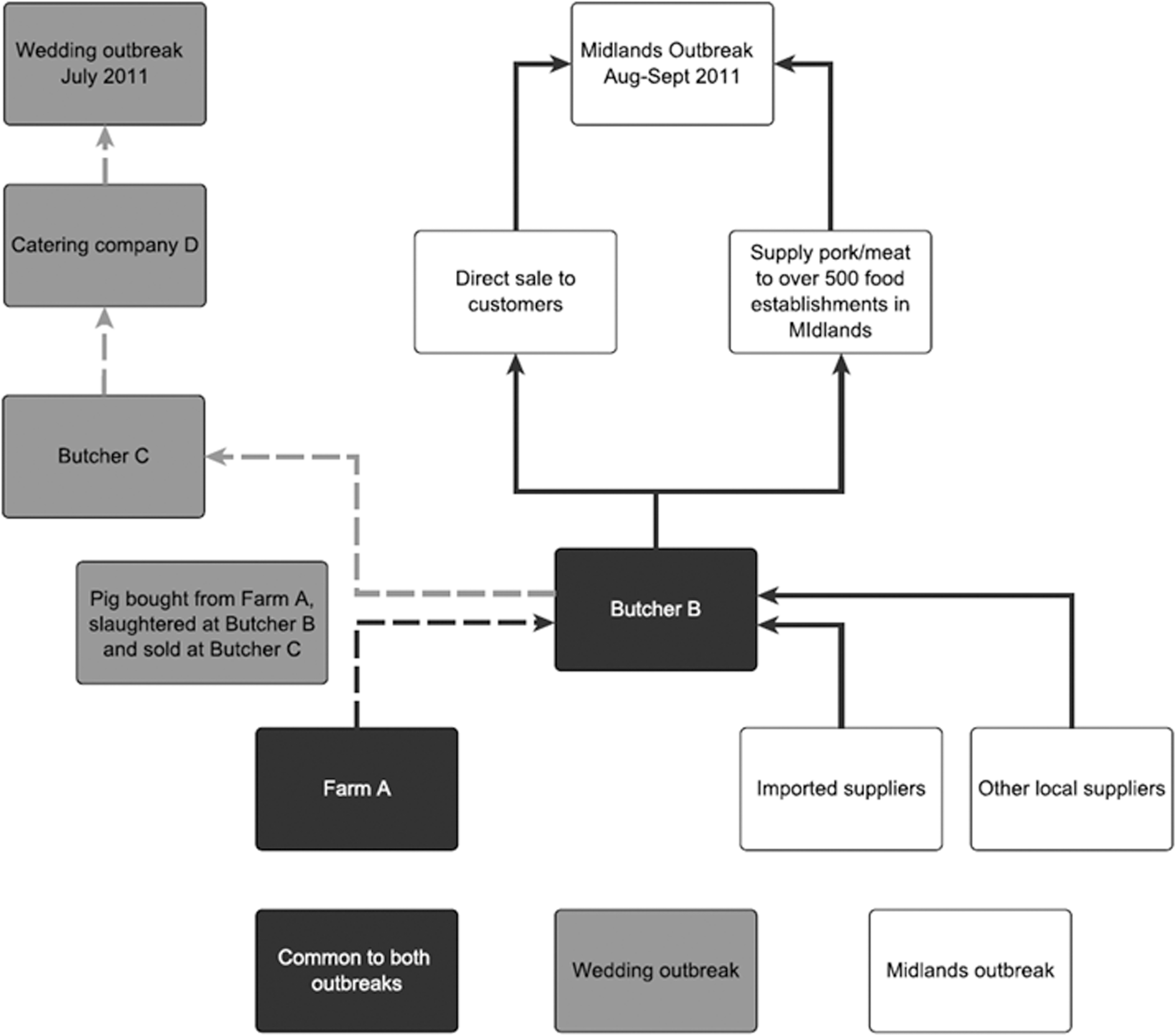
Trace-back results for Salmonella Typhimurium DT120 multidrug-resistant (ASSuTTm) outbreaks, July–September 2011, England and Wales.
Discussion
Between July and September 2011, 51 confirmed cases of S. Typhimurium DT120 with an uncommon resistance profile (ASSuTTm) and within a two-loci variation of MLVA profile (3-11-12-NA-0211) were reported in England and Wales. These cases were part of two discrete but linked outbreaks. As only one in four Salmonella cases are estimated to be laboratory confirmed and notified to public health authorities, it is likely that the actual number of cases was much higher (Food Standards Agency, 2011).
Epidemiological investigations strongly suggested that pork consumption was the most likely risk factor for these linked outbreaks. Since multidrug-resistant Salmonellae are relatively common in England, the “Wedding outbreak” was managed as a routine foodborne Salmonella outbreak by the West Midlands authorities. Investigations and control measures focused entirely on the catering company and their food safety practices. Investigations instigated following the “Midlands outbreak” confirmed the links with the “Wedding outbreak,” triggering food trace-back investigations.
Trace-back investigations confirmed that farm A and butcher B were implicated in the transmission pathway for both outbreaks. Two alternative hypotheses can be proposed. First, Salmonella-contaminated pigs from farm A were the source of this outbreak. Farm A supplied the pig implicated in the “Wedding outbreak” and was also a regular supplier to butcher B. An alternative possibility is that Salmonella-contaminated pork/meat procured by butcher B from another local supplier (other than farm A) was the source. Cross-contamination at the time of slaughter and/or preparation could explain the “Wedding outbreak” and subsequent “Midlands outbreak.”
The Food Standards Agency estimates, based on lymph node and cecal prevalence in the 2007 European Survey, that currently 20%–30% of slaughtered pigs are Salmonella carriers or may have subclinical infections. In 2008, 19.4% of pig breeding holdings and 9.9% of production pig breeding holdings in the UK were infected with S. Typhimurium (European Food Safety Authority, 2009). Multidrug-resistant DT120 strains of the ASSuT or similar profiles with or without resistance to trimethoprim are known to circulate among pigs in England. Although trimethoprim resistance is uncommon, it is thought to be carried on a highly mobile plasmid and hence could emerge easily in farms where a variety of resistant Salmonella species are in circulation (Threlfall et al., 1980; Amyes, 1987). Sampling of pigs at farm A was considered but was not carried out due to procedural reasons.
Although total control is difficult with current production methods, improving biosecurity in farms and Salmonella control within the pig-meat food chain, along with effective food safety management systems in food businesses, may be effective measures to reduce the burden of human illness (Purvis et al., 2005; Kirchner et al., 2011). There is currently no statutory Salmonella control program in the UK pig sector. However, approximately 90% of pigs slaughtered are part of an industry program aimed at reducing the level of Salmonella in pigs: the Zoonosis National Control Programme for Salmonella in pigs (ZNCP), which includes the requirement for a Salmonella control plan on farms and provides information and support material for effective biosecurity and other control options such as vaccination and diet modification. Improved control of infection in farms may assist in reducing the number of porcine-associated cases of Salmonella in humans (ZNCP, 2008).
Inadequate meat handling and cooking practices remain as important contributory causes of these outbreaks. Improvements in food safety systems may have prevented the outbreaks from occurring. Effective control measures were implemented by the environmental health officers in the “Wedding outbreak.” In contrast, the “Midlands outbreak” resolved spontaneously before any specific public health interventions were implemented.
Pulsed-field gel electrophoresis (PFGE) is the current standard technique for molecular typing of Salmonella, and this has led to the development of PulseNet databases of PFGE profiles in the United States and Europe to aid enhanced surveillance and epidemiological investigations (Swaminathan et al., 2001; Swaminathan et al., 2006). Although PFGE is highly discriminatory for most bacterial pathogens, it is not sufficient to resolve epidemiologically unrelated isolates for some clonal pathogens such as Salmonella. Conversely, MLVA has been found to be particularly valuable for discriminating within the most common phage types of S. Typhimurium and has been shown to be superior to PFGE for both surveillance and outbreak investigations (Boxrud et al., 2007; Torpdahl et al., 2007; Petersen et al., 2011; Prendergast et al., 2011; Kurosawa et al., 2012). It is also the preferred method of subtyping for outbreak investigations of S. Typhimurium in England and is widely used by a number of other European reference laboratories (Chiou et al., 2010).
Despite gaps in the epidemiological evidence, the similarities in the MLVA profiles of the organisms from samples obtained from both outbreaks provide evidence that MLVA is a helpful tool in S. Typhimurium DT120 outbreak investigations. Except for one epidemiologically linked case with a two-loci variation, all the other cases were single-locus variants of the outbreak MLVA strain. It remains important that analysis by MLVA and inclusion of MLVA profiles in an outbreak case definition should be carried out in a hierarchical fashion with existing typing schemes, as profiles may be common across a serotype for different phage types. MLVA is a relatively new typing tool, and limited information is available on the stability of the loci. It is still uncertain whether tandem repeats evolve so rapidly that variation could lead to multiple types emerging during an outbreak caused by a single ancestral isolate (Hopkins et al., 2011). Nevertheless, MLVA remains a strong tool in outbreak investigations and is already in use as a supplement and sometimes a replacement for PFGE.
There are several significant limitations of this investigation. First, only a limited number of food samples from the “Wedding outbreak” were available for microbiological analysis, and these food samples were sampled 6 days after the event. Second, only 51% of the eligible cohort responded. Third, in the “Midlands outbreak,” the wide geographical distribution of the relatively small number of cases in multiple jurisdictions did not trigger exceedence limits until after the outbreak had ceased. The surveillance system in England is based on serotyping, phage typing, and antimicrobial resistance typing of all isolates received by the national reference laboratory from local diagnostic laboratories across the country. This resulted in delayed outbreak recognition and precluded analytical investigations. Finally, sampling was not undertaken at farm A to confirm or refute the hypothesis that it might have been a source of the two linked outbreaks. Outbreak investigation procedures have now been updated, partly as a result of the challenges faced in this outbreak.
Conclusions
Two linked outbreaks of an uncommon, multidrug-resistant strain of S. Typhimurium occurred in the Midlands region in England in 2011. The investigations highlight the utility of MLVA in supporting epidemiological investigations caused by S. Typhimurium DT120. Safe handling and cooking of pork by food-business operators and consumers are key interventions to prevent future outbreaks.
Footnotes
Acknowledgments
The authors gratefully acknowledge the support of the Outbreak Control Team members and other key individuals involved in the investigations: Andrea Cooper, Cathy Mallaghan, Caroline Hird, Chloe Leggat, Janice Bright, Jharna Kumbang, Katherine Packham, Lesley McFarlane, Lindsey Abbott, Neil Anstey, Philip Monk, Sophia Makki, Vivienne Parish, East Midlands PHE Centre; Joan Birkin, Jonathan Lloyd, William Morris, Sophie Newitt, East Midlands Field Epidemiology Service; Huda Mohammad, West Midlands PHE Centre; Helen Bagnall, Jeremy Hawker, Obaghe Edeghere, Yasmin Rehman, West Midlands Field Epidemiology Service; Abigail Scrivener, Darryle Trainor, Stratford-on-Avon District Council; Emma Williamson, Rugby Borough Council; Ruth Hollingsworth, Peter Minhinnett, Harborough District Council; Fiona Grant; Sanhita Chakrabarti, NHS Northamptonshire; Ivan Browne, NHS Leicester City; Tim Davies, NHS Leicestershire County and Rutland; Rob Johnston, Deborah Fenelon, Marilyne Harvey, PHE Food, Water and Environmental Laboratory; Chris Bentley, Natalie Saville, PHE Communications; Paul Cook, Colin Houston, Joanne Aish, Mary Howell, William Francis, Food Standards Agency; Lesley Larkin, Animal Health and Veterinary Laboratories Agency; Colleagues in PHE Centres and Environmental Health departments in other regions for their help and assistance in follow-up of cases, and staff at the Gastrointestinal Bacteria Reference Unit, Colindale.
Disclosure Statement
No competing financial interests exist.