




Abstract
This study aimed to evaluate the role of wild boars and deer as reservoirs of foodborne bacteria. We investigated the prevalence and antimicrobial susceptibility of Campylobacter spp., Salmonella spp., Shiga toxin–producing Escherichia coli (STEC) O157 and O26, and Listeria monocytogenes isolated from wild boars and deer in Japan, from July through December 2010. Campylobacter spp. and Salmonella spp. were isolated from 43.8% (95% confidence interval [CI]: 35.0–52.6) and 7.4% (95% CI: 2.8–12.1) of rectal content samples of wild boars, respectively, but not from wild deer. The most common Campylobacter species was C. lanienae and C. hyointestinalis. The nine Salmonella serovars isolated were S. enterica subsp. enterica serovar Agona (three isolates), S. Narashino (two), S. Enteritidis (one), S. Havana (one), S. Infantis (one), and S. Thompson (one). Five (16%) and 6 (29%) isolates of C. lanienae and C. hyointestinalis, respectively, were resistant to enrofloxacin. STEC O157 and O26 and L. monocytogenes were isolated from 2.3% (95% CI: 0–5.0), 0.8% (95% CI: 0–2.3), and 6.1% (95% CI: 1.7–10.5) of the rectal content samples of wild deer, respectively, but not from wild boars. This first nationwide survey of the prevalence of foodborne bacteria in wild boars and wild deer in Japan suggests that consumption of meat from these animals is associated with the risk of causing infection with these bacteria in humans. Moreover, these animals are potential vehicles for distribution of antimicrobial-resistant bacteria into their habitat. The prevalence and antimicrobial susceptibility of such foodborne bacteria in these wild animals should be monitored periodically.
Introduction
Meat derived from wild animals, especially wild boars (Sus scrofa) and wild deer (Cervus nippon), are served in restaurants across Japan. Several foodborne infections caused by consumption of meat from wild boars and wild deer have been reported (Tei et al., 2003; Li et al., 2005). In addition, although wild animals are not normally exposed to antimicrobial agents, they can be infected with antimicrobial-resistant bacteria (Poeta et al., 2007; Navarro-Gonzalez et al., 2012), because they may enter livestock farms or become infected with antimicrobial-resistant bacteria that escaped from livestock farms. A variety of antimicrobial agents are used for therapy and growth promotion in livestock farms (National Veterinary Assay Laboratory [NVAL], 2009), and antimicrobial-resistant Campylobacter spp., Salmonella spp., and STEC O157 and O26 have been isolated from food-producing animals (NVAL, 2009; Sasaki et al., 2012c).
Therefore, we conducted a survey on the prevalence and antimicrobial susceptibility of these foodborne bacteria in wild boars and wild deer in Japan to evaluate the role of wild boars and deer as reservoirs of foodborne bacteria.
Materials and Methods
Samples
From July through December 2010, 121 wild boars and 128 wild deer were hunted in seven regions and in five regions of Japan, respectively (Fig. 1). Hunted animals were transported to 14 meat-processing facilities for wild animals. At these facilities, specimens of the rectal contents (up to 100 g) of each animal were collected in a sterile plastic container. In addition, for Campylobacter isolation, approximately 3 g of each rectal content sample was placed in anaerobic Kenki-porter vials (Clinical Supply, Tokyo, Japan). These samples were sent to the Institute for Food and Environmental Sciences (IFES), by express delivery under refrigeration and were examined within 1 week of hunting.
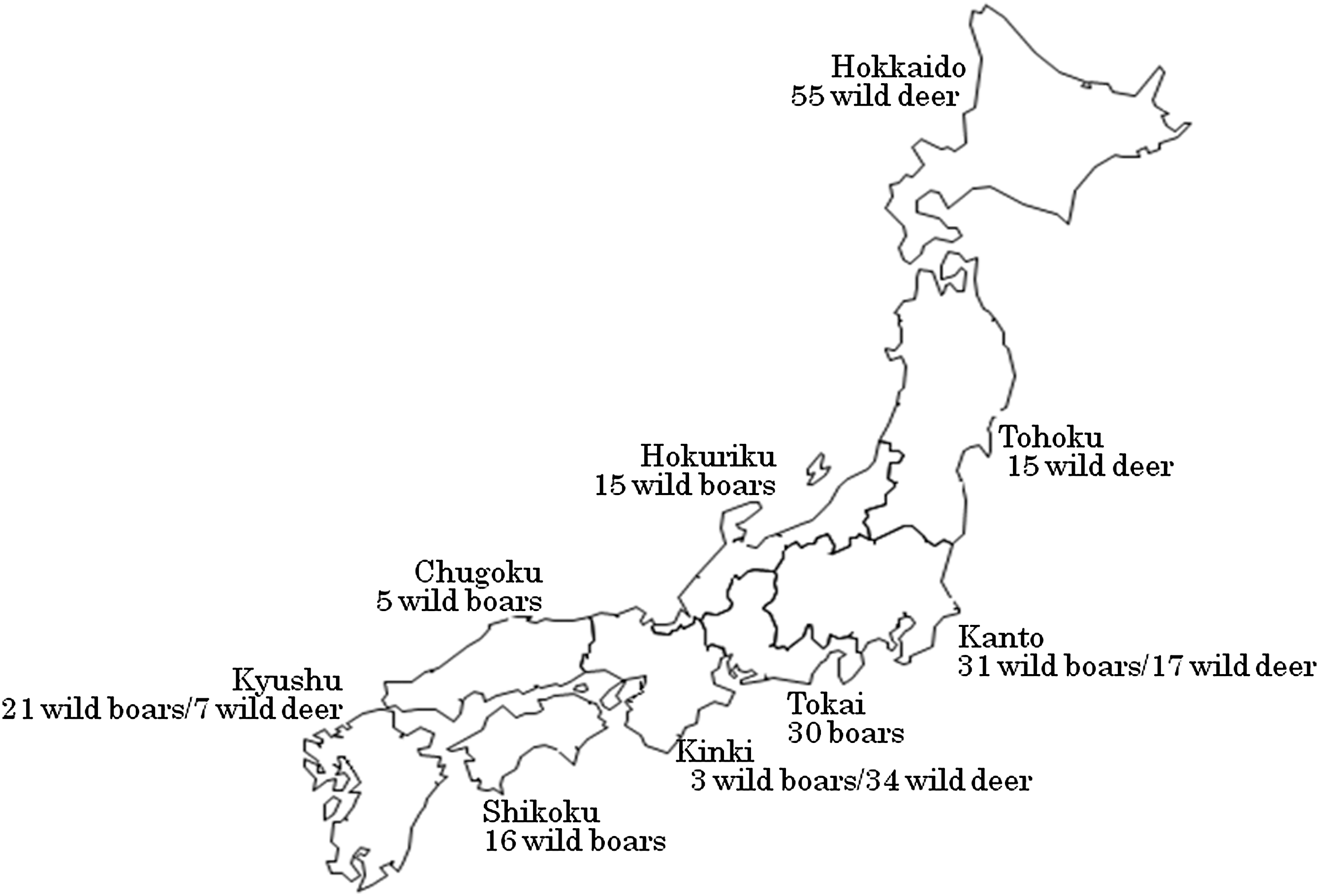
Map of hunting sites sampled in the present study.
Campylobacter isolation
Isolation of Campylobacter spp. was carried out as previously described (Sasaki et al., 2011b). For identification of Campylobacter species, API Campy (Sysmex bioMérieux, Tokyo, Japan) was used. Polymerase chain reaction (PCR) using the universal primer pairs 27F and 1492R (Kim et al., 2010) was employed to amplify an expected 1530-bp region of the 16S rDNA of 32 isolates that could not be identified by API Campy.
Salmonella isolation
Isolation of Salmonella spp. was carried out as previously described (Sasaki et al., 2012b). Depending on the amount of rectal contents available, between 3 and 25 g of sample was used. Salmonella isolates were tested by slide agglutination with O antisera (Denka Seiken, Tokyo, Japan) and tube agglutination with H antisera (Denka Seiken). Serovars were determined on the basis of reaction with O- and H-group antigens according to the Kauffmann–White scheme (Grimont and Weill, 2007).
STEC O157 and O26 isolation
Isolation of STEC O157 and O26 was carried out as previously described (Sasaki et al., 2011a). Depending on the amount of rectal contents available, between 3 and 25 g of sample was used. The production of Stx1 and/or Stx2 was confirmed by reverse passive latex agglutination with a Shiga toxin detection kit (VTEC-RPLA SEIKEN, Denka Seiken). The types of the Stx genes (stx 1a, stx 2a, stx 2c, stx 2d, stx 2e, and stx 2f) and enterohemorrhagic E. coli (EHEC)-hlyA, eae, rfbE O157, and fliC H7 were investigated by PCR analysis using primers reported by Wang et al. (2002).
L. monocytogenes isolation
Each rectal content sample (3–25 g) was mixed with 9 volumes of Half-Fraser broth (Merck KGaA, Darmstadt, Germany) and kept at 30°C for 24 h, for enrichment. After incubation, 0.1 mL of each broth was streaked on agar Listeria Ottaviani and Agosti medium (Merck FGaA) and PALCAM agar (Merck KGaA) and incubated at 30°C for 48 h. Five suspected colonies were subcultured onto trypticase soy agar plates containing 0.6% yeast extract. For the identification of Listeria spp., API Listeria (Sysmex bioMérieux) was used. L. monocytogenes isolates were subjected to the Christie, Atkins, Munch-Peterson (CAMP) test.
Serotyping was performed by examination of group-specific Listeria O and H antigens by slide agglutination using commercially prepared antisera (Denka Seiken). Four virulence-associated genes (actA, hlyA, iap, and prfA) were investigated by PCR analysis as previously described (Bubert et al., 1997; Wiedmann et al., 1997).
Antimicrobial susceptibility testing
The minimum inhibitory concentration of antimicrobial agents was determined using the agar dilution method of the Clinical and Laboratory Standards Institute (CLSI, 2008a). Campylobacter jejuni ATCC33560, Enterococcus faecalis ATCC29212, Escherichia coli ATCC 25922, and Staphylococcus aureus ATCC29213 were used as quality control strains. The 16 antimicrobial agents tested were ampicillin (ABPC), cefazolin (CEZ), ceftiofur (CFT), dihydrostreptomycin (DSM), gentamicin (GM), kanamycin (KM), apramycin (APM), oxytetracycline (OTC), bicozamycin (BCM), chloramphenicol (CP), erythromycin (EM), colistin (CL), nalidixic acid (NA), enrofloxacin (ERFX), trimethoprim (TMP), and fosfomycin (FOM). ABPC, GM, KM, OTC, CP, EM, NA and TMP were purchased from Wako Pure Chemical Industries, Ltd. (Osaka, Japan); CEZ, DSM, CL, and FOM were bought from MP Biomedicals Japan Inc. (Tokyo, Japan); CFT from Hayashi Pure Chemical Industries, Ltd. (Osaka, Japan); BCM from Food and Agricultural Materials Inspection Center (Saitama, Japan); and APM and ERFX from LKT Laboratories, Inc. (St. Paul, MN).
For Campylobacter spp., eight antimicrobial agents (i.e., ABPC, DSM, GM, OTC, CP, EM, NA, and ERFX) were used for testing. Except for GM, resistance breakpoints of ≥2 mg/L, as specified by the Danish Integrated Antimicrobial Resistance Monitoring and Research Programme (DANMAP, 2009) and as adopted in previous reports (Ishihara et al., 2004; NVAL, 2009), were used in this study.
For STEC O157 and O26, 15 antimicrobial agents (i.e., ABPC, CEZ, CFT, DSM, GM, KM, APM, OTC, BCM, CP, CL, NA, ERFX, TMP, and FOM) were used for testing. Resistance breakpoints as adopted in previous reports were applied (CLSI, 2008b; NVAL, 2009; Sasaki et al., 2012c).
For Salmonella spp., 13 antimicrobial agents (i.e., ABPC, CEZ, CFT, DSM, GM, KM, OTC, BCM, CP, CL, NA, ERFX, and TMP) were used for testing. Resistance breakpoints as defined in previous reports were used (CLSI, 2008b; Esaki et al., 2004; NVAL, 2009).
Results
The rectal content samples of 121 wild boars and 128 wild deer were subjected to isolation of Campylobacter spp., STEC O157 and O26, and Salmonella spp. However, because of the limited volume of the rectal contents, only the rectal content samples of 75 wild boars and 114 wild deer could be used for isolation of L. monocytogenes.
Campylobacter spp.
Campylobacter spp. were obtained from the rectal content samples of 53 wild boars (43.8%; 95% CI: 35.0–52.6; Table 1). Campylobacter-positive wild boars were present in all of the seven regions investigated. The most common Campylobacter species was C. lanienae, followed by C. hyointestinalis, and C. jejuni. All of the C. lanienae isolates and 1 C. hyointestinalis isolate were identified by the 16 rRNA gene sequences. C. lanienae-positive wild boars were obtained from six of the seven regions investigated (Kanto, Hokuriku, Tokai, Chugoku, Shikoku, and Kyushu). Similarly, wild boars positive for C. hyointestinalis were found in six of the seven regions (Kanto, Hokuriku, Tokai, Kinki, Shikoku, and Kyushu). The wild boar positive for C. jejuni was hunted in the Kinki region.
Percentage in parentheses.
Rectal content samples from 75 wild boars and 114 wild deer were processed for Listeria isolation.
STEC, Shiga toxin–producing Escherichia coli.
All the isolates of C. lanienae and C. hyointestinalis were resistant to NA but were susceptible to both ABPC and EM (Table 2). The C. jejuni isolate was susceptible to all of the antimicrobial agents tested. Of the 31 C. lanienae isolates, three (10%), seven (23%), and five (16%) were resistant to DSM, OTC, and ERFX, respectively. Thirteen (42%) C. lanienae isolates were resistant to one or two antimicrobial agents other than NA. One C. lanienae isolate was resistant to five antimicrobial agents (DSM, OTC, CP, NA, and ERFX). Eleven (52%) and six (29%) C. hyointestinalis isolates were resistant to DSM and ERFX, respectively. Six C. hyointestinalis isolates were resistant to three antimicrobial agents (DSM, NA, and ERFX).
ABPC, ampicillin; DSM, dihydrostreptomycin; GM, gentamicin; OTC, oxytetracycline; CP, chloramphenicol; EM, erythromycin; NA, nalidixic acid; ERFX, enrofloxacin.
Salmonella spp.
Salmonella spp. were obtained from the rectal contents of nine wild boars (7.4%; 95% CI: 2.8–12.1). The Salmonella-positive boars were hunted in three regions (Tokai, Kanto, and Shikoku). The serovars of the nine Salmonella isolates obtained were Salmonella enterica subsp. enterica serovar Agona (three isolates), S. Narashino (two isolates), S. Enteritidis (one isolate), S. Havana (one isolate), S. Infantis (one isolate), and S. Thompson (one isolate). All of the Salmonella-positive wild boars, except for the wild boar positive for S. Thompson, were also positive for Campylobacter spp. Of the eight Salmonella-positive wild boars, five were positive for C. hyointestinalis, while the remaining three were positive for C. lanienae.
Six Salmonella isolates (two S. Agona isolates, two S. Narashino isolates, one S. Infantis isolate, and one S. Thompson isolate) were resistant to one or more antimicrobial agents, whereas three isolates (one S. Havana isolate, one S. Agona isolate, and one S. Enteritidis isolate) were susceptible to all of the antimicrobial agents tested. Six (67%) Salmonella isolates were resistant to DSM and/or OTC.
STEC O157 and O26
E. coli O157 isolates were obtained from the rectal contents of three wild deer (2.3%; 95% CI: 0–5.0). These wild deer were hunted in the Hokkaido region. All three of the isolates were regarded as STEC O157 because they produced Stx2c; all three STEC O157 isolates harbored stx 2c eae, rfbE O157, and fliC H7, but two did not harbor EHEC-hlyA.
E. coli O26 isolates were obtained from four wild boars and 16 wild deer. Only one E. coli O26 isolate from a wild deer (0.8%; 95% CI: 0–2.3) was regarded as STEC O26, as the isolates were positive for stx 1a, and produced Stx1a. The STEC O26 isolate harbored eae and EHEC-hlyA. The wild deer positive for STEC O26 was hunted in the Hokkaido region. All of the STEC O157 and O26 isolates were susceptible to all the antimicrobial agents tested.
Listeria monocytogenes
Listeria spp. were obtained from the rectal contents of 28 wild boars (37.3%) and 26 wild deer (22.8%). Three wild deer were infected with two Listeria species. L. innocua was the most common of the Listeria spp., and was obtained from 26 wild boars and 17 wild deer. L. monocytogenes was the second most common Listeria spp. and was obtained from seven wild deer (6.1%; 95% CI: 1.7–10.5) hunted in three regions (Hokkaido, Tohoku, and Kyushu). The serovars of the seven L. monocytogenes isolates were 1/2b (three isolates), 1/2a (two isolates), and 4b (two isolates). All of the L. monocytogenes isolates harbored all of the virulence-associated genes (actA, hly, iap, and prfA) tested in the study, and yielded positive CAMP test results.
Discussion
There was a marked difference in the prevalence of foodborne bacteria between wild boars and wild deer. While Campylobacter spp. and Salmonella spp. were isolated only from the rectal contents of wild boars, STEC O157 and O26 and L. monocytogenes were isolated only from the rectal contents of wild deer.
There have been several reports of the presence of these foodborne bacteria in wild boars. Hayashidani et al. (2002) reported that L. monocytogenes was isolated from the feces of two (1.5%) of 131 wild boars in Japan. Wahlström et al. (2003) reported that the prevalence rates of Campylobacter spp., Salmonella spp., and STEC O157 in fecal samples of 31 wild boars in Sweden were calculated to be 12%, 0%, and 1%, respectively, and that C. jejuni and C. coli were the most common Campylobacter species. Wacheck et al. (2010) reported that the prevalence rates of Campylobacter spp., Salmonella spp., STEC, and L. monocytogenes in the feces of 73 wild boars in Geneva were 0%, 0%, 0%, and 1%, respectively. Jay-Russell et al. (2012) previously reported that 12 (40%) of 30 wild boars in California were positive for Campylobacter spp., including C. lanienae, in fecal and/or tonsil samples; the most common species in their study was C. jejuni. Although the prevalence of these foodborne bacteria in wild boars varies among studies, these foodborne bacteria are capable of colonizing the intestine of wild boars. The results of this study suggest that appropriate control measures during eviscerating and handling the carcasses of wild boars is required to reduce the contamination of boar meat by these foodborne bacteria.
While the pathogenic potential of C. lanienae to humans has not yet been elucidated, the other Campylobacter species and Salmonella serovars isolated from wild boars in this study are regarded as human pathogens, as they have been isolated from human gastroenteritis cases (Lawson et al., 1998; Gorkiewicz et al., 2002; CDC, 2008). The results of the current study suggested that at least 20% of wild boars harbor these pathogenic bacteria in their gastrointestinal tracts.
Interestingly, C. lanienae was the most common Campylobacter species isolated from wild boars, and was found in wild boars throughout Japan. The bacterium was first described by Logan et al. (2000). In that study, C. lanienae was isolated from the feces of healthy abattoir workers in Switzerland. Although C. lanienae has occasionally been isolated from pigs (Schweitzer et al., 2011), cattle (Inglis et al., 2006), and sheep (Oporto and Hurtado, 2011) in countries other than Japan, this bacterium is a minor species of campylobacters in these animals. The primary source of C. lanienae remains unknown. In Japan, six C. lanienae isolates were obtained from four pigs in the investigation of the presence of Campylobacter in 183 healthy cattle, 180 pigs, and 156 broilers between June 1999 and January 2000 (Sasaki et al., 2003). Since then, no report of the presence of C. lanienae in Japan has been published. To our knowledge, this is the first report on the presence of Campylobacter spp. in wild boars in Japan.
STEC O157 and O26, and L. monocytogenes were isolated from three (2.3%), one (0.8%), and seven (6.1%) wild deer in our study, respectively. All of the L. monocytogenes isolates were also positive for all virulence-associated genes investigated and could be categorized into three serovars: 1/2a, 1/2b, and 4b. These three serovars are commonly found in human listeriosis (Vázquez-Boland et al., 2001). Therefore, L. monocytogenes obtained from wild deer in this study are potentially pathogenic to humans. Yoshida et al. (2000) reported isolation of L. monocytogenes from one (1%) of 95 wild deer in Japan. Wahlström et al. (2003) reported that the prevalence rates of Campylobacter spp., Salmonella spp., and STEC O157 in the fecal samples of 69 roe deer in Sweden were 4%, 0%, and 0%, respectively. Gorski et al. (2011) reported that Salmonella spp. was isolated from two (2%) of 104 wild deer in California, while García-Sánchez et al. (2007) reported isolation of E. coli O157 from three (1.5%) of 206 red deer in Southwestern Spain. Mora et al. (2012) also reported isolation of E. coli O157 and E. coli O26 from one (0.6%) and four (2.2%) of 179 roe deer in the northwest of Spain, respectively. Obwegeser et al. (2012) reported that all fecal samples from 239 wild ruminants (84 red deer, 64 roe deer, 64 chamois, and 27 ibex) were negative for Salmonella spp. and L. monocytogenes. The prevalence rates of these foodborne bacteria, other than L. monocytogenes, in the present study were similar to that reported by the above studies. L. monocytogenes was isolated from 6.1% (7/114) of wild deer, stressing the importance of good hygienic practice during eviscerating and handling the carcasses of deer to reduce the contamination of deer meat by L. monocytogenes.
In the present study, some Campylobacter spp. and Salmonella spp. isolates were resistant to antimicrobials, whereas all the STEC O157 and O26 isolates were pansusceptible to all antimicrobials tested. High resistance rates to DSM and/or OTC in Campylobacter and Salmonella isolates were observed. Ishihara et al. (2004) investigated the antimicrobial susceptibility of C. hyointestinalis and C. lanienae isolated from pigs in Japan, and found that more than 66% of the isolates were resistant to DSM and/or OTC. Salmonella isolated from food-producing animals and poultry in Japan show a high frequency of resistance to DSM and/or OTC (Asai et al., 2006; NVAL, 2009; Sasaki et al., 2012a). In our study, several C. hyointestinalis and C. lanienae isolates were resistant to ERFX. C. hyointestinalis and C. lanienae isolates were susceptible to fluoroquinolones when these bacteria were proposed as new Campylobacter species (Gebhart et al., 1985; Logan et al., 2000). Ishihara et al. (2004) had also reported that C. hyointestinalis and C. lanienae isolated from pigs were susceptible to fluoroquinolones. On the other hand, Laatu et al. (2005) reported that one ciprofloxacin-resistant C. hyointestinalis isolate was obtained from fecal samples of cattle in Finland. Schweitzer et al. (2011) recently reported that 5 (22%) of 23 C. lanienae isolates from pigs in Hungary were resistant to ERFX. Fluoroquinolones have been used for the treatment of bacterial pneumonia and diarrhea in food-producing animals. Therefore, ERFX-resistant C. hyointestinalis and C. lanienae isolates may be selected in the intestinal tracts of food-producing animals and from there leak out into the environment. According to this hypothesis, fluoroquinolone-resistant isolates of C. hyointestinalis and C. lanienae would be present in the intestinal tract contents of food-producing animals.
Conclusions
This is the first nationwide survey for the presence of foodborne bacteria in wild boars and wild deer in Japan. The results of the present study suggest that consumption of meat from these animals poses the risk that these bacterial infections may be transferred to humans, and that these animals are potential vectors for the spread of antimicrobial-resistant bacteria to livestock farms. Therefore, adequate sanitary inspection of meat from these wild animals is essential to minimize the risk of these bacterial infections in humans. The prevalence and antimicrobial susceptibility of these foodborne bacteria in these wild animals should be monitored periodically.
Footnotes
Acknowledgments
We wish to express our gratitude to the IFES for their cooperation. This study was funded by the Ministry of Agriculture, Forestry and Fisheries of Japan.
Disclosure Statement
No competing financial interests exist.