




Abstract
Objective:
This study describes an effective educational program to improve children's knowledge about characteristics of microorganisms and food contamination, and their personal hygiene behaviors.
Materials and Methods:
Between November 2011 and March 2012, a health campaign, targeted at fifth-grade students of 12 public primary compulsory schools, was conceived. Participants were divided into two classes, a theoretical class and a practical class based on two different teaching approaches. To address children's knowledge and behaviors on the program topics and to monitor the effectiveness of the health campaign on changing pre-existent concepts and habits, pre- and post-intervention questionnaires were administered both to students and parents. Poisson and binomial mixed models were performed.
Results:
Two hundred forty-nine children were enrolled. Results show an overall improvement in children's knowledge both for the practical and theoretical classes (incident risk ratios [IRRs]: 1.2, 95% confidence interval (CI) 1.1–1.2, p<0.001 and 1.1, 95% CI 1.0–1.1, p<0.001, post- versus pre-intervention). The same effect was observed for children's behavior, comparing post- versus pre-intervention for both groups (IRRs were 3.4, 95% CI 2.2–5.2, p<0.001 and 3.2 95% CI 1.9–5.5, p<0.001).
Conclusion and Applications:
The methodology described in this article might be usefully adopted to conduct food safety classes, contributing to the amelioration of children's awareness on food related risks and leading to significant benefit for primary prevention.
Introduction
M
The distribution of strong evidence of outbreaks by settings, reported by European Member States, showed that a large proportion of outbreaks originate in the domestic environment. The “Union Summary report on trends and sources of zoonoses zoonotic agents and food-borne outbreaks” edited by European Food Safety Authority (EFSA), reports that in 2010 the household setting accounted for the 38.7% of the total cases and for the 55.6% of those caused by Salmonella (EFSA, 2010).
These data emphasize the role of safety measures applied by consumers in foodborne-illnesses prevention. However, evidence shows that most consumers are unaware of their home contribution to food safety risks (Worsfold and Griffith, 1997; Losasso et al., 2012), since they are more worried about hygiene standards outside the domestic setting (Miles et al., 2004; Haapala and Probert, 2004; Eves et al., 2010).
Education and training on basic principles of food safety are emphasized in the international literature since they could contribute to reduce the occurrence of foodborne illnesses, if the messages are specifically tailored to consumers' needs and habits (Medeiros et al., 2001; Altekruse et al., 2009).
Previous studies have focused on effective strategies for improving consumer behavior in the food hygiene context (Redmond and Griffith, 2003; Miles et al., 2004) but little research has been conducted into school-based food safety education.
Food safety education of children is thought to be essential for the development of proper handling of food practices (Haapala and Probert, 2004; Youatt et al., 1996); moreover, teaching food hygiene in schools could be an effective way to reach all the family members, as students share knowledge on correct practices in the home setting (Egan et al., 2008; Haapala and Probert, 2004).
Nevertheless, research on health-related behaviors suggests that, in order to achieve long-term effects, education should induce the use of rational thinking through the awareness of cause–effect relationship (Parry et al., 2004; Prochaska, 2008).
Starting from these considerations, the goal of the present work was to develop a food safety program for the fifth grade of the Italian public primary compulsory school system aimed at improving children's skills, which would be useful in protecting themselves and their families from foodborne illnesses. The first objective was to encourage children to change their habits toward safer behaviors. The second objective was to compare the effectiveness of a practical versus a theoretical class in changing children's knowledge about microorganisms and measures that can be implemented at the consumer level to reduce the risk of microbial food contamination.
Results here presented are part of a major research project and are complementary to those presented in a previous article by us (Faccio et al., 2013).
Materials and Methods
Study design
The complete study design is described in Supplementary Data S1 Study Design (Supplementary Data are available online at
Briefly, between November 2011 and March 2012, the Istituto Zooprofilattico Sperimentale delle Venezie, in collaboration with the University of Padua and the School Coordination Office of the Padua province, conceived a health campaign called Mission on the invisible world, targeting fifth-grade students of the Italian public primary compulsory school, aged between 9 and 11 years.
It was decided to target fifth-grade students in order to meet school curriculum requests, in agreement with the School Coordination Office. Twelve public schools were enrolled in the study; six of them were located in Padua city center and the remaining six were situated in the countryside. The participating classes were randomly divided into two groups: a theoretical group and a practical group, based on two different teaching approaches.
The research did not require institutional review board approval but, due to participants being underage, informed consent was required by parents or tutors.
Teaching material and evaluation questionnaire
Teaching material used for both classes consisted of ad hoc multimedia and movies, made by trainers, and is available on request.
To address children's knowledge of and behaviors for the program topics and to monitor the effectiveness of the health campaign on changing pre-existing concepts and habits, the same pre- and post-intervention questionnaire was administered to both practical and theoretical classes.
Eventually, to evaluate children's hygiene practices from the parents' point of view and to compare children's and parents' perceptions about the change of children's habits due to the campaign, a second pre- and post-intervention questionnaire was administered to parents. Children's and parents' questionnaire are reported in Supplementary Data S2 Children's Questionnaire and Supplementary Data S3 Parents' Questionnaire.
In the first part, information on respondents' characteristics (sex and ethnicity) was collected. The second part, called “Knowledge,” was based on the following nine topics composed of seven true–false questions each: (1) bacteria localization in the environment; (2) differences between viruses and bacteria; (3) relationships between bacteria and the human body; (4) hand hygiene; (5) proper handling of raw meat to reduce foodborne illness risks; (6) proper handling of fruits and vegetables to reduce foodborne risks; (7) bacteria and food technology; (8) food-handling hygiene; and (9) insight into flu and antimicrobial resistance. The third section, called “Behaviors,” was composed of eight questions corresponding to the following topics: (1) hand hygiene before eating; (2) hand hygiene when returning back home; (3) hand hygiene after stroking animals; (4) hand hygiene after handling eggs; (5) hand hygiene after handling meat; (6) hand hygiene after eating; (7) hand hygiene after using the toilet; and (8) use of hand to cover mouth when coughing.
Each question in the “Knowledge” section was coded as a dummy variable by assigning the value 1 to the correct answer and 0 otherwise. Each item gave rise to a score ranging from 0 (no correct answers) to 7 (all correct answers); a total “Knowledge” score ranging from 0 (no correct answers) to 63 (all correct answers [9 topics composed by 7 questions each]) was then calculated.
Each topic in the “Behaviors” section of children's and parents' questionnaires consisted of four possible answers (“never,” “sometimes,” “often,” and “always”) coded as a categorical ordinal variable ranging from 0 (worst habit, corresponding to the answer “never”) to 3 (best habit, corresponding to the answer “always”) and, finally, a total “Behaviors” score ranging from 0 (worst habits) to 24 (best habits) was computed. The parents' questionnaire consisted of the demographic description of respondents and of the “Behaviors” section, referring to children's habits.
Data entry and statistical analysis
Children and parents autonomously filled out the questionnaires, and responses were entered into an electronic database (Access 2009, Microsoft Corporation, Redmond, WA).
Categorical variables (sex, race, and school location) were summarized as counts with percentages; differences between theoretical and practical classes attendants were tested using the Pearson chi-square test.
To compare the effectiveness of the practical and theoretical classes pre- and post-intervention in modifying children's knowledge and behaviors, Poisson and Binomial Mixed Models for repeated measures and random intercepts (log as link function) were performed, respectively (Twisk, 2003). Single topics and the overall score both of “Knowledge” and “Behaviors” sections were used as outcomes (dependent variables) and questionnaire administration time (post- versus pre-intervention) and type of class (practical versus theoretical) as determinants (independent variables). Separated models were run for each topic, adjusting for determinants and the following covariates: sex (female versus male), race (white versus nonwhite) and school location (province versus city center). Separated models were performed for the practical and theoretical intervention (namely, type of intervention was not a dependent variable, but a stratified variable). The obtained estimates describe the differences of the outcomes due to the different contribution of the independent variables in terms of incident risk ratio (IRR), with a relative confidence interval of 95% (95% CI). The same models were used to evaluate the overall intervention effectiveness in modifying children's knowledge and behaviors (independently from the class), considering as determinant the questionnaire administration time (post- versus pre-intervention) and adjusting for the other potential confounders (sex, race, and school location) as covariate. Regarding “Knowledge” outcomes and time variable (post- versus pre-intervention), for example, the IRR is interpreted as percentage of correct answers given by the children for a particular topic in the post-intervention in respect to the pre-intervention. That is, if IRR is >1 and statistically significant (p≤0.05), then 95% CI does not include 1, which means that children give more correct answers in the post-intervention than in the pre-intervention, and it is possible to assert the effectiveness of the intervention (practical or theoretical); on the contrary, if IRR is <1 and statistically significant (p≤0.05), then 95% CI doesn't include 1; this means that children give more correct answers in the pre-intervention than in the post-intervention, and the intervention is not effective.
To measure the agreement between children's and parents' responses, Cohen's κtest was performed (Lee and Fung, 1993) and the magnitude of the agreement was evaluated according to the Landis and Koch (Landis and Koch, 1977) approach.
To better understand the level of concordance between children and parents on children's habits, the children's crude score was detracted from the parents' one and the distribution of the obtained results was evaluated. The difference obtained for each item ranged between −3 (parents declaring the worst habit and children the best) and +3 (parents declaring the best habit and children the worst), where zero indicated the complete concordance between parents' and children's answers.
Statistical analyses were performed using Stata Statistical Software (StataCorp, College Station, TX): Release 12, and the Poisson and Binomial Mixed Models were run using GLLAMM (Generalized Linear Latent and Mixed Models) programs (Rabe-Hesketh et al., 2004).
Results and Discussion
Demographic characteristics
Demographic characteristics of the children who took part in the program are described in Table 1. The different number of participants in the two classes was due to differences in the number of students attending the enrolled schools.
NS: not statistically significant (p>0.05).
Intervention effectiveness in modifying children's “Knowledge”
As shown in Table 2, an overall improvement in children's knowledge was observed both for the practical and theoretical classes, as the IRRs were 1.2 (95% CI 1.1–1.1.2; p<0.001) and 1.10 (95% CI 1.1–1.2; p<0.001), respectively.
Obtained through Poisson Mixed Models for repeated measures and with random intercepts.
NS: not statistically significant (p>0.05).
IRR, incident risk ratio; CI, confidence interval; NS, not significant.
The main improvement in children's knowledge (estimates expressed as post- versus pre-intervention) was evidenced by the relationships between bacteria and the human body and the bacteria and food technology topics, and their total IRRs were 1.3 (95% CI 1.2–1.4 ; p<0.001) and 1.4 (95% CI 1.3–1.6; p<0.001), respectively. This means that the number of correct answers post-intervention was 30% and 40% higher than in the pre-intervention for the two topics, respectively. A significant progress in children's knowledge on the abovementioned issues was observed in both the two classes, with IRRs being 1.3 (95% CI 1.12–1.5; p<0.001) and 1.5 (95% CI 1.4–1.7; p=0.03) for the practical class and 1.3 (95% CI 1.1–1.5; p<0.001) and 1.3 (95% CI 1.2–1.5; p<0.001) for the theoretical one.
The practical approach to teaching was also effective in the case of the bacteria localization in the environment; the differences between viruses and bacteria; the proper handling of raw meat to reduce foodborne risks; and the food handling hygiene topics, as the IRRs were 1.3 (95% CI 1.2–1.5; p<0.001), 1.1 (95% CI 1.0–1.2; p=0.02), 1.1 (95% CI 1.0–1.2; p=0.03), 1.1 (95% CI 1.0–1.3; p<0.001), respectively. This result is strongly supported by previously reports, which indicated that students find practical work relatively useful and enjoyable compared to other scientific teaching methods (Cerini et al., 2003; Abrahams and Millar, 2008).
As shown in Table 2, no statistically significant progress in the children's knowledge on hand hygiene and insight into flu and antimicrobial resistance was observed. In regard to hand hygiene, this might be due to the fact that children were already aware about the importance of hand washing, as the score distribution shape for this issue was strongly shifted toward high values both in the pre- and in the post-intervention (data not shown). For this reason, this result can still be counted as a success because children have been able to improve on an already virtuous habit. The same consideration cannot fully be applicable to the insight into flu and antimicrobial resistance, which included the knowledge of flu etiology, flu symptoms, the spread of viruses, and the improper use of pharmacological treatments including the use of antibiotics. Some of these issues are repeatedly emphasized in junior schools, so the link between covering the mouth when sneezing and infection prevention is well known, besides being a polite behavior. However, some contents of the intervention should be considered as new information for children, such as the differences between bacteria and viruses, and the correct use of medicines to counteract bacterial or viral infections, thus reducing antibiotic misuse.
In the case of the proper handling of fruit and vegetables to reduce foodborne risks, the IRR (post- versus pre-intervention) concerning the practical class was statistically significant and equal to 0.9 (95% CI 0.8–0.9; p=0.03), demonstrating that in this case the intervention was not effective (Table 2).
The overall analysis indicated that children have generally more difficulties with items related to food management such as “vegetables preparation” and “washing vegetables before eating” than items such as “hand-washing ” or “microbes and their environment,” which were mastered by most of the participants. This might be due to the fact that while primary-school children have not yet assumed responsibility for food preparation, they have already been educated to be responsible for their own personal hygiene. The same observation has also been made in a previous study, which involved middle-school students with a fair level of food safety knowledge (Haapala and Probert, 2004).
Intervention effectiveness in modifying children's “Behaviors”
The “Behaviors” section of the questionnaire investigated the change of children's attitudes towards daily habits that can impact the risk of foodborne diseases, with the majority of the administered questions regarding the practice of hand washing. As in the case of the “Knowledge” section, the overall effectiveness of practical and theoretical class (post- versus pre-intervention) was observed, since the IRRs were 3.4 (95% CI 2.2–5.2; p<0.001) and 3.2 (95% CI 1.9–5.5; p<0.001) for the practical and the theoretical classes, respectively (Table 2). The greatest improvement in children's changed behaviors (post- versus pre-intervention) was seen for the practice of hand-washing when coming back home, in both the case of the practical and theoretical classes (IRRs 4.4, 95% CI 2.5–7.6; p<0.001 and IRR 3.0, 95% CI 1.5–6.2; p=0.002, respectively). Concerning the other items, a general statistically significant post-intervention gains (versus pre-intervention) were noticed, which were either due to the practical or the theoretical program depending on the issue, apart from the hand hygiene before eating and the hand hygiene after handling eggs issues, where children improved their behavior in both classes (Table 3). These findings strongly support the results of the “Knowledge” section about the importance of hand washing, lending reliability to the whole result.
Obtained through Binomial Mixed Models for repeated measures and with random intercepts.
NS: not statistically significant (p>0.05).
IRR, incident risk ratio; CI, confidence interval; NS, not significant.
The enhancement of children's “Behaviors” was also perceived by parents, as the overall IRRs were 2.6 (95% CI 1.7–3.8; p<0.001) and 2.8 (95% CI 1.7–4.8; p<0.001) for the practical and the theoretical classes, respectively (Table 4). Parents recognized that the main improvements in children's behavior were achieved for the issues connected with food manipulation, as in the case of the hand hygiene after handling eggs, for which the IRR for the practical classes was 4.0 (95% CI 2.4–6.7; p<0.001) and the hand hygiene after handling meat, where the IRRs were statistically significant and equal to 2.8 (95% CI 1.6–4.9; p<0.001) for the practical class and 2.3 (95% CI 1.1–5.1; p=0.032) for the theoretical one (Table 4). This result leads to the achievement of one of the main goals of the project due to the strong existing association between food handling errors and the most frequent foodborne illnesses (EFSA, 2012; Medeiros et al., 2001).
Obtained through Binomial Mixed Models for repeated measures and with random intercepts.
NS: not statistically significant (p>0.05).
IRR, incident risk ratio; CI, confidence interval; NS, not significant.
Agreement between children and parents about children's behaviors
In order to better estimate the differences of perception between children and parents concerning children's behavior, the Cohen's κtest was performed and the results are summarized in Figure 1. A “Fair” agreement between parents' and children's answers was detected pre-intervention, but this shifted into the “Slight” agreement for the post-intervention questionnaire. In order to better investigate this result, the crude difference in the outcomes between parents and children was calculated (Fig. 2). The obtained results showed the percentage of strict concordance (score differences between parents and children equal to zero) ranging between 40.7% (in the case of wash hands after meat handling) and 66.5% (in the case of wash hands before eating) in the pre-intervention and between 32.1% and 66.5% for the same topics in the post-intervention (Fig. 2).
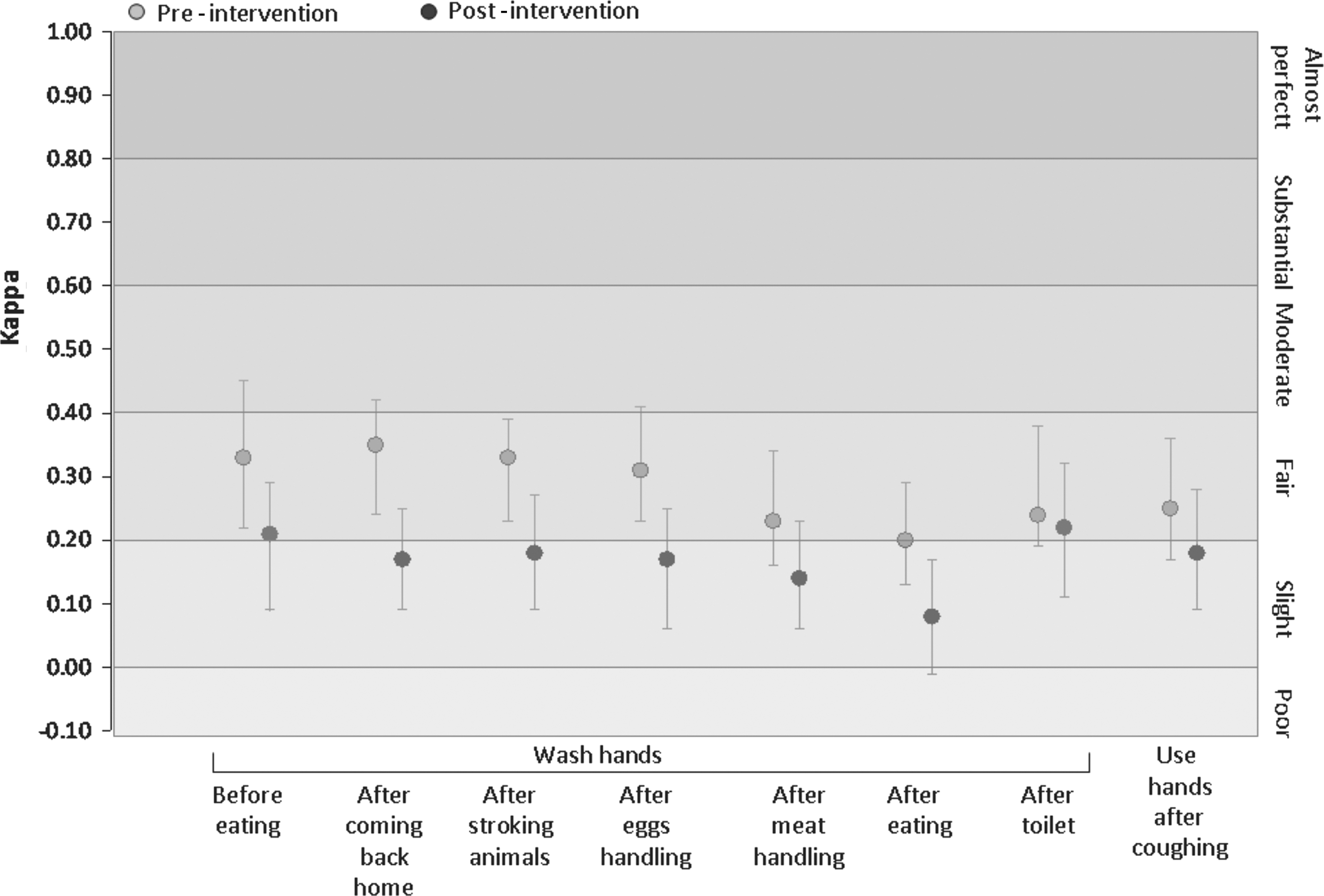
Agreement between children and parents responses about children's habits, pre- and post-intervention. Agreement was performed using Cohen's κtest (with relative bootstrap 95% confidence interval, indicated by bars in the figure). Circles describe the magnitude of agreement (poor, slight, fair, moderate, substantial, and almost perfect) between children and parents pre- (light-gray circles) and post-intervention (dark-gray circles).
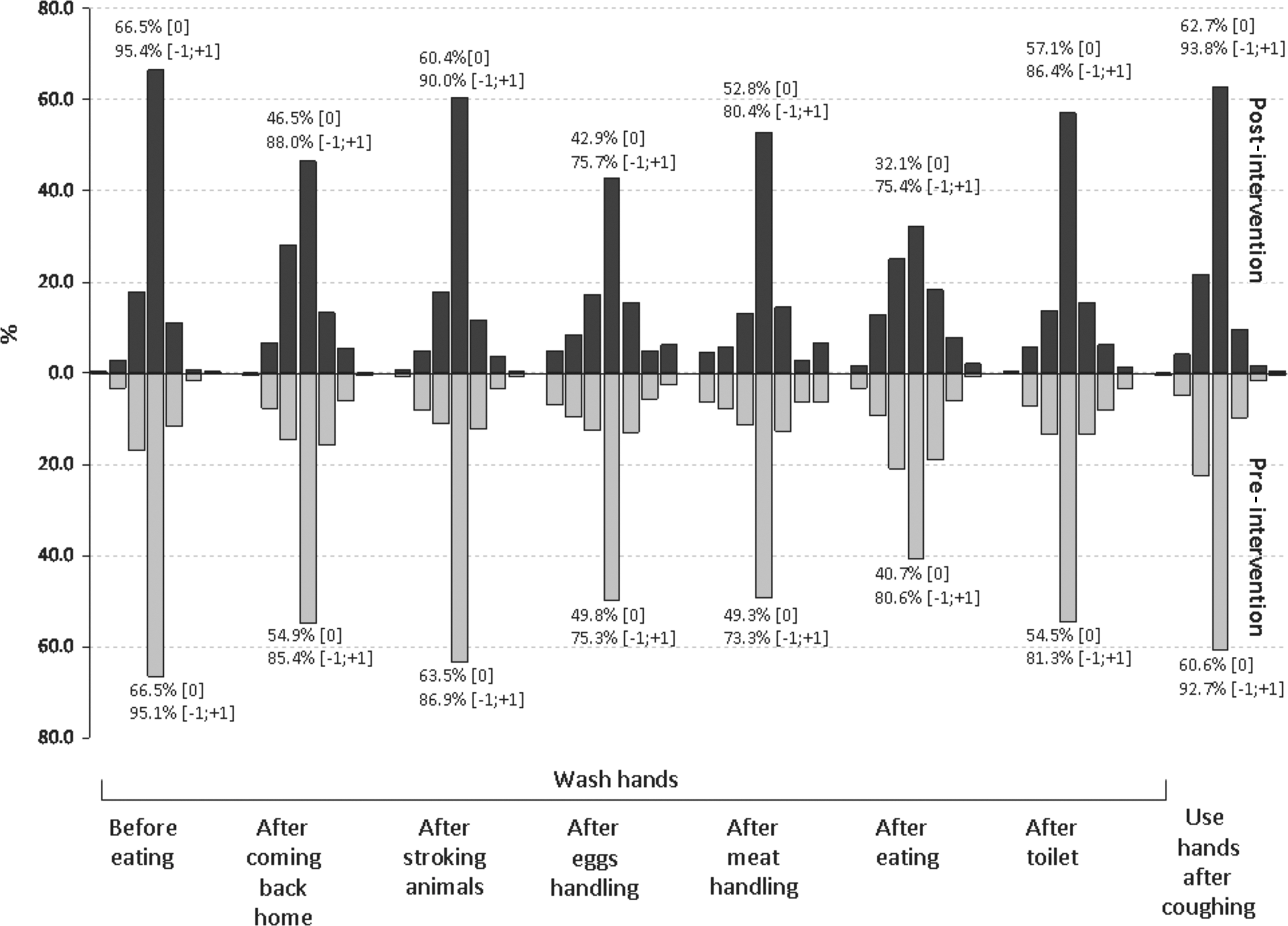
Differences between parents' and children's crude scores about children's behaviors. The obtained differences range between −3 (parents declaring the worst habit and children the best) and +3 (parents declaring the best habit and children the worst); the value of zero indicates complete concordance between parents' and children's answers. Light-gray and dark-gray bars refer to pre-intervention versus post-intervention differences, respectively. Percentages below/above light-gray and dark-gray bars indicate the percentage of complete concordant answers (indicated by “[0]”) and the percentage of responses whereby differences among parents and children range between −1 and +1 (indicated by “[-1; +1]”).
However, in most cases where a full concordance was not obtained, the difference between parents' and children's scores corresponded to a shift of only one degree (Fig. 2). This suggests that both children and parents noticed a change in children's behavior after the intervention, even if with a different perception in the magnitude of such change.
Conclusions
This study provides insight into food safety cognitions and self-reported behaviors of primary-school students involved in a health promotion campaign that was carried out in the schools with the aim of improving children's knowledge and habits in the context of food safety. As discussed in the previous paragraphs, the success of the intervention was demonstrated both for the practical and theoretical approaches, even though the practical model was more tailored to primary-school children's cognitive needs. Moreover, it is well known that children who become aware of the reasons for good hygienic practices via practical examples and who can benefit from good facilities will be more likely to perform long-term protective hygiene-related behaviors (Eves et al., 2010).
Historically many restrictions to the practical model of teaching food microbiology in the public school have been cited by primary school teachers, including limited budgets, poor access to resources and inability to do experimental work with microorganisms (Egan et al., 2008).
Nevertheless, this work demonstrated that the goal could be easily accomplished with a limited need for material resources by performing just a few tailored practical experiments strongly focused on children's knowledge needs.
On the basis of the results achieved, the methodology described in this article might be usefully adopted to conduct food safety classes, contributing to the amelioration of children's knowledge of food-related risks and ultimately leading to significant benefit in the primary prevention of foodborne illnesses.
Nonetheless, as described in the Results and Discussion section, some topics did not achieve significant improvement. In these cases, some reflections are due as they may provide a starting point for the improvement of future campaigns in terms of clarifying the message or by adding further levels of assessment that might investigate the covered topics by stimulating children's creativity and propensity to share with peers their didactic experiences.
Footnotes
Disclosure Statement
No competing financial interests exist.
References
Supplementary Material
Please find the following supplemental material available below.
For Open Access articles published under a Creative Commons License, all supplemental material carries the same license as the article it is associated with.
For non-Open Access articles published, all supplemental material carries a non-exclusive license, and permission requests for re-use of supplemental material or any part of supplemental material shall be sent directly to the copyright owner as specified in the copyright notice associated with the article.
