




Abstract
Cronobacter spp. (Enterobacter sakazakii) are important foodborne pathogens. Infections with this pathogen can lead to neonatal meningitis, necrotizing enterocolitis, and bacteremia. This study examined Cronobacter spp. contamination in commercial powdered infant formulas (PIFs) and follow-up formulas (FUFs) in China. Forty-nine of 399 samples were contaminated with Cronobacter spp. and 10.2% of the isolates were resistant to cefotaxime; in contrast, all of the tested isolates were susceptible to amikacin, amoxicillin/clavulanic acid, cefepime, ciprofloxacin, imipenem, and meropenem. Pulsed-field gel electrophoresis (PFGE) and multilocus sequence typing (MLST) analyses produced a total of 16 PFGE banding patterns and 11 sequence types (STs), including 7 novel STs. In summary, the rates at which Cronobacter spp. were isolated from commercial PIF and FUF samples in China were relatively high, and the isolated strains exhibited high susceptibility in vitro to most antibiotics. The PFGE method exhibited higher typing capability than the MLST method, and molecular typing results revealed that the contamination of PIF and FUF with Cronobacter spp. in China may be mainly due to the addition of contaminated materials. Thus, the development of more effective control strategies during the manufacturing process is needed.
Introduction
C
In this study, 399 samples from 29 PIF and FUF brands from 14 provinces were collected in Shijiazhuang. Cronobacter spp. bacteria were isolated and characterized. The susceptibility of the isolated strains to 14 antibiotics was tested, and PFGE and multilocus sequence typing (MLST) were utilized for the molecular typing of each isolate.
Materials and Methods
Food samples
From December 2011 to December 2012, a total of 399 commercial food samples were purchased from retail stores and supermarkets in Shijiazhuang city. Comprising 234 FUFs and 165 PIFs, samples were from 29 brands from 14 provinces of China. PIFs were from 14 brands from 10 provinces, FUFs were from 23 brands from 12 provinces.
Isolation and identification
The isolation and identification of Cronobacter spp. was carried out according to ISO/TS 22964 (ISO, 2006) with modification. For each sample, 25 g was suspended using 225 mL buffered peptone water (Beijing Landbridge, Beijing, China). Sample suspensions were incubated overnight at 36°. A volume of 1.0 mL of the pre-enrichment culture was added into 9 mL modified lauryl sulfate tryptose broth–vancomycin medium (mLST-Vm) (Beijing Landbridge, Beijing, China) and incubated overnight at 44°. A loopful of mLST-Vm was streaked directly onto Druggan Forsythe Iversen (DFI) (Oxoid CM1055, Hampshire, UK) agar plates and incubated for 24 h at 36°. Colonies producing blue–green color on DFI agar were subcultured by streaking each colony onto a single trypticase soy agar plate (TSA) (Beijing Landbridge, Beijing, China). The resulting colonies from TSA plates were identified using API 20E biochemical galleries (bioMérieux, France) according to the manufacturer's instructions. In accordance with relevant reference (Joseph et al., 2012), the species of the isolates was identified via the comparison of fusA allele sequences.
Antibiotic susceptibility
The antibiotic susceptibility testing was done using CLSI (CLSI, 2011) methods.
PFGE
All isolates were subtyped by PFGE, and the PulseNet standardized protocol for subtyping Cronobacter spp. was applied (Brengi et al., 2012). PFGE types were analyzed and dendrograms were created using Bionumerics v4.0 software (Applied Maths, Belgium), with the DICE coefficient and the unweighted pair group method with arithmetic means applied.
MLST
Genomic DNA was prepared using the QIAmp DNA mini kit (Qiagen, Germany) according to the manufacturer's instructions. Seven housekeeping genes were amplified using the primer and PCR conditions as described by the Cronobacter MLST website (
Results
Isolated strains
In this study, Cronobacter spp. were isolated from 49 of the 399 samples; in particular, the isolation rates from PIF and FUF samples were 11.5% (19/165) and 12.8% (30/234), respectively. The isolates included 48 C. sakazakii and 1 C. malonaticus. Cronobacter spp. was isolated from a total of 20 brands from 11 provinces. Among PIF samples, Cronobacter spp. were isolated from 7 brands from 8 provinces, whereas among FUF samples, Cronobacter spp. were isolated from 18 brands from 8 provinces.
Susceptibility tests
The susceptible, intermediate, and resistance rates of the 49 examined Cronobacter spp. isolates with respect to 14 antibiotics are presented in Table 1. The isolates were most resistant to cefotaxime, with resistance and susceptible rates of 10.2% and 67.3%, respectively. In addition, the isolates exhibited relatively high intermediate rates of 14.3% and 22.4% for cefuroxime and cefotaxime, respectively. Furthermore, in this study, only one isolate was resistant to both ceftazidime and ampicillin/sulbactam. All of the examined isolates were susceptible to amikacin, amoxicillin/clavulanic acid, cefepime, ciprofloxacin, imipenem, and meropenem; among the remaining tested antibiotics, the next-highest susceptible rates were observed for co-trimoxazole (98.0%), cefoperazone (95.9%), piperacillin/tazobactam (95.9%), piperacillin (95.9%), ampicillin/sulbactam (95.9%), ceftazidime (91.8%), and cefuroxime (83.7%). A total of 26 isolates were susceptible to all 14 antibiotics.
Concentrations of antimicrobials used in disc-diffusion test.
One isolate was resistant to both ceftazidime and ampicillin/sulbactam.
PFGE and MLST
As indicated in Figure 1, the PFGE dendrogram that was generated using 2 endonucleases revealed 16 PFGE patterns (Pattern01 to Pattern16). Pattern01 was produced by 16 strains isolated from samples from 11 different brands in 8 provinces; Pattern06 was produced by 4 strains isolated from samples from 3 different brands in 4 provinces; Pattern09 was produced by 14 strains isolated from samples from 7 different brands in 6 provinces; and Pattern12 was produced by 2 strains isolated from different brands and provinces. The remaining PFGE patterns were each produced by only one isolate. SpeI-PFGE analysis revealed that Pattern09 and Pattern10 differed by only a single band. Pattern01, Pattern06, and Pattern09 were produced by strains isolated from PIF and FUF samples from various different brands and provinces.
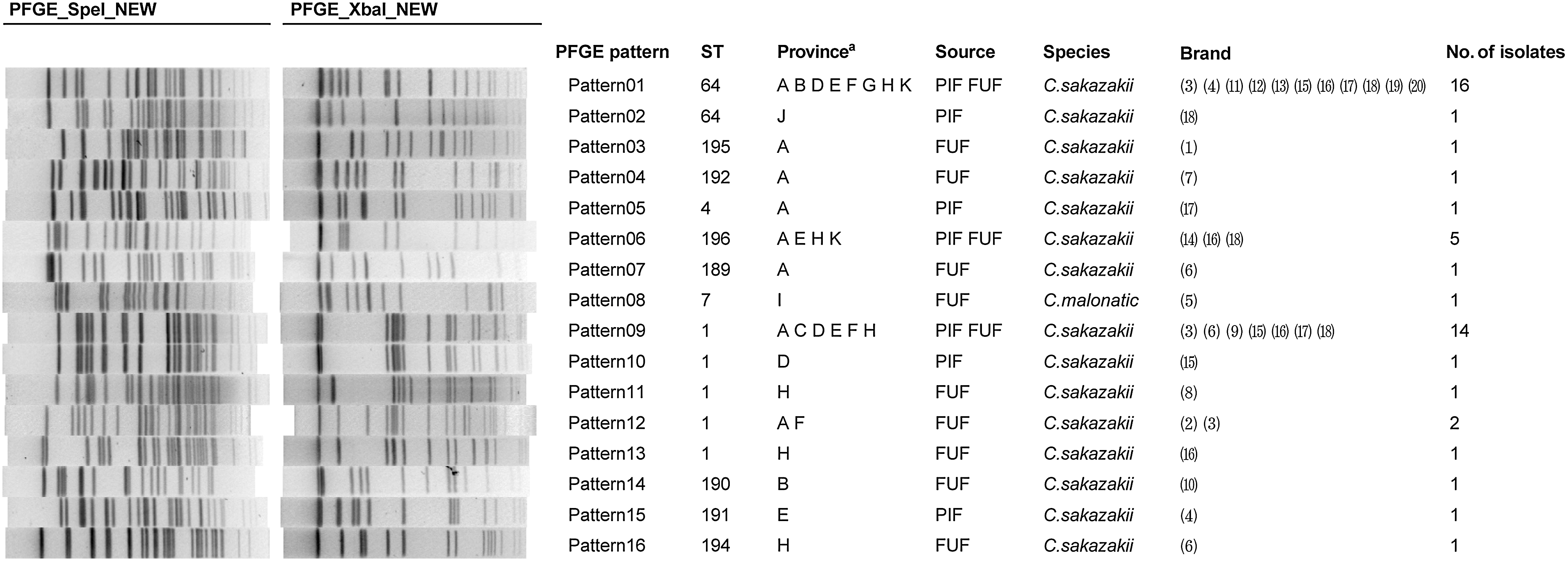
Pulsed-field gel electrophoresis (PFGE) patterns and multilocus sequence typing sequence types (ST) for the Cronobacter isolates. aA, Guangdong; B, Jiangxi; C, Tianjin; D, Hebei; E, Heilongjiang; F, Zhejiang; G, Fujian; H, Shandong; I, Shanxi; J, Hubei; K, Neimenggu.
Analyses of the MLST produced 11 STs. PFGE Pattern01 and 02 belonged to ST64, which was produced by 17 strains isolated from samples from 11 different brands in 9 provinces. Also, PFGE Pattern09 to Pattern13 belong to ST1, which was produced by 19 strains isolated from samples from 9 different brands in 6 provinces. All ST196 were PFGE Pattern06. The remaining STs were from single isolates, each with their own unique PFGE pattern. In addition, it is notable that ST189, ST190, ST191, ST192, ST194, ST195, and ST196 were newly discovered STs.
Discussion
Cronobacter spp. infection is mainly associated with the contamination of PIF. In addition, because FUF is one of the major food sources for infants, the contamination of FUF with Cronobacter spp. can also pose potential health hazards. In this study, Cronobacter spp. were detected in 11.5% of Chinese PIF samples and 12.8% of Chinese FUF samples; these rates are generally higher than the rates at which Cronobacter spp. were detected by investigations conducted in other countries. In particular, published studies have detected Cronobacter spp. in 0.7% in UK (Chap et al., 2009), 13.3% in Jordan (Shaker et al., 2007), and 6.0% in Korea (Kim et al., 2011) of FUF samples and in 14.2% in The Netherlands (Muytjens et al., 1988), 6.7% in Canada (White and Farber, 1997), and 0.24% in the United Kingdom (Iversen et al., 2004) of PIF samples. Neonatal Cronobacter-confirmed infections based on data published between 2000 and 2008 were analyzed. The overall lethality of the 67 invasive infections was 26.9%. And the lethality of Cronobacter meningitis, bacteremia, and NEC was calculated to be 41.9% (p<0.0001), <10%, and 19.0% (p<0.05), respectively (Friedemann, 2009). Although no such data have been reported in China, the findings of the current study suggest that the contamination of PIF and FUF by Cronobacter spp. is a serious problem.
Susceptibility tests revealed that the isolated strains were susceptible to most antibiotics. The highest resistance rate (10.2%) was observed for cefotaxime; in addition, 26 isolates were susceptible to all 14 of the antibiotics tested in this study. Cronobacter spp. had high antimicrobial susceptibility in some other studies. The isolated Cronobacter spp. from commercial PIF samples in Argentina and Bangladesh, respectively, were susceptible to all the tested antibiotics (Terragno et al., 2009; Hoque et al., 2010). In the combined results of molecular typing experiments of the current study, although there was only a minimal difference between the banding patterns of Pattern10 and Pattern09 in the PFGE assay, the Pattern10 strains were resistant to ceftazidime and ampicillin/sulbactam, whereas the Pattern09 strains were susceptible to both antibiotics. Moreover, none of the strains with ST64 exhibited resistance to the tested antibiotics.
PFGE is widely used in studies of the outbreak of infections caused by various pathogens; notably, PFGE has generated particularly good results in traceability studies. MLST focuses on changes in pathogen housekeeping genes. Analytical software is employed to compare MLST data with international databases of pathogen molecular types, and the consequent accumulation of reproducible MLST results allows for the global sharing and exchange of data. Since PFGE is difficult to standardize and do interlaboratory comparisons, both PFGE and MLST, rather than either in isolation, would be much better. In this study, the use of PFGE for the molecular typing of Cronobacter spp. isolates produced 16 PFGE banding patterns, and the use of MLST for molecular typing produced 11 STs, including 7 novel STs. PFGE analyses exhibited greater capability to differentiate among strains than the MLST analyses. Comparisons of the MLST data from this study with international MLST databases revealed that ST1, ST4, ST7, and ST64 have been reported in numerous international studies. Thus, the major MLST types obtained for the Cronobacter spp. isolates examined in this study were consistent with international epidemic strains. In addition, certain researchers believe that Cronobacter spp. with ST4 is associated with neonatal meningitis (Hariri et al., 2013). Although only 1 out of the 49 isolates obtained in this study was ST4, the study results nonetheless suggested that Cronobacter spp. contamination of Chinese PIFs poses a pathogenic risk. As the database increases, so does epidemiological understanding of the relationships between STs and disease potential. The molecular typing results of this study revealed that although certain strains with the same PFGE banding pattern and ST were obtained from the same brand of product, other strains with the same ST and PFGE banding pattern were isolated from different brands or provinces of product. In addition, strains isolated from the same brand and province could exhibit different PFGE banding patterns and STs. Considering that contamination was not restricted to a particular manufacturer but seemed reasonably widespread, detection of this contaminant may have policy implications for the whole industry.
There are two main sources of Cronobacter spp. contamination. First, the contamination of PIF and/or FUF could occur during the manufacturing process, such as through the use of contaminated machinery and equipment. In this study, certain strains isolated from the same brand exhibited the same PFGE banding pattern and ST, suggesting the possibility of contamination during the manufacturing process. Second, the contamination of PIF and/or FUF could occur through the addition of contaminated materials. The use of a high-temperature sterilization process during the early stages of manufacturing PIF and FUF can effectively eliminate Cronobacter spp. at this step of PIF and FUF production. However, nutrient addition and optimization occurs during subsequent stages of PIF and FUF production, increasing the risk of product contamination. These late-stage additives include starchy substances, vitamins, and minerals. Sterilization methods for these additives cannot completely eliminate Cronobacter spp.; therefore, product contamination is likely to occur during the later stages of product manufacture (Mullane et al., 2007). However, certain strains isolated from products from the same brand and province exhibited different PFGE banding patterns and STs, suggesting that the examined products may have been subjected to multiple sources of contamination. In particular, FUF is primarily utilized to feed infants who are 6 months of age or older; thus, to improve the nutritional value and diversity of FUFs, these products will include various additives, such as powdered milk, meat, and vegetables. These materials are potential sources of Cronobacter spp. contamination (FAO/WHO, 2006; Kim et al., 2008; Schmid et al., 2009; Molloy et al., 2009; Healy et al., 2010), complicating efforts to identify the specific source of this contamination. In addition, using hazard analysis and critical control point to guide sampling, further studies could have the opportunity to identify sources of contamination and critical control points with utilization of detection and molecular typing.
Conclusion
This study focused on examining Cronobacter spp. contamination in commercial Chinese PIFs and FUFs. PFGE and MLST assays were utilized for the molecular typing of the isolated strains, and susceptibility of these strains was described by susceptibility testing. The study results revealed relatively high isolation rates of Cronobacter spp. from commercial PIF and FUF samples in China. The isolated strains were mainly C. sakazakii. Susceptibility testing demonstrated that the isolates were highly susceptible to most antibiotics. The use of PFGE and MLST for the molecular typing of Cronobacter spp. produced good polymorphism. Our results suggest that more effective control strategies against Cronobacter spp. contamination should be developed during the PIF and FUF manufacturing process. Moreover, further studies are also needed to evaluate the burden of disease caused by Cronobacter spp. in China.
Footnotes
Acknowledgments
This study was supported by the National Science and Technology Key Project, China (No. 2012ZX10004-215).
Disclosure Statement
No competing financial interests exist.