




Abstract
Atmospheric pressure plasma (APP) is an emerging nonthermal microbial inactivation technique. In this study, agar and raw chicken breast were inoculated with Escherichia coli and treated with an APP jet based on cold arc plasma. The aim of this study was to investigate the optimum conditions for the plasma treatment of an APP jet in order to maximize the efficiency of E. coli inactivation. The combination of N2+O2 (10 standard cubic centimeters per minute) and a longer treatment time (10 min) resulted in the highest inactivation of E. coli on agar plates with an optimum treatment distance of 20 mm. The samples in dry and wet conditions showed similar reductions in E. coli count when one side of the samples was treated at a given treatment time. Treating both sides—2.5 min on each side—resulted in a higher growth inhibition of E. coli than treatment of a single side only for 5 min. However, there was no significant difference between one-side treated samples (10 min) and both-sides treated samples (5+5 min). When the concentration of E. coli in the chicken breast sample was 104 colony-forming units (CFU)/g, the reduction rate of the E. coli was the highest, followed by 105, 106, and 107 CFU/g; however, no difference was found between 103 and 104 CFU/g. In conclusion, various treatment conditions may affect the inactivation efficiency of E. coli. In the present study, the optimum condition was determined as the treatment distance of 20 mm and longer treatment time (10 min) with the addition of oxygen to the nitrogen gas flow. Furthermore, the cell concentration of sample was an important parameter for the efficacy of the inactivation process.
Introduction
C
In several countries, the application of physical or chemical decontamination treatments to poultry carcasses is permitted after slaughtering and prior to or during the chilling stage, thus combining their separate antimicrobial effects. Chemical decontamination techniques such as organic acids, phosphates, or chlorine-based solution, among others, have proved effective in reducing the microbial load of chicken meat stored at low temperatures (Loretz et al., 2010). The problem unfortunately is not only restricted with chlorine and surviving bacteria, but also residues and antimicrobial resistance of the bacteria. Thus, current European regulations on meat hygiene do not allow any treatment other than portable water or steam (Alonso-Hernando et al., 2013). Therefore, successful elimination of bacteria from raw poultry products is challenging.
Atmospheric pressure plasma (APP) is an emerging nonthermal microbial inactivation technique. APP is an ionized gas, which consists of different antimicrobial substances, including charged particles, ultraviolet (UV) photons, and reactive species (Moisan et al., 2002; Deng et al., 2006; Misra et al., 2011). There are different types of APP with their own characteristics (Dirks et al., 2012). APP jet is used because of its stable discharge, low gas temperature, and high concentrations of reactive species (Schutze et al., 1998; Walsh et al., 2006). Highly reactive species can overcome natural defense mechanisms, resulting in damage to DNA, proteins, lipids, and membranes (Kim et al., 2013). The ability of APP to reduce foodborne pathogens on the surface of products has been examined, and it has been revealed that APP has bactericidal, virucidal, and fungicidal properties (Deng et al., 2006; Lee et al., 2006; Moreau et al., 2008; Fernández et al., 2012). Therefore, the generation and utilization of plasma may be competitive due to its simplicity and cost-effectiveness compared to other microbial inactivation methods (Kim et al., 2013). Lee et al. (2011, 2012) reported that L. monocytogenes inoculated onto slices of cooked chicken breast, ham, and cooked egg white and yolk was efficiently reduced by an APP jet. Similar results were observed in chicken meat and skin inoculated with L. innocua and exposed to an APP jet (Noriega et al., 2011).
Most of these previous studies were, however, limited in their ability to confirm the inactivation of microorganisms by APP. Experimental conditions, including plasma physics (gas composition, flow rate, input power, and type of discharge) and molecular microbiology (gram negative or positive, bacteria or fungi, and cell concentration of microorganism), may influence the inactivation efficiency of APP treatment (Deng et al., 2006; Fernández and Thompson, 2011; Fernández et al., 2013). A recent study suggests that the bacterial growth phase and growth temperature play a minor role in the inactivation of Salmonella Typhimurium by APP jet with nitrogen (Fernández et al., 2012). It is thus important to find the best plasma conditions for its optimum inactivation efficiency.
The main objective of the present study was to investigate the optimum conditions to maximize E. coli inactivation efficiency, including distance of the sample from the plasma jet, gas composition, humidity of the sample, and the microbial cell concentration. The inactivation effect of plasma treatment on both sides of the samples was also studied for its use in practical situations.
Materials and Methods
Sample preparation and sterilization
Raw chicken breasts with the skins still on were purchased from a local market in Daejeon, Korea. Prior to the inoculation, the samples were sterilized using electron-beam irradiation (35 kGy) with a 2.5 MeV linear electron beam radiofrequency accelerator (EB-Tech, Daejeon, Korea). To confirm the target dose, alanine dosimeters attached to the top and bottom surfaces of the sample pack were read using a 104 Electron Paramagnetic Resonance unit (EMS-104; Bruker Instruments Inc., Billerica, MA). The calculated maximum/minimum dose ratio was less than 1.004 for all the samples. Tryptic soy agar plates (50×10 mm; Difco, Becton Dickinson, Sparks, MD) were also prepared.
Microorganisms and inoculation
E. coli (KCTC 1682, serotype, serogroup O6, from clinical source) was obtained from the Korean Collection for Type Culture (KCTC, Daejeon, Korea). E. coli was cultivated in tryptic soy broth (Difco) at 37°C for 48 h. The culture was then centrifuged (3000×g for 10 min at 4°C) using a refrigerated centrifuge (UNION 32R, Hanil Science Industrial Co., Ltd., Korea). The resulting pellet was washed twice with sterile saline (0.85%) solution and suspended in the same saline solution to achieve a viable cell density of 106 colony-forming units (CFU)/mL. The skin on the chicken breast was peeled off using a sterilized knife. The agar plates and the skin side of the raw chicken breast (15×15×5 mm) were inoculated with 25 and 50 μL of this solution and were spread, respectively. After that, a half of each chicken breast was kept at room temperature on a clean bench for 60 min (dry state). The other half of each chicken breast was kept for 5 min (wet state) under the same conditions and immediately treated with plasma for comparisons with the former. In order to see the difference of microbial concentration, different dilutions, which ranged from 103 to 107 CFU/mL, with saline solution were prepared and 50 μL of each solution was inoculated onto skin-off chicken breast, and then spread.
Treatment with APP jets
The APP jet device used in this study was based on a cold arc plasma with a cylindrical powered electrode with a sharpened tip, while the diameter of the emit hole was 1.5 mm. This electrode was covered with a grounded metal cathode nozzle with a cooling system (Fig. 1). The samples were treated at 50 W, and N2 (99.9%) with total 6 standard liters per minute was used to discharge the plasma. The gas composition was changed by adding 10 standard cubic centimeters per minute (sccm) of O2, and the distance between the sample and the APP jet was tested to obtain the optimum conditions for the initial microbial inactivation efficiency. Once the optimum treatment distance and gas composition were determined, the chicken breast sample was treated at a distance of 20 mm with a N2+O2 in gas combination. Chicken breast at dry or wet state was treated for 5 or 10 min. The samples at dry state were divided into two groups, one-side or both-side treatments. A sterilized pincette was used to invert the chicken breast after treatment on one side was completed, in order to expose both sides to the plasma treatment. The inoculated chicken breast with different concentrations of E. coli was treated by the plasma jet for 5 min.
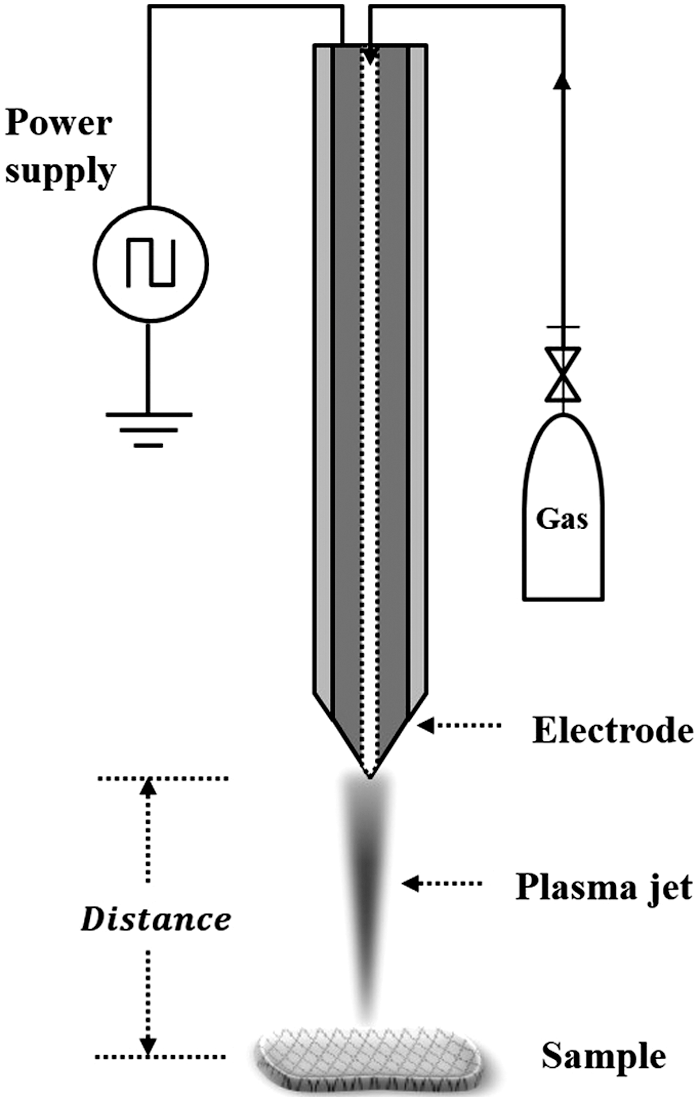
Schematic diagram of the experimental setup of the atmospheric pressure plasma jet.
The visible emission spectrum of the APP jet was obtained through spectrometers (MAYA2000 Pro) with the relevant optical setups (Kim et al., 2013).
Microbial analysis
Immediately after plasma treatment, each chicken breast (2.5 g) was homogenized with 22.5 mL of sterile saline (0.85%) solution. The solution was then serially diluted in sterile saline, and each diluent (0.1 mL) was spread onto tryptic soy agar (Difco). The plates were incubated at 37°C for 48 h, and microbial counts were expressed as log CFU/g or log CFU/mL.
Statistical analysis
All experiments were conducted with three replicates, and the data were analyzed using one-way analysis of variance. Significant differences among mean values were identified using Student-Newman-Keul's multiple-range test with SAS software (SAS, Release 9.2, SAS Institute Inc., Cary, NC) using a confidence level of p<0.05.
Results and Discussion
Table 1 shows the inactivation of E. coli on agar plates following APP treatments. The combination of N2+O2 (10 sccm) and the longer treatment time (10 min) resulted in the highest inactivation of E. coli on the agar plate when treated at an optimum distance of 20 mm.
Means±standard error (n=3).
Different letters within same column differ significantly (p<0.05).
Different letters within same row differ significantly (p<0.05).
Gas flow rate: 6 L/minute for N2; 10 standard cubic centimeters per minute of O2 was added for N2+O2.
Reactive species are formed depending on the gas composition, and it has been reported that adding O2 promotes the formation of reactive oxygen species (ROS) in the plasma, which plays the most important role in the inactivation of microorganisms among the various reactive species (Deng et al., 2006; Lee et al., 2006; Lee et al., 2012). As shown in Figure 2, the reactive O I, OH, and NO emissions were enhanced in the gas treatment by combination of N2+O2. ROS are dominant biocidal agents capable of accessing and directly attacking the cell wall (Lee et al., 2006; Machala et al., 2010). Lee et al. (2006) and Jung et al. (2010) observed morphological changes in E. coli, yeast, and Bacillus subtilis spores when they were exposed to cold plasma producing ROS as a main cause of inactivation. Enhancing the production of ROS seems to be more effective in causing inactivation, although this is not a simple task (Deng et al., 2006). The addition of a certain amount of oxygen in the background gas increased the effect of the plasma compared with the addition of more or less oxygen (Philip et al., 2002). Gweon et al. (2009) also demonstrated that a specific level of O2 increased the plasma inactivation effect. This level was 1% when combined with He. Liu et al. (2008) reported that oxygen radicals can produce lipid oxidation byproducts including hexanal and malondialdehyde. However, there were no significant differences on the pH levels and lipid oxidation values of bacon and cooked egg white after APP treatment with different gas compositions (He or He+O2) (Kim et al., 2011; Lee et al., 2012). Cooked egg white also shows no significant differences in sensory evaluation among gas compositions. However, cooked egg yolk showed significantly lower scores in odor and overall acceptability when O2 was added (Lee et al., 2012).
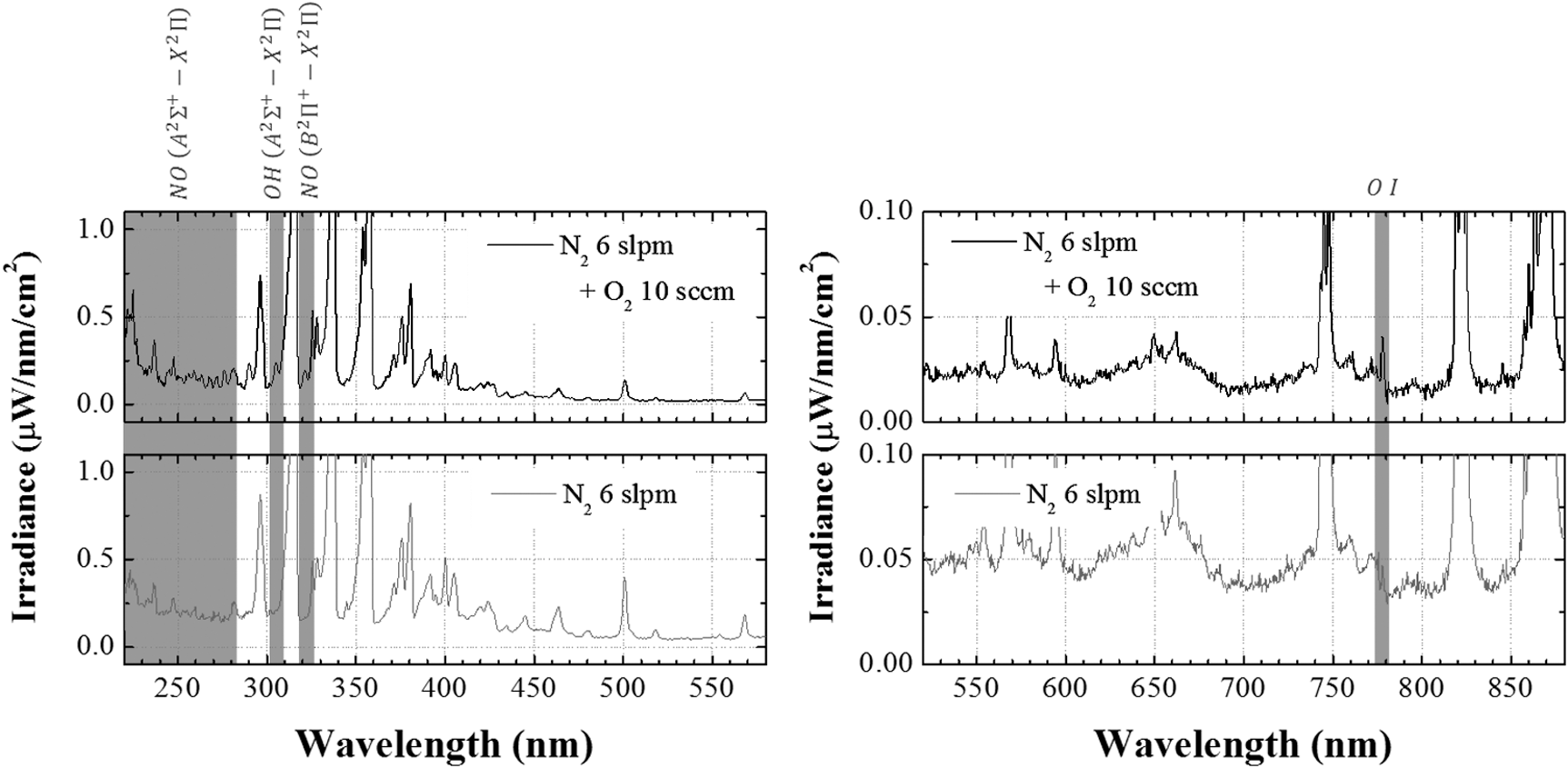
Emission spectrum of the atmospheric pressure plasma jet with and without oxygen addition in gas flow. slpm, standard liters per minute; sccm, standard cubic centimers per minute.
In principle, plasma inactivation is caused by charged particles, reactive species, UV photons, and heat (Feng et al., 2009). However, recently, UV photons have been reported to play a negligible role in APP (Deng et al., 2006; Machala et al., 2010; Maisch et al., 2012) and, in the present experiment, heat was not a possible inactivation factor because the gas temperature was near room temperature. The gas temperature here denotes the temperature of heavy particles in the plasma that is the average kinetic energy of the gas molecules in the treatment region. Charged particles and reactive species are formed in different locations (Deng et al., 2006). The effect of the charged particles is thought to be negligible due to their short collision mean free paths, meaning significant drop of the charged particle density even just a few millimeters away from the plasma region (Fridman et al., 2007). On the other hand, the chemically reactive radicals such as ROS or reactive nitrogen species can have a much longer mean free path. When comparing the reduced numbers of E. coli at 10- and 20-mm treatment distances as shown in Table 1, it may be suggested that the radicals have a greater inactivation capability than the charged particles. A distance of 30 mm seems too far for plasma inactivation. Using jet-type plasma, Fernández et al. (2012) observed that charged particles did not play a major role in the inactivation of Salmonella. Regardless of the decreased UV intensity and charged particle density due to the increased distance between the almond and jet plasma, a remote position was better for inactivating E. coli O157:H7 and Salmonella compared to a closer position (Niemira, 2012). Inoculated raw chicken meat and skin demonstrated that the effect of plasma is sensitive to distance between the samples and the plasma source (Noriega et al., 2011). In accordance with the results of Table 1, the remaining experiments were conducted with the combination of N2+O2 (10 sccm) at a treatment distance of 20 mm.
The inactivation of E. coli on chicken breasts by APP jet is shown in Table 2. The condition of meat, wet or dry, had no significant effect on the inactivation of E. coli when one side of the samples was treated at a given treatment time. Similarly, there was no significant difference in the plasma inactivation of L. innocua, regardless of the moisture state of the chicken breast skins (Noriega et al., 2011), which was consistent with the present results. However, several other authors proposed that moisture condition affects plasma results (Noriega et al., 2011; Dirks et al., 2012; Fernández et al., 2012; Rød et al., 2012). For instance, Dirks et al. (2012) observed that dielectric barrier discharge plasma was more effective on a further moistened surface of chicken than other samples. In contrast, the plasma inactivation of L. innocua increased in samples with low moisture content, maintained in a sealed container (Rød et al., 2012). Table 2 further shows that the reduction of E. coli increased with a higher plasma exposure time, irrespective of the condition of meat with one-side treatment.
Means±standard error (n=3).
Different letters within the column differ significantly (p<0.05).
Dry, plasma treatment after staying for 1 h after inoculation; wet, plasma treatment right after inoculation.
2.5+2.5, both-sides treatment by 2.5 min each; 5+5, both-sides treatment by 5 min each; others: one-side treatment time.
This study is the first attempt to investigate the microbial inactivating effect of plasma when treatment is applied to both sides of the sample. The treatment for 2.5 min on each side resulted in a higher growth inhibition of E. coli (reduction of 1.44 log CFU/g) compared to the treatment on a single side for 5 min (reduction 1.14 log CFU/g). However, there was no significant difference between treating a single side for 10 min or both sides for 5+5 min. It has previously been noticed, in experiments using electron-beam irradiation, that both sides of a sample need to be treated during sterilization to overcome its low permeability (Scharf et al., 1999; Kang et al., 2012). Zhang et al. (1998) showed a double-sided arc plasma. However, this technique was used for welding and not for bacterial inactivation. In this experiment, the microbial inactivating potential of plasma through the treatment of both sides of samples has been proposed. However, plasma treatment on both sides of the sample for 5+5 min did not result in doubling the efficacy compared with a single-side treatment for 5 min. This may be because the inactivation effect of plasma does not follow a linear reduction over time (Lee et al., 2006; Noriega et al., 2011; Fernández et al., 2012; Lee et al., 2012).
Table 3 shows the inactivation of E. coli in chicken breast at different cell concentrations after the treatment of both sides with an APP jet for 5 min. The chicken breast inoculated with E. coli in concentrations of 105–107 presented significantly lower log reductions than the cell concentrations 103 and 104.
Means±standard error (n=3).
Different letters within the column differ significantly (p<0.05).
Each side of the samples was treated for 5 min.
CFU, colony-forming units.
Several previous studies reported the relationship between initial concentration of microorganism and inactivation efficiency of plasma (Lee et al., 2006; Fernández and Thompson, 2011; Dirks et al., 2012; Fernández et al., 2013). Dirks et al. (2012) proposed that a subpopulation of the organism was resistant to the treatment: A dielectric barrier discharge plasma treatment of raw chicken inoculated with different cell concentrations of Campylobacter jejuni resulted in a protective effect at the higher densities of the pathogens. Fridman et al. (2007) and Fernández et al. (2012) showed that increasing the pathogen concentration resulted in a reduction in the efficiency of inactivation by APP, which is in agreement with the findings of the present study. Fernández et al. (2011) proposed that multilayered cellular structures can be made when cell densities are high. In this structure, the upper layers have an effect on those beneath. In case of Lee et al. (2006), however, microbial inactivation of Bacillus spores by APP did not depend on the initial cell concentration.
In general, E. coli detected in chicken is 2 log, which is lower than the concentration of E. coli used in this study (Jang et al., 2008; Kim et al., 2009). In this respect, it is expected to be more effective in real-life practice. In addition, it may be suggested that the early stages of contaminated products are better for APP inactivation, because low cell concentrations of E. coli were greatly reduced by the APP jet.
Conclusions
Various APP jet parameters affect the inactivation efficiency of E. coli in raw chicken breasts. In the present study, the optimum condition was determined as the treatment distance of 20 mm and longer treatment time (10 min) with the addition of oxygen to the nitrogen gas flow. Furthermore, the cell concentration of sample was an important parameter for the efficacy of the inactivation process.
Footnotes
Acknowledgments
This work was carried out with the support of “Cooperative Research Program for Agriculture Science & Technology Development (Project No. PJ0092212013),” Rural Development Administration, Republic of Korea.
Disclosure Statement
No competing financial interests exist.