




Abstract
The foodborne illnesses associated with poultry meat due to Salmonella are a major concern in the United States. In this study, the antimicrobial efficacy of carvacrol, eugenol, thyme essential oil, and trans-cinnamaldehyde was determined against different Salmonella serotypes in vitro and on turkey breast cutlets. Minimum inhibitory concentration (MIC) and minimum bactericidal concentration (MBC) of antimicrobial agents were determined using a microdilution colorimetric assay. Carvacrol was the most effective antimicrobial agent since it exhibited the lowest MIC and MBC (0.313 μL/mL, respectively) in culture media against Salmonella. Turkey breast cutlets inoculated with Salmonella Enteritidis, Salmonella Heidelberg, and Salmonella Typhimurium were dip treated with different concentrations (0.5, 1, 2, and 5% vol/vol) of carvacrol, eugenol, thyme essential oil, and trans-cinnamaldehyde for 2 min. Samples were analyzed after 24-h storage at 4°C for recovery of Salmonella. Significant reductions of Salmonella (p≤0.05) on turkey breast cutlets were obtained with 1, 2, and 5% treatments. These compounds exhibited a concentration-dependent response on turkey breast cutlets against Salmonella. For example, 1% carvacrol resulted in 1.0 log colony-forming units (CFU)/g reduction of Salmonella whereas 5% carvacrol caused 2.6 log CFU/g reduction. Based on its efficacy in the 2-min dip study, carvacrol was selected for 30-s and 60-s dip treatments of Salmonella-inoculated turkey breast cutlets. Dipping turkey breast cutlets in 5% carvacrol for 30 s and 60 s resulted in 1.0 and 1.8 log reductions of Salmonella (p≤0.05), respectively. None of the antimicrobial agents caused any changes in the meat pH (p>0.05). In conclusion, this study revealed that plant-derived compounds such as carvacrol can reduce Salmonella on turkey breast cutlets without changing the pH of meat.
Introduction
I
Plant-derived essential oils such as oregano, cinnamon, clove, and thyme are generally recognized as safe
Materials and Methods
Salmonella serotypes
Five Salmonella serotypes were used to study the in vitro antimicrobial efficacy of carvacrol, eugenol, thyme essential oil, and trans-cinnamaldehyde. The Salmonella serotypes included in the study were Salmonella Enteritiditis ATCC 4931, Salmonella Hadar ATCC 51956, Salmonella Heidelberg ATCC 8326, Salmonella Kentucky ATCC 9263, and Salmonella Typhimurium (ATCC 14028, 19585, and 23564).
Plant-derived natural compounds
Carvacrol (≥98%), trans-cinnamaldehyde (≥99%), and eugenol (99%) were purchased from Sigma Aldrich (St. Louis, MO.). Thyme essential oils (red and white, 100% pure) were obtained from Aura cacia (Frontier Natural Products Co-op., Norway, IA).
Disc-diffusion assay for determining the antimicrobial efficacy of plant-derived compounds against Salmonella spp.
The antimicrobial agents were screened for activity against five serotypes of Salmonella using a disc-diffusion assay as described by O'Bryan et al. (2008). Briefly, a 16-h culture of Salmonella in trypticase soy broth (TSB) (Thermo Fischer Scientific, Remel Inc., Lenexa, KS) was prepared and adjusted the inoculum to approximate colony-forming units per milliliter with 0.1% peptone water. The inoculum was streaked onto trypticase soy agar (Thermo Fischer Scientific) plates using sterile swabs separate for each serotype and kept at least 15 min at room temperature to absorb the inoculum. Then 6-mm sterile filter paper discs were placed at the center of each plate and 20 μL of the antimicrobial agent was applied on top of the disc. The zone of inhibition was measured in millimeters after 24-h incubation at 37°C. Antimicrobial agents were classified as not sensitive, least sensitive, moderately sensitive, highly sensitive, or extremely sensitive based on the zones of inhibition of <10, 11–30, 31–60, 61–80, and >80 mm, respectively (Desai et al., 2012). Each antimicrobial agent was tested in triplicate against each Salmonella serotype, and the whole experiment was repeated three times.
Determination of MIC and MBC of plant-derived antimicrobials against Salmonella spp.
MIC and MBC of each antimicrobial agent were determined against individual Salmonella serotypes with 96-well microtiter plates using a colorimetric broth microdilution technique (Burt and Reinders, 2003). A volume of 200 μL of 1% (vol/vol) of the plant-derived antimicrobial agent in Muller-Hinton Broth (MHB; Oxoid Ltd., Hampshire, England) was added into the first well in row A as an initial concentration. Then 100 μL of sterile MHB was added in all other wells from rows B to H. The antimicrobial agent was then diluted twofold from the first well of rows A to H and discarding the excess from row H. After dilution of the antimicrobial agents, 100 μL of inoculum (approximately colony-forming units per milliliter) was added into each well followed by 20 μL of Alamar Blue dye. Positive (100 μL MHB+100 μL inoculum+20 μL dye; but no antimicrobial agent) and negative (200 μL antimicrobial agent +20 μL dye; but no inoculum) controls were also maintained. A color change of the wells from blue to pink after 24-h incubation at 37°C indicated bacterial growth. MIC was read as the highest dilution of the antimicrobial agent, which maintained a blue color in the first well of a row. For determination of MBC, from the wells showing blue color after the incubation at 37°C for 24 h, the aliquots of 100 μL were plated onto Muller-Hinton Agar (MHA; Oxoid Ltd., Hampshire, England) plates and incubated for 24 h at 37°C. The highest dilution (lowest concentration) of the antimicrobial agent showing no bacterial growth (no visible colonies) on MHA plates after 24-h incubation at 37°C was considered the MBC of that compound. Three replicates of each microassay were carried out and the experiment was carried out twice.
Efficacy of plant-based antimicrobials as dip treatments against Salmonella spp. on turkey breast cutlets
Inoculum preparation
Broth cultures (18–20 h) of Salmonella Enteritiditis, Salmonella Heidelberg, and Salmonella Typhimurium in TSB were prepared by transferring fresh colonies from each serotype to 10 mL of TSB and incubated for 18–24 h at 37°C. Broth cultures were centrifuged separately at 3300× g for 10 min at 4°C. Pellets were washed and resuspended in 10 mL of sterile 0.1% peptone water for each serotype, and a cocktail was prepared by mixing an equal volume for each serotype. The inoculum level was adjusted to approximately colony-forming units per milliliter by transferring 1 mL of cocktail into 9 mL of 0.1% peptone water.
Antimicrobial treatments
A volume of 100 μL of the inoculum was applied at different locations on the surface of 25-g pieces of turkey breast cutlets and spread uniformly to achieve a final concentration of approximate colony-forming units per gram of meat. Salmonella-inoculated turkey cutlets were kept for 30 min at room temperature in a biosafety cabinet for bacterial attachment. Different concentrations (0.5, 1, 2, and 5% vol/vol) of the antimicrobial agents (carvacrol, trans-cinnamaldehyde, eugenol, and red thyme oil) were prepared in phosphate buffered saline (PBS) and homogenized as described by Moore et al. (2012). Turkey breast cutlets were submerged in these solutions for a 2-min dip treatment. Salmonella-inoculated turkey breast cutlets that were dipped in PBS for 2 min were used as positive control and noninoculated, untreated fresh turkey breast cutlets were the negative control. After the dip treatment, samples were stored aerobically in sterile sampling bags (Nasco whirl pack, ID# BO1239, Universal Medical Inc., Norwood, MA) for 24 h at 4°C. The antimicrobial agent that showed maximum activity in the 2-min dip treatment was then selected for further dip treatments at 30 and 60 s.
Microbiological analysis
Sample homogenates were prepared by stomaching the 25-g meat sample with 225 mL of 0.1% peptone water in a stomacher (Stomacher® 400 circular, Seward Laboratory Systems Inc., Davie, FL) at 200 rpm for 2 min and used to recover Salmonella cells. A volume of 100 μL of sample homogenates was plated onto xylose lysine tergitol-4 agar (XLT4) (Becton Dickinson, Sparks, MD) after serial 10-fold dilutions. Bacterial enumerations were carried out after the incubation of XLT4 plates under aerobic conditions at 37°C for 24 h. However, the recovery of sublethally injured Salmonella cells due to the application of antimicrobial agents may not be possible with XLT4. Therefore, Salmonella recovered in this study using XLT4 agar are noninjured survivors. Three replications were conducted with duplicate samples for each treatment within each individual experiment.
Determination of pH of the meat
The meat pH was determined as described by Sharma et al. (2013). The pH of the turkey cutlets (both treated and control samples) was measured using a pH meter (Accumet® AB15 basic pH meter; Fisher Scientific, Pittsburgh, PA). The pH probes were placed into the sample homogenates prepared as described above and recorded the pH on each day of microbial analysis.
Sensory evaluation
Sensory evaluation was conducted with trained panelists (n=8) to determine the difference in aroma of carvacrol (5% vol/vol) treated cooked and raw turkey breast cutlets from that of control samples (Desai et al., 2012). The test samples were prepared by dipping cutlets in 5% carvacrol for 30 s or 60 s. Sterile water-dipped (30 s or 60 s) cutlets were used as controls. Raw test samples were served directly to the panelists without cooking along with labeled and blind controls after cutting it into 2.5-cm cubes. Cooked samples were prepared by heating carvacrol-treated and control samples to an internal temperature of 71°C. The samples were then wrapped in aluminum foil, stored for 15 min at 20°C, and then served to panelists along with blind and labeled controls. Two sets of samples were given to a panelist at a time. The first set contained only labeled controls and the second set contained blind controls and treatments that were identified by randomly assigned three-digit codes. The panelists were provided a score sheet and asked to compare the aroma of the blind control and treatment samples to the aroma of the control using the following scale: 0=No difference, 1=Slight difference, 2=Moderate difference, 3=Large difference, 4=Very large difference.
Statistical analysis
Disc diffusion assay was repeated three times with triplicate plates for each treatment. For MIC and MBC assay, three replicates of each microassay were carried out and the experiment was carried out twice. Turkey breast cutlets challenge studies were repeated three times with two replicates. Analysis of variance tests were performed using the proc general linear model (proc GLM) procedure of SAS 9.3 version (SAS Institute, Cary, NC) (SAS, 2012). The treatment means were separated using the least significant difference test. The treatments were found to be significantly different compared to control when p≤0.05.
Results and Discussion
In vitro antimicrobial efficacy of carvacrol, eugenol, thyme essential oil, and trans-cinnamaldehyde
In this study, Salmonella serotypes were highly sensitive to thyme (red and white) essential oils, moderately sensitive to carvacrol and trans-cinnamaldehyde, and least sensitive to eugenol (Table 1). Earlier disc-diffusion assay studies also indicated that these compounds possessed in vitro antibacterial activity against spoilage organisms (Zheng et al., 2013) and pathogenic organisms (Burt and Reinders, 2003; Desai et al., 2012). In the present study, carvacrol was found to be the most effective antimicrobial agent with the lowest MIC and MBC of 0.313 μL/mL. The MIC and MBC values of antimicrobial agents were in the following order: carvacrol<red thyme oil<white thyme oil<trans-cinnamaldehyde<eugenol (Table 2). For each antimicrobial agent, with the exception of white thyme oil, the MIC and MBC values against different serotypes of Salmonella spp. remained the same throughout the experiment. The MIC and MBC values obtained did not follow the same pattern as that of the results of the zones of inhibition of antimicrobial agents. This may be due to the difference in the solubility and diffusion of the antimicrobial agents onto the medium while conducting the disc diffusion assay (Jiang, 2011). The red thyme oil was selected from the two different thyme oils for dip treatments on turkey breast cutlets, since red thyme oil possessed lower MIC and MBC values compared to white thyme oil.
Antimicrobial agents were evaluated as not sensitive, least sensitive, moderately sensitive, highly sensitive, and extremely sensitive with zone of inhibitions of <10 mm, 11–30 mm, 31–60 mm, 61–80 mm, and >80 mm, respectively (Desai et al., 2012).
Within a column, treatments lacking common superscript differ (p≤0.05).
Within a column, treatments lacking common superscript differ (p≤0.05).
Soni et al. (2013) evaluated the MIC and MBC of thyme oil and carvacrol against Salmonella Typhimurium and reported that the two antimicrobial agents possessed 0.25 μL/mL as MIC and MBC against tested serotypes. In the current study, higher MIC and MBC were obtained for antimicrobials against Salmonella serotypes, and these values were different (p≤0.05) for carvacrol and thyme oils. The results may vary according to the differences in the methods used for conducting the study, nonuniformity in the concentration of the antimicrobial agent, inoculum level tested, and incubation time (Burt, 2004).
Antimicrobial efficacy of plant-based compounds against Salmonella spp. as 2-min dip treatments on turkey breast cutlets
In this study, all of the antimicrobials that were tested at 1, 2, and 5% (vol/vol) concentrations resulted in reductions of Salmonella (p≤0.05) on turkey breast cutlets (Fig. 1). Carvacrol showed maximum reduction of Salmonella in 2-min dip treatments. Carvacrol at 1, 2, and 5% concentrations led to 1, 1.7, and 2.6 log CFU/g reductions of Salmonella (p≤0.05) on turkey breast cutlets as compared to the positive control. Trans-cinnamaldehyde and red thyme essential oil at concentrations of 1, 2, and 5% resulted in 0.9, 0.9, and 2.3 log CFU/g as well as 0.4, 0.5, and 1.0 log CFU/g reductions of Salmonella respectively. Eugenol treatments led to 0.7, 1.1, and 1.0 log CFU/g reductions of Salmonella with 1, 2, and 5% concentrations.
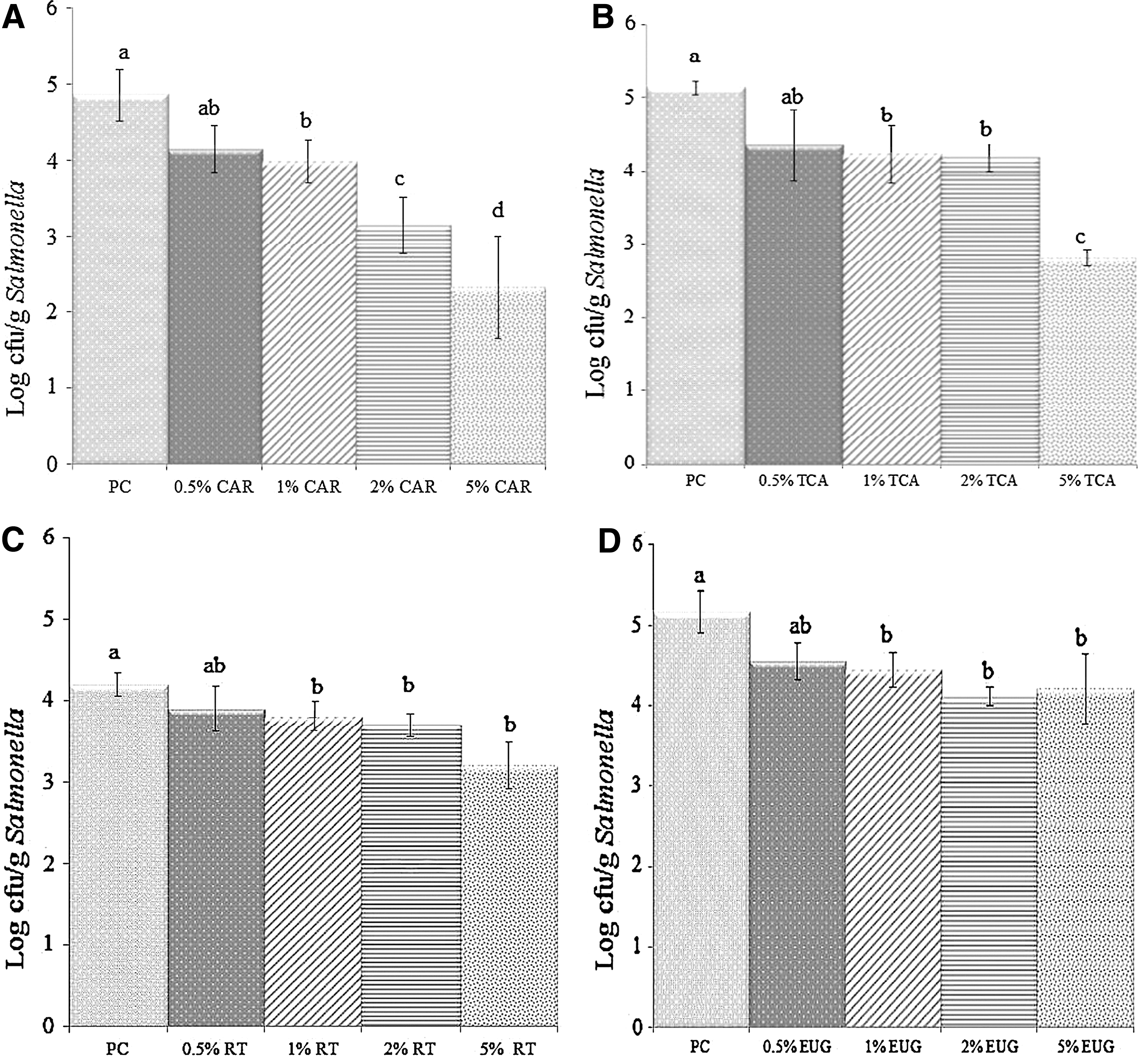
Effect of 2-min dip treatments of carvacrol (CAR)
Moore et al. (2012) reported that 0.5% oregano oil as a dip treatment for 2 min on leafy green vegetables inoculated with Salmonella Newport led to 6 log CFU/g reduction after 24-h storage at 4°C. A study by Mattson et al. (2011) revealed that when carvacrol (0.25 and 0.75%), trans-cinnamaldehyde (0.5 and 0.75%), and eugenol (0.75%) were used as wash treatments of Salmonella-inoculated tomatoes for 1 min, there was a∽6 log CFU/mL reduction of Salmonella. In the present study, up to 5% concentration of the antimicrobial agents were used to get the desired effect in spite of their lower MIC and MBC values, since meat is a complex matrix and reduces the availability and activity of antimicrobial agents, which necessitates the use of more than 10 times the concentration that was found to be effective in in vitro studies (Burt, 2004). Desai et al. (2012) reported that a 30-min dip treatment of carvacrol on catfish fillets was effective against Listeria monocytogenes at 4°C, simulating the conditions of a chiller tank in catfish processing. The treatments resulted in a dose-dependent activity, and carvacrol was more effective than thymol. These observations corroborate the findings of our study, where a dose-dependent reduction of Salmonella was observed with carvacrol, trans-cinnamaldehyde, thyme oil, and eugenol for 2-min dip treatments.
Effect of 30-s and 60-s dip treatments of carvacrol against Salmonella spp. on turkey breast cutlets
To determine the effect of reduced dipping, turkey breast cutlets were dipped for 30 s and 60 s in 0.5, 1, 2, and 5% carvacrol (vol/vol). Carvacrol was selected for 30-s and 60-s dip treatments, since it had the lowest MIC and MBC values and had a higher activity in the 2-min dip treatment of cutlets when compared to other antimicrobials. There was no difference between the positive control and 0.5, 1, or 2% carvacrol treatments on Salmonella counts (p>0.05) with 30-s dip treatments. The 5% carvacrol concentration resulted in 1.0 log CFU/g reduction of Salmonella (p≤0.05) when compared to the positive control after the 30-s dipping time (Fig. 2A). Similarly, the 60-s dipping of turkey breast cutlets in 0.5, 1, and 2% carvacrol did not result in a significant reduction of Salmonella. However, 5% carvacrol resulted in a 1.8 log CFU/g reduction of Salmonella (p≤0.05) (Fig. 2B). The natural contamination levels of Salmonella in postchill carcasses have been reported as fewer than 2.0 log CFU/g (Nagel et al., 2013; Oladunjoye et al., 2013). Therefore, if a 1.0 or 2.0 log reduction can be achieved, 90–99% of Salmonella present in the meat will be killed. In this study, 30- and 60-s dip treatments with 5% carvacrol resulted in 1.0 and 1.8 log CFU/g reduction of Salmonella, which could result in elimination of >90% of Salmonella on the meat.
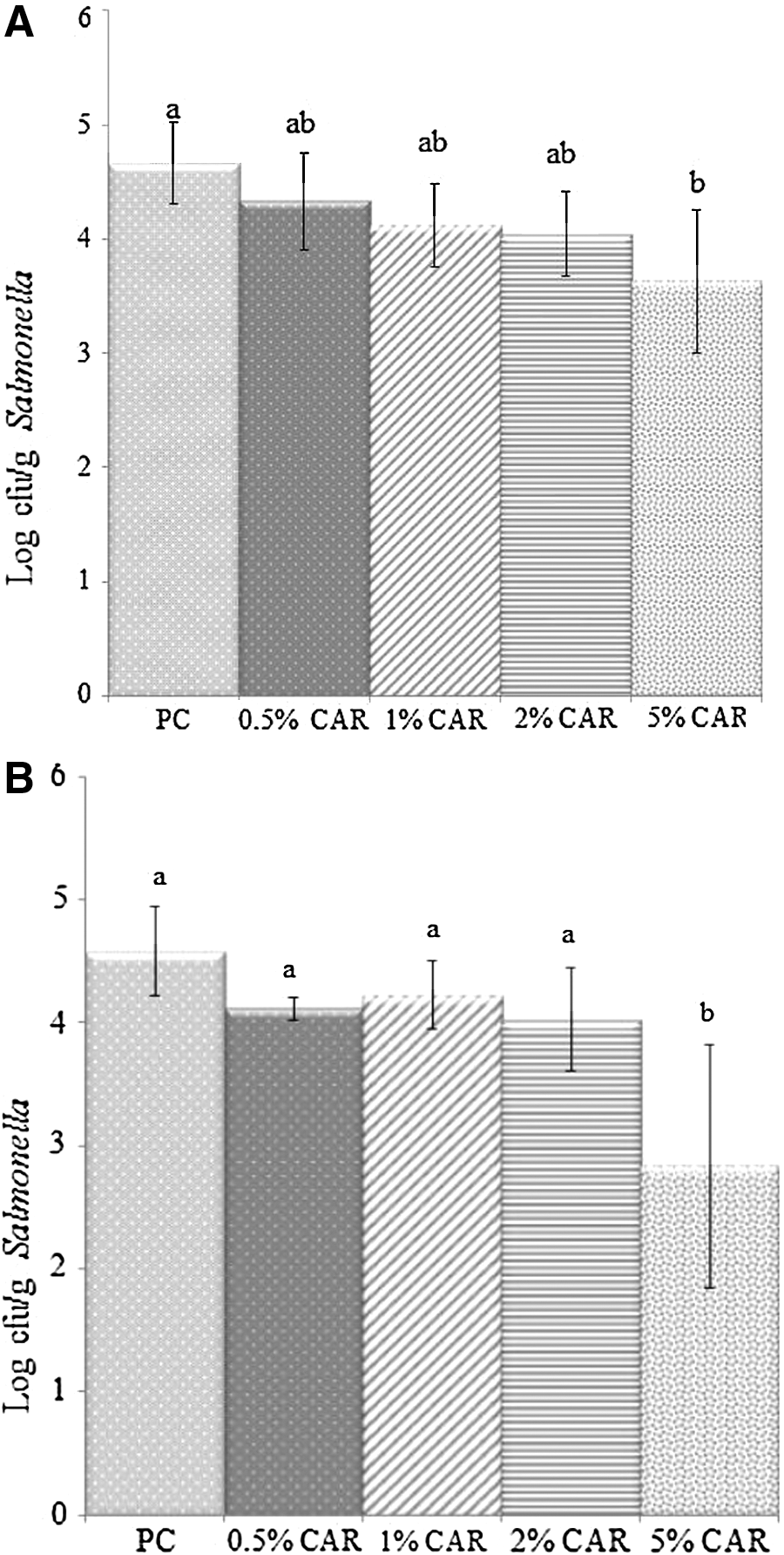
Effect of 30-s
Oladunjoye et al. (2013) evaluated the antimicrobial efficacy of carvacrol against Salmonella spp. on ground turkey with different fat percentages and reported that 1% carvacrol in propylene glycol (50:50 vol/vol) was sufficient for the complete elimination of Salmonella from an initial concentration of 5.4 log CFU/g in ground turkey with 1% fat. Carvacrol (5%) eliminated Salmonella in ground turkey with 7% fat and reduced Salmonella by∽4 log CFU/g reduction in ground turkey with 15% fat, respectively. The reduced activity of carvacrol at a higher fat percentage may be due to the dissolution of carvacrol in the lipid phase of the meat and subsequent diminished contact with the bacteria that is present in the water phase (Burt, 2004). Upadhyaya et al. (2013) used carvacrol, eugenol, and trans-cinnamaldehyde (0.25, 0.5, and 0.75%) as topical washings on Salmonella inoculated eggs at 32°C. Carvacrol was effective in reducing Salmonella from an initial inoculum of 106 CFU/ mL to nondetectable levels with a contact time of 30 s. In the present study, carvacrol also showed activity against Salmonella in 2-min, 30-s, and 60-s dip treatments. It can be summarized that carvacrol could potentially be an effective antimicrobial against Salmonella when used as dip treatment during poultry processing.
Determination of pH of the meat
Meat pH is related to functional properties of meat proteins (Chan et al., 2011b; Sharma et al., 2013). Low pH negatively affects the texture of final products and high pH results in reduced shelf life and color defects (Chan et al., 2011a). Therefore, any change in meat pH due to antimicrobial interventions is undesirable. There were no differences in pH (p>0.05) between turkey breast cutlets treated with plant-derived compounds and untreated samples (Table 3).
Sensory evaluation
The sensory evaluation results (Table 4) revealed that there was a difference (p≤0.05) in the aroma of turkey breast cutlets dipped in carvacrol as compared to the cutlets dipped in sterile distilled water for both cooked and raw samples. Therefore, future research will be focused on reducing the effective concentration of carvacrol in the meat system using different combinations of plant-derived compounds.
Within a column, treatments lacking common superscript differ (p≤0.05).
Conclusions
The current study revealed the sensitivity of different Salmonella serotypes to the plant-derived compounds. Carvacrol was the most effective antimicrobial agent with the lowest MIC and MBC and was effective in reducing Salmonella on turkey breast cutlets with a concentration as low as 1% with a 2-min dip treatment. Carvacrol also demonstrated a dose-dependent reduction of Salmonella on turkey breast cutlets and resulted in a significant reduction of Salmonella even with a lower amount of contact time (30 s or 60 s) at a 5% concentration.
Footnotes
Acknowledgments
The funding for this research was supported by a Special Research Initiative award by Mississippi Agricultural and Forestry Experiment Station (MAFES).
Disclosure Statement
No competing financial interests exist.