




Abstract
The objective of this work was to evaluate the survival of a Brucella abortus aqpX mutant during the elaboration and conservation of fresh and ripened cheeses at 4°C and 24°C. The pH values and water activity were monitored for each type of cheese. The fresh cheese was elaborated with raw milk inoculated with 6×10⁸ colony-forming units (CFU)/mL each of parental and mutant strain. Ripening cheeses were elaborated with both raw and pasteurized milk and inoculated with 12×108 CFU/mL each of parental and mutant strains. In fresh cheese, survival was observed during elaboration and conservation for 7 days at 4°C in mutant and parental strains. The number of survivors of the mutant strain was 10 times lower compared with the parental strain at pH 5 and a w of 0.930. In the cheese elaborated with raw milk and ripened at 24°C, both strains survived until day 17 at pH 4.0 and a w of 0.89. However, when the cheese was elaborated with pasteurized milk, the parental strain survived until day 31 of ripening, and the mutant strain survived 24 days at pH 4 and a w of 0.886. The survival of the mutant strain showed a diminution of one logarithm during elaboration and ripening of cheese as compared with the parental strain. When the cheese was elaborated with raw milk and ripened at 4°C, survival of the parental strain was 24 days, whereas the mutant strain survived only 17 days (pH 5 and a w 0.90). Regarding the cheese elaborated with pasteurized milk and maturated at 4°C, both strains survived 31 days (pH 5 and a w 0.90), with the same survival diminution during elaboration and ripening. Our results show that in both types of cheese, the mutated aqpX strain survived 10 times less than the parental strain, which shows that the aqpX gene can be related to the survival of Brucella abortus in this type of cheese.
Introduction
B
The availability of water is a factor affecting the development and survival of microorganisms because it allows for the maintenance of turgidity and the avoidance of cellular damage. In this regard, some microorganisms possess intramembrane proteins that form water-selective channels, which constitute a more efficient water transport system (Calamita et al., 1995, 1998). These selective channels, known as aquaporins, have been identified in a large variety of organisms, including animals, plants, fungi, and bacteria (Carbrey et al., 2001; Tanghe et al., 2006; Akai et al., 2012). Brucella possesses constitutive mechanisms of osmoregulation determined by the presence of aquaporins, which are proteins related to water transport, which allow bacteria to adapt to pH or intracellular osmolarity variations (Rodríguez et al., 2000). Previous studies demonstrated that the expression of the aqpX gene increases in hyperosmolarity conditions (Hernández-Castro et al., 2003). Several factors influence the survival of Brucella in cheeses including the temperature, acidity, salinity, and water activity (a w ) or microbial charge (Bourgeois and Larpent, 1995). The objective of this study was to assess the survival of the B. abortus 2308 and B. abortus aqpX null mutant during the elaboration of fresh and ripened cheeses manufactured with raw and pasteurized milk under two different temperatures (4°C and 24°C).
Materials and Methods
Bacterial strains and growth conditions
Brucella abortus 2308 and B. abortus aqpX::lacZ-Km null mutant (Hernández-Castro et al., 2003) were grown at 37°C in Brucella broth (Oxoid, Hampshire, England), with orbital shaking, to the midexponential phase, and the aliquots were frozen at −80°C in Brucella broth–30% glycerol. For each experiment, a log-phase bacterial culture was prepared in 5 mL of Brucella broth for 20 h at 37°C with agitation. The bacterial numbers were determined by comparing the optical density at 600 nm with the standard curve and by retrospective counts (Comerci et al., 2001). When necessary, 50 μg/mL of kanamycin and 10 μg/mL of nalidixic acid were added. The experiments involving live Brucella were performed in a type III biosafety laboratory.
Determination of Brucella in cheese and cheese whey
The isolation and identification of B. abortus 2308 and the B. abortus aqpX::lacZ-Km null mutant were performed by standard microbiology procedures (Alton et al., 1975). On the sampling days, cheese (10 g) or whey (10 mL) were sampled under aseptic conditions and transferred to a sterile container, and 90 mL of a phosphate-buffered solution was added before maceration. Serial dilutions (10−1–10−8) were performed and plated onto Farrell medium (Oxoid). Finally, the plates were incubated at 37°C for 3 days.
Elaboration of the cheese samples
The fresh and ripened cheeses were elaborated using raw or pasteurized cow's milk from a brucellosis-free herd. When necessary, raw milk was pasteurized using the high temperature/short time method. A total of 250 mL of raw milk was used for the elaboration of the 3 fresh cheeses; 500 mL of raw milk was used for the elaboration of the ripened cheese, which was divided into 2 cheese groups; the first group of 3 cheeses was ripened at 4°C, and the second group of 3 cheeses was ripened at 24°C. Additionally, 500 mL of pasteurized milk was used for the elaboration of the ripened cheese, which was divided into 2 cheese groups, as mentioned above. For the survival determinations, serial dilutions were made and plated in triplicate on Farrell agar. The plates were incubated at 37°C for 3 days followed by counting of the colony-forming units (CFU)/mL. The fresh and ripened cheeses were elaborated according to the method described by Scholz (1997), briefly described below.
Elaboration and conservation of the fresh cheese
The raw milk used to prepare the fresh cheese was inoculated at the beginning of the 2-h temperate stage with 6×10⁸ CFU/mL each of B. abortus 2308 and B. abortus aqpX::lacZ-Km. Coagulating enzymes were added, with stirring for 2 h. The sample cheese was cut and left to rest for 10 min and then placed on perforated aluminum molds to drip the whey for 18 h at room temperature. The finished cheese was conserved at 4°C for 7 days; the survival, pH, and a w were monitored in all the stages.
Cheese ripened at 4°C and 24°C elaborated with pasteurized or raw milk
The ripened cheese was elaborated with pasteurized or raw milk. The milk was inoculated during the temperate stage with 12×108 CFU/mL each of B. abortus 2308 or B. abortus aqpX-lacZ-Km. The manufacture of the ripened cheeses was divided into 9 stages, as follows: (1) temperate stage at 24°C for 30 min; (2) the addition of commercial Lactococcus lactis subsp. lactis and Lactococcus cremoris starter cultures, and incubation for 24 h at room temperature; (3) cutting of the curd for 30 min; (4) draining of the whey for 18 h; (5) immersion in brine for 30 min; (6) ripening for 10 days; (7) ripening for 17 days; (8) ripening for 24 days; and (9) ripening for 31 days postinoculation. The cheeses were ripened at 4°C and 24°C. The survival, pH, and a w were determined during these stages. The cheeses were elaborated in three independent experiments.
Determination of pH and aw
The pH was determined at each stage of the elaboration, conservation, and ripening processes for each type of cheese in an Orion Benchtop pH/temp meter 410a (Thermo, Beverly, MA). The available water in the milk and in the cheeses at each stage of elaboration, conservation, and ripening was measured in a Rotronic a w Quick (Rotronic AG, Bassersdorf, Switzerland).
Statistical analysis
The data were analyzed with analysis of variance and subjected to Pearson's correlation test using SPSS, version 12, software. The statistical significance was set at p<0.05. The data were plotted with Graph Pad Prism 5.
Results
Survival in fresh cheeses
After 2 h of incubation in milk, the viable counts of B. abortus 2308 and the mutant strain were 3×10⁷ and 6×10⁶ CFU/mL, respectively. The viable count for both strains retained this 10-fold difference during the elaboration and conservation process. The results showed that both strains survived for >7 days at 4°C with a load of 3×10⁴ CFU/mL for B. abortus 2308 and 2×10³ CFU/mL for the aqpX mutant at the end of the experiment (Fig. 1A).
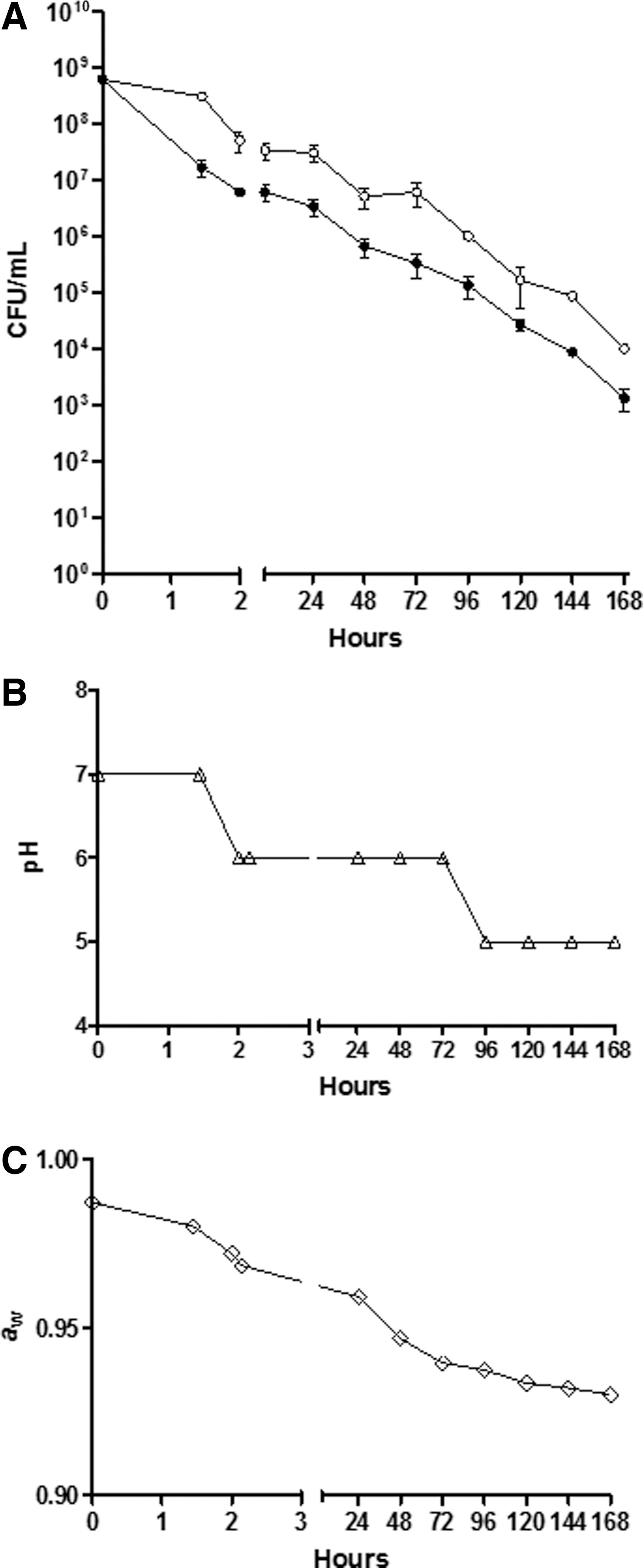
Brucella abortus 2308 and B. abortus aqpX mutant survival determinations during fresh cheese manufacture using raw milk at 4°C.
The pH in the cheeses had the following two descents during the experiment: first, during the curding stage and then at 5 days of conservation (Fig. 1A). In regard to the a w value, with an initial value of 0.98, a value of 0.959 in the finished cheese (24 h) and of 0.930 on day 7 were shown (Fig. 1C). The statistical analysis revealed significant differences (p<0.05) in the viable numbers of the Brucella strains during the elaboration and conservation stages of fresh cheeses. It was shown that the pH and a w value had no influence (p>0.05) on the survival of any of the strains despite the observed changes.
Survival of Brucella in the ripened cheeses elaborated with raw milk
The survival pattern of the 2 strains showed a significant difference (p<0.05), up to one logarithm, during the process of the elaboration and conservation of cheese at 24°C. B. abortus 2308 yielded a count of 7×10³ CFU/mL at day 17 of ripening that later disappeared completely. For B. abortus aqpX::lacZ-Km survival, the count was 3×10² CFU/mL for the identical period of ripening (Fig. 2A) until complete disappearance at a later time.
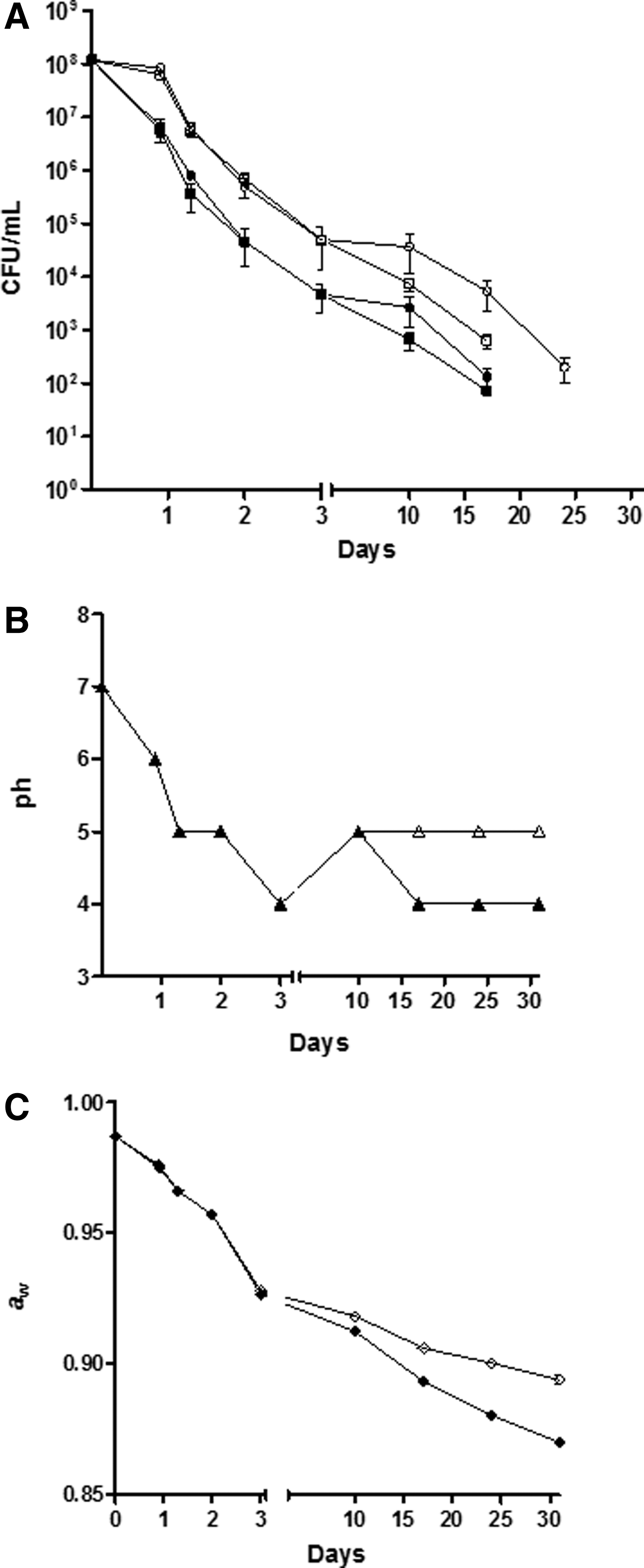
Brucella abortus 2308 and B. abortus aqpX mutant survival determinations during ripening cheese manufacture using raw milk at 4°C and 24°C.
Similarly, the cheese ripened at 4°C showed a significant difference (p<0.05) 10 times lower during the elaboration and ripening processes. At this lowest temperature, B. abortus 2308 survived for 24 d of ripening with a count of 6×10² CFU/mL, whereas B. abortus aqpX::lacZ-Km survived for 17 days of ripening with a count of 4×10² CFU/mL (Fig. 2A). Additionally, the ripening temperatures (4°C and 24°C) had a statistically significant correlation with the survival of both strains (p<0.01).
Effect of pH and aw on the survival of strains in cheeses ripened at 4°C and 24°C and elaborated with raw milk
The pH values of ripened cheeses were identical at the 2 ripening temperatures for 10 d of ripening. However, pH variations were observed in the ripening stages without a difference between the strains. The pH of the milk used for the elaboration of cheeses was 7.0 and, at both temperatures, the value diminished progressively until reaching the brine stage at pH 4; afterwards, an increase to pH 5 was observed in both temperatures. In cheese ripening at 4°C, the pH remained constant at the end of ripening, whereas during ripening at 24°C, the pH value decreased to 4 and was maintained until the end of ripening (Fig. 2B). The pH was not statistically significant; however, a positive correlation was observed between survival and the pH (p<0.01).
The a w value in the milk (0.987) decreased slightly in the first elaboration stages at both temperatures; however, in the brine stage, the a w value diminished to 0.920. In the cheeses ripened at 4°C, an a w value of 0.906 was found on day 17; however, in the cheeses ripened at 24°C, a diminution was observed (0.89) (Fig. 2C). At the end of ripening, the a w value at 4°C was 0.89, and the value was 0.87 at 24°C. Statistically significant differences (p<0.04) were observed between the a w value and the survival of the strains exposed to different ripening temperatures.
Survival of the strains in cheeses elaborated with pasteurized milk and ripened at 24°C and 4°C
During the elaboration process of the cheese ripened at 24°C, 10-fold differences were observed between the 2 strains; however, in the ripening stage, the B. abortus 2308 strain survived until 31 d at a concentration of 2×10² CFU/mL, unlike the mutant strain, which survived until d 24 of ripening at a concentration of 3×10² CFU/mL (Fig. 3A). In the cheeses ripened at 4°C, the 2 strains survived until d 31 of ripening, with counts of 2×10⁴ CFU/mL and 5×10³ CFU/mL for B. abortus 2308 and the mutant strain, respectively (Fig. 3A). A statistically significant correlation was observed between B. abortus 2308 and the mutant strain survival at 4°C and B. abortus 2308 and the mutant strain survival at 24°C (p<0.02).
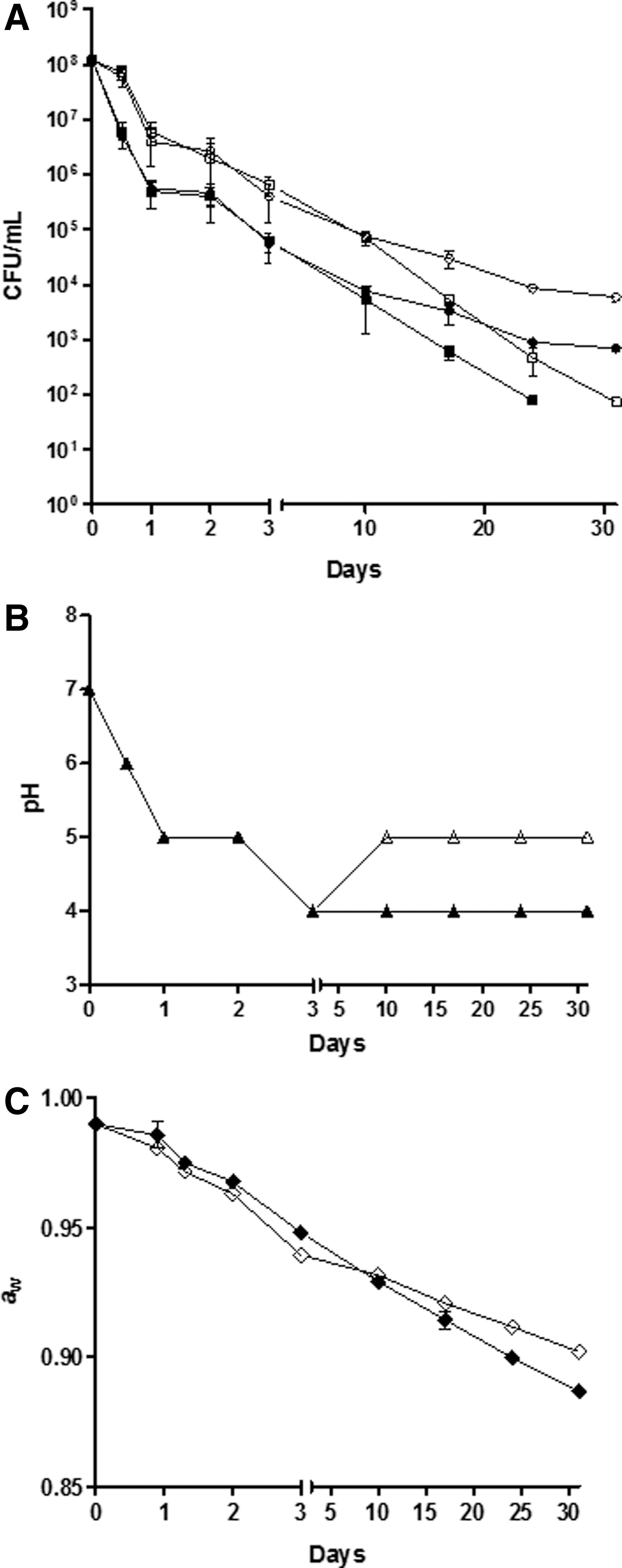
Brucella abortus 2308 and B. abortus aqpX mutant survival determinations during ripening cheese manufacture using pasteurized milk at 4°C and 24°C.
Effect of pH and aw on the survival of the strains in the cheeses ripened at 4°C and 24°C elaborated with pasteurized milk
The pH values in the cheeses ripened at 4°C and 24°C were identical for both strains until 24 d of ripening. The initial pH of 7.0 decreased progressively to pH 4 in the brine; in the cheeses ripened at 4°C, the pH increased to 5 and was maintained until the end of ripening, whereas at 24°C, a pH of 4 was maintained until 31 days (Fig. 3B). The pH effect was not statistically significant among the temperatures. In addition, the a w value was slightly diminished during the initial elaboration stages. The a w values found in the ripened cheeses were similar for both temperatures until the brine stage (0.94/4°C and 0.93/24°C). In the cheeses ripened at 4°C, an a w value of 0.90 was observed until 31 d. However, in the cheeses ripened at 24°C, the value of a w decreased to 0.88 until 31 d (Fig. 3C). Statistically significant differences (p<0.03) were observed between the a w value and the survival of the strains exposed to different ripening temperatures.
Survival in cheese whey
The determination of survival in the whey of the fresh cheeses rendered a count of 3×10⁷ CFU/mL for B. abortus 2308 and 4×10⁶ CFU/mL for the mutant strain. In addition, both strains displayed pH and a w values of 6 and of 0.97, respectively.
In the whey of the ripened cheeses elaborated with raw milk, B. abortus 2308 presented a survival of 3×10⁵, whereas survival of the mutant strain was 2×10⁴, with a pH value of 5 and a w value of 0.90. In the cheeses elaborated with pasteurized milk, a count of 4×10⁶ CFU/mL was detected for B. abortus 2308, whereas that for the mutant strain was 7×10⁵ CFU/mL, and in this case the pH and a w value were 5 and 0.93, respectively. The data displayed significant differences (p<0.05) between the a w value and strain survival in the whey of ripened cheeses.
Discussion
Brucella spp. could survive for long periods in dust, dung, water, slurries, soil, and dairy products. The survival periods depend on many variables including temperature, sunlight, and the number of bacteria as well as the pH and presence of bacterial microflora or microbial contaminants (WHO, 2006). The objective of this research was to evaluate the survival of B. abortus aqpX mutant during the elaboration and conservation of fresh and ripened cheeses at 4°C and 24°C. In this study, we have shown that the mutation of the aqpX gene in B. abortus diminished survival in fresh and ripened cheeses. In the fresh cheeses kept at 4°C, the absence of the gene generated a decrease of one logarithm in the CFU/mL count with respect to the parental strain, which was attributed to the mutation effect and not to the a w value or pH level, because the identical values of a w (0.930) and pH (5.0) were observed for both strains during the 7 days of evaluation (Fig. 1). It has been reported that, in food, Brucella and Escherichia coli are able to survive with an a w value lower than 0.89 (Montville and Mathews, 2011).
Brucella could adapt to pH variations during the elaboration of dairy products (El-Daher et al., 1990; Zuñiga-Estrada et al., 2005), most likely through osmoprotective mechanisms, in which aquaporins could be involved. The survival of B. abortus detected in this study is similar to that reported in “soft white” cheese elaborated with raw milk inoculated with B. abortus or B. melitensis and stored at 5°C, in which the bacterium survived up to 21 d (Díaz-Cinco et al., 1998, 2000). In a related study, B. melitensis was recovered even from fresh cheeses conserved at 4°C after 8 wk of elaboration (Abdallah et al., 2007).
Plommet et al. (1988) reported the reduction of the survival of Brucella spp. in cheese manufacturing, with B. abortus being detected for 30 d in ripened cheeses elaborated with raw milk from cows and conserved at 8°C (Plommet et al., 1988). In that work, B. melitensis was able to survive in cheeses elaborated with goat milk ripened at 4°C for 50 d at pH 5 and a w of 0.90. (Méndez-González et al., 2011) reported that the bacterium is able to survive 20 d in conditions of a w of 0.89 and pH 4 during the ripening process at 24°C. In our study, we observed that in cheeses elaborated with raw cow milk and ripened at 4°C, B. abortus 2308 survived for 24 d in conditions of a w of 0.90 and pH 5, and the mutant strain was only detected on d 17 at the same pH and a w of 0.907. It was detected that ripening at 24°C in an acidic pH (4) and a w 0.895 inhibited the survival of both strains beyond 17 d (Fig. 2A). The influence of a w on survival is more evident at 24°C than at a lower temperature and long ripening periods; the higher survival observed at 4°C coincides with the relatively high values of pH and a w. It has been proposed that at pH 4, the persistence of the bacterium is not affected when a w is higher than 0.90 (Shadbolt et al., 2001; Zúñiga-Estrada et al., 2005). Reduced a w is used to control microbial growth in foods. Microorganisms generally have optimum and minimum levels of a w for growth, and in some cases small differences determine reduced bacterial loads (Chirife and Buera, 1996). The reported differences in survival might be attributed to the a w values, time, and temperature of ripening in addition to the mutation effect.
In the ripened cheeses, we identified a diminution of one logarithm in the CFU/mL count between the mutant and the parental strain during all the stages of cheese elaboration and ripening. The mutant strain was not able to compensate for and adapt in the identical manner as the parental strain to the conditions of osmotic stress because of the lack of the aqpX gene, which allows adaptation to osmotic and pH changes. Hence, the survival of mutants that lack these proteins could be affected in dairy products. No reported studies have evaluated the association of any gene with the survival of Brucella in milk or cheese. Recently, Palacios-Chaves et al. (2012) reported on the cyclopropane fatty acid synthase mutant of B. abortus. The mutant was evaluated under high osmolarity and acidic pH, which are conditions similar to those observed in contaminated materials and fomites; the observation of their reduced ability to grow or survive suggested that the gene is associated with the extracellular life of Brucella.
Milk pasteurization was an additional survival factor for ripening at 4°C because it allowed a greater recovery of bacteria of both strains, which could be attributed to the protection exerted by other microorganisms in this type of milk (Montville and Mathews, 2011). These results are in agreement with those of other studies reporting long survival times in ultrapasteurized milk (Falensky et al., 2011) and yogurt (Zuñiga-Estrada et al., 2005). We demonstrated that the null mutation of the aqpX gene affected the survival capacity of B. abortus during the elaboration, conservation, and ripening of fresh cheeses at different temperatures, using raw and pasteurized cow milk, as well as in the whey.
We detected the presence of both Brucella strains in the whey of cheeses, as well as during their elaboration, emphasizing the lower survival of the mutant strain, with up to one logarithm difference. Similarly, Méndez-González et al. (2011) reported the survival of B. melitensis in the whey of goat cheeses, which constitutes a byproduct risk in cheese-producing plants and for cattle feed. Our findings support the hypothesis that cheese produced according to traditional manufacturing practices using raw milk contaminated with Brucella could contain bacteria at levels capable of causing brucellosis by the time the cheese reaches the consumer (FDA, 2006). The isolation of Brucella from fresh and ripened cheese in this study confirms the potential health risk for urban and rural populations, which should be considered in the promotion of safer practices.
The presence of aqpX in B. abortus suggests that it could be involved in the osmoadaptation responses and the absence of the aqpX gene is a key element for bacteria survival in cheese, which is one of the main ways for the disease transmission in humans. The influence of a w and temperature (24°C) for long ripening periods determines Brucella elimination in cheese, even if the best method to eliminate Brucella in cheese is the use of previously pasteurized milk for its manufacture. Further work is necessary to determine whether the mutant strain is attenuated in macrophages or epithelial cells, as well as in the mouse model.
Footnotes
Disclosure Statement
No competing financial interests exist.