




Abstract
This study was undertaken to screen methicillin-resistant Staphylococcus aureus (MRSA) in animal carcasses and slaughterhouse workers and characterize MRSA isolates identified during 2010–2012 in Korea. A total of 830 (16.4%) S. aureus and 65 (1.3%) MRSA were isolated from 9669 carcass samples. MRSA was more frequently detected in chicken carcasses (1.2%) than in cattle (0.3%) and pig carcasses (0.6%). The prevalence of MRSA in workers was 6.9% (4/58) in chicken slaughterhouse workers, but no MRSA was detected in pig and cattle slaughterhouse workers (0/41). Two different lineages of MRSA were identified (i.e., human-associated type [ST5, ST59, and ST72] and livestock-associated [LA] type [ST398, ST541, and ST692]); only LA MRSA was observed in chicken carcasses, whereas both types were found in cattle and pig carcasses and workers. All human-associated MRSA isolates carried enterotoxin and/or leukotoxin genes, whereas LA MRSA types did not carry these genes, except ST692 type. However, all LA MRSA isolates were multiresistant, whereas human-associated types were susceptible or resistant to fewer than two antimicrobials except ST5. Furthermore, one or more resistance genes were attributed for resistance to aminoglycosides (aac(6′)-Ie-aph(2″), ant(4′)-Ia, and aph(3′)-IIIa), tetracycline [tet(K), tet(L), tet(M), and tet(S)], macrolide–lincosamide–streptogramin B (ermA, ermB, ermC, and ermT), lincosamide [lnu(B)], phenicol–lincosamide–oxazolidinone–pleuromutilin–streptogramin A (cfr), chloramphenicol (fexA), and fusidic acid [fus(C)]. To our knowledge, this is the first report of tet(S) gene in MRSA isolates and first detection of a unique (ST692) type of MRSA in occupational workers. Detection of new types of human-associated and LA MRSA with multiple resistance and virulence genes in food animal products constitutes a potential threat to public health.
Introduction
I
In addition, food-related MRSA infection has been reported from the United States (Jones et al., 2002) and the Netherlands (Verkade and Kluytmans, 2014). Several studies were performed to screen foods of animal origin intended for human consumption for the presence of MRSA and to investigate the characteristics of the MRSA isolates in many countries such as North American (Pu et al., 2009), European (de Boer et al., 2009), and Asian countries (Cui et al., 2009; Ogata et al., 2012; Boost et al., 2013b).
In Korea, previous studies identified MRSA in various animals and animal products, although the prevalence was low compared with the European countries. The major type of MRSA from animals and raw meats was ST72, a predominant type of CA (community-associated) MRSA in humans in Korea (Song et al., 2011). Furthermore, ST5 (Kwon et al., 2006) and ST692 (Lim et al., 2010) were also identified in chicken meats. Recently, our team reported LA type (ST398 and ST541) of MRSA from live pigs with relatively high prevalence compared to other samples in Korea (Lim et al., 2012). The high prevalence of MRSA in animals could increase the risk of transmission of MRSA from animals to animal products and humans. In spite of identification of MRSA in various animals and animal products, and the increased MRSA prevalence in animal carcasses in our monitoring studies recently, there is no information about MRSA occurrence in occupational workers. The aims of this study, therefore, were to screen the presence of MRSA in slaughterhouse workers and carcasses and to investigate their molecular types, virulence, and antimicrobial-resistance characteristics.
Materials and Methods
Sample collection
A total of 16 local veterinary service institutes nationwide participated in the collection of samples (except human samples) and isolation of S. aureus. They sent the S. aureus isolated from carcasses to Animal and Plant Quarantine Agency (QIA) two times (June and December) a year during 2010–2012. Antimicrobial susceptibility testing and characterization of the MRSA isolates were done at the QIA.
Carcass samples
In total, 9669 carcass samples (3396 cattle, 3613 pigs, and 2660 chickens) were collected from 30, 35, and 28 cattle, pig, and chicken slaughterhouses, respectively. Carcasses were sampled at the slaughter chilling room. A sterile gauze pad (10×10 cm) per carcass was used to swab an unlimited area of approximately 100 cm2 at each of the 3 sites: cattle and pig carcasses were swabbed on the back and chest, and chickens were swabbed on the whole carcasses. All swab gauzes were placed into Whirl-Pak bags (Becton Dickinson, Franklin Lakes, NJ) and transported in a cooler with ice packs to the laboratory for processing within 24 h.
Worker's nasal samples
In total, 99 nasal swab samples were collected from workers in 9 slaughterhouses from 6 provinces in Korea from 2011 to 2013: 41 samples from 5 cattle and pig slaughterhouses and 58 samples from 4 chicken slaughterhouses. Among them, 34 (82.9%) and 14 (24.1%) male and 7 (17.1%) and 44 (75.9%) female workers were sampled in pig plus cattle slaughterhouses and chicken slaughterhouses, respectively. Six to 22 workers per slaughterhouse were sampled. Nasal specimens were collected by inserting a sterile cotton-tip swab into both anterior nares of each person.
Isolation of S. aureus
All collected samples were placed in containers at 4°C and examined within 24 h. Carcass gauze swabs were homogenized with 50 mL of 1% buffered peptone water (Becton Dickinson). One milliliter of homogenized samples and nasal samples were inoculated into 9 mL Mueller Hinton broth (Becton Dickinson) supplemented with 6.5% NaCl and incubated overnight at 37°C. Pre-enriched 1-mL samples were inoculated into 9 mL of tryptic soy broth (Becton Dickinson) supplemented with cefoxitin (3.5 mg/L, Sigma-Aldrich, St. Louis, MO) and incubated overnight at 37°C. Then these cultured samples were streaked on the chromogenic MRSA agar (Oxoid, Hampshire, UK) and incubated overnight at 37°C. Up to five presumptive S. aureus colonies from each carcass and nasal sample were selected and subcultured on blood agar (KOMED, Sungnam, Korea). A multiplex PCR assay that amplifies 16S rRNA, clfA, and mecA genes was used to identify S. aureus and MRSA (Mason et al., 2001). Nasal swab samples from slaughterhouse workers were not examined for S. aureus detection but only for MRSA. One S. aureus or MRSA isolate per positive sample was subjected to further analysis.
Antimicrobial susceptibility testing
Antimicrobial susceptibility test was done by the broth-dilution method according to the Clinical and Laboratory Standards Institute (CLSI) guidelines (CLSI, 2010) and the European Committee on Antimicrobial Susceptibility Testing (EUCAST) criteria (EUCAST, 2012) with commercial antimicrobial-containing plates (Thermo Trek Diagnostics, Cleveland, OH). The antimicrobial agents tested were gentamicin, kanamycin, penicillin, cefoxitin, ciprofloxacin, vancomycin, erythromycin, linezolid, sulfamethoxazole, trimethoprim, chloramphenicol, quinupristin/dalfopristin, tetracycline, rifampin, fusidate, and clindamycin. Two standard strains (S. aureus ATCC 25923 and Escherichia coli ATCC 35218) were used as quality-control strains.
MLST, Spa, SCCmec typing, and PFGE
Multilocus sequence typing (MLST) was performed by amplifying internal fragments of seven genes (arcC, aroE, glpF, gmk, pta, tpi, and yqiL) of S. aureus as described previously (Enright et al., 2000). Sequenced genes by ABI prism 3100 analyzer (Genotech, Daejeon, Korea) were compared with the MLST website for S. aureus (
Detection of antimicrobial resistance, virulence, and host-specific genes
MRSA isolates were screened for antimicrobial resistance genes and virulence factors using PCR primers (Supplementary Table S1; Supplementary Data are available online at
Results
Prevalence of MRSA in carcasses and slaughterhouse workers
A total of 830 (16.4%) S. aureus and 65 (1.3%) MRSA were isolated from 9669 carcass samples taken from 30, 35, and 28 cattle, pig, and chicken slaughterhouses: 175 (5.2%) and 9 (5.1%) from cattle carcasses, 269 (7.4%) and 23 (8.6%) from pig carcasses, and 386 (14.5%) and 33 (8.5%) from chicken carcasses, respectively (Table 1). Of the 99 swabs collected from 91 workers and 8 veterinarians in 4 slaughterhouses, 4 (4.0%) were MRSA positive. The prevalence was different depending on the type of slaughterhouse with 6.9% (4/58) in chicken slaughterhouse workers and no detection in pig and cattle slaughterhouse workers (0/41).
A slaughterhouse was counted only once during the study period to avoid repetition.
% indicates the S. aureus isolates/no. of samples.
% indicates the MRSA isolates/no. of S. aureus.
% indicates the MRSA isolates/no. of samples.
Characterization of MRSA by MLST, spa, SCCmec, and PFGE
A total of 65 MRSA isolates from animal carcasses showed six ST types (ST5, ST59, ST72, ST398, ST541, and ST692), seven spa types (t002, t437, t324, t664, t034, t898, and t2247), and four SCCmec types (II, III, IV, and V) (Table 2). The distribution of STs and spa types varied according to the source: cattle carcasses and pig carcasses isolates belonged to ST5-t002-II (n=6), ST5-t002-IV (n=6), ST59-t437-V (n=1), ST72-t324-IV (n=6), ST72-t664-IV (n=2), ST398-t034-V (n=3), ST541-t034-V (n=6), and ST541-t898-V (n=2), whereas all chicken-carcass isolates belonged to ST692-t2247-III (n=33). The MRSA isolates from slaughterhouse workers were classified into ST72-t324-IV (n=2), ST72-untypable-IV (n=1), and ST692-t2247-III (n=1), which were distributed in animal carcasses in this study. PFGE patterns of ST72 and ST692 chicken slaughterhouse worker isolates were closely related to those of one cattle carcass (V16-12-S01-003-003) and two chicken-carcass isolates (V07-11-S03-003-005 and V06-12-S03-003-088) of the same ST, respectively (Fig. 1).
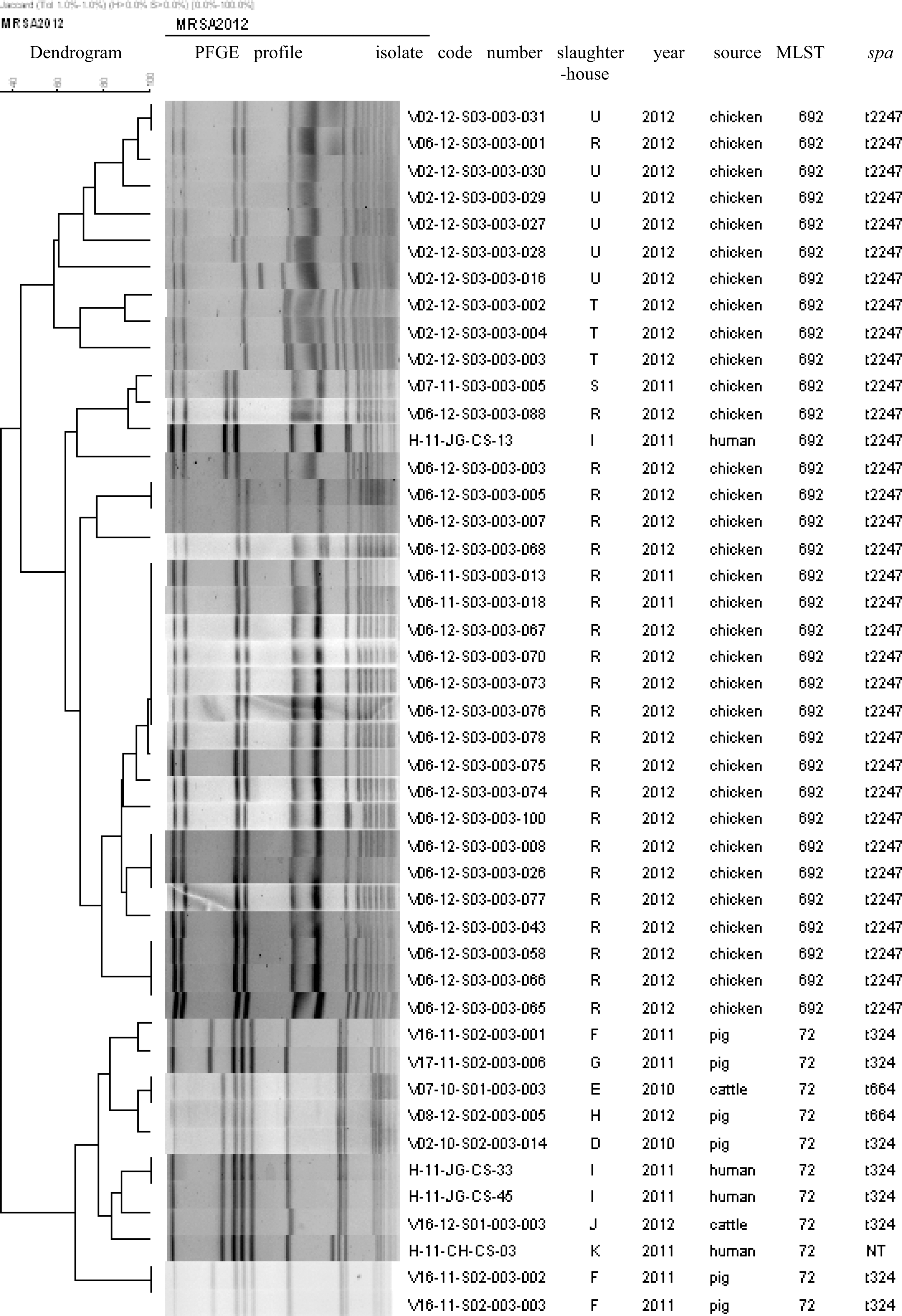
Dendrogram showing the cluster analysis of SmaI pulsed-field gel electrophoresis (PFGE) patterns of 45 ST72 and ST692 methicillin-resistant Staphylococcus aureus (MRSA) strains isolated from slaughterhouse workers and corresponding ST types from carcasses. The cluster analysis was done by using the Dice coefficient and the unweighted-pair group method with arithmetic averages. Details given in the first through eighth columns from the left are dendrogram, PFGE profile, isolate code number, slaughterhouse investigated,isolation year, source, multilocus sequence type (MLST), and spa type for each strain. A similarity value of ≥80% was considered as being closely related.
HA, human associated.
LA, livestock associated.
I, K, R, S, T, U, chicken slaughterhouse.
GEN, gentamicin; KAN, kanamycin; CIP, ciprofloxacin; ERY, erythromycin; TIA, tiamulin; LNZ, linezolid; CHL, chloramphenicol; SYN, quinupristin/dalfopristin; TET, tetracycline; FUS, fusidate; CLI, clindamycin.
egc, enterotoxin gene cluster (seg-sei-sem-sen-seo).
—, Not detected.
Phenotype and genotype of antimicrobial resistance
The resistance profile was different from ST types regardless of origin. All LA types of MRSA isolates were multiresistant (three more antimicrobial subclasses), whereas human-associated types were susceptible or resistant to less than two antimicrobial subclasses except ST5. Human-associated types of MRSA isolates were commonly resistant to aminoglycosides. Furthermore, fusidic acid resistance was detected in only six ST5 types of MRSA, whereas linezolid, tiamulin, chloramphenicol, and quinupristin/dalfopristin resistance was observed only in specific ST types such as ST398- and ST541-type isolates.
One or more genes encoding for aminoglycoside-modifying enzyme were observed in gentamicin- and/or kanamycin-resistant isolates: aac(6′)-Ie-aph(2″) (n=13), ant(4′)-Ia (n=9), aph(3′)-IIIa (n=1), ant(4′)-Ia+aph(3′)-IIIa (n=1), and aac(6′)-Ie-aph(2″)+ant(4′)-Ia (n=4). Tetracycline resistance was mediated by a single tet gene in human-associated types [12/24, 57.1%: tet(M) (n=5), tet(K) (n=7)], and in LA types [4/45, 8.9% : tet(L) (n=1), tet(M) (n=3)]. The combined tet genes were identified only in LA types [41/45, 91.1%: tet(K)+tet(M) (n=2), tet(L)+tet(S) (n=33), tet(K)+tet(L)+tet(M) (n=6)]. One uncommon tet gene in staphylococci, tet(S), was detected in all ST692 type of chicken carcasses isolates. MLSB resistance, seen in 50 isolates, was mainly mediated by a single gene such ermA (n=5) and ermC (n=3) genes in human-associated MRSA isolates. A multidrug-resistant gene that showed multiple resistance to linezolid, chloramphenicol, clindamycin, quinupristin/dalfopristin, and tiamulin from pig carcasses, cfr, was detected in five LA-MRSA isolates from pig carcasses with the fexA chloramphenicol resistance gene.
Detection of toxin and host-specific genes
The toxin gene analysis revealed that the prevalence of virulence genes was strongly associated with the type of clones. All human-associated types of MRSA strains carried the enterotoxin and/or leukocidin genes, whereas LA types do not (except ST692 LA-MRSA strains). Staphylococcal enterotoxin gene profile mostly differed according to ST types. Egc-cluster (seg-sei-sem-sen-seo) with additional sep-tsst1 or sed-sej-ser was observed in all but one human-associated type of MRSA isolate. Leukocidin E and D were detected in 30 LA-type isolates and in all human-associated type of isolates except for 2 strains (1 ST59 and 1 ST72). Panton-Valentine Leukocidin toxin gene was detected in one ST59 isolate from cattle carcass with an additional seb-sek-seq gene cluster. All of the human-associated MRSA isolates carried IEC such as chp, scn, and/or sak except for the ST72-t324-IV type (n=1), but all LA-MRSA isolates did not (Table 2).
Discussion
This study showed the presence of two different lineage types of MRSA on the basis of epidemiological characteristics in animal products and slaughterhouse workers: human-associated type (ST5, ST59, and ST72) and LA type (ST398, ST541, and ST692). To our knowledge, this was first detection of LA types of MRSA in animal carcasses in Korea, although the LA types—ST541-t034-V and ST398-t034-V—were reported from live pigs during 2008–2009 (Lim et al., 2012). This phenomenon was similar to other countries such as the Netherlands (de Boer et al., 2009) and China (Cui et al., 2009). This indicated that these animals are the main reservoirs of MRSA in carcasses. The finding of ST398 in cattle carcasses is interesting as MRSA ST398 has not been reported from dairy cattle or cattle farmers in Korea. The carcass might have been contaminated during the slaughtering process, because pigs and cattle were slaughtered in the same building, although the working process is different.
Furthermore, new types of human-associated MRSA (ST5-t002-II or IV and ST59-t437-V) were detected in the carcasses for the first time in Korea. Detection of ST5-t002-II or IV and ST59-t437-V type was unexpected because it has not been previously reported in a nonhuman source, although ST5 type with different SCCmec III was reported in retail chickens in Korea (Kwon et al., 2006). ST5-t002-II or IV is predominant in human-associated infections in Korea, and ST59-t437 is prevalent in Asian countries including Taiwan and Korea (Song et al., 2011). These results suggest that carcass samples may be contaminated by bacteria from personnel and the environment of food-processing plants. Further study of live animals and the environment at various levels of the food-supply chain is needed for intervention and to develop measures to reduce contamination.
There are several reports of ST398 carriage in the occupationally exposed workers (Van Cleef et al., 2010; Boost et al., 2013a; Wendlandt et al., 2013). Although three of the four MRSA from workers were ST72 in this study, one isolate was of chicken-carcass origin; ST692 type, which was the unique type in Korean chicken carcasses, is the first report in an exposed population. Moreover, the PFGE pattern of an isolate from a worker was closely related to those of two MRSA isolates from chicken carcasses. Although we could not demonstrate detection of MRSA from chicken carcasses from the slaughterhouse that was MRSA positive in workers, it is possible for transmission to occur from chicken carcasses to workers because ST692 has not been reported in the human population but has been reported in chicken carcasses in Korea. However, further investigation on the animal products and workers from same slaughterhouse is necessary to demonstrate the transmission of MRSA. Generally LA type of MRSA hardly get colonized and transmitted to humans (Chroboczek et al., 2013). However, ST692-type human isolate was resistant to antimicrobials that are commonly used for MRSA treatment in humans such as ciprofloxacin, erythromycin, and clindamycin, which could reduce treatment options in case of infection to humans.
Some mobile genetic elements carrying genes encoding host immune evasion strategies appear to be host specific in S. aureus (Chroboczek et al., 2013). The IEC of genes was found in nearly all human isolates, but only in a few animal isolates (Chroboczek et al., 2013). In the present study, all human lineages of MRSA carried chp, sak, and/or scn, but the LA lineage did not. Although we are not sure about the origin of ST692 type, which was only reported in chicken meat in Korea (Lim et al., 2010), it is unlikely that ST692 originated from humans due to the absence of the IEC gene.
The set of virulence marker and toxin genes investigated showed profiles characteristic of the MRSA lineages detected, including those of the human-adapted ST5, ST72, and ST59, and LA ST398, ST541, and ST692 isolates in this study. All human-associated types of MRSA isolates carried enterotoxins, whereas LA MRSA types did not. Generally, LA MRSA strains lack important virulence determinants that are typically present in other community- and hospital-associated MRSA isolates (Kadlec et al., 2012; Chroboczek et al., 2013).
The high number of resistance determinants in LA-type isolates is in clear contrast to the low number of virulence factors in this study. All LA-type isolates were resistant to tetracycline [encoded by tet(M) alone or together with tet(K) and/or tet(L)], a property of the ST398 clone also found by other authors (Kehrenberg et al., 2009; Kadlec et al., 2012; Chroboczek et al., 2013). In addition, tet(S) was detected in 33 MRSA of chicken origin. Although the tet(S) gene was identified in streptococci, enterococci, Listeria monocytogenes, and Lactococcus lactis (Lancaster et al., 2004), to our knowledge, this is the first report of tet(S) in MRSA. Further genetic analysis is necessary to understand the acquisition and evolution of this gene in chicken-carcasses isolates.
In this study, the resistance genes that are uncommon in staphylococci from humans but reported in LA MRSA ST398 (Kadlec et al., 2012), fexA and cfr, were detected in MRSA isolates from pig carcasses. Kehernverg et al. (2009) reported the cfr gene in a single MRSA ST398 isolate among 65 MRSA ST398 isolates from pigs. However, in our study, a total of 5 ST398 and ST541 isolates carried this gene, which comprised about 50% (5/11) of the isolates. Although ST398 and ST541 types of MRSA have not been reported in humans from Korea, there is a high risk of transmission to humans with constant exposure to meat contaminated with MRSA. Although linezolid has not been authorized for use in animals in Korea, acquisition of multiple-resistance genetic elements could cause failure of treatment if humans get infected through meat contaminated with this type of isolate. We observed the difference in antimicrobial resistance between sample types. Resistance to ciprofloxacin was much higher in MRSA isolates from chicken carcasses, while resistance to aminoglycosides, chloramphenicol, and tiamulin was more frequently shown in pig carcasses. Differences in the patterns of resistance were noted, perhaps reflecting differences in antimicrobial use regimens among livestock species (Anonymous, 2012).
In conclusion, we found three novel findings in this study. First, a unique type of MRSA ST692 in Korean chicken was detected in a worker in a chicken slaughterhouse. Second, tet(S) was detected in MRSA for the first time. Third, new types of human-associated and LA MRSA isolates were observed in the food-animal products in Korea. Although the prevalence of MRSA in food-animal products in Korea is still maintained at a low level compared to many other European countries, the occurrence and increase in multiple-resistant LA MRSA lineage and virulent human-associated MRSA lineage can be a potential threat to public, since animal-related-job workers and consumers are constantly exposed to these MRSA lineages.
Footnotes
Acknowledgments
This work was supported by a grant (C-1541778-2013-14-01) from the Animal and Plant Quarantine Agency, Ministry of Agriculture, Food and Rural Affairs, Republic of Korea.
Disclosure Statement
No competing financial interests exist.
References
Supplementary Material
Please find the following supplemental material available below.
For Open Access articles published under a Creative Commons License, all supplemental material carries the same license as the article it is associated with.
For non-Open Access articles published, all supplemental material carries a non-exclusive license, and permission requests for re-use of supplemental material or any part of supplemental material shall be sent directly to the copyright owner as specified in the copyright notice associated with the article.
