




Abstract
Cronobacter spp. are bacterial pathogens that affect children and immunocompromised adults. In this study, we used multilocus sequence typing (MLST) to determine sequence types (STs) in 11 Cronobacter spp. strains isolated from retail foods, 29 strains from dust samples obtained from vacuum cleaners, and 4 clinical isolates. Using biochemical tests, species-specific polymerase chain reaction, and MLST analysis, 36 strains were identified as Cronobacter sakazakii, and 6 were identified as Cronobacter malonaticus. In addition, one strain that originated from retail food and one from a dust sample from a vacuum cleaner were identified on the basis of MLST analysis as Cronobacter dublinensis and Cronobacter turicensis, respectively. Cronobacter spp. strains isolated from the retail foods were assigned to eight different MLST sequence types, seven of which were newly identified. The strains isolated from the dust samples were assigned to 7 known STs and 14 unknown STs. Three clinical isolates and one household dust isolate were assigned to ST4, which is the predominant ST associated with neonatal meningitis. One clinical isolate was classified based on MLST analysis as Cronobacter malonaticus and belonged to an as-yet-unknown ST. Three strains isolated from the household dust samples were assigned to ST1, which is another clinically significant ST. It can be concluded that Cronobacter spp. strains of different origin are genetically quite variable. The recovery of C. sakazakii strains belonging to ST1 and ST4 from the dust samples suggests the possibility that contamination could occur during food preparation. All of the novel STs and alleles for C. sakazakii, C. malonaticus, C. dublinensis, and C. turicensis determined in this study were deposited in the Cronobacter MLST database available online (
Introduction
C
Most Cronobacter spp. strains reported in the literature have been isolated from foods or clinical specimens. The main sources of this pathogen in infants are powdered infant milk formula, powdered milk, and powdered weaning foods (FAO/WHO, 2008). Cronobacter strains have also been isolated from ready-to-eat foods, dried products, spices, eggs, and meat (Iversen and Forsythe, 2004; Friedemann, 2007). Recently, Gičová et al. (2013) have isolated 13 Cronobacter strains from 916 powdered infant formulas and milk-based and cereal-based powdered weaning foods. In our previous study, 20 Cronobacter spp. strains were isolated from 291 food samples, and 52 strains were isolated from dust samples obtained from homes, restaurants, bars, and hotels (Mozrová et al., 2014).
Only a portion of Cronobacter spp. strains are pathogens. A multilocus sequence-typing (MLST) scheme based on seven housekeeping genes has been described by Enright and Spratt (1998) and proposed as a nucleotide sequence–based approach that could be applied to assess many bacterial pathogens. Although MLST is not designed to evaluate the virulence of bacterial strains, a large proportion of severe neonatal infections are caused by particular sequence types (STs). Comparative analysis with the online Cronobacter MLST database (
The aim of the present study was to perform MLST to evaluate Cronobacter spp. strains isolated in our previous experiment from retail foods and dust samples obtained from vacuum cleaners (Mozrová et al., 2014). An MLST of four clinical isolates obtained from the Institute of Chemical Technology in Prague was also carried out.
Materials and Methods
Bacterial strains and phenotypic characteristics
For this study, 11 presumptive Cronobacter spp. strains isolated from samples of retail foods and 29 strains isolated from dust samples obtained from vacuum cleaners in homes, offices, and nurseries were further characterized. The strains were isolated from October 2010 to October 2012 in accordance with the reference standard ČSN P ISO/TS 22964 (Mozrová et al., 2014). The phenotypic characteristics of the isolates were determined using an ENTEROtest 24 commercial kit and the program TNW ProAuto 7.0 (Erba Lachema Ltd., Brno, Czech Republic) according to the manufacturer's instructions. Four clinical isolates, denoted DBM 3198, DBM 3201, DBM 3582, and DBM 3585, were obtained from the culture collection of the Department of Biochemistry and Microbiology of the University of Chemistry and Technology in Prague (Czech Republic). Their phenotypic characteristics were also determined using API ID 32E strips purchased from bioMérieux CZ (Prague, Czech Republic). The strains were maintained in 20% glycerol (vol/vol) at −40°C. The culture medium contained (in grams per liter) peptone from casein tryptic digest (8.5), soy peptone (1.5), NaCl (2.5), K2HPO4 (1.3), and glucose (1.3). The medium components were purchased from Sigma-Aldrich, Ltd. (Prague, Czech Republic).
Species-specific polymerase chain reaction (PCR) and MLST
A PCR assay for the species-specific detection of the rpoB gene in C. sakazakii and C. malonaticus was performed according to Stoop et al. (2009). The amplification mixture contained 10 μL of Red Taq Ready® Mix (Sigma Aldrich, Ltd., Prague, Czech Republic), 1 μL of DNA, final concentrations of 0.5 μmol/L of primers (Csakf 5′-ACG CCA AGC CTA TCT CCG CG-3′; Csakr 5′ ACG GTT GGC GTC ATC GTG-3′; Cmalf 5′-CGT CGT ATC TCT GCT CTC-3′; and Cmalr 5′-AGG TTG GTG TTC GCC TGA-3′), and distilled H2O in a total volume of 20 μL. The PCR program for the detection of C. sakazakii was as follows: 3 min at 94°C followed by 30 cycles of denaturation at 94°C for 1 min, annealing at 67°C for 1 min, and elongation at 72°C for 1 min. The PCR program for the detection of C. malonaticus was the same, except that the annealing temperature was 60°C. The presence or absence of PCR products was verified by agarose gel electrophoresis in 0.5×Tris-borate-EDTA buffer (1.2% agarose gel at 100 V for 30 min) and staining with GelRed (Biotium, Inc., Hayward, CA) solution.
MLST was conducted according to the protocol described by Joseph et al. (2012b), with minor adjustments. Briefly, genomic DNA from 44 Cronobacter spp. isolates was extracted from 1 mL of overnight culture using a DNeasy Blood & Tissue DNA Isolation Kit (Qiagen, local supplier: Bioconsult Laboratories, Ltd., Prague, Czech Republic) according to the manufacturer's instructions. Prior to amplification, the quality and concentration of the isolated DNA were determined using a Nanodrop 1000 spectrometer (Thermo Fisher Scientific, Waltham, MA). The amplification and nested sequencing primers for the MLST loci have been previously described by Baldwin et al. (2009). The reaction conditions for all of the primers were as follows: initial denaturation at 94°C for 2 min, 30 cycles of denaturation at 94°C for 1 min, primer annealing at 58°C for 1 min, extension at 72°C for 2 min, and a final extension step of 72°C for 5 min. Each 25-μL amplification reaction mixture contained ∼10 ng chromosomal DNA, 20 pmol forward and reverse primers, and 1×PCR buffer (Promega UK, Ltd., Southampton, UK) containing 1.5 mM MgCl2, 0.8 mM deoxynucleotide triphosphates, and 1.25 U Taq (Promega, UK). The correct size and integrity of the amplification products were determined by horizontal electrophoresis through a 1.5% agarose gel with Tris-acetate running buffer (40 mM Tris-acetate and 1 mM EDTA, pH 8.0) at 100 V for 30 min. The agarose gel contained 1×SYBR Safe™ DNA gel stain (Invitrogen, local supplier: Life Technologies Czech Republic, Prague) to visualize the DNA bands. The PCR products were then purified using MinElute PCR Purification Kits (Qiagen) following the manufacturer's protocol. The purified PCR products (∼50 ng/μL) were mixed together in equal amounts with the respective sequencing primers (10 μM) and sent to Macrogen Europe (Amsterdam, The Netherlands) for sequencing in a single direction.
Phylogenetic studies based on MLST analysis
Phylogenetic analysis was performed using a phylogenetic tree that was constructed based on seven genes, as described previously (Baldwin et al., 2009). The raw sequences of seven genes (atpD, fusA, glnS, gltB, gyrB, infB, and ppsA) amplified from 44 Cronobacter spp. isolates were edited using the Chromas Lite 2.1.1 program (Technelysium Pty Ltd., South Brisbane, Australia). The sequences were then aligned using the ClustalW algorithm in the BioEdit 709 program (Informer Technologies Inc., Shingle Springs, CA) along with 17 and 3 different STs derived from the strains C. sakazakii and C. malonaticus, respectively. The seven locus sequences of C. sakazakii, C. malonaticus, C. dublinensis, C. turicensis, C. universalis, C. condimenti, and C. muytjensii type strains were also used in the phylogenetic studies. The ST sequences and the sequences of the Cronobacter spp. type strains were retrieved from the Cronobacter MLST database (
Sequence Type Analysis and Recombinational Tests (START) version 2 (University of Oxford, UK) (Jolley et al., 2001) was used for the determination of the numbers of different alleles, polymorphic sites, proportion of polymorphic fragments, and percentage of cytosine and guanine content within the seven loci. All 44 investigated isolates were tested. The eBURSTv3 application (Feil et al., 2004) was used for the distribution of the isolates into different clades. The SplitsTree4 software (Center for Bioinformatics, Tübingen University, Germany) (Huson and Bryant, 2006) was applied for the evaluation of recombination events in the Cronobacter spp. population used in this study. For this purpose, the same concatenated nucleotide sequences from the seven loci that were used for the construction of the phylogenetic tree using the maximum-likelihood method were employed.
Results
Species-specific PCR and MLST analysis identified 10 of the 11 strains isolated from the retail foods as C. sakazakii. The strain K74, with a low level of biochemical similarity (54.2%), was identified as C. dublinensis by phylogenetic analysis (Table 1 and Figs. 1 and 2). The Cronobacter spp. strains isolated from the retail foods were assigned to eight different MLST STs, seven of which were newly designated. Six of them belonged to C. sakazakii, and the last one was assigned to C. dublinensis (Table 1).
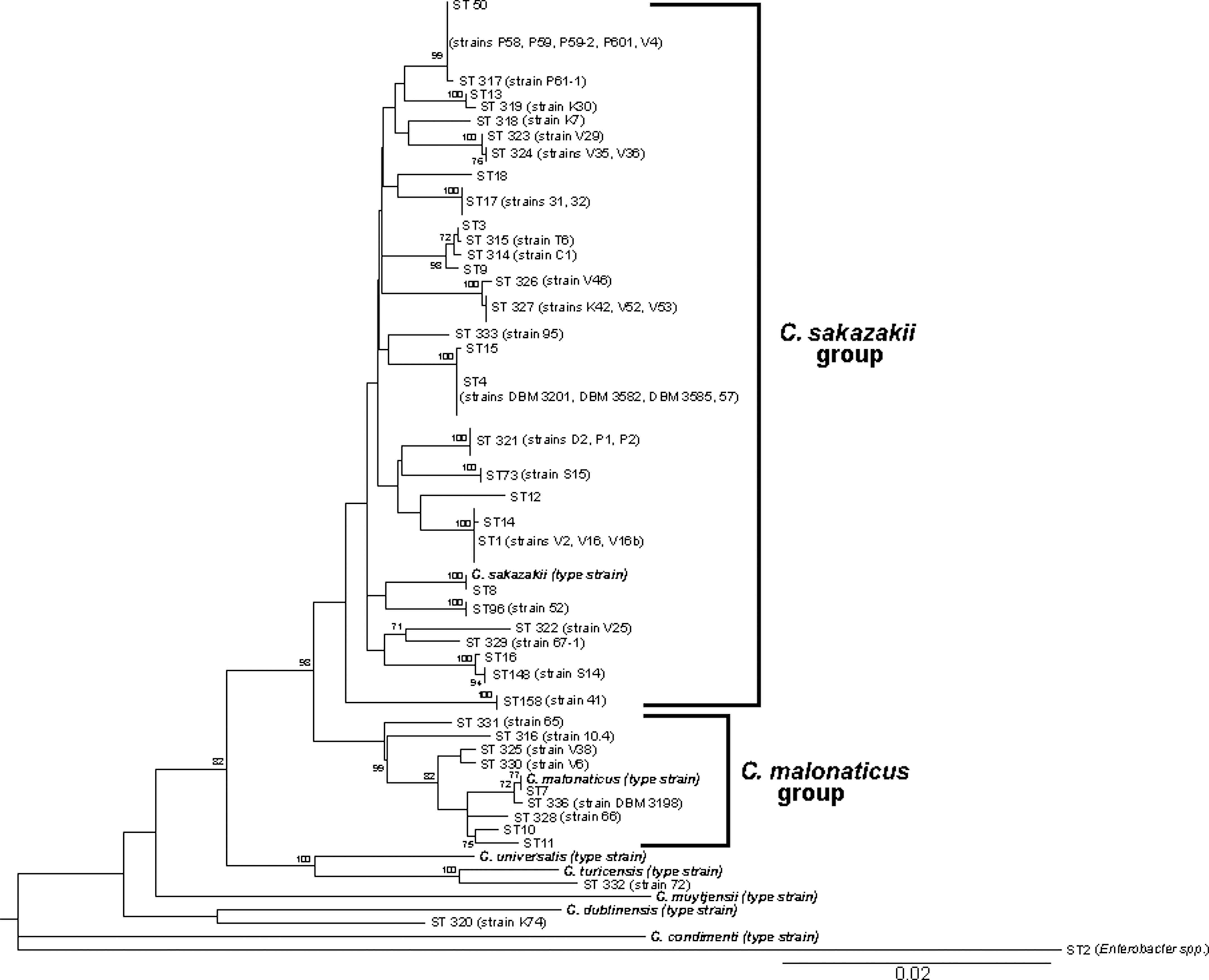
Phylogenetic tree based on concatenated nucleotide sequences derived from the seven genes (atpD, fusA, glnS, gltB, gyrB, infB, and ppsA). It was reconstructed using the maximum-likelihood statistical method and Jukes–Cantor model within the MEGA6 program. Bootstrap values, expressed as percentages (≥70) of 1000 data sets, are given at nodes. The tree was rooted by Enterobacter spp. (ST2). Bar, 0.02 substitutions per nucleotide position. It includes known sequence types (STs) for C. sakazakii determined for some of isolates used in this study and newly designated STs for evaluated Cronobacter sakazakii-, C. malonaticus-, C. dublinensis-, and C. turicensis strains. Concatenated sequences of type strains of known Cronobacter species were also included because of classification and incorporation of studied strains within the Cronobacter clusters.
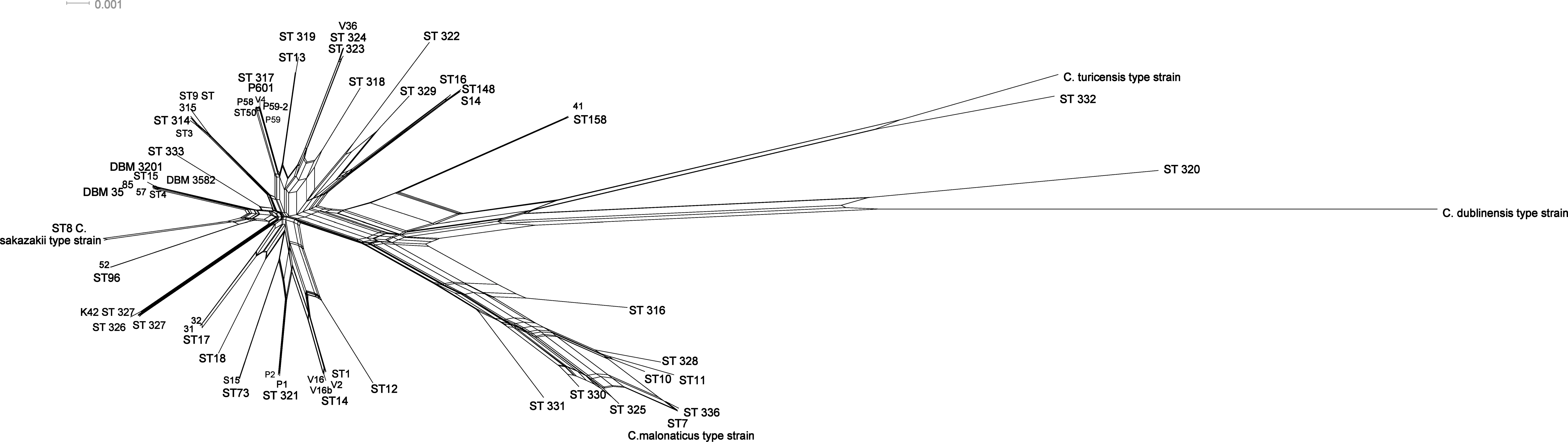
Neighbor-net phylogenetic tree reconstructed using the SplitsTree4 software based on concatenated seven-loci sequence alignment. It provides insight into the diversity and recombination events of Cronobacter spp. strains used in this study. Known and newly designated sequence types (STs) are shown at the tips of the branches. The formation of parallelograms indicates possible recombination events.
Newly determined STs are in bold type.
PCR, polymerase chain reaction; MLST, multilocus sequence typing; ST, sequence type.
Biochemical tests identified all of the Cronobacter spp. strains isolated from the dust samples as C. sakazakii. However, these tests are not suitable for distinguishing individual species. The species-specific PCR and MLST analyses identified 5 strains with low levels of biochemical similarity (36.6–95.6%) as C. malonaticus. Strain 72, which also had a low level of biochemical similarity (59.0%), was classified using by MLST analysis as C. turicensis (Figs. 1 and 2). The environmental isolates were assigned to 8 known ST types (1, 4, 17, 50, 73, 96, 148, and 158) of C. sakazakii and to 14 newly designated ST types, of which 8 belonged to C. sakazakii, 5 to C. malonaticus, and 1 to C. turicensis (Table 1). C. sakazakii isolate V4 from the dust samples was genetically identical to isolates P58, P59, and P59-2 from chocolate and to isolate P601 from rice in chocolate. C. sakazakii strain 57 from the household dust samples was assigned to sequence type ST4, which is a stable clone with a high propensity for neonatal meningitis.
All four Cronobacter spp. clinical isolates were identified by biochemical tests (ENTEROtest 24 and API ID 32E) as C. sakazakii. However, the species-specific PCR and MLST analyses identified strain DBM 3198 as C. malonaticus. With the exception of this strain, the Cronobacter spp. clinical isolates were assigned to sequence type ST4.
Table 2 shows the results of START analysis, providing an overview of the number of different alleles and polymorphic sites of each gene. The average GC content (58.6%) of all 7 sequenced genes among the 44 Cronobacter spp. isolates is in agreement with previous results reported by Joseph et al. (2012a), who examined more than 300 Cronobacter spp. isolates. The number of new alleles of the 7 loci and the newly determined STs among the 44 isolates identified as 4 Cronobacter species were also obtained from this analysis. There were 13 novel STs assigned for C. sakazakii, 6 for C. malonaticus, and 1 each for C. dublinensis and C. turicensis (Table 3). Forty-four Cronobacter spp. isolates were separated into 27 different clades based on their phylogenetic relationships using eBURSTv3 (Table 4). These findings indicate the considerable genetic variability of the isolates.
START, Sequence Type Analysis and Recombinational Tests; GC, guanine-cytosine.
ST, sequence type.
The phylogenetic tree reconstructed using the maximum-likelihood method provides insight into diversity of the C. sakazakii and C. malonaticus isolates evaluated in this study (Fig. 1). This finding is consistent with a previous report by Joseph et al. (2012b). Phylogenetic analysis using the SplitsTree4 software showed recombination events and evolutionary relationships among the studied Cronobacter spp. isolates (Fig. 2) and confirmed the tight clustering of the C. sakazakii strains.
Discussion
A phylogenetic study based on MLST revealed that C. sakazakii and C. malonaticus strains of different origin can be genetically highly variable. The C. sakazakii strains evaluated in this study were classified into 14 newly designated STs, and the C. malonaticus strains were assigned to 6 novel STs (Table 1 and Fig. 1). In accordance with our expectations, ST4 was the most prevalent ST found in the clinical isolates (three of four strains). Sonbol et al. (2013), who summarized the results of Cronobacter spp. typing from samples of powdered infant formula and specimens obtained from milk powder production factories in 14 countries, reported that 21 of 72 C. sakazakii strains were grouped into the clinically significant ST4 clonal complex. Swiss authors who performed MLST analysis of 19 strains of C. sakazakii collected from an infant formula–producing facility identified ST4 as the most frequent ST (Müller et al., 2013). In contrast, ST4 was not found among four C. sakazakii strains isolated from infant formula in the study of Cetinkaya et al. (2013). Gičová et al. (2013) also reported that only 1 of 12 C. sakazakii strains isolated from infant formula was assigned to the ST4 clonal complex. The recovery of C. sakazakii ST1 from three dust samples obtained from homes is noteworthy because this ST has been associated with severe neonatal meningitis in the United States (Himelright et al., 2002). A number of strains of the ST1 ST have been isolated from powdered infant formula, foods, and clinical and environmental samples in different countries (Joseph et al., 2012b). Our strains V2, V16, V16b, and 57, belonging to ST1 and ST4 and with high propensities for neonatal infection, were isolated from the household dust samples. There are several reports on the presence of Cronobacter spp. in household dust. Kandhai et al. (2004) isolated 5 strains of Cronobacter spp. from 16 dust samples, Molloy et al. (2009) detected 1 strain in 6 dust samples, Jaradat et al. (2009) found 2 strains in 6 dust samples, and Mozrová et al. (2014) isolated 52 strains from 140 dust samples. These data indicate that the presence of Cronobacter spp. in household environments is rather common. Thus, the contamination of infant milk formula or other foods may occur during household preparation. The clinical significance of the 24 as-yet-unknown STs is unclear but cannot be excluded. Additionally, it should be taken into account that the assessment of STs from seven loci is considered low resolution compared with the results obtained from whole-genome sequencing. It is possible that different strains share the same STs in these seven loci.
Conclusions
Cronobacter spp. strains isolated from retail foods and dust samples obtained from vacuum cleaners were assigned to 15 known MLST STs and 21 unknown STs. Eight strains identified as C. sakazakii on the basis of biochemical tests were assigned to three other Cronobacter species using species-specific PCR and MLST. It can be concluded that (1) the Cronobacter spp. strains examined were genetically very variable and that (2) MLST enabled us to overcome the shortcomings of identification methods based on biochemical characteristics. Strains assigned to clinically significant STs were identified in the household dust samples, but not in the retail food specimens.
Footnotes
Acknowledgments
This study was supported the Czech University of Life Sciences (project CIGA 20142014) and by the Ministry of Agriculture of the Czech Republic (project MZERO0714).
Disclosure Statement
No competing financial interests exist.