




Abstract
Background:
Contamination of food with multiantibiotic-resistant bacteria, particularly extended-spectrum β-lactamase (ESBL)–producing Enterobacteriaceae, is considered a potential source for the wide dissemination of ESBL-producing bacteria in communities. However, little is known about the extent of contamination of food with ESBL-producing bacteria in Vietnam.
Objective:
This study was conducted to assess the characteristics of ESBL-producing Escherichia coli isolated from retail meats and shrimp in Nha Trang, Vietnam.
Materials and Methods:
A total of 350 food samples (poultry [n=143], pork [n=147], and shrimp [n=60]) were purchased in July and November 2013 from a local market. ESBL-producing E. coli were isolated, and ESBL genotypes, phylogenetic groups, and antibiotic resistance profiles were determined.
Results:
The prevalence of ESBL-producing E. coli in retail foods was 40.6%. β-Lactamase-encoding genes of the CTX-M-1 (50.7%), CTX-M-9 (41.5%), TEM (59.9%), and SHV (2.8%) groups were detected singly or in combination. The percentages of single ESBL isolates harboring CTX-M-1 or -9 plus TEM groups were 35.2% and 16.2%, respectively. B1 was the most prevalent phylogroup in ESBL isolates from pork (44.7%), poultry (55.9%), and shrimp (72.7%). B2 was the least prevalent (4.2% and 4.8% for pork and poultry isolates, respectively). The prevalence of multidrug resistance (MDR; resistance to ≥3 antimicrobial groups) in ESBL-producing E. coli isolated from food was 85.9%.
Discussion and Conclusions:
This is the first report of the characteristics of ESBL-producing E. coli in retail foods in a local city in Vietnam. Our findings indicate that retail foods are contaminated with ESBL-producing E. coli, of which many were MDR. Further monitoring and public health efforts targeting food administration are needed to control the spread of ESBL-producing bacteria in communities.
Introduction
E
E. coli isolated from food in Vietnam has been reported (Van, 2007a; Van et al., 2007b, 2008), but little is known about ESBL-producing E. coli in food. Therefore, this study was conducted to assess the characteristics of ESBL-producing E. coli in retail foods at a local market in Nha Trang, Vietnam.
Materials and Methods
A total of 350 retail food samples including those from poultry (n=143; chops and thighs), pork (n=147; chops), and shrimp (n=60) were purchased from different retail stalls at a local market in Nha Trang, Vietnam, in July and November 2013. Twenty-five grams of each sample was suspended in 225 mL of buffered peptone water and stomachered for 2 min. One milliliter of suspension was inoculated in tryptone bile X-glucuronide agar (Merck KGaA, Darmstadt, Germany) containing 2 μg/mL of cefotaxime and incubated at 37°C for 24 h. One colony of each sample that represented characteristics of E. coli on a plate was collected for further confirmation of ESBL-producing E. coli.
The ESBL phenotype was determined by the double-disc synergy test using ceftazidime and cefotaxime with and without clavulanic acid, as recommended by the Clinical and Laboratory Standards Institute (CLSI, 2014). ESBL-producing isolates were identified as E. coli using the IMViC test following the manufacturer's instruction (Becton Dickinson, Franklin Lakes, NJ).
Bacterial DNA was extracted by boiling a suspension of an overnight colony of ESBL-producing isolates in 100 μL Tris (hydroxymethyl) aminomethane–EDTA buffer (pH 8.0). DNA samples (1 ng/μL) were used as polymerase chain reaction (PCR) templates for genotyping and phylogenetic grouping.
Genotypes of β-lactamases were assessed using multiplex PCR using primers specific to the TEM, SHV, CTX-M-1, CTX-M-2, CTX-M-8, CTX-M-9, and CTX-M-25 groups, as described in Table 1. PCR amplification was conducted with the following conditions: initial denaturation at 95°C for 5 min, followed by 25 cycles of denaturation at 95°C for 30 s, annealing at 60°C for 90 s, extension at 72°C for 90 s, and a final cycle of amplification at 68°C for 10 min. The amplified products were visualized using 1.5% agarose gel electrophoresis and staining with gel red (Biotium, Hayward, CA).
Phylogenetic groups were determined by triplex PCR using a combination of the two genes chuA and yjaA and the DNA fragment TSPE4.C2, described previously (Clermont et al., 2000).
ESBL-producing E. coli isolates were tested for susceptibility to 14 antimicrobial agents using the disc-diffusion method following the standard procedure of the CLSI. Susceptibility results were interpreted according to the CLSI document M100-S24 (CLSI, 2014). The discs for disc-diffusion testing (Becton Dickinson) included the following antibiotics: ampicillin (AMP), cefotaxime (CTX), cefoxitin (FOX), ceftazidime (CAZ), meropenem (MEM), gentamicin (GEN), kanamycin (KAN), streptomycin (STR), tetracycline (TE), ciprofloxacin (CIP), nalidixic acid (NA), sulfamethoxazole-trimethoprim (SXT), chloramphenicol (CHL), and fosfomycin (FOF). The strains E. coli ATCC 25922 and Staphylococcus aureus ATCC 25923 were included in each run as positive and negative controls, respectively.
The significance of the results was established using chi-square tests. If any of the expected cell frequencies were less than five, Fisher exact tests were used. The significance level was set at p<0.05. Statistical analysis was performed using SPSS for Windows (version 16.0; SPSS Inc., Chicago, IL).
Results
As shown in Table 2, ESBL-producing E. coli were detected in 142 of 350 samples (40.6%). Prevalence of ESBL-producing E. coli from poultry (58.7%) was significantly higher than those for pork (32%) and shrimp (18.3%) (p<0.05). The isolated ESBL-producing E. coli carried predominantly genes of the CTX-M class (131/142, 92.3%), followed by the TEM (59.9%) and SHV (2.1%). The prevalences of isolates with CTX-M types belonging to the CTX-M-1 and CTX-M-9 groups were 50.7% and 41.5%, respectively. No CTX-M-2, -8, or -25 genotypes were found. Importantly, we detected a high prevalence of strains harboring the combinations of genes encoding enzymes of the CTX-M-1 or -9 plus TEM groups (35.2% and 16.2%, respectively). Nine out of 142 (6.3%) of isolates were positive only with the TEM group and 1 isolate coexisted with β-lactamase genes in the TEM and SHV groups.
Dual positive, **Triple positive.
Statistically significant (p<0.001, chi-square test) variation between poultry and pork; between poultry and shrimp.
Statistically significant (p<0.05, chi-square test) variation between pork and shrimp.
Those amplicons were not sequenced and it was not certain if they correspond to ESBL variants.
Only CTX-M-1 group.
Only CTX-M-9 group.
PCR analysis of the 142 isolates showed that phylogenetic groups B1 (55.9%) and D (23.8%) were predominant among isolates from poultry, whereas B1 (44.7% and 72.7%) and A (38.3% and 18.2%) were the most frequently detected among isolates from pork and shrimp, respectively. The least prevalent phylogroup was B2, accounting for 4.2% and 4.8% of pork and poultry isolates, respectively (Fig. 1).
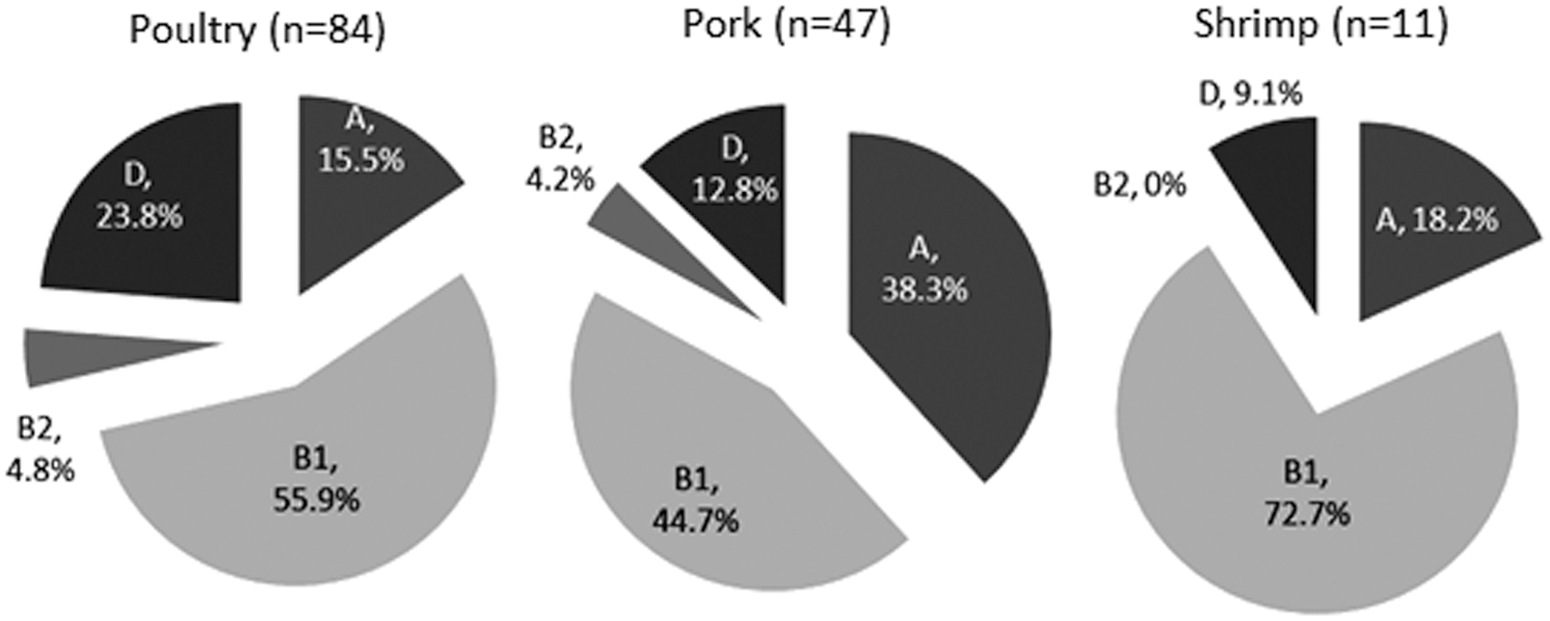
Phylogenetic groups of extended-spectrum β-lactamase-producing Escherichia coli isolates from food samples.
The phenotypic antibiotic resistance profiles of the ESBL-producing E. coli isolated from food samples are shown in Figure 2. There were no MEM-resistant isolates and only 7 (4.9%) FOF-resistant isolates. However, multidrug resistance (MDR) was observed in a high number of ESBL-producing E. coli (122/142, 85.9%). The number of MDR isolates was particularly high in poultry (81/84, 96.4%), followed by pork (35/47, 74.5%) and shrimp (6/11, 54.5%). The MDR resistance profiles of isolates obtained from food samples are shown in Figure 3. We found a significant number of isolates (35/84, 41.7%) with MDR to 6 antibiotics groups (in addition to the β-lactam group) in poultry samples.
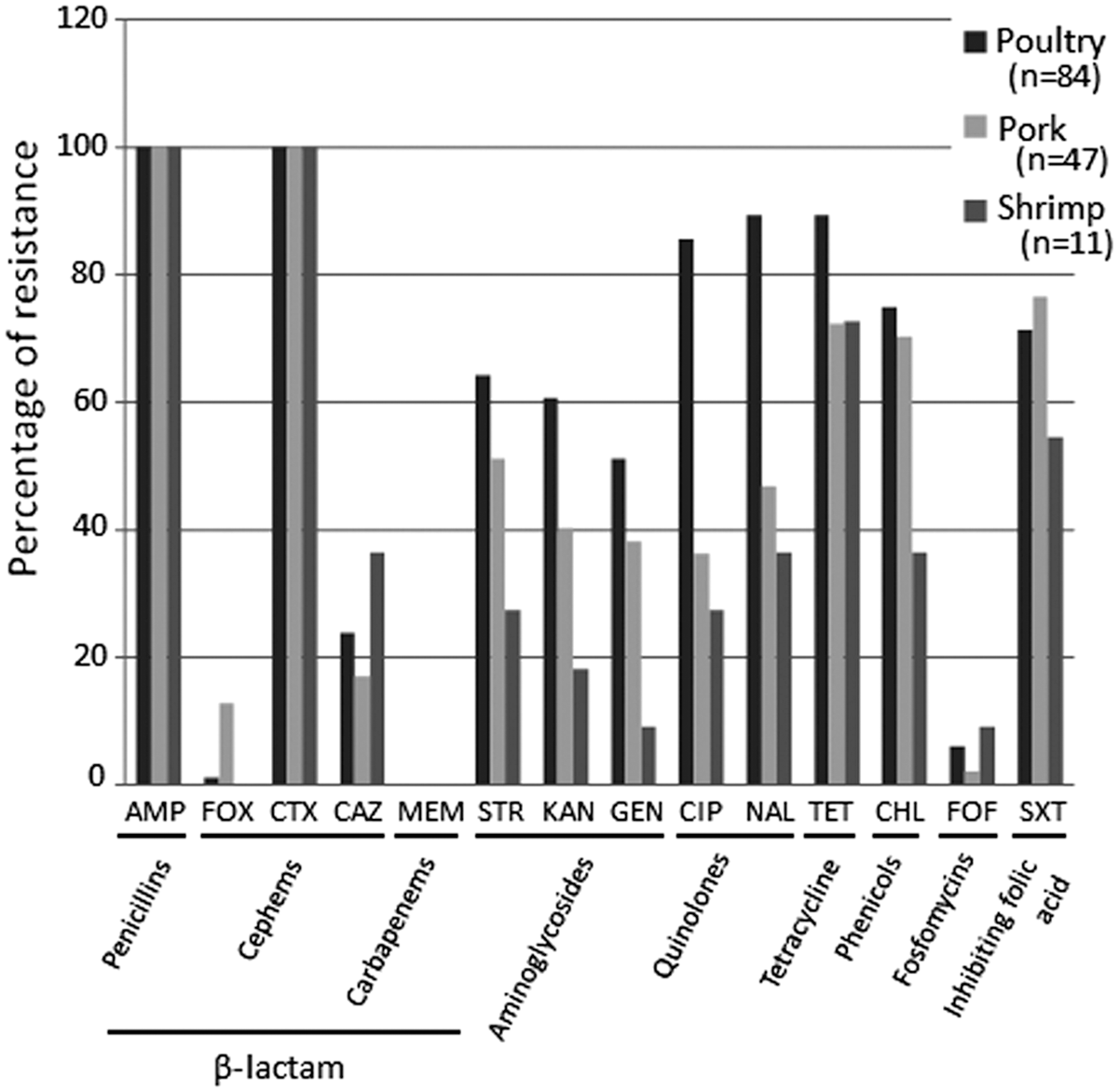
Percentage of extended spectrum β-lactamase-producing Escherichia coli isolates from poultry, pork, and shrimp that exhibited resistance to antimicrobial agents. For antibiotic abbreviations, see text.
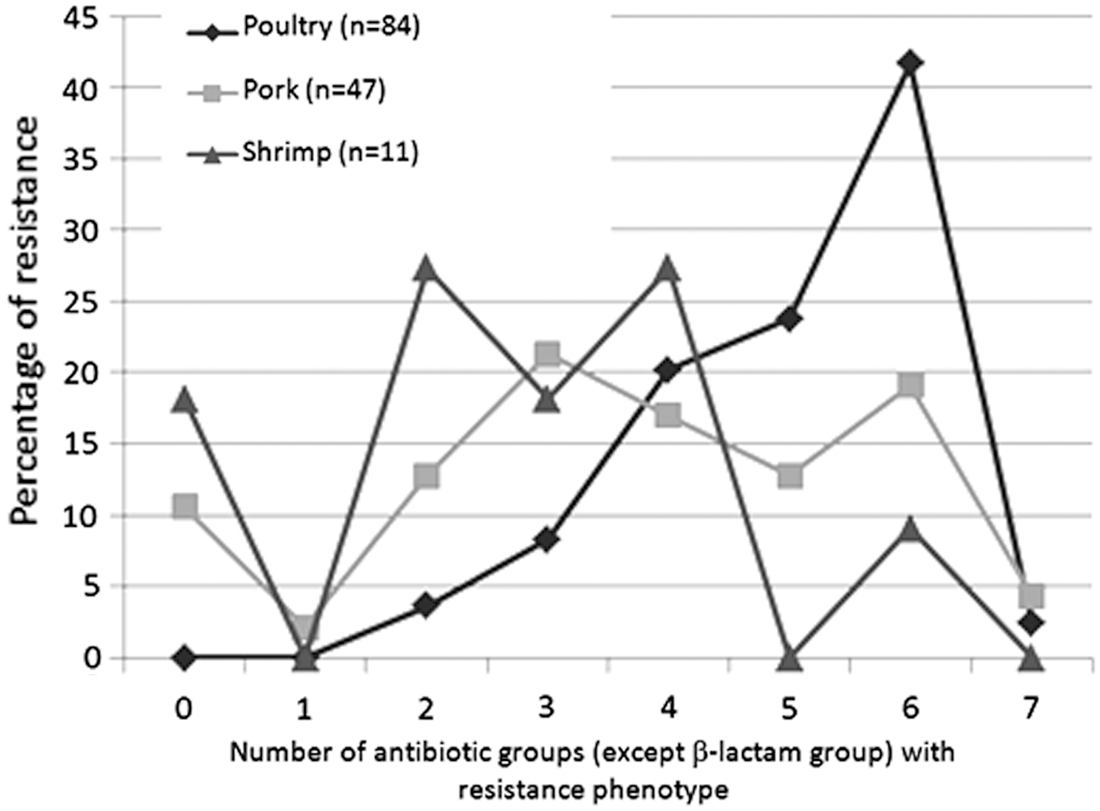
Multidrug resistance of extended-spectrum β-lactamase–producing Escherichia coli isolates from food samples.
Discussion
The prevalence and characteristics of ESBL-producing E. coli in clinical settings have been studied extensively (Pitout and Laupland, 2008; Falagas and Karageorgopoulos, 2009; Nakamura et al., 2012). It has been reported that ESBL-producing bacteria are spreading rapidly not only in clinical but also in community settings (Vinué et al., 2009; Luvsansharav et al., 2012). In particular, a high prevalence of ESBL-producing Enterobacteriaceae has been detected in community residents from the Indochinese peninsula (Sasaki et al., 2010; Nakayama et al., 2015). Food contaminated with ESBL-producing bacteria is thought to be one of the potential risk factors for a wide dissemination of ESBL-producing bacteria in humans (Lazarus et al., 2015). The present study was conducted to assess the prevalence of food contamination with ESBL-producing bacteria in a local market as a representative site in Vietnam.
Our data show that more than 40% of retail foods in this local market in Vietnam were contaminated with ESBL-producing E. coli. The prevalence of contamination was significantly higher in poultry than in pork and shrimp. A previous study by a Danish group reported that imported broiler meats contained a high number of extended-spectrum cephalosporinase–producing E. coli (36%), but only a low prevalence of contamination was reported for Danish pork (2.0%) (Agerso et al., 2012). In the Netherlands, two recent studies showed that poultry was contaminated with ESBL-producing E. coli with high prevalence, at 76.8% (Overdevest et al., 2011) and 94% (Leverstein van Hall et al., 2011). It has also been reported that 20% of mixed minced meats produced from pork and beef in Austria was contaminated with ESBL-producing E. coli (Petternel et al., 2014). These reports are similar to our data concerning the prevalence of ESBL-producing E. coli found in retail meats. In Vietnam, a high contamination rate of poultry with E. coli (90%) has been reported (Van, 2007a), but no information on the contamination of retail foods with ESBL-producing E. coli has been available so far. To our knowledge, this is the first report of the characteristics of ESBL-producing E. coli in retail foods in Vietnam.
It is not clear why such a high prevalence of ESBL-producing bacteria is found in retail foods. The use of large volumes of antibiotics in food-producing animals has been proposed as a contributing factor (Vieira et al., 2011). In this regard, we confirmed residual antibiotics in a significant number of meat samples in a different study (Yamaguchi et al., 2015).
The majority of ESBL-producing isolates in this study belonged to phylogroup B1, and fewer to groups A and D. Group B2 was only detected at low percentages from pork (4.2%) and poultry (4.8%) isolates. Virulent clonal groups of human extraintestinal pathogenic E. coli isolates derived primarily from group B2 and to a lesser extent from group D have been suggested in a previous study (Jakobsen et al., 2010). Therefore, it is possible that some B2 and D isolates in this study are pathogenic and could pose a risk to public health.
The analysis of β-lactamase genes in this study revealed that a high number of ESBL-producing E. coli isolates harbored genes of the CTX-M (92.2%) family. The CTX-M family has been reported as the most prevalent ESBL gene and is widely disseminated in E. coli isolates from food and food-producing animals in European countries (Cortés et al., 2010; Stuart et al., 2012). In Vietnam, information on β-lactamase genes in E. coli isolates from food and food-producing animals is very limited. TEM genes have been reported as the dominant antibiotic-resistant genes in E. coli isolates from raw meats and shellfish (Van et al., 2008). CTX-M, TEM, and SHV genes have been found in clinical E. coli isolates in Vietnam with a prevalence of 18.7%, 84.3%, and 44%, respectively (Cao et al., 2002). In our study, the CTX-M-1 and -9 gene groups were the major subgroups of CTX-M genotypes. Our findings are similar to those reported in other countries, including the Netherlands, where the CTX-M-1 group was the most prevalent in E. coli isolates from poultry and human clinical samples (Leverstein van Hall et al., 2011). It was also the predominant group found in E. coli isolates from pigs (69.0%), while the CTX-M-9 group was detected in 64.9%, of E. coli isolates from poultry in Spain (Cortés et al., 2010).
Our study revealed a high prevalence of ESBL-producing E. coli isolates carrying CTX-M-1 or -9 plus TEM groups (35.2% and 16.2%, respectively). A combination of TEM, SHV, and CTX β-lactamase genes has been reported previously in clinical E. coli isolates in Taiwan (Ma et al., 2005), Thailand (Udomsantisuk et al., 2011), and Turkey (Cicek et al., 2013). Moreover, the coexistence of CTX-M and TEM genes in E. coli isolates from food and food-producing animal samples has been described in Japan (14.6%) (Hiroi et al., 2011), Switzerland (32.5%) (Geser et al., 2012), and Italy (26.7%) (Stefani et al., 2014). The CTX-M-encoding genes have commonly been located on plasmids. TEM genes often coexist on the same plasmid, and associations with SHV genes are probable. These plasmids can also carry genes for resistance to multiple other antibiotics, including aminoglycosides, chloramphenicol, sulfonamide, trimethoprim, and tetracycline (Bonnet, 2004).
MDR bacteria, which are by definition resistant to at least one antibiotic drug of three or more antibiotic classes (Canton and Ruiz-Garbajosa, 2011), were observed at a high level (85.9%) in all food sources in the present study. We show that 96.4% of ESBL-producing E. coli isolates from poultry were MDR, and 41.6% of these were resistant to β-lactams and coresistant to other classes including aminoglycoside, quinolones, tetracycline, phenicols, and inhibiting folic acid. These results are in partial agreement with a previous report showing that 61.6% of E. coli (not ESBL-producing E. coli) isolates from raw meats and shellfish in 2004 in Vietnam were MDR (Van et al., 2007b). It is noteworthy that almost 10 years later, ESBL-producing bacteria with a high MDR phenotype isolated in foods have been increasing as a predominant group. The high rates of antibiotic-resistant strains isolated from retail meats and shrimp in this study imply that agri- and aquacultures might receive regular pressure to use antimicrobials. In Vietnam, individuals can easily purchase antibiotics without a doctor's prescription to treat themselves and their livestock (Nguyen et al., 2013). Moreover, recent reports from Vietnam showed that antimicrobials are extensively used in large-scale pig and poultry farming (Carrique-Mas et al., 2015; Dang et al., 2013). In fact, residual antibiotics in a significant number of food samples were observed in Vietnam (Yamaguchi et al., 2015). These circumstances may contribute to the high rates of MDR ESBL-producing bacteria in food in Vietnam. Since the wide dissemination of MDR ESBL-producing bacteria in communities can be a major threat to public health, further monitoring and public health efforts targeting food safety management are needed to control the spread of these antibiotic-resistant bacteria.
Footnotes
Acknowledgments
We sincerely thank S. Yamasaki and H. Watabe for their valuable advice. This work was supported by the Japan Science and Technology Agency (JST)/Japan International Cooperation Agency (JICA) as part of the Science and Technology Research Partnership for Sustainable Development (SATREPS) and the Vietnam Ministry of Health.
Disclosure Statement
No competing financial interests exist.