




Abstract
The effect of caprylic acid (CA) on Campylobacter jejuni in chickens was evaluated using two approaches: dietary supplementation or surface treatment of chilled chicken carcasses. To analyze the dietary effect of CA, individually housed broiler chickens (n=48) were artificially infected with C. jejuni VFU612 (106 colony-forming units [CFU]/bird) on the 21st and 35th days of life. Dietary CA (2.5 and 5 g/kg of feed, fed throughout the entire experiment) significantly decreased C. jejuni shedding (p<0.05). However, the effect only lasted for 3–7 days after infection. The numbers of Campylobacter shed by the positive control birds reached its maximum on the 37th day of life, while on that same day, both Treatment I and Treatment II groups shed significantly lower (p<0.05) numbers of Campylobacter (by 0.8 and 1.8 log10 CFU/g, respectively). Also, peak shedding was delayed by 1 day in both treated groups. After euthanasia of each chicken on the 42nd day of life, no differences in Campylobacter counts in the crop, gizzard, ileum, and cecum were found between the positive control and the treated groups (p>0.05). Surface contamination of the chilled chicken halves was performed with C. jejuni VFU612 (clinical isolate) and CCM6214 (collection strain). Surface treatment with CA at 1.25 and 2.5 mg/mL for 1 min significantly reduced C. jejuni VFU612 contamination of chicken skin (p<0.05) by 0.29–0.53 and 1.14–1.58 log10 CFU/g of skin, respectively. Counts of C. jejuni CCM6214 were reduced by 0.68–1.65 log10 CFU/g of skin). In conclusion, dietary CA affected numbers of C. jejuni in the gastrointestinal contents of chickens, whereas surface treatment reduced C. jejuni contamination in processed chicken carcasses.
Introduction
C
Fatty acids and their derivatives are reported to have bacteriostatic and bactericidal properties against a wide range of microorganisms, together with affecting the immune response of the host (reviewed by Harrison et al., 2013). Medium-chain fatty acids are natural compounds of milk, colostrum, palm kernel oil, or coconut oil (Hulankova et al., 2013). As reported by the Joint FAO/WHO Expert Committee on Food Additives, caprylic acid (CA) is considered safe when used as a flavor (JECFA, 1999). In the United States, CA has been recognized as safe (Generally Recognized as Safe [GRAS]) by the U.S. Food and Drug Administration (ID Code 124-07-2) and approved for use as a chemical decontaminant in poultry processing (USDA-FSIS, 2012).
In in vitro experiments, CA and 1-monocaprin were found effective against C. jejuni (Thormar and Bergsson, 2001; Molatova et al., 2010). Medium-chain fatty acids (MCFA) also have been proven to possess antibacterial activity in vivo, mostly in cases of experimental infections. In broiler chickens that have been artificially infected with C. jejuni, adding an emulsion of monocaprin into the drinking water and feed affected the infection (Hilmarsson et al., 2006). Even though the treatment did not prevent spread of the infection itself, Campylobacter counts in cloacal swabs were significantly reduced, particularly during the first 2 days of the treatment. The use of a dietary mixture of CA and capric acid (1:1 ratio) significantly reduced shedding of Campylobacter in broiler chickens (Molatova et al., 2011).
Fatty acids can be administered not only in the feed or water, but also should be considered for use as decontaminants on chicken skin. The native bacterial flora of chicken skin was reduced by a single washing or by successive washings of the chicken skin by potassium hydroxide and lauric acid (Hinton et al., 2007; Hinton and Cason, 2008). The bacterial population was also successfully reduced by the treatment of chicken skin with oleic acid (Hinton and Ingram, 2000).
The aim of this study was to estimate the effect of CA on counts of Campylobacter in chickens that were reared on feed experimentally contaminated with C. jejuni. Furthermore, the effect of surface treatment of chicken skin by CA on C. jejuni attached to broiler skin during refrigerated storage was tested.
Materials and Methods
Bacterium and culture conditions
A clinical isolate of C. jejuni (VFU612) was used in the experiment that aimed to evaluate the effect of CA in experimentally infected chickens, and two strains (C. jejuni VFU612 and C. jejuni CCM6214) were used in the trial in order to evaluate the effect of CA on chilled chicken carcasses. A clinical isolate of C. jejuni (VFU612, isolated from a naturally colonized chicken), kindly provided by Dr. Steinhauserova (University of Veterinary and Pharmaceutical Sciences Brno, Czech Republic), and a collection strain of C. jejuni CCM6214 (Czech Collection of Microorganisms, Brno, Czech Republic) were grown and maintained in Nutrient Broth No. 2 (Oxoid Inc., Basingstoke, Hampshire, UK) containing Campylobacter Growth Supplement, Preston Campylobacter Selective Supplement, and 5% Laked Horse Blood (Oxoid). Inoculated cultures were incubated at 42°C for 48 h under microaerophilic conditions (85% N2, 10% CO2, and 5% O2). Prior to the experiments, the bacterial culture was made rifampicin resistant to eliminate the addition of possible background campylobacters into the observation (Skrivanova et al., 2015).
Effect of CA in chickens experimentally infected with C. jejuni
One-day-old male Ross 308 chickens (n=48), purchased from a commercial hatchery (Rabbit, Trhový Štěpánov, Czech Republic), were used. Animals were randomly divided into 4 groups of 12 animals (positive control, negative control, treated group I [2.5 g/kg CA in the feed], treated group II [5 g/kg CA in the feed]), and housed in 4 floor pens. The animals were kept in floor pens for the first 14 days of their lives. At 14 days of age, all chickens were moved to individual metabolic cages. Animals of both control groups were fed with a wheat- and corn-based granulated diet, free of antimicrobials (Biopharm, Jilove u Prahy, Czech Republic), containing dry matter, crude protein, and crude fat at 883, 218, and 61 g/kg, respectively; the nitrogen-corrected apparent metabolizable energy was 12.59 MJ/kg. Animals of treated groups received the same diet supplemented with 2.5 or 5 g/kg of CA (Sigma Aldrich, Prague, Czech Republic). CA was added at the expense of rapeseed oil in the basal diet.
The trial design is shown in Figure 1. At 21 and 35 days of age, chickens from the positive control and both treatment groups were orally challenged with rifampicin-resistant C. jejuni VFU612 (0.5 mL of 106 colony-forming units [CFU]/mL). At regular time intervals postinoculation, chickens were tested for the shedding of C. jejuni, and body weights and feed intake were monitored. The health status of each animal was checked daily. At 42 days of age, chickens were euthanized with Isofluran Piramal (isoflurane) (Torrex Chiesi CZ, Prague, Czech Republic) via inhalation, followed by cervical dislocation. The contents of the crop, stomach, ileum, and cecum (subsequently to be referred to as “digesta”) were taken immediately for further bacteriological analyses. The number of viable bacteria was determined on selective agar plates (Preston Campylobacter Agar Base, Preston Campylobacter Selective Supplement, Laked Horse Blood; Oxoid) containing 20 μg/mL of rifampicin after 48 h incubation at 42°C in microaerophilic conditions. Typical colonies were confirmed by Gram staining and microscopy. If a suspect colony occurred, the agglutination of the colony was performed (Dryspot Campylobacter Test Kit; Oxoid).
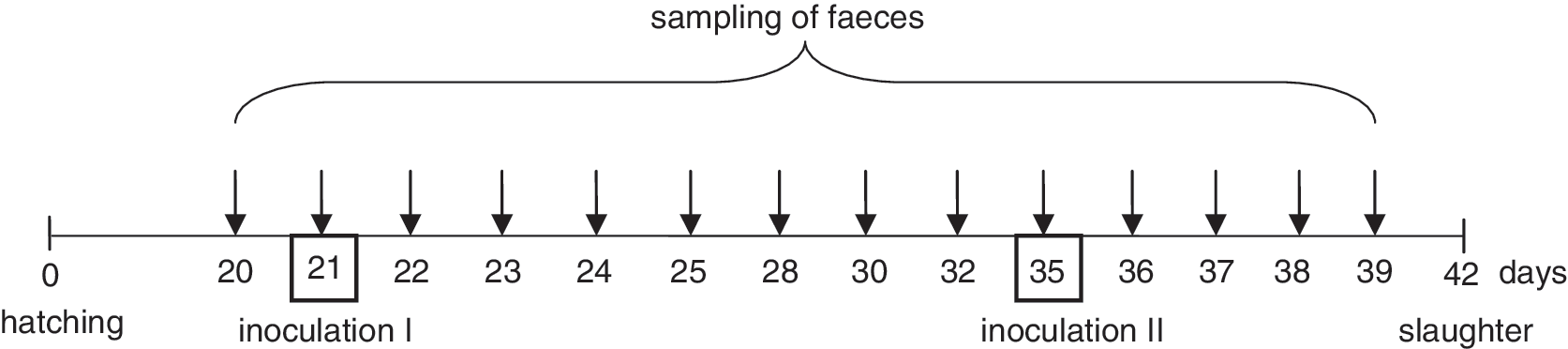
Trial design.
The results were expressed as log10 CFU/g of digesta. Differences in bacterial counts among groups were compared using an analysis of variance, followed by Scheffe test. All data were analyzed using the SAS System for Windows, 8.2 (SAS Institute, Cary, NC) (SAS Institute, 2001).
The experiment was performed under the supervision of the Ethical Committee of the Institute of Animal Science (Prague, Czech Republic) and the Central Commission for Animal Welfare of the Ministry of Agriculture of the Czech Republic.
Surface treatment of chilled chicken carcasses with CA
Eighteen chilled broiler chicken carcasses (1640±79 g) were obtained at the chilling stage of the slaughter. After delivery to the laboratory, the carcasses were washed under cold tap water for 10 s to remove any potential surface dirt and debris (Kim and Marshall, 2000). The contamination of the carcasses with bacterial cultures was performed according to Zhao et al. (2009). Briefly, for the first group, chicken carcasses were submerged in a sterile beaker containing a freshly diluted culture of C. jejuni VFU612 in sterile saline (106 CFU/mL) for 60 s. Similarly, the same procedure was used for the second group of chicken carcasses, which were inoculated with C. jejuni CCM6214. Inoculated carcasses were kept in a laminar flow hood for 20 min at room temperature to allow the attachment of bacteria. The treatment of chicken carcasses with CA was realized as described in Dolezalova et al. (2010). Each carcass was divided into halves. One half from each of the first 9 chicken carcasses was dipped into 1000 mL of a sterile solution of CA at 1.25 mg/mL for 60 s, whereas the other half was dipped in sterile distilled water for the same time. The remaining nine carcasses underwent the same procedure except that the concentration of CA used for the surface treatment was 2.5 mg/mL.
Skin pH was measured at laboratory temperature (pH meter 3520 Jenway; Bibby Scientific Limited, Staffordshire, UK); three readings per skin were performed and averaged. Chicken skin was sampled after 1, 2, and 3 days of storage at 4±2°C. For microbiological analyses, 10 g of a skin sample each day was aseptically dissected and shaken for 15 min in 90 mL of sterile peptone water (Ozdemir et al., 2006). After the skin was extracted from the solution, decimal dilutions were made using sterile peptone water; 0.1 mL of appropriate 10-fold dilutions (102–107 CFU/mL) were surface plated on Preston agar plates containing rifampicin (20 μg/mL), Preston supplement, and Laked Horse Blood (Oxoid), and the plates were incubated in microaerophilic conditions (using a Campygen Gas Generation Kit; Oxoid) at 42°C for 48 h. All samples were incubated in triplicate. Typical colonies were counted and expressed as log10 CFU/g of skin. The confirmation of the colonies was performed as described above. Differences in pH values and bacterial counts (among groups and days of storage) were compared by an analysis of variance followed by Sheffe test. All data were analyzed using the SAS program (SAS Institute, 2001).
Results
Experimental infection
The dynamics in C. jejuni shedding in all experimental groups is shown in Table 1. The Campylobacter that was first detected occurred earlier in the excreta of the chickens from the positive control group. After the first experimental infection, the highest numbers of Campylobacter in the excreta were 5.59 log10 CFU/g and occurred in a positive control group (third day postinfection). The second inoculation resulted in a maximum of 7.12 log10 CFU/g of excreta in the positive control at day 17 after the first inoculation (i.e., day 3 after the second inoculation). Feed supplementation with 0.5% CA consistently decreased fecal C. jejuni counts by 1.12–2.50 log10 CFU/g, compared with the positive control group, for 7 consecutive days after the first inoculation. After the second artificial infection, the supplementation of chicken feed with 0.25% of CA only caused statistically significant changes in C. jejuni shedding during the first 3 days. The 0.5% CA in the feed prolonged this effect for 1 day. On the fifth day after the second infection, Campylobacter shedding was not significantly different among the positive control and treated groups (p>0.05). Campylobacter (rifampicin resistant) was not detected in the negative control group (Fig. 2). After the slaughter (21 days after the first inoculation and 7 days after the second inoculation), no statistically significant changes in the numbers of C. jejuni were observed in connection with either treatment (Table 2).
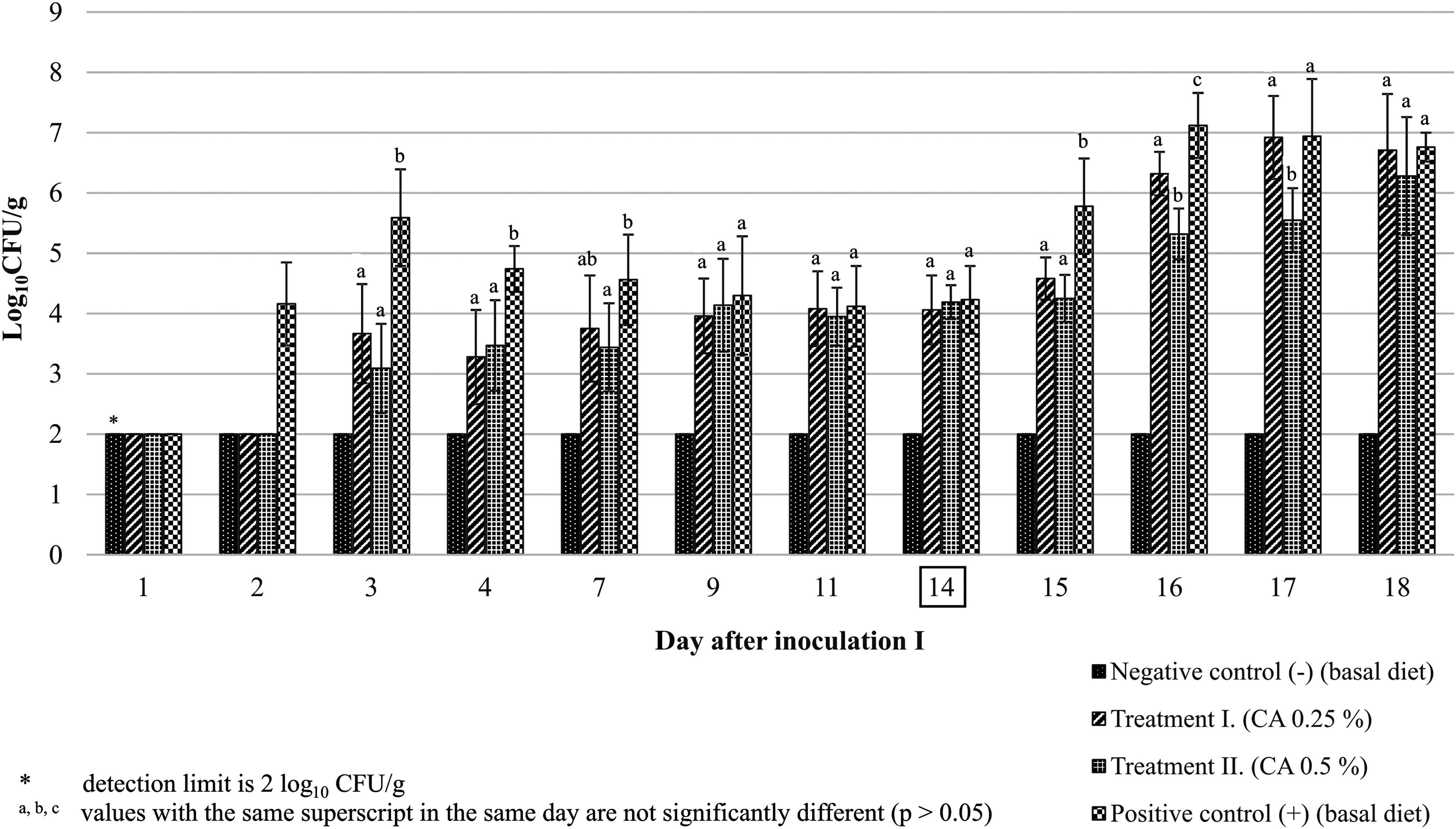
Mean numbers (log10 colony-forming units [CFU]/g) of Campylobacter jejuni in feces of male chickens.
Values in the same row with the same superscript (n=48) are not significantly different (p>0.05).
CA, caprylic acid; DL, detection limit, 2 log10 CFU/g.
Values in the same row with the same superscript are not significantly different (p>0.05).
CA, caprylic acid; DL, detection limit, 2 log10 CFU/g (n=48).
The growth performance traits of the chickens are shown in Table 3. Both treatments decreased average daily growth and negatively affected the feed intake. The final body weights of the treated animals were lower; however, changes were not statistically significant.
Values in the same row with the same superscript are not significantly different (p>0.05).
CA, caprylic acid; BW, body weight; DGI, daily growth-increments; IFI, inherited feed intake; FCR, feed conversion rate; ø DGI, average daily growth increments.
Antimicrobial activity of CA against C. jejuni attached to chicken skin
The effect of CA on the number of C. jejuni attached to the chicken skin during 3 days of storage is shown in Tables 4 and 5. Treatment of C. jejuni–contaminated samples with CA significantly decreased the numbers of C. jejuni after 1, 2, and 3 days of storage for both concentrations tested (p<0.05). The inhibitory effect (reduction of Campylobacter in treated groups, compared with the control) was consistent during the 3 days of the storage. The lower concentration decreased the numbers of C. jejuni CCM6214 by 0.68–1.12 and C. jejuni VFU612 by 0.29–0.53 orders of magnitude, whereas the higher concentration reduced the number of C. jejuni CCM6214 by 0.94–1.65 and C. jejuni VFU612 by 1.14–1.58 orders.
Mean of 9 measurements in triplicates±SD, log10 colony-forming units/g skin (n=27).
Samples were treated with sterile distilled water instead of the acid.
Values in the same column with the same superscript are not significantly different (p≥0.05).
Mean of 9 measurements in triplicates±SD, log10 colony-forming units/g skin (n=27).
Samples were treated with sterile distilled water instead of the acid.
Values in the same column with the same superscript are not significantly different (p≥0.05).
Discussion
The intestinal presence of Campylobacter in chickens is a common phenomenon, and although these organisms are rarely associated with clinical signs of illness in chickens, they can be the source of campylobacteriosis in humans (Bardon et al., 2011). The cecal presence of C. jejuni results in horizontal transmission of the pathogen and in carcass contamination during slaughter. Therefore, interventional strategies implemented at the farms for reducing C. jejuni counts in chicken intestinal tract are critical for delivering a microbiologically safer product (Solis de los Santos, 2008). CA has already been considered by other scientists as a water supplement or a feed additive for reducing Campylobacter spp. occurrence in broiler chickens. For example, a study by Hermans et al. (2012) was concerned with the application of CA to the drinking water of broilers. Results of this study demonstrated that the application of an MCFA emulsion in drinking water might be successfully applied to reduce the probability of Campylobacter colonization and can exclude drinking water as a potential contamination and transmission source. On the other hand, there are still speculations that this form may not reach the ceca in concentrations adequate for inhibiting Campylobacter (Hermans et al., 2010). Solis de los Santos (2008) showed a significant reduction of campylobacters in the cecum of 15-day-old chickens provided with feed containing 0.35%, 0.7%, 1.4%, or 2.8%, of CA. Our experimental work is in agreement with this reduction in Campylobacter spp. However, a slightly different concept was tested in our study as follows: A lower concentration range was tested, this range was tested for an entire fattening period, and the dynamics in Campylobacter shedding was evaluated. Our results showed the inhibitory effect of dietary CA; however, the action is a time-limited phenomenon.
Dietary CA in both concentrations decreased average daily growth and negatively affected the feed intake (Table 3). The effect of CA on feed consumption was also observed by Solis de los Santos et al. (2008). The lowest concentration used in their experiments was 0.35%. Even in our tests with lower concentration of CA (0.25%), the feed intake was significantly affected. The reduced consumption of feed containing CA may be caused by its effect on the satiety center (Cave, 1982).
Not only has a free form of CA been tested as a feed supplement, but its derivatives have also been tested. Hilmarsson et al. (2006) observed very interesting results in broiler chickens artificially infected with Campylobacter, where the supplementation of the feed with glycerol monocaprate (monocaprin) led to a reduction of Campylobacter in cloacal swabs. However, the supplementation did not prevent the spread of Campylobacter among the flock. The advantage of monocaprin is its better solubility. Therefore, it can also be used in drinking water. The aforementioned authors also tested this approach, with results very similar to those from feed supplementation.
Broiler chickens entering the processing facilities possess a wide variety of microbial contamination on the skin (Kotula and Pandya, 1995; Hinton and Cason, 2008). In some countries, chlorine water is used as a sanitizer in poultry processing (Directive 6355.1 of the Food Safety and Inspection Service of the U.S. Department of Agriculture dated September 23, 1996). However, the widespread use of easily available chlorine as a disinfectant in food processing has raised safety concerns regarding its carcinogenic byproducts and their potential incorporation into the food (Russell and Keener, 2007). In the United States, contrary to in Europe, organic acid rinses have been approved by the Food Safety and Inspection Service of the U.S. Department of Agriculture (Directive 6340.1 dated November 24, 1992). However, in terms of a surface treatment of chicken skin, sensory traits can be affected by CA to a certain extent (Skrivanova et al., 2015).
The effect of CA (1.25 and 2.5 mg/mL) on C. jejuni attached to broiler skin was tested in our study to assess its potential as a poultry surface decontaminant. Treatment with CA did not significantly decrease the pH of the skin (data not shown; p>0.05).
Prior to the artificial contamination of the chicken skin with C. jejuni, no rifampicin-resistant Campylobacter occurred on the chicken surface. Both concentrations of CA showed the inhibitory effect toward C. jejuni, and the activity remained obvious during the 3-day storage (Tables 4 and 5).
Previously, CA has been shown to be useful for the reduction of enteropathogenic bacteria in meat products. However, to our knowledge, the effect of free CA on chicken skin contaminated with C. jejuni has not been tested yet.
Riedel et al. (2009) used a 5% CA sodium salt (CY) solution to reduce Campylobacter on chicken skin and meat. This treatment showed a decline in C. jejuni numbers on chicken skin (1.35 log, not significantly different). The effect of CY was more pronounced (2.84 log, significantly different) after 24 h of cold storage. In case of meat treatment, the immediate reduction after dipping for 1 min was 2.25 log and nearly 4 log after 24 h of cold storage; both values were significantly higher compared with results with sterile water and skin treatments. This indicates that the 1-min dip procedure utilizing CY caused a lasting reduction of C. jejuni on chicken skin after 24 h of cold storage. The reduction of C. jejuni in our study was lower, however, compared with Riedel et al. (2009), probably due to the use of a lower concentration or a different form of the effective substance.
In our previous research, the impact of CA on Salmonella Enteritidis was tested, using similar methodology (Skrivanova et al., 2015). The results show an equal pattern in terms of antibacterial properties of CA. In this article, the additional information was given by evaluating the dynamics of bacterial shedding. We assume a very similar pattern in Salmonella Enteritidis shedding, if tested. However, this theory needs to be confirmed.
Conclusions
CA can be used as a dietary supplement for broiler chickens in terms of reducing C. jejuni occurrence. Another option, in some countries, can be the surface treatment of chilled broiler carcasses with CA.
Footnotes
Acknowledgments
The authors thank Prof. Steinhauserova for the bacterial isolate. This research was supported by the projects of Ministry of Agriculture of the Czech Republic (MZeRO07014) and Czech University of Life Sciences in Prague (CIGA 20142014).
Disclosure Statement
No competing financial interests exist.