




Abstract
The aim of this study is to understand the prevalence and molecular characterization of 16S rRNA methylase gene, rmtB, among Escherichia coli strains isolated from bovine mastitis in China. A total of 245 E. coli isolates were collected from bovine mastitis in China between 2013 and 2014 and were screened for 16S rRNA methylase genes (armA, rmtA, rmtB, rmtC, rmtD, rmtE, and npmA) by polymerase chain reaction. About 5.3% (13/245) of the isolates carried the rmtB gene; the isolates were highly resistant to amikacin. Thirteen rmtB-positive strains were analyzed for the presence of extended-spectrum β-lactamase genes (bla TEM , bla CTX-M , bla OXA , and bla SHV). All the isolates harbored both bla TEM-1 and bla CTX-M-15 genes and two of the isolates were also positive for bla OXA-1. Pulsed-field gel electrophoresis (PFGE) analysis indicated that the nine rmtB-positive strains belonging to ST10 from one farm showed the similar PFGE pattern, indicating a clonal expansion in this farm. S1-PFGE and Southern blotting showed that 12 isolates harbored the rmtB gene in plasmids of two different sizes (≈45 kb [n=10] and ≈48 kb [n=2]), while only 1 strain harbored the rmtB gene in the chromosome. These plasmids were transferable by conjugation studies, and two isolates from two respective farms carried the same size of plasmid, suggesting that the horizontal transmission of plasmids also contributed to the spread of rmtB gene. This is the first report of prevalence of the 16S rRNA methylase gene rmtB among E. coli isolated from bovine mastitis in China, and rmtB-carrying E. coli may pose a threat to the treatment of bovine mastitis.
Introduction
A
Materials and Methods
Bacterial isolates
From May 2013 to July 2014, a total of 245 E. coli isolates were collected from subclinical or clinical cases of bovine mastitis in six farms in Ningxia Province, China. In total, 1258 mastitis milk samples were inoculated on MacConkey agar plates and incubated at 37°C for 18 h. After Gram-staining microscopy, suspected colonies were inoculated on CHROMagar E. coli agar (CHROMagar Company, Paris, France) and incubated at 37°C for 18–24 h. The blue-colored colonies on the culture plates were regarded as presumptive E. coli colonies, and only one colony per plate was picked. Identification was later confirmed by biochemical analysis using an API 20E microsubstrate system (bioMérieux, Marcy l'Etoile, France). All confirmed E. coli isolates were stored at −80°C in Brain Heart Infusion (BHI, Land Bridge Technology Company, Beijing, China) broth medium containing 20% glycerol.
Antimicrobial susceptibility testing
The minimum inhibitory concentration (MIC) of various antimicrobial agents was determined by the broth microdilution method according to the guidelines recommended by the Clinical and Laboratory Standards Institute (CLSI, 2013). An inoculum of 105 colony-forming units per milliliter was incubated in Mueller-Hinton broth (MHB) in the presence of twofold serial dilutions of antimicrobials and the MIC was defined as the lowest concentration of antibiotic completely inhibiting visible growth. The following antimicrobial agents and the concentrations (μg/mL) were tested: ampicillin (256-0.25), cefazolin (128-0.125), cefotaxime (64-0.0625), streptomycin (128-0.125), gentamicin (128-0.125), kanamycin (256-0.25), amikacin (256-0.25), tetracycline (128-0.125), doxycycline (128-0.125), chloramphenicol (128-0.125), florfenicol (128-0.125), polymyxin B (128-0.125), ciprofloxacin (16-0.015625), norfloxacin (64-0.0625), enrofloxacin (32-0.03125), ofloxacin (32-0.03125), and sulfamethoxydiazine (512-0.5). The E. coli ATCC 25922 was used as a quality-control strain.
Detection of 16S rRNA methylase and ESBL genes
Two hundred forty-five E. coli strains were screened for 16S rRNA methylase genes (armA, rmtA, rmtB, rmtC, rmtD, rmtE, and npmA) by polymerase chain reaction (PCR) as shown in Table 1. Isolates that were positive for any of the genes mentioned above were further analyzed for the presence of ESBL genes (bla TEM , bla CTX-M , bla OXA , and bla SHV), using previously described primers, shown in Table 1. All of the positive PCR amplicons were confirmed by sequencing. The obtained DNA sequences were compared with those in GenBank using the BLAST program.
Pulsed-field gel electrophoresis (PFGE) analysis
To further characterize the genetic backgrounds of the 13 rmtB-positive isolates, they were digested with the restriction enzyme XbaI and then subjected to PFGE analysis, according to the PulseNet Standardized Laboratory Protocol (Efrain et al., 2001), using the CHEF MAPPER™ System (Bio-Rad Laboratories, Hercules, CA). The gels were run at 6.0 V/cm with initial and final switch times of 2.16 s and 54.17 s, respectively, at an angle of 120° at 14°C for 18.5 h. Salmonella serovar Braenderup H9812 was used as a standard size marker. Cluster analysis of pulsotypes was carried out according to the Dice coefficient method using InfoQuest FP Software (Version 4.5, Bio-Rad). The isolates with more than 85% similarity belonged to 1 PFGE cluster.
Multilocus sequence typing (MLST)
In order to compare the E. coli isolates found in this study with others described previously, the isolate was genotyped by MLST. MLST was conducted according to an established protocol (Wirth et al., 2006). Seven housekeeping genes (adk, fumC, gyrB, icd, mdh, purA, and recA) were amplified and sequenced following the website instructions (
Conjugation experiments
Conjugation experiments were carried out to determine the transferability of 16S rRNA methylase genes according to Wang et al. (2003). The donor (rmtB-positive isolates) and the recipient (E. coli J53AzR) were inoculated separately into BHI broth and incubated at 37°C for 5 h with shaking. They were then mixed for conjugation at a ratio of 1:3 (vol/vol). Next, the mixtures were coated onto filter sterilized membranes, and incubated on BHI agar at 37°C. After 24-h incubation, the filter membranes were flushed with 1 mL BHI broth, and the flushing fluid plated onto MacConkey agar supplemented with amikacin (32 μg/mL) and sodium azide (150 μg/mL). The transconjugants were selected and confirmed by PCR. The MICs for donors, transconjugants, and the recipient were determined by the broth microdilution method in accordance with CLSI standards (CLSI, 2013).
Southern hybridization
In order to determine the location of the rmtB-positive gene on plasmids or in the chromosomal DNA, Southern blotting was performed (Xia et al., 2010) by standard methods with rmtB-specific digoxigenin (DIG)-labeled probes formed by the PCR DIG detection system according to the manufacturer's instruction (Roche Diagnostics Gmbh, Mannheim, Germany). Briefly, S1 nuclease PFGE was carried out to estimate the sizes of plasmids according to Barton et al. (1995). After depurination, denaturation, and neutralization of the S1 PFGE agarose gels, the DNA was transferred to a positively charged nylon membrane (Millipore, Billerica, MA) by capillary action overnight at 25°C. Hybridization was performed by using rmtB-specific DIG-labeled probe with DIG Easy Hyb solution at 42°C for 12 h in a hybridization oven. Then the band was detected by chemiluminescence with anti-DIG, alkaline phosphate, and substrate after immunodetection.
Results
Susceptibility testing
Results of antimicrobial susceptibility profiles of the 245 E. coli strains that were tested against 17 antibiotics are shown in Figure 1. The highest proportion of resistance was towards ampicillin (51.84%), followed by streptomycin (37.96%), doxycycline (36.33%), tetracycline (35.51%), chloramphenicol (33.06%), cefazolin (30.20%), and sulfamethoxydiazine (28.57%) (Fig. 1). The relatively susceptible antimicrobials were quinolones (ciprofloxacin, norfloxacin, enrofloxacin, and ofloxacin) (Fig. 1).
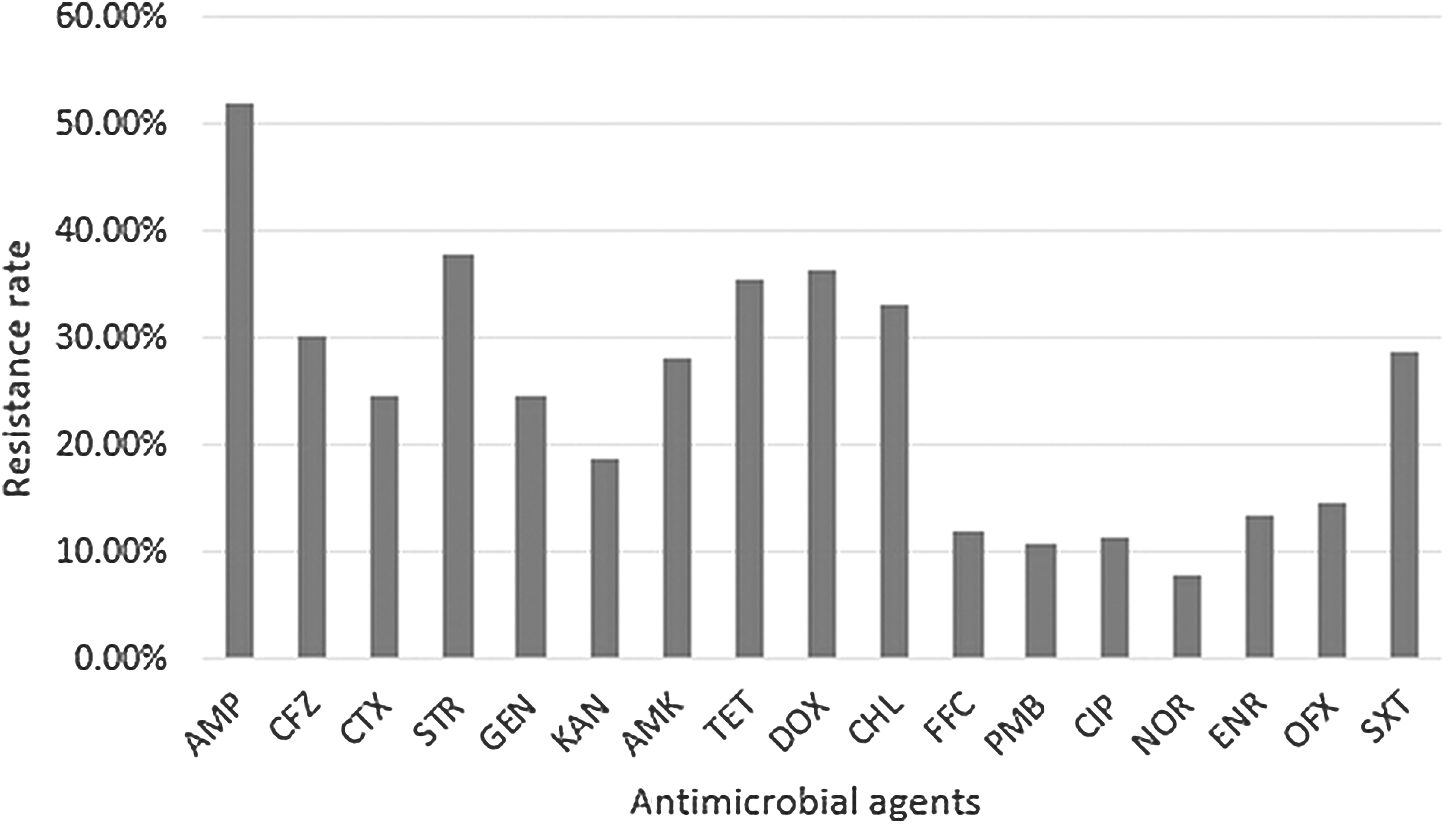
The resistance rate of 245 Escherichia coli strains to 17 antimicrobial agents. AMP, ampicillin; CFZ, cefazolin; CTX, cefotaxime; STR, streptomycin; GEN, gentamicin; KAN, kanamycin; AMK, amikacin; TET, tetracycline; DOX, doxycycline; CHL, chloramphenicol; FFC, florfenicol; PMB, polymyxin B; CIP, ciprofloxacin; NOR, norfloxacin; ENR, enrofloxacin; OFX, ofloxacin; SXT, sulfamethoxydiazine.
Detection of 16S rRNA methylase and β-lactamase genes
Of the 245 E. coli isolates tested, only 13 (5.3%), collected from 4 farms, carried the rmtB gene. All isolates were negative for the armA, rmtA, rmtC, rmtD, rmtE, and npmA genes (Table 2). Additionally, the 13 rmtB-positive isolates were examined for ESBL genes. All the isolates harbored both bla TEM-1 and bla CTX-M-15 genes. Two of the isolates were also positive for bla OXA-1. No isolate harbored the blaSHV gene (Table 2).
PFGE, pulsed-field gel electrophoresis; MLST, multilocus sequence typing; MIC, minimum inhibitory concentration; AMP, ampicillin; CFZ, cefazolin; AMK, amikacin; GEN, gentamicin; KAN, kanamycin; TET, tetracycline; FFC, florfenicol; CIP, ciprofloxacin; T, transconjugants.
PFGE analysis and MLST
PFGE analysis of the 13 rmtB-positive isolates demonstrated that there were five different PFGE cluster patterns, designated A, B, C, D, and E (Fig. 2). PFGE cluster E consisted of nine isolates that originated from the same farm, whereas the four PFGE patterns (A, B, C, and D) contained only a single isolate, each from a distinct farm. The MLST revealed that 11 isolates belonged to the clonal lineage ST10 with the MLST allelic profile 10-11-4-8-8-8-2, whereas only 1 isolate belonged to ST446 with the MLST allelic profile 6-19-33-26-11-8-6. The nine isolates of the same PFGE pattern belonged to ST10, and the other two ST10 isolates were clonally unrelated (Table 2).
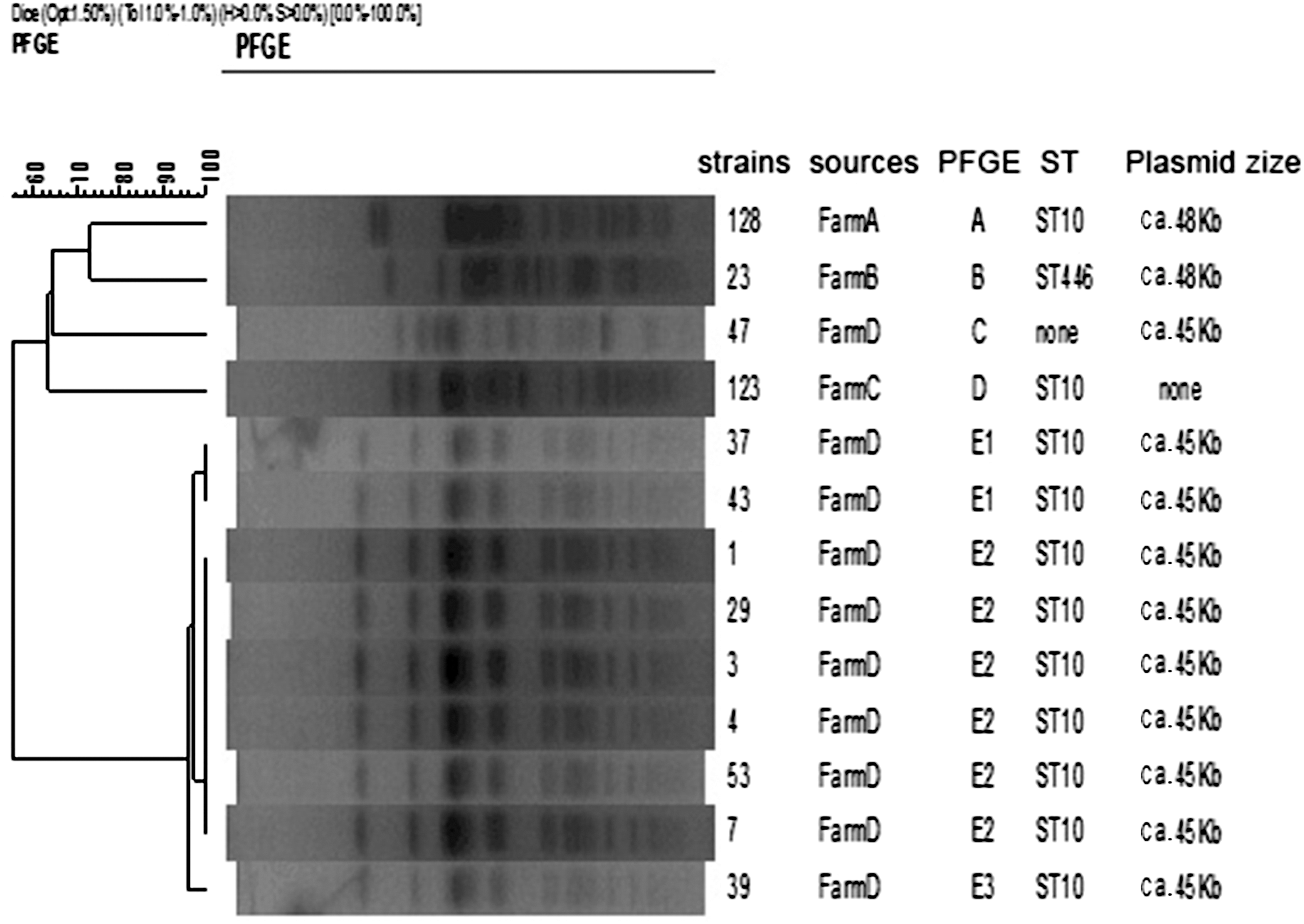
Pulsed-field gel electrophoresis (PFGE) analysis patterns of rmtB-positive isolates. ST, sequence type.
Conjugation experiments
The transfer of amikacin by conjugation to E. coli J53 was successful for 12 of the 13 rmtB-positive isolates. PCR confirmed the presence of rmtB and bla TEM-1, genes in 12 transconjugants, and the presence of the bla CTX-M-15 gene in nine transconjugants (Table 2). The transconjugants showed resistance profiles in various levels compared to the donors. Transconjugants showed great increases in the MICs of ampicillin, cefazolin, amikacin, gentamicin, and tetracycline, when compared to the recipient J53. Regarding the MICs of florfenicol and ciprofloxacin, there was almost no change (Table 2).
Southern hybridization
The Southern hybridization results revealed that the rmtB gene from 12 isolates and their transconjugants were located on plasmids of 2 different sizes (≈45 kb [n=10] and ≈48 kb [n=2]), and that a single isolate was located on the chromosome (Fig. 3). Ten isolates in which the rmtB gene was located on the≈45-kb plasmid came from the same farm, while the other 2 isolates from 2 different farms were located on the same≈48-kb plasmid.
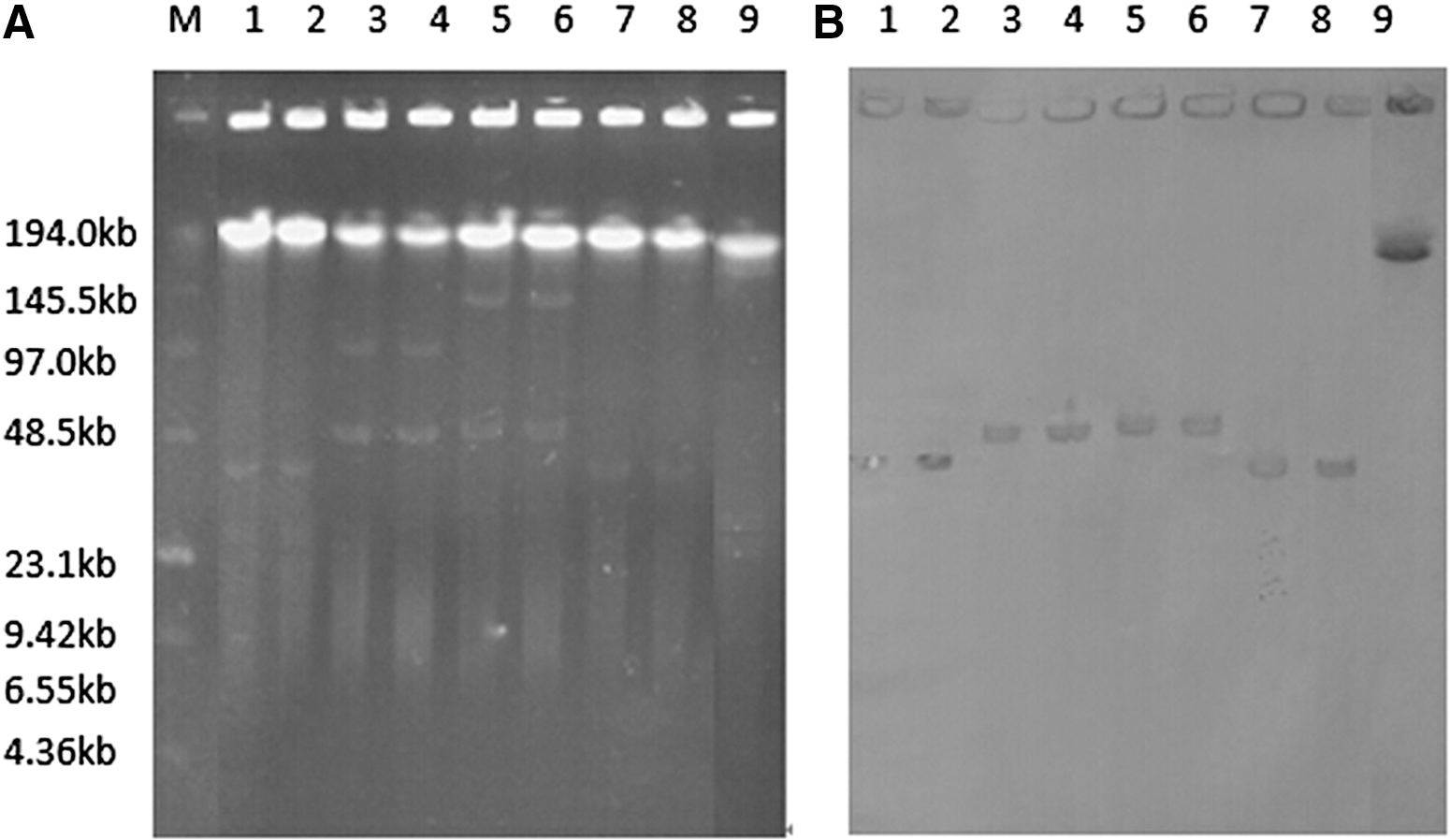
S1-Pulsed-field gel electrophoresis (PFGE) and Southern blot profiles of rmtB-positive isolates and their transconjugants.
Discussion
The 16S rRNA methylases pose a public health threat because they confer broad and high-level resistance to most clinically available aminoglycosides. In recent years, diverse 16S rRNA methylases have emerged as acquired resistance determinants in several genera of the Enterobacteriaceae, and have been detected not only in humans (Hidalgo et al., 2013) but also in pets (Deng et al., 2011), livestock (Gonzalez-Zorn et al., 2005), and food (Granier et al., 2011). The most frequent 16S rRNA methylases in Enterobacteriaceae are armA, rmtB, rmtF, and npmA (Doi and Arakawa, 2007b; Wachino et al., 2007). To date, only armA and rmtB have been detected in clinical strains isolated from some animals and humans in China (Liu et al., 2013; Yu et al., 2009). In this study, we first detected the 16S rRNA methylase gene rmtB among E. coli isolated from bovine mastitis in China.
Our study showed that 18 E. coli isolates were highly resistant to amikacin (MIC≥128 μg/mL), kanamycin (MIC≥128 μg/mL), gentamicin (MIC≥64 μg/mL), and streptomycin (MIC≥64 μg/mL) (Table 2). Among these strains, 13 isolates (72%) carried the rmtB gene (MIC≥256 μg/mL), indicating that rmtB was the dominant 16S rRNA methylase gene in high-level aminoglycoside-resistant E. coli in Ningxia, China. These results also indicated that high-level amikacin resistance is an appropriate indicator for the presence of 16S rRNA methylase in clinical isolates of Gram-negative bacteria. The prevalence rate of rmtB from bovine mastitis in this study was lower (5.3%) than that of previous studies from China (11.5%) (Liu et al., 2013) and Brazil (7.63%) (Fritsche et al., 2008).
Previous reports have shown that 16S rRNA methylase genes are often associated with other resistance determinants, such as bla TEM, bla CTX-M , bla SHV, and bla OXA (Galimand et al., 2003; Doi et al., 2004, 2007c; Ma et al., 2009). The current study also showed that 16S rRNA methylase, rmtB-positive isolates had higher resistance not only to aminoglycosides, but also to β-lactams. The linkage of the ESBL-encoding genes and rmtB was also observed. As shown in Table 2, all of the 13 rmtB-positives isolates harbored both bla TEM-1 and bla CTX-M-15 genes, whereas 2 isolates, collected from different farms, were positive for bla OXA-1. In addition, these isolates presented high-level resistance to ampicillin and cefazolin.
In this study, the 13 rmtB-positive E. coli isolates were successfully typed by PFGE, and a total of 5 different PFGE profiles were obtained. Nine isolates in PFGE cluster E came from the same farm, which indicated that the rmtB-positive isolates were spread mainly by clonal dissemination. MLST results showed that there were two sequence types (STs) among the 13 rmtB-positive isolates, namely, ST10 and ST446. Of the 11 isolates belonging to ST10, 9 were of the same PFGE type E, which showed similarity >80%. Others, including 2 ST10 and 1 ST446, also showed similarity (<80%) by PFGE, but were clonally unrelated. Therefore, these results revealed that ST10 was the main ST type, which was widespread in the dairy farms we surveyed. This ST has also been reported in cow milk in Tunisia (Grami et al., 2014). The sharing of ST10 isolates detected in our study is relevant since isolates with this ST are emerging as pathogens (Manges and Johnson, 2012). ST10 has a global distribution that has not only been detected in animals such as avian (Pires-dos-Santos et al., 2013; Blaak et al., 2014; Dissanayake et al., 2014), veal calves (Hordijk et al., 2013), and dogs (Dahmen et al., 2013), but also in humans (Oteo et al., 2009; Ben Sallem et al., 2012). Although ST10 seems to be an important zoonotic-associated ST worldwide, this is the first reported in bovine mastitis in China. Only one isolate in our study belonged to ST446, which was previously detected in multi-drug-resistant E. coli, isolated from food-producing animals, and humans in Switzerland (Wang et al., 2013).
Conjugation experiments showed that plasmid transfer of high-level aminoglycoside resistance to E. coli J53 was successful for 12 of the 13 rmtB-positive isolates. The antimicrobial MICs revealed that resistance to aminoglycosides and β-lactam antibiotics were transferred into the recipient. The results of Southern hybridization revealed that the rmtB gene in 12 isolates was located on plasmids of two different sizes and their transconjugants, while in 1 isolate it was located on the chromosome. Although most of 16S rRNA methylase genes were shown to be located on plasmids (Du et al., 2009; Liu et al., 2013), evidence from this study showed that the rmtB gene among E. coli isolates from bovine mastitis in Ningxia was not only located on plasmids, but was also on the chromosome.
Findings of PFGE, conjugation experiments, and Southern hybridization suggested that the transfer of the rmtB gene was due to clonal spread within the same farms, as well as horizontal plasmid spread among different farms. Therefore, both two modes contributed to the transmission of resistance. The clonal spread will usually lead to one epidemic clone in one area and the horizontal spread could cause drug-resistant plasmids widely diffused among different bacterial clones from multiple farms. Previously, it was reported that both horizontal transfer and clonal spread were responsible for the dissemination of the rmtB gene in E. coli isolated from pigs in China (Chen et al., 2007). Considering that the resistant genes may be transmitted to humans through the food chain, the spread of 16S rRNA methylase genes should be taken into serious consideration.
Conclusions
To our knowledge, this is the first report of prevalence of the 16S rRNA methylase gene rmtB among E. coli isolated from bovine mastitis in China. In addition, our findings indicate that rmtB is the predominant 16S rRNA methylase gene mediating high-level aminoglycoside resistance in Ningxia, China. The results of PFGE, conjugation experiments, and Southern hybridization suggested that both clonal expansion in local areas and horizontal transmission between different farms contributed to the spread of the rmtB gene. Thus, aminoglycoside-resistant isolates producing rmtB may become a major therapeutic threat for bovine mastitis in future.
Footnotes
Acknowledgments
The study was supported by the National Natural Science Foundation of China (31160519).
Disclosure Statement
No competing financial interests exist.