




Abstract
Salmonella Kentucky has become the predominant serovar recovered from broilers slaughtered in the United States, and the prevalence of antimicrobial resistance (AMR) has increased dramatically in this serovar. Relationships between AMR, genotype, and plasmid replicon types were characterized for 600 Salmonella Kentucky isolates recovered from chicken carcasses from 2004 to 2013. Pulsed-field gel electrophoresis cluster analysis revealed 112 unique types sharing 79% similarity. Over half of the isolates studies were assigned to two large clusters (unique restriction patterns) consisting of 190 (A) and 151 (B) isolates. The remaining (n = 259) more diverse isolates (110 unique patterns) shall be designated cluster C for discussion. Clusters A had significantly more (p < 0.05) isolates resistant to streptomycin (68.4%) and tetracycline (91.6%) compared to cluster C (50.6% and 40.9% to streptomycin and tetracycline, respectively) or cluster B, which had the least (p < 0.05) resistance (11.9% and 13.2% to streptomycin and tetracycline, respectively). In addition, there was segregation of plasmid replicon types among clusters. Cluster A had significantly more (p < 0.05) replicon type FIB (90.5%) compared to cluster C (37.1%), which had significantly more compared to cluster B (10.6%). Cluster B had significantly more (p < 0.05) replicon type I1 (87.4%) compared to cluster C (68.7%), which had significantly more (p < 0.05) compared to cluster A (32.6%). Cluster C harbored significantly more (p < 0.05) HI2 replicon type (18.1%) compared to clonal clusters A (1.6%) or B (1.3%). The prevalence of plasmid replicon type A/C did not differ among clusters (A, 0.5%; B, 2.0%; C, 0.4%). Both streptomycin and tetracycline resistance were significantly linked (p < 0.05) to plasmid replicon type FIB. In addition, replicon type HI2 was also significantly linked (p < 0.05) to streptomycin resistance. We conclude that the dramatic increase in streptomycin and tetracycline resistance among Salmonella Kentucky isolated from poultry is due to the expansion of strains harboring plasmid replicon types FIB and HI2.
Introduction
S
Contaminated raw and undercooked poultry are important transmission vehicles of human salmonellosis (Kimura et al., 2004; Marcus et al., 2007). In the United States, over the past two decades Salmonella enterica serovar Kentucky has become the predominant serovar recovered from broiler slaughter samples. Over this same time interval, the prevalence of resistance to streptomycin and tetracycline has increased dramatically among Salmonella Kentucky isolates recovered from chicken (National Antimicrobial Resistance Monitoring System [NARMS]
There has been a growing public health concern over the emergence of antimicrobial resistance (AMR) and multidrug resistance among Salmonella serovars recovered from animals and humans. The majority of the genes associated with AMR among Salmonella are attributed to large transferable plasmids. Plasmid-linked genes encoding AMR, virulence factors, and toxin production enable their bacterial host to adapt and persist in changing environments (Frost et al., 2005; Bennett, 2008). Plasmids with similar replication controls are unable to coexist in the same host cell, thus may be characterized into incompatibility (Inc)-based groups.
To determine the plasmid types associated with the increasing prevalence of streptomycin and tetracycline resistance among broiler slaughter isolates, we characterized the AMR and plasmid replicon profiles of a randomly selected subset of Salmonella Kentucky isolates recovered from broiler carcasses.
Materials and Methods
Bacterial isolates
Six hundred Salmonella Kentucky isolates used in these studies were cultured from chicken carcass rinsates collected through USDA Food Safety Inspection Service (FSIS) Salmonella PR/HACCP verification testing program from 2004 to 2013. HACCP verification program isolates were submitted from each of the three FSIS filed laboratories and represent chicken slaughter facilities throughout the United States. Salmonella serovars were determined at the USDA National Veterinary Services Laboratories (Ames, IA). The 600 randomly selected Salmonella Kentucky isolates included in these studies were distributed by year as follows: 2004, n = 90; 2005, n = 152; 2006, n = 106; 2007, n = 72; 2008, n = 28; 2009, n = 32; 2010, n = 28; 2011, n = 35; 2012, n = 36; and 2013, n = 21. Bacterial strains were stored at −80°C in LB Lennox (Becton and Dickinson and Company, Franklin Lakes, NJ) with 30% glycerol (Thermo Fisher Scientific, Waltham, MA) and were resuscitated on sheep blood agar (Remel, Lenexa, KS) for further characterization.
Antimicrobial susceptibility testing
Salmonella isolates were evaluated for susceptibilities to a panel of 15 antimicrobials. Minimal inhibitory concentrations (MIC) were determined by the broth microdilution using the Sensititre system (Thermo Fisher Scientific) and recommended quality control organisms. The antimicrobials included amikacin (2004 through 2010, amikacin testing discontinued in 2011), amoxicillin–clavulanic acid, ampicillin, cefoxitin, ceftiofur, ceftriaxone, chloramphenicol, ciprofloxacin, gentamicin, kanamycin, nalidixic acid, streptomycin, sulfisoxazole, tetracycline, and trimethoprim–sulfamethoxazole. MICs were interpreted according to the Clinical and Laboratory Standards Institute (CLSI) guidelines when available, or by using the criteria established by the NARMS (
Multiplex polymerase chain reaction for plasmid replicon typing
All Salmonella isolates were examined for the presence of 18 plasmid replicons using three multiplex polymerase chain reaction (PCR) assays as described by Johnson et al (2007). Primers were obtained from Eurofins MWG Operon (Huntsville, AL). Reference plasmid DNA and isolate template DNA for PCR were prepared by suspending an isolated colony in 200 μL of sterile water and heating at 100°C for 10 min. PCRs were performed using HotStart Taq plus DNA polymerase (Qiagen, Valencia, CA) according to the manufacturer's instructions. PCR cycle conditions were as follows: 5 min at 94°C: 30 cycles of 30 s at 94°C, 30 s at 60°C, and 90 s at 72°C, and a final extension step of 5 min at 72°C. Amplicons were visualized on 1× Tris-borate-EDTA 2% agarose gels alongside a 100-bp ladder (Bio-Rad, Hercules, CA). Positive and negative controls (without DNA) were run with each multiplex primer panel. Isolates were considered positive for a particular gene if an amplicon of the expected size was observed.
Pulsed-field gel electrophoresis
DNA macrorestriction profiles were determined by performing pulsed-field gel electrophoresis (PFGE) with XbaI digestion on all 600 Salmonella isolates using a standardized PulseNet protocol (CDC, 2004). BioNumerics software ver.6.6 (Applied-Maths, Kortrijk, Belgium) was utilized for cluster analysis using the Dice coefficient, 1.5% band tolerance, 1.5% optimization, and the unweighted-pair group method with arithmetic mean.
Statistical analysis
Correlations between antimicrobial susceptibility and plasmid replicon types were determined by linkage disequilibrium, calculated as an extension of Fisher's exact probability test using Arlequin ver. 3.5 (Excoffier et al., 2005). Standard settings were used: 10,000 steps in the Markov chain and 1000 dememorization steps; calculations of D, D′, and r2 coefficients were made using a significance level of p < 0.05. Differences in antimicrobial susceptibility and prevalence of plasmid replicon types over time were determined using Fisher's exact probability test with a significance level of p < 0.05.
Results
Antimicrobial susceptibility
Of the 600 Salmonella Kentucky isolates examined, 236 (39.3%) were susceptible to all antimicrobials tested. The prevalence of AMR among Salmonella Kentucky isolates is shown by year in Table 1. The highest prevalence of AMR was observed for tetracycline (50.0%) followed by streptomycin (46.5%). The prevalence of resistance to ampicillin, amoxicillin–clavulanic acid, ceftriaxone, ceftiofur, and cefoxitin ranged from 14.3% to 16.7%, and the prevalence of resistance to chloramphenicol, gentamicin, kanamycin, nalidixic acid, sulfisoxazole, and trimethoprim–sulfamethoxazole was ≤3.5%. No isolates were resistant to amikacin or ciprofloxacin. Examination of the AMR over time (2004–2013) shows a significant increase (p < 0.05) in streptomycin (32.2–81.0%) and tetracycline (40.0–61.9%) resistance.
Values within rows without common superscripts are significantly different (p < 0.05) by Fisher's exact probability test.
NT, not tested.
Plasmid replicon types
A PCR-based replicon typing assay for detection of 18 different plasmid Inc types was performed on all Salmonella Kentucky isolates. The most prevalent Inc replicon types observed among the 600 isolates were I1 (62.0%), FIB (47.3%), and HI2 (8.7%). Replicon types A/C, K/B, P, and FIC were detected in less than 1% of the isolates (Table 2), and none of the isolates harbored B/O, T, W, FIIA, FIA, Y, X, HI1, N, or L/M replicon types. A single replicon type was detected in the majority (92.4%) of pan-susceptible isolates. Isolates that were resistant to one or more antimicrobials generally harbored one (61.6%) or two (36.2%) plasmid replicon types (Table 3). The plasmid typing assay used in this study only detects 18 of the 26 known Inc replicon types in Enterobacteriaceae (Johnson et al., 2007); however, replicon types were detected in all but 3.8% of the Salmonella Kentucky isolates tested.
Values within rows without common superscripts are significantly different (p < 0.05) by Fisher's exact probability test.
No isolates were identified that harbored B/O, T, W, FIIA, FIA, Y, X, HI1, N, or L/M replicon types.
Plasmid profiles by PFGE cluster assignment.
Antimicrobials: amoxicillin/clavulanic acid (Amo), ampicillin (Amp), cefoxitin (Fox), ceftiofur (Tio), ceftriaxone (Axo), chloramphenicol (Chl), gentamicin (Gen), kanamycin (Kan), nalidixic acid (Nal), streptomycin (Str), sulfisoxazole (Sul), tetracycline (Tet), and trimethoprim/sulfamethoxazole (Tri).
The prevalence (n) of Inc replicon types detected among isolates with a common antimicrobial resistance profile. A minus sign (−) indicates no plasmid replicon type detected.
PFGE, pulsed-field gel electrophoresis.
PFGE cluster analysis
Cluster analysis based on PFGE patterns of the 600 Salmonella Kentucky broiler isolates used in these studies revealed 112 unique types sharing 79% similarity (Fig. 1). Over half of the isolates studies were assigned to two large clusters (unique restriction patterns) consisting of 190 (A) and 151 (B) isolates. The remaining (n = 259) more diverse isolates (110 unique restriction patterns) shall be designated cluster C for discussion. Figure 2 shows the distribution of isolates in clusters A, B, and C over the study period. Supplementary Figure S1 (Supplementary Data are available online at

PFGE cluster analysis of 600 Salmonella enterica serovar Kentucky isolates recovered from chicken slaughter from 2004 to 2013 with associated AMR profiles. Cluster “A” consists of 190 isolates harboring plasmid replicon types; FIB (90.5%), I1 (32.6%), HI2 (1.6%), and A/C (0.5%). Cluster “B” consists of 151 isolates harboring plasmid replicon types; FIB (10.6%), I1 (87.4%), HI2 (1.3%), and A/C (2.0%). Cluster “C” includes all remaining isolates (n = 259), which harbor plasmid replicon types; FIB (37.1%), I1 (68.7%), HI2 (18.1%), and A/C (0.4%). AMR, antimicrobial resistance; PFGE, pulsed-field gel electrophoresis.
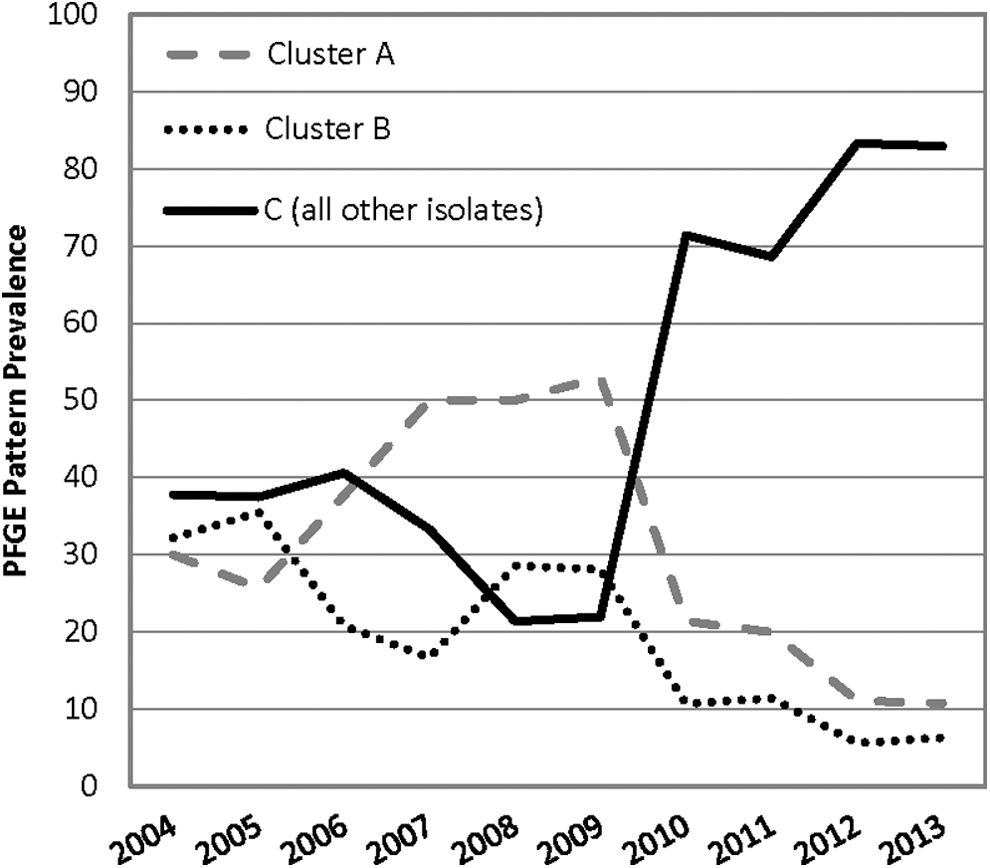
Prevalence of PFGE restriction patterns among 600 Salmonella enterica serovar Kentucky isolates recovered from chicken slaughter from 2004 to 2013. Cluster “A” represents 190 isolates with a common PFGE restriction pattern. Cluster “B” represents 151 isolates with a common PFGE pattern. “C” represents the remaining 259 more diverse isolates, including 110 distinguishable PFGE patterns. PFGE, pulsed-field gel electrophoresis.
The larger of the two clusters (A) had significantly more (p < 0.05) isolates resistant to streptomycin (68.4%) and tetracycline (91.6%) compared to cluster C (50.6% and 40.9% to streptomycin and tetracycline, respectively) or cluster B, which had the least (p < 0.05) resistance (11.9% and 13.2% to streptomycin and tetracycline, respectively). In addition, there was segregation of plasmid replicon types among clusters. Cluster A had significantly more (p < 0.05) replicon type FIB (90.5%) compared to cluster C (37.1%), which had significantly more compared to cluster B (10.6%). Cluster B had significantly more (p < 0.05) replicon type I1 (87.4%) compared to cluster C (68.7%), which had significantly more (p < 0.05) compared to cluster A (32.6%). The more diverse isolates, cluster C, harbored significantly more (p < 0.05) HI2 replicon type (18.1%) compared to clonal clusters A (1.6%) or B (1.3%). The prevalence of plasmid replicon type A/C did not differ among clusters (A, 0.5%; B, 2.0%; C, 0.4%).
Linkage disequilibrium analysis
Linkage disequilibrium analysis was performed to determine the significance of relationships between plasmid Inc types and AMR (Fig. 3). IncI1, the most prevalent replicon type detected in this study, was observed to have significant linkage (p < 0.05) to FIB replicon type and eight antimicrobials, including amoxicillin/clavulanic acid, ampicillin, cefoxitin, ceftriaxone, ceftiofur, gentamicin, streptomycin, and tetracycline. Inc I1 was detected in 88.4% of Salmonella Kentucky isolates resistant to five or more antimicrobials (n = 95) and 85.7% of the isolates resistant to nine or more antimicrobials (n = 7, Table 3). In contrast, the I1 replicon type was detected much less frequently among isolates resistant to only streptomycin (14.3%, n = 21) or tetracycline (14.6%, n = 48), and isolates resistant to both streptomycin and tetracycline only (27.0%, n = 185). IncI1 was also detected in 91.5% of the pan-susceptible isolates (n = 236).
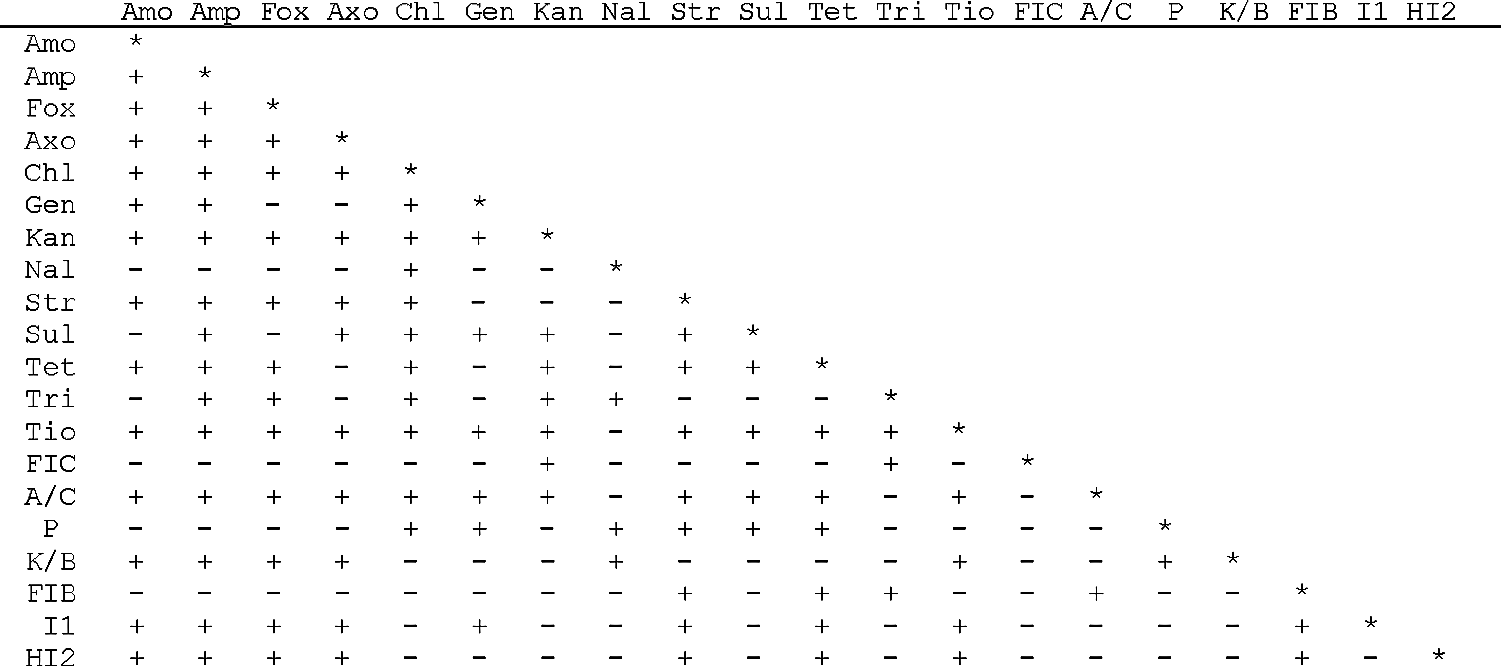
Pairwise linkage disequilibrium analysis of observed AMR and plasmid replicon types among 600 Salmonella enterica serovar Kentucky isolates recovered from chicken slaughter from 2004 to 2013. A “+” indicates a p value of 0.05 or less, indicating significant linkage, and a “−” indicates a p value of greater than 0.05. Antimicrobials: amoxicillin/clavulanic acid (Amo), ampicillin (Amp), cefoxitin (Fox), ceftiofur (Tio), ceftriaxone (Axo), chloramphenicol (Chl), gentamicin (Gen), kanamycin (Kan), nalidixic acid (Nal), streptomycin (Str), sulfisoxazole (Sul), tetracycline (Tet), and trimethoprim/sulfamethoxazole (Tri). No isolates were resistant to amikacin or ciprofloxacin, and no isolates were identified that harbored B/O, T, W, FIIA, FIA, Y, X, HI1, N, or L/M replicon types. AMR, antimicrobial resistance.
IncFIB replicon type was significantly linked (p < 0.05) with streptomycin and tetracycline resistance. FIB was detected in 95.8% of isolates resistant to tetracycline only and 97.8% of the isolates resistant to both streptomycin and tetracycline only. Examination of the plasmid replicon types over time (Table 2) showed a significant increase (p < 0.05) in the prevalence of IncFIB (35.6–61.9%), with concurrent significant increases in streptomycin (32.2–81.0%) and tetracycline (40.0–61.9%) resistance (Table 1).
IncHI2 was significantly linked to amoxicillin/clavulanic acid, ampicillin, cefoxitin, ceftriaxone, ceftiofur, streptomycin, and tetracycline. HI2 was found in 24.5% of the isolates resistant to five or more antimicrobials and was the predominant replicon type observed (76.2%) among isolates resistant to streptomycin only. IncA/C was significantly linked with resistance to 11 antimicrobials, amoxicillin/clavulanic acid, ampicillin, cefoxitin, ceftriaxone, ceftiofur, chloramphenicol, gentamicin, kanamycin, streptomycin, sulfisoxazole, and tetracycline, and was present in 71.4% of the isolates resistant to nine or more antimicrobials (n = 7).
Discussion
This study was designed to characterize a set of Salmonella Kentucky isolates representative of broiler slaughter industry in the United States, for their AMR phenotype, plasmid replicon type, and PFGE genotypes to further understand the distribution of AMR in relation to plasmids based upon replicon types. Linkage analysis revealed significant correlations between AMR profiles and plasmid replicon types. Analysis of the PFGE patterns determined that two large clusters comprised over half (56.8%) of the isolates studied. The remaining isolates (n = 259) were genotypically more diverse, being distributed into 110 PFGE pattern types. The PFGE cluster analysis also showed segregation of plasmid replicon types among the two large clonal groups (Fig. 1) and the remaining more diverse strains.
The most common Inc replicon type found in this collection of Salmonella Kentucky isolates was IncI1. Lindsey et al (2009) reported that IncI1 did not appear to be clonally distributed and was common among a diverse set of Salmonella serotypes. Previous studies have reported IncI1 to be the predominant replicon type found in Escherichia coli and Salmonella from poultry (Garcia-Fernandez et al., 2008; Dierikx et al., 2010).
Fricke et al (2009) recently described an IncI1 replicon type plasmid in Salmonella Kentucky derived from poultry, conferring resistance to extended-spectrum cephalosporins (ESC) and β-lactam/β-lactamases inhibitor combinations. We found the I1 replicon type was harbored in 92.3% (84 of 91) of the isolates displaying resistance to ceftriaxone and amoxicillin/clavulanic acid, a combination associated with the presence of a bla CMY mechanism of resistance. However, the I1 replicon was also harbored in 92.8% (219 of 236) of the pan-susceptible isolates. IncI1 replicon plasmids of two types (with and without resistance genes) may have been harbored by pan-susceptible and ESC and β-lactam/β-lactamases inhibitor-resistant strains, or the resistance genes were harbored in other plasmids replicon types, as the majority of isolates (71 of 91) resistant to ceftriaxone and amoxicillin/clavulanic acid harbored multiple replicon types. In this study, plasmids were not sequenced. Therefore, among strains harboring multiple plasmids, attributing resistance phenotypes to specific plasmid replicon types was not possible.
Significant linkage between IncFIB and streptomycin and tetracycline resistance was observed. Analysis over time (2004–2013) showed a significant increase in the prevalence of Inc replicon type FIB and a concurrent significant increase in streptomycin and tetracycline resistance among this collection of isolates. The shift in broiler isolate populations occurring after 2009 (more diverse and less clonal isolates) has not significantly affected the prevalence of replicon type FIB among Salmonella Kentucky isolates. A large plasmid recovered from a Salmonella Kentucky poultry isolate, encoding virulence factors, streptomycin and tetracycline resistance, and containing two replicon types (FIIA and FIB) has been recently described (Fricke et al., 2009). We cannot attribute streptomycin and tetracycline resistance observed in the isolates we studied to the plasmid previously reported as no FIIA replicon type was detected in any of the isolates evaluated.
IncHI2, although far less prevalent than FIB among these isolates, has increased in prevalence over the past 10 years and is contributing to the increase in streptomycin resistance. IncA/C was significantly linked to 11 antimicrobials and was detected in 71.4% of the isolates resistant to 9 or more antimicrobials. Similar results linking IncA/C with multidrug resistance have been reported for Salmonella and E. coli (Lindsey et al., 2009; Lindsey et al., 2011). Among the collection of 600 isolates we studied, the prevalence of resistance to five or more antimicrobials has not increased significantly over time.
Salmonella Kentucky has remained the predominant serovar recovered from chicken slaughter over the past two decades. The success of this serovar has been linked to genes expressing colonization factors in poultry (Fricke et al., 2009). Fortunately, Salmonella Kentucky is not among the top 20 serovars isolated from humans with lab-confirmed salmonellosis in the United States (CDC, 2014). However, the possibility that plasmids conferring resistance to streptomycin (IncHI2) and tetracycline (IncFIB) may be transferred to more virulent serovars of Salmonella and result in their increased prevalence cannot be discounted.
The change in Salmonella Kentucky broiler isolate populations occurring between 2009 and 2010 is dramatic. There were no changes in FSIS culture methods or increased monitoring due to an outbreak associated with Salmonella Kentucky in poultry to account for any of the changes in isolate populations. However, FSIS sampling schedule was changed to a risk-based sampling protocol after 2006. Slaughter plants not meeting guidelines were sampled more frequently. Thus, trend analysis may not be valid. Changes in poultry production practices or other factors may have influenced the decline in prevalence of clonal cluster A.
Conclusion
This study describes the major plasmid replicon types that have contributed to the increase in streptomycin and tetracycline resistance among Salmonella Kentucky isolates derived from poultry slaughter in the United States over the past 10 years. The increase in streptomycin and tetracycline resistance appears to be driven primarily by the expansion of strains harboring plasmid replicon types FIB and HI2 rather than selective pressure attributed to use of antimicrobials in the poultry industry.
Footnotes
Disclosure Statement
No competing financial interests exist.
References
Supplementary Material
Please find the following supplemental material available below.
For Open Access articles published under a Creative Commons License, all supplemental material carries the same license as the article it is associated with.
For non-Open Access articles published, all supplemental material carries a non-exclusive license, and permission requests for re-use of supplemental material or any part of supplemental material shall be sent directly to the copyright owner as specified in the copyright notice associated with the article.
