




Abstract
Introduction:
Salmonellosis is a significant public health problem, with eggs frequently identified as a food vehicle during outbreak investigations. Salmonella enterica serovar Typhimurium and Salmonella enterica serovar Enteritidis are the two most frequently identified causes of egg-associated disease in industrialized countries. In Australia, a comprehensive review of egg-associated outbreaks has not been previously undertaken.
Methods:
Using a national register of foodborne outbreaks, we undertook a descriptive review of egg-associated outbreaks between 2001 and 2011. Included in our review was additional detail from the findings of trace back investigations conducted to the farm level. Evidence classifications were developed and applied to each outbreak based on descriptive and analytical epidemiology, food safety investigations, and microbiological testing of clinical, food, and trace back-derived samples.
Results:
Over the study period, the proportion of foodborne Salmonella outbreaks linked to eggs increased significantly (p < 0.001). In total, 166 outbreaks were identified, with 90% caused by Salmonella Typhimurium. The majority of outbreaks were linked to commercial food providers, with raw egg use the major contributing factor. These events resulted in more than 3200 cases, more than 650 hospitalizations, and at least 4 deaths. Fifty-four percent of investigations used analytical epidemiology, food microbiology, and trace back microbiology to demonstrate links between human illness and eggs. Trace back investigations identified S. enterica indistinguishable from outbreak-associated clinical or food samples on 50% of sampled egg farms.
Conclusion:
Effective control of egg-associated salmonellosis remains a challenge in Australia, with Salmonella Typhimurium dominating as the causative serotype in outbreak events. Although outbreaks predominantly occur in the settings of restaurants, the high recovery rate of indistinguishable Salmonella on epidemiologically implicated egg farms suggests that further efforts to minimize infection pressure at the primary production level are needed in Australia.
Introduction
N
Materials and Methods
OzFoodNet, the national network for foodborne disease surveillance and response in Australia, has conducted surveillance for enteric and foodborne disease outbreaks since 2000 (Kirk et al., 2008). We conducted a review of all foodborne or suspected foodborne outbreaks reported to OzFoodNet's Outbreak Register by Australian states and territories between 2001 and 2011. Outbreak Register criteria define a foodborne outbreak as an incident where ≥2 persons experience a similar illness after consuming a common food or meal and epidemiological analyses implicate the meal or food as the source of illness. A suspected foodborne outbreak is defined as an incident where ≥2 persons experience illness after consuming a common meal or food and that specific meal or food is suspected but other modes of transmission cannot be ruled out (OzFoodNet Working Group, 2015).
Information collected as part of outbreak surveillance reporting includes the food vehicle, the setting where the outbreak occurred, where the food was prepared, the month the outbreak occurred, the etiological agent, the number of persons exposed and affected, the outcome of infection (hospitalization and death), the type of investigation conducted, and the levels of evidence obtained. We undertook a keyword search of the Outbreak Register to identify outbreaks where any egg use had been reported or where egg-containing food vehicles had previously been implicated. We also obtained annual denominator data on total foodborne outbreaks and total foodborne Salmonella outbreaks. To determine whether outbreaks identified through the keyword search would be included in the final study, consensus was sought between the authors and a foodborne disease epidemiologist from the state or territory in which the outbreak occurred. The following were used as a guide by the authors and state and territory epidemiologists for including outbreaks in the study: (1) eggs or egg-containing dishes were identified as possible sources of foodborne illness through their preparation in a manner by which contamination, survival, or growth could have occurred but where an enteric pathogen was not detected in the food item, (2) descriptive epidemiology suggests the outbreak was egg related in the absence of alternative explanations, or (3) egg or egg-containing products were implicated in the Outbreak Register but there was an absence of epidemiological or microbiological evidence. For outbreaks selected for inclusion, we asked jurisdictional epidemiologists to revisit investigation records and provide additional details on trace back findings using a standardized form. Trace back may be defined as a method of determining the source and distribution of a product associated with an outbreak, in addition to identifying points where contamination could have occurred (Guzewich and Salsbury, 2000).
During the study period, phage typing was the method of characterization most consistently reported by Australian states and territories. We report Salmonella Typhimurium outbreaks by phage type and based on the international typing scheme developed by the U.K. Health Protection Agency's Laboratory of Enteric Pathogens, Colindale, United Kingdom (Anderson et al., 1977).
Evidence classification
We assigned a level of evidence to each outbreak in the final data set based on a set of eight classifications. These classifications were derived from the findings of descriptive epidemiology and food safety investigations, in addition to one or more of the following: analytical epidemiology, clinical and food microbiology, and trace back microbiology. The eight classification options were (1) descriptive evidence only, (2) statistical evidence, (3) laboratory evidence and descriptive evidence, (4) descriptive and trace back evidence, (5) laboratory and statistical evidence, (6) laboratory and trace back evidence, (7) statistical and trace back evidence, and (8) statistical, laboratory, and trace back evidence.
Descriptive evidence included compelling information collected from epidemiological and environmental health investigations implicating eggs or an egg-containing food vehicle. All outbreaks included in the study had descriptive evidence of egg implication by default.
Statistical evidence indicated that a food vehicle containing eggs was implicated through analytical epidemiology. Details of the magnitude of effect were recorded where there was a statistically significant measure of association observed.
Laboratory evidence indicated that microbiological evidence of Salmonella was recovered from eggs or egg-containing food vehicles obtained from the setting in which implicated food was prepared, purchased, or consumed. The Salmonella recovered from food was required to match that of the linked cases using a standard method of Salmonella characterization.
Trace back evidence was obtained where an indistinguishable Salmonella was recovered from a farm laying or grading environment (or from eggs directly sampled from an implicated farm).
Data analysis
We analyzed data using Microsoft Excel (Microsoft 2013; Microsoft, Redmond, WA) and Stata SE version 13 (StataCorp 2013; Stata Statistical Software: Release 13; StataCorp LP, College Station, TX). Chi-square tests for homogeneity and trend were used to assess changes in proportion related to outbreaks over the time of the study. Kappa coefficients were used to assess inter-rater agreement for evidence level assignments, with results interpreted using previously described values (McHugh, 2012).
Ethics approval was not sought as data were collected under public health legislation.
Results
Outbreak etiology
The initial search of the Outbreak Register identified 260 outbreaks. After review, 94 were excluded because of there being insufficient evidence to implicate eggs or because another cause for the outbreak was determined. For the remaining 166 egg-associated outbreaks, Salmonella enterica was the causative agent for all, with Salmonella Typhimurium responsible for 150 (90%) of these events. Other serovars implicated in causing at least two egg-associated outbreaks included the serovars Hessarek, Potsdam, Saintpaul, Singapore, and Virchow. Salmonella Enteritidis was identified as the cause of a single egg-associated outbreak.
Egg-associated outbreaks over time
During the study period, 451 (34%) of the 1327 foodborne or suspected foodborne outbreaks were caused by S. enterica, including 166 (37%) of outbreaks associated with eggs. A significant increase in egg-associated Salmonella outbreaks was observed, rising from approximately one in every five outbreaks in 2001 to nearly one in every two outbreaks, from 2007 onward (p < 0.001) (Table 1).
Outbreak frequency and phage type distribution
Figure 1 shows Salmonella Typhimurium outbreaks by phage type, with phage type 108/170 (n = 48) (hereafter referred as 170) being the most frequently identified outbreak-associated phage type, followed by phage type 44 (n = 26), phage type 9 (n = 25), and phage type 135a (n = 16). Together, these four phage types were responsible for 115 (77%) of the 150 egg-associated Salmonella Typhimurium outbreaks.
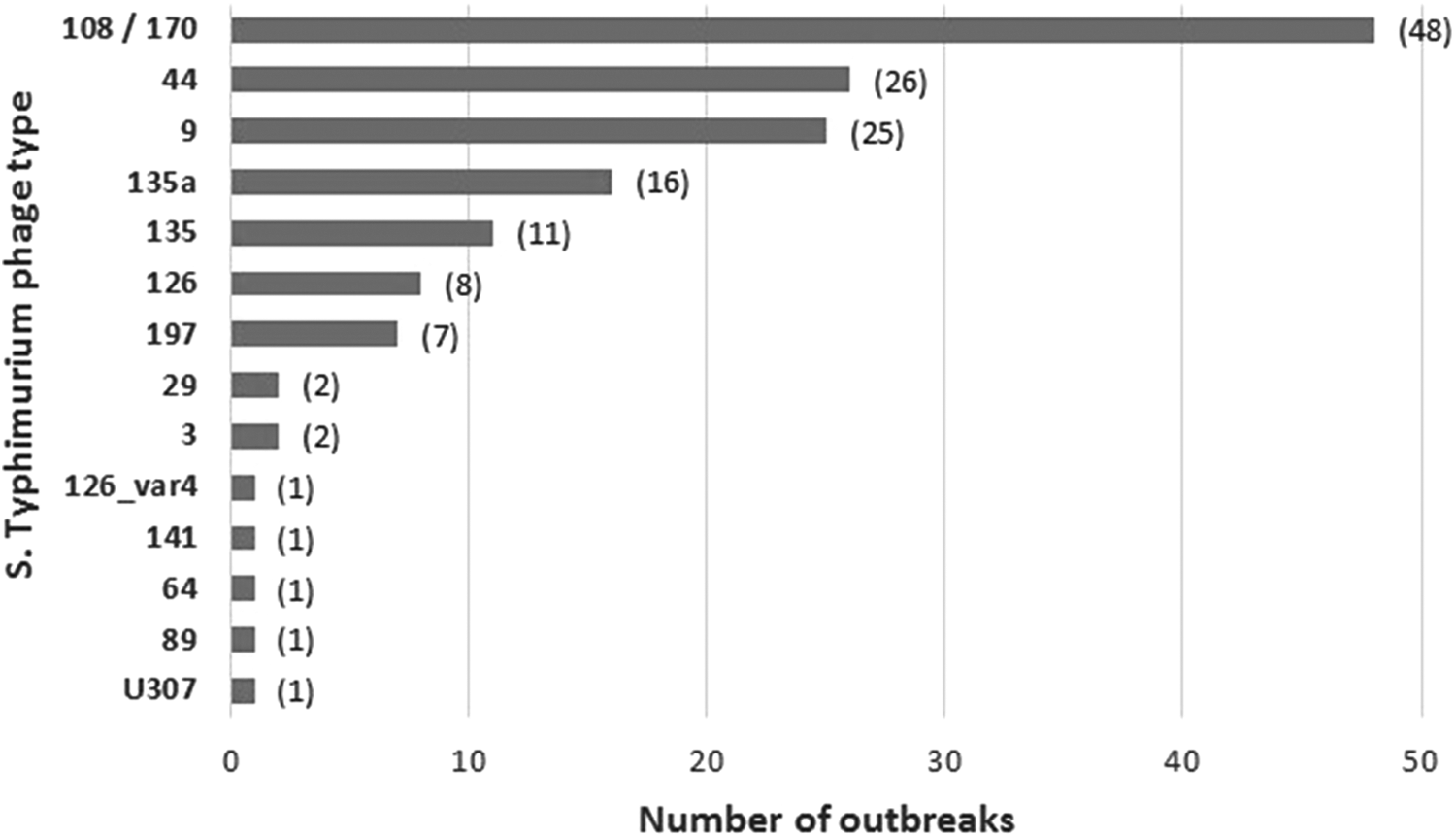
Frequency of Salmonella Typhimurium egg-associated outbreaks by phage type, Australia, 2001 to 2011.
We observed a significant increase in Salmonella Typhimurium phage type 170 outbreaks during the study period (p < 0.001). Conversely, outbreaks of phage type 135a infections decreased during that time (p < 0.02). Rates of outbreak occurrence were consistent across Australian states and territories. The more populous states of New South Wales, Victoria, and Queensland reported 125 (75%) of the 166 outbreaks. The distribution of Salmonella Typhimurium phage types varied across Australia and phage type 170 had the widest distribution, with outbreaks in seven of eight Australian states and territories. No outbreaks that crossed state boundaries were identified.
Outbreak features
There were 3254 cases associated with the 166 egg-associated outbreaks and the median outbreak size was 10 cases (range 2–319 cases). There were 659 hospitalizations and the median number of admissions was 2 (range 0–136). The proportion of cases being hospitalized declined annually (p = 0.04). Four outbreak-related deaths were also recorded.
Outbreak settings and food vehicles
Commercial food providers, including restaurants, bakeries, fast food premises, and commercially catered events accounted for 102 (61%) of the 166 outbreaks and 2526 (78%) of the 3254 outbreak cases. Twenty-eight percent of outbreaks occurred in the setting of private residences but total number of cases were lower than commercial settings.
The most common outbreak vehicles were foods prepared using raw or minimally cooked eggs, specifically mayonnaise, sauces, and dressings and desserts. These two groups accounted for 87 (52%) of food vehicles in the 166 outbreaks. Other food vehicles included deep fried ice cream (ice cream coated in an egg and bread crumb mixture), bakery products, raw egg-containing drinks, and lightly cooked eggs served as simple breakfast meals.
Evidence of causation
Fifty-four percent of investigations employed analytical epidemiology, food microbiology, and trace back microbiology, or combinations of these approaches to demonstrate links between illness and eggs or egg-containing foods (Fig. 2). For the remaining outbreaks, egg-associated dishes were implicated using descriptive evidence obtained through case series investigation and the findings from food safety inspections. Inter-rater agreement on the assignment of evidence levels was high (kappa coefficient 0.78).
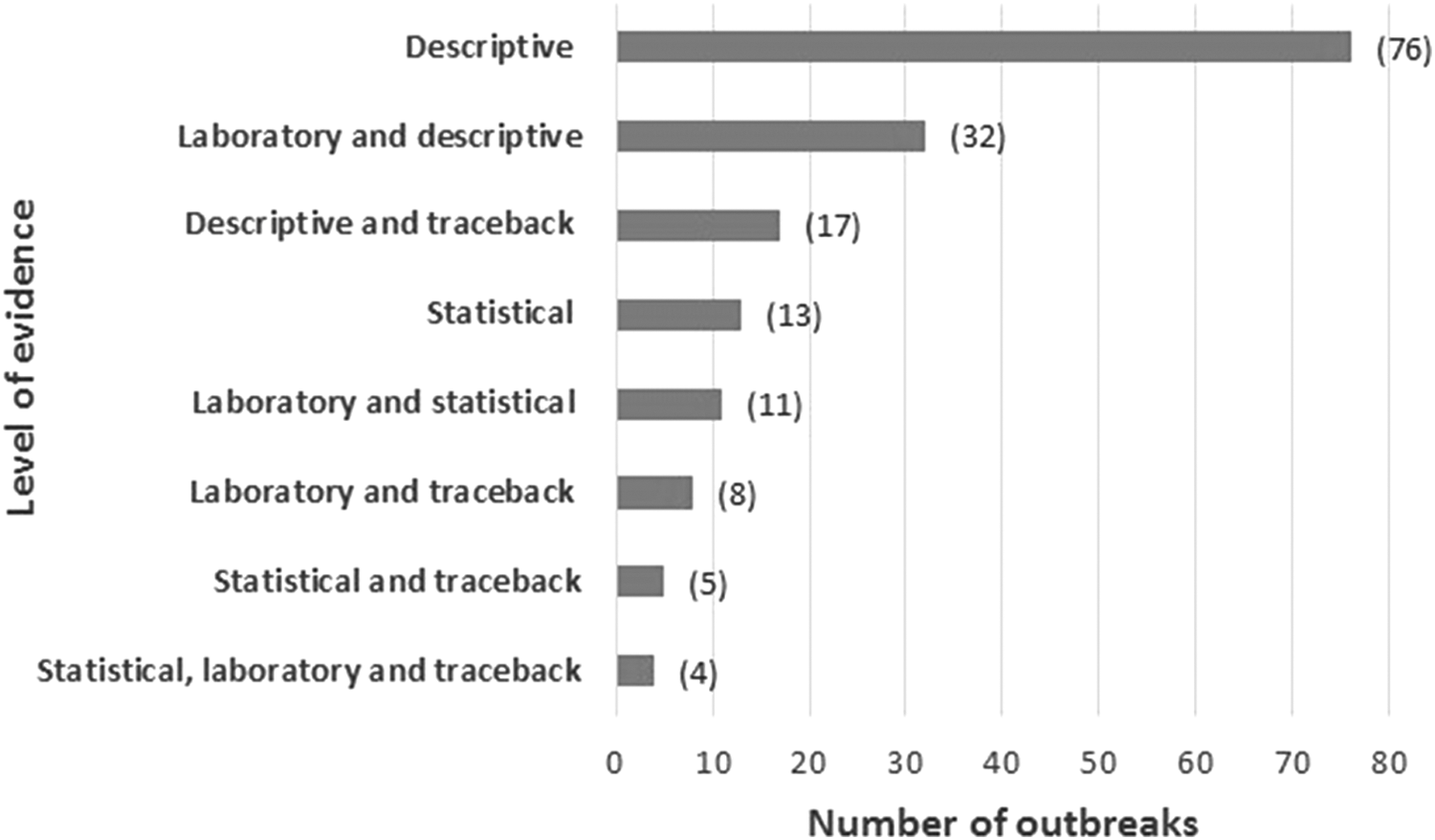
Levels of evidence for egg-associated outbreaks, Australia, 2001 to 2011.
Trace back
Trace back investigations were conducted for 106 (64%) of the 166 outbreaks, with 72 (68%) of these investigations identifying a specific farm from which the implicated eggs had been produced. For these farms, 63 (88%) were inspected and testing undertaken. Fifty-one percent of the tested farms had phage types or multilocus variable number of tandem repeats analysis patterns detected in the farm environment, on eggs or both, that were indistinguishable from Salmonella recovered from outbreak cases.
Discussion
We observed a significant increase in the number of Salmonella outbreaks associated with eggs in Australia between 2001 and 2011. These outbreaks had a substantial health impact, with more than 3200 persons affected and 20% of cases hospitalized. This situation has resulted in extensive concern among public health experts, the egg industry, and the wider community. Most strikingly, a single serovar Salmonella Typhimurium has been responsible for nearly all of these outbreaks.
The Australian experience contrasts with other comparable international settings where Salmonella Enteritidis has long been a dominant cause of both sporadic disease and outbreaks (Gillespie et al., 2005; Braden, 2006). In our study Salmonella Typhimurium was responsible for 90% of outbreaks, whereas across a similar period the European Union and United States reported Salmonella Enteritidis as causing 72% and 64% of egg-associated outbreaks, respectively (European Food Safety Authority [EFSA] and European Centre for Disease Prevention and Control [ECDC], 2013; Gould et al., 2013). Although some locally acquired Salmonella Enteritidis infections do occur in Australia, these infections are not due to phage types 4 or 14b, strains with strong links to egg-associated disease (Gillespie et al., 2005; Janmohamed et al., 2011). Australia has only reported a single outbreak of egg-associated Salmonella Enteritidis infection due to phage type 26 (OzFoodNet Working Group, 2005). These observations and the findings from jurisdictional schemes monitoring Salmonella Enteritidis in laying flocks (Animal Health Australia, 2014) suggest a lower level of risk for Australia from this internationally significant serovar.
Between 2001 and 2011, the incidence of Salmonella Typhimurium infection in Australia climbed 93%, up from 14 cases/100,000 to 27 cases/100,000, with this serovar comprising 5940 (48%) of the 12,271 salmonellosis notifications in 2011 (OzFoodNet Working Group, 2015). Internationally, egg-associated outbreaks of Salmonella Enteritidis infection have been shown to increase during periods of high disease incidence (Lane et al., 2014), whereas the marked reduction in egg-associated outbreaks (declining to 20% between 2008 and 2011) in the European Union occurred in parallel with a general decline in salmonellosis over the same period (European Food Safety Authority [EFSA] and European Centre for Disease Prevention and Control [ECDC], 2013). Although variations in phage type distributions exist between Australian states, the majority of Salmonella Typhimurium outbreaks appear to be caused by those phage types responsible for the majority of sporadic infections, with phage type 170 being particularly prominent (Sintchenko et al., 2012). We suggest that these local and international observations support the role of eggs in the rising incidence of salmonellosis in Australia.
In common with the settings for egg-associated outbreaks internationally (European Food Safety Authority [EFSA] and European Centre for Disease Prevention and Control [ECDC], 2013; Gould et al., 2013), the majority of outbreaks we have described occurred in restaurants or other commercial food settings. Our review of outbreak findings also confirmed the use of raw egg as the major contributing factor to these events. This raises concerns over a lack of consumer and food services sector recognition that raw egg-containing foods carry a risk. Currently there are no restrictions in Australia regarding the use of raw eggs in ready-to-eat foods, although guidelines on the safe handling and preparation of such foods are available in a number of states. In 2009, Food Standards Australia New Zealand identified there was a risk associated with the consumption of raw and lightly cooked eggs, but concluded there was little epidemiological data to link clean eggs with outbreaks of salmonellosis (Food Standards Australia and New Zealand [FSANZ], 2009). However, the conclusion regarding the epidemiological evidence was based on data up to mid-2005, whereas our findings show egg-associated outbreaks began to more noticeably increase from 2007. Given the increase in outbreaks we have demonstrated, it is apparent a need exists to improve both the effectiveness of food safety messaging and the strength of existing regulatory mechanisms, including more dynamic risk assessment practices that better reflect changing circumstances.
The apparent absence of Salmonella Enteritidis in Australian layer flocks (Animal Health Australia, 2014) suggests that external soiling of egg shells with fecal material and contamination from the farming environment are the likely methods of egg contamination in Australia, with undercooking, cross-contamination, or other amplification during food preparation likely leading to the numerous outbreaks we have described. However, there does exist some uncertainty over whether horizontal means of transfer alone can sufficiently explain the Australian situation with vertical transfer of Salmonella Typhimurium remaining a possibility (Wales and Davies, 2011). To improve the understanding of egg-associated disease in Australia, there is a need for greater cooperation and sharing of information between public health, food safety and primary industry regulators, and the egg industry. Prevention of egg-associated outbreaks cannot rely on health messaging targeting consumers and the restaurant sector alone. More than 50% of farms and grading facilities inspected as part of outbreak investigations yielded the outbreak strain. In Australia, production control measures have a biosecurity focus, with particular emphasis on housing facility sanitation and control of potential vectors (Animal Health Australia, 2015). Although vaccines are available in Australia, there is no formal vaccination control program for layer flocks against serovars with a significant human health impact, with vaccination activities varying between individual producers and across states (personal communication Margaret Sexton). For post-collection control, Australia, like the United States and Japan, extensively uses egg washing to reduce eggshell contamination (Hutchison et al., 2004). However, this practice is debated as it may favor transmission of Salmonella Typhimurium across the eggshell, particularly when post-washing storage and drying conditions are substandard (Gole et al., 2014). Elsewhere, European Union members have used routine prevalence monitoring and the destruction of contaminated flocks, in combination with an industry insurance system, to achieve large reductions in human salmonellosis (The European Parliament and the Council of the European Union, 2003; Wegener et al., 2003; Hugas and Beloeil, 2014). European assessment of these programs has shown that they are effective and reduce societal costs of egg-associated illness (Korsgaard et al., 2009).
Limitations
Although the maturation of the OzFoodNet network has likely contributed to an improved capacity to detect outbreaks, the figure of 166 egg-associated outbreaks likely remains an underestimation of the true number of events that occurred in Australia between 2001 and 2011. Many factors influence whether or not authorities detect outbreaks, including the size of the outbreak and the severity of illness; consumer and physician awareness, interest, and motivation to report the incident; and the resources and disease surveillance activities of state and local public health agencies (Lynch et al., 2006). Although the hospitalization rate of 20% was high, we may still have underestimated serious illness and death associated with these outbreaks. Investigative focus is often on identification and removal of a food vehicle, with longer term follow-up of outbreak cases less commonly carried out as part of public health action.
Ascertainment bias is potentially problematic with this study, as approximately half of the outbreaks we identified were reliant on descriptive evidence. However, this is not unusual as many outbreaks will not be conducive to analytical investigation, extensive sampling, or detailed trace back. This is particularly true for outbreaks in private residences, a frequently reported setting, but one where regulatory action, including sampling, is not enforceable. We believe that the consensus approach between state and territory foodborne disease experts was considered and thorough, ensuring that all egg-associated outbreaks recorded in the National Register between 2001 and 2011 were included in this review.
Conclusion
Controlling salmonellosis continues to present as a significant public health and food safety challenge in Australia. We observed a marked increase in outbreaks associated with Salmonella Typhimurium, with these events generating significant morbidity. Outbreaks where restaurants served raw egg-containing foods were common, suggesting difficulties with consumers and commercial food businesses recognizing and adhering to food safety messaging. Importantly, investigations also identified outbreak strains on epidemiologically implicated layer farms or production environments 50% of the time. This suggests that a more concerted effort to minimize infection pressure at the primary production level is needed to reduce the high number of egg-associated outbreaks and disease in Australia.
Footnotes
Acknowledgments
We thank the following current and past OzFoodNet Working Group members who have assisted with this study: Australian Government Department of Health (Gerard Fitzsimmons, Katrina Knope), Northern Territory (Jenine Gunn), New South Wales, (Neil Franklin, Catriona Furlong, Cherie Heilbronn, Katina Kardamanidis, Sally Munnoch, Nicola Stephens), Queensland (Robert Bell, Frances Sheehan), South Australia (Emily Fearnley), Tasmania (Michelle Green, Charlotte McKercher), Victoria (Karin Lalor), and Western Australia (Mary Barker, Barry Combs, Robyn Gibbs). We also acknowledge the invaluable role played by state public health reference laboratories, in particular staff from the Australian Salmonella Reference Centre, Adelaide, Australia, and the Microbiological Diagnostic Unit, University of Melbourne, Melbourne, Australia, where phage typing of clinical, food, and environmental isolates was performed.
Finally, we thank other colleagues in communicable disease control, environmental health, food safety, and primary industries who contributed to the investigation of these outbreaks.
The OzFoodNet Working Group is funded by the Australian Government Department of Health.
Disclosure Statement
No competing financial interests exist.