




Abstract
The efficacy of a Salmonella vaccine for reducing fecal shedding of Salmonella during the finishing period and lymph node (LN) carriage at harvest was investigated in commercial feedlot cattle. The study was designed as a pen-level randomized complete block with two treatment groups, a Salmonella Newport siderophore receptor and porin proteins-based vaccine (VAC) and a nonvaccinated control (CON). Cattle were randomly allocated into 24 pens within 12 blocks based on the time of allocation. Twenty to 25 fecal pats were collected from each of the study pen floors once a month from June to August 2013. During harvest, a minimum of 25 sub-iliac LN were collected from carcasses within each study pen. Fecal and pulverized LN samples were cultured for Salmonella quantification and detection. Mixed models were used to analyze the effect of vaccination on fecal shedding and LN carriage of Salmonella. Montevideo and Anatum were the predominant Salmonella serotypes among fecal samples and LNs; no Newport isolates were recovered. Vaccination was not significantly associated (p = 0.57) with the prevalence of Salmonella in feces over time; the mean within-pen prevalence was 62.3% and 66.0% among VAC and CON, respectively. Sampling month was significantly associated (p < 0.01) with fecal prevalence; mean prevalence was 71.4% for June, 48.6% for July, and 70.8% for August. Across all pens, the cumulative prevalence of Salmonella in LN was 86.4%. Vaccination resulted in no significant reduction in LN prevalence (p = 0.52); mean prevalence was 85.7% for VAC and 87.4% for CON groups. Although vaccinated cattle had numerically fewer Salmonella LN and fecal positives, there were no statistically significant vaccine effects. Potential reasons for the lack of vaccine efficacy could include an overwhelming Salmonella exposure, a lack of cross-protection against non-Newport serotypes, and insufficient duration of immunity relative to harvest.
Introduction
S
Because of the significant challenges associated with addressing LN Salmonella at the postharvest phase, preharvest approaches may be necessary to mitigate the risks. However, there are limited data on the risk of, and preharvest risk factors for, Salmonella LN carriage. There is conflicting evidence regarding Salmonella in LN, as it pertains to regional and demographic characteristics. Carriage varied among regions in the United States in a study (Haneklaus et al., 2012) and by season (Arthur et al., 2008; Brown et al., 2015b), but it did not differ significantly by region or season in another study (Gragg et al., 2013b). Moreover, studies reported that fed cattle have a lower prevalence of LN carriage than cull cattle (Arthur et al., 2008; Koohmaraie et al., 2012); whereas Gragg et al. (2013a) found greater prevalence in fed cattle than cull cattle in samples from processing plants. Moreover, Brown et al. (2015b) suggested that the differences observed between beef and dairy breeds are not due to breed (when fed in the same feedlot environment) but rather reflect potential differences based on age, immune function, or other factors.
There is a commercially available vaccine that uses siderophore receptor and porin proteins (SRP) extracted from Salmonella enterica serotype Newport as antigens. This vaccine technology makes use of an iron transport mechanism of Gram-negative bacteria, which ultimately causes the death of bacteria by inhibiting iron acquisition, which is crucial for cell homeostasis (Leong and Neilands, 1976). A study of dairy cows indicated that the use of the Salmonella Newport SRP vaccine is associated with reduced Salmonella (fecal and hide) levels in cull cattle (Loneragan et al., 2012). However, there are no data to indicate whether the Salmonella SRP vaccine will reduce LN carriage at harvest.
To evaluate the potential industry impact, it is important to evaluate the efficacy of commercially available preharvest food safety interventions in commercial production systems with high-risk cattle populations (Cull et al., 2012). Therefore, the primary objective of the study was to determine the efficacy of the Salmonella SRP vaccine for reducing fecal shedding and prevalence and concentration of Salmonella in LNs of fed cattle at harvest from a commercial feedlot population with an expected high prevalence of Salmonella. A secondary objective consisted of evaluating the efficacy of the vaccine in reducing Salmonella fecal shedding in feedlot cattle, over time, during the finishing period before animals were processed.
Materials and Methods
Sample size estimation
Sample size was estimated under a null hypothesis of no difference between proportions of Salmonella-positive LN among treatments and an alternative hypothesis of no less than 50% vaccine efficacy. Type 1 and Type 2 error probabilities were set as 0.05 and 0.10, respectively. The baseline (control [CON]) prevalence of Salmonella positive LN was estimated to be 70% based on previous sub-iliac LN data from fed cattle at the study feedlot.
Study population and experimental design
Twenty-four pens of cattle in a large commercial feedlot operation (∼75,000-head capacity), in the Texas panhandle, were enrolled in the study. The participating feedlot was chosen (eligibility criteria) because of appropriate cattle inventory, animal-handling facilities, and research capabilities. A total of 2159 crossbred steers (English × Continental) were received in two groups: 1093 between March 6th and 8th, 2013, and 1066 between March 13th and 18th, 2013. Cattle were procured from ranches and sale yards (from Texas, Oklahoma, Kansas, and South Dakota), which are representative of the participating feedlot's procurement practices. Steers were weighed and penned by source after arrival and were handled according to the standard operating procedures of the feedlot. Allocation (day 0 of the study) coincided with initial processing (within 2–3 days postarrival to the feedlot), which consisted of the following: a vaccine containing modified live strains of bovine viral diarrhea virus, infectious bovine rhinotracheitis virus, and parainfluenza-3 and bovine respiratory syncytial virus (Bovi-Shield GOLD 3; Zoetis LLC, Florham Park, NJ); a slow-release delivery system containing trenbolone acetate and estradiol (Revalor XS; Merck Animal Health, Madison, NJ); 1% w/v doramectin (Dectomax; Zoetis LLC); and permethrin-piperonyl butoxide (Exit Gold Synergized Pour-on; Aspen Veterinary Products, Liberty, MO), which were administered according to instructions on labels.
Cattle were randomly allocated into 24 pens within 12 blocks based on the time of allocation, starting in March 2013. Each study pen housed 87 or 88 animals. The study consisted of a randomized completed block design with two treatments, vaccinated (VAC) and control (CON) and pen as the experimental unit. Cattle from each lot of eligible and enrolled cattle were randomly allocated into pairs of pens corresponding to treatment groups: one vaccinated (VAC) and one control (CON) pen. The allocation process continued until 12 pairs (blocks) of pens, for a total of 24 pens, were filled. Pens of cattle designated as VAC were administered the vaccine (2 mL subcutaneously, Salmonella Newport bacterial extract SRP® vaccine; Zoetis, LLC) on day 0 of the trial (day of allocation) and again, 3 weeks later, as per the vaccine label. Control (CON) cattle did not receive a placebo and were not re-handled when VAC cattle received their second vaccine.
All cattle health, production, and feed management were conducted by following standard operating procedures of the feedlot and were identical for cattle in all study pens. Cattle were transitioned from a starting diet to finishing diet over approximately a 28 day period. Steers were fed, three times daily, a starting diet (RAMP™; Cargill Corn Milling, Dalhart, TX) and then adapted to a finishing diet consisting of: 61.3% steam-flaked grain (wheat or corn), 13.6% wet corn gluten feed (Sweet Bran or Sweet Bran/supplement blend; Cargill Corn Milling), 1.3% dry corn gluten feed, 8.1% distiller's dried grains, 7.7% silage (triticale or sorghum), 3.4% condensed corn distiller's solubles and glycerin, 2.8% blended animal fat, and 1.8% dry supplement. Finishing diets were also formulated to contain 40 g/ton monensin, 9 g/ton tylosin, and 2645 IU/kg vitamin A. All steers were fed zilpaterol hydrochloride (7.6 g/ton, Zilmax; Merck Animal Health) for 21 days, followed by 3 days of withdrawal, immediately before harvest. Cattle deemed unhealthy at allocation or later determined to be chronically ill were excluded from the study. Cattle health, performance, and carcass characteristics were gathered throughout the study and recorded by feedlot personnel. The study started on March 13th and ended on August 28th, 2013.
Blinding
Individuals responsible for daily healthcare and cattle performance measures at the feedlot, sampling personnel (collecting fecal samples), harvest facility staff, laboratory personnel, and the data analyst were blinded to the treatment group designation while they performed their roles.
Fecal and LN sample collection
Twenty freshly voided fecal pats were collected from pen floors once a month, on June 24th and July 14th, 2013. The third and final set of fecal samples was collected in August 2013 (25 fecal samples/pen), ∼12 h before cattle from study pens were shipped to a commercial processing plant. A minimum of 10 g of fecal samples were collected using plastic spoons and placed in clear plastic specimen containers. Samples were shipped in refrigerated containers, within 24 h of collection, to the Food and Feed Safety Research Unit, USDA-ARS (College Station, TX), for culture.
Cattle from the study pens were harvested in blocks between the 12th and 26th of August, 2013 (sampling dates: August 12th, 19th, and 26th, 2013). At the processing plant, carcasses were tagged to indicate the start and end of each study lot (study pen). Carcasses were processed following standard procedures of the commercial processing plant. For each lot, the first carcass and thereafter every other carcass were sampled, until samples from at least 25 carcasses were collected from each study pen. One sub-iliac LN, and surrounding adipose tissue, was removed by experienced plant personnel, using knife cuts, from one side (flank) of the selected carcasses at the air injection stand, after carcasses were split and before entering the cooler. Samples were placed in a prelabeled Whirl-Pak® sample collection bag (Nasco, Fort Atkinson, WI). All samples were shipped in refrigerated containers within 24 h of collection to the Pre-harvest Food Safety Laboratory at Kansas State University for processing and testing.
Laboratory methods for detection of Salmonella in fecal samples
Samples were cultured for Salmonella detection after an enrichment step, whereas direct plating of the sample before enrichment was used for quantification as previously described (Edrington et al., 2009). Briefly, ∼10 g of feces was suspended in 90 mL of tetrathionate broth (Difco, Sparks, MD). For quantification, 50 μL of the feces/tetrathionate broth suspension (before incubation) was removed and spiral plated (Spiral Biotech Autoplate 4000; Advanced Instruments, Inc., Norwood, MA) onto xylose lysine deoxycholate (Neogen Corp., Lansing, MI) agar. Plates were incubated at 37°C for 24 h, followed by an additional 24 h at room temperature. Black colonies, presumptive of Salmonella, were counted and counts were transformed to log10 CFU (colony-forming unit)/g feces. After spiral plating, the feces/tetrathionate mixture was incubated overnight (37°C); then, 100 μL was transferred to 5 mL Rappaport-Vassiliadis (RV, RV10 broth; Neogen Corp.) broth and incubated at 42°C for 24 h, before plating on brilliant green agar supplemented with novobiocin (25 μg/mL, BGAnov; Hardy Diagnostics, Santa Maria, CA). Plates were incubated (37°C, overnight) and after incubation, colonies exhibiting Salmonella-like morphology were confirmed biochemically. Presumptive positive colonies were subjected to slide agglutination (Difco Laboratories, Detroit, MI) with polyvalent serum for genus confirmation. Confirmed fecal isolates were serotyped at a commercial laboratory (Northwest Arkansas Veterinary Services LLC, Springdale, AR).
Laboratory methods for detection of Salmonella in LNs
A culture-based procedure based on immunomagnetic separation and Hektoen Enteric agar plating (IMS-HE) and 3 M Petrifilm on Hektoen Enteric (HE) plates were used for Salmonella isolation and quantification, respectively (Brichta-Harhay et al., 2012).
IMS-HE procedure
On arrival of samples, the fat and fascia around the LN were trimmed. After surface sterilization in boiling water for 5 s, LN were placed individually into stomacher bags and pulverized with a rubber mallet. Eighty milliliters of tryptic soy broth (Neogen Corp.) was added to the bag, and the sample was homogenized in the stomacher for 30 s. Stomacher bags were incubated at room temperature (25°C) for 2 h and then at 42°C for 12 h. After incubation, 1 mL of the homogenate was transferred into 96-well micro-titer plates containing 20 μL of anti-Salmonella immunomagnetic separation (IMS; Neogen Corp.) beads. Plates were placed into the Kingfisher machine for IMS processing. The IMS procedure was performed in a Kingfisher Flex Magnetic Particle Processor (Thermo Scientific, Waltham, MA) according to the protocol provided by the manufacturer. Beads from the 96-well plate were transferred into 3 mL RV broth (Neogen Corp.) and incubated for 18–20 h at 42°C. After incubation, 100 μL of RV was spread-plated onto HE (Becton Dickinson Co., Franklin Lakes, NJ) agar plates and incubated for 18–20 h at 37°C. Six blue to blue-green with black center colonies per plate were streaked onto blood agar plates. Plates were incubated at 37°C for 18–20 h. Colonies from blood agar plates were agglutinated using pooled A-VI group antisera (Difco) and if positive, a polymerase chain reaction procedure targeting the invA gene was performed for genus confirmation (Alam et al., 2009). Each isolate was tested with individual serogroup antiserum to classify the serogroup, and identification of the serotype was performed at a commercial laboratory (Northwest Arkansas Veterinary Services LLC.).
Petrifilm procedure
One-milliliter aliquots of the homogenate from stomacher bags were plated onto EB Petrifilm (3 M Petrifilm Enterobacteriaceae count plates; 3M, St. Paul, MN) plates, in duplicate. Petrifilm plates were incubated at 37°C for 18–24 h. The cover of the Petrifilm plates was then removed, and the film was placed onto HE agar plates. After a gentle tap, the films were discarded and the plates were incubated at 37°C for 18–24 h. Colonies with Salmonella-like phenotypic characteristics (blue-green with black center colonies) were counted, and a maximum of 10 colonies per plate were inoculated onto blood agar plates and incubated at 37°C for 18–20 h. Each colony was then agglutinated with pooled A-VI groups antisera to confirm the presence of Salmonella.
Data analyses
Analyses were carried out on a per-protocol basis, as deaths (from causes other than the treatment or the outcome) were not considered, and only animals completing the study (i.e., processed at slaughterhouse) were included for analysis purposes. The main outcome of interest was the within-pen prevalence of Salmonella in LN and in fecal samples. Secondary outcomes consisted of performance (days on feed, dry matter intake, average daily gain, and feed:gain) and carcass parameters (hot carcass weight, dressing %, quality grade, and yield grade) (Table 1). Overall crude fecal prevalence for Salmonella was calculated across all study pens as the number of fecal samples testing positive for Salmonella, based on the enrichment procedure, by sampling period (June, July, August), divided by the total number of fecal samples tested during each sampling period. Within-pen cumulative prevalence was calculated as the number of fecal samples testing positive for Salmonella within a pen, divided by the total number of samples collected per pen. To evaluate the efficacy of the SRP vaccine in fecal samples over time, generalized linear mixed models (GLMM) were used to assess associations between treatment and month of sampling with the within-pen fecal prevalence of Salmonella (based on the enrichment protocol). Models were fitted using a binomial distribution, logit link, residual pseudo-likelihood estimation, Kenward–Rogers degrees of freedom, a random intercept for block, and a residual-type random component with a covariance structure (i.e., first-order antedependence [given the uneven time intervals]) to account for the hierarchical structure of the study (i.e., blocking and repeated measures) using Proc Glimmix (SAS 9.4; SAS Institute, Inc., Cary, NC). The outcome consisted of the within-pen fecal prevalence of Salmonella, expressed as [events/trials], and the predictor variables consisted of treatment (VAC vs. CON), sampling month (June, July, August), and a two-way interaction between treatment and sampling month. Model-adjusted means and their 95% confidence intervals (95% CIs) were obtained, and p-values <0.05 were deemed statistically significant. Similar models were fitted to assess the efficacy of the SRP vaccine in LN carriage of Salmonella.
None of the variables differed significantly (p > 0.05) among treatment groups.
The mean, median, and range of concentration of Salmonella in feces were computed among enumerable samples as well as among all samples tested using the direct plating method. Samples testing negative (below the detection limit of the tests) for both direct plating and enrichment procedures were designated values of −1 log10 CFU/g. Samples testing positive for enrichment but negative for direct plating were designated values of 1 log10 CFU/g: below the direct plating assay's detection limit of 2 log10 CFU/g. Nonparametric tests (Wilcoxon rank sum) were used to determine differences in the concentration of Salmonella in fecal samples between treatment groups.
The mean concentration of Salmonella between two Petrifilm replicates was calculated using arithmetic means. However, if one plate had a 0 count and the second plate had a count of 1, the mean number of colonies was designated as 1. The mean, median, and range concentration of Salmonella were computed among enumerable samples, as well as among all samples tested using the Petrifilm method. Samples that tested negative for both IMS-HE and Petrifilm were designated a value of −1 log10 CFU/LN (0.1 CFU/LN). Samples testing positive for IMS-HE but negative for Petrifilm were designated a value of 1 log10 CFU/LN. Too numerous to count samples were designated values of 5.18 log10 CFU/LN (150,000 CFU/LN), a number above the highest value observed among enumerable samples in the study (5.18 or 149,700 CFU/LN). Nonparametric tests (Wilcoxon rank sum) were used to determine differences in the concentration of Salmonella in LN between treatment groups. Fisher's exact tests for 2 (treatment) by K (number of serogroups) contingency tables were used to assess whether the distribution of Salmonella serogroups differed among treatment groups. Lastly, similar modeling approaches to the ones described earlier (GLMM) were used to assess the effect of treatment on health, performance, and carcass outcomes (Table 1).
Results
Cattle health and performance data
Of the 2099 cattle allocated in the 24 study pens, 20 died of causes other than the treatment or Salmonella-related disease (e.g., respiratory [n = 12], digestive [n = 2], other [n = 6; lameness, bullers {steer that is repeatedly mounted by other steers}]) and 64 were culled due to chronic disease (e.g., respiratory [n = 24], digestive [n = 2], other [n = 38; lameness, miscellaneous causes]): As such, a total of 2015 cattle (1106 vaccinates and 1009 controls) were harvested on completion of the study. Data on cattle health and performance, collected by the feedlot using their standard recording procedures, are summarized, by treatment group, in Table 1. The treatment groups did not significantly differ (p > 0.05) with respect to cattle health, performance, or carcass characteristics.
Fecal and LN sample collection
Four hundred eighty, 478, and 600 fecal samples were collected in June, July, and August, respectively, for a total of 1558 pen-floor fecal pat samples. A total of 648 LN were collected from cattle harvested from the study pens between the 12th and 26th of August, 2013.
Salmonella prevalence and vaccine efficacy in fecal samples over time
Crude cumulative fecal prevalence was 71.3% (342/480; 95% CI = 66.97–75.3) in June, 48.9% (234/478; 95% CI = 44.4–53.5) in July, and 70.7% (424/600; 95% CI: 66.8–74.3) in August. Within-pen prevalence ranged from 15% to 100% in June, from 15% to 80% in July, and from 24% to 96% in August. The effect of the vaccine was not significantly associated (p = 0.57) with the within-pen prevalence of Salmonella in feces over time: Mean cumulative within-pen prevalence, across all time points, was 62.3% among VAC (95% CI = 51.9–71.6) and 66.0% (95% CI = 55.6–75.0) among CON. The month of sampling was significantly associated (p < 0.01) with the within-pen prevalence of Salmonella in fecal samples. Model-adjusted cumulative fecal prevalence was 71.4% (95% CI = 60.4–80.3) for June, 48.6% (95% CI = 38.9–58.5) for July, and 70.8% (95% CI = 60.6–79.3) for August. The effect of treatment on the within-pen fecal prevalence of Salmonella did not differ significantly (p = 0.99) by month of sampling (i.e., the two-way interaction was not significant). Model-adjusted mean Salmonella fecal prevalence by treatment group and month is shown in Figure 1.
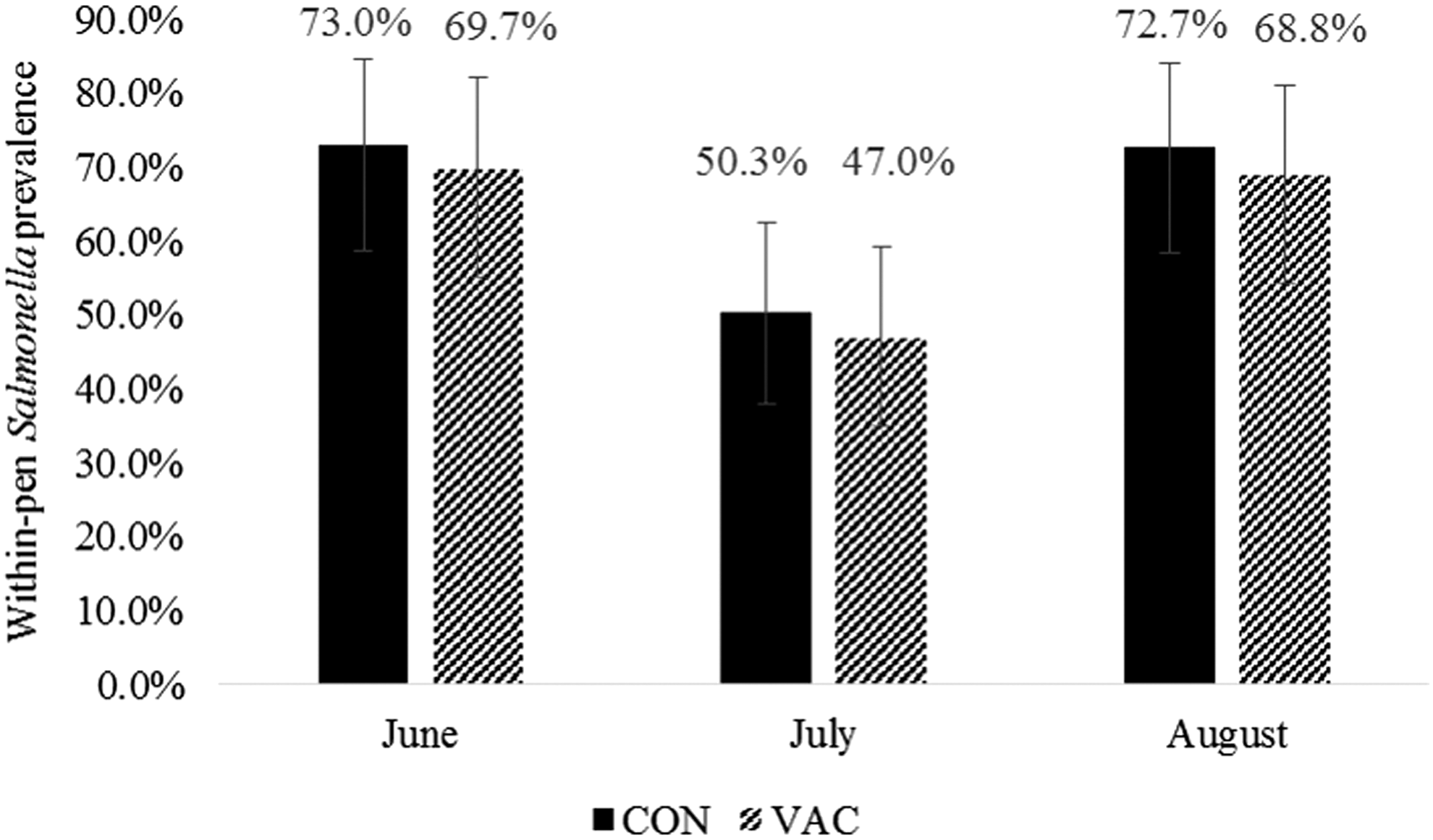
Model-adjusted* mean within-pen prevalence of Salmonella in fecal samples by sampling month and treatment group. Error bars represent 95% confidence intervals*. Note: * Obtained from generalized linear mixed models with random effects to account for the randomized complete block design and repeated measures.
Prevalence and microbial characterization of Salmonella and vaccine efficacy in fecal and LN samples at harvest
Of the fecal samples collected a few hours before harvest (August sampling; n = 600), 424 (70.7%) tested positive by the enrichment protocol. Of the 600 fecal samples, 56 (9.3%, 56/600) had colony counts greater or equal than 2 log10 CFU/g (detection limit) based on the direct plating method. The mean and median concentrations of Salmonella among enumerable samples were 2.97 and 2.69 log10 CFU/g, respectively (not considering −1 and 1 log10 CFU/g values), with a range of 2.13–4.68 log10 CFU/g. Among all samples tested using the direct plating method, the mean and median concentrations of Salmonella were 1 log10 CFU/g, with a range of −1 to 4.68 log10 CFU/g. The mean concentration within pens ranged from 1.04 to 3.28 log10 CFU/g. Median Salmonella counts were not statistically different between treatment groups (p = 0.27).
The Salmonella isolates from fecal samples belonged to serogroups C, E, and K. The majority of Salmonella isolates belonged to serogroup C1 (64.9%), followed by E1 (26.9%), K (8.0%), and Poly E (0.2%). Serotypes identified were Montevideo (n = 273), Mbandaka (n = 1), Tennessee (n = 1), Anatum (n = 112), Meleagridis (n = 2), and Cerro (n = 34) (Table 2). The distribution of serogroups and serotypes was not significantly different (p > 0.05) by treatment group.
VAC, vaccinated.
Eighty-one percent (524/648, 95% CI = 77.6–83.8) of LN samples tested positive for Salmonella based on the IMS-HE procedure. The model-adjusted cumulative prevalence for Salmonella in LN was 86.4% (95% CI = 72.0–94.0). Within-pen prevalence ranged from 19.2% to 100.0%. The vaccine was not significantly associated (p = 0.97) with the within-pen prevalence of Salmonella in LN. Model-adjusted within-pen mean Salmonella prevalence in LN was 85.7% among VAC and 87.4% among CON (Fig. 2).
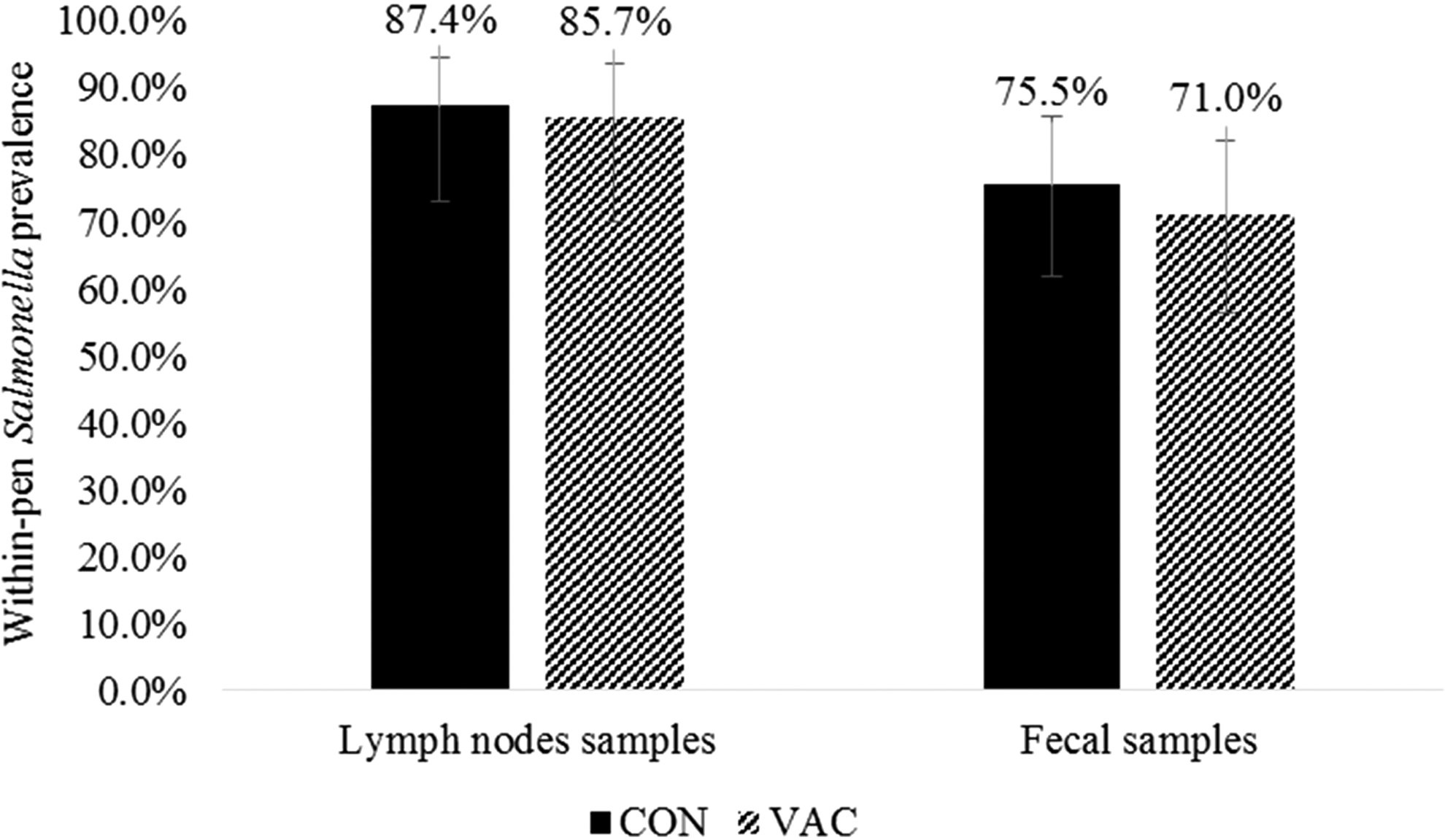
Model-adjusted* mean within-pen prevalence of Salmonella in lymph nodes and feces at the time of harvest by treatment group. Error bars represent 95% confidence intervals*. Note: * Obtained from generalized linear mixed models with random effects to account for the randomized complete block design.
Seventy percent of LN samples (452/648) were enumerable based on Petrifilm plates. Among IMS-HE-positive LN samples, 23.2% tested negative based on Petrifilm. Counts among enumerable plates (n = 452) ranged from 2 to 5.18 log10 CFU/LN, and the mean and median concentrations of Salmonella were 4.15 and 4.48 log10 CFU/LN, respectively. Among all LN samples (n = 648), the mean and median concentrations of Salmonella were 2.97 and 3.60 log10 CFU/LN, respectively, with a range of −1 to 5.18 log10 CFU/LN. The mean concentration within pens ranged from 3.87 to 5.09 log10 CFU/LN. Salmonella concentrations were not statistically different between treatment groups (p = 0.24).
Three serogroups (C, E, and K) were identified in LN test-positive samples, with the majority of the Salmonella-positive samples belonging to serogroup C1 (84.7%), followed by both C1 and E1 (7.1%), E1 (5.7%), K (2.3%), and E and K (0.2%). Serotypes identified included Montevideo (n = 444), Anatum (n = 29), Meleagridis (n = 1), and Cerro. In samples containing mixed serogroups C1 and E1 (i.e., not pure colonies), serotypes Montevideo/Anatum (n = 34), Montevideo/E1:e,h:- (n = 2), and Infantis/E1:e,h:- (n = 1) were identified (Tables 3 and 4). Table 3 depicts the distribution of serogroups and serotypes by treatment group; the distribution of serogroups, however, was not significantly different (p = 0.12) between treatment groups.
VAC, vaccinated.
Discussion
The prevalence of Salmonella in this commercial feedlot cattle population (in feces and sub-iliac LN) was extremely high, and no evidence for a vaccine effect was observed. The study was designed to evaluate the efficacy of the SRP vaccine in a feedlot population with a high Salmonella burden, because a high level of pathogen burden has been useful in demonstrating the efficacy of preharvest interventions, and it provides the greatest potential food safety benefits (Dodd et al., 2011b; Cull et al., 2012). However, an LN prevalence of more than 80% across 24 pens and more than 2000 animals was higher than expected. Given that even the most selective enrichment and culture procedures have less than perfect diagnostic sensitivity, and that other LNs (non-sub-iliac) also may frequently carry Salmonella (Arthur et al., 2008; Gragg et al., 2013b), it is plausible that all, or nearly all, of the cattle in this population were carrying Salmonella in one or more LNs.
Although Salmonella was detected in a high percentage (48.6–71.4%) of fecal samples in this study, other feedlot studies in this region also have had fecal prevalence estimates of 50% or higher (Loneragan and Brashears, 2005; Stephens et al., 2007; Alam et al., 2009). Sampling month was significantly associated with the within-pen fecal prevalence of Salmonella, where a significant drop in prevalence was observed in the month of July compared with the June and August samplings. However, the effect of the vaccine on Salmonella fecal prevalence was not statistically significant: Thus, factors such as immune status, weather, or management, among others, may have caused this reduction in shedding during July. Likewise, the percentage of Salmonella that recovered from sub-iliac LNs in our study was similar to that reported for a Mexican harvest facility (76.5%) (Gragg et al., 2013b) and for one Texas feedlot (88.2%) but not others (Haneklaus et al., 2012). However, the latter two studies tested a limited number of sub-iliac LNs samples: 68 and 85, respectively. A high prevalence is more common in the study geographical region (south) where prevalence of Salmonella is often higher compared with northern states (USDA-APHIS, 2001; Gragg et al., 2013a). However, there are limited data indicating that even within this southern region the prevalence of Salmonella can vary greatly among different feedlots (Haneklaus et al., 2012).
As previously reported for feedlot cattle in this region, Montevideo and Anatum were the predominant serotypes among fecal samples and LNs (Fluckey et al., 2007; Kunze et al., 2008; Gragg et al., 2013b; USDA-APHIS, 2014). These serotypes are also commonly isolated from ground beef in federal testing programs (USDA-FSIS, 2011). However, there is diversity of serotypes isolated from healthy feedlot cattle as reported by studies in which Kentucky, Meleagridis and Reading, or Anatum and Lexington were the predominant serotypes in fecal or LN samples (Dodd et al., 2011a; Gragg et al., 2013a; USDA-APHIS, 2014).
The SRP vaccine used in this study targets Salmonella Newport, which was not one of the serotypes detected in these study cattle. Possibly, the SRP antigens are different for other serotypes, including Montevideo, which was the predominant serotype in this study. We did not find significant differences in the distribution of serogroups and serotypes in fecal or LN samples between treatment groups (Tables 2 and 3); however, the relative statistical power to demonstrate differential efficacy for serotypes other than Montevideo was extremely limited given the small number of isolates that belonged to other serogroups or serotypes.
A previous experimental study indicated that the use of the Salmonella SRP vaccine did not have a significant effect on fecal shedding of Salmonella in the feces of healthy dairy cattle (Hermesch et al., 2008), but it did demonstrate a production (i.e., milk production) enhancing effect of vaccination. The herd-level use of the Salmonella Newport SRP vaccine was associated with reduced fecal and hide prevalence (but not concentration) of Salmonella in cull dairy cattle (Loneragan et al., 2012). However, this was an observational study that was not designed to evaluate vaccine efficacy (Loneragan et al., 2012). If this association were to hold in an experimental vaccine efficacy study of cull cows, differences in factors that can affect the equilibrium of bacteria in the gastrointestinal tract, including cattle age, immunity, management, dietary energy requirements, and days on high grain rations, could explain potential differences observed in Salmonella shedding between cull and feedlot cattle.
Another study of the Salmonella SRP vaccine in feedlot cattle demonstrated no significant differences between vaccinated and control cattle in Salmonella fecal shedding or health and performance effects (Dodd et al., 2011a). However, in that feedlot population, the fecal prevalence of Salmonella approached 0% by the time of harvest (Dodd et al., 2011a). Here, we found that cattle health and performance were not significantly associated with vaccination. However, the health and performance of these study cattle were optimal, and, thus, it seems unlikely that the high prevalence of Salmonella had any negative impacts on the cattle.
An overwhelming Salmonella exposure in this study population may have reduced the ability to demonstrate vaccine efficacy. In addition, the time at which cattle LNs become infected with Salmonella in the feedlot production system is undefined. Recent studies indicate that cattle may be exposed to Salmonella via multiple routes, including fecal-oral, transdermal, and vertical (Edrington et al., 2013; Brown et al., 2015a; Olafson et al., 2015; Hanson et al., 2016). Specifically, Hanson et al. (2016) have reported that Salmonella was recovered from 10% of sub-iliac LN samples from neonate calves (within 2 min postparturition) born from asymptomatic dams, suggesting a possible vertical transmission.
Cattle in the present study could have had Salmonella in their LNs before vaccination, which could have a negative impact on vaccine efficacy in a study such as this. Moreover, as fecal shedding was high, cattle may have been continually exposed or re-exposed throughout the feeding period. Alternatively, LNs may not have become Salmonella positive until shortly before harvest; cattle were harvested over 120 days after the second/last vaccination. As the duration of protection for LN carriage has never been defined for this vaccine (or other interventions), it is possible that the vaccine efficacy was higher earlier in the finishing period, but waned by the time of harvest. In this case, withdrawal time could be an important consideration for vaccine implementation later in the feeding period. It is important to note that the effect of this vaccine, nor any other preharvest interventions, on LN carriage has never been tested, and, as such, they are not labeled for the control of LN carriage.
Although cattle receiving the SRP vaccine had numerically fewer Salmonella fecal-positive and LN samples, there was no statistically significant vaccine effect in these commercial feedlot cattle with a high prevalence of Salmonella. Some of the reasons for the apparent lack of vaccine efficacy include a potentially overwhelming exposure, unknown durations of immunity and infection, and lack of cross-protection against non-Newport serotypes (Montevideo in particular). There is a need to better understand the temporal dynamics of LN infections and how the relative timing of intervention administration may impact potential efficacy. Recently, researchers reported that biting flies or other arthropods may serve as possible vectors of transmission for Salmonella to LN (Olafson et al., 2015). However, when Brown et al. (2015b) compared carriage of Salmonella in LN of Brahman cattle, considered more parasite resistant than other breeds, with that of other beef breeds, there were no significant differences in concentration or prevalence. Similarly, variability in Salmonella prevalence and serotypes within and among feedlots and how the efficacy of vaccines (or other interventions) may be impacted by Salmonella burden and strain type are not well known. The remarkably high LN prevalence and concentration in this study demonstrates why Salmonella continues to be a major issue for the beef industry. Unfortunately, the transmission and maintenance of LN contamination in the feedlot animal, and the epidemiology and ecology in the production environment are still poorly understood.
Footnotes
Acknowledgments
Funds for this project were provided by Zoetis LLC, the Beef Check-Off through the National Cattlemen's Beef Association, and the College of Veterinary Medicine at Kansas State University. The authors also thank feedlot personnel and students who assisted with sample collection and processing as well as are grateful for the technical assistance of Xiaorong Shi.
Disclosure Statement
No competing financial interests exist.