




Abstract
Many public venues such as farms, fairs, and petting zoos encourage animal contact for both educational and entertainment purposes. However, healthy farm animals, including cattle, small ruminants, and poultry, can be reservoirs for enteric zoonotic pathogens, with human infections resulting in nausea, vomiting, diarrhea, and, in some cases, severe complications that can lead to death. As animals shed these organisms in their feces, contamination of themselves and their surroundings is unavoidable. The majority of North Americans reside in urban and suburban settings, and the general public often possess limited knowledge of agricultural practices and minimal contact with farm animals. Furthermore, there is a lack of understanding of zoonotic pathogens, particularly how these pathogens are spread and the human behaviors that may increase the risk of infection. Human risk behaviors include hand-to-mouth contact immediately after physical contact with animals and their environments, a practice that facilitates the ingestion of pathogens. It is often young children who become ill due to their under-developed immune systems and poorer hygienic practices compared with adults, such as more frequent hand-to-mouth behaviors, and infrequent or improper hand washing. These illnesses are often preventable, simply through adequate hygiene and hand washing. Our objective was to use a structured approach to review the main causal organisms responsible for human illnesses acquired in petting zoo and open farm environments, Shiga toxin–producing Escherichia coli, nontyphoidal Salmonella, Campylobacter, and Cryptosporidium. Notable outbreaks involving direct contact with farm animals and farm, fair, or petting zoo environments are discussed and recommendations for how public venues can increase safety and hand hygiene compliance among visitors are proposed. The most effective protective measures against enteric illnesses include education of the public, increasing overall awareness of the risks and the importance of hand hygiene, as well as access to hand-washing facilities.
Introduction
I
Despite the many benefits of public agricultural events, there are also significant risks if proper hygiene measures are not taken. Of particular importance are zoonotic diseases (or zoonoses), which are infections transmitted between animals and humans. These infectious agents may be passed in animal feces and transmitted to humans through fecal-oral contact. Farm animals such as poultry and ruminants are important reservoirs for zoonotic pathogens (Erdozain et al., 2015).
Infants and children younger than 5 years are at the greatest risk of acquiring zoonotic pathogens from animals (Dunn et al., 2015). Often, this is due to poor hygienic practices, attraction to or curiosity about animals, and an immature or inadequate immune system (Pickering et al., 2008; Dunn et al., 2015). In many cases, the zoonotic illnesses are preventable through improved hygiene (Erdozain et al., 2015). The symptoms and consequences of these infections also tend to be more severe in infants and young children (Pickering et al., 2008). People of any age with primary or secondary immunodeficiency are at risk of more severe disease, especially pregnant women and the elderly (Pickering et al., 2008). Most frequently, zoonotic infections are of the gastrointestinal tract, with mild to severe outcomes ranging from diarrhea, abdominal cramping, and vomiting to bloody diarrhea, kidney failure, and, in some cases, death (Dunn et al., 2015).
This review addresses the main animal reservoirs and the zoonotic pathogens commonly transmitted from farm animals to humans at agricultural events, as well as the typical routes of transmission. Furthermore, this review will discuss lessons learned from outbreaks caused by zoonotic pathogens, and the important hygienic practices that can increase visitor safety.
Transmission in the Farm, Fair, or Petting Zoo
It is estimated that 60–75% of emerging infectious diseases in humans are zoonotic (Jones et al., 2008; Pickering et al., 2008), which include bacterial, viral, fungal, protozoal agents, and parasites (Hale et al., 2012). Fecal-oral transmission is considered direct when infection occurs through physical contact with an animal. Indirect transmission is also common, through routes that have an affiliation with the animal (i.e., transmission vehicle) such as aerosols, a contaminated environmental reservoir, food, or water (LeJeune and Kersting, 2010).
Carriage of zoonotic pathogens has been documented for many animal species, including domesticated pets (e.g., cats, dogs), hooved animals, ruminants, rodents, reptiles, amphibians, migratory birds, and many others (Pickering et al., 2008). Among fairs, farms, and petting zoos, the main animal reservoirs include cattle, sheep, goats, pigs, and poultry (Centers for Disease Control and Prevention, 2012a; National Association of State Public Health Veterinarians, 2013). Animal reservoirs carry pathogens in their gastrointestinal tract and shed these organisms in their feces. These hosts are often asymptomatic carriers, as they are usually healthy and show no clinical signs of illness or visible indications that they host pathogens (Baker et al., 2016).
Animal fur, hair, skin, and saliva can harbor infectious organisms due to fecal contamination (National Association of State Public Health Veterinarians, 2013). Transmission occurs when people pet, touch, feed, or are licked by animals, or when they have contacted contaminated animal bedding, flooring, barriers, or other contaminated surfaces, including strollers, clothes, and shoes (Fig. 1) (Winfield and Groisman, 2003). If the contaminated person touches their face or mucus membranes, eats, drinks, or smokes before washing their hands, their chances of ingesting pathogens and becoming ill are increased (National Association of State Public Health Veterinarians, 2013). Disease transmission can also occur in the absence of direct animal contact if a pathogen is disseminated in the environment and is ingested with dust or other fomites (Winfield and Groisman, 2003; Davis et al., 2005; Keen et al., 2006).
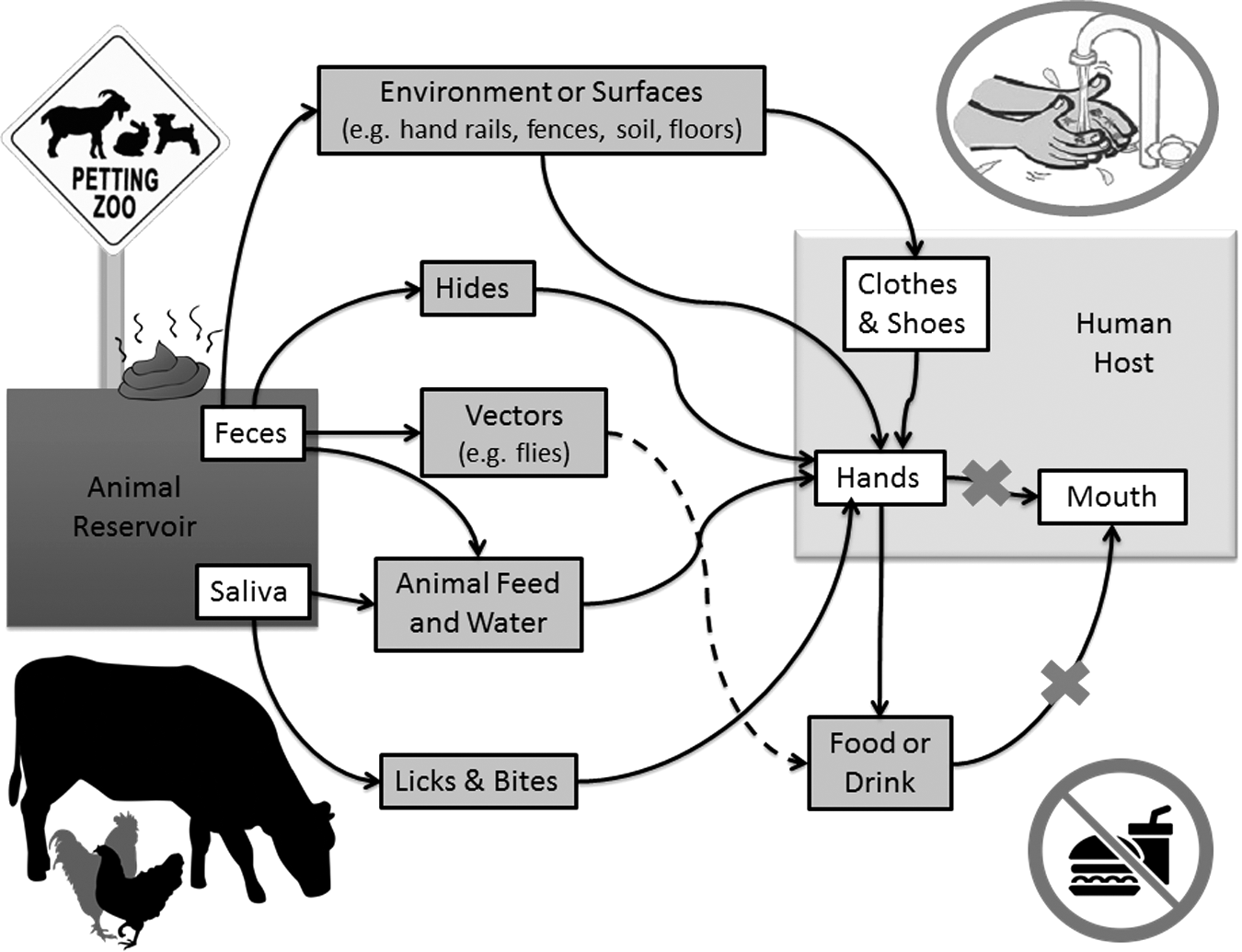
Potential transmission routes for pathogens from animals to humans within an animal environment (including farms, fairs, and petting zoos). Important control points are indicated by an X symbol, namely hand washing before any hand-to-mouth behaviors and the absence of food or drink within the animal area.
Infections Linked to Animal Contact
Hale et al. (2012) estimated that 14% of illnesses from seven common zoonotic pathogens were due to direct contact with farm animals. Campylobacter was responsible for ∼42% of these illnesses, followed by nontyphoidal Salmonella (29%), Cryptosporidium (26%), non-O157 Shiga toxin–producing Escherichia coli (STEC) (2%), STEC O157 (1%), Yersinia enterocolitica (<0.5%), and Listeria monocytogenes (<0.5%) (Hale et al., 2012). Salmonella, Campylobacter, and Cryptosporidium are responsible for the majority of hospitalizations and deaths (Hale et al., 2012).
Although the transmission of STEC infections is low compared with other zoonotic pathogens, it is a significant issue because of its very small infective dose (as few as 10 cells), and the severity of illness that can develop, particularly in young children (Baker et al., 2016). Serotype O157:H7 is a particularly dangerous STEC strain; however, the top 6 non-O157 STEC serogroups causing human disease include O26, O45, O103, O111, O121, and O145 (Brooks et al., 2005; Luna-Gierke et al., 2014; Baker et al., 2016). An estimated 8% and 6% of non-O157 and O157 STEC (∼10,000 and 6000 cases), respectively, are due to direct animal contact in the United States annually (Hale et al., 2012). Hale et al. (2012) estimated that each year, 230 hospitalizations and 2 deaths could be attributed to STEC infections arising from direct animal contact.
Campylobacter, the zoonotic pathogen responsible for the majority of illnesses, also has a very low infectious dose (a few hundred cells) (Humphrey et al., 2007). An estimated 17% of Campylobacter infections (nearly 190,000 illnesses) are due to direct contact with animals, resulting in 1877 hospitalizations and 17 deaths in the United States each year (Hale et al., 2012).
Nontyphoidal Salmonella is another zoonotic pathogen that is usually associated with the ingestion of contaminated food, with an estimated 9–11% (127,000 cases) of all Salmonella cases attributed to direct animal contact, with another 13% acquired through environmental sources (Hoelzer et al., 2011; Hale et al., 2012). It has been estimated that Salmonella infections acquired through direct animal contact are responsible for up to 2392 hospitalizations and 47 deaths in the United States each year (Hale et al., 2012). The infective dose for nontyphoidal Salmonella is estimated at 103 cells (Public Health Agency of Canada, 2011), with more than 20% of clinical cases in the United States occurring in children younger than 5 years (Hoelzer et al., 2011).
The protozoan pathogen Cryptosporidium parvum is commonly found in animals, with ruminants being an important reservoir (Ryan et al., 2014). Studies identified the touching or handling of farm animals, cattle in particular, as the foremost risk factor for C. parvum infection in humans (Hunter and Thompson, 2005; Hunter et al., 2007). An estimated 16% (113,000) of all Cryptosporidium infections are due to animal contact, with more than 400 hospitalizations and 7 deaths in the United States each year (Hale et al., 2012).
Animal Reservoirs
Carriage of STEC by cattle and sheep can range from low to very high (≥104 colony-forming units [CFU]/g of feces) (McPherson et al., 2015; Baker et al., 2016). Individual cattle or small ruminants that shed more than 104 CFU/g feces are termed super-shedders (Baker et al., 2016). Though only a few individuals within a herd or flock may be super-shedders, they can be responsible for widespread animal-to-animal transmission and contamination of the environment (Baker et al., 2016). One study estimated that 96% of all E. coli O157:H7 shed by a group of cattle arose from only 9% of the individuals in the herd (Omisakin et al., 2003). Identification of super-shedders can be difficult, as shedding of STEC levels ≥104 CFU/g appears to be highly intermittent (McPherson et al., 2015; Munns et al., 2015).
Many human cases of Salmonella have also been traced back to cattle. Salmonella prevalence estimates in cattle are variable, with estimates of between-herd prevalence of 2–42% and within-herd estimates of 0–37% (Hoelzer et al., 2011). Research suggests that Salmonella prevalence varies significantly by geographical region, with a lower prevalence in the northern U.S. states and Canada than in the southern states (Besser et al., 2000; Sorensen et al., 2002). Cattle commonly shed Salmonella serovars Typhimurium and Dublin and may shed 103–105 CFU/g of feces (Gopinath et al., 2012). A considerable number of Salmonella serotypes frequently isolated from humans have been isolated from both sick and clinically healthy cattle.
Several outbreaks have been linked to direct contact with cattle in public settings, including farm visits, fairs, petting zoos, and farm day camps in the United States (Hoelzer et al., 2011). C. parvum is often associated with cattle, particularly in suckling calves (Scott et al., 1995; O'Handley et al., 1999; Santín et al., 2004; Fayer et al., 2006). Cryptosporidium infection begins with ingestion of sporulated oocysts, the thick-walled and environmentally hardy stage of the life cycle. Cattle may shed up to 104 oocysts/g of feces (Scott et al., 1994), and human infections may result from as few as 10 oocysts (Ryan et al., 2014). Campylobacter has also been associated with cattle (Harvey et al., 2004; Bolton et al., 2012), with cows shedding an estimated 1.1 × 10² CFU/g of feces and calves shedding nearly 250-fold more (2.7 × 10⁴ CFU/g of feces) (Nielsen, 2002).
Poultry are a natural host of Campylobacter jejuni, and they are responsible for an estimated 80% of human campylobacteriosis cases (Bolton, 2015). This bacteria colonizes the cecal mucosa of birds where populations can exceed 108 CFU/g (Bolton, 2015). Salmonella spp. are also commonly detected in birds, particularly chickens and their hatchlings (Centers for Disease Control and Prevention, 2012b). Salmonella serovars carried by chickens include Enteritidis and Typhimurium, and shedding levels can range from 101 to 107 CFU/g of cecum (Gopinath et al., 2012). Numerous Salmonella serotypes have also been isolated from a variety of nondomesticated birds, including pigeons, doves, parrots, and parakeets (Hoelzer et al., 2011).
Small ruminants and pigs are also important reservoirs of E. coli, Salmonella, Campylobacter, and Cryptosporidium species (Gopinath et al., 2012; National Association of State Public Health Veterinarians, 2013; Bolton, 2015). Transmission of Salmonella from small ruminants and pigs to humans has also been reported, particularly through occupational exposure (Hoelzer et al., 2011; Daly and Hill, 2016).
Reptiles, amphibians, and fish have also been implicated as sources of human zoonotic salmonellosis (Hoelzer et al., 2011). It has been estimated that 90% of captive reptiles carry Salmonella (Woodward et al., 1997).
Management factors can also increase the risk of pathogen transmission at animal exhibits. For example, animals are more likely to shed pathogens due to stress from prolonged transportation, confinement, crowding, and increased handing by humans (Williams and Newell, 1970; Isaacson et al., 1999; Hurd et al., 2002; Dowd et al., 2007). Comingling of animals increases the likelihood of animal-to-animal transmission of pathogens (Rostagno, 2009). Certain pathogens (e.g., Salmonella) are more prevalent in younger than older animals, which are often used in petting zoos and educational programs for children (National Association of State Public Health Veterinarians, 2013). Shedding of STEC and Salmonella organisms has been shown to be highest during the summer and fall months, when the majority of animal exhibits, fairs, and petting zoos occur (Edrington et al., 2006; Menrath et al., 2010). Some pathogens shed by animals may remain viable and pose an infectious risk for months or even years in feces (Rahn et al., 1997; Sandvang et al., 2000; Baloda et al., 2001; Brown et al., 2002; Renter et al., 2003; LeJeune et al., 2004; Callaway et al., 2005) and the environment (Dunn et al., 2015). In one study, STEC O157:H7 was recovered from sawdust on a barn floor 42 weeks after an agricultural fair (Varma et al., 2003).
Zoonotic Pathogen Prevalence in Farm, Fair, and Petting Zoo Animals
Relatively few studies have examined the prevalence of STEC in fair and petting zoo livestock in North America. A study of 12 U.S. county fairs found E. coli O157 in 11% of cattle manure samples and 75% of the fairs (Cho et al., 2006). Nearly 3000 livestock fecal samples from county and state fairs in 2 U.S. states (Keen et al., 2006) demonstrated that STEC O157:H7 was isolated from livestock at 31 (96.9%) of the 32 fairs. Prevalence of STEC O157:H7 was the highest from cattle (11.4%), followed by sheep and goats (3.6%), and swine (1.2%). Flies were also collected from each fair, and 5.2% of the 154 samples collected were positive for O157:H7 (Keen et al., 2006). Other researchers detected STEC O157:H7 in pig feces at a livestock fair in California (Roug et al., 2013). In a study of 15 animal species in a petting zoo, STEC were detected in 7 goats and 3 cows (DebRoy and Roberts, 2006). To date, the prevalence of the top 6 non-O157 STEC serogroups in fairs and petting zoos has not been studied.
The prevalence of Salmonella in farms, fairs, and petting zoos has only been examined in a small number of studies. Salmonella were present in more than 50% of the samples collected from poultry exhibits at several agricultural fairs in Colorado (Pabilonia et al., 2014), and at least one environmental sample was positive for Salmonella at 10 of 11 fairs (Pabilonia et al., 2014). Another study examined the prevalence of Salmonella in feces collected from 997 animals in 36 animal exhibits and found that 0.6% of goats, 1.7% of equids, and 2% of cattle were positive (Keen et al., 2007). Salmonella was isolated from 7% of pigs and 2% of chickens at a California county fair (Roug et al., 2013).
Based on a meta-analysis of seven studies from around the world, the mean prevalence of Campylobacter among petting zoo animals was 6.5% (Pintar et al., 2015). In the Netherlands, feces from nearly 65% of petting farms were found to contain STEC O157 and/or Salmonella and/or Campylobacter species (Heuvelink et al., 2007).
Roug et al. (2013) screened 152 fecal samples from animals at a county fair in California and found that none tested positive for Cryptosporidium. Another study screened stool samples from 129 zoo animals and found Cryptosporidium in a wildebeest, prairie bison, and tortoise (Alves et al., 2005). Though data directly from fairs and petting zoos are limited, studies of North American dairy farms found Cryptosporidium on more than 90% of farms and indicated that even healthy calves shed the pathogen in their feces (LeJeune and Davis, 2004).
Special consideration should be taken when interpreting pathogen prevalence. First, the carriage of a pathogen species by an animal does not preclude the simultaneous carriage of other pathogens (Smith et al., 2004). Second, prevalence of pathogens and strains may differ among animals of the same species, among herds, and across geographical regions (Omisakin et al., 2003; Putignani and Menichella, 2010; Kagambèga et al., 2013). Finally, pathogens such as E. coli O157:H7 and Salmonella are often shed intermittently, thereby complicating their detection and estimates of prevalence (Pickering et al., 2008; Menrath et al., 2010).
Outbreaks in Public Settings Due to Contact with Animals in Farm, Fair, or Petting Zoo Environments
Although the majority of enteric zoonotic outbreaks occur as a result of contaminated food or water, numerous outbreaks have been traced back to direct contact with animals or indirect contact via fair, farm, and petting zoo environments (Hale et al., 2012). The first recorded outbreaks of STEC O157 associated with an animal exhibit occurred in England (1994), affecting seven individuals, with four developing Hemolytic Uremic Syndrome (HUS), followed by Wales (1995) with another three individuals affected with one developing HUS (LeJeune and Davis, 2004). Most of the victims were children, all of whom had previously visited farms. Investigations into the farms revealed inadequate hand-washing facilities and over-crowded animals. Furthermore, no information was provided to visitors regarding the risks of zoonoses, and children were allowed direct contact with the animals under limited supervision (LeJeune and Davis, 2004).
Between 1996 and 2012, ∼200 human infectious disease outbreaks involving animals in public settings were reported to the Centers for Disease Control and Prevention (CDC) (National Association of State Public Health Veterinarians, 2013). Table 1 summarizes the North American outbreaks traced back to direct contact with livestock or poultry, or indirect contact with animals in a fair, farm, or petting zoo environment between 1995 and 2015. This table includes 81 outbreaks, with 41 linked to E. coli O157, 4 to non-O157 STEC, 21 to Salmonella, 6 to Campylobacter, 6 to Cryptosporidium, and 3 to multi-pathogen events.
Centers for Disease Control and Prevention (CDC, unpublished data).
Outbreak occurred in multiple states or provinces.
Salmonella enterica subtypes: Infantis, Newport, and Lille.
S. enterica subtypes: Infantis, Newport, Lille, and Mbandaka.
S. enterica subtypes: Infantis, Newport, and Hadar.
S. enterica subtypes: Enteritidis, Hadar, Indiana, Muenchen, and Muenster.
Multiple pathogens: Cryptosporidium parvum, non-O157 STEC, Salmonella enterica subtype Typhimurium, and Campylobacter jejuni.
Multiple pathogens: C. parvum, E. coli O157:H7, and non-O157 STEC.
Multiple pathogens: C. jejuni, C. parvum.
HUS, Hemolytic Uremic Syndrome; na, not applicable; STEC, Shiga toxin–producing Escherichia coli.
A notable outbreak linked to O157:H7 occurred in Ontario, Canada (1999), where a petting zoo was associated with 155 probable cases and 7 culture-confirmed infections (Warshawsky et al., 2002). Risk of infection was associated with direct contact with sheep and goats, a lack of hand washing, and eating within the animal area (LeJeune and Davis, 2004).
Two STEC outbreaks in 2000 were also associated with direct animal contact at open farms, one in Pennsylvania and the other in Washington State (Steinmuller et al., 2006). In the Pennsylvania outbreak, 51 people became ill (median age, 4 years) and 8 developed HUS (National Association of State Public Health Veterinarians, 2013). Investigation into the Pennsylvania outbreak revealed that 15% of cattle shed O157:H7 in feces. Most of the children involved were preschoolers, and there were no restrictions on eating or drinking in the animal area, nor was there supervision of animal contact (LeJeune and Davis, 2004).
Another noteworthy outbreak occurred at the North Carolina State Fair in 2004, where 108 STEC O157:H7 cases were reported (41 laboratory-confirmed), with 20 patients hospitalized and 15 developing HUS (Goode et al., 2009). A laboratory investigation concluded that E. coli O157:H7 in sheep and goat feces were responsible for contamination of the petting zoo environment (Stirling et al., 2007; Goode et al., 2009).
The majority of North American Salmonella outbreaks in the past decade have involved live poultry, including a large outbreak in Canada that sickened at least 61 and hospitalized 9 people across 5 provinces (Public Health Agency of Canada, 2015). In the United States, outbreaks of salmonellosis have been associated with live poultry (e.g., chicks, chickens, ducklings, ducks, geese, turkeys) (Hale et al., 2012), totaling more than 1600 cases, 334 hospitalizations, and at least 3 deaths since 2009 (Centers for Disease Control and Prevention, 2012b; Loharikar et al., 2013). Exposure in some of these outbreaks was in nonpublic settings, but a number of ill people reported contact with live poultry in feed stores, schools, day care facilities, nursing homes, or petting zoos (National Association of State Public Health Veterinarians, 2013).
Though not specifically associated with petting zoos, several outbreaks of Salmonella have originated from direct contact with nontraditional pets (e.g., hedgehogs, mice, guinea pigs) (Hoelzer et al., 2011), as well as with reptiles and amphibians (e.g., small turtles, snakes, lizards, frogs) (National Association of State Public Health Veterinarians, 2013).
A number of outbreaks are listed as multiple-pathogen outbreaks where illnesses were attributed to two or more pathogens. Two multiple-pathogen outbreaks occurred in Minnesota during 2000 and 2001, infecting 84 people and including STEC O157:H7, non-O157 STEC strains, C. parvum, Salmonella enterica serotype Typhimurium, and C. jejuni (Smith et al., 2004). All of these organisms were identified in calves, and risk factors for children included caring for an ill calf, and getting a visible amount of manure on their hands (National Association of State Public Health Veterinarians, 2013).
Vaccination and Antimicrobial Treatment for Zoonotic Pathogens
This section covers some key biosecurity measures that should be considered by the owners and caretakers of animals participating in public events. Importantly, removing visibly ill animals is not sufficient to protect the health of animals and humans, since animals usually exhibit no clinical signs as a result of shedding zoonotic pathogens (National Association of State Public Health Veterinarians, 2013). Some vaccines for zoonotic pathogens are either commercially available or in development. One vaccine against E. coli O157:H7 was fully licensed in Canada, but is no longer available, and two vaccines are available in the United States with restricted licenses (Matthews et al., 2013). However, these vaccines are rarely used in ruminant livestock (Matthews et al., 2013), as producers bear the cost of vaccination yet receive no direct economic benefit as the animals are clinically healthy (Matthews et al., 2013).
Vaccination of cattle against E. coli O157:H7 has been reviewed recently (Snedeker et al., 2012; Matthews et al., 2013; Varela et al., 2013). Whether vaccination could be an effective public health control measure for animal exhibits and petting zoos is unclear. Research indicates that vaccination does not consistently reduce prevalence of STEC O157:H7 in cattle feces, and additional development is required (Stanford et al., 2014). Comparisons of multiple studies indicate significant heterogeneity in the results, suggesting differential responses to vaccination across trials (Snedeker et al., 2012). In addition, vaccination may reduce but not eliminate the pathogen, making it necessary to employ a suite of interventions to reduce zoonotic risk (Snedeker et al., 2012). Currently, no vaccines for E. coli O157:H7 in small ruminants are commercially available.
Routine testing of animals is not recommended as a reliable means of preventing infection (McMillian et al., 2007), as most pathogens are shed intermittently. In addition, the inherent limitations of laboratory tests make it difficult to rapidly identify and remove infected animals from the herd or flock. Treatment of animals with antimicrobials is also not a practical option, because it has been shown to prolong shedding and could contribute to antimicrobial resistance (Al Amri et al., 2007; Béraud et al., 2008). Antimicrobial treatment cannot reliably eliminate infection, prevent shedding, or protect against reinfection and often may fail to target the pathogen of interest (National Association of State Public Health Veterinarians, 2013).
Hygienic practices can be employed on-farm to minimize transfer of pathogens between animals and from animals to humans. These include regular cleaning and disinfection of buildings and equipment, water testing and treatment, use of appropriate feeders to prevent defecation in feed, regular disinfection of animal water and feed containers, and the use feed that is produced in a manner that avoids microbial contamination (Doyle and Erickson, 2012). Hygienic practices should be employed during both housing of animals on farms and their transportation, so as to avoid cross-contamination during transport as a result of ineffective cleaning and sanitation of transport crates, containers, trailers, and vehicles (Doyle and Erickson, 2012). For farms that have visitors on-site, provision of protective footwear or footwear cleaning facilities is recommended.
Human Risk Behaviors
Fair and event organizers, educators, petting zoo and farm staff, and visitors should be aware of risky behaviors that can facilitate exposure to and transmission of zoonotic pathogens (Erdozain et al., 2015). An observational study identified some of the most common risk behaviors performed by visitors in 13 petting zoos in the United States (Erdozain et al., 2013). These included touching hands to face in animal areas, animals licking hands, and eating or drinking within animal-contact areas (Erdozain et al., 2013, 2015). Children touching their mouths, putting objects in their mouths, biting their nails, having contact with manure, sucking thumbs, eating, or having soiled hands and shoes during or after being in animal-contact areas have also been identified as risk factors and linked to STEC infections (Hoelzer et al., 2011).
Animal-exhibit associated outbreak investigations have consistently found a protective effect of hand washing after handling animals and before eating (Davis et al., 2006). Hand washing is a critical defense against ingestion of many pathogens; however, it is often improperly taught to young children. Proper hand washing consists of using soap and thoroughly massaging the hands, creating a lather, and scrubbing them for at least 20 s before rinsing with running water (warm or cold) (National Association of State Public Health Veterinarians, 2013). Hands must be dried with paper towel or hand driers, not on clothing, which could result in secondary contamination.
Alcohol-based hand sanitizers are highly effective against a range of bacterial pathogens, fungi, enveloped viruses, and certain nonenveloped viruses (Edmonds et al., 2010). Several studies have indicated that alcohol-based hand sanitizers are superior to hand washing for reducing microbial contamination, while requiring less time to use and often resulting in greater compliance than hand washing (Widmer, 2000; Girou et al., 2002; Chow et al., 2012). However, a possible contributing factor to the smaller bacterial reduction of hand washing as opposed to the use of an alcohol-based hand sanitizer is an insufficient amount of time spent scrubbing when only hand washing is used (Widmer, 2000; Girou et al., 2002; Edmonds et al., 2010; Chow et al., 2012).
Though hand sanitizers may effectively reduce hand contamination with coliform bacteria (e.g., E. coli O157:H7), these products are ineffective if hands are visibly dirty (Davis et al., 2006; Anderson and Weese, 2012). Furthermore, these alcohol-based products are ineffective against many other pathogens that maybe present within a petting zoo environment (e.g., Cryptosporidium) (Anderson and Weese, 2012). The mechanical action of hand washing as well as the cleansing properties of surfactants in soaps are believed to contribute to the better reduction of microorganisms when hands are heavily soiled (Edmonds et al., 2010). Consequently, hand sanitizers are not a suitable stand-alone replacement for hand washing, but rather best used in conjunction with this preventative measure.
During a study of 13 petting zoos in Kansas and Missouri, hand hygiene compliance of 574 visitors was observed (Erdozain et al., 2013). Only 37% of visitors attempted any type of hand hygiene. Importantly, visitors were 4.8 × more likely to wash their hands when a staff member was present (Erdozain et al., 2013). Hand hygiene compliance was also observed at 36 petting zoos in Ontario, Canada (Weese et al., 2007). A compliance of 0–77% was observed (mean value 30.9%). Increased hand hygiene compliance was observed when hand-washing stations were located near the exit (Weese et al., 2007).
A subsequent study of a single petting zoo in Ontario found hand hygiene compliance to be 58% (Anderson and Weese, 2012). The most effective hand hygiene intervention observed in this study was a combination of improved signage for hand washing and petting zoo personnel stationed along the exit dispensing hand sanitizer (Anderson and Weese, 2012). Verbal hand hygiene reminders by venue staff have also been associated with increased compliance (Anderson and Weese, 2012).
Legal and Economic Implications of Infection in Public Contact Areas
After several large-scale outbreaks in the United States, legislatures of the affected states enacted laws mandating standards for animal exhibition sanitation (Babcock, 2006). These laws require animal exhibit operators to promote public awareness of the risk of contracting a zoonotic disease, to provide adequate hand-cleansing facilities, and to prohibit the exhibition of animals not properly cared for by a veterinarian (Babcock, 2006). The National Association of State Public Health Veterinarians (NASPHV), in conjunction with the CDC, published recommendations to prevent disease outbreaks in public settings with animal exhibits (National Association of State Public Health Veterinarians, 2013).
The North Carolina legislature adopted “Aedin's Law” named after a child hospitalized with HUS after a major STEC outbreak associated with a state fair (Goode et al., 2009). This law requires that animal exhibitors acquire a public permit and adopt the regulations outlined by CDC/NASPHV (Babcock, 2006).
Under premises liability law, the entity responsible for managing the animal exhibition has a duty to care for the visitors invited onto the property, including adequately reducing and identifying risks and by warning the visitors of the risks present (Babcock, 2006). These laws hold exhibitors to a standard of possessing a reasonable knowledge of the risks involved and as a result, a claim of ignorance is not an effective defense (Babcock, 2006).
Anecdotal reports indicate that outbreaks associated with petting zoos have substantial legal implications for the industry (McMillian et al., 2007), with some fairs having difficulty obtaining insurance, resulting in their discontinuance. These outcomes eliminate important opportunities for agricultural education and completely eliminate urban contact with farm animals (McMillian et al., 2007). Petting zoos will almost certainly be discontinued if the possibility of large-scale, life-threatening outbreaks is linked to agricultural fairs (Babcock, 2006).
The economic burden of zoonotic illnesses is a result of the direct costs associated with medical care, productivity loss, and premature deaths (Scharff, 2012). Estimates of the cost of illness of STEC O157 infection also include the medical costs and productivity losses from long-term health outcomes in a subset of individuals, as well as monetized estimates of pain, suffering, and functional disability (Scharff, 2012; Sockett et al., 2014). In Canada, an estimated 22,344 cases of STEC O157 infection each year cost the country $26.7 million (Sockett et al., 2014). Premature deaths account for a large proportion of the cost, since the majority of deaths occur in young children (Sockett et al., 2014). There are more than 37,000 additional ongoing cases, with long-term outcomes costing $377.2 million per year, raising the total annual cost of infection to $403.9 million (Sockett et al., 2014).
Importantly, these estimates are based on data from the National Notifiable Diseases Registry, which include cases from all sources, primarily foodborne. Therefore, the costs of STEC O157 illness arising from direct animal contact would only represent a fraction of total cases, as an estimated 6% arise from direct animal contact in the United States) (Hale et al., 2012).
One study estimated the burden of infection by various different pathogens on a cost-per-case basis (in U.S. dollars) (Scharff, 2012). The basic cost-of-illness model included economic estimates for medical costs, productivity losses, and illness-related mortality, with STEC O157:H7 ranking the highest at $9606 per case. The costs per case of the other major zoonotic pathogens were as follows: Salmonella, $4312; Cryptosporidium, $2056; Campylobacter, $1846; and non-O157 STEC, $896 (Scharff, 2012). These values do not include the pain, suffering, and long-term functional disability from the illness, which combined could increase the cost per case by as much as $11,000 (Scharff, 2012). Non-healthcare costs are also pronounced, including class action and victim claim settlements, fines, and prosecution costs (Pennington, 2010).
Best Practices for Events Encouraging Human–Animal Interactions
The published practice recommendations by NASPHV, in conjunction with the CDC, are addressed to government agencies, educators, exhibit managers, veterinarians, and visitors (Hoelzer et al., 2011). These recommendations include encouraging good hygiene practices, improving facility design, implementing disease monitoring and prevention systems, and prohibiting high-risk contact behaviors (Hoelzer et al., 2011). Several Canadian and U.S. health authorities, including the Canadian Food Inspection Agency (CFIA) and the Centers of Disease Control and Prevention (CDC), as well as the individual provincial and state health departments, have issued notices on the causes, symptoms, and risks associated with zoonoses as well as tips for preventing illness when visiting petting zoos (Canadian Food Inspection Agency, 2012; Centers for Disease Control and Prevention, 2015).
Important elements of an animal-contact area are reviewed by Erdozain et al. (2015). Briefly, these include a separate entrance and exit to facilitate one-way flow of visitor traffic, a safe area away from the animal area to store personal belongings, transition zones to promote hand hygiene, and a service area inaccessible to the public for transport of animals and waste in and out of the animal area (Erdozain et al., 2015).
The animal-contact area itself should be isolated from other public areas, particularly eating and food-preparation areas, by fences and/or walls. Animals should be kept clean, and manure, urine, and soiled bedding should be promptly removed (Erdozain et al., 2015).
All surfaces in animal-contact areas should be cleaned daily, including, but not limited to, walkways, fencing, faucets, and sinks. Recommended disinfectants include diluted bleach (1:16 bleach:water), or quaternary ammonium compounds used as per the manufacturer's label (National Association of State Public Health Veterinarians, 2013; Erdozain et al., 2015). Furthermore, most disinfectants require at least 10 min of contact time to thoroughly decontaminate surfaces (Erdozain et al., 2015).
Finally, a very important preventative measure is education, particularly of event staff and visitors, as awareness of zoonotic disease risks protects against outbreaks (National Association of State Public Health Veterinarians, 2013). A study by Hawking et al. (2013) found that a “farm hygiene” lesson improved the awareness of risks associated with microbes and steps to prevent infection by as much as 18% (Hawking et al., 2013). Educating students on bacteria as well as general and specific hygiene practices before farm visits with their class or school is recommended (Hawking et al., 2013).
Zoonotic Pathogens and the Urban Consumer
In addition to the limited knowledge of zoonotic pathogens and farm and petting zoo hygiene among the general public, there is an even broader lack of consumer knowledge surrounding contemporary agricultural practices and food production (Sharp et al., 2002). Research suggests that individuals with repeated exposure to enteric pathogens, such as those living or working on farms, may become less susceptible to infection (Belongia et al., 2003; Hale et al., 2012). However, most members of the public have no direct interaction with farms in their daily lives, and are, therefore, more susceptible. However, many will attend a farm, fair, or petting zoo in their lifetime, highlighting the importance of preventative hygiene measures. In addition, these events provide a unique opportunity for people from an urban environment to experience elements of the rural lifestyle and to interact directly with farmers. This is an excellent opportunity for education that extends beyond the risks of direct animal contact.
Farms, fairs, and petting zoos should be encouraged to provide additional education about agricultural practices, food production, and food safety. Though it is the responsibility of the health community, food industry, regulators, and the media together to educate the public about food safety, public agricultural events provide another venue to encourage familiarity with these concepts (Wilcock et al., 2004). The reality of zoonotic pathogens is that regulations cannot provide complete protection from foodborne illnesses nor those contracted from direct animal contact. Rather, education is required so that the public may realize their responsibility in ensuring their own safety.
Conclusions
Anecdotal reports of difficulty in obtaining insurance and fairs discontinuing petting zoos are increasingly common due to legal regulations and fears of zoonotic transmission (McMillian et al., 2007). As a result, opportunities for public education and interaction with animals may be lost. At this time, contamination of animal environments cannot be entirely eliminated. However, the risks associated with direct animal contact and enteric pathogens can be reduced with appropriate sanitary practices and education. Therefore, the implementation of the recommendations outlined by the health authorities and NASPHV, such as promoting hand washing, and avoidance of risk behaviors like eating and drinking in animal areas, are critical to ensure that opportunities for human–animal interaction remain under minimal risk conditions (McMillian et al., 2007).
Additional research on pathogen incidence in fair and petting zoos, and development of training sessions and educational materials for fair and petting zoo operators would be beneficial steps toward improving public safety in public animal venues. Such outreach activities are an important component of gaining the urban public's social license to operate, but only if they can be undertaken in a manner that minimizes the risks of zoonotic transmission.
Methods
The literature search was conducted from December 2015 to May 2016 by using Google Scholar, Scopus, Web of Science, and PubMed. Key words searched included Escherichia coli O157:H7, non-O157 STEC, Salmonella, Campylobacter, and Cryptosporidium, both with and without simultaneously searching the phrases petting zoo, animal exhibit/exhibition, and county/state fair. All studies acquired from the databases from 1995 mentioned earlier to those at present that described human enteric pathogens (Escherichia coli O157:H7 and non-O157, Salmonella, Campylobacter, and Cryptosporidium) within the context of zoonotic transmission, public venues, and animal exhibitions (fairs, farms, petting zoos) were included. Studies before this year were excluded, except for where information was sparse, specifically regarding the shedding of Cryptosporidium and Salmonella organisms.
Only manuscripts in English were considered, as authors lacked the ability to interpret manuscripts presented in other languages. The year 1995 was selected as the cut-off year, as relevant references were not found in the databases before this time. Studies that possessed these key words and were relevant to the topic area were selected. Data were excepted, as they were presented within peer-reviewed manuscripts. Where nonpeer reviewed health reports were cited, the appropriate web address to access the reports was included.
Footnotes
Acknowledgments
The authors wish to express their appreciation to the Canadian Association of Fairs and Exhibitions and the Growing Forward II program of Agriculture and Agri-Food Canada for the financial support that enabled this review to be prepared.
Disclosure Statement
No competing financial interests exist.