




Abstract
Salmonella carriage in pigs is a significant food safety issue. This study describes a new protocol of Salmonella infection based on exposure to an artificially contaminated environment that closely mimics natural exposure to the organism. The aim of the study was to develop and evaluate the effectiveness of this protocol, which could then be used as a tool in the investigation of control measures. In addition, Salmonella shedding pattern and growth performance of the pigs were examined. Trial pigs (n = 10) were placed in a pen that had been previously contaminated by housing two pigs experimentally challenged with a monophasic Salmonella Typhimurium (mST). A further 10 pigs were placed in a Salmonella-free pen. Pigs were weighed on days 0 and 28. Feces was collected on days 0, 2, 3, 5, 7, 14, 21, and 28 and examined for the presence and quantity of Salmonella. The trial was replicated once. All pigs in the contaminated pens shed Salmonella within the first 2 days of exposure with values ranging from 100 to 104 CFU/g. The noninfected pigs had significantly higher final body weights on day 28 than those exposed to the Salmonella contaminated environment in both replicates. The pigs in the Salmonella-free pen had significantly higher average daily weight gain over the 28-day period compared to the infected animals (p < 0.001). Although not significant, numerical improvements in average daily feed intake and feed conversion efficiency were observed in the Salmonella-free pigs when compared to the contaminated pigs. The approach used was successful in infecting pigs with Salmonella without the need for direct inoculation or exposure to seeder pigs. This “natural” method of infection in which pigs are exposed to low levels of environmental contamination with Salmonella may be an effective tool that could be utilized when investigating control measures.
Introduction
S
This is a major public health concern and highlights the need for control measures, often including interventions at the primary production level (Boyen et al., 2008). Previous studies have examined the efficacy of control measures through experimental inoculation or field trials. Experimental inoculation studies typically challenge the pigs with high doses of up to 109 CFU of Salmonella (Fedorka-cray et al., 1995; Hurd et al., 2003; Boughton et al., 2007; Casey et al., 2007) or alternatively use seeder pigs shedding high numbers of organisms to transmit infection to their pen mates (Michiels et al. 2012). Neither of these approaches closely mimics natural infection as it occurs on most farms. The high doses of Salmonella used in these models often result in clinical signs and fecal excretion of high numbers of bacteria, thereby causing the infection pressure to become excessive for the realistic evaluation of control strategies.
Field trials are useful in that they use the natural Salmonella infection already present on-farm, but due to the multifactorial nature of Salmonella infection on farms, results vary greatly between herds and between studies (Wales et al., 2011), making it difficult to fully assess the effectiveness of the implemented interventions. The present study describes a new protocol for experimental Salmonella infection based on exposure to an artificially contaminated environment that closely mimics natural exposure to the organism. The aim of the study was to develop and evaluate the feasibility and reproducibility of this protocol as well as to examine the Salmonella shedding pattern and growth performance of the infected pigs compared to noninfected batch mates.
Materials and Methods
Animal ethics and experimental licensing
Ethical approval was obtained from the University College Dublin Animal Research Ethics Committee (Approval number: AREC 15 09), and an experimental authorization was obtained from the Irish Health Products Regulatory Authority (Authorization number: AE19113/P005).
Animals and facilities
Seven-week-old [PIC337 × (Landrace × Large-White)] pigs with a mean weight of 14.7 kg were loose-housed in boxes adapted for holding pigs. Each box included a clean area and a pen (12 m2) with a solid concrete floor. Pig density complied with Irish and EU legislation (EU Directive 2010/63). The pen floor, apart from the dunging area, was covered with a deep layer of sawdust. A feed hopper was provided in each pen, together with a nipple drinker. Average temperature was maintained at 23°C with a relative humidity of 88%. Pigs were sourced from a commercial herd with 0% seroprevalence levels according to the Irish National Salmonella Control Programme (NPSCP) classification level for the 3 months before the commencement of the trial. Fecal samples were collected from the herd 2 weeks before the purchase of the pigs and tested for the presence of Salmonella to ensure the pigs were not shedding the organism in their feces.
Environmental contamination
A field isolate of Salmonella enterica subspecies enterica serovar 4,[5],12:i:-, phage type DT193 with multiple drug resistance pattern ASSuT (Ampicillin [A], streptomycin [S], sulfonamide [Su], and tetracycline [T]) was streaked to extinction on Plate count agar (PCA) to achieve single colonies. This was incubated at 37°C for 24 h. Two colonies from the PCA plate were inoculated into 10 mL of Tryptone soya broth (TSB) and incubated at 37°C for 24 h. This pure broth culture with an expected concentration of 108 CFU/mL was diluted in phosphate-buffered saline (PBS) to obtain a concentration of 107 CFU/mL. This culture was then further diluted 1:10 in PBS to achieve a final concentration of 106 CFU/mL. Two female 7-week-old pigs were orally inoculated with 5 mL (106 CFU/mL) of this inoculum by oral gavage. These pigs were placed in one of the pens where they were provided with ad libitum access to feed and water.
The animals were allowed to shed Salmonella in their feces for 5 days at which point they were removed from the pen and euthanized. Following their removal, the feces in the defecating area of the pen was mixed to ensure more even distribution of contamination levels before entry of the trial pigs into the contaminated environment. A pooled fecal sample (10 g) was collected from five points in the defecating area, and the level of Salmonella was found to be 2.51 × 10³ CFU/g of feces in the first replicate and 7.94 × 10³ CFU/g of feces in the second replicate.
Pen swabs were collected from a negative control pen also to confirm the absence of Salmonella. Trial pigs (n = 10), confirmed as Salmonella free, were then placed in the Salmonella-contaminated pen. A further 10 pigs were placed in the Salmonella-free pen. A compulsory biosecurity protocol was followed by all personnel moving between the Salmonella-free pen and the Salmonella-contaminated pen that included use of different boots, boot covers, and overalls. The trial was replicated once, with the second replicate performed following full cleaning and disinfection of the pens and challenge of another two pigs as for the first replicate.
Sampling
Feces were collected from each pig by digital rectal stimulation on days 0, 2, 3, 5, 7, 14, 21, and 28, with day 0 being the day of entry to the trial pens. All samples were collected and handled aseptically to avoid cross-contamination.
Blood was collected from each pig by jugular venepuncture for serological analysis on day 0 to ensure pigs were Salmonella free and day 28 of the experiment. Samples were collected using plastic tubes for whole blood (BD Vacutainer, Becton Dickinson, United Kingdom). Sera was obtained after coagulation and centrifugation of the tubes (1500 rpm for 10 min) and stored at −20°C until analysis.
Individual pig weights were recorded on days 0 and 28. Feed disappearance was recorded throughout the trial. These weights were used to calculate average daily feed intake (ADFI), average daily weight gain (ADWG), and feed conversion efficiency (FCE) (Lawlor et al., 2006). Pigs were checked daily to ensure they were bright, alert, eating, and drinking normally. The incidence and severity of diarrhea were recorded by visual examination of fecal consistency and were scored on a scale of 1–4 as follows: 1—Normal formed feces, 2—soft feces, 3—liquid feces, and 4—watery feces.
Sample analyses
All samples were stored at 4°C and analyzed within 24 h. Feces (10 g) were screened for the presence/absence of Salmonella using the International Standard Organization 6579:2007 (Amendment 1: Annex D) method (ISO 6579:2002/Amd.1:2007). Salmonella was also enumerated in the feces using a miniaturized most probable number (MPN) technique following the ISO 6579-2:2012 standard. The number of wells giving a positive confirmed reaction for each dilution was recorded and used to calculate the MPN using relevant software (Jarvis et al., 2010).
Serum samples were analyzed in duplicate by the Department of Agriculture Food and Marine (Ireland) using an in-house indirect Enzyme-Linked Immunosorbent Assay (ELISA) (Nielsen et al., 1995). Testing was performed in accordance with the methods used for serological monitoring in the current National Salmonella Control Programme. The crude optical density (OD) values of the unknown samples were adjusted with OD values of the positive and negative controls [(sample−negative control/positive control−negative control) × 100]. Two different cutoffs were fixed at optical densities of 10% and 20% to elucidate the seroconversion and seroprevalence.
Statistical analyses
All statistical analyses were performed using SAS 9.3 (Cary, NC). Statistical differences among the number of shedders at each sampling point and the concentration of Salmonella in feces were estimated by a chi-square test and the mixed model procedure, respectively. For growth performance, data were analyzed using mixed models and initial pig weight was used as a covariate for the analysis of pig weight at day 28, feed intake, average daily gain, and FCE. Means for serology were separated using the Tukey–Kramer least square means adjustment for multiple comparisons and evaluated as the presence of Salmonella antibodies in serum. Significant differences were established at p ≤ 0.05.
Results
Pig health
Two of four of the orally challenged pigs developed diarrhea (score 4) 5 days postinoculation. Eight of 20 pigs exposed to contaminated pens developed transitory diarrhea (score 3) during week 1 of the trial. One of the 20 control pigs also showed mild diarrhea on a single day during the first week, but this was not linked to Salmonella (negative feces in the analysis). All animals remained bright and alert and continued to eat and drink throughout the study.
Salmonella shedding
Salmonella was not detected in any fecal samples taken before introduction of the pigs into the contaminated environment or in the Salmonella-free pen at any stage. All pigs in the contaminated pen shed Salmonella in their feces within the first 2 days of exposure, with values ranging from 100 to 104 CFU/g (Fig. 1). Although the feces of all pigs, except two, were positive in both replicates up to day 14 (Table 1), marked differences were detected on day 21 (p < 0.001) when all feces from replicate 1 pigs were negative. Three pigs from this replicate shed Salmonella again 7 days later (Table 1). This abrupt cessation of shedding was not observed in the last two samplings for replicate 2. The levels of Salmonella in the feces reduced after day 7, as did the variability in the quantity of Salmonella shed by pen mates (Fig. 1). In the first replicate, a significant decrease was observed in the mean concentration of Salmonella detected in feces between day 7 and 21 (p < 0.001) and levels reduced to as low as 100 CFU/g on day 28.
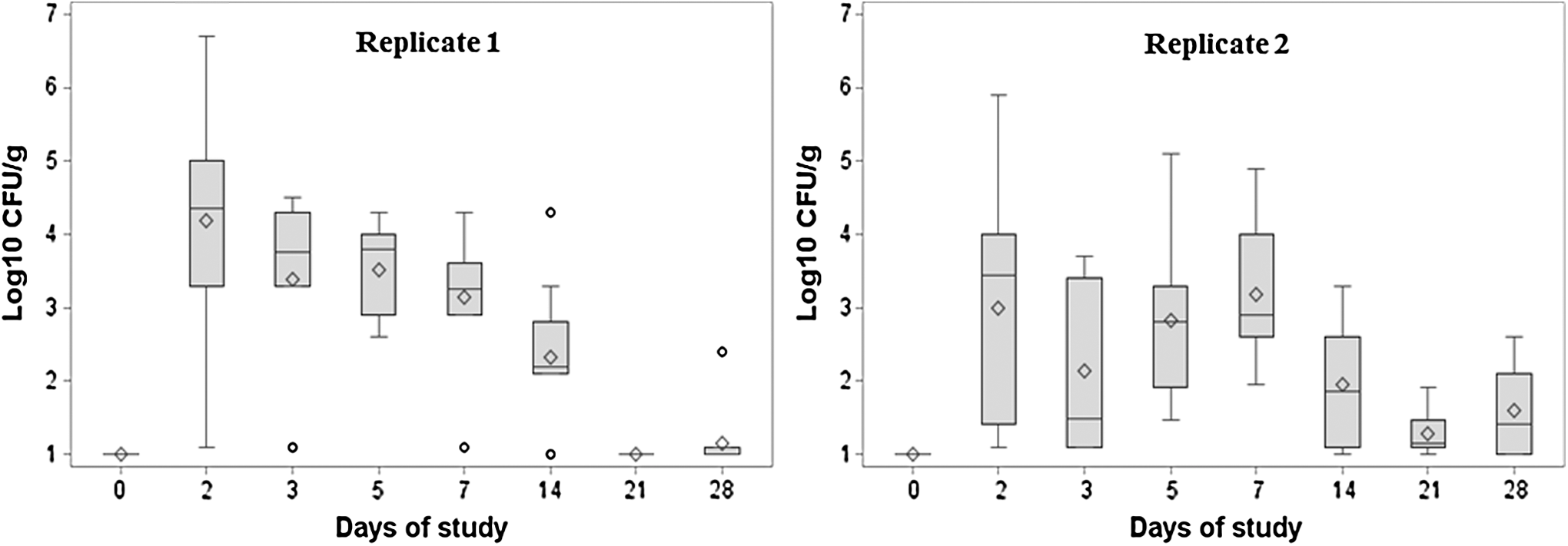
Concentration of Salmonella in feces from 10 pigs in each of two replicates after their introduction to a contaminated environment.
Serology
The serological results were based on 10% OD and 20% OD cutoff points. On day 0, before introduction of pigs to the contaminated environment, all pigs were seronegative. The negative control group remained seronegative throughout the trial. By day 28 most of the pigs in the Salmonella-positive group (17 pigs out of 20) had seroconverted using both the 10% OD and 20% cutoff points
Growth parameters
The noninfected pigs had significantly higher (p < 0.001) final body weights on day 28 than those exposed to the contaminated pens in both replicates (Table 2). The pigs in the Salmonella-free pen had significantly higher ADWG over the 28-day period compared to the infected animals (p < 0.001). Although not significant, numerical improvements in ADFI and FCE were observed in the Salmonella-free pigs when compared to the contaminated pigs.
ADFI, average daily feed intake; ADWG, average daily weight gain; FCE, feed conversion efficiency.
Discussion
In this study, we aimed to develop a protocol of experimental infection that closely mimics natural on-farm exposure of pigs to Salmonella. We wished to simulate mild or subclinical infection rather than clinical disease, as this is what is commonly observed on commercial farms (Beloeil et al., 2003). Using this protocol, where the environment was contaminated before entry of the animals, the pigs were exposed to Salmonella in a way that closely reflects that encountered on a commercial farm. On day 0 before the introduction of the pigs to the contaminated environment, all pigs were seronegative and Salmonella was not detected in any of the fecal samples showing that any Salmonella isolated was as a result of infection from the mST present in the pen.
Rapid infection was observed, with all pigs infected within the first 2 days of exposure, despite environmental concentrations being considerably lower than the oral doses usually used in challenge studies. Trial pigs were exposed to an environment contaminated with 103 CFU/g of feces. In their study of contamination levels in the lairage, Loynachan and Harris (2005) observed that at least 103 CFU/g of feces was required to infect pigs by a contaminated environment (Loynachan and Harris, 2005).
Mild clinical signs were observed in some (8 of 20) exposed pigs, and Salmonella was not isolated from the negative control group at any time. Diarrhea seen in the Salmonella-free pen was self-limiting and occurred during the first week. The commercial herd from which the pigs were sourced had no recorded occurrence of dysentery, intestinal spirochetosis, clinical ileitis, postweaning Escherichia coli diarrhea in 7–8-week-old pigs, or any infectious intestinal disorder such as porcine epidemic diarrhea. Thus, we ascribed the diarrhea in the negative control group to the change in diet and possible stress associated with the change of environment as Salmonella was not detected in the feces of the negative control animals.
With regard to the diarrhea in the Salmonella contaminated pen, other factors may have had some influence. Salmonella is usually a subacute subclinical infection under natural conditions, but the combination of a virulent serotype with pigs from a Salmonella-free herd (no maternal antibodies) may have exacerbated the infection with resultant mild clinical signs. Ideally, if resources had been unlimited, it would have been interesting to try several different contamination strategies, including lower levels of contamination with different groups of pigs. The majority of pigs shed Salmonella for at least 7 days at concentrations of 100–104 CFU/g. This is in contrast to other studies where pigs were experimentally infected or seeder pigs were used, in which pigs frequently shed 106–108 CFU/g in the first few days postinfection (Boyen et al., 2008).
An important difference between the present protocol and studies which use “seeder” pigs is that the trial pigs are not mixed with infected animals that are shedding unknown concentrations of Salmonella, but instead are introduced to a contaminated environment where the Salmonella concentrations are quantified. In this way, the concentration of Salmonella to which the trial pigs are exposed is known and can be controlled at least in part to ensure that the infectious dose is lower than that given in most experimental challenge studies. Although differences in the amount of feces analyzed, methodology used, and serotype involved may explain in part the variability reported in published studies, it is likely that challenge doses of up to 109 CFU frequently used in experimental infection models are in excess of levels of exposure experienced during natural infection. This makes the efficacy and practical application of potential control strategies difficult to fully assess in such studies.
Nevertheless, challenge studies using direct inoculation are useful as they provide a more controlled method of experimental infection than field trials, which can be associated with many logistical and compliance problems. The protocol described in this article may provide a useful alternative method of infection that retains some of the advantages of challenge studies while substantially removing the unpredictable aspects of field studies. During natural infection, pigs commonly exhibit intermittent shedding of low numbers of the organism in their feces after the initial acute phase of infection (Beloeil et al., 2003). The number of positive pigs and the concentration in feces (104–100 CFU/g) started to decrease after 2 weeks, which is in agreement with other studies (Boyen et al., 2009).
The intermittent nature of shedding after the initial phase of infection should be taken into account when interventions are evaluated for longer than 2 weeks postinfection. Despite the fact that pigs in both replicates of the study were exposed to the same concentration of Salmonella in the environment and were obtained from the same herd and at the same age, there were differences in Salmonella shedding between replicates; the number of positive animals was consistent between replicates up to day 14 but varied thereafter (Table 1).
In addition, greater variability was observed in replicate 2 in terms of the numbers of organisms shed by individual pigs (Fig. 1). This confirms that variability can be expected, not only among pigs in the pen but also between replicates of the study. Variation between individual animals would be expected in animals infected by other methods also, including natural infection due to individual host factors of susceptibility and immune response.
As expected, exposure to Salmonella affected all production parameters measured, including ADWG, similar to that found in previous studies (Bruno et al., 2013).
Conclusion
This design of experimental infection involving exposure to a contaminated environment was chosen as it closely reflects the natural route of transmission and exposure to Salmonella that is encountered on farm. Infection was successful without the need to inoculate or mix with seeder pigs. This protocol may be an effective tool, which could be utilized when investigating control measures for Salmonella for use on commercial farms.
Footnotes
Acknowledgments
This study was funded by the Food Institutional Research Measure (FIRM) administered by the Department of Agriculture Food and the Marine (DAFM). The authors gratefully acknowledge the staff at Longtown Research Farm and the Central Veterinary Research Laboratory (CVRL) Backweston for their expert help in the conduct of the study.
Disclosure Statement
No competing financial interests exist.