




Abstract
Toxoplasmosis can be acquired through the ingestion of contaminated drinking water with oocysts of Toxoplasma gondii, highly resistant to the routinely disinfection processes; based on chlorination commonly used in the water supply industry. The aim of this study was to determine the presence of T. gondii DNA in samples of public drinking water from an endemic region of southern Mexico. In total 74 samples of water (5 L each) were collected from the three well fields (I, II, and III) and 71 independent wells, distributing public drinking water to the city of Merida Yucatan, after passing through the chlorination process. Water samples were filtered and concentrated by a sucrose solution, then DNA was extracted and evaluated through a nested-PCR (nPCR) specific for T. gondii. Positive samples were detected in 5.4% (4/74) of the water samples. This is the first report of the presence of T. gondii DNA in public drinking water from a large city in southern Mexico, where their consumption without any postpurification treatment could pose a risk for acquiring the infection in the urban population.
Introduction
T
Merida capital city of Yucatan, Mexico is considered an endemic area of T. gondii, with a high seroprevalence in the human population, with ranges from 25% to 91% (Zavala-Velázquez et al., 1989; Góngora-Biachi et al., 1998; Jiménez-Coello et al., 2011; Vado-Solís et al., 2013; Ortega-Pacheco et al., 2015) and in meat producing animals, with ranges from 25% to 100% (Ortega-Pacheco et al., 2011, 2013; Hernandez-Cortazar et al., 2014, 2016b). In addition, this study region has a karstic aquifer prone to pollution due to its high permeability (Bauer-Gottwein et al., 2011), which could influence the dissemination of Toxoplasma gondii oocysts.
Several outbreaks of clinical toxoplasmosis associated with consumption of public drinking water contaminated with Toxoplasma gondii oocysts have been reported (Bowie et al., 1997; Bahia-Oliveira et al., 2003; de Moura et al., 2006; Palanisamy et al., 2006; Balasundaram et al., 2010). However, few studies have been conducted to detect T. gondii DNA in drinking water; range prevalences reported are from 7.7% to 58.6% (Isaac-Renton et al., 1998; Villena et al., 2004; Sroka et al., 2006; Aubert and Villena, 2009; Demirel et al., 2014; Wells et al., 2015; Triviño-Valencia et al., 2016), where higher frequencies reported in shallow wells (<7 m deep), in surface water sources, and in unfiltered municipally treated water.
The aim of this study was to determine the presence of T. gondii DNA in water samples of purification plants that supply an endemic region in southeastern Mexico.
Materials and Methods
Study area and sampling
This study was conducted in the city of Merida, the capital of Yucatan, Mexico. The climate in the region is tropical sub-humid (Aw) with an average annual temperature 24°C–28°C and a range of total annual rainfall of 400–2000 mm. This study period was considered from March to early July 2015, covering the dry season and the beginning of the rainy season (INEGI, 2014). The aquifer in the city is karstic. Groundwater is the only water resource available in this study area (Bauer-Gottwein et al., 2011). A cross-sectional study was conducted in 3 main fields of water purification treatment wells (I, II, and III) and 71 independent wells. Water samples (5 L) were taken into sterile glass vials (Sroka et al., 2006). All water samples were collected after passing the chlorination process, which is the only method of disinfection used. The well-fie111ld I, II, and III are responsible for distributing public drinking water to the central and largest areas of the city, while the independent wells are responsible for distributing public drinking water to specific regions on the periphery of the city.
Preparation of water samples and DNA extraction
Water samples were filtered through polyvinylidene fluoride filter 0.45 μm (Stericup® Units Filter; Millipore) with the help of a vacuum pump (No. 420-1901-00FK; Thermo Scientific). The concentration of oocysts was performed according to the methodology described by Isaac-Renton et al. (1998). The pellet was resuspended in 180 μL of tissue lysis buffer, Qiagen Blood and Tissue kit (ATL) and 20 μL Proteinase K (QIAGEN, France) buffer, followed by incubation at 56°C for 15 h and DNA extraction was carried out using the commercial kit QIAamp DNA Mini Kit (QIAGEN). After purification, DNA samples were stored at −20°C until analysis. To assess the absence of PCR endogenous inhibitors each DNA sample was analyzed by amplification of the 18S constitutive gene.
Nested PCR for the detection of T. gondii DNA
The nested PCR (nPCR) was used to amplify a fragment of 390 pb of SAG1 gene (main surface protein of T. gondii), using a thermocycler Veriti 96 wells (Applied Biosystems). Amplification was performed with the external primers sense 5′-GTTCTAACCACGCACCCTGAG-3′ and antisense 5′-AAGAGTGGGAGGCTCTGTGA-3′; in the second amplification primers used were internal sense 5′-CAATGTGC ACCTGTAGGAAGC-3′ and antisense 5′-GTGGTTCTCC GTCGGTGTGAG-3′ (Su et al., 2010). The first amplification reaction was performed with 1X PCR buffer (Promega) at a concentration of 2 mM of MgCl2; 0.8 mM of dNTPs; 0.5uM for each primer; 1.5 U Taq polymerase; 20 μg of BSA (Promega); and 2 μL DNA samples in a final volume of 25 μL. The second run had the same conditions as the first PCR, only the concentration of primers was 0.3 μM and for the second run 2 μL PCR of the product from the first round were used. The PCR conditions in the first run were 95°C for 5 min, followed by 30 cycles at 94°C for 30 s, 55°C for 1 min, and 72°C for 2 min. In the second run it was 95°C for 5 min, followed by 35 cycles at 94°C for 30 s, 60°C for 1 min, and 72°C for 1 min and 30 s. As positive controls DNA from T. gondii tachyzoites (1 × 10⁴) of reference strain of Toxoplasma gondii (RH) strain was used (provided by the Mexican National Reference Center; InDRE, SSA); as a negative control, a master mix without DNA was used. The amplification products (390 bp) were visualized on agarose gel 1.5%, stained with ethidium bromide (5 μg/mL in H2O).
Results
No endogenous inhibitors for PCR were present in DNA samples since the 18S constitutive gene amplified in all the 74 samples tested water. Four out of the 74 water samples (5.4%) were positive for T. gondii (Fig. 1).
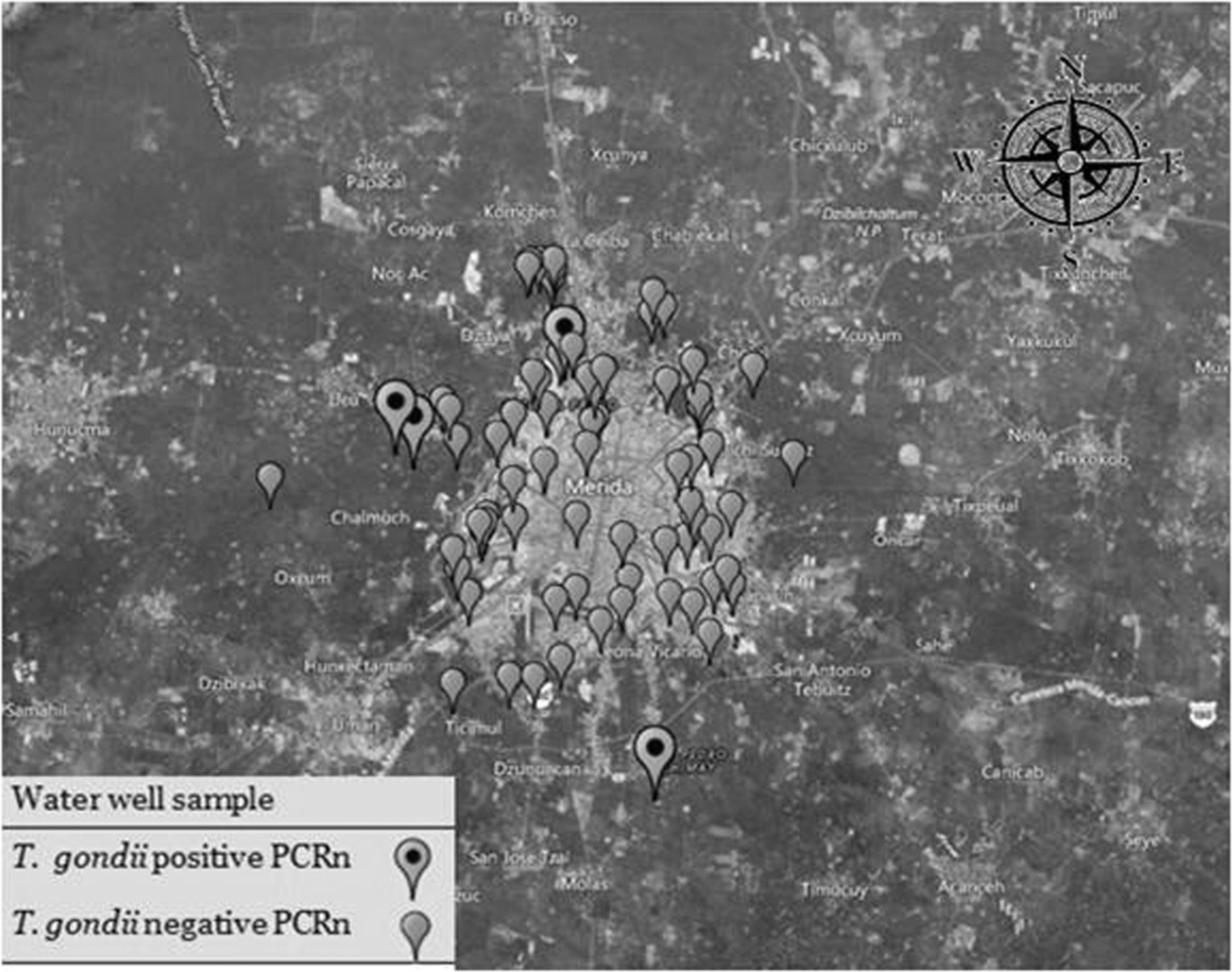
Distribution of sampled points of potable water in the city of Merida Yucatan Mexico, where positive cases for Toxoplasma gondii DNA through PCRn were found. PCRn, PCR-nested.
Discussion
The detection of T. gondii DNA in 5.4% of public drinking water samples evidence its presence in groundwater sources distributed in the city of study, thus representing a risk to public health. This study region has one of the largest global karstic aquifers, being sensitive to pollution due to its high permeability, intrusion of seawater, and anthropogenic pollution due to the continuous growth of the population (Bauer-Gottwein et al., 2011). The city of Merida, is located in an area called “ring of cenotes” (a cenote is a subterranean cave with water) in the Yucatan Peninsula, which serves as an important source of groundwater that carries water from the south to the north of the city (Perry et al., 1995); some cenotes may have fracture zones in the surface influencing the flow of contaminants and facilitate water infiltration into the aquifer (Bauer-Gottwein et al., 2011). These features could favor the distribution of Toxoplasma gondii oocysts into the groundwater. In this study, the presence of T. gondii DNA was found in one well field, and three independent systems; the well field where DNA of T. gondii was found, is responsible for distributing public drinking water to 65% of the population of the city (Marín et al., 2000). This finding is of great importance because the range of water distribution of that well field is very wide, increasing the risk of exposition to oocysts in the areas of distribution.
It is worth mentioning that all samples positive for T. gondii were collected at the beginning of the rainy season (CONAGUA, 2015). The Toxoplasma gondii oocysts can be distributed over considerable areas due to natural phenomena (i.e., hurricanes and floods), which can allow contamination of surface water and groundwater (Sroka et al., 2006). Further studies should cover the rainy and dry season to gain a better understanding of the presence of T. gondii at different times of the year. It has been proven over time that felines are the only definitive hosts of T. gondii and a primary infection may result in the excretion of millions of nonsporulated oocysts into the environment for 2 weeks. Oocysts can become infective over a period of 1–5 d depending on temperature and humidity conditions (Jones and Dubey, 2010). Due to the environmental conditions of studied area sporulation and survival of oocysts is favored, with an increased probability to be maintained its infectivity and able to reach water sources.
In the city of Merida a high prevalence (92%) of T. gondii in the population of domestic cats has been reported (Castillo-Morales et al., 2012), where cats can get reinfected along their life when eaten infected preys and can have reshedding oocyst over short periods of time after initial infection (Dubey, 1995). Wild (Ávila-Nájera et al., 2015) and domestic cats contribute on the environmental contamination with excreted oocysts, easily washed into the groundwater. The amount of infective oocysts in the environment depends on the size of the feline population, incidence of infection of T. gondii in felines, number of oocysts excreted by an infected feline, number of sporulated oocysts in the environment and the survival of infective oocysts (Dabritz and Conrad, 2010). There have been no studies in Mexico to determine the burden of oocysts in the environment and no stringent measures to control the cat population in the cities, especially in endemic regions with T. gondii. For example, in the United States every year around 1.2 million metric tons of cat feces are deposited to the environment, where the burden of annual oocysts in a community was 3–434 oocysts per square foot, being higher where cats selectively defecate (Torrey and Yolken, 2013). In city of Merida the burden of oocyst in districts where the drinking water wells are concentrated is not known and this may be associated with infection cases in the distribution. For example, a positive association between the presence of IgG antibodies to T. gondii in women with spontaneous abortion and consumption of the public drinking water from the city of Merida, Yucatan has been reported (Hernandez-Cortazar et al., 2016).
Chlorination is the only treatment used in the fields of water purification wells from the city of Merida Yucatan. Exposure to high concentrations of chlorine and ozone are not able to inactivate Toxoplasma gondii oocysts (Wainwright et al., 2007). However, it has been shown that Ultra Violet treatment can be an effective method of disinfection to inactivate Toxoplasma gondii oocysts in drinking water (Dumetre et al., 2008). Although the PCR used in this study cannot determine the viability of Toxoplasma gondii oocysts, it is a good tool to detect the exposure of water sources. It is advisable to conduct additional studies to determine the viability of Toxoplasma gondii oocysts in water sources either by a reverse transcription-PCR detecting messenger RNA or mouse bioassay.
For the detection of T. gondii repetitive DNA sequences are often used, including the 35-copy B1 gene, the 300-copy 529 bp repeat element and the 110-copy internal transcribed spacer (ITS-1) or 18S ribosomal DNA gene sequences (Su et al., 2010). However, the nPCR of T. gondii SAG1 gene, is more sensitive than a quantitative Polimerase Chain Reaction (qPCR) of T. gondii B1 gene (Hernandez-Cortazar et al., 2016). Even the B1 gene is repeated 35 times in the genome of T. gondii, compared with the SAG1 gene that has a single copy, nPCR methodology allows a more sensitive performance to detect the parasite due to the number of amplification rounds. The B1 and SAG1 genes are highly conserved gene sequences among different strains of T. gondii (Contini et al., 2005), for that reason, the use of these gene targets ensures a better detection of the parasite in regions where a wide variety of strains of T. gondii could be present.
The presence of T. gondii DNA in public drinking water samples evidence the contamination of water resources in this endemic area. Therefore, the consumption of public drinking water without a specific postpurification treatment could pose a risk for acquiring the infection in the urban population.
Footnotes
Acknowledgments
The authors gratefully acknowledge Consejo Nacional de Ciencia y Tecnologia (CONACYT) for grant funds for 259166 project and also for the financial support of a PhD student from a PNPC-CONACYT-PI-CCBA-UADY.
Disclosure Statement
No competing financial interests exist.