




Abstract
One thousand four hundred ninety-one Salmonella isolates recovered from retail foods including chicken, beef, fish, pork, dumplings, and cold dishes in China in 2007, 2008, 2010, 2011, and 2012 were analyzed for distribution of serotype and antimicrobial susceptibility. A total of 129 Salmonella serotypes were detected among 1491 isolates. Salmonella Enteritidis (21.5%), Typhimurium (11.0%), Indiana (10.8%), Thompson (5.4%), Derby (5.1%), Agona (3.8%), and Shubra (3.0%) were the seven most important serotypes in 1491 isolates. For antibiotic susceptibility, except 16 (1.1%) isolates were susceptible to all tested antibiotics, 131 (8.8%) resisted 1–2 and 1344 (90.1%) resisted three or more antibiotics. One thousand forty-six (70.2%) of 1491 Salmonella isolates were identified as multidrug-resistant (MDR) isolates, which could resist three or more categories of antibiotics. Resistance to sulfisoxazole (78.1%) was most common among the tested Salmonella, followed by tetracycline (70.6%), trimethoprim/sulfamethoxazole (68.0%), and nalidixic acid (63.4%). Resistances to amikacin (20.0%), levofloxacin (18.7%), gatifloxacin (17.9%), ceftriaxone (17.7%), and cefoxitin (13.2%) were less frequently detected. Resistance to fluoroquinolones was most common among Salmonella Shubra and Indiana isolates, while resistance to cephalosporins was frequently detected among Salmonella Thompson isolates. The results highlighted the diversity of Salmonella serotypes and the high prevalence of Salmonella MDR isolates in China. Compared with Salmonella Enteritidis and Typhimurium isolates, the higher fluoroquinolones and cephalosporins resistance rates of some individual serotypes (Salmonella Shubra, Indiana, and Thompson) also provided more information for further study related to fluoroquinolones or cephalosporin-resistant Salmonella.
Introduction
F
Up to now, more than 2610 Salmonella serotypes have been identified (Mezal et al., 2014). Salmonella Enteritidis and Typhimurium were recognized as the most prevalent serotypes associated with infections over the world (Mohamed et al., 2013; Lai et al., 2014; Maka et al., 2014; Wang et al., 2015). However, the prevalence of other serotypes, such as Salmonella Indiana, Javiana, Infants, and Shubra, were different from countries (Luque et al., 2009; Yang et al., 2010; Alvarez-Fernandez et al., 2012).
Over the past decades, antimicrobial agents were increasingly used in livestock raise and human salmonellosis treatment. The overdosed and abusive antibiotics usage consequently pushed more pathogens to multidrug-resistant (MDR) ones and are supposed to be a significant potential threat to food safety and public health (Lai et al., 2014; Wang et al., 2015). Owing to increasing multidrug resistance levels, conventional antibiotics were gradually replaced by new generational ones for pathogens treatment (Lai et al., 2014). Among which, extended-spectrum cephalosporins and fluoroquinolones were the most effective antimicrobial agents. However, recent studies, as well as previous ones indicated that some Salmonella could seriously resist these two categories of antibiotics (Hur et al., 2012; Lai et al., 2014).
In this study, the distribution and intimate relationship between serotypes and antimicrobial resistance phenotypes of 1491 Salmonella isolates in 5 years were analyzed to better understand the prevalence and antimicrobial resistance situation of Salmonella in retail foods in China.
Materials and Methods
Samples and bacterial strains
A total of 1491 Salmonella isolates that recovered were from local foods in six provinces (Shaanxi, n = 652; Sichuan, n = 98; Henan, n = 235; Fujian, n = 77; Guangxi, n = 100; and Guangdong, n = 149) and two national cities (Beijing, n = 111 and Shanghai, n = 69), which have joined the World Health Organization Global Salm-Surv program, from 2007 to 2012 (except 2009) in China were used in this study. Of these isolates, 1418 (95.1%) were recovered from retail chicken, 57 (3.8%) from pork, 4 (0.3%) from beef, 5 (0.3%) from fish, 3 (0.2%) from dumplings, and 4 (0.3%) from cold dishes. Two hundred (13.4%), 246 (16.5%), 689 (46.2%), 274 (18.4%), and 82 (5.5%) were recovered in 2007, 2008, 2010, 2011, and 2012, respectively.
When the food samples were collected during the surveillance years, each province/national city-level region was divided into three areas, one city, and one village will be selected within each of the three areas. Within each city and village, large markets, small markets, wet markets, and restaurant were sampled. The samples came with ambient temperature, frozen and chilled. Moreover, all samples were kept at four centigrades after collecting.
Sampling and identification methods were based on our previous study (Yang et al., 2013). All isolates were stored at −80°C in Luria–Bertani broth (Beijing Land Bridge Technology Co., Ltd, Beijing, China) with 50% glycerol until use.
Serotyping
Salmonella isolates were all serotyped in Henan Center for Disease Control and Prevention at Zhengzhou, Henan, China. O and H antigens were determined by slide agglutination with hyperimmune sera (S&A Reagent Lab, Bangkok, Thailand; Statens Serum Institut, Artilerivej, Denmark) and the serotypes were assigned according to the manufacturer's instructions and White–Kauffmann classification scheme (Grimont and Weill, 2007).
During each surveillance year, the top five largest number of serotypes were defined as frequently detected serotypes, otherwise were seldom detected serotypes.
Antimicrobial susceptibility testing
Antimicrobial minimal inhibitory concentrations (MICs) were determined by the agar dilution method using Mueller–Hinton agar (Beijing Land Bridge Technology Co., Ltd.) and interpreted by the guidelines recommended by the Clinical and Laboratory Standards Institute (CLSI) (2012). Breakpoints were interpreted according to the open CLSI standards (2012) and National Antimicrobial Resistance Monitoring System (NARMS) of the United States for susceptibility testing for Salmonella and Escherichia coli (
The antimicrobial agents and their MICs (μg/mL) were ampicillin (AMP, penicillin, 32 μg/mL), amoxicillin-clavulanic acid (AMC, β-lactam/β-lactamase inhibitor combinations, 32/16 μg/mL), ceftiofur (TIO, cephalosporins, 8 μg/mL), ceftriaxone (CRO, cephalosporins, 4 μg/mL), cefoxitin (FOX, cephamycins, 32 μg/mL), gentamicin (GEN, aminoglycoside, 16 μg/mL), kanamycin (KAN, aminoglycoside, 64 μg/mL), amikacin (AMK, aminoglycoside, 64 μg/mL), streptomycin (STR, aminoglycoside, 64 μg/mL), tetracycline (TCY, tetracycline, 16 μg/mL), sulfisoxazole (FIS, folate pathway inhibitor, 512 μg/mL), trimethoprim/sulfamethoxazole (SXT, folate pathway inhibitor, 4/76 μg/mL), chloramphenicol (CHL, phenicol, 32 μg/mL), nalidixic acid (NAL, quinolone, 32 μg/mL), ciprofloxacin (CIP, fluoroquinolone, 4 μg/mL), gatifloxacin (GAT, fluoroquinolone, 8 μg/mL), and levofloxacin (LEVO, fluoroquinolone, 8 μg/mL).
E. coli ATCC25922 and ATCC 35218, Enterococcus faecalis ATCC29212 were used as quality control organisms in MICs determination. All MICs were tested three times per isolate per antibiotic to avoid random event. Isolates resisted to at least three categories of antibiotics were considered as MDR ones.
Statistical analysis
Statistical comparisons of the prevalence of serotypes, rates of antibiotic-resistant isolates in different Salmonella serotypes, retail foods, and sample collection years, were analyzed by chi-square test or Fisher's exact test (expected cell sizes <5) with SPSS 19.0 (IBM, New York, NY). The threshold for the significant difference was p < 0.05, and an extremely significant difference was p < 0.01.
Results
Salmonella serotype
One hundred twenty-nine serotypes were identified among 1491 Salmonella isolates. Salmonella Enteritidis (323, 21.7%) was the most important serotype in 1491 Salmonella isolates, followed by Typhimurium (165, 11.1%), Indiana (163, 10.9%), Thompson (82, 5.5%), Derby (77, 5.2%), Agona (58, 3.9%), Shubra (46, 3.1%), Infantis (38, 2.5%), Bsilla (36, 2.4%), and Rissen (34, 2.3%). These 10 serotypes totally comprised 1022 (68.5%) isolates. Salmonella Enteritidis was the top one detected serotype in the five surveillance years except 2011. Specifically, 46.5%, 28.0%, 18.1%, and 23.4% of the isolates in 2007, 2008, 2010, and 2012 belonged to this serotype.
Salmonella Typhimurium was the top one detected serotype in 2011 (18.1%), and frequently detected in other 4 years. Salmonella Shubra was frequently detected in 2007 (13.0%) and 2008 (4.1%), but it could seldom be identified in 2010, 2011, and 2012. Salmonella Indiana was frequently detected in 2007 (6.5%), 2010 (14.2%), and 2012 (11.7%), whereas it was seldom prevalent in 2008 and 2011. Salmonella Thompson was frequently detected in 2010 (7.5%), 2011 (8.4%), and 2012 (5.3%), but it was seldom prevalent in other years (Table 1).
“Blank” means this serotype is not the top five serotypes in that year, and its detailed number was not mentioned in this table.
Antimicrobial susceptibility
Resistance to sulfisoxazole (78.1%) was most common among the tested Salmonella, followed by tetracycline (70.6%), trimethoprim-sulfamethoxazole (68.0%), nalidixic acid (63.4%), ampicillin (53.2%), amoxicillin-clavulanic acid (42.6%), chloramphenicol (40.3%), kanamycin (36.9%), streptomycin (34.9%), gentamicin (31.1%), ceftiofur (28.6%), ciprofloxacin (22.2%), amikacin (20.0%), levofloxacin (18.7%), gatifloxacin (17.9%), ceftriaxone (17.7%), and cefoxitin (13.2%).
Except 16 (1.1%) isolates were susceptible to all the 17 antibiotics, 131 (8.8%) were resistant to 1–2 antibiotics, and 1344 (90.1%) were resistant to 3 or more antimicrobials. Three hundred sixteen (21.2%) isolates were resistant to more than 10 antimicrobials. One thousand forty-six of 1491 isolates (70.2%) were classified as MDR isolates, which were resistant to three or more antibiotical categories. Based on different sampling years, detection rates of the MDR isolates ranged from 33.5% to 93.9% (Table 2).
“Number” means the MDR isolates/the total Salmonella isolates in that year, sample types or serotype. Numbers shared same letter (a, b, or c) do not have significant difference. “p = 0.00” indicated extremely significant difference of MDR isolates detection rates were found among 5 years, sample types, or serotypes.
MDR, multidrug-resistant.
Antibiotic resistance of the isolates varied in the commonly detected serotypes. Compared with Salmonella Enteritidis and Typhimurium, Indiana, Thompson, and Shubra isolates had much higher resistance rates (Fig. 1). For different years, the overall trend of the antibiotic resistance rates in each of the 5 years was similar except those to ceftiofur, nalidixic acid, levofloxacin, and gatifloxacin in 2012 (higher), and nalidixic acid in 2007 (lower) (Fig. 2).
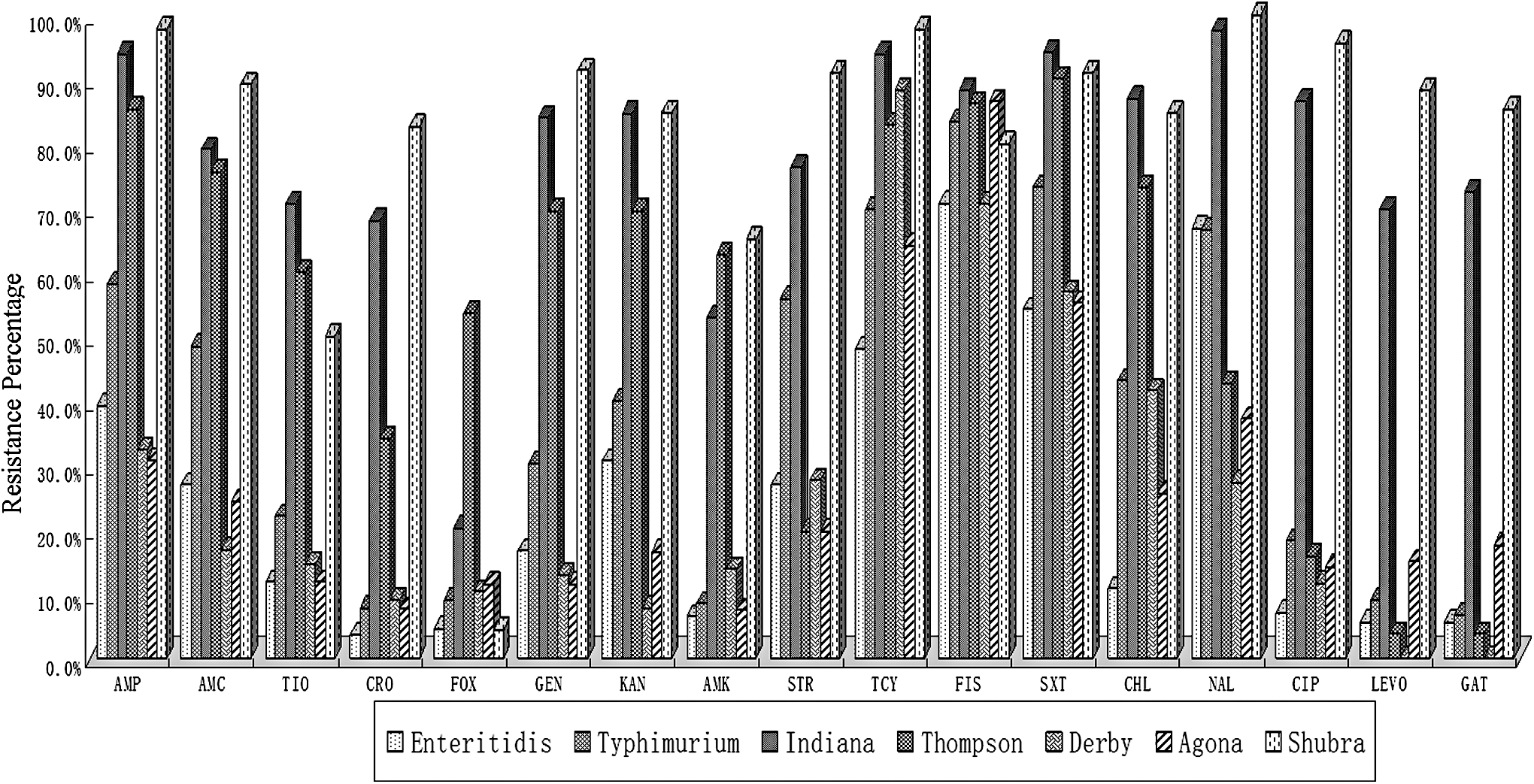
Variation of the antimicrobial resistance of Salmonella Enteritidis, Typhimurium, Indiana, Thompson, Derby, Agona, and Shubra isolates. AMC, amoxicillin-clavulanic acid; AMK, amikacin; AMP, ampicillin; CHL, chloramphenicol; CIP, ciprofloxacin; CRO, ceftriaxone; FIS, sulfisoxazole; FOX, cefoxitin; GAT, gatifloxacin; GEN, gentamicin; KAN, kanamycin; LEVO, levofloxacin; NAL, nalidixic acid; STR, streptomycin; SXT, trimethoprim/sulfamethoxazole; TCY, tetracycline; TIO, ceftiofur.

The antimicrobial resistance variations of the 5 years' isolates to cephalosporins, quinolones, and fluoroquinolones. AMC, amoxicillin-clavulanic acid; AMK, amikacin; AMP, ampicillin; CHL, chloramphenicol; CIP, ciprofloxacin; CRO, ceftriaxone; FIS, sulfisoxazole; FOX, cefoxitin; GAT, gatifloxacin; GEN, gentamicin; KAN, kanamycin; LEVO, levofloxacin; NAL, nalidixic acid; STR, streptomycin; SXT, trimethoprim/sulfamethoxazole; TCY, tetracycline; TIO, ceftiofur.
Discussion
Since the majority of human nontyphoidal salmonellosis associated with food consumption, the serotypes and antibiotic susceptibility of foodborne Salmonella isolates are particularly important for salmonellosis treatment and public health (Lauderdale et al., 2006). Based on previous surveillance data, Salmonella Enteritidis, Typhimurium, and Indiana were the three dominant serotypes widely distributed in China (Xia et al., 2009; Gong et al., 2016; Zhao et al., 2016). Even though in other countries, such as Spain (Alvarez-Fernandez et al., 2012), Korea (Hur et al., 2012), and the United States (Hendriksen et al., 2011), where Salmonella Enteritidis and Typhimurium were detected as two of the most predominant serotypes, the wide spread of Salmonella Indiana isolates was quite uncommon (Uyttendaele et al., 1998; Hendriksen et al., 2011; Fernandez et al., 2012; Reddy et al., 2016).
Salmonella Enteritidis was the most predominant serotype. Even though the previous studies in China indicated that most clinical Salmonella Enteritidis isolates were drug-susceptible (Su et al., 2004; Xia et al., 2009), a lot of antibiotic-resistant Salmonella Enteritidis isolates were found in retail foods in our study. Three hundred twenty-one of 323 (99.4%) Salmonella Enteritidis isolates were resistant to at least 1 antibiotic. The antibiotic resistance rates of Salmonella Enteritidis isolates to sulfisoxazole (70.8%), nalidixic (66.9%), and ampicillin (39.3%) (Table 3) were much higher than those in Taiwan (Lauderdale et al., 2006), Europe (Threlfall et al., 2003), and the United States (
For each antibiotic, the antimicrobial resistance rates shared same letter (a, b, c, or d) and do not have significant difference.
AMC, amoxicillin-clavulanic acid; AMK, amikacin; AMP, ampicillin; CHL, chloramphenicol; CIP, ciprofloxacin; CRO, ceftriaxone; FIS, sulfisoxazole; FOX, cefoxitin; GAT, gatifloxacin; GEN, gentamicin; KAN, kanamycin; LEVO, levofloxacin; NAL, nalidixic acid; STR, streptomycin; SXT, trimethoprim/sulfamethoxazole; TCY, tetracycline; TIO, ceftiofur.
However, compared to the samples from farms (chicken meat, feces, and eggshells), the resistance rates of Salmonella Enteritidis isolates to sulfisoxazole, nalidixic, and ampicillin were 97.8%, 87.0%, and 50.0%, respectively, which were much higher than ours (Hur et al., 2011). The great difference was probably caused by different sample categories. Different from retail chicken carcasses after processing, the eggshells and feces were much easier to be exposed to a higher antibiotic concentration since antibiotics were commonly overused in animal feeding and therapy (Castilla et al., 2012; Hur et al., 2012).
Salmonella Typhimurium was widely believed to have greater ability to infect human and exhibit higher resistance than other serotypes (Sarwari et al., 2001; Shrestha et al., 2010; Alvarez-Fernandez et al., 2012). However, the antibiotic resistance rates of Salmonella Typhimurium isolates in our survey was similar to that of Salmonella Enteritidis (Table 3; Fig. 1), and was lower than those reported in Spain (Alvarez-Fernandez et al., 2012), Africa (Abedellah et al., 2009), the United States (Berrang et al., 2009), and Nepal (Shrestha et al., 2010).
Antimicrobial resistance of nontyphoid Salmonella has always been a global problem (Yang et al., 2013). The resistance rates of Salmonella were from 20% to 30% in the early 1990s to 70% in some countries in 2000s (Su et al., 2004; Yang et al., 2013). The MDR rate in our survey was 70.2% (n = 1046), and a sharp raise occurred after 2007 (p = 0.00) (Table 2). Although the MDR rate was lower than that in Spain (100%) (Alvarez-Fernandez et al., 2012), it was similar to those in Poland (52%) (Maka et al., 2014), Vietnam (78.4%) (Lai et al., 2014; Mezal et al., 2014), and Korea (65.2%) (Hur et al., 2011). The wide spread of MDR isolates in China suggested that they posed potential threat to the public health and salmonellosis treatment.
In China, many antibiotics were used in food-producing animals to increase animal production and disease prevention, and antibiotics overuse was widely recognized as one of the major reasons for the increased resistance (Hur et al., 2012; Lai et al., 2014). Even though Salmonella Enteritidis and Typhimurium isolates were much more frequent than other serotypes, the resistance rates of them were much lower than that of Salmonella Indiana, Thompson, and Shubra (Fig. 1). In this study, except to cefoxitin, the resistance rates of Salmonella Shubra isolates to other drugs were all relatively high (Fig. 1). Of course, the reason why the antibiotic resistance rates of Salmonella Indiana and Shubra isolates were much higher than that of Salmonella Enteritidis and Typhimurium still need to be further studied. Up to now, antibiotic resistance of Salmonella Shubra was still not well documented worldwide.
Quinolones and fluoroquinolones have been used for human and animal Salmonella infections treatment since the 1980s in China (Su et al., 2004), and the wide prevalence of quinolones- and fluoroquinolones-resistant Salmonella isolates occurred in the early 1990s (Olsen et al., 2001). Isolates of most serotypes were susceptible to the third and forth generational fluoroquinolones (levofloxacin and gatifloxacin, respectively), while Salmonella Indiana and Shubra isolates showed higher drug resistance rates to these antibiotics than other serotypes (Fig. 1). For example, the antibiotic resistant rates of Salmonella Shubra to ciprofloxacin, gatifloxacin, and levofloxacin were up to 95.7%, 85.3%, and 88.2%, respectively (Table 3).
The sample collection records indicated that the high antibiotic resistance rates of Salmonella Shubra was not an accidental event, because these fluoroquinolones-resistant Salmonella Shubra isolates were recovered from all eight sampling provinces and all kinds of food samples. Similar results could also be found among Salmonella Indiana isolates.
Cephalosporins was another drug category commonly used for salmonellosis treatment (Yang et al., 2010; Alvarez-Fernandez et al., 2012). Ceftiofur, the first generational cephalosporin, was widely used in animal agriculture in China (Douris et al., 2008; Singer et al., 2008), and has posed the potential to be selected for resistance to third-generation cephalosporins (Singer et al., 2008; Thai et al., 2012). Ceftriaxone is another third generational cephalosporin that was widely used to treat children with Salmonella infections (Yang et al., 2010). Overall, Salmonella Thompson had higher resistance rates to cephalosporins than other serotypes, especially to cefoxitin (53.7%) (Fig. 1). Although the majority of Salmonella Shubra and Indiana isolates also resisted to ceftiofur and ceftriaxone, they were relatively susceptible to cefoxitin.
Conclusions
Salmonella Enteritidis and Typhimurium were two predominant serotypes among the 129 serotypes, and MDR isolates were widely detected. Salmonella Indiana and Shubra isolates had higher resistance rates to the third-generation cephalosporins (TIO; CRO) and fluoroquinolones than Salmonella Enteritidis and Typhimurium. And Salmonella Thompson exhibited higher resistance rates to cephalosporins, especially to cefoxitin.
Footnotes
Acknowledgment
The research work was supported the by National Natural Science Foundation of China (Grant Nos. 31671956 and 31171682).
Disclosure Statement
No competing financial interests exist.