




Abstract
A collaborative investigation between public health and animal health led to numerous interventions along the food chain in response to an outbreak of human salmonellosis and increased incidence of Salmonella Enteritidis (SE) among poultry. Incidence of both human and chicken SE decreased substantially in 2012 and 2013 following these interventions. We used time series analysis to assess the impact of three interventions: vaccination of broiler breeder flocks, separation in the hatchery of breeder eggs, and an industry order to stop farm-gate sales of ungraded broiler hatching eggs. Results show a Granger causal association between human SE incidence and SE incidence in chickens 8 months earlier. Among the interventions, separation of breeder flocks showed a consistent and statistically significant association with declining SE incidence in chickens. Our results did not show consistent declines in chicken SE following breeder flock vaccination (live or inactivated vaccine). None of the interventions had statistically significant impacts on human SE incidence. Our results are consistent with a positive effect of certain interventions and also reveal where additional data are needed for a more comprehensive evaluation. Multiple interventions throughout the food chain are best practices when dealing with enteric pathogens; collecting data on the timing and intensity of these interventions allow proper evaluation of their independent and combined effects. Finally, we identify considerations for others interested in undertaking similar evaluations. Ongoing collaborative work between public health and animal health is required to refine strategies for SE control in British Columbia.
Introduction
B
Collaboration among public health, animal health authorities, and industry led to a number of interventions implemented through the farm-to-fork chain (Table 1). Subsequent to these interventions, human and poultry incidence declined during 2012 and 2013 (BC Integrated Surveillance of Foodborne Pathogens, 2012, 2013). Evaluation of such interventions is important for understanding their impact in reducing illness or outbreaks, particularly to identify those that are most effective and advocate for future outbreak control resources. In this article, we report on a study to quantify the impact of three interventions on the incidence of SE in animals and humans.
SE, Salmonella Enteritidis.
Materials and Methods
Data
In BC, human salmonellosis is a reportable disease. All human cases of SE PT 8/PFGE SENXAI.0003 reported between 2008 and 2013, where the case did not report travel outside of Canada in the 3 days before exposure, were included. 32.9% of cases were excluded due to travel. PFGE was conducted by the provincial reference laboratory, the British Columbia Centre for Disease Control Public Health Laboratory, and PT was conducted by the National Microbiology Laboratory.
Chicken-related samples were collected as part of a federal sampling program that includes hatchery fluff collected every 6 weeks (Justice Canada, 2015). All SE isolates from the three main hatcheries in BC (herein referred to as Hatcheries A, B, and C) between 2008 and 2013 were included. These three facilities hatch about 90% of the broiler chickens raised in BC. Using hatchery records, it was possible to attribute SE isolates back to the source breeder flock. A specific breeder flock was considered positive if fluff from its hatched progeny yielded SE isolates more than once during its productive life. A flock was assumed to be positive for its entire 8-month production life regardless of when the positive samples were identified. Monthly numbers of positive breeder flocks were then calculated by tallying those deemed positive.
Interventions
Of the 12 different interventions used to control SE, three were evaluated because they were implemented during defined periods of time, were targeted to address the current outbreak of SE, and were believed to have the largest impact on both animal and human incidence. This was based on the experience of other countries showing the most successful methods to control SE tend to be those using on-farm control (Rodrigue et al., 1990; Wegener et al., 2003; Braden, 2006). The three interventions evaluated were as follows: • Vaccination of broiler breeder flocks (hatching egg flocks) Two hatcheries implemented a live oral vaccine in January 2010. In May 2011, both hatcheries added an inactivated injected vaccine to their programs. A third hatchery implemented a combined live and inactivated vaccine program in May 2009 and continued with this program throughout the study period. • Separation of breeder flocks during incubation and hatch in the hatchery In BC, breeder stocks are often imported as eggs rather than as live chicks. Consequently, chicks that are to be used as breeders are hatched in the same hatchery as chicks that will be placed for broiler chicken (meat) production. To reduce the risk of cross contamination of SE from meat birds to breeder chicks, the hatcheries took measures to separate breeder chick hatches from broiler chick hatches. Separation was implemented differently in each hatchery, one implemented separation in April 2011 using separate rooms, the second implemented separation in November 2012 using different incubators and hatchers, and the third in May 2012 by importing chicks. • Industry order to stop farm-gate sales of broiler hatching eggs by broiler hatching egg producers The third intervention was the BC Broiler Hatching Egg Commission order to cease “farm-gate” sales of broiler hatching eggs starting in July 2010. This intervention was done to prevent these ungraded eggs from being distributed and used in food service establishments, where they had been identified as a source of human illness.
Within our study period, the total number of flocks remained roughly constant with a steady production lifespan and turnover rate at hatcheries. The number and proportion of flocks vaccinated or separated each month was based on a total of 130 flocks and a complete flock turnover in 12 months. We estimated the proportion vaccinated or separated at a hatchery each month by incrementing the previous month's value by a constant proportion (1/12) of their total flocks, starting from 0 until it reached 100% after 1 year, after which it remained constant for the remaining study period.
Analysis
The minimum number of months between when interventions were implemented and when they would have impacted human and poultry incidence were determined based on known production timelines (Fig. 1). Months were the smallest scale of analysis. Separation and vaccination had an estimated lag time of 6 months to impact animal incidence and 8 months to affect human incidence. The ban of broiler hatching eggs from farm-gate sales had a lag time of 1 month to impact human incidence. We focused our statistical analyses on these periods as expected windows of time, in which an association between intervention and SE incidence might reasonably occur. Poisson regressions were conducted to assess the association between interventions and human and animal incidence. Monthly numbers of SE positives (incident human cases or infected breeder flocks, as described above) were treated as our dependent variable and intervention (monthly number of flocks, by hatchery, receiving live vaccine, inactive vaccine, or under chick separation regime) and hatchery (A, B, or C) were treated as explanatory factors. Model fit and variable selection were performed using standard backward elimination and Akaike information criterion; extra-Poisson variation was modeled using an overdispersion parameter. We also used time-series vector autoregressive models to assess the lagged association between human and animal incidence and to test for causality. Stationarity was assessed using Dickey–Fuller tests, and differencing was applied to nonstationary series. Model fit was examined using standard diagnostics (autocorrelation function, prediction error, and Q–Q plots). The Granger causality test determines if animal SE incidence is significantly predictive of human SE incidence and therefore more likely to be a truly causal influence as opposed to simply an association in time. All analyses were carried out using SAS version 9.4.
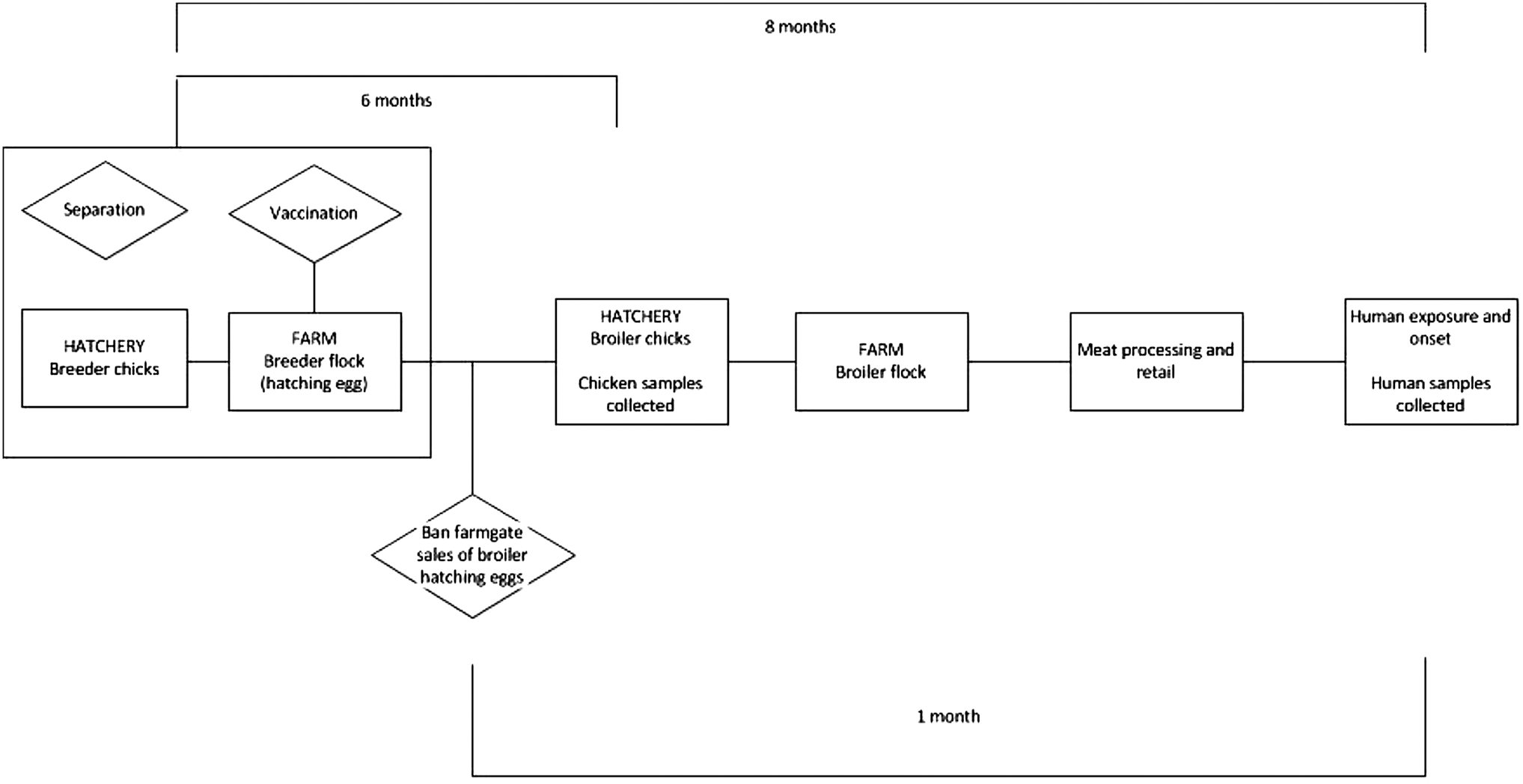
Poultry food chain/process with interventions and time periods.
Results
In all three hatcheries, breeder chick separation coincided with decreases in the number of SE-positive breeder flocks (overall separation effect p = 0.03). Indeed, the proportion of SE-positive breeder flocks dropped by more than half when comparing the year following full implementation of chick separation with the year before separation (17.9% ± 5.7% vs. 8.0% ± 5.0%, all hatcheries, N = 130 flocks). In contrast, vaccination (live or inactive) did not consistently affect the number of positive flocks. Inactivated vaccine was associated with a significant reduction in numbers of positive breeder flocks in one of the three hatcheries (inactive vaccine × hatchery interaction p < 0.001), from 20.7% ± 0.07% SE-positive flocks in the year before vaccination to 3.0% ± 3.5% positive flocks in the year following vaccination (N = 22 flocks). Live vaccine programs were not associated with reduced numbers of SE-positive breeder flocks in any hatchery.
However, neither the hatchery interventions considered here (live and inactive vaccine programs and breeder chick separation) nor the ban on farm-gate sales significantly affected the numbers of human cases in our data (p > 0.2 in all cases).
A time series relationship was identified between SE-positive breeder flocks and human cases. Specifically, increases in positive breeder flocks were associated with significant increases in human cases 8 months later (p = 0.04; Fig. 2). Further analysis suggests that this is indeed a Granger causal effect of breeder flocks on human cases and not simply an association in time (Granger causality test, p = 0.048).
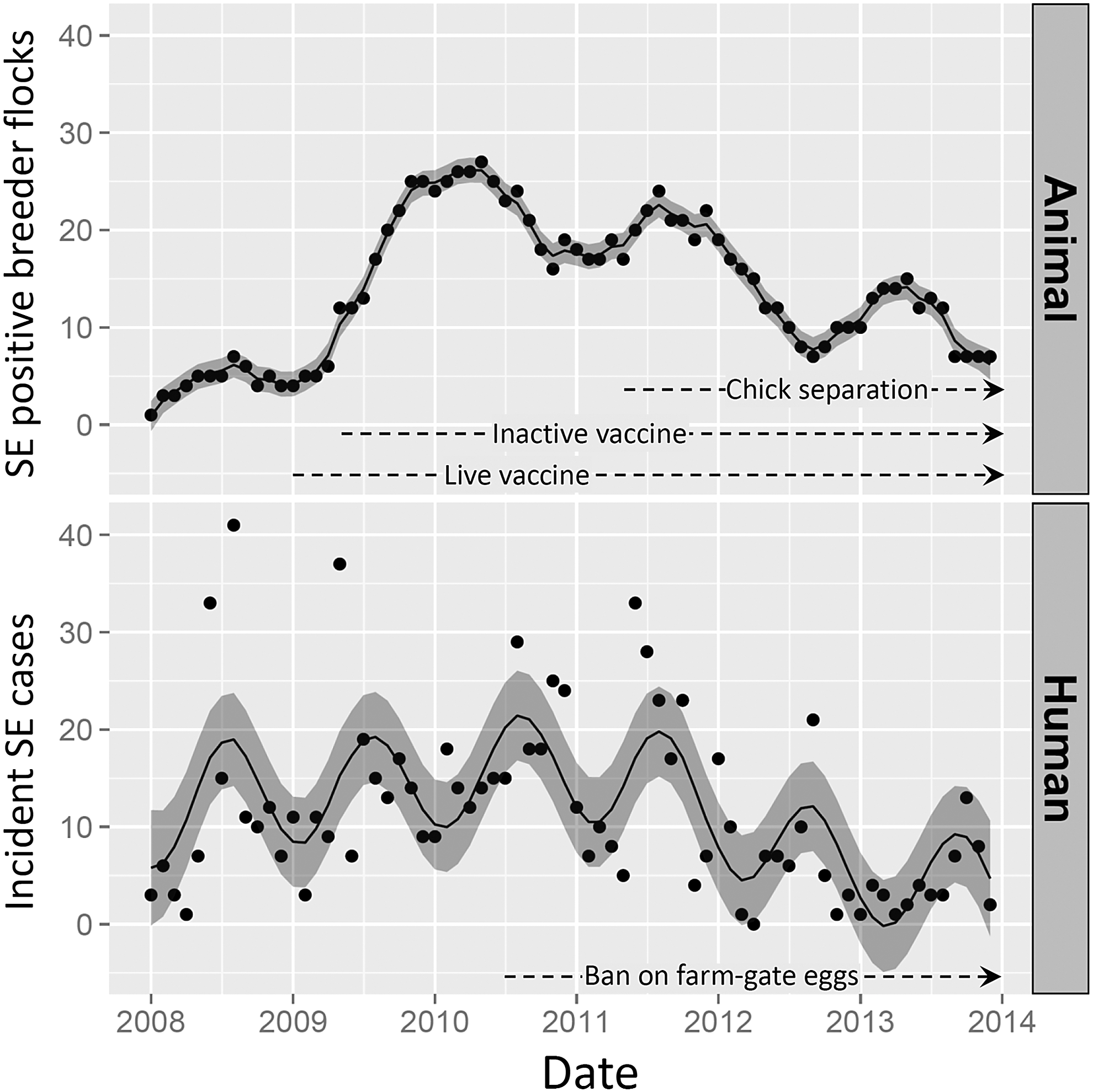
Time series showing numbers of Salmonella Enteritidis (SE)-positive breeder flocks (animal) and incident SE cases (human), British Columbia, 2008–2013. Observed counts (points) are shown with regression model fit (solid line) and 95% confidence interval (colored ribbon). Dashed arrows represent the timing of three interventions (breeder chick separation, inactive or live vaccine, and ban on farm-gate egg sales), beginning with the earliest known start dates.
Discussion
In this study, we evaluated the impacts of specific interventions on both human and chicken SE incidence in BC between 2008 and 2013. Evaluating the impact of interventions across human and animal sectors, including time series analysis, are novel features of our work.
The 8-month lag observed between human and poultry incidence is consistent with our a priori expectations based on known timelines of poultry production and human exposure through chicken meat consumption. The demonstration of a Granger causal association between poultry incidence and human incidence reinforces the importance of the animal sector in determining human illness. Our analysis also showed a significant association across hatcheries between declines in SE incidence among chickens and the separation of breeder chicks during hatch. Although we did not detect a consistent effect of vaccination overall, inactivated vaccine was associated with reduced SE in one of the three hatcheries. Such differences between hatcheries might reflect the timing of interventions. In two hatcheries, for example, separation and inactive vaccine occurred together and could have combined in their effects.
Despite the effect of breeder chick separation on reduced SE-positive flocks, we were not able to detect an association between any of the interventions and human SE incidence. This may be due, in part, to the limitations of our data, including the time periods we selected for the intervention to have impact, to the nature of the interventions themselves, or to the fact that human illness was partly controlled by other means. We used available data collected routinely for other purposes and not specific to the evaluation of these interventions. The interventions were most directly targeted at reducing SE in poultry and were not directly related to when and where human exposure would occur. Thus, we could not easily attribute human illness to a particular hatchery or to particular hatchery-level interventions, which were applied at differing times across facilities. Our analysis was, therefore, better suited to detect impacts on poultry and quite limited for detecting impacts on human incidence. Detecting the downstream impacts of agricultural interventions on human illness remains an important challenge for future evaluations.
In the United Kingdom, a temporal relationship between the introduction of vaccination in broiler-breeder and egg-laying flocks and decreases in human salmonellosis has been observed (O'Brien, 2013). The comprehensive nature of this program may explain why impacts related to human illness were detectable. Separation during hatch has not been highlighted as a primary intervention for reduction of salmonellosis; however, many control programs internationally highlight the importance of on-farm interventions, which may include restricting or preventing movement (Wegener et al., 2003; Braden, 2006; O'Brien, 2013). Many countries have used interventions that include intensive testing and depopulation for infected flocks. These programs have been successful at decreasing animal and human salmonellosis, but have come with notable costs for both industry and government (Wegener et al., 2003).
A large number and variety of interventions were implemented from farm-to-fork to control the SE outbreak in BC (Table 1). The use of multiple interventions throughout the farm to food chain is often highlighted as best practice in mitigating SE as well as other enteric pathogens (Wegener et al., 2003; Braden, 2006; Poirier et al., 2008; Sears et al., 2011; O'Brien, 2013). No other interventions were directed at the poultry industry or the public during this time period. Therefore, the decreases in SE associated with the interventions described are believed to represent causal impacts, although other factors such as changes in strains of Salmonella, human consumption/exposure patterns, or behavioral changes cannot be excluded.
Certain limitations are noteworthy in our study. First, two interventions occurred almost simultaneously (vaccination and separation) in two of the hatcheries, hindering our ability to assess each intervention separately. The association between separation and chicken SE incidence may have been influenced by vaccination and vice versa. Second, we assumed consistent implementation of interventions (e.g., constant number of flocks vaccinated/separated over time); however, unknown variations, such as changes in vaccine or periods of time when separation was not applied, may have occurred. Furthermore, positive flocks were determined based on samples taken in the hatchery, and a flock was considered positive for its entire life. This may have overestimated the number of positive breeder flocks, as eggs from multiple different breeder flocks would frequently be represented in a single hatcher. However, the process of designating positives was consistent, so any bias would be equally represented. Finally, only 1–3 years of post-intervention data were available for this evaluation. This relative scarcity of data following implementation of interventions makes before–after comparisons more challenging and hinders the assessment of long-term impacts on poultry and human incidence. This study provides an assessment of the impact of interventions up to a point in time. Further assessment of these interventions would be required to better understand their impact.
Our work identified limitations and considerations for others planning similar evaluations. We recommend, when interventions are being planned, to consider the establishment of an evaluation protocol, including what data will be required to measure the impacts. Identification and collection of additional data variables may improve the ability to demonstrate the effectiveness and impact of interventions, but may require additional resources. Ongoing measurements of the rollout or intensity of an intervention is key for establishing time-series effects on health outcomes. A priori identification of critical time periods between interventions and their expected impacts was valuable and helped to guide analyses specific to an intervention, as well as to reinforce conclusions.
Unfortunately, after 2 years of low incidence, the incidence of SE in poultry and humans increased again starting in 2014. Although it is not clear why this occurred, it may be due to modification in the implementation of some of these interventions. A more comprehensive, multisectoral approach is now being considered and will also need to be evaluated.
Conclusion
This evaluation demonstrated that some interventions had detectable impacts and others did not. This information will help inform what mitigation procedures and future interventions should be considered in BC and elsewhere. This work adds to our experience that collaborative and integrated assessment and investigation by public health and animal health is essential to develop and refine approaches for interventions throughout the food chain.
Footnotes
Acknowledgments
We acknowledge the public health, animal health, industry collaborators, and investigators as well as human and animal diagnostic laboratories.
Disclosure Statement
No competing financial interests exist.