




Abstract
In response to the potential hazards associated with the globalization of the food industry, research has been focused on the development of new sensing techniques to provide the means of contamination detection at any stage in the food supply chain. The demand for on-site detection is growing as pre-emptive sensing of pathogens could eliminate foodborne-related outbreaks and associated healthcare costs. Reduction in food waste is also a driver for point-of-use (POU) sensing, from both an economic and environmental standpoint. The following review discusses the latest advancements in platforms that have the greatest potential for inexpensive, real-time detection, and identification of foodborne pathogens. Specific focus has been placed on the development techniques, which utilize micro- and nanoscale technology. Sample preparation-free techniques are also discussed, as the growing demand to enable POU sensing at any stage in the food supply chain will be a major driver toward the advancements of these nondestructive methods.
Introduction
Importance of food quality monitoring
F
In an ideal situation to monitor quality assurance, food products would need to be sampled at every stage in the process, from primary food production through final distribution to the customer. Figure 1 illustrates key locations during the food production path where monitoring could prevent the distribution of contaminated food to consumers. To enable food safety evaluations at each of these locations, contamination monitoring would need to be inexpensive with easy-to-use devices that provided immediate results.
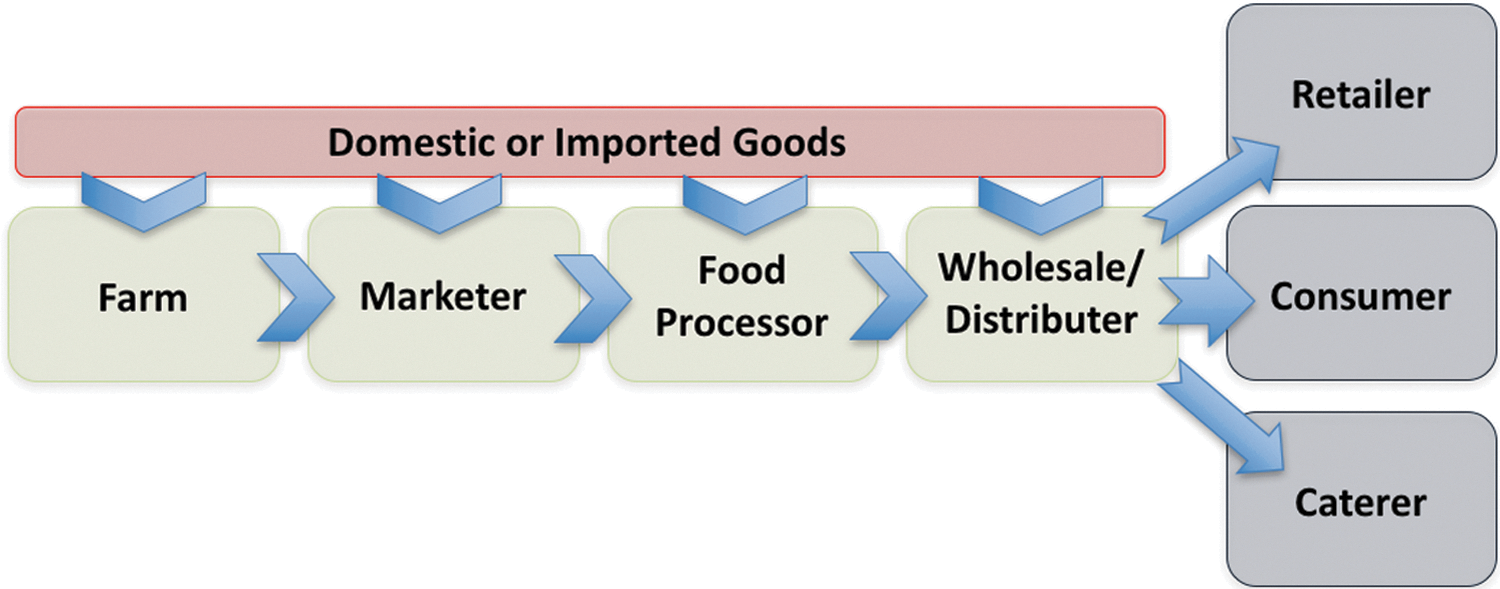
Graphical representation of the food production path. Product contamination could occur at any point in the path, illustrating the need for POU detection. Blue arrows represent locations where food monitoring could prevent the distribution of contaminated food to consumers. POU, point-of-use. Color images available online at
Real-time monitoring is especially critical in the early identification of rapid contamination events such as bioterrorism attacks aimed at the food supply (Pedrero et al., 2009; CDC, 2016). From a preventative standpoint, point-of-use (POU) pathogen detection devices would also be extremely helpful to overcome quality assurance challenges faced by restaurants and grocery stores. In these situations, determination of food quality is based on set guidelines by the United States Department of Agriculture (USDA), and not if actual spoilage has occurred (USDA, 2017a). If food is inspected in these locations, it is based on visual or olfactory detection, useful if decay is present, but unable to detect pathogenic contamination. Rapid monitoring of food goods would allow for detection of any pathogens before its distribution. Monitoring is also a critical component for a reduction in food waste; millions of tons of food gets trashed annually because it is past its previously determined sell by date, a number that may not be reflective of the actual food quality (Lehner, 2013). It is estimated that in the United States alone 30% of food is wasted each year, leading not only to lost resources, but also adding to landfills and methane emissions (USDA, 2017b).
Current detection methods for pathogen contamination in food
While extremely sensitive and effective, traditional culture enrichment techniques for pathogen detection are very laborious and can extend over several days (Mandal et al., 2011). Detection challenges are due to the complexity of the food matrix and potential lack of homogeneity, as well as the potential for a low number of pathogens within the matrix. As the location of pathogens varies greatly between products and types of contamination, homogenization is required to obtain a complete product analysis. Mechanical methods are usually performed to homogenize the food sample, which range from simple blending to more advanced techniques such as ultrasound (Rohde et al., 2015). The various matrix compounds, such as proteins, vitamins, minerals, saccharides, and lipids, must also be eliminated to prevent interference effects (Campos et al., 2012; Lisalova et al., 2016). Separation and concentration of pathogens has been performed using physical-, chemical- and biological-based (e.g., antibody) methods. Potential cell damage during homogenization, in combination with the typically low numbers of pathogens often present in contaminated samples, necessitate long microbial enrichment periods, hindering the development of more rapid techniques. Because of these issues, new preparation and purification methods are some of the most actively researched areas in analytical chemistry (Cifuentes, 2012).
Significant advancements in the reduction of detection time have been made through the development of enzyme-based nucleic acid amplification methods, such as multiplex polymerase chain reaction (mPCR), which provide accurate results in about 24 h (Law et al., 2015; USDA, 2017c). Using mPCR, shorter processing times are achieved by replacement of culture enrichment procedures with those that amplify specific nucleic acid sequences. The use of genetic material also leads to highly specific identification, particularly important for microorganisms that cannot be readily cultured. Quantitative or real-time PCR provides real-time data (fluorescent reading) with less processing, but intensive sample preparation and expensive thermal cyclers still limit this technique to a laboratory setting (Zhang et al., 2011). However, the relative ease, speed, and accuracy of these PCR-based screening methods have made them one of the USDA's and the United States Food and Drug Administration's preferred laboratory procedures for microbial analysis in foods (USDA, 2017c; USFDA, 2017). Other conventional “rapid” techniques include miniaturized biochemical kits that use biochemical characteristics for pathogen identification and antibody immunoassays, in which antibody functionalized arrays identify target bacteria through the specificity of the antigen–antibody reaction (Chen et al., 2013). The requirement of complex sample preparation and sophisticated instruments also hinders these techniques (Cifuentes, 2012), from implementation in POU applications.
The following review discusses recently reported foodborne pathogen detection platforms that exhibit potential for on-site deployment (e.g., food storage silos, grocery stores, restaurants). Intended to supplement the comprehensive detection method reviews already available, this work emphasizes advancements occurring within the past several years on techniques with rapid detection and identification using simplified sample preparation and analysis. Sample preparation-free techniques are also discussed, despite the complexities associated with the instrumentation and analysis, because the growing demand to enable POU sensing at any stage in the food supply chain will be a major driver toward the advancements of these nondestructive methods.
Recent Advancements in Pathogen Contaminant Detection
To effectively enable pathogen monitoring at any stage in the food supply chain, an ideal POU sensor would have the following attributes: (1) minimal or no sample preparation, (2) real-time detection of low cell counts, (3) identification of multiple pathogens, (4) multiple use (extended use, resistance to fouling), (5) inexpensive, (6) ease of operation, (7) ability to function in real-world conditions, and (8) extended shelf life. Ultimately, a POU device would also be portable with integrated detection and analysis that is compact enough to be easily carried by a person or be deployed to a sensor network. Overcoming the technological complexities to developing such a sensor will require a multifaceted approach, potentially utilizing a variety of platforms for performance. The following sections discuss a variety of methods that have the potential to satisfy some of the desirable attributes in an ideal sensor.
Loop-mediated isothermal amplification
Loop-mediated isothermal amplification (LAMP) is a nucleic acid amplification technique such as PCR; however, process differences allow for amplification to be conducted at a single temperature (Notomi et al., 2000; Zhang et al., 2011). The isothermal nature of this technique leads to more simplistic and cost-effective equipment, while maintaining the high levels of sensitivity needed for pathogen detection. With the goal of rapid, automated POU sensing, researchers have incorporated this technique into miniaturized systems for the detection of pathogenic bacteria (Oh et al., 2016; Sayad et al., 2016). Oh et al. (2016) fabricated a “lab-on-a-disk” centrifugal microfluidic device using colorimetric detection quantified by microvolume ultraviolet–visible (UV-Vis) spectrophotometry. The centrifugal component eliminated the need for microvalves and -pumps, whereas colorimetric detection of amplicons provided simplistic spectrophotometric analysis. Using this system, three kinds of pathogenic bacteria were detected: E. coli O157:H7, Salmonella typhimurium, and Vibrio parahaemolyticus. A limit of detection (LOD) was reported of 380 copies of DNA with a processing time of 1 h.
Biosensors
Biosensors encompass a wide range of analytical techniques which translate specific biorecognition events into measureable signals (Singh et al., 2013). Figure 2 shows a generalized graphical representation of a biosensor: (1) Targets: pathogens of interest and/or volatile organic compounds (VOCs); (2) Bioreceptors: a single or multiplex array of biological probe platforms for specific pathogen recognition; (3) Transducer: a transduction platform for signal generation upon a binding event; and (4) an amplifier to strengthen the signal to a measurable level for a semiquantification of pathogen capture. The type of transducer determines the class of biosensor (e.g., optical, electrochemical, etc.) with additional specificity pertaining to target labeling (i.e., both labeled and label-free targets can be analyzed using optical biosensors) (Arora et al., 2011; Singh et al., 2013).

A graphical representation of the main components in a biosensor (adapted from Arora et al., 2011; Singh et al., 2013). Targets of interest interact with receptors, which produce a signal upon binding. The transducer platform dictates the class of biosensor (e.g., optical, electrochemical). Color images available online at
Optical biosensors
Optical detection is based on correlating an observed optical signal to the interaction between a specified bioprobe and the target pathogen. A unique advantage of photon-based measurements over electron-based sensors (e.g., electrochemical) is their immunity to electromagnetic interference, which may be important in POU field applications. Among the many detection and quantification mechanisms, the most common pathogen detection method is based on fluorescence. Fluorescence sensing platforms are based on interactions between fluorescently tagged target pathogens and their associated biorecognition molecules (Fan et al., 2008; Martin et al., 2013). As most organic fluorophores exhibit environment-dependent luminescence, an understanding of the photophysical behavior and fluorescence parameters is critical before selection. Environmental conditions leading to interferences include: variability in luminescent response with pH, susceptibility to photobleaching, short excited state lifetimes, luminescent emission shift, and short-term stability in aqueous mediums. These factors would make these sensors best suited for production facilities where testing could be performed in a controlled environment.
An emerging class of label-free biosensors appears to have the greatest potential for deployment in wide range of POU applications. Label-free methods detect target molecules in their natural state, reducing processing complexity and eliminating potential interference effects from fluorophores (Massad-Ivanir et al., 2011). Depending on the detection mechanism, quantitative and kinetic measurements can be performed with high sensitivity, as the detection signal does not scale down with sample volume (Fan et al., 2008). Surface plasmon resonance (SPR) (Lisalova et al., 2016) affinity biosensors are considered one of the most versatile and powerful label-free techniques, relying on the excitation of surface plasmons in a resonant manner with incident light (Fan et al., 2008; Martin et al., 2013). One of the main challenges to real-world implementation of SPR biosensors is signal interference from the sample matrix; nonspecific adsorption of nontarget molecules leads to false positive signals, as well as biofouling. Lísalová et al. (2016) overcame this obstacle through the formation of a low fouling, functionalized poly(carboxybetaine acrylamide) (pCBAA) brush used in the detection of E. coli O157:H7 and Salmonella from hamburger and cucumber samples. Direct detection of E. coli in the complex food matrix was achieved within 80 min, without any bacterial enrichment steps. Reported limits of detections were on the order of tens of cells per mL, approximately an order of magnitude higher than those reported in mediums of less complexity. Salmonella detection limits were significantly higher, on the order of 103 colony-forming unit (CFU)/mL, due to differences in the affinity and specificity of the respective antibodies. However, adjustments to the respective detection assay conditions could lead to improvements in sensitivity.
Electrochemical biosensors
In recent years, the focus on electrochemical techniques has increased due to advantages in speed, sensitivity, specificity, and cost. The nature of the detection mechanism leads to detection times on the order of minutes, compared with hours for other platforms, and minimal instrumentation makes automation and field deployment feasible. Data collection can also be controlled through compact devices, such as smart phones, allowing remote sensing and real-time data distribution. The idea behind this methodology is that binding events between target molecules and the biosensing platform are converted into measurable electrical signals that can be used for pathogen identification and quantification. Various electrochemical analysis techniques are utilized in the formation and characterization of the bioprobes, and subsequent pathogen detection; Cyclic voltammetry (CV) is often used for controlled growth onto probe substrates (Miodek et al., 2015) or to examine the effects of different experimental conditions (Chen et al., 2015a), whereas differential pulse voltammetry (DPV) (Chen et al., 2015a) and impedance spectroscopy (Tian et al., 2016) have been used for direct pathogen detection. Chen et al. (2015a) employed both CV and DPV techniques to study a cationic gold nanoparticle (NP) enzyme complex-based platform for E. coli detection. New sensor platforms will continue to move toward less costly materials for viability in the POU market. Sensing platforms can also be tailored for sample preparation-free methods through the detection of pathogen VOCs.
Electrochemical detection is often enhanced through the use of single or multiwalled carbon nanotubes (SWCNTs or MWCNTs). The nm-sized CNTs are ideal for sensing due to their low charge carrier density. When binding events occur, charge accumulation or depletion ensues throughout the bulk of the structure, leading to easily measureable electrical property changes. MWCNT-decorated devices have been successful at rapid, sensitive detection, with applications ranging from the detection of DNA extracted from Mycobacterium tuberculosis using MWCNTs coated with polypyrrole (PPy) and redox polyamidoamine dendrimer (Miodek et al., 2015) to the direct detection of E. coli O157:H7 using a genosensor constructed from a glassy carbon electrode (GCE)–cadmium sulfide (CdS) NP hybrid decorated with metal-doped MWCNTs (Abdalhai et al., 2015). Yamada et al. (2016) reported on the incorporation of SWCNTs into a multijunction array device for portable, rapid sensing of E. coli K12 and Staphylococcus aureus. The device incorporated four junctions in the multiplexing circuit; two functionalized with E. coli antibodies and two with S. aureus. Current response was quantified by measuring the current at each junction before and after conjugation between the target and the antibody. Simultaneous detection was achieved in the dual pathogen solution in 1 min with 102 CFU/mL concentrations.
Similar to bacteria-related illnesses, POU detection of viruses is also critical due to illness acuteness and life-long effects. Wang et al. (2015) showed the feasibility of electrochemical detection of avian influenza H5N1 virus using aptamer-based bionanogates. In the absence of target molecules, the aptamer-bound gate blocked coenzymes and substrates in the suspension from interacting with enzymes immobilized on the sensing electrode. The presence of the virus targets in the suspension triggered aptamer–virus complexes, opening the gate, and allowing enzymatic reactions. Electrochemical signals generated from these reactions were measured and used to quantify virus levels with a detection limit of 2−9 hemagglutination units. As complex reagents and sample preparation are still required, a process like this would be most useful in the early stages of the food production chain. Regardless of sample preparation, this 1 h rapid virus detection method is still invaluable in unexpected contamination events (e.g., bioterrorism).
Magnetic-based methods
Magnetic NP detection techniques are based upon the functionalization of the NPs with molecular probes (e.g., oligonucleotides, proteins, antibodies) that encourage bioconjugation with target pathogens. Besides the choice of molecular probe, the major difference in detection methodologies stem from the treatment and analysis of the suspension once bioconjugation has occurred. One of the main advantages of this technique is that it requires little or no pretreatment of samples due to the fact that most biological and environmental samples intrinsically have a low magnetic background. In basic separation methods, external magnetic fields are used to isolate the magnetic material after binding to the target pathogen, whereupon common microbial assays can be used for quantification. Improvements to the technique can be made on the binding end through bioconjugation between the NPs and specific bioprobes (e.g., antibodies) (Kim et al., 2015), or on the analysis end with new sensitive techniques, such as micro-NMR (Chung et al., 2013) or immunomagnetic separation (Xu et al., 2016) using microelectrodes, which could be deployed in POU applications.
Magnetic resonance imaging (MRI) is one spectroscopic technique that could be utilized to provide a holistic picture of general trends among a food throughout the day. Typically, MRI is used in the medical profession to image the physiological processes occurring within the body. Although not developed for the food industry, it has many potential applications for commercial food manufacturers as the price in these technologies continues to drop. As MRI has high spatial resolution and excellent soft tissue contrast, it can be utilized to non-invasively image inflammation due to bacterial infections (Hoerr et al., 2013). MRI on food can reveal the internal environment, such as temperature and water distribution, and is currently being used to investigate the internalization of pathogens in produce (USDA, 2017d). Examination of moist foods is especially critical, as the higher the mobility of water within a product, the more vulnerable it is to adverse chemical and biological reactions (Yu et al., 2016). While the detection of contamination is important, more detailed information (i.e., differentiation of distinct cellular populations) can be achieved if high-relaxivity contrast agents are present due to their large effect on the MRI signal (Shapiro et al., 2004). For example, in vivo detection of Gram-positive and Gram-negative bacteria was achieved through interaction with nanometer-sized iron particles, as they are superparamagnetic and can have a large impact on magnetic field homogeneity (Hoerr et al., 2013).
Magnetic relaxation switching (MRS) assays use antibody-conjugated magnetic NPs for the detection of pathogens (Perez et al., 2002; Chen et al., 2013, 2015b). A schematic representation of this aqueous-based process is shown in Figure 3. Antibody-conjugated NPs dispersed throughout a solution will aggregate in the presence of a target pathogen (antigen) when subjected to an external uniform magnetic field. The local heterogeneous magnetic field created from aggregation alters the transverse relaxation time (T2) of the surrounding water molecules. The concentration of target species can then be determined by measuring the change in the transverse relaxation time. However, the following issues have limited the commercial viability of conventional MRS sensors: (1) difficulty in choosing a suitable analytical mode due to many correlation facts, such as type of target and core size of the magnetic NPs; (2) lack of change in the magnetic NPs from the dispersed to aggregated state upon antigen binding, resulting in a loss in sensitivity; and (3) the need for the concentration ratio between the target antigen and the magnetic NPs to be within a certain range for effective analysis. To overcome these technical challenges, Chen et al. (2015b) added a magnetic separation piece to the MRS, utilizing the disparity in magnetic field responses between large and small magnetic beads (MBs), utilizing excess small MBs as a magnetic probe. In this technique, MBs with diameters of 250 nm (MB250) and 30 nm (MB30), both conjugated with the target antigen, creating an MB250-target-MB30 immunocomplex. A small magnetic field (0.01 T) applied to the system rapidly separated out the immunocomplex, whereas unconjugated MB30 remained in suspension due to their low saturation magnetization. Higher T2 values result with lower concentrations of unreacted MB30, thus enabling pathogen quantification through T2 measurements before and after target introduction into the system. When this processes was applied to ground beef, the LOD for E. coli O157:H7 was 2.05 × 10³ CFU/g.
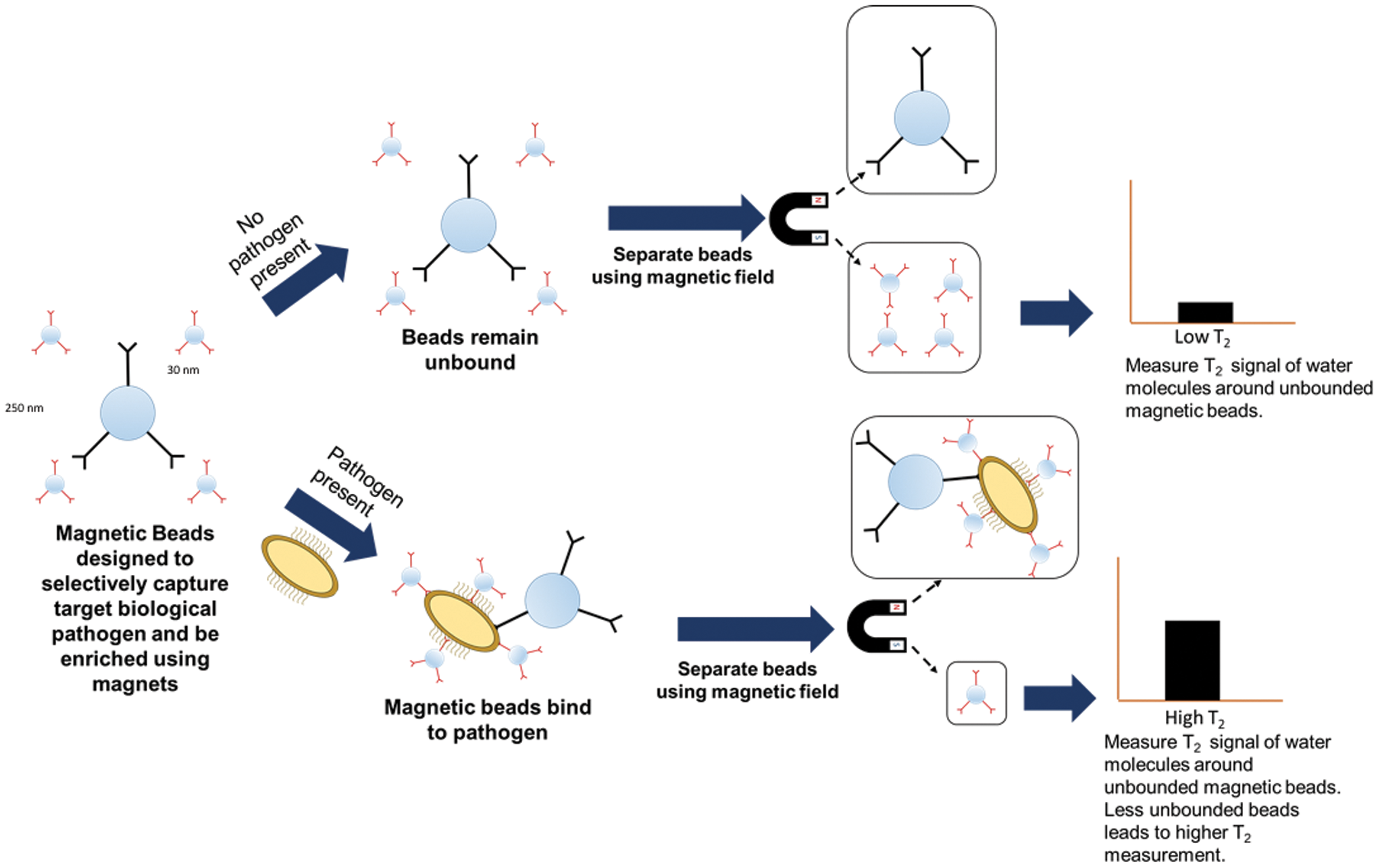
Schematic of magnetic separation and MRS (adapted from Chen et al., 2015b). A magnetic field of 0.01 T is used to separate magnetic beads (functionalized with antibodies) of different sizes, 250 and 30 nm. Initially beads are exposed to a sample with a potential pathogen. If no pathogen is present, the beads remain unbound and are separated. The transverse relaxation time (T2) is measured for the water molecules surrounding the smaller 30 nm beads. In this condition, the T2 time is low. If a pathogen is present, then it is bound to antibodies on the magnetic beads. The magnetic separation step in this case results in lower number of unbound 30 nm beads. The T2 in this case is much higher indicating the presence of a pathogen. MRS, magnetic relaxation switching. Color images available online at
Sample preparation-free techniques
The development of nondestructive techniques for POU devices is critical for the advancement of food safety monitoring. Methods that can detect changes in visually noticeable external attributes (e.g., color, texture), as well as internal attributes (e.g., decomposition-related chemical changes), are especially critical for packaged food. Elimination of product homogenization would also reduce cost, analysis time, and food waste. While an ideal POU detection device would incorporate nondestructive techniques with pathogen identification, just detecting the presence of contaminants would be suitable in many situations. For example, a restaurant dishing out food from a single container over a sustained period of time would have the ability to monitor any changes that developed over time or after the replacement with a new container.
A variety of spectroscopic techniques have gained attention due to recent technological processes in the photonics and optics used in these systems, enabling the development of more rapid and cost-effective devices (Davis and Mauer, 2010; Xu et al., 2015). These techniques typically require little sample preparation or are preparation free, have high sensitivity with low sample amounts, and enable real-time detection using no chemicals.
Hyperspectral imaging (HSI) is an emerging platform that integrates spectroscopic and photographic techniques into one system to attain both spatial and spectral information about an object (Xu et al., 2015; ElMasry and Nakauchi, 2016). During HSI, an object is subjected to wavelengths throughout the electromagnetic spectrum, from ultraviolet to long-wave infrared, and the collected data are processed and combined. With regard to food quality assessments, HSI can be combined with digital sorters to identify inherent physicochemical discrepancies between products during production. While an extremely powerful tool, it is costly and the processing of large data sets leads to longer processing times.
Another HSI platform for pathogen detection is acousto-optic tunable filter (AOTF)-based hyperspectral microscope imaging (HMI) (Park et al., 2015). In this technique the AOTF-based spectral filter system is a solid-state optical filter with the ability of adjustable passbands at programmable bandwidths. This tuning capability eliminates the need to scan beyond the target area, providing high-speed, high-throughput quantitative image analysis. In less than a minute, an AOTF-HMI developed by Park et al. (2015) identified isolated cultures of Salmonella and Staphylococcus with 99.99% accuracy; however, further research is needed to determine if classification can still be accomplished using complex food matrices.
In another modification on HSI, Huang et al. (2015) developed a near infrared (NIR) multispectral imaging (MSI) technique to monitor total volatile basic nitrogen during meat decay. Although MSI is only able to capture images at specific frequencies across the electromagnetic spectrum, HSI can initially be used to determine the optimum waveband filters. Lower instrument complexity and less data processing makes an MSI-based system more feasible for practical usage. However, the implementation of either of these imaging techniques is still a way off due to the complexity in the data modeling of the chemical mechanisms involved the decomposition process.
A less complex, nondestructive technique for pathogen detection is based on sensing of volatiles produced during food decomposition. Sensing platforms can be tailored to detect different volatiles released during the enzymatic and microbial decomposition of food, and then used to determine the total viable count of bacteria. For example, during the decomposition of meat, fat will decompose into aldehydes and aldehyde acids, whereas carbohydrates decompose into alcohols, ketones, aldehydes, hydrocarbons, and carboxylic acid gases (Huang et al., 2015). Chen et al. (2016) developed an “electronic nose” colorimetric-based sensor for the detection of VOCs from decomposing chicken. This technique may not be able to provide as complete of a picture as compared with some of the more complex spectroscopic methods; however, it has the distinct advantage of significantly less complexity, making VOC detection one of the more viable methods for POU sensing.
Recently, other methods using low-cost metal-functionalized titania nanostructures from our research group (Fig. 4) have be engineered for detection of VOCs that are known to be given off by bacteria. This method utilizes specific metals (in a specific valence state) on the surface of the titania nanotube substrate as a recognition element to specifically bind VOCs of interest (Bhattacharyya et al., 2015, 2016). The operation principle of this approach is based on the binding affinity that a specific metal may have for a specific organic molecule. Dubnikova et al. (2002) demonstrated that this type of interaction is possible using the organic molecule triacetone triperoxide (TATP), in which quantum chemical methods concluded that Zn2+ and In3+ formed the strongest bonds with TATP (when in vapor). Our group recently utilized this principle with a metal-functionalized titania nanotube substrate to enable the detection of TATP, as well as four VOCs that are produced by Mycobacterium (Ray et al., 2014, 2015). Figure 5 illustrates examples of the measurements taken from metal-functionalized titania nanotube-based sensors. The VOCs, methylcyclohexane, methylnicotinate, methyl p-anisate, and o-phenylanisole, are known to be given off by bacteria (Syhre and Chambers, 2008; Qader et al., 2015) and tomato decomposition (Chung et al., 1983). The detection limit for this type of sensor is shown to be in the range of 0.01 ppm depending on the type of VOC (Bhattacharyya et al., 2016).
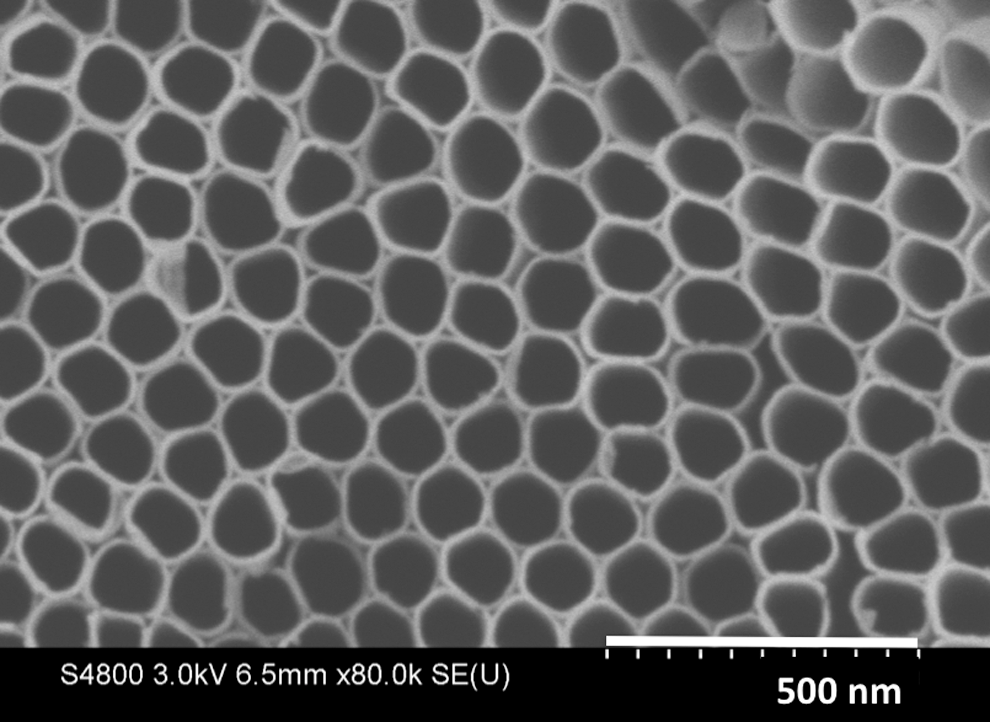
Self-ordered titanium dioxide nanotube array, grown anodically on titanium foil. After functionalization with metal nanoparticles, these arrays can be used for the detection of VOCs. Image taken by authors' group. VOCs, volatile organic compounds.
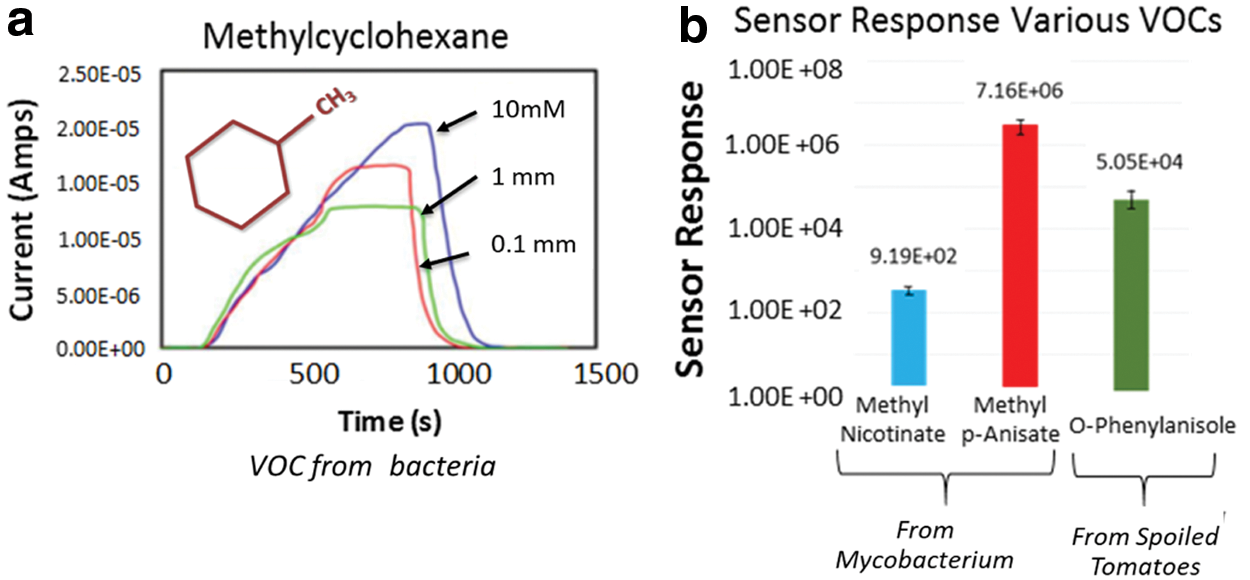
Examples of VOC detection derived from bacteria and spoiled tomatoes using the metal-functionalized titania nanotube-sensing platform.
During detection, the sensor is typically operated at a low bias voltage (−0.2 to −0.8 V), the value of which is chosen using CV methods to determine the maximum oxidation and reduction peaks for the specific metal and VOC. When the VOC reaches the functionalized titania, it complexes with a metal ion on the surface, resulting in an exchange of electrons. This exchange of electrons causes a large change in current (orders of magnitude) and is measured using a simple potentiostat. The readout for the end-user is a simple yes/no answer based on the change in current. The proposed technology creates a sample preparation-free platform that can be applied to any food safety situation that has a VOC as an indicator. Furthermore, the detection is fast (on the order of minutes), portable, label-free, requires no antibodies for detection, requires minimal training to operate and can be deployed as a sensor network.
The titania nanotube-sensing platform is significantly different from standard metal oxide sensors and other chemoresistive sensing materials used for VOC detection (i.e., carbon nanotubes, conductive polymers) because it uses the metal functionalization on the surface to specifically bind VOCs of interest. The sensor composition of titania and metals makes it amenable to a long shelflife without the need for specific storage temperatures that are typically needed for antibody-based sensors. Titania nanotubes are advantageous over titania thin films or particles as (1) they provide increased signal amplification due to more open binding sites and (2) have improved charge transport over NPs which gives them an advantage over NP constructs. One disadvantage in this technique is that moisture can interfere with the signal detection. To alleviate this problem, water vapor can be condensed before detection or the sensor can be encapsulated in a gas permeable membrane
Challenges and Future Directions
Advances in many aspects of food sensing have led to enhanced sensitivity and specificity of target pathogens in laboratory settings, where complex equipment, controlled environments, and single-use sensors are acceptable to obtain the highest quality results; however, these issues are not feasible in POU devices where facilities to prepare samples and control the environment are not available. Due to challenges with specificity and sensitivity, the majority of the techniques described in this review are not commercially available for monitoring food and water samples. Nonetheless, technological advancements are moving many of these approaches closer to commercialization. The combined list of desirable attributes for an ideal POU detection system can be grouped into three main categories: pathogen sensitivity, device portability, and no sample preparation (i.e., no homogenization and/or label-free detection). While pathogen identification would be ideal, an effective POU device would only require the ability to determine if a contamination event has occurred. Figure 6 is a visual representation of this grouping, as well as how the various techniques described in this review compare to an ideal POU device. Table 1 lists the limits of defection for the various pathogen sensing techniques, as well as the time for analysis. It is the author's opinion that at this time the frontrunner technologies are based on pathogen VOC detection due to their noninvasive nature and ease of operation, as well as their fairly simplistic minimal equipment requirements compared with the HSI-based techniques. However, an integrated approach involving the combination of several methodologies might be required to advance the current sensor technology to a true POU device format.
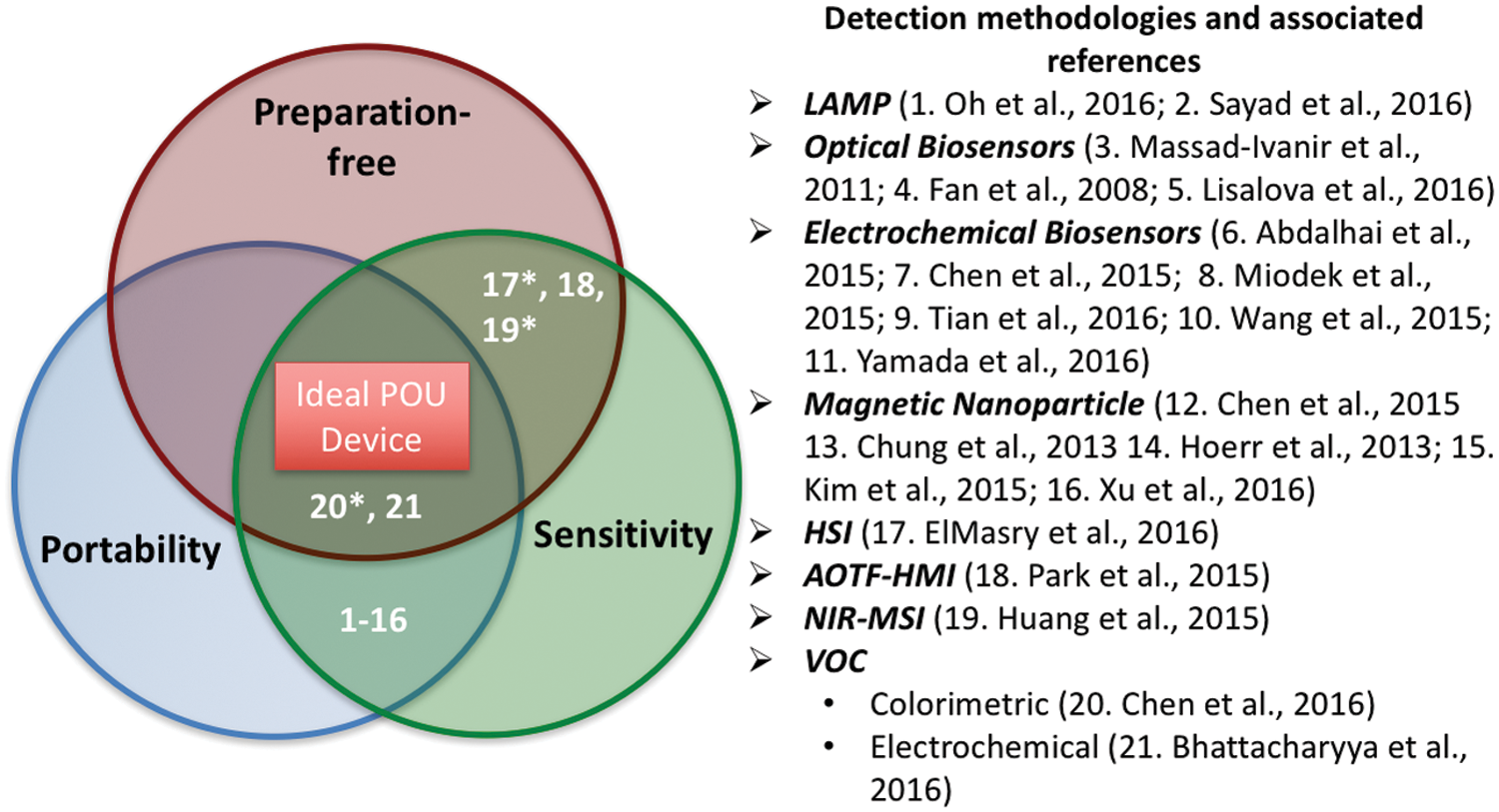
Current detection techniques and associated attributes in relation to an ideal POU sensor. The numbers on the diagram are associated with the references listed on the side of the diagram. Detection time and cost were excluded, as these factors tend to improve with technology development. Asterisks (*) indicate technologies with limited ability for pathogen identification. Color images available online at
The Associated References are in Brackets.
CFU, colony-forming unit; LAMP, loop-mediated isothermal amplification.
Sensors that utilize biorecognition platforms (e.g., LAMP, optical, and electrochemical biosensors, etc.) are advantageous from the perspective of portability and pathogen detection sensitivity and specificity. While some of the instrumentation for detection and analysis has evolved to withstand more extreme environmental conditions, any bioprobe-based platform will be single use, as regeneration is not feasible once conjugation has occurred. Multiuse platforms would likely be a secondary issue in situations where specific identification of the pathogen is needed (i.e., foodborne pathogen related outbreaks). However, the use of a sensor functionalized with an inorganic compound could enable multiuse detection.
Spectroscopic techniques have strengths over bioprobe platforms due to their nondestructive nature and nonfouling detection capabilities. A holistic evaluation of a product without modification enables the determination of pathogen distribution throughout a sample, potentially assisting in source identification and prevention of additional contamination events. This technique also has potential uses at every stage of the food production chain; online detection during processing can be developed to scan 100% of products, product change during extended transport could help determine contamination sources, and scanning of grocery store products would decrease the distribution of tainted items and reduce food waste. Noninvasive detection also permits multiuse sensing without fouling from bioconjugation or interaction with the food matrix. Beyond the lack of specificity, the main technological challenge associated with spectroscopic techniques is the large amount of data processed during analysis. Modified approaches, such as AOTF-HMI and NIR-MSI, may require an HSI-built database, but require less processing and instrument complexity. These advancements could lead to POU devices similar to price scanners in grocery stores, simplistic enough to enable operation by a wide variety of people regardless of educational background.
POU detection systems could also be connected into wireless sensor networks (WSN), allowing for the continuous monitoring of products through the food cycle (Pang et al., 2012). These networks transmit information from spatially distributed sensors to a main location. In bidirection systems, the connected data can not only be processed, but also used to control further sensor activity. In a food monitoring WSN, detection systems would be placed at sites along the food cycle chain. Detection of pathogens at one stage would automatically alert other sites in an attempt to not only determine the source of contamination, but also mitigate any additional contamination. This type of comprehensive monitoring system is now critical due to our current highly distributed, globalized food chain.
Footnotes
Acknowledgment
The authors would like to acknowledge the Crus Center for Renewable Energy for providing financial support.
Disclosure Statement
No competing financial interests exist.