




Abstract
Campylobacteriosis is the common gastrointestinal disease worldwide. However, in many parts of the world, including India, the impact of campylobacteriosis is less commonly investigated. This study aimed to determine the prevalence and antibiotic susceptibility profiles of Campylobacter jejuni in raw poultry meat and poultry-related samples at retail shops in a region of Northern India. A total of 400 samples of chicken meat (150), chicken intestine (150), feathers (50), and chopping boards and knives (50) samples were screened for the presence of C. jejuni by selective enrichment culture followed by selective plating on mCCDA and also by polymerase chain reaction (PCR) after selective enrichment. The highest prevalence of Campylobacter contamination (38.6%) was observed in chicken meat followed by chicken intestine (24.0%). C. jejuni was detected in 14.0% of chopping boards, knives, and feather samples by culturing method. The hipO gene based PCR detection yielded 36.0% C. jejuni from chicken meat samples; in other samples, however, the prevalence of C. jejuni was observed similar to that of cultural method. The antibiotic susceptibility profiles confirmed drug resistance among 97% of C. jejuni isolates, with 84.1% of C. jejuni isolates resistant to co-trimoxazole followed by cephalothin (81.1%) and tetracycline (59.4%). Low incidence of resistance (6.9–8.9%) was observed against nalidixic acid, ciprofloxacin, erythromycin, gentamicin, and azithromycin. Resistance to multiple drugs (≥4) was recorded in 31.6% of the strains. The findings of this study demonstrated high prevalence of drug-resistant C. jejuni in raw chicken meat and intestinal isolates. The high occurrence of C. jejuni in chicken meat might be due to cross contamination as a result of slaughtering and poor hygienic conditions. Implementation of monitoring/surveillance programs to monitor the prevalence of multidrug-resistant Campylobacter spp. in food production animals, particularly, poultry in semiurban regions, as well as main cities in India, is highly required for better public health protection.
Introduction
C
The presence of the Campylobacter species in the intestinal tract of poultry is well documented, where campylobacters were isolated from fecal droppings, cloacal swabs, and cecal contents of chicken (Ogden et al., 2007; Gormley et al., 2014; Vidal et al., 2016). Poultry are recognized as a major environmental reservoir of Campylobacter spp., as colonization of chicken by the bacterium is most likely through contaminated water supply of the broiler and/or campylobacter contamination of the broiler environment (Ogden et al., 2007; Berghaus et al., 2013; Skarp et al., 2016). Once Campylobacter colonize the flock, the organism transmits between birds by the fecal–oral route, and Campylobacter-positive birds remain colonized until slaughter (Saint-Cyr et al., 2016). Chicken meat obtained from supermarkets and slaughterhouses was found to be heavily contaminated with campylobacters (Wassenaar, 2011; Berghaus et al., 2013; Skarp et al., 2016). The source of meat contamination is the birds themselves, yet the processing (e.g., defeathering; evisceration and packing) could cause cross contamination (Saint-Cyr et al., 2016).
The detection of Campylobacter from poultry meat usually involves selective enrichments followed by selective plating on solid media (Seliwiorstow et al., 2016). Various polymerase chain reaction (PCR) protocols have been developed using different sets of primers that target Campylobacter-specific genes (e.g., fla; hipO) for the detection of Campylobacter from poultry products (Manzano et al., 1995; Bang et al., 2002), either by direct extraction of target DNA from poultry meat samples (Manzano et al., 1995) or extracting target DNA from selective enrichment culture (Denis et al., 2001).
The detection of antimicrobial-resistant C. jejuni in chicken meat is of primary concern as antimicrobial-resistant strains may lead to more prolonged or severe illness than the susceptible strains during the treatment of foodborne campylobacteriosis. It is observed that resistance of C. jejuni to fluoroquinolones and macrolides, which are generally used for the treatment of bacterial gastroenteritis, has increased during the past two decades, due to excessive use of this group of antimicrobials in food-producing animals (Grant et al., 2016).
The incidence of C. jejuni infections, including multidrug-resistant strains, in the community is well documented in various locations within the Indian subcontinent (Bandekar et al., 2005; Ghosh et al., 2013; Mukherjee et al., 2013, 2014). The consumption of poultry meat is very popular among Indian communities, as poultry meat is more affordable in comparison to livestock (Marinou et al., 2012). Despite the fact that there are few reports documenting the incidence of C. jejuni and their susceptibility profiles in poultry meat and other food commodities in India (Kakkar and Dogra, 1990; Sen-Gupta et al., 1991; Khurana and Kumar, 1996; Kumar et al., 2001; Barua and Rathore, 2006; Singh et al., 2009), little is known about incidence of C. jejuni on raw meat sold at retail shops and supermarkets in India. Simultaneously, there is no official surveillance program that can monitor the presence of antimicrobial-resistant C. jejuni in food animals (Marinou et al., 2012). Therefore, the present study aimed to investigate the prevalence of C. jejuni in raw chicken meat samples collected at consumer retail shop in a semiurban community, Bareilly, India. Furthermore, the presence of C. jejuni was also investigated in chicken intestine, chopping boards, and knives to study the cross contamination of poultry meat at retail shops.
Materials and Methods
Sample collection
A total of 400 samples comprising raw chicken meat (150), chicken intestine (150), feathers (50), and chopping boards and knives (50) were collected from local retail shops in Bareilly city, India, as described by Andrews and Hammack (2003). Raw poultry meat and intestines (100 g each sample) were collected in screw-cap jar containing 100 mL of buffered peptone water (0.1%; Hi Media Pvt. Ltd., Mumbai, India) aseptically. Chicken feathers (two to three feathers per sample) were collected in sterile test tubes. Most of the time feathers and meat were collected from the same chicken on the same day. Chopping boards and knife samples were collected using sterile swabs (one swab per sample). All samples were transferred to the laboratory on ice away from direct sunlight. Microbiological examinations began at the same day of sampling.
Isolation and identification of C. jejuni by cultural methods
Isolation of C. jejuni from chicken meat samples was performed according to the U.S. FDA Bacteriological Analytical Manual method described by Hunt et al. (2001) with few modifications. Briefly, raw meat (25 g) sample was homogenized for 2 min in 200 mL of Buffered Peptone Water (Hi Media Pvt. Ltd.) and centrifuged at 16,000 × g for 15 min. The supernatant was discarded, and the pellets were resuspended in 10 mL of Buffered Peptone Water. The 3.0 mL of suspension was transferred to 100 mL Campylobacter blood-free enrichment broth and incubated at 30°C for 5 h under microaerobic conditions, using Campy Pak, as generating packs (BD-Becton and Dickinson) for pre-enrichment. The incubation was continued for final enrichment at 42°C for 30 h under microaerobic conditions. Enrichment cultures were streaked onto modified Campylobacter blood-free agar (mCCDA; Hi Media Pvt. Ltd.) and incubated at 42°C for 48 h. For the detection of C. jejuni from intestine, feathers, chopping board, and knife samples, swabs from each sample were immersed in 10 mL of Campylobacter enrichment broth and incubated for pre-enrichment (30°C for 2 h) and enrichment (42°C for 30 h) followed by streaking on mCCDA and incubated at 42°C for 48 h under microaerobic conditions.
The confirmation of presumptive Campylobacter colonies growing on mCCDA was performed by examination of the morphological features of typical Campylobacter growth on mCCDA that appears as gray, moist, flat, and spreading colonies and microscopic examination after Gram staining, where campylobacters appear as Gram-negative, gull-winged shaped. Further confirmations of presumptive Campylobacter isolates were carried out by means of biochemical tests determined by catalase, oxidase, glucose fermentation, production of H2S on Triple Sugar Iron (TSI) agar (Hi Media Pvt. Ltd.), NO3 reduction, growth at 25°C, 37°C, and 42°C, and hippurate hydrolysis assay as described by Hunt et al. (2001).
Detection of C. jejuni by PCR
For PCR based detection of C. jejuni, DNA was extracted directly from 1.0 mL aliquots taken from Campylobacter enrichment cultures. The hipO gene based detection for the identification of C. jejuni by PCR was performed as described by Linton et al. (1997) with some modifications. The DNA extraction method was adopted as described by Sambrook and Russell (2001), using DNA Extraction Kit (Genei, Bangalore, India). The primers HIP400F (5′-GAA GAG GGT TTG GGT GGT G-3′) and HIP1134R (5′-AGC TAG CTT CGC ATA ATA ACT TG-3′) used in this study were synthesized by Agile Life Sciences (Mumbai, India). The PCR for amplification of hipO gene (735 bp) was optimized as follows: 5.0 μL 1 × final concentration PCR buffer (20 mM Tris HCl, pH 8.0 at 25°C, 100 mM KCl, 0.1 mM EDTA, 1 mM DTT, 50% glycerol, 0.5% Tween 20, and 0.5% Nonidet P-40), 200 μM of each dATP, dCTP, dGTP, and dTTP, 0.4 μM of each primer, 0.4 U of Taq DNA polymerase, 2.0 mM MgCl2, and 5.0 μL of bacterial DNA. Nuclease-free water was added to obtain a final volume of 50 μL. PCR conditions included an initial denaturation step at 94°C for 5 min, followed by 30 subsequent cycles consisting of heat denaturation at 94°C for 1 min, annealing at 66°C for 1 min, and extension at 72°C for 2 min. A final extension was performed at 72°C for 7 min. PCR products were separated in 1.5% agarose gel electrophoresis, stained by ethidium bromide (Sigma-Aldrich), and visualized under ultraviolet light. The specificity of PCR assay was determined using reference/standard cultures of C. jejuni (MTCC 11168), C. coli (MTCC 1126), and Escherichia coli (MTCC 443), as positive and negative controls.
Statistical analysis
The t-test for comparing the means of two samples was used to determine if there is a difference between the detection of C. jejuni by conventional cultural methods and molecular PCR detection. To test the null hypothesis this states that there should be no difference in the detection rates of C. jejuni using conventional cultural technique and PCR protocol after selective enrichment.
Determination of antibiotic resistance
Antibiotic resistance profiles of C. jejuni isolates were determined by disc diffusion method as described by Giacomelli et al. (2014). Nine commercial sensitivity discs (Hi Media Pvt. Ltd.) that belong to six classes of drugs were used as follows: Macrolides: Azithromycin (15 μg/mL) and Erythromycin (15 μg/mL), Cephalosporins: Cephalothin (30 μg/mL), Fluoroquinolones: Ciprofloxacin (5 μg/mL), Quinolones: Nalidixic acid (30 μg/mL), Sulfonamides: co-trimoxazole (25 μg/mL), Aminoglycosides: Gentamicin (10 μg/mL), Tetracyclines: Tetracycline (30 μg/mL), and Phenicols: Chloramphenicol (30 μg/mL). Briefly, 0.1 mL of test bacterial suspension (108 colony forming unit [CFU]/mL) was prepared in brain-heart infusion broth (BHI; Pronadisa) and was spread onto mCCDA plates (Hi Media Pvt. Ltd.). The plates were incubated at 37°C for 18 h microaerobically. Inhibition bacterial growth diameter around the antibiotic disc was measured.
Results
Prevalence of C. jejuni in poultry and poultry-related samples
The prevalence of C. jejuni in all types of samples is presented in Table 1. Both conventional and PCR based detection methods were applied. Using conventional cultural methods, C. jejuni was detected in 58 of raw meat samples (38.7%, n = 150) followed by intestinal samples (24.0%, n = 150). The detection of C. jejuni by PCR, targeting the hipO gene (735 bp), after selective enrichment showed that 54 of raw meat (36.0%, n = 150) and 36 of intestine samples (24.0%, n = 150) were positive for C. jejuni, respectively. The detection rate of C. jejuni in other samples is listed in Table 1 and Figure 1. Overall, 105 presumptive campylobacters were recovered, of which only 101 isolates were confirmed as C. jejuni by both conventional cultural and PCR method and 4 isolates by cultural methods only. Overall among 400 samples were collected; 26.3% and 25.3% samples were positive for the presence of C. jejuni by cultural and PCR based methods, respectively. No statistical significant differences (t-test) were found in the detection rates of C. jejuni in all samples using conventional cultural technique and PCR after selective enrichment (Table 1).
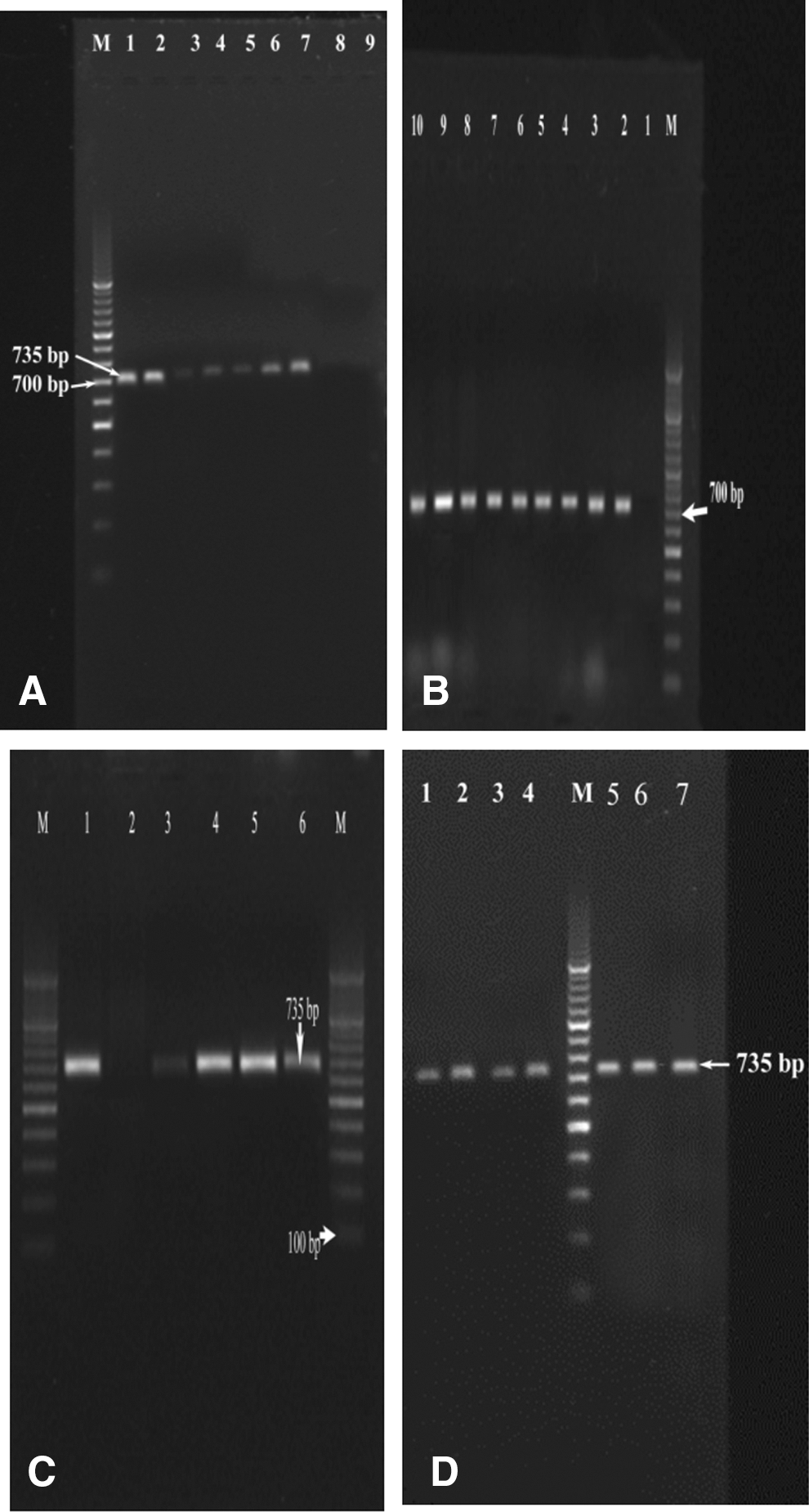
hipO gene (735 bp) based identification of Campylobacter jejuni isolates by PCR. Lane M: DNA ladder (100 bp),
No statistical significant difference (p = NS) at 5% (t-test for comparing the means of two samples).
Cultural methods were composed of selective enrichment followed by selective plating.
PCR based detection was performed after selective enrichment step.
PCR, polymerase chain reaction.
Antibiotic resistance profiles of C. jejuni
The antibacterial resistance profiles of a total of 101 isolates of C. jejuni were determined against 9 antibiotics. The antibiotic susceptibility profiles confirmed drug resistance among 97% of C. jejuni isolates, with 84.1% of C. jejuni isolates resistant to co-trimoxazole followed by cephalothin (81.1%) and tetracycline (59.4%). Low incidence of resistance (6.9–8.9%) was observed against nalidixic acid, ciprofloxacin, erythromycin, gentamicin, and azithromycin. Only 3 isolates out of 101 (2.9%) were susceptible to all antibiotics tested (Table 2). There were 27 resistance patterns exhibited among the 101 isolates of C. jejuni. The most common resistance pattern was detected in 26 (25.7%) of the isolates, which were resistant to cephalothin, co-trimoxazole, and tetracycline. Resistance to 2 or more antibiotics was found in 95 (94.0%) of the isolates. It was found that 10 (9.9%) isolates were resistant to 5–6 antibiotics. Overall resistance to multiple drugs (≥4) was recorded in 31.6% isolated strains (Fig. 2 and Table 3). The criterion for multiresistance is defined by resistance to three or more classes of antimicrobial agents (Schwarz et al., 2010); thus, 25.7% of the isolates were exhibiting multiresistance pattern to three classes of antimicrobials, namely cephalosporins, sulfonamides, and tetracyclines. A notable multiresistance pattern to five different classes of antimicrobial agents (cephalosporins, sulfonamides, quinolones, macrolides, and phenicols) was observed in four isolates (3.96%, n = 101) (Table 3).
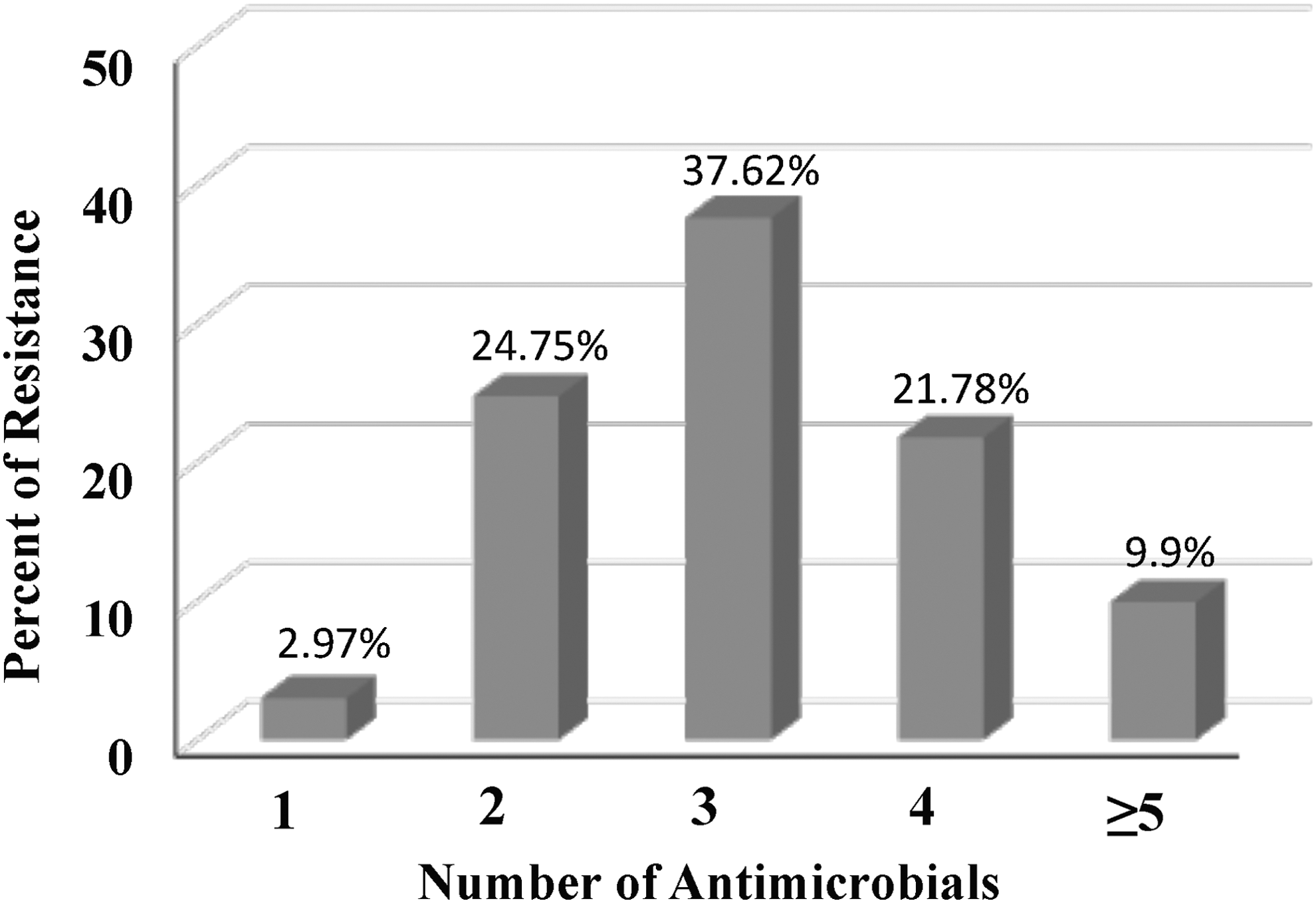
Antimicrobial resistance to different combinations of antibacterial drugs among 101 C. jejuni isolates.
Three isolates (2.9%) were sensitive to all antibacterial drugs tested.
C (n) = from chicken; CK (n) = from chopping boards and knives; F (n) = from feathers; I (n) = from intestine.
Az, azithromycin; Cf, ciprofloxacin; Ch, cephalothin; Cl, chloramphenicol; Ct, co-trimoxazole; Er, erythromycin; G, gentamicin; Na, nalidixic acid; T, tetracycline.
Discussion
C. jejuni accounts for the majority of campylobacteriosis in humans, by which half of these cases originate from the consumption of undercooked contaminated meat, unpasteurized dairy products, and contaminated water (Jones, 2001). Of these different sources of Campylobacter-associated infections, poultry is considered as the most important source of human campylobacteriosis (Josefsen et al., 2015).
Detection of campylobacters in food and environmental samples by PCR after selective enrichment step has provided more accurate accounts of the true incidence of Campylobacter spp., as well as reduces the time for detection and eliminates the need for conventional confirmatory tests (Abulreesh et al., 2017). We report 25.3% detection of C. jejuni in samples (n = 400) examined, by PCR after selective enrichment step, compared to 26.3% by conventional cultural methods; however, no statistical significant differences in the detection rates of C. jejuni were found between conventional and molecular techniques as determined by t-test. Few samples of the presumptive positive isolates recovered by cultural methods were not confirmed as C. jejuni, by PCR method, which requires further detailed investigation by 16SrRNA gene sequence analysis. The detection of campylobacters by PCR after selective enrichment step has been recommended as a standardized method for the detection of Campylobacter spp. in poultry products, dairy products, drinking water, and aquatic environments (Denis et al., 2001; Abulreesh et al., 2006, 2014; Gharst et al., 2013), as well in fecal samples where campylobacters are present in relatively higher numbers than in food or environmental samples (Rasmussen et al., 1996; Vanniasinkam et al., 1999).
The prevalence of C. jejuni on raw poultry meat and other poultry products that are available for consumers at points of sale (e.g., supermarkets, retail shops) is of great concern from a public health standpoint; therefore, various studies worldwide investigated the incidence of C. jejuni on raw chicken meat. In this study, we found that 36% (n = 150) of raw chicken meat sold at local retail shops is contaminated with C. jejuni; this is higher than the prevalence rate reported in Argentina (14.5%, n = 60) (Zbrun et al., 2015), also higher than 29.3% (n = 33) prevalence rate reported in Japan (Kojima et al., 2015). In Europe, the prevalence was even lower in countries like Spain, Italy, and Sweden (30%, 11%, and 8%, respectively) as reported by Mozina et al. (2011) in survey conducted between 2003 and 2007; lower prevalence rate of 17.2% (n = 302) was also reported in China (Zhang et al., 2016). Conversely, higher prevalence of Campylobacter spp. on raw poultry meat at supermarkets or retail shops, higher than what we reported in this study, was found in Qatar with 48% (n = 400) (Abu-Madi et al., 2016). In a 7-year study in the United States, the average prevalence of Campylobacter spp. on raw poultry meat was found to be 41% (n = 755), with higher prevalence recorded in 2005 (47%), followed by gradual reduction over the years to reach 34% in 2011 (Williams and Oyarzabal, 2012). High prevalence of C. jejuni in poultry also observed in various locations in India (Baserisalehi et al., 2007; Rajendran et al., 2012), together with the results reported in this study, may shed some light on the incrimination of poultry as a possible reservoir of human campylobacteriosis in northern India.
Although the differences of sampling design and testing methods may play a role in the variation of the results reported in these studies, nonetheless, the strict surveillance/monitoring programs of hygiene practices that are applied to slaughterhouses and processing plants may, in part, contribute to the low prevalence of Campylobacter contamination in raw poultry meat, particularly in the European Union (EU), where monitoring of Campylobacter in poultry is mandatory (Josefsen et al., 2015; Mezher et al., 2016). This was observed in some EU countries like France and Germany with higher Campylobacter-contaminated poultry meat at retail shops (85% and 40%, respectively); however, these high prevalence rates showed sharp decrease over the years (<30%) due to improved slaughtering practices that reduce cross contamination (Mozina et al., 2011). In India no such surveillance programs are implemented; thus, cross contamination is highly likely to occur, and therefore, high prevalence of C. jejuni on raw poultry meat is highly likely to occur.
Furthermore, the local retail shops that were surveyed in this study were performing slaughtering, defeathering, and rinsing of chicken carcass before sale. Common knives, chopping boards, defeathering boards, and common washing tanks are all used throughout the day at these premises; this was obvious in the contamination of the equipment used in these shops by C. jejuni (14%, n = 50). Given the fact that the colonization of Campylobacter in chicken is usually high (1010 CFU/g cecum content), chicken carcass can be easily contaminated during slaughtering, defeathering, and processing, either directly from the intestinal content or indirectly through washing water and other equipments; even Campylobacter-negative flocks can be contaminated during and after slaughtering process, as a result, the load of the bacterium on the meat ready for sale is usually high (Cason et al., 1999; Josefsen et al., 2015). However, proper hygiene practices after slaughtering (e.g., defeathering, washing, and packaging) resulted in sharp decrease in the loads of campylobacters on poultry meat and other poultry products sold at supermarkets and retail shops. This was observed in Italy, with decreasing rates of C. jejuni on poultry carcass noted among slaughterhouses (80%), deboning (49%), butcheries (34%), and finally, large-scale retailers (25%) (Stella et al., 2017). With lack of surveillance/monitoring of retail shops that practice slaughtering and processing of poultry before sale in India, cross contamination is unavoidable, and therefore, the risk of campylobacteriosis in the community is inevitable.
Campylobacteriosis is a self-limiting disease that does not require antibiotic treatment in the majority of cases, unless in those immunocompromised patients (Kaakoush et al., 2015). However, the incidence of multidrug–resistant Campylobacter spp. in food production animals and the food chain in general is of great importance to public health authorities. In this study, we found that 97% (n = 101) of C. jejuni isolated from raw poultry meat and slaughtering equipments at retail shops are resistant to different antimicrobials. We recorded a common multiresistant pattern in 25.7% of the isolates to three different classes of antimicrobial agents; however, multiresistance to more than three classes was less common, for example, 3.96% were multiresistant to five different classes of antimicrobials. Similar resistant trends were found in central Europe where nearly half of Campylobacter spp. originates from poultry meat at retail shops were resistant to at least two unrelated antimicrobial drugs used in human and veterinary medicine (Mozina et al., 2011).
Unlike the resistant trend that has been reported in various studies (Haruna et al., 2012; Agunos et al., 2014; Giacomelli et al., 2014; Wieczorek and Osek, 2015), we found that the prevalence of C. jejuni isolates resistant to fluoroquinolones in this study was low; however, prevalence of tetracycline–resistant C. jejuni was shown to be similar to the trends reported elsewhere (Jore et al., 2010; Kovalenko et al., 2014; Wieczorek and Osek, 2015). The use of fluoroquinolones and tetracyclines as therapeutic agents for food-producing animal may result in the emergence of resistant strains of C. jejuni that can be transmitted to humans (Wieczorek and Osek, 2015).
Low incidence of resistance was observed in this study against macrolides, that is, azithromycin (8.9%) and erythromycin (6.9%) in the strains of C. jejuni. This is in agreement with other studies reported by many workers (Haruna et al., 2012; Kovalenko et al., 2014; Wieczorek and Osek, 2015). Erythromycin was suggested to be the drug of choice for treating Campylobacter-associated infections, as C. jejuni appears to be predominantly susceptible to erythromycin with low levels of resistance (Wieczorek and Osek, 2015). The results reported in this study reinforce the recommendation that the indiscriminate use of antibiotic in human and veterinary medicine in India should be controlled, and the implementation of surveillance of antibiotic susceptibility patterns of Campylobacter in poultry and other food production animals, which can be transmitted to human through the food chain, is highly recommended.
Conclusion
The overall prevalence of C. jejuni, particularly multidrug-resistance strains on raw poultry meat and slaughtering equipments isolated from local retail shops in semiurban areas in India, is of great concern to public health, since the consumption of poultry meat is very popular in Indian communities and poultry meat is the major source of human campylobacteriosis; thus, antimicrobial-resistant C. jejuni can be easily transmitted to humans that increase the burden of Campylobacter infections in the community. Therefore, implementation of monitoring/surveillance programs to monitor the prevalence of C. jejuni, particularly multidrug-resistant campylobacters in food production animals, particularly raw poultry meat that is sold in markets of semiurban regions, as well as main cities in India, is highly required for better public health protection.
Footnotes
Acknowledgment
The authors are grateful to Director, Indian Veterinary Research Institute (IVRI), India, for providing facilities during this investigation to J.A.K.
Authors' Contributions
J.A.K. performed experimental work and prepared a rough draft of the article, R.S.R. experiment designing and supervision, H.H.A. article write up, F.A.Q. data analysis, and I.A. experiment designing, supervision, and editing the final draft of the article.
Disclosure Statement
No competing financial interests exist.