




Abstract
The incidence of the Salmonella contamination of poultry products in Senegal is unknown. Salmonella contamination and antimicrobial drug resistance profiles in chicken carcasses were investigated. Between July 2012 and July 2013, three types of chicken carcasses (broilers, laying hens, and premises chickens) obtained from retailers in the markets of Dakar and its suburbs were tested for Salmonella contamination. Salmonella strains were isolated from 300 chicken carcasses according to International Organization for Standardization ISO 6579 (2002) guidelines. In these samples, 273 isolates were obtained, belonging to 22 serovars, and 53% samples were contaminated with at least 1 serovar. Standardized techniques were used for the susceptibility testing and serotyping of isolates. Hygiene conditions, in terms of the cleanliness of stalls, the packing of chicken carcasses in bags, and the maintenance of the cold chain at the stall, were moderately poor. The three serovars most frequently identified were Salmonella Istanbul (28%), Salmonella Brancaster (19%), and Salmonella Kentucky (13%). Overall, 21% of isolates were resistant to quinolones and fluoroquinolones. Serovar Istanbul was resistant to tetracycline (TE) and trimethoprim + sulfamethoxazole (SXT). Serovars Brancaster and Kentucky were resistant to betalactams and to quinolones or fluoroquinolones. The uncommon serovar Senftenberg had the strongest resistance profile, displaying resistance to betalactams including imipenem (IMP). Large numbers of isolates were resistant to TE (66%) and SXT (47%). Resistance to cephalosporins (5%), chloramphenicol (2%), gentamicin (8%), and IMP (1%) was less frequent. A large proportion of the broilers sold in Dakar markets were contaminated with Salmonella. This situation probably resulted from poor hygiene conditions in chicken farms and slaughterhouses and from breaks in the cold chain at some point in the distribution of poultry products.
Introduction
According to World Health Organization (WHO), food safety policies should cover all stages of food production, from the farm to the plate of the consumer (WHO, 2015). Salmonella is one of the leading causes of human gastroenteritis worldwide. Every year, 1 in 10 people worldwide falls ill after eating contaminated food and 420,000 die. Children under the age of 5 years are particularly vulnerable and 125,000 deaths in this population annually are linked to salmonellosis (WHO, 2015). The burden of gastroenteritis is higher in Africa and Southeast Asia (Majowicz et al., 2010). Nontyphoid Salmonella is the main cause of bacteremia in immunocompromised individuals and infants, particularly neonates (Bryce et al., 2005; Morpeth et al., 2009). However, the epidemiology of Salmonella in developing countries is poorly documented (Kariuki et al., 2006; Crump and Heyderman, 2015). The contamination source of Salmonella is primary from food animals, especial poultry, which was served as a potential reservoir for human infection. Indeed, the consumption of contaminated poultry products (cooked or undercooked products) seems to be one of the main sources of human infection (Dhama et al., 2013).
The incidence of Salmonella contamination in food products is largely unknown in Senegal. Only few studies have focused on the microbiological quality of poultry products in Senegal but not reported. Chicken carcasses are often displayed and sold at ambient temperatures in markets. This undoubtedly contributes to Salmonella proliferation, but it is not the only factor. Power shortages aggravate the situation by disrupting the cold chain. A study conducted in 2004 (Cardinale et al., 2004) reported an incidence of Salmonella contamination in chicken carcasses of 32%. This study also reported the isolation of a new Salmonella serovar (Salmonella enterica serovar Keurmassar) with a multidrug resistance phenotype (Cardinale et al., 2004). This same serovar was later detected in both humans and food samples (Gassama-Sow et al., 2004). Another serovar, Salmonella Kentucky, was isolated in this study. This same serovar was recently isolated from poultry samples and shown to be resistant to multiple antimicrobial drugs, including amoxicillin (AMX), gentamicin (GM), and sulfonamides (Le Hello et al., 2011).
Antibiotics are used as veterinary and human medicines for the prevention, treatment, and control of infectious diseases. However, their overuse can have adverse effects, including the development of antibiotic resistance. The role of farm animals in the emergence and dissemination of both antimicrobial drug-resistant bacteria and their resistance determinants to humans is poorly understood (Muloi et al., 2018).
In this study, Salmonella contamination and antimicrobial drug resistance profiles in chicken carcasses sold on the markets of Dakar and its suburbs were evaluated.
Materials and Methods
Sampling methods
A field survey at various farms, slaughterhouses, and retailer stores was conducted to gain insight into the conditions of production, preparation for sale, and microbiological quality of the chicken carcasses sold on the markets of Dakar, Senegal. Chicken carcasses were bought from multipurpose Dakar markets, placed in sterile bags with ice packs, and immediately sent to the laboratory for microbiological analysis. The chicken carcasses were bought from different stalls in Dakar markets, but were of three types: broilers, laying hens, and chickens premises. The target markets for sample collection are identified here as M1 to M8. These markets are the largest in Dakar, in terms of the population frequenting them. Hygiene conditions were assessed for each market by evaluating stall cleanliness, the packing of chicken carcasses in bags, the maintenance of the cold chain, and the presence, on site, of an operational freezer.
Isolation and identification of Salmonella isolates
In total, 25 g of mixed parts of the chicken carcasses (part of the neck, thighs, anus, and skin) were removed, ground, and mixed with 250 mL of buffered peptone water before incubation at 37°C for 24 h. A sample of the resulting suspension (1 mL) was transferred to Muller–Kauffmann Tetrathionate-Novobiocin broth and another 500 μL was transferred to Rappaport-Vassiliadis Salmonella enrichment broth and incubated at 42°C for 24 h. The broth cultures were then used to inoculate XLD agar medium (Becton Dickinson) and Hektoen enteric agar (Oxoid) plates, which were incubated at 37°C for 24 h. Salmonella was isolated according to International Organization for Standardization ISO 6579 (2002) guidelines, Amendment 1: 2007 Horizontal methods for detection of Salmonella. Suspected Salmonella colonies were confirmed by biochemical (Api 20E, ref 20100; Biomérieux, France) and serological tests (Statens Serum Institut). Serotyping was performed by slide agglutination in a Kauffmann–White scheme (Grimont and Weill, 2007).
Antimicrobial drug susceptibility testing
Antimicrobial drug susceptibility was assessed according to the CA-SFM 2011 guidelines (
Data collection and validation
This study was performed at the food safety and environmental hygiene laboratory of the Pasteur Institute of Dakar. The samples (chicken carcasses) were delivered in accordance with the hygiene and food safety requirements of the Pasteur Institute of Dakar laboratory for microbiological testing.
The raw data were entered into an Excel spreadsheet and subjected to statistical data analysis with R software.
Results
Environment in which chicken carcasses are sold on markets
Three hundred chicken carcasses were collected between July 2012 and July 2013: 162 broilers, 110 chicken premises, and 28 laying hens. The conditions of chicken carcass sale were considered moderately poor in terms of hygiene, except at the M2 market, where hygiene conditions were poor in 40% of cases. Indeed, 78% of the chicken carcasses from this market were contaminated with Salmonella (Table 1). A field survey of various farms, slaughterhouses, and retail stalls was conducted, but the data on hygiene conditions are not given here.
Farming and Sale Conditions of Chickens in Dakar
M1 to M8: markets; NS, no satisfactory; A, acceptable; S, satisfactory; IF, industrial farming; TF, traditional farming; STF, semitraditional farming; U, urban; R, rural; CP, chicken premises; B, broilers; LH, laying hens.
Salmonella contamination
Overall, 53% (n = 159) of the 300 chicken carcasses were contaminated with one or more Salmonella strains, and 273 Salmonella isolates were isolated. Salmonella contamination levels were higher for broilers obtained from the M2 (75%), M1 (68%), M8 (62%), M3 (50%), M7 (43%), and M6 (42%) markets. For chickens premises, Salmonella contamination levels were higher at markets M2 (91%), M6 (77%), M4 (62.5%), M7 (62%), M8 (45%), and M1 (40%). For laying hens, Salmonella contamination levels were higher at markets M4 (100%), M6 (78%), and M2 (40%) (Fig. 1).
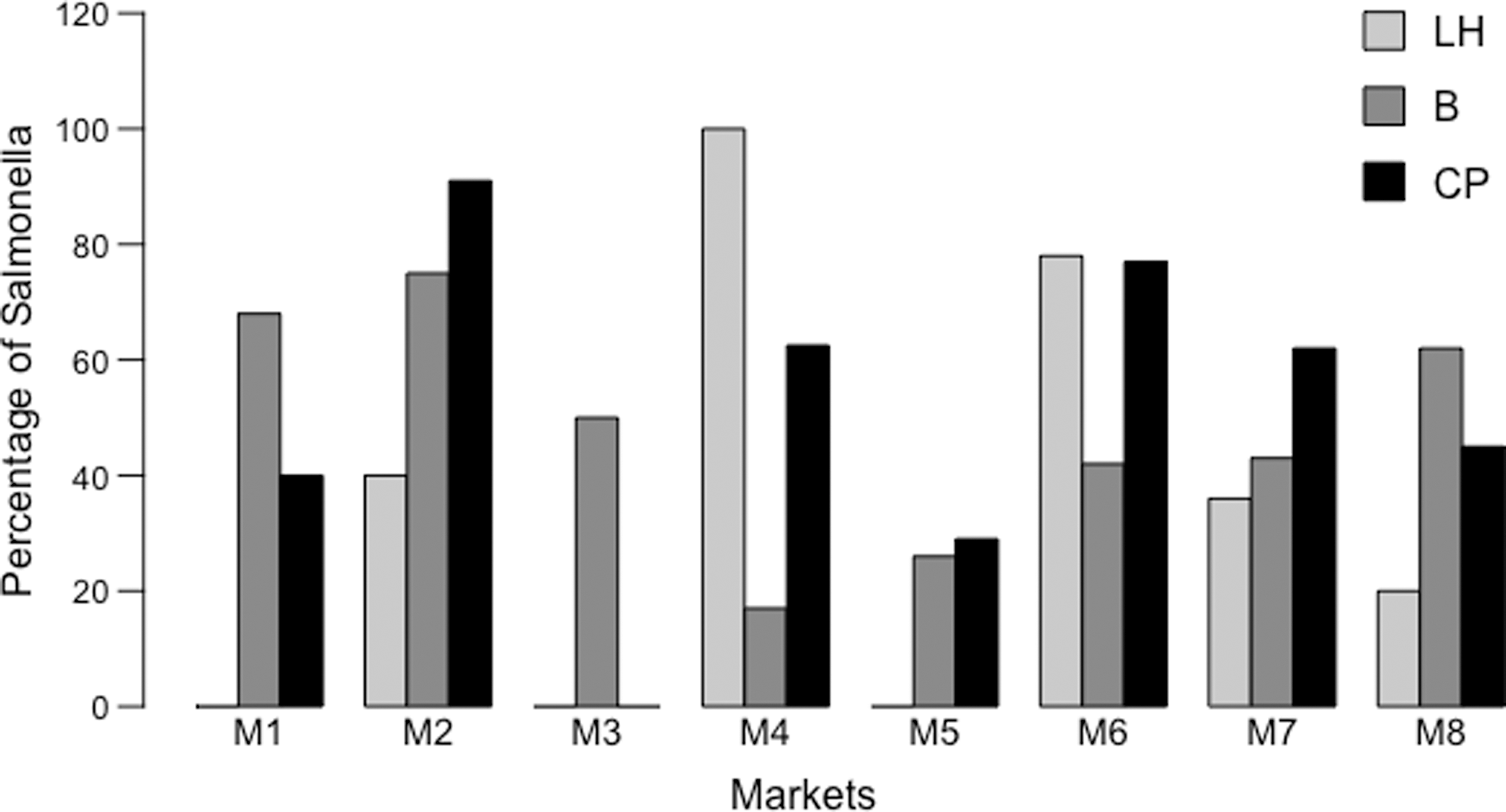
Salmonella Contamination Levels at Markets. M1 to M8, markets for sample collection; B, broilers; CP, chickens premises; LH, laying hens.
Salmonella serotyping
Serotyping of the 273 Salmonella isolates obtained resulted in the identification of 22 Salmonella serovars. The serovars Istanbul (28%), Brancaster (19%), and Kentucky (13%) were the most frequent.
Antibiotic resistance
About 75% of the strains were resistant to antimicrobial drugs (Fig. 2). Resistance to quinolones and fluoroquinolones was detected in 22% (60/273) of the 273 Salmonella isolates. The incidences of resistance to TE and SXT were very high, at 66% (182) and 47% (128), respectively. A few Salmonella isolates were resistant to cephalosporin (CF) 6.5% (18/273), GM 8% (23/273), CCC 2% (7/273), and IMP 1% (3/273). Interestingly, 25% of isolates were susceptible to all antibiotics tested (Fig. 2). Serovars Istanbul, Brancaster, and Kentucky were multidrug resistant (Fig. 3). Serovar Senftenberg, which was uncommon, had the strongest resistance profile, displaying resistance to betalactams including IMP, to quinolones or fluoroquinolones (Fig. 3).
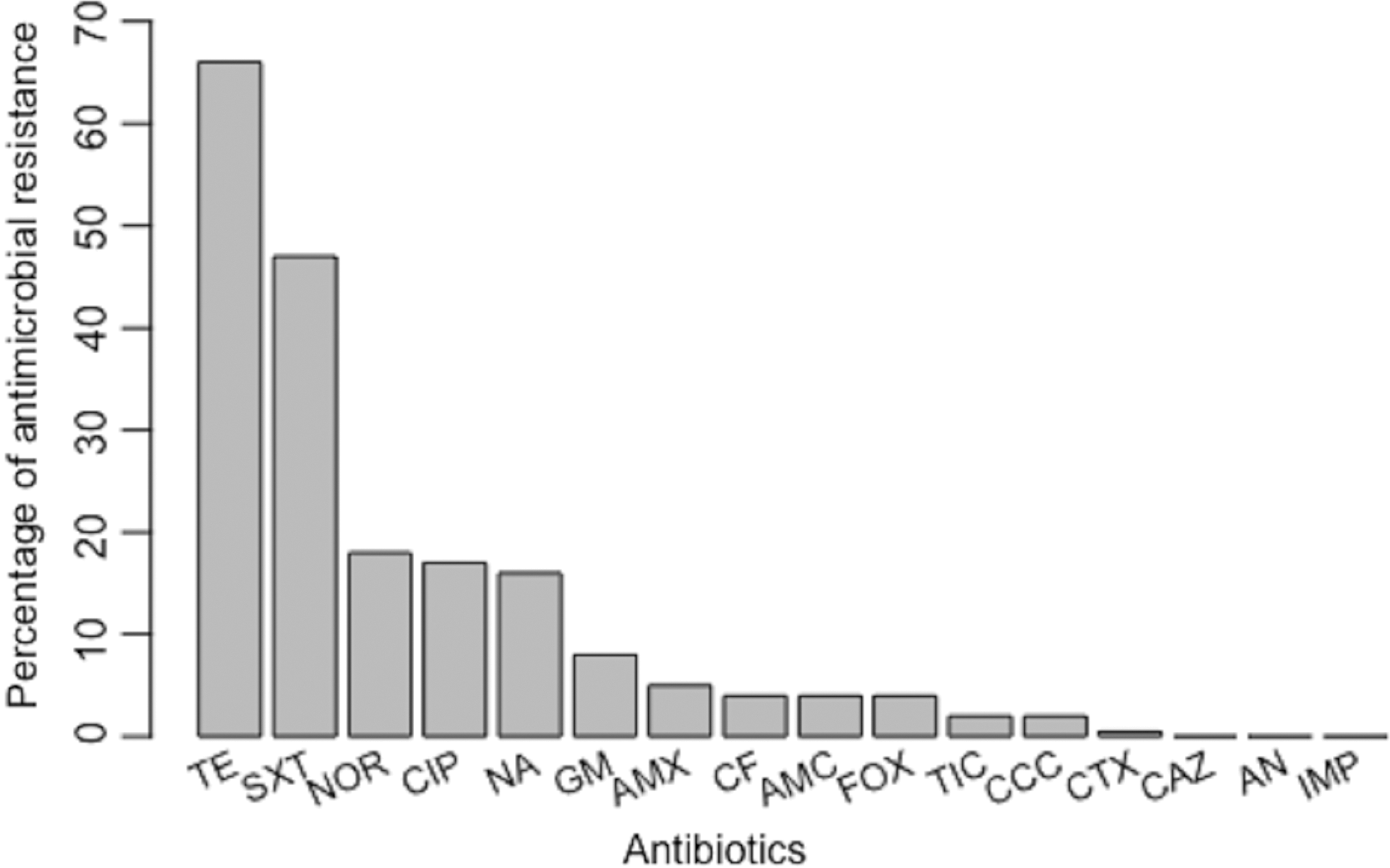
Percentage of Antibiotic Resistance in Salmonella Isolates. AMC, Amoxicillin + clavulanic acid; AMX, amoxicillin; AN, amikacin; CAZ, ceftazidim; CCC, chloramphenicol; CF, cefalotin; CIP, ciprofloxacin; CTX; cefotaxim, FOX, cefoxitin, GM, gentamicin; IMP, imipenem; NA, nalidixic acid; NOR, norfloxacin; SXT, trimethoprim + sulfamethoxazol; TE, tetracyclin; TIC, ticarcillin.
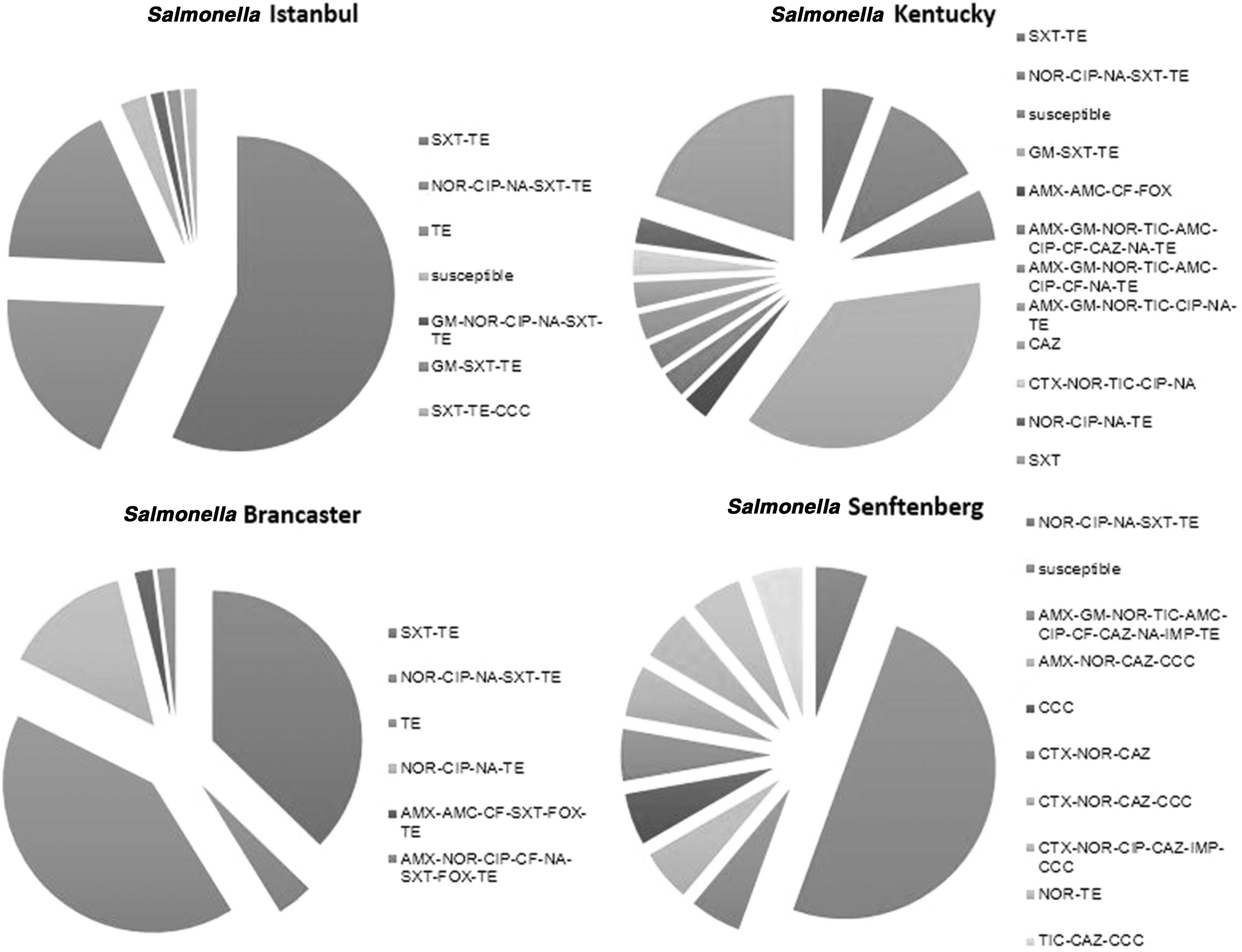
Main Salmonella serovars resistance patterns.
The commonest resistance phenotype was NA-TE-SXT, corresponding to resistance to quinolones or fluoroquinolones (NA), TE, and SXT; these antibiotics are widely used in veterinary medicine in Senegal. The second most frequent resistance profile was CF-GM-NA, corresponding to resistance to CF, GM, and quinolones or fluoroquinolones (NA); these antibiotics are used in both veterinary and human medicine (Table 2).
Salmonella Antibiotics Resistance Patterns
AMC, amoxicillin + clavulanic acid; AMX, amoxicillin; CAZ, ceftazidime; CCC, chloramphenicol; CF, cefalothin; CIP, ciprofloxacin; CTX, cefotaxime; FOX, cefoxitin; GM, gentamicin; IMP, imipenem; NA, nalidixic acid; NOR, norfloxacin; SXT, trimethoprim + sulfamethoxazole; TE, tetracycline; TIC, ticarcillin.
Discussion
Salmonella was found in all three categories of chicken carcasses from all the markets studied, suggesting that Salmonella contamination is widespread in poultry products from Dakar, the capital of Senegal, and its suburbs. Hygiene conditions were unacceptable at most of the retail stalls tested. Chickens were sold in the open air, unrefrigerated, and the carcasses had been plucked by hand. Many of the chicken carcasses purchased from markets were contaminated with Salmonella. This situation may be the result of breaks in the cold chain at some point during the distribution process even for chickens refrigerated at the point of sale. Furthermore, fridges are often switched off in Senegal, because they cost too much to run. There is no electricity overnight and the carcasses therefore remain in fridges without a power supply. The cold chain is, thus, broken, and the sale of chickens in the open air favors further bacterial proliferation. Overall, 53% of chicken carcasses were contaminated with Salmonella, indicating a high level of contamination in chickens and a risk of food poisoning in consumers.
The Salmonella isolates obtained displayed resistance to multiple antibiotics. In a study by Cardinale et al. (2005), susceptibility tests on 142 Salmonella isolates revealed multidrug resistance (i.e., to more than two drugs) in 14.5% of Salmonella Hadar and 5% of Salmonella Enteritidis isolates (Cardinle et al., 2005). In a study conducted in Ghana, 57 (60.6%) strains were found to be resistant to one or more of the nine antimicrobial drugs tested by disk diffusion, and 23 (40.4%) of these strains displayed multiresistance (resistance to ≥3 classes of antimicrobial drugs) (Andoh et al., 2016).
The resistance observed in this study may reflect the use of antibiotics as growth promoters, and for the prevention and treatment of infection in veterinary medicine and in the prevention of human disease (Andoh et al., 2016).
Twenty-two serovars were identified in this study, the most frequent being Salmonella Istanbul 26% (70/273), Salmonella Brancaster 19% (51/273), and Salmonella Kentucky 12% (33/273). These serovars have been reported to circulate between poultry and humans. Previous studies have suggested that illness is mostly attributed to exposure to contaminated food with broiler chickens among the most frequently identified sources of contamination (Pires et al., 2014).
Resistance to quinolones and fluoroquinolones was detected in 21% of the 273 Salmonella isolates tested, and 25% of the isolates were susceptible to all the antibiotics tested. An emergence of strains resistant to quinolones or fluoroquinolones was noted in these chickens destined for human consumption in this study, as previously reported by Le Hello et al. (2013) and Barua et al. (2012), who described the emergence of CIP-resistant Salmonella Kentucky ST198.
Serovar Istanbul was the most frequently isolated serovar from chicken carcasses; most strains were resistant to SXT-TE, but only 15 strains were quinolone resistant. This serovar was identified in others studies performed in Senegal (Cardinale et al., 2005; Alambedji-Bada et al., 2006) as an emerging serovar but it was susceptible. Salmonella Brancaster was the second most frequent serovar in chicken carcasses. This serovar has frequently been isolated from chicken carcasses in Senegal (Cardinale et al., 2005; Dione et al., 2012). Serovar Brancaster was resistant to quinolones (22%). More than 90% of isolates of Salmonella Brancaster and Kentucky were resistant to TE and SXT, and 30% of Salmonella Kentucky isolates were also resistant to quinolones. Several studies have shown that the selection of resistant strains results from the widespread use of different families of antibiotics in animals, as growth promoters in particular (Sanders, 2005).
Poultry farming is a sector that has been expanding in Senegal since 2000, and various antibiotics, including quinolones have been widely used in poultry. The resistance of Salmonella Kentucky to quinolones has been reported in previous studies (Dione et al., 2011). Salmonella Senftenberg was isolated from only a few carcasses (7/273 isolates), but it displayed resistance to at least 10 antibiotics.
These isolates were resistant to all betalactams tested, including third generation CFs, and even IMP. IMP is an antibiotic of last resort in the treatment of clinical infections. These highly resistant strains thus constitute a major health risk to consumers of these chicken products if the cold chain is not respected.
Salmonella Senftenberg is currently emerging in the poultry sector (Boumart et al., 2012), and presents a major risk to human health because of its multidrug resistance. It may be present in animals at slaughter and during food processing.
Serovars Hadar, Gera, and Yeerongpilly were less frequently encountered. Isolates from these serovars had a multidrug resistance phenotype (resistant to more than nine antibiotics). In particular, one of the serovar Yeerongpilly isolates was resistant to first-, second-, and third-generation CFs, whereas serovar Hadar isolates were resistant to quinolones, fluoroquinolones, TE, gentamicin, and IMP.
The presence of these multidrug-resistant strains constitutes a major public health problem. Multidrug resistance may result from the horizontal transfer of resistance genes through bacterial conjugation (Gassama-Sow et al., 2004). Additional studies are underway to assess the possible transfer of such resistance to human strains.
Conclusion
Salmonella isolation from chicken carcasses provides an indication of the level of contamination. Poor hygiene and breaks in the cold chain at the market are contributory factors. However, a lack of hygiene at slaughterhouses, and a lack of respect for the cold chain during the transport and distribution of carcasses to markets may also promote bacterial proliferation. The emergence of antimicrobial drug resistance is alarming and of increasing public health concern. The authorities should conduct public awareness campaigns concerning the appropriate use of antibiotics in the poultry sector. Veterinary professionals should take greater care when prescribing and using antibiotics. Preventive and educational work is required at all levels, from the production to the distribution of poultry products, to ensure the wellbeing and health of consumers.
Footnotes
Acknowledgment
This work was supported by a grant from the WHO Advisory Group on Integrated Surveillance of Antimicrobial Resistance (AGISAR).
Authors' Contributions
N.K.N. and B.S.B. were involved in collecting samples from markets and drafted the article. S.N.D. carried out the laboratory testing on food. A.S. and A.A.W. participated in the identification of isolates and susceptibility testing. R.B. helped with the collection and identification of isolates. R.B.A. participated in the design and coordination of the study. A.G.S. designed the study and revised the article. All the authors have read and approved the final version of the article.
Disclosure Statement
None of the authors has any conflict of interest to declare.