




Abstract
The discovery of antibiotics brought with it many advances in the health and well-being of humans and animals; however, in recent years development of antimicrobial resistance (AMR) has increasingly become a concern. Much of the antibiotic use on dairy farms is for disease management in mature cattle, and AMR in fecal organisms is relatively rare in this group. However, young dairy calves often carry high levels of AMR in their fecal Escherichia coli and Salmonella enterica, which could provide a potential reservoir of AMR genes on dairy farms. To develop practical and effective antibiotic stewardship policies for dairy calf rearing, it is vital to have a solid understanding of the current state of knowledge regarding AMR in these animals. A systematic review process was used to summarize the current scientific literature regarding AMR in fecal S. enterica and E. coli and associations between management practices and AMR prevalence in dairy calves in the United States and Canada. Seven online databases were searched for literature published from 1997 to 2018. Multiple studies indicated an association between preweaned calves and increased risk of fecal shedding of resistant bacteria, compared to other animal groups on dairy farms. There also was evidence, although less consistent, of an impact of antibiotic treatment, antibiotic-containing milk replacer feeding, and feeding nonsalable or waste milk (WM) on the presence of AMR bacteria. Overall, the research summarized in this systematic review highlights the need for continued research on the impact of management practices, including antibiotic use, WM feeding, and disease prevention practices in reducing AMR in E. coli and S. enterica in dairy calves. In addition, few data were available on physiological and microbiological factors that may contribute to the high relative populations of resistant bacteria in young calves, suggesting another valuable area of future research.
Introduction
As in humans, the use of antibiotics in dairy cattle has greatly benefited health, welfare, and productivity; however, their use is not without the possibility of adverse consequences. Antimicrobial resistance (AMR) is a concern in both human and animal populations. Despite uncertainty in the evidence linking AMR development in animals to AMR in humans (Muloi et al., 2018), the use of antibiotics in animal agriculture has come under scrutiny. A World Health Organization-funded meta-analysis concluded that practices restricting antibiotic use in animal agriculture are associated with reduced AMR in animals and humans, suggesting that improved antibiotic stewardship could curb AMR risks in animal agriculture (Tang et al., 2017).
Antibiotic stewardship on dairy farms often focuses on mastitis management, the cause for the majority of antibiotic use (USDA-APHIS, 2008). However, despite a greater frequency and volume of antibiotic use in adult cows, there is growing concern because dairy calves carry proportionally higher levels of resistance in commensal Escherichia coli and Salmonella enterica (Edrington et al., 2008; Berge et al., 2010; Cao, 2015). It is vital to have a solid understanding of the current knowledge of AMR in dairy calves to develop practical and effective antibiotic stewardship practices. A systematic review process was chosen to allow an in-depth rigorous assessment of the currently published research. The objective of this review was to identify areas of consensus and to summarize data to aid in the development of evidence-based antibiotic stewardship programs, as well as to identify areas in need of additional research relating to AMR in dairy calves in the United States and Canada.
Materials and Methods
Literature search
A systematic literature search of seven electronic databases (Fig. 1) was conducted using Preferred Reporting Items for Systematic Reviews and Meta-Analyses guidelines (Moher et al., 2009). The search terms included descriptors of dairy cattle, drug resistance, and Salmonella or E. coli (Table 1). Searches were limited to publications from 1997 to the date searches were conducted (February 2018).
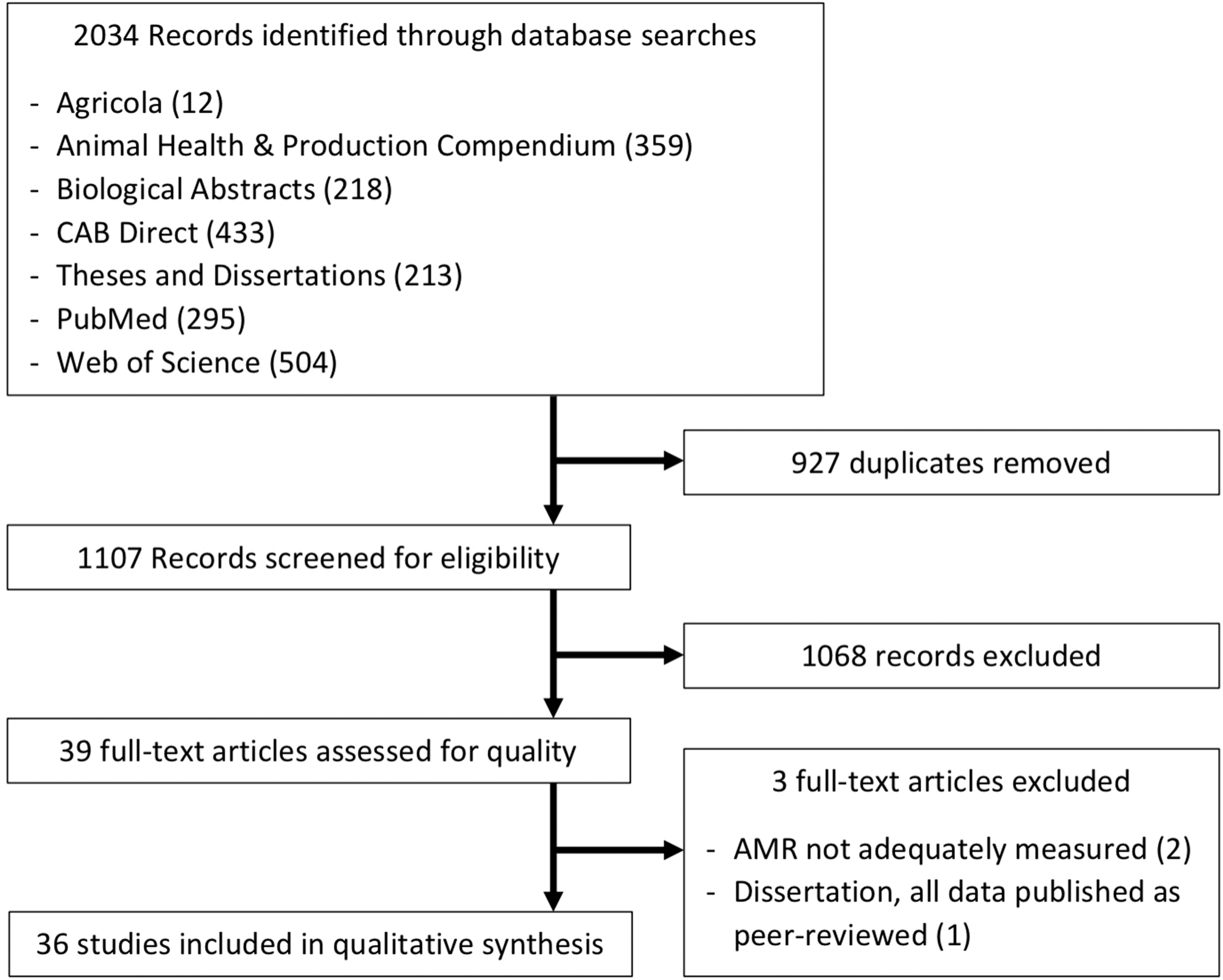
Flow diagram depicting selection of studies for inclusion.
Systematic Search Parameters
AMR, antimicrobial resistance.
Study selection and data extraction
Following the removal of duplicate records, two of the authors assessed each article for eligibility. Studies were eligible if two authors agreed that all inclusion and exclusion criteria were satisfied (Table 1). For each eligible study, two authors evaluated the quality of the research based on predetermined criteria, which, when met, allowed inclusion in the final review (Table 1). Dissertations and theses were assessed on a chapter-by-chapter basis. Chapters published in peer-reviewed journals were excluded in favor of the peer-reviewed article. Data extraction was performed by one author with a second checking for accuracy and completeness. Due to the diversity of data collection and reporting among the studies, a meta-analysis was not performed.
Results
Search
The results of the systematic literature search are summarized in Figure 1. The 36 articles included in this review comprised 23 observational and 13 experimental studies. AMR was reported for E. coli in 19 studies, for S. enterica in 8, and for both in 9. Methods of measuring AMR varied, with 22 studies using broth dilution minimum inhibitory concentration, 15 utilizing disc diffusion, four reporting AMR genes, and one using break point agar. Multiple methods were used in four articles. Multidrug resistance (MDR) was defined differently across studies, ranging from resistance to more than one antibiotic, to resistance to five or more antibiotics or three or more classes of antibiotics.
Age of calf
Age frequently was reported as a significant risk factor associated with AMR in E. coli, with preweaned calves exhibiting greater risk of resistance compared to other age groups (Table 2) (Berge et al., 2005, 2010; Galvao et al., 2005; Villarroel, 2007; Awosile et al., 2018). Donaldson et al. (2006) reported decreasing counts of ceftiofur-resistant Gram-negative enteric bacteria (90% of which were E. coli) as calves aged (p < 0.001). Cao (2015) reported the greatest farm-level prevalence of resistant, MDR (≥3 classes of antimicrobials), and bla CMY-2-carrying E. coli in preweaned calves, but the prevalence of E. coli carrying the bla CTX-M gene was low and more evenly distributed across age groups (Table 3). Among young calves, maximal risk of resistance typically was reported at around 2 weeks of age in calves not fed antibiotic-containing medicated milk replacer (MMR) (Berge et al., 2005, 2006a; Galvao et al., 2005; Awosile et al., 2018).
Summary of Multivariable Logistic Regression from Studies with Outcomes Related to Age of Calf
MMR, medicated milk replacer; MDR, multidrug resistance; IgG, immunoglobulin G; OR, odds ratio; CI, confidence interval; SE, standard error.
Summary of Prevalence Data for Studies with Outcomes Related to Age of Calf
MDR, multidrug resistance; NY, New York; PA, Pennsylvania; VT, Vermont; MA, Massachusetts; CT, Connecticut; MI, Michigan; MN, Minnesota; WI, Wisconsin.
Several studies demonstrated a greater proportion of resistant or MDR S. enterica isolated from calves compared to lactating cows (Table 3) (Ray et al., 2007; Edrington et al., 2008; Habing et al., 2012). In suspected salmonellosis cases, prevalence of MDR (≥5 antimicrobials) S. enterica isolates was also higher in calves than lactating cows (Cummings et al., 2009). Edrington et al. (2011) reported no difference between pre- and postweaned dairy calves; however, this study was sampled at 2 d before and 2 d after weaning, which may have influenced the ability to detect a difference between these groups. Cao (2015) reported low levels of resistance in S. enterica across all age groups sampled.
Antibiotic treatment
The impact of antibiotic treatment on resistance in E. coli was reported in several studies (Berge et al., 2005, 2006a; Villarroel, 2007; Pereira et al., 2014c; Liu et al., 2016; Awosile et al., 2018). Increasing risk of AMR in E. coli, by various measures, was reported in some, but not all instances for studies reporting impact of treatment before sampling (Table 4) (Berge et al., 2005, 2006a; Villarroel, 2007; Pereira et al., 2014c). Berge et al. (2006a) reported an increased risk of isolating more highly resistant E. coli from non-MMR-fed calves treated within 5 days of sampling, but not in treated calves fed MMR. The latter group had a highly resistant E. coli population, possibly masking any impact of parenteral treatment. One study reported treatment as a risk factor for isolation of resistant S. enterica; however, this was significant at 3 weeks and 2 months post-treatment, but not at 2 or 4 weeks post-treatment (Villarroel, 2007).
Summary of Multivariable Logistic Regression from Studies with Outcomes Related to Antibiotic Treatment
MMR, medicated milk replacer; MDR, multidrug resistance; ns, non-significant; NY, New York; OR, odds ratio; CI, confidence interval; SE, standard error, Tx, treatment.
Liu et al. (2016) demonstrated that calves treated with therapeutic doses of ceftiofur or florfenicol had elevated numbers of fecal E. coli resistant to the treatment medication (p = 0.005, p = 0.001), but this was not observed in oxytetracycline-treated calves. Florfenicol-treated calves also had increased isolation of ceftiofur-resistant fecal E. coli (r = 0.5; p < 0.05), and untreated calves in a neighboring pen had increased prevalence of florfenicol-resistant fecal E. coli compared to more remotely housed calves (p < 0.001).
Medicated (antibiotic-containing) milk replacer
Several studies evaluated the impact of feeding MMR on AMR in fecal bacteria (Table 5) (Khachatryan et al., 2004, 2006; Berge et al., 2006a; Kaneene et al., 2008, 2009; Averill, 2009; Pereira et al., 2011). All evaluated the use of a tetracycline-class antibiotic alone or in combination with either neomycin or sulfamethazine and amprolium. Studies that only evaluated changes in tetracycline resistance had varied results, with reports of elevated resistance (Khachatryan et al., 2004), reduced resistance (Kaneene et al., 2008), and no difference (Averill, 2009) in AMR E. coli in MMR-fed calves compared to non-MMR-fed calves. In contrast, most studies measuring resistance to a wider variety of antibiotics demonstrated greater resistance to at least some classes of antibiotics and/or higher prevalence of MDR bacteria in MMR-fed calves compared to non-MMR-fed calves (Berge et al., 2006a; Khachatryan et al., 2006; Kaneene et al., 2009; Pereira et al., 2011). An exception demonstrated higher prevalence of resistance to chloramphenicol in calves fed milk replacer (MR) alone, compared to calves fed MR mixed with an added dietary supplement, regardless of whether it contained antibiotics or not (Khachatryan et al., 2006).
Summary of Results from Studies with Outcomes Related to Feeding of Antibiotic-Containing Milk Replacer
MR, milk replacer; MIC, minimum inhibitory concentration; MDR, multidrug resistance; OR, odds ratio; CI, confidence interval.
Nonsalable or waste milk feeding
Antibiotic treatment of lactating cows generally requires that milk is withheld from sale due to the possibility of it containing violative antibiotic residues. On some dairies, this nonsalable, or waste milk (WM), is used to feed calves, which might present an opportunity for selection of AMR bacteria in the gut. Three studies assessed the impact of WM feeding on the presence of AMR E. coli in calf feces (Table 6) (Pereira et al., 2014b; Maynou et al., 2017; Awosile et al., 2018). In the two experimental studies, feeding regimens differed, but both found higher prevalence of resistant E. coli to some, but not all assessed antibiotics in the treatment group compared to non-WM-fed calves (Pereira et al., 2014b; Maynou et al., 2017); however, the study by Maynou et al. (2017) had large numbers of calves removed from analysis due to the need for therapeutic antibiotic treatment.
Summary of Results from Studies with Outcomes Related to Feeding of Nonsalable Milk or Similar
MR, milk replacer; WM, waste milk; BT, salable bulk tank; OR, odds ratio; SE, standard error.
Other (uncategorized)
Several studies did not fit in the previous categories, but yielded valuable information for this review. A comparison of AMR E. coli between farms housing calves in individual versus group pens demonstrated a greater risk of resistance to some antibiotics in group-housed calves (ciprofloxacin, nalidixic acid; p ≤ 0.001) and others (ampicillin, ceftiofur, gentamycin, streptomycin, tetracycline; p ≤ 0.04) in individually-housed calves (Pereira et al., 2014d). In a comparison between calves on calf ranches and dairy farms, E. coli isolated from the former had a greater likelihood of being more highly resistant (odds ratio = 2.4, 95% confidence interval = 1.6–3.6; p < 0.0001) (Berge et al., 2005). E. coli isolates from calf ranch calves were also shown to be more strongly associated with phenotypes that could not be explained by common resistance genes (Davis et al., 2011). A study of the emergence of E. coli carrying the bla CTX-M gene in Washington State demonstrated a higher prevalence of bla CTX-M on farms with >3000 adult cows, that moved animals onto the premises, where fresh bedding was added less than weekly, or where residual fly sprays were not used (Davis et al., 2015). An assessment of farm management factors on California dairies and calf ranches indicated that none was significantly associated with the presence of MDR S. enterica (Berge et al., 2006b).
Descriptive studies were included to capture a full understanding of the current knowledge of AMR in dairy calves. Several studies reported data suggesting that patterns of AMR could vary widely from farm to farm during a salmonellosis outbreak, but often remained consistent within the farm (Bischoff et al., 2004; Alexander et al., 2009; Kaneene et al., 2010). During an outbreak in calves on a single dairy, 86% of S. enterica isolates were serovar Oranienburg, of which 97% were resistant to nine or more antimicrobials (Kaneene et al., 2010). In addition, a report from two farms experiencing an outbreak in calves detailed that S. enterica isolates from one farm were all serovar Typhimurium var. Copenhagen with a core pattern of resistance to nine antibiotics, while on the other farm, all isolates were serovar Typhimurium, with 36/39 isolates considered pan-susceptible (Alexander et al., 2009). In contrast, 65% of isolates collected from calves on six different operations displayed a core resistance pattern to four antibiotics, with or without resistance to other antimicrobials (Berge et al., 2003). In a case–control study comparing case farms with a history of salmonellosis caused by highly resistant S. enterica to farms with no salmonellosis history, calves from case farms shed E. coli isolates with a slightly higher prevalence of resistance to some antibiotics, but not others (DeFrancesco et al., 2004). A longitudinal study of calves on five Michigan dairy farms found the highest prevalence of resistance among E. coli strains to spectinomycin, penicillin, and clindamycin (Ferguson, 2000).
Two studies reported in vitro transfer of resistance from calf-derived bacteria (Bischoff et al., 2004; Jiang et al., 2006). Resistance was transferred to E. coli from calf-derived ampicillin-resistant Salmonella Kinshasa, with evidence of cotransfer of resistance to other antibiotics (Bischoff et al., 2004). In vitro transfer of both bla CMY2 and the class 1 integron to various Salmonella serovars from calf-derived S. enterica and E. coli isolates was also reported (Jiang et al., 2006). However, an in vivo transfer study did not indicate the transfer of resistance between naturally occurring MDR E. coli in dairy calves and cattle-origin Salmonella Newport or Reading (Edrington et al., 2013). In a study of in vivo fitness, an E. coli strain carrying the predominant resistance pattern among calves on the study farm was demonstrated to have an in vivo fitness advantage in neonatal calves, but not older heifers. (Khachatryan, 2005).
Discussion
The observation that preweaned dairy calves carried a relatively high prevalence of AMR in fecal bacteria was a driving factor in conducting this review. The evidence supporting a difference in AMR prevalence between preweaned calves and other cattle on dairies was, for the most part, consistent across studies and was demonstrated in both E. coli and S. enterica. The breadth of these studies indicates that this phenomenon has been observed geographically across the United States and Canada and over time. However, the demonstration of an in vivo fitness advantage of a resistant strain of E. coli in neonatal calves that could not be demonstrated in older heifers, as well as the digestive differences between a pre- and postweaned ruminant, suggests that other physiological or microbiological factors may also be at play (Khachatryan, 2005). Further research into the factors involved in increased AMR presence in preweaned calves may bring valuable new insight into how to best manage AMR on dairy operations.
The full implementation of the Veterinary Feed Directive (VFD) in January of 2017 brought major changes to how medically-important in-feed antibiotics, including those used in milk or MR, are used in the United States by placing these drugs under the order of a veterinarian (FDA-CVM, 2013). The evidence summarized in this study may suggest that the use of MMR could select for resistant organisms. The VFD regulations may reduce the quantity of antibiotics used in milk-fed calves, but further research will be needed to determine their full impact on populations of AMR bacteria.
Parenteral administration of antibiotics also may select for AMR. In studies specifying the treatment antibiotic, it was demonstrated that different antibiotic treatment choices may impact resistant populations differently (Pereira et al., 2014c; Liu et al., 2016). In addition, Liu et al. (2016) demonstrated an increase in both florfenicol- and ceftiofur-resistant E. coli populations after florfenicol treatment, suggesting possible coselection of resistance. Although these studies show that the antibiotic chosen for treatment of disease in calves may play a role in selection pressure on E. coli populations, neither provides sufficient evidence to truly inform antibiotic selection. Further research on the impact of specific treatment antibiotics and the role of coselection on AMR organisms could inform prudent antibiotic selection to minimize the development of resistance, particularly to antimicrobials vital to human health.
Although treatment protocols are the hallmark of on-farm antimicrobial stewardship, practices to prevent and limit the spread of disease also play a role in reducing antimicrobial use. Davis et al. (2015) demonstrated that one of several management factors associated with an increased prevalence of the bla CTX-M gene in E. coli was the movement of animals onto the premises, suggesting a potential role for between-farm biosecurity practices in reducing the spread of resistance. In addition, calf ranch calves, which are typically comingled from multiple sources, were shown to be at risk of shedding more highly resistant E. coli than calves raised on their farm of origin (Berge et al., 2005). Although there are many differences in management between these calf rearing systems, the comingling of calves from multiple sources may influence the prevalence of AMR E. coli on calf ranches. Within-farm animal contact may also impact resistant populations. Liu et al. (2016) demonstrated that untreated calves housed adjacent to florfenicol-treated calves shed E. coli with a higher prevalence of florfenicol resistance compared to more remotely housed calves. Improving our understanding of the impact of biosecurity, as well as other disease prevention practices, may help to strengthen antimicrobial stewardship programs on dairy farms.
Feed-based and parenteral antibiotics may be the primary routes for administering antibiotics to calves, but antibiotic residues in WM represent another potential risk for selection of resistance. The NAHMS 2007 Dairy Study found that over 30% of U.S. dairy farms fed WM to heifer calves (USDA-APHIS, 2010). The concentration of antibiotics in WM may be low (Pereira et al., 2014a), but even very low concentrations of antibiotics have been shown to select for resistant organisms (Gullberg et al., 2011). A cross-sectional evaluation of WM on 34 New York State dairies demonstrated that over 80% of samples were positive using a commercial antibiotic screening test, with ceftiofur determined to be the most common drug residue (Pereira et al., 2014a). Although an economic advantage of feeding pasteurized WM to dairy calves has been demonstrated (Godden et al., 2005), it is also important to understand the potential undesired impacts of this practice on AMR. Although few studies reported here assess the impact of WM on resistant organisms, these suggest that WM feeding may exert some selection pressure on fecal E. coli (Pereira et al., 2014b; Maynou et al., 2017). Further research into the impact of WM feeding on AMR in calves and the persistence of AMR beyond weaning will be valuable for further assessing the impact of this feeding practice.
Conclusion
The purpose of this systematic review was to aid in the development of antibiotic stewardship programs and to guide future research by summarizing evidence relating to AMR populations and associations between management factors and AMR in dairy calves on United States and Canadian farms. The heterogeneity in the methods used to both measure and report AMR made interpretation and comparison across studies challenging. The majority of studies reported phenotypic resistance; however, with the rapid evolution of genotypic methods, interpretation will continue to be complex, but will bring the potential to provide new insights as well. To develop effective antimicrobial stewardship programs, it is vital to have a strong understanding of factors that influence development, spread, and persistence of AMR in dairy calves. Future research to improve understanding of calf physiology and the impact of management factors on AMR will help inform evidence-based biosecurity, treatment, and management decisions to minimize AMR on dairy operations.
Footnotes
Acknowledgments
This work was supported, in part, by funding from the Pennsylvania Department of Agriculture (Agreement OSP# 191748) and the U.S. Department of Agriculture (Agreement OSP# 176619).
Disclosure Statement
No competing financial interests exist.