




Abstract
Contamination of fresh vegetables and berries with human enteric viruses is a major cause of food poisoning. The aim of this study was to investigate the prevalence of norovirus GI, norovirus GII, hepatitis A virus (HAV), adenovirus, astrovirus, rotavirus, and male-specific coliphage systematically in fresh fruit and vegetables and associated agricultural environmental samples, including irrigation water, soil, and worker's gloves. Enteric viruses were detected by international standard methods (ISO/TS 15216), and male-specific coliphages were isolated using US EPA Method 1601. For the study, 773 samples were collected from June 2016 to April 2017, including Chinese cabbage (n = 244), cucumber (n = 98), lettuce (n = 73), strawberry (n = 120), soil (n = 191), irrigation water (n = 14), and gloves (n = 27). Two cucumber and two irrigation water samples were positive for norovirus GI, and one cucumber and two irrigation water samples were positive for norovirus GII. HAV was detected in one strawberry sample and one glove sample. The other tested foodborne viruses were not detected in any of the samples. Sixteen male-specific coliphages were isolated from Chinese cabbage, cucumber, lettuce, cherry tomato, soil, and irrigation water. The isolation of male-specific coliphage would be more practical to investigate the fecal contamination in produce rather than pathogenic viruses.
Introduction
Human norovirus (HuNoV), rotavirus (RotaV), astrovirus (AstroV), and adenovirus (AdenoV) are important pathogens that cause nonbacterial gastroenteritis (Brassard et al., 2012). Hepatitis A virus (HAV) is a foodborne virus causing acute hepatitis through fecal–oral route (Lin et al., 2018). According to the Ministry of Food and Drug Safety (MFDS), the number of viral food poisoning cases in South Korea has increased 2 times more than 5 years ago (2013–2018) (MFDS, 2018). Since the kimchi, traditional fermented vegetable, was first identified as a cause of HuNoV outbreaks in 2011, the fresh cabbage mix, salad, and radish kimchi served as school meals caused several viral outbreaks in South Korea (Yu et al., 2010; Cho et al., 2014). Based on the statistics of the previous study, fresh produce, mixed fruit, and mixed vegetables are leading causes of foodborne viral illness in the United States (Painter et al., 2013). Strawberry, raspberry, coleslaw, green salad, and fresh fruit caused HuNoV outbreaks (Seymour and Appleton, 2001). The imported green onions were identified as the cause of an HAV outbreak in the United States (Wheeler et al., 2005). Therefore, fresh produce is considered a high-risk food (Lynch et al., 2009).
The consumption of fresh produce in developed countries has been increasing because of the desire for healthier lifestyles (Mir et al., 2018). Fresh produce can be contaminated at both pre- and postharvest step because irrigation water, soil, organic fertilizer, and human handling have been reported as sources of virus contamination (Brassard et al., 2012). Viral contamination of surface, ground, and irrigation water and soil has been examined in previous studies (Santamaria and Toranzos, 2003; Lodder and de Roda Husman, 2005; Gerba and Choi, 2006). Water for irrigation or food processing could be used in unclear condition as it is difficult to eliminate foodborne viruses completely using current wastewater treatment practices (Blatchley et al., 2007; Doyle and Erickson, 2008). Of importance, the internalization of HuNoV in hydroponically grown green onion was addressed when the contaminated irrigation water or soil was used for cultivation (Carter, 2005; Yang et al., 2018). Although HAV is infectious in soil substrate for up to 30 d, murine norovirus 1 (MNV-1) remains infectious in soil for up to 60 d (Hirneisen and Kniel, 2013). As HuNoV can adapt to the environment, it can remain in soil substrate or on a plant for a long time (Appleton, 2000). Thus, routine monitoring of soil and irrigation water should be emphasized to prevent virus contamination pre- and postharvest.
Massive data monitoring of the field and food chains of fresh produce is needed to develop effective foodborne outbreak prevention strategies because washing is not enough to eliminate the contamination of enteric virus on produce (Seymour and Appleton, 2001; Kozak et al., 2013). Contamination of fresh produce has been investigated in many countries, including the United States, Europe, Belgium, Canada, and France (Baert et al., 2011; Callejón et al., 2015). In addition, AdenoV and male-specific coliphage have been used as microbial indicators to examine the human fecal contamination of food, water, sewage, and environmental samples because the detection rate of foodborne viruses is very low (Kokkinos et al., 2017). Up to date, routine surveillance data of foodborne viruses in fresh produce and environmental samples in South Korea are lacking. Therefore, this study aimed to detect HuNoV, HAV, RotaV, AstroV, AdenoV, and male-specific coliphage in fresh produce as well as in irrigation water, soils, and gloves collected from farms and to analyze their seasonal and geographical prevalence.
Materials and Methods
Sampling
A total of 773 samples were collected from January 2016 to December 2017 (Table 1). The samples included 541 samples of fresh produce (Chinese cabbage, strawberry, cucumber, lettuce, pepper, and cherry tomato), 191 soil samples, 14 irrigation water, and 27 workers' gloves from 80 farms. The farms were located in seven provinces (Gyeonggi-do, Chungcheongnam-do, Chungcheongbuk-do, Jeollanam-do, Jeollabuk-do, Gyeongsangnam-do, and Gangwon-do) of South Korea (Fig. 1). All samples were collected from each farm during harvest season with the consent of the farm owners. All samples were stored and transported under refrigeration and tested within 48 h of collection.
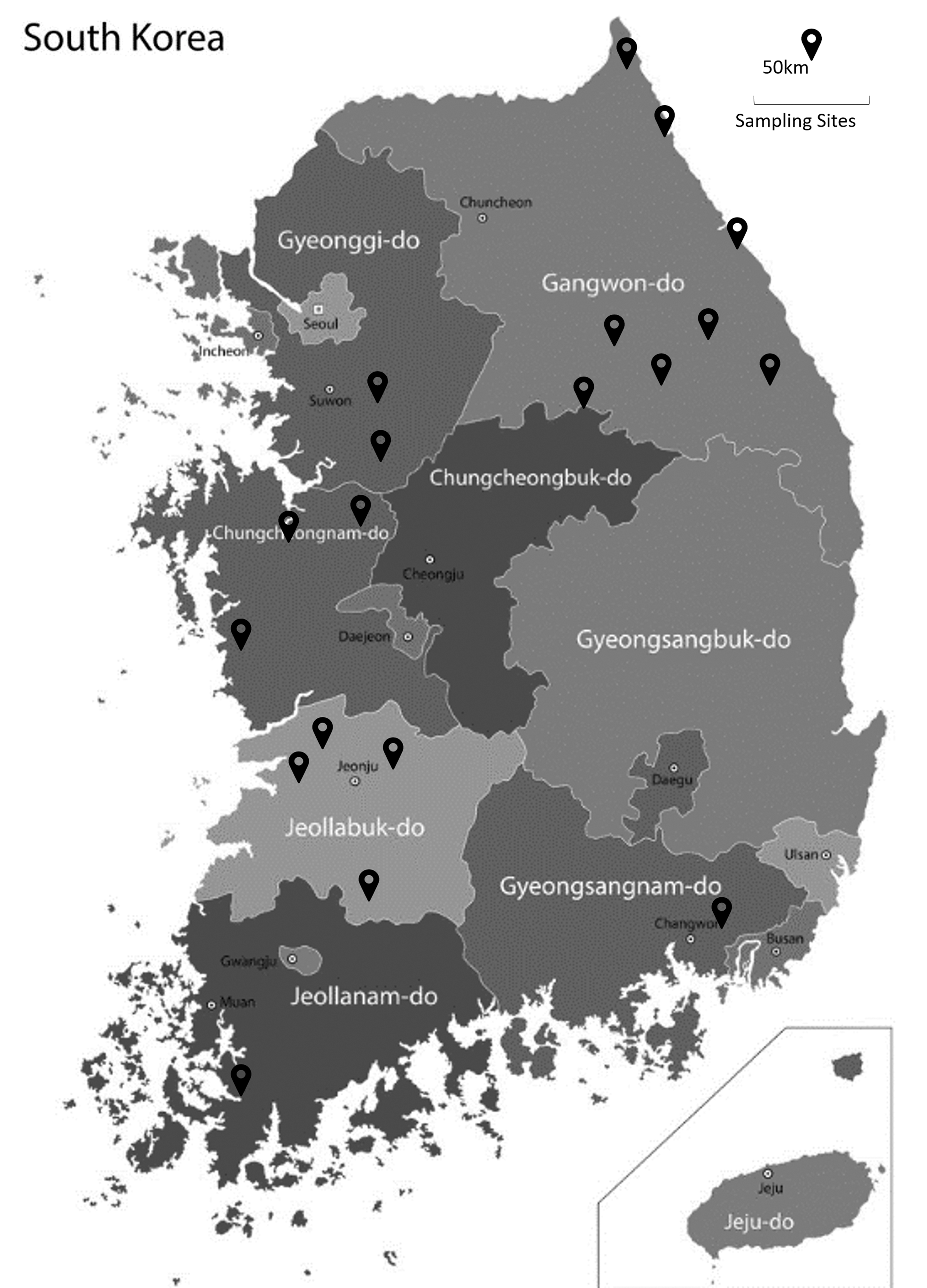
Geographical distribution of fresh produce farms in South Korea.
Number of Farms Visited and Samples Collected in 2016 and 2017
NT, not tested.
Sample processing for virus detection in fresh produce, irrigation water, soil, and gloves
The fresh produce was pretreated in accordance with ISO/TS 15216-1:2013 (Baert et al., 2011; Terio et al., 2017). In brief, 25 g of sample was cut into 2.5 × 2.5 × 2.5 cm pieces and put in a 400 mL filter bag. Then, 40 mL of Tris-glycine buffer (100 mM Tris-HCl and 50 mM glycine containing 1% beef extract) was added to the filter bag to elute virus. Five log copies per 10 μL of MNV-1 gifted by Dr. Skip Virgin from Washington University was used as a processing control in all samples. Eluates were incubated at 25°C for 20 min with rocking at 120 rpm and then transferred to a new centrifuge tube. After centrifugation at 10,000 g for 30 min at 5°C, the supernatant was collected and the pH was adjusted to 7.0 using 1 M HCl. Eluted viruses were concentrated by polyethylene glycol (PEG) 8000 precipitation. For the PEG precipitation, 0.25 times of 5 × /PEG 8000/1.5 M NaCl solution were added to the eluates and incubated at 4°C for 60 min with rocking at 120 rpm. After centrifugation at 10,000 g for 30 min at 4°C, the pellets were suspended in 500 μL of phosphate-buffered saline (pH 7.4) for RNA extraction and stored at −70°C until use.
Fourteen irrigation water samples were collected from 14 farms. For the analysis, 500 L of irrigation water was filtered through the 1-MDS electropositive cartridge filter (Cuno, Meriden, CT) and examined using the virus adsorption–elution technique (US EPA, 1996). In brief, viruses attached to the 1-MDS filter were eluted with 1.5% beef extract containing 0.05 M glycine, pH 9.5 (Sigma-Aldrich, MO), and then the cartridge housing was filled with beef extract by a peristatic pump and soaked for 5 min. This process was repeated once. The eluates ware adjusted to pH 3.5 with 1 M HCl and precipitated by centrifugation at 2500 g at 4°C for 15 min. The supernatant was removed and the precipitate was resuspended in 20–30 mL of 0.15 M sodium phosphate buffer (Na2HPO4, pH 9.0–9.5). The supernatant was centrifuged at 7000 g at 4°C for 10 min, and then transferred to a new collection tube. The pH was adjusted to 7.0–7.5 using 1 M HCl, and the samples were filtered through a 0.22 μm pore size syringe filter to eliminate bacterial contamination. The filtered samples were concentrated to 500 μL using a Vivaspin 20 with a molecular weight cutoff of 10,000 Da (Sartorius Stedim Biotech, United Kingdom). A 500 μL aliquot of the sample was used for RNA extraction and stored at −70°C until virus recovery.
For soil, 2 g of sample were suspended in 18 mL of peptone water and centrifuged at 1452 g for 20 min at 4°C. For gloves, a pair of gloves from each worker were collected and weighed. They were suspended in peptone water with 1:10 ratio (w/v). For homogenate/supernatant, 10 mL was processed according to EPA Method 1601, and 500 μL was used for nucleic acid extraction.
Real-time reverse transcription polymerase chain reaction and polymerase chain reaction
Viral RNA and DNA were extracted using the RNeasy Mini kit (Qiagen, Valencia, CA) according to the manufacturer's instructions. Total nucleic acid was eluted with 50 μL of RNase-free water. Five microliters of RNA template was used for real-time reverse transcription polymerase chain reaction (RT-PCR) or PCR. The primers and probes for the six viruses (HuNoV GI and GII, HAV, RotaV, AstroV, AdenoV, and MNV-1) are listed in Table 2. Real-time RT-PCR or PCR was performed with a Dice Real-time Thermal Cycler System (TaKaRa, Shiga, Japan). The positive controls used for the real-time RT-PCR were described previously (Seo et al., 2014). A fragment of AstroV RNA synthesized by Integrated DNA Technologies (IDT, Coralville, IA) was used as a positive control.
Primers and Probes for the Seven Viruses Targeted in This Study
AdenoV, adenovirus; AstroV, astrovirus; HAV, hepatitis A virus; HuNoV, human norovirus; MNV-1, murine norovirus 1; RotaV, rotavirus.
To confirm extraction efficiency, the recovery rate of MNV-1 process control was calculated for each sample preparation. When the MNV-1 extraction efficiency of any sample was <1%, sample preparation and virus detection was tested again (Baert et al., 2011; Terio et al., 2017).
Isolation of male-specific coliphage
Male-specific coliphage was isolated according to the U.S. Environmental Protection Agency Method 1601. In brief, for water samples, a 100 mL sample was mixed with 1.25 mL of MgCl2, 0.5 mL of log-phase Escherichia coli Famp, 5 mL of 10 × tryptic soy broth (TSB), and 1 mL of ampicillin/streptomycin (1.5 μg/mL). Samples of fresh produce, soil, and gloves were prepared as described hereunder. For fresh produce, 25 g of sample was mixed with 100 mL of 0.1% peptone water and incubated at 37°C for 30 min. For soil, 2 g of sample was suspended in 18 mL of peptone water and centrifuged at 1452 g for 20 min at 4°C. Ten milliliters of supernatant was processed according to EPA Method 1601.
For enrichment of male-specific coliphage, a 10 mL aliquot of sample was mixed with 125 μL of MgCl2, 50 μL of log-phase E. coli Famp (ATCC 700891), 500 μL of 10 × TSB, and 100 μL of ampicillin/streptomycin. After incubation overnight at 37°C, 10 μL of the enriched broth was spotted onto a premade spot plate coated with E. coli Famp. The plates were observed after overnight incubation at 37°C for a circular zone of lysis because of the presence of male-specific coliphage.
Results
From 2016 to 2017, 773 samples were collected from 80 farms in South Korea for foodborne virus detection (Table 1). The samples collected in 2016 included fresh produce (231), soil (71), and irrigation water (4) from 33 farms. The samples collected in 2017 included fresh vegetable (187), fruit (123), soil (120), irrigation water (10), and gloves (9) from 47 farms. Because most farms did not allow direct access to their ground water pump or water tank, only 14 irrigation water samples were collected from 8 cucumber farms, including 2 strawberry farms, 1 Chinese cabbage farm, 1 pepper farm, 1 lettuce farm, and 1 cherry tomato farm. Of the 27 glove samples, 18 and 9 were obtained from 7 strawberry farms and 2 Chinese cabbage farms, respectively.
The prevalence of foodborne viruses is given in Table 3. HuNoV GI and GII were detected in 4 (0.51%) and 3 (0.38%) of the 773 samples, respectively. HAV was detected in only 2 (0.25%) samples. RotaV, AstroV, and AdenoV were not detected in any of the tested samples. The range of Ct value was 37.33–41.26 for HuNoV GI and 37.57–39.77 for HuNoV GII in contaminated samples. The recovery rate of MNV-1 used as the processing control was >3% for all samples. As an indicator of fecal contamination, 16 male-specific coliphages (3.77%) were isolated from 427 pooled homogenates because each sample was prepared from several produce samples collected from each farm (Table 3). Among the 16 coliphages, 7 (6.66%) were isolated from 105 Chinese cabbage samples; 1 (4.34%) was isolated from 23 cucumbers; 2 (13.33%) were isolated from 15 lettuces; 2 (1.06%) were isolated from 187 soils; and 3 (5.36%) were isolated from 56 irrigation water: 1 from a Chinese cabbage farm and 2 from lettuce farms. One coliphage was isolated from a cherry tomato. No male-specific coliphage was detected in the collected strawberries, pepper, or glove samples.
Etiological Prevalence of Foodborne Viruses in Fresh Produce from Farms in Korea
No. of positives/number tested.
The regional prevalence of foodborne viruses and male-specific coliphage is given in Table 4. The four HuNoV GI and three HuNoV GII were found in Gyeonggi-do and Gyeongsangnam-do. The two HAV were detected in Gyeongsangnam-do. Of the 16 male-specific coliphages, 9 were isolated from Chinese cabbage farms in Gyeonggi-do (3) and Gangwon-do (6), and the remaining 7 coliphages were isolated from 4 lettuce farms, 1 strawberry farm, 1 cherry tomato farm, and 1 cucumber farm, all in Gyeonggi-do.
Geographical Prevalence of Foodborne Viruses in Fresh Produce from Korean Farms
No. of positives/number tested.
The relationship between the detection of foodborne virus and coliphage isolation per farm are summarized in Table 5. Many coliphages were isolated from cucumber, lettuce, Chinese cabbage, cherry tomato, irrigation water, and soil. Coliphages were isolated from both Chinese cabbage and soil collected from two farms in Gangwon-do. At four other Chinese cabbage farms, coliphage was isolated from Chinese cabbage samples, but not from soil samples. Although many male-specific coliphages were isolated from various samples, no foodborne virus was simultaneously detected with coliphage. Interestingly, foodborne viruses were detected only at three farms: one cucumber farm and two strawberry farms. Both HuNoV GI and GII were detected in one cucumber sample from cucumber farm A in Gyeonggi-do. Another sample collected from the same cucumber farm was positive for HuNoV GI. HAV was detected in a strawberry sample and a harvester's glove from strawberry farm A in Gyeongsangnam-do. To determine the source of HAV contamination at strawberry farm A, strawberry, soil, gloves, and irrigation water were resampled 5 weeks after the first sampling. From this second batch of samples, only coliphage was isolated in irrigation water, and no foodborne virus was detected in any sample. Both HuNoV GI and GII were detected in irrigation water from strawberry farm B, but no coliphage was isolated.
Detection Profiles of Farms with Multiple Foodborne Viruses and Coliphages
Samplings were performed twice in a row from farms A, I, J, K, M, and N.
Discussion
The consumption of fresh produce has increased because of the growing desire for healthy lifestyles (Callejón et al., 2015). However, the number of outbreaks of foodborne virus associated with the consumption of fresh produce has also recently increased (Callejón et al., 2015). Fresh produce is considered to be a major source of enteric viruses because it is eaten raw and is subjected to minimal washing (Kokkinos et al., 2012). Contamination of HuNoV and HAV has been epidemiologically linked to the consumption of fresh produce, frozen raspberries, coleslaw, green salads, and fresh fruits (Seymour and Appleton, 2001). The US CDC reported that the main cause of foodborne illness is related to the consumption of fresh produce (Sivapalasingam et al., 2004). In the United States and European Union, 108 of 233 HuNoV outbreaks from 2004 to 2012 were associated with fresh produce (Callejón et al., 2015). In addition, contaminated green onions caused multistate outbreaks of HAV in Ohio, Kentucky, Florida, Tennessee, Georgia, and North Carolina in the United States from 1999 to 2003 (Wheeler et al., 2005). In Australia, fresh produce accounts for 4% of foodborne illnesses (Kirk et al., 2008).
To our knowledge, this is the first systematic surveillance study of the prevalence of foodborne virus in fresh produce and environmental samples in South Korea. Of interest, these data showed that HuNoV and HAV were detected in only 0.25–0.51% of Korean fresh produce and environmental samples. In addition, RotaV, AdenoV, and AstroV were not detected in any tested sample (Table 3). Similar surveillance studies performed in other countries were focused on monitoring HuNoV and HAV in fresh produce and ready-to-eat vegetables (Baert et al., 2011; Losio et al., 2015; Terio et al., 2017). Of interest, the detection rate of HuNoV in green vegetables was as high as 28–50% in Canada, Belgium, and France, and the prevalence of HuNoV was 34.5% and 6.7% in Belgian and French soft red fruits, respectively (Baert et al., 2011). In contrast, HuNoV was not detected in ready-to-eat vegetables purchased from Italian supermarkets, whereas HAV and hepatitis E virus (HEV) were present in 1.9% and 0.6% of these ready-to-eat vegetables, respectively (Terio et al., 2017). Similarly, the EU FP7 project VITAL (for Integrated Monitoring and Control of Foodborne Viruses in European Food Supply Chains) reported that the contamination rates of HuNoV GI, HuNoV GII, and HEV were as low as 0.8–3.2% in fresh lettuce collected at supermarkets and a farmers' market in Greece, Poland, and Serbia (Kokkinos et al., 2012). Although this study examined Chinese cabbage, cucumber, and other produce rather than lettuce, the detection rate of HuNoV and HAV in Korean produce is as low as 0.25–0.51%. This finding was very similar to previous data in Italian green vegetables and the European FP7 VITAL project (Kokkinos et al., 2012; Terio et al., 2017).
Of interest, HAV was detected both in a strawberry and a harvester's gloves collected from strawberry farm in Gyeongsangnam-do (Table 5). When all workers who harvested and packaged strawberries wore gloves, they did not change gloves often. Although HAV outbreak had not occurred owing to strawberry, this was the first detection of HAV in strawberry and a harvester's glove in South Korea. HAV contamination of strawberry cake or frozen berries has been reported in United States, New Zealand, and Italy (Niu et al., 1992; Calder et al., 2003; Chiapponi et al., 2014). Several HAV outbreaks have been associated with contamination of food handler or harvester's hands (De Graaf et al., 2016; Kokkinos et al., 2017). As virus contamination can occur throughout the food chain during the pre- and postharvest stages (Greig and Ravel, 2009), clean hands and frequent changing of worker's gloves should be emphasized to prevent the cross-contamination of fresh produce.
As the detection rates of enteric viruses in food are low, various bacterial indicators, bacteriophages, enteroviruses, polyomavirus, and AdenoV have been used to trace virus contamination (Pina et al., 1998; Kokkinos et al., 2012). In addition, it is generally recognized that bacteria are not suitable indicators for virus contamination because they show lower survival than viruses and are highly susceptible to chemical disinfection (Schwab et al., 1998). Therefore, AdenoV is frequently used as an indicator microorganism of fecal contamination in water and foods, as it is abundantly present in urban sewage, without seasonal variation (Wu et al., 2011). In a comparison of human AdenoV, porcine AdenoV, and bovine polyomavirus in the European FP7 VITAL project, human AdenoV was shown to be a useful indicator for tracing fecal viral contamination in the leafy green vegetable supply chain in three European countries (Pina et al., 1998). Cheong et al. (2009) also detected AdenoV rather than enterovirus or HuNoV in spinach samples and irrigation water from several Korean farms (Cheong et al., 2009). When previous studies detected AdenoV to investigate the indicator of fecal contamination, a broadly reactive primer set for pan-AdenoV was used (Pina et al., 1998; Cheong et al., 2009). On the contrary, this study could not detect AdenoV in any fresh produce or environmental samples because the primer set was specifically designed to detect human AdenoV serotypes 40 and 41, which cause gastroenteritis (Lyman et al., 2009). This difference in the sensitivity and specificity of the primer sets may explain this discrepancy.
In the comparison of foodborne viruses and male-specific coliphages in food and environmental samples, male-specific coliphages were proposed as a potential indicator of fecal contamination than AdenoV (Hodgson et al., 2017). This study also investigated whether male-specific coliphage could be sensitive indicator for estimating contamination by foodborne virus or feces in soils and irrigation water compared with other indicator microorganisms. Male-specific coliphages have the advantage of amplification from samples, whereas foodborne viruses are generally not cultivated in vitro. Cross-contamination between produce and environmental samples was suspected at some farms because male-specific coliphages were present in both Chinese cabbage and soil samples on two farms in Gangwon-do. When male-specific coliphages were identified in Chinese cabbage, soil, and irrigation water (Table 5), E. coli was frequently isolated from many of these samples (data not shown). However, the other foodborne viruses were not detected in any of the bacteriophage-positive samples. This finding was consistent with previous results (Kokkinos et al., 2012). The high prevalence of male-specific coliphage suggested potential fecal contamination in Chinese cabbages. Male-specific coliphage can be a useful indicator microorganism for fecal contamination.
Although this study aimed to analyze the virus contamination of fresh produce, irrigation water, soil, and harvester's gloves for 2 years, there were several limitations to demonstrate the safety of fresh produce and environmental samples in South Korea: (1) The number of farms was limited because it was extremely hard to get permission for sampling from the farm owner. (2) The contamination of foodborne viruses was not compared in parallel with previous studies because the popularly consumed produce in South Korea is different from western countries. (3) Environmental samples including irrigation water, groundwater, and worker's glove were generally inaccessible from each farm. (4) HuNoV IV was not analyzed because HuNoV GIV outbreak was not reported in South Korea to date. (5) The association of fresh produce and environmental samples was not elucidated clearly even when any farms suspected with the contamination of virus or indicative microorganism were analyzed repeatedly. It was a major obstacle to trace the virus contamination in the field because the high-sensitive on-site detection kit for the foodborne virus is not available and fresh produce has short distribution time for sale. But, it was noteworthy that the prevalence of foodborne virus in fresh produce was very low and that irrigation water and worker's gloves showed higher rates of contamination than fresh produce in South Korea. To improve the safety of fresh produce, further studies should provide sampling guidelines for analyzing the foodborne virus and effective interventions to prevent cross-contamination between the environment and fresh produce/agricultural products.
Footnotes
Acknowledgments
This work was supported by the Korea Institute of Planning and Evaluation for Technology in Food, Agriculture, Forestry and Fisheries (IPET) through the Advanced Production Technology Development Project funded by the Ministry of Agriculture, Food and Rural Affairs (MAFRA; grant number 316021-03-3-SB010) and Basic Science Research Program through the National Research Foundation of Korea (NRF) funded by the Ministry of Education (NRF-2018R1A6A1A03025159). H. Shin was supported by a Chung-Ang University Graduate Research Scholarship in 2016.
Disclosure Statement
No competing financial interests exist.