




Abstract
Plant and essential oil extracts have been used for some time as antimicrobials and antioxidants, although little is known about the interactions between the main components of these plant materials. This knowledge could help to design more potent antimicrobial and antioxidant mixtures. Carvacrol and thymol, the main components of the essential oils of the Lamiaceae family of plants, were assessed in combination to evaluate their antioxidant activity and antimicrobial effect against 19 strains of Staphylococcus aureus (S. aureus) of different origins (clinical, meat, milk, and other) and mostly (12) enterotoxin producers. The microdilution test assay was used to determine the minimum inhibitory concentration (MIC) and minimum bactericidal concentration (MBC) of the two phenolics alone and in combination. Based on the fractional inhibitory concentration index (FICI), no antimicrobial interaction (0.5 < FICI <4) between carvacrol and thymol was observed against 42% of the S. aureus strains and an antagonistic interaction (FICI >4) was observed in the rest, which indicates different behavior among strains in relation to this antimicrobial combination. Particularly, an antagonistic effect was observed in 29% of the meat origin strains and 57% of the dairy origin strains. Combinations of carvacrol and thymol were bactericidal (differences in MIC and MBC values not more than twofold) for 60% of the tested strains. At low concentrations of both components, the antioxidant effect is additive. However, at high concentrations (2.50 or 2.66 mM) of at least one of the components of the combination, it is antagonistic. The different types of interactions of the components in the combination can depend on many factors (ratio, structural characteristics, and the establishment of intermolecular complexes). The results could be used as reference to apply this combination in foods to control S. aureus, to maintain the organoleptic properties and to extend the shelf-life of them.
Introduction
The monoterpenes, carvacrol (2-methyl-5-[propan-2-yl]phenol) and thymol (2-Isopropyl-5-methylphenol), are the main components of the essential oils of Lamiaceae (Memar et al., 2017). They have been registered by the European Commission for use as flavorings in foodstuffs as they do not pose a health risk for the consumer (European Commission, 1999) and are classified as Generally Recognized As Safe (GRAS) substances by the Food and Drug Administration (FDA, 2016).
Carvacrol is a phenolic compound that has been used for many generations as a food preservative. This natural phytochemical is used as a flavoring agent in several products and possesses anti-inflammatory, antioxidant, antitumor, analgesic, antihepatotoxic, and insecticidal properties (Suntres et al., 2015). Thymol can be used as a natural antifungal agent in edible films as an active packaging agent to increase fruit shelf life, but its application doses (100–500 μg/mL) (Marchese et al., 2016) are often organoleptically unacceptable (Mastromatteo et al., 2010). Both compounds have recognized antimicrobial activity against many bacterial and fungal spoilage and pathogenic foodborne microorganisms (Memar et al., 2017).
Also, both phenolics possess useful antioxidant properties (Tomaino et al., 2005), thus suggesting that their administration could increase the quality of novel functional foods. However, Llana-Ruiz-Cabello et al. (2014) reported that the combination of carvacrol and thymol at high concentrations induces cytotoxic effects (500:50 μM) on the human cell line Caco-2.
Staphylococcus aureus is a foodborne pathogen considered to be one of the most prevalent causes of gastroenteritis worldwide (Seo and Bohach, 2013). It has been frequently found in food processing plants and dairy products, eggs, seafood, and meat (Liu et al., 2017). To our knowledge, published bibliography on antimicrobial interactions between carvacrol and thymol is scarce and few published studies refer to their effect against S. aureus.
The use of phenolics in combination to facilitate control of foodborne pathogens could be a strategy for use in the food industry, although it would be necessary to evaluate the effect of phenolic compounds on the sensory characteristics of foods. Looking to the antimicrobial activity of combinations of antimicrobial substances, the interaction between them could be synergistic, antagonistic, or other, and knowledge of the nature of these interactions would be important to elucidate their effect in complex systems such as foods. Moreover, the antioxidant activity of phenolics may be affected by interactions between them when used in combination (Peyrat-Maillard et al., 2003).
In previous studies, we selected 6 of the 17 most efficient phenolics against S. aureus, among which were carvacrol and thymol, to test their minimum inhibitory concentration (MIC) and minimum bactericidal concentration (MBC) values against this bacterium and their capacity as antioxidants (Rúa et al., 2011). We also evaluated the interaction of binary combinations of butylated hydroxyanisole and the other phenolic compounds selected against this bacterial species (Fernández-Álvarez et al., 2014).
The aim of the present study was to go a step further in understanding the antimicrobial effect of the combination of carvacrol and thymol against 19 S. aureus strains of different origins. The antioxidant effect of this combination was also evaluated.
Materials and Methods
Cultures and S. aureus strains
Nine culture collection strains (three ATCC recommended for antimicrobial susceptibility testing; five recognized enterotoxin producers; and one methicillin-resistant), six strains isolated from bulk tank ewes' milk, and four strains isolated from rabbit carcasses, kindly provided by Dr. García-Armesto and Dr. Rodríguez-Calleja, respectively, Department of Food Hygiene and Food Technology, University of León, Spain, were used in this study (Table 1). The stock cultures were maintained in Eppendorf tubes with brain heart infusion broth (BHIB, ref. CM 225; Oxoid Ltd., Basingstoke, United Kingdom) and 30% (v/v) glycerol at −40°C. Activation of the frozen stock culture, checking the recovery ability and purity of the strains, and preparation of the inoculum 5 × 10⁵ CFU/mL for the antimicrobial assay were performed as reported previously (Rúa et al., 2011).
Staphylococcus aureus Strains Used in This Study, Their Sources, and Other Characteristics
In commercial strains, some applications and characteristics are pointed out specified by the Culture Collections; in laboratory strains, the enterotoxigenic character is mentioned according to García-Armesto (1990, University of León,
ATCC, American Type Culture Collection; CCM, Czech Colletion of Microorganisms; CCTM, Centre de Collection de Types Microbien, Université de Lausanne (Switzerland); CECT, Colección Española de Cultivos Tipo; MRSA, methicillin-resistant S. aureus.
Chemicals and preparation of stock solutions for the antimicrobial assays
The carvacrol and thymol were obtained from Cymit Química, S.L. (Barcelona, Spain), and the 2,2′-azino-bis (3-ethyl benzothiazoline-6-sulfonic acid) diammonium salt (ABTS) from Sigma-Aldrich, Co. (St. Louis, MO). Stock solutions of carvacrol and thymol (at a final concentration of 6.4 mg/mL each) were freshly prepared by dissolving the appropriate amount of each phenolic compound in one part of ethanol 95% (v/v) and nine parts of sterile water. The combination of carvacrol and thymol was prepared by mixing equal volumes of the stock solutions of the two compounds.
MIC, MBC, and antimicrobial interaction testing
A microdilution test assay was used to determine the MICs of the individual phenolic compounds and of the combinations of carvacrol and thymol against S. aureus (ISO Standard 20776-1:2006). Flat-bottom 96-well microplates were filled with 50 μL of Mueller Hinton Broth (MHB)/well, with the exception of the first row of wells, which was filled with 100 μL of stock solution of each individual phenolic compound or the binary combination of carvacrol and thymol. The range of the concentration of the antimicrobials (3200–50 μg/mL) and the inoculation were performed as reported previously (Rúa et al., 2011). Positive (MHB and bacterial inoculum) and negative controls (MHB or stock solution of each individual or combined carvacrol and thymol) were run in parallel. The microplates were sealed using a sterile microporous film (Sigma-Aldrich, Co.), mixed manually, and incubated at 35°C for 16–18 h. The plates were then examined for evidence of growth by measuring the turbidity of each well at 620 nm on a microplate reader (Bio Kinetics Reader, 640 Microplate; Bio-Tek Instruments Cultek). MIC values were defined as the minimal concentration of antimicrobial compound inhibiting the growth of the test strain (Barry, 1976).
MBCs were estimated according to Barry (1976) from the same microplates used to determine the MICs, following a procedure described previously (Rúa et al., 2011). Aliquots from the wells were used to estimate the MICs and from wells in the three previous rows on plates with nonselective media (brain heart infusion agar [BHIA] +1% of yeast extract). For the bacteria counts, the miniaturized technique was used as previously described by the International Commission on Microbiological Specifications for Foods (ICMSF, 1978). MBC was defined as the lowest concentration of antimicrobial compound that results in a 99.9% kill of the viable cell in the primary inoculum (Barry, 1976). The bactericidal effect is considered when MBCs are within 2 twofold dilutions of the MICs (Moody and Knapp, 2007).
MIC data were transformed to fractional inhibitory concentration (FIC). The FIC of an individual antimicrobial compound is the ratio of the concentration of the antimicrobial in the inhibitory concentration with a second compound to the concentration of the antimicrobial by itself as follows: FIC = MIC of A with B/MIC of A. The FIC index (FICI) was calculated with the FICs for the individual antimicrobials using the following formula: FICI = FICA + FICB. Fractional bactericidal concentrations (FBC) and FBC index (FBCI) were calculated similarly to FIC and FICI. The FICI and FBCI were interpreted according to Mackay et al. (2000): synergy = FICI or FBCI ≤0.5; indifference = FICI or FBCI >0.5 to ≤4; antagonism = FICI or FBCI >4.
Antioxidant activity by ABTS assay
The antioxidant activity of carvacrol and thymol alone and combined was determined by the ABTS method at pH 4.5 (Rúa et al., 2017). For the spectrophotometric assay, absorbance at 734 nm was determined using 1 mL of the ABTS radical cation solution and 10 μL of different concentrations of phenolics alone and in combination. The activity for each concentration of individual phenolic was calculated graphically using a calibration curve in the linear range by plotting antioxidant activity versus the corresponding phenolic concentration. Antioxidant activity was expressed as mM Trolox equivalents using a Trolox standard curve (0–3.0 mM). The interaction of carvacrol and thymol in combination was determined by subtracting the experimental antioxidant activity of the mixture to the summation of the individual measurement of antioxidant activity of each phenolic. A positive or negative difference indicated a synergistic or antagonistic effect, respectively.
Statistical analysis
For antimicrobial activity, statistical analysis was undertaken using a paired sample t-test for comparison between mean of two different groups. Previously, the normality of the data was checked using Kolmogorov–Smirnov (Lilliefors correction) with a confidence level of p < 0.05. Data analysis of the antioxidant activity was performed by one-sample Student's t-test. Results were considered significant if p < 0.05. The concentration that inhibited and killed the 50% and 90% of the tested strains (MIC50 and MIC90, MBC50, and MBC90, respectively) was determined for the phenolics alone and in combination. The analysis was performed with the IBM SPSS Statistics, version 24 (IBM Corporation, New York), software available at the University of León.
Results
MICs and MBCs of individual and combined carvacrol and thymol
Mean MIC values ± standard deviation of carvacrol and thymol alone and in combination against the total 19 strains of S. aureus included in this study are shown in Figure 1. Individual mean MIC of carvacrol (384.21 ± 78.40 μg/mL, n = 76) and thymol (511.84 ± 299.76 μg/mL, n = 76) were significantly lower (p < 0.05) (approximately three times and two times, respectively) than the MICs of both in combination (1043.24 ± 379.28 μg/mL, n = 74) (Fig. 1A). The mean MIC values, both individually and in combination, were lower for strains of meat origin (378.57 ± 113.39 carvacrol alone; 457.14 ± 170.90 thymol alone; and 900.00 ± 300.61 carvacrol plus thymol) and close to those of milk origin (385.71 ± 52.45 carvacrol alone; 471.43 ± 182.28 thymol alone; and 914.29 ± 285.08 carvacrol plus thymol), being higher for strains of several origins (390.00 ± 44.72 carvacrol alone; 645.00 ± 490.41 thymol alone; and 1466.67 ± 306.78 carvacrol plus thymol) (Fig. 1B, C).
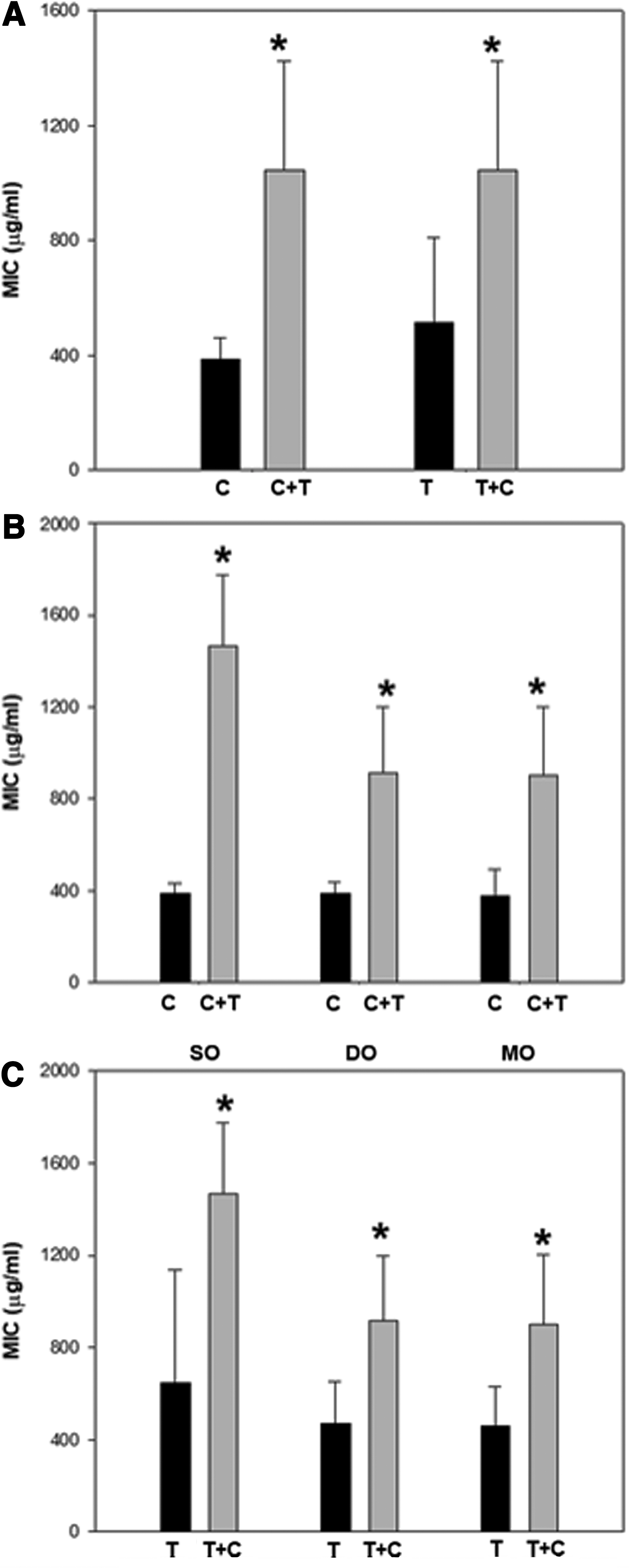
MIC of thymol and carvacrol alone and in combination against the 19 Staphylococcus aureus strains studied. Values are the mean ± standard deviation of those obtained for
The effect of the combination of carvacrol and thymol based on the mean MIC values for each group is reinforced when the MIC 50 and 90 values are estimated both for carvacrol and thymol alone and in combination for the different established origins (Table 2). This table also shows the values of MBC 50 and 90, since these data can be more convincing. In addition, the MIC 50 data correspond to the median of each group, which are close to the MIC average values, represented in Figure 1. The strains belonging to the three origins are shown in Tables 3 and 4.
Minimal Inhibitory Concentration 50 and 90 and Minimal Bactericidal Concentration 50 and 90 of Carvacrol and Thymol Alone and in Combination Against Staphylococcus aureus Strains of Different Origins
MIC50 and MIC90, concentration (μg/mL) that inhibited the growth of 50% and 90% of the strains; MBC50 and MBC90, concentration (μg/mL) that destroyed 50% and 90% of the strains.
DO, dairy origin; MBC, minimum bactericidal concentration; MIC, minimum inhibitory concentration; MO, meat origin; SO, several origins.
Antimicrobial Inhibitory Interaction of Carvacrol and Thymol in Combination Against Staphylococcus aureus Strains of Different Origins
Values of the MICs (μg/mL) are the mean of, at least, two experiments of duplicate.
According to Petersen et al. (2006).
C, carvacrol; DO, dairy origin; FIC, fractional inhibitory concentration; FICI, fractional inhibitory concentration index; MIC, minimum inhibitory concentration; MO, meat origin; SO, several origins; T, thymol.
Antimicrobial Bactericidal Interactions of Carvacrol and Thymol in Combination Against Staphylococcus aureus Strains of Different Origins
Values of the MBCs (μg/mL) are the mean of, at least, two experiments of duplicate.
According to Mackay et al. (2000).
C, carvacrol; DO, dairy origin; FBC, fractional bactericidal concentration; FBCI, fractional bactericidal concentration index; MBC, minimum bactericidal concentration; MO, meat origin; ND, not determined; SO, several origins; T, thymol.
Interspecific antimicrobial interaction of carvacrol and thymol
The interaction (FIC and FICI values) between carvacrol and thymol in combination against the 19 S. aureus strains is summarized in Table 3. According to most of the criteria for the interpretation of the results of interaction of combinations of antimicrobials, the effect between two combined compounds is antagonistic when FICI >4.0, and synergistic when FICI ≤0.5, establishing intermediate categories when the FICI is between these values (Petersen et al., 2006). When applying this criterion to our results, we found a noninteraction effect (0.5 < FICI ≤4) between carvacrol and thymol in combination for 42% of strains tested, that is, 8 strains. An antagonistic effect was observed in the remaining strains (58%), that is, 11 strains, significant differences in this percentage among strains grouped according to their origin being seen: several (100%), dairy (57%), and meat (29%).
Table 4 summarizes the MBC values for carvacrol and thymol alone and in combination against 16 of the 19 strains. Not enough valid data were obtained for the three remaining strains, so it was impossible to calculate the FBCI for them. Individual mean MBC of carvacrol was 433.33 ± 233.49 μg/mL and of thymol 561.64 ± 356.93 μg/mL, these values were significantly lower than those for both compounds in combination (1013.33 ± 356.76 μg/mL). The results of the bactericidal interaction (FBC and FBCI values) of carvacrol in combination with thymol against S. aureus strains are also shown in Table 4. According to the criteria reported by Mackay et al. (2000) for FBCs and FBCI (synergy, antagonism, and others), which are the same as those followed for FICs and FICIs in this study, we found similar results for the strains of food origin in the bactericidal and inhibitory interactions; establishing an antagonistic effect for 43% of the strains of dairy origin (three of seven) and 29% for those of meat origin (two of seven). Comparing the MIC and MBC values for carvacrol and thymol in combination, and taking into account the general consideration (differences in MIC and MBC values not more than twofold), we found that combinations of carvacrol and thymol were bactericidal for ∼60% of the strains tested.
Effect of the combination of carvacrol and thymol on total antioxidant activity
In the present study, the ABTS assay was carried out to evaluate the antioxidant activity of different concentrations of carvacrol, thymol, and their combination. The antioxidant activity for carvacrol and thymol was concentration dependent in the concentration range studied between 0.33 and 2.66 mM (50–400 μg/mL), with similar values for both antioxidants (Table 5).
Antioxidant Activities (mM Trolox Equivalents) of Carvacrol and Thymol Alone and in Combination
Data are the mean ± standard deviation of antioxidant activity of at least two measurements, each performed in duplicated. The values in brackets are the sum of antioxidant activities of individual phenolics at corresponding concentrations. Positive and negative value of difference indicated synergetic and antagonistic interaction, respectively. The interaction is considered as additive if absolute value of difference is less than the standard deviation of the antioxidant activity of the mixture.
Significant differences (p < 0.05) of the total antioxidant activity of the combination to the sum of the antioxidant activity of individual phenolics.
To investigate the effect of carvacrol and thymol in combination on antioxidant activity, the total antioxidant activity of the mixture was measured at different concentrations of carvacrol (0.33–2.50 mM) and thymol (0.33–2.66 mM) (Table 5). As can be seen for low concentrations of both carvacrol and thymol in the mixture, the total antioxidant activity was equal to the sum of the antioxidant activity of these individual phenolics, indicating that the combination exerts an additive effect. However, for high concentrations (2.50 or 2.66 mM) of one of the two phenolics and variable concentrations of the other (0.33 to 2.50 or 2.66 mM), the difference indicated an antagonistic effect. Interestingly, the higher the concentration of the variable phenolic the higher the antagonistic interaction.
Discussion
In this study we investigated the interaction between carvacrol and thymol in combination to establish its antimicrobial effectiveness against S. aureus. The individual MIC values for the S. aureus strains used in this study are between 200 and 400 μg/mL for carvacrol and practically between 300 and 600 μg/mL for thymol.
Similar MIC values were reported for carvacrol (ranging from 291 to 400 μg/mL) against several S. aureus, Staphylococcus epidermidis, and Streptococcus pneumoniae strains (Nostro et al., 2004; Bnyan et al., 2014; Cirino et al., 2014). However, much lower (23.4 μg/mL) and higher (625 μg/mL) values for other S. aureus strains have been reported (Mathela et al., 2010; Cirino et al., 2014). With regard to thymol, our MIC values are similar to those reported for S. aureus strains: 580 μg/mL (Nostro et al., 2004) and 625 μg/mL (Cirino et al., 2014), although 10 μg/mL has also been reported (Wattanasatcha et al., 2012). In general, for Gram-positive bacteria, the antimicrobial effect of these two phenolics varies widely, with MIC values ranging from 2.5 μg/mL (for carvacrol) in Micrococcus flavus (Džamić et al., 2015) or 10 μg/mL (for thymol) to up to 1500 μg/mL for both compounds in Lactobacillus spp. (Du et al., 2015).
Both phenolic monoterpenoids are structurally very similar. The antimicrobial effect occurs when the hydrophobic moiety of these molecules interacts with the hydrophobic domain of the cytoplasmic membrane of bacterial cells (Hyldgaard et al., 2012) and when the hydroxyl group, combined with a system of delocalized electrons, confers an acidic character to these molecules, thus causing cytoplasmic acidification of the bacteria (Ultee et al., 2002; Ben Arfa et al., 2006).
According to our results, carvacrol in combination with thymol loses more effectiveness than thymol alone. The antimicrobial interaction was antagonistic (for all strains of diverse origin and for approximately half of those of dairy origin), while for the strains of meat origin there were mostly no antagonism. No interaction was observed in the other strains. Noninteraction has also been described in the combination of thymol and carvacrol for other strains of S. aureus, as well as in other Gram-positive (e.g., Micrococcus luteus and Lactobacillus spp.) and Gram-negative bacteria (e.g., Pseudomonas aeruginosa and Escherichia coli) (Lambert et al., 2001; Hernández-Hernández et al., 2014; Du et al., 2015). Other studies have also indicated synergistic effects against E. coli strains, (Bassolé and Juliani, 2012) and antagonistic effects against Bacillus cereus, S. aureus, and E. coli (Galluci et al., 2009).
On the basis of the studies conducted with essential oils obtained from oregano and thyme plants, it was demonstrated that their effectiveness against S. aureus seems to depend on the proportion of carvacrol and thymol in each of these oils which, in turn, could condition the type of interaction between them. In addition, it has been described that the antimicrobial effect of pure carvacrol was 1500 times more effective than when it was present in the oregano essential oil as it is affected by the trace components of the essential oil (Rao et al., 2010). It has been reported that to maximize the synergistic effect of both compounds, the appropriate ratio of carvacrol:thymol should preferably be >1 (Michiels et al., 2007), but in our study it was always 1:1.
Greater variability was observed in the MBCs values for the strains studied. For different strains of S. aureus, values similar to those we recorded (between 145 and 1200 μg/mL) have been reported for both thymol and carvacrol (Nostro et al., 2007; Nostro et al., 2017), although an MBC of 50 μg/mL has been obtained for the strain ATCC 6538 of S. aureus (Džamić et al., 2015).
Antioxidant activity was concentration dependent for both carvacrol and thymol alone. Similar results were also found by Slamenova et al. (2013) and Llana-Ruiz-Cabello et al. (2015). In addition, in our study when the antioxidant effect of the combination was antagonistic, this effect also increased with the concentration of the variable phenolic compound. At the concentrations of the two compounds used to study the antimicrobial effect of the combination, the antioxidant effect was always antagonistic. However, at low concentrations of the two phenolic compounds (50–200 μg/mL), it was additive. This could contribute to maintaining the organoleptic properties of food, and be beneficial to human health. The World Health Organization (WHO) has stated that thymol residues in food have no effect on consumer health as long as they do not exceed 50 mg/kg.
Conclusion
The combination of carvacrol and thymol showed both an antagonistic and a noninteraction effect against S. aureus strains depending on their origin (several, dairy, and meat). Therefore, the strain variation should be a factor to be taken into account when thymol or carvacrol are used as a food preservative. At high concentrations of at least one of the components of the combination, the antioxidant effect is also antagonistic, and additive at low concentrations of both components. Therefore, we consider that the combination of carvacrol and thymol at low concentrations (ranged from 50 to 200 μg/mL) may be beneficial for the maintenance of the organoleptic properties of food, as well as to human health.
Footnotes
Acknowledgments
The preset study was financially supported by research grant UXXI2017/00098 from the University of León. María Rosario García-Armesto and Javier Rúa contributed with equal responsibility to conducting this study. The authors acknowledge Dr. Ramón Álvarez for valuable assistance in statistical analysis.
Disclosure Statement
No competing financial interests exist.