




Abstract
Deoxynivalenol (DON) or “vomitoxin” is a mycotoxin produced by Fusarium species. Few food poisoning cases caused by DON have been reported since the 1990s in China. However, on May 16, 2019, the Zhuhai Center for Disease Control and Prevention received a case report from primary school “S” that many students began vomiting after eating breakfast. To discern the cause and control the outbreak effectively, an epidemiological investigation was carried out. This retrospective cohort study defined both suspected and probable cases of food poisoning using ultra-high-performance liquid chromatography coupled with triple quadrupole mass spectrometry to detect 16 mycotoxins simultaneously. A total of 101 cases (14 suspected and 87 probable) were identified, with an overall attack rate of 8.1%. All cases were in grades 1–3. The main symptoms of probable cases were vomiting (100%) and nausea (63%). The average incubation time was 25 min after eating. Comparison of students who ate breakfast provided by the school with those who did not revealed the relative risk was 6.0 (95% confidence intervals [CI] = 2.2–16) among students in grades 1–3. The concentration of DON in the leftover raw breakfast noodles ranged from 6856 to 11,982 μg/kg and 878.3 to 1074.2 μg/kg in leftover cooked noodles. DON exposure was 1.3–1.6 μg/kg body weight for grades 1–2 and 1.7–2.1 μg/kg body weight for grade 3. The attack rate of grade 3 was 4.3 times higher than that for grades 1–2 (95% CI = 3.0–6.3). The food poisoning outbreak on May 16, 2019 in primary school “S” in China, was determined to be caused by DON-contaminated commercial raw noodles.
Introduction
Deoxynivalenol (DON) is a type B trichothecene and one of the most common mycotoxins found in cereals. DON is produced mainly by the fungi Fusarium graminearum, Fusarium culmorum, and Fusarium crookwellense, which are common field pathogens of wheat, barley, and maize (Wu et al., 2011). DON is widely detected in food and grain samples (Mishra et al., 2019) and commonly called “vomitoxin” for its capacity to induce vomiting in various mammalian species, including humans (Bonnet et al., 2012). One physicochemical property of DON is that it is resistant to high temperatures and able to survive heating, frying, and cooking (Bullerman and Bianchini, 2007).
The most common route of exposure to DON is dietary ingestion, which causes acute symptoms, including nausea, vomiting, diarrhea, abdominal pain, headache, dizziness, fever, and so on. Except for acute toxicity, DON has chronic toxicity, cytotoxicity, synergistic/antagonistic effects, cytotoxicity, reproductive and teratological effects, carcinogenicity, genotoxicity, and immunotoxicity (Sobrova et al., 2010). In China, few food poisoning cases caused by DON have been reported since the 1990s (Li et al., 1999). However, on May 16, 2019, the Zhuhai Center for Disease Control and Prevention received a report from primary school “S” that many students started to vomit after having breakfast in school. To determine the cause and control the outbreak effectively, an epidemiological investigation was carried out.
Methods
Setting
Primary school “S” is a public, nonboarding school in the city of Zhuhai (Guangdong, China) consisting of 1245 students, 65 teachers, and 6 administrative staff. There are six grades (four to five classes/grade), one physician in clinic, and seven cooks in the school canteen who prepare breakfast and lunch. The canteen is managed by catering management group “X” who also contracts with four other primary school canteens in Zhuhai. Breakfasts are distributed to each class by the school cooks at around 08:25 a.m. every morning to >900 students and staff.
Epidemiologic investigation
Case definition and identification
Suspected cases were defined as students or faculty with one of the following symptoms: vomiting, nausea, abdominal pain, diarrhea, headache, dizziness, and/or fever on or after May 16, 2019. Probable cases were defined as suspected cases who vomited after breakfast on May 16, 2019. To identify all cases, all head teachers in the primary school were interviewed, and school clinic records were reviewed for any sick or absent students and/or staff.
Retrospective cohort study
The canteen breakfast registration list for May 16, 2019 was checked, and students who ate breakfast provided by the school (exposure group) were compared with those who did not (control group) to see if there was a significant difference.
Questionnaire and interview
Questionnaires were designed and covered information regarding clinical data and food and water consumption from May 14 to 16, 2019. All head teachers and students in grades 1–3 were interviewed.
Food processing investigation
On May 16, 2019, on-site inspection of the school canteen was carried out; menus were checked, all raw materials from May 14 to 16, 2019, were sampled, and cooks were interviewed about processing of the breakfast food on May 16, 2019.
Bivariate analysis
Relative risk and the 95% confidence intervals (CI) were calculated using Epi Info version 7.2.2.16 (Center for Disease Control, Atlanta, GA) and the attack rate compared between the exposure and control group. The analysis was also stratified by school grade and type of meal (meal A vs. meal B) to identify potential risk factors.
Laboratory tests
Ultra-high-performance liquid chromatography coupled with triple quadrupole mass spectrometry was used to simultaneously detect 16 mycotoxins, including DON and zearalenone (ZEA), in leftover food samples. Quantification was carried out by internal standard calibration curve using the isotope dilution technique under negative electrospray ionization mode with multiple reaction ion monitoring (Oueslati et al., 2012). Anal swabs taken from cases and canteen staff were cultured in the laboratory and tested for Staphylococcus aureus or Bacillus cereus. Real-time reverse transcription–polymerase chain reaction was implemented to detect enterotoxins of S. aureus (Chiang et al., 2008).
Results
A total of 101 cases (14 suspected and 87 probable) were identified in the outbreak, with an overall attack rate of 8.1%. All cases were students in grades 1–3. Among probable cases, 87 (100%) reported symptoms of vomiting, 55 (63%) reported nausea, 34 (40%) had abdominal pain, 5 (5.7%) experienced dizziness, 3 (3.4%) had headache, and 1 (1.1%) had fever. Thirty-one probable cases underwent routine blood and liver function tests. Of them, 2 (6.5%) showed an increase in white blood cells. All cases were mild and recovered the same day. The outbreak began at 08:30 a.m. on May 16, 2019, and lasted for ∼2 h and 12 min. The incidence peaked from 08:50 to 09:00 a.m., with a median onset time of 08:50 a.m. and an average incubation time of 25 min after eating (Fig. 1). The highest attack rate was found in grade 3 (29%). There was no significant difference in attack rates between male and female students in each grade (p > 0.05; Table 1).
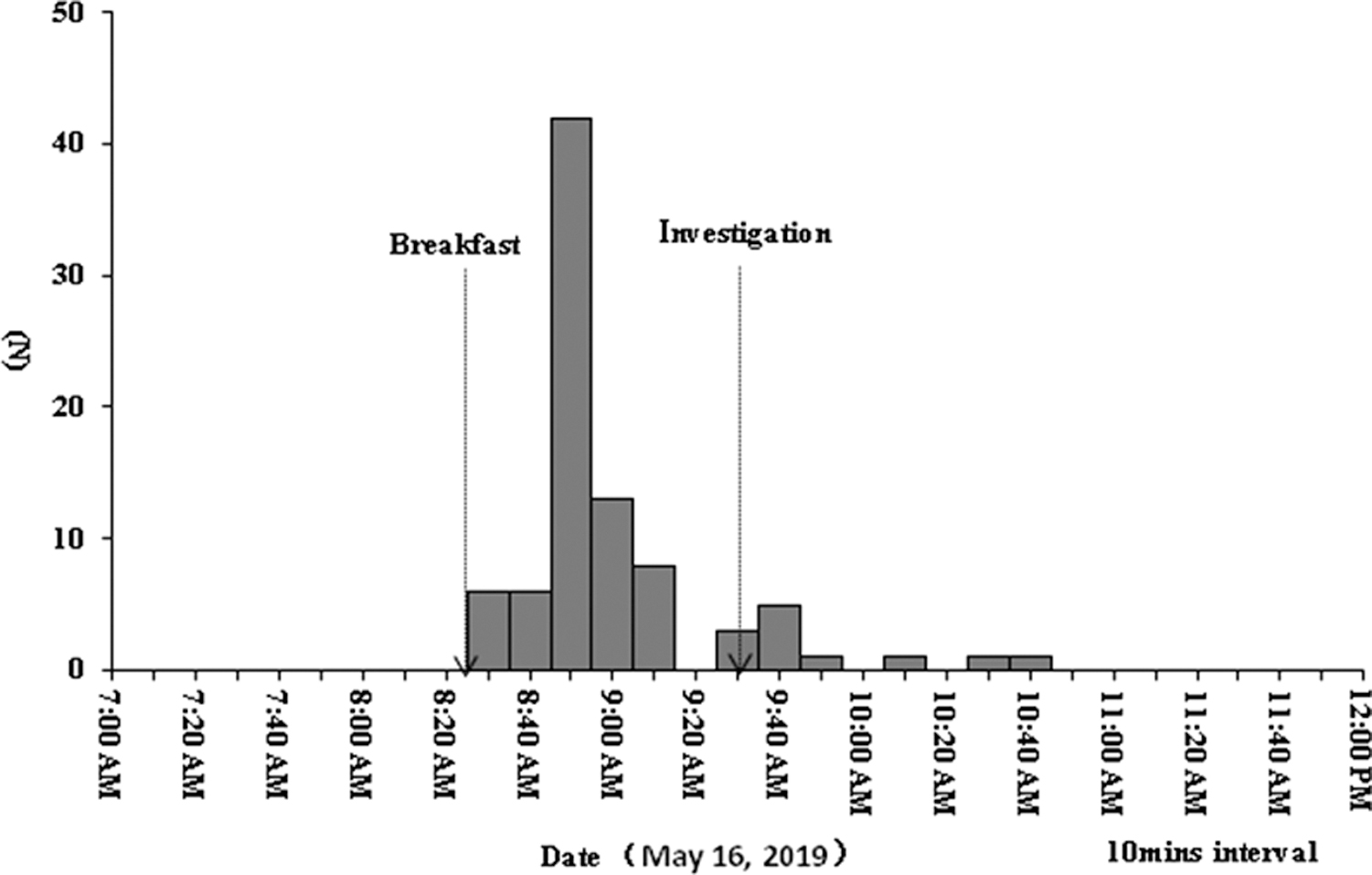
Time distribution of the probable cases in food poisoning caused by deoxynivalenol at a School, Zhuhai, Guangdong, 2019.
Attack Rate in the Food Poisoning Caused by Deoxynivalenol at a School, Zhuhai, Guangdong, China, 2019
Probable case.
AR, attack rate.
Hypothesis generation
The epidemic curve revealed a point-source exposure pattern. Person-to-person transmission was considered to be unlikely as the event only lasted for 2 h and 12 min. Although piped and filtered drinking water was provided to all students and staff, food poisoning cases were only among students in grades 1–3, suggesting the outbreak was unlikely to be caused by the drinking water. The school provided breakfast for most students and lunch to only a few students every day. On May 15, 2019, all students had the same breakfast at school, whereas on May 16, 2019, different breakfasts were provided to junior (grades 1–3, meal A) and senior (grades 4–6, meal B) students. Because only junior students got sick on May 16, it was hypothesized that the breakfast for grades 1–3 on May 16, 2019 was the risk factor for this outbreak.
Retrospective cohort study findings
The overall relative risk when comparing students who ate breakfast provided by the school with those who did not was 7.2 (95% CI = 2.7–20). The relative risk of grade 1–3 students was 6.0 (95% CI = 2.2–16). These data support the hypothesis that eating the breakfast provided by the school (meal A) on May 16, 2019 was a risk factor for the outbreak (Table 2).
Risk Factor of the Food Poisoning Caused by Deoxynivalenol at a School, Zhuhai, Guangdong, China, 2019
Probable case.
AR, attack rate; CI, confidence intervals; RR, relative risk.
Laboratory tests
On May 16, 2019, 21 food samples, including leftover raw and cooked noodles that were provided to students, were collected and 25 anal swab samples from cases and cooks. All swab samples tested negative for S. aureus and enterotoxins of S. aureus and B. cereus. However, DON and ZEA were detected in both leftover raw and cooked noodles (Table 3). The concentration of DON in leftover raw noodles ranged from 6856 to 11,982 μg/kg, and the concentration of ZEA ranged from 12.6 to 20.3 μg/kg. In leftover cooked noodles, the concentration of DON ranged from 878.3 to 1074.2 μg/kg, and the maximum concentration of ZEA was 1.2 μg/kg.
Testing of the Food Poisoning Caused by Deoxynivalenol at a School, Zhuhai, Guangdong, China, 2019
From the boxes produced on April 24, 2019.
From different boxes produced on April 25, 2019.
Leftover noodles from cases among the grade 3.
DON, deoxynivalenol; ZEA, zearalenone.
Dose–response relationship
The school canteen prepared 6.5 boxes of noodles with a total weight of 23,075 g for the breakfast served to junior students on May 16, 2019. Interviews of head teachers revealed the service of breakfast for grades 1–2 was 2/3 as high as that for grade 3; therefore, the noodle intake per person was estimated to be 41 g for grades 1–2 and 61 g for grade 3. As concentrations of DON in leftover cooked noodles ranged from 878.3 to 1074.2 μg/kg, the intake dose of DON per person was estimated to be 36–44 μg or 1.3–1.6 μg/kg body weight for grades 1–2 and 54–66 μg or 1.7–2.1 μg/kg body weight for grade 3. The attack rate for grade 3 was 4.3 times higher than that of grades 1–2 (95% CI = 3.0–6.3; Table 4).
Dose Response of the Food Poisoning Caused by Deoxynivalenol at a School, Zhuhai, Guangdong, China, 2019
Probable case.
Students who ate breakfast on May 16, 2019.
AR, attack rate; BW, body weight; CI, confidence intervals; DON, deoxynivalenol; RR, relative risk; s in mean ± s, standard deviation.
Risk food investigation
On May 16, 2019, the school canteen provided two different breakfasts: soup noodles with tomatoes, minced meat, and eggs (meal A) for junior students (grades 1–3) and porridge, rolls, and jam bags (meal B) for senior students (grades 4–6). The soup noodles were prepared as follows: first, the tomatoes, minced meat, and eggs were stir-fried, whereas the raw noodles were boiled in water for 8 min. Then, the soup noodles were mixed with the three stir-fried ingredients. A total of 6.5 boxes of commercially packaged noodles, mainly made of wheat and corn, were used to prepare the soup noodles for grades 1–3. These noodles were produced by company “JR” in Guangdong on April 24 or 25, 2019 and purchased by company “X” on May 10, 2019. The chef failed to remember the quality of each batch he had used. On the morning of May 16, 2019, ∼50 school staff also ate the soup, which was made from the same packaged noodles but cooked slightly differently: after boiling in water, the noodles were fried with carrots for 5 min. About 2800 g of packaged noodles were used for staff. The estimated intake and exposure dose of DON were 56 g per person and 0.82–1.0 μg/kg body weight, respectively, in adults weighing 60 kg. However, none of these staff got sick after eating the school breakfast. The same batches of packaged noodles were used in another primary school “T” in Zhuhai, of which the canteen was also managed by company “X.” On May 15, 2019, 12 of 767 students reported vomiting within 30 min after eating the soup noodles. A sample of leftover noodles collected from the canteen from primary school “T” revealed concentration of DON was 572.7 μg/kg with an estimated exposure dose of 0.75 μg/kg body weight.
Discussion
The present report is a detailed and structured epidemiological investigation of the food poisoning outbreak caused by DON-contaminated commercial packaged noodles on May 16, 2019 in primary school “S.” The clinical features of this outbreak were consistent with those reported in previous DON-caused outbreaks in Japan and Korea from 1946 to 1963 and in China from 1961 to 1981 (Pestka, 2010), with only one exception: no diarrhea was reported during this event. The average incubation time was 25 min after eating, and all cases were mild and recovered the same day.
Ingestion of mycotoxins can result in adverse impacts on human health, of which the magnitude depends on several aspects, such as the concentration of mycotoxins present, period of exposure, acute/chronic infections, body weight, synergistic effects of coexistent mycotoxins, environmental factors (storage conditions, etc.), and previous health status (Freire and da Rocha, 2017). The joint Food and Agriculture Organization/World Health Organization Expert Committee on Food Additives has set the provisional maximum tolerable daily intake (PMTDI) for DON and its acetylated forms as 1 μg/kg body weight/d (JECFA, 2001, 2011). In China, the concentration limit in cereals and their products is <1000 μg/kg for DON and <60 μg/kg for ZEA (Lu and Yang, 2015). In the outbreak described in this study, the DON concentration in raw noodles was estimated to be 6 to 11 times the permissible level, whereas the maximum concentration of ZEA in leftover cooked noodles was 1.2 μg/kg, far less than the limit. The estimated exposure doses of cases greatly exceeded the PMTDI, and a positive dose–response relationship was found. These results confirm the commercially packaged noodles were contaminated with DON and ZEA and caused the food poisoning outbreak in primary school “S.”
The concentrations of DON in the commercial noodles decreased dramatically after boiling in water for 8 min as DON is water soluble and leaches into the surrounding water (Sugita-Konishi et al., 2006). However, routine cooking methods used in primary school “S” did not fully eliminate the mycotoxin from the noodles and made those who ingested them sick. Although no case was reported among staff having the same noodles for breakfasts, this was probably because their DON exposure doses were lower than that of the students. Moreover, adults tend to be more tolerant to the toxic effects compared with children. Of interest, 4 of the 142 students in grades 1–3 who did not have breakfast at school also vomited. However, this was likely caused by psychogenic effects or possible information bias. By comparison, the attack rate in primary school “T” was very low, which might be because of exposure to lower doses of DON.
The development of PMTDI is based on the reduction of food intake and weight gain in a 2-year study in mice (Iverson et al., 1995), and there is no PMTDI considered specifically for humans at present. The intake dose of DON (μg/kg body weight) was unclear in previous DON-caused outbreaks (Bhat et al., 1989; Pestka, 2010). In the May 16, 2019 outbreak, both the concentrations of DON in leftover cooked noodles and estimated intake doses of DON were determined. Thus, the present investigation may provide a basic understanding for future development of PMTDI.
By identifying the cause of the food poisoning outbreak, control methods were applied in time to avoid an escalation of the incident throughout the region. However, this investigation has some limitations as the DON metabolites in cases were not analyzed, nor was the reason the raw noodles were contaminated further investigated. Nonetheless, as a result of the current outbreak and investigation, the Food and Drug Administration in Guangdong recalled all the remaining commercial packaged raw noodles produced by company “JR” and is carrying out further food-tracing work. Furthermore, it is suggested that the province strengthens the monitoring and examination of food contaminants to prevent cereals and their products from being contaminated by toxins.
Conclusion
The food poisoning outbreak on May 16, 2019 in primary school “S” was caused by DON-contaminated commercial packaged noodles.
Footnotes
Acknowledgments
The authors thank all public health doctors from the Zhuhai Center for Disease Control and Prevention who took part in administering the questionnaire and laboratory tests.
Disclosure Statement
No competing financial interests exist.
Funding Information
Funding for this study was provided by the Zhuhai Center for Disease Control and Prevention.