




Abstract
This study assessed an enzyme-linked immunosorbent assay (ELISA) based assay to detect Salmonella in swine as a potential tool to predict the presence of Salmonella in swine carcasses. The following samples were collected from 10 swine batches: blood (n = 100); environment (barn floor, n = 10, and lairage floor, n = 10); meat juice (n = 100, obtained after defrosting of diaphragm); tonsils (n = 100); mesenteric lymph nodes (MLNs) (n = 100); and carcasses after bleeding (n = 100), after singeing (n = 100), after evisceration (n = 100), and after final rinsing (n = 100). Blood and meat juice were subjected to ELISA to detect antibodies against Salmonella, and other samples were subjected to Salmonella detection by ISO 6579. Salmonella was detected in 3 samples from barn floors, 7 lairage floors, 45 tonsils, 43 MLNs and in 3 carcasses. Based on ELISA, Salmonella positive samples were: 86 and 46 blood serum (20% and 40% cut-offs) and 68 and 46 meat juice (20% and 40% cut-offs). Optical density readings from blood serum and meat juice presented a high and significant correlation (r = 0.93, p < 0.001), and a substantial agreement for Salmonella detection (K = 0.69, ELISA 40% cut-off). The agreement between ELISA and microbiological analysis for Salmonella detection in pig carcasses were absent or poor, with the exception of results obtained by ELISA 40% cut-off from blood serum and meat juice with MLNs (K = 0.49 and 0.50, respectively) and tonsils (K = 0.29 and 0.30, respectively). Based on the obtained results, meat juice can be considered an alternative to blood serum as a matrix for ELISA for preliminary detection of Salmonella, allowing the identification of potential sources of contamination during slaughtering.
Introduction
Pigs are usually asymptomatic carriers of Salmonella, excreting the pathogen intermittently or when stressed. In such a condition, pigs can spread Salmonella widely in the pork production chain (Mannion et al., 2008; Silva et al., 2012; Argüello et al., 2013; Simons et al., 2016). Several studies have demonstrated the prevalence of Salmonella in pig farms and its spread to slaughterhouses, and they highlight the relevance of infected animals as carriers of this pathogen to processing facilities (Silva et al., 2012; Argüello et al., 2013). This evidence has led to rigorous control of Salmonella from the first steps of production to processing of end products, conducted by the pork companies and guided by official inspection services.
Different official programs for Salmonella control in swine have been discussed and developed in several countries; most of these programs were based on the Danish model, which considers the serology of animals as the main monitoring tool (Wegener et al., 2003; Mainar-Jaime et al., 2018). However, some countries failed in adopting serology-based programs due to different reasons, such as distinct Salmonella levels in pig farms, leading to distinct approaches for data interpretation and guidance, and the complexity of Salmonella transmission among animals and producing systems, jeopardizing proper prediction of positive results (Wegener et al., 2003; British Pig Executive 2012; Brossé 2015; Gradassi et al., 2015; Zdolec et al., 2015; Blaha 2017; Mainar-Jaime et al., 2018). Because of these limitations, some countries have adopted the microbiological detection method for Salmonella isolation from the key sites of pig carcasses, such as tonsils and mesenteric lymph nodes (MLNs), and achieved reliable results, as occurs in Sweden (Wegener et al., 2003).
Kich et al. (2007) developed an enzyme-linked immunosorbent assay (ELISA) that is capable of detecting antibodies against most of the prevalent Salmonella serotype found in the Brazilian pork production chain; despite this, up to this date, no official program has been established in the country to monitor this pathogen in swine production (Kich et al., 2007). This study aimed at assessing the adequacy of using an ELISA-based assay as an alternative to a screen and support tool to predict the potential presence of Salmonella in the key sites of swine carcasses.
Materials and Methods
Sampling
A pork production chain located in Paraná State, Brazil, and subjected to official inspection by the Brazilian Ministry of Agriculture, was selected for this study with the agreement of the owners. Two days before transport to the slaughterhouse, the swine batches were visited and samples from barn floors were obtained by footprint, as described by Botteldoorn et al. (2003). Each swine batch is from a different farm. After arrival at the slaughterhouse, the lairage floor was sampled by footprint (Botteldoorn et al., 2003) and 10 animals per batch were randomly selected. During the slaughtering steps, the following samples of the selected animals were collected: blood (after bleeding), carcass surface after bleeding (400 cm2), carcass after singeing (400 cm2), carcass after evisceration (400 cm2), carcass after final washing (400 cm2), and from the diaphragm, palatine tonsils, and MLNs. The samples were collected from the same carcasses throughout slaughter steps. Surface samples of carcasses were obtained by swabbing with sterile sponges, which were previously moistened with 10 mL of buffered peptone water (BPW; 0.1%, w/v; Oxoid Ltd., Basingstoke, England), on four 100 cm2 areas, as described by ISO 17604 (ISO 2015). All samples were stored at 4°C until analysis.
Salmonella detection by microbiological method
All samples, except for blood and diaphragm, were subjected to Salmonella detection according to ISO 6579 (ISO 2002), with some modifications. Samples obtained by overshoes and swabbing were transferred to sterile bags, added with BPW (0.1%, w/v; Oxoid) to create a final volume of 200 mL, and homogenized for 1 min at 230 rpm (Stomacher 400; Seward, Worthing, England). Portions of 12.5 g of tonsils and MLNs were transferred to sterile bags, added with 112.5 mL of BPW (1%, w/v; Oxoid), and homogenized as described earlier. Aliquots of 40 mL of the homogenates obtained were centrifuged at 2000 g for 15 min; the supernatant was discarded; and the pellet obtained was suspended with 10 mL of BPW (1%, w/v; Oxoid) and then incubated at 37°C for 24 h. The cultures obtained were transferred to Rappaport Vassiliadis Soya broth (Oxoid) and Muller-Kauffman Tetrathionate Novobiocin broth (Oxoid), and they were incubated at 42°C and 37°C, respectively, for 24 h. The cultures were then streaked onto agar plates containing Xylose Lysine Deoxycholate Agar (Oxoid) and Mannitol Lysine Crystal Violet Brilliant Agar (Oxoid), and they were incubated at 37°C for 24 h; colonies that presented the typical morphology of Salmonella were selected and subjected to biochemical tests for identification. Cultures identified as Salmonella were subjected to polymerase chain reaction targeting invA, as described by Swamy et al. (1996) and ompC, as described by Alvarez et al. (2004) to confirm the identification with Salmonella Abony NCTC 6017 used as a positive control. Thirty-nine isolates were selected based on their sample origin and subjected to agglutination assays by using Salmonella antisera (Denka Seiken Co., Tokyo, Japan) to identify their serogroups.
Salmonella detection by serology
Blood and diaphragm samples were processed and subjected to an ELISA to detect Salmonella infection detection by serology, as described by Kich et al. (2007). Just after sampling, blood samples were centrifuged at 2000 g for 15 min, and the serum obtained was stored in sterile flasks at −80°C; also, fragments of the collected diaphragms were frozen at −80°C for 24 h, thawed at 4°C for 24 h, and the meat juice obtained was collected in sterile flasks and stored at −80°C. Just before the ELISA, serum and meat juice samples were thawed at 4°C for 8 h, diluted at 1:400 and 1:30, respectively, in phosphate buffer sodium (PBS) supplemented with Tween 20 (0.05%, v/v) and bovine serum albumin (1%, v/v) (PBS-TA), pH 7.4, and transferred in triplicates to 96-well plates previously prepared with the antigen (1:2000). After incubation at 37°C for 30 min, the plates were washed with PBS-TA, and 100 μL of anti-pig IgG conjugated to horseradish peroxidase, diluted at 1:25,000 in PBS-TA, was added per well. The plates were incubated at 37°C for 1 h, washed with tap water, and added to 100 μL per well of a substrate (3.5 μL H2O2, 230 μL 10 N NaOH, and 10 μL 3,39,5,59 tetramethyl-benzidine) for color reaction. The plates were incubated at 25°C for 15 min, when the reaction was stopped by adding 50 μL of 2 M sulfuric acid in each well. The optical density at 450 nm was assessed by using a plate reader (Titertek Multiscan, McLean, VA). The matrices from known positive and negative animals were used as positive and negative controls, respectively. The results for both matrices were expressed as OD% obtained by “sample-to-positive (S/P)” ratio multiplied by 100, using the following equation:
In this study, two different cut-off values were evaluated: Samples were considered positive with OD% > 20% or OD% > 40% (Kich et al., 2007).
Data analysis
The results obtained for pig batches (barns and lairage floors) were considered with the corresponding pig carcasses sampled during slaughtering. In addition, a pig carcass was considered positive for Salmonella by the microbiological detection method when the pathogen was isolated in at least one slaughtering step. ELISA results were compared considering the different cut-offs adopted in the readings; and the results obtained by ELISA (20% and 40% cut-off, from blood and meat juice) and microbiological detection (barn and lairage floor) were considered as indicative of the presence of Salmonella in tonsils, MLNs, and carcasses. The agreement of results for Salmonella in different samples for a same animal, but obtained by different methodologies, was calculated and compared by the Cohen's Kappa index using the software OpenEpi (Dean et al., 2013), and by the McNemar test (p < 0.05), using the software XLStat (Addinsoft, Inc., New York, NY). Optical densities (ODs) from blood serum and meat juice samples were compared by linear regression (p < 0.05), using the software XLStat (Addinsoft).
Results
Table 1 shows the results for Salmonella in the samples obtained. The pathogen was detected mainly from the lairage floors (7/10), followed by tonsils (45/100), and MLNs (43/100). Selected Salmonella confirmed isolates were characterized as belonging to serogroups O:4 (32/39), O:3 (3/39), O:9 (2/39), O:8 (1/39), and O:7 (1/39). Based on the serological results from blood serum and meat juice, higher frequencies of Salmonella seropositive animals were observed when considering the ELISA 40% cut-off (Table 1). Individual OD readings for each tested sample are presented in the Supplementary Table S1.
Frequencies of Positive Results to Salmonella Based on Different Approaches, Samples, and Protocols in Paraná State, Brazil, 2018
Considering at least one Salmonella spp. positive result in the different slaughtering steps of the same pig carcass.
The correlation between serum and meat juice was very high (r = 0.93, p < 0.001; Fig. 1), and Table 2 shows the agreement of Salmonella positive results in these samples obtained by ELISA. Despite the absence of agreement by McNemar (p < 0.05), OD readings presented a high and significant correlation index (Fig. 1) and the Cohen's Kappa indices indicated a substantial agreement of the data obtained for samples when considering ELISA 40% cut-off (Table 2). A moderate agreement was observed by Cohen's Kappa test when the data obtained from blood serum with 40% cut-off and meat juice with 20% cut-off were compared (Table 2).
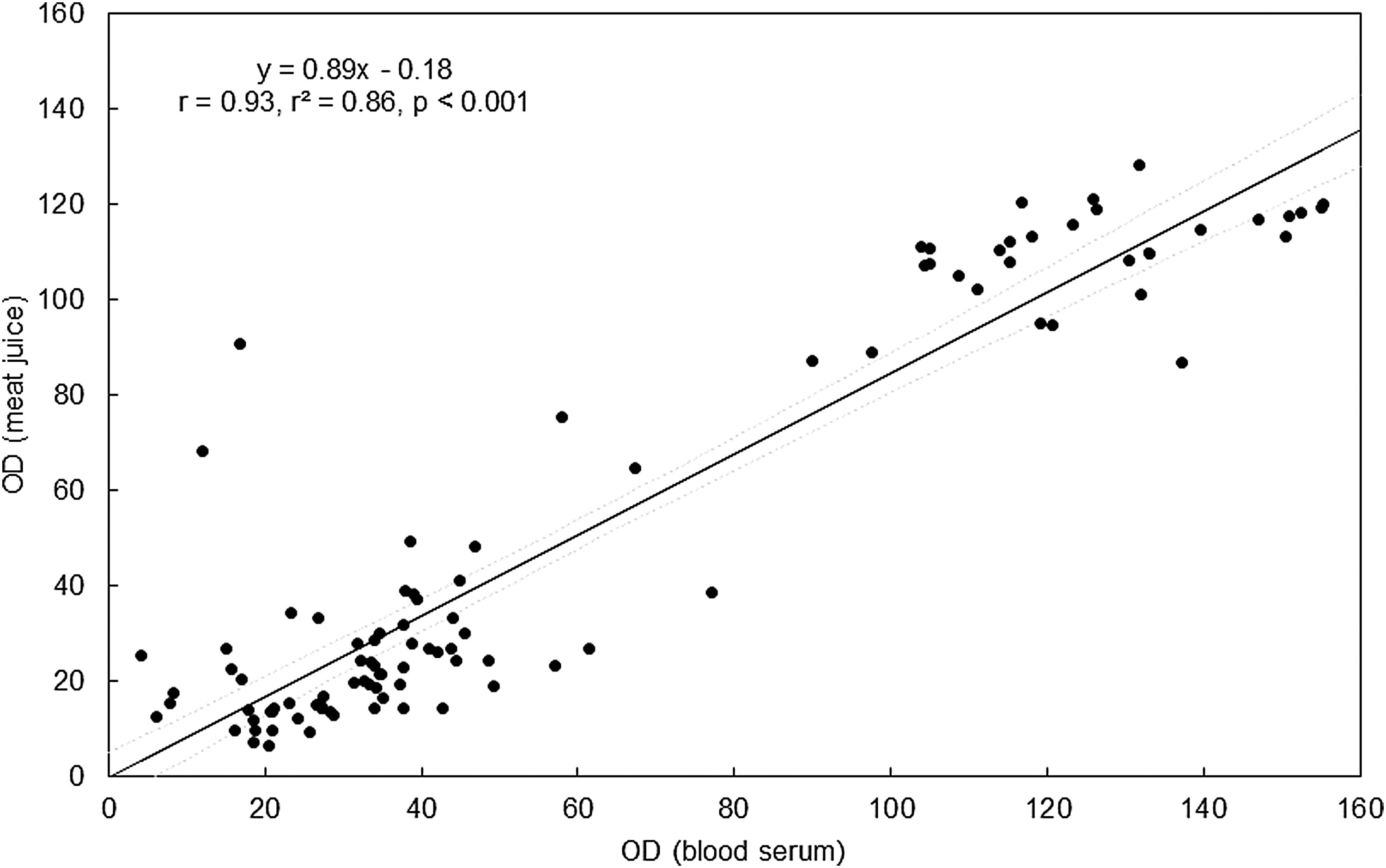
Dispersion of optical density readings (λ = 450 nm, values multiplied by 100) of serum and meat juice from 100 finishing pigs slaughtered in Paraná state, Brazil, 2018. r = correlation index, r 2 = coefficient of determination of the adopted model, p = level of significance.
Comparison of Salmonella Detection in 100 Blood Serums and 100 Meat Juices Obtained by Enzyme-Linked Immunosorbent Assay, Considering 20% and 40% Cut-offs (20CO and 40CO, Respectively) in Paraná State, Brazil, 2018
McNemar interpretation: p-values higher than 0.05 indicate equivalency of results.
Cohen's Kappa interpretation: K < 0.00—poor agreement; 0.00 < K < 0.20—slight agreement; 0.21 < K < 0.40—fair agreement; 0.41 < K < 0.60—moderate agreement; 0.61 < K < 0.80—substantial agreement; 0.81 < K < 1.00—almost perfect agreement.
Chi-square test with Yates correction, due to one of the expected frequencies lower than 5.
95% CI, 95% confidence interval; K, Kappa reference value; p, level of significance; Q, McNemar reference value.
Figure 2 shows the analysis of the equivalent results obtained among the collected samples, when considering serum (ELISA), and meat juice (ELISA), as references for predicting the contamination of Salmonella in tonsils, MLNs, and carcasses. The results obtained by ELISA 20% cut-off did not present significant agreement with results obtained by microbiological detection, whereas the results obtained by ELISA 40% cut-off presented significant agreement with results of microbiological detection from tonsils and MLNs, using McNemar (Table 3). When considering the Cohen's Kappa, the results from blood serum and meat juice obtained by ELISA 40% cut-off presented moderate agreement with the conventional isolation of MLNs (Fig. 2).

Comparison of Salmonella detection by ELISA (20% and 40% cut-offs, 20CO and 40CO, respectively, in 100 blood serum samples and 100 meat juice samples) and conventional isolation (100 tonsils, 100 mesenteric lymph nodes and 100 pig carcasses) in Paraná state, Brazil, 2018. The numbers between sample types are the Kappa reference value (K). Cohen's Kappa interpretation: K < 0.00—poor agreement; 0.00 < K < 0.20—slight agreement; 0.21 < K < 0.40—fair agreement; 0.41 < K < 0.60—moderate agreement; 0.61 < K < 0.80—substantial agreement; 0.81 < K < 1.00—almost perfect agreement. ELISA, enzyme-linked immunosorbent assay.
Comparison of Salmonella Detection in 100 Blood Serums, 100 Meat Juices Obtained by Enzyme-Linked Immunosorbent Assay Considering 20% and 40% Cut-offs (20CO and 40CO, Respectively) and Conventional Isolation (100 Mesenteric Lymph Nodes, 100 Tonsils and 100 Pig Carcasses) in Paraná State, Brazil, 2018
McNemar interpretation: p-values higher than 0.05 indicate equivalency of results.
p, level of significance; Q, McNemar reference value.
Table 4 shows the analysis of the coincident results of Salmonella obtained only by the microbiological detection method, when considering as a reference the presence of positive results in the floors of barns and lairage. The presence of Salmonella in barn and lairage floors did not present significant association or agreement with the detection of the pathogen in the key contamination points of pig carcasses during slaughtering (Table 4).
Comparison of Salmonella Detection by Conventional Isolation in 10 Barn Floors, 10 Lairage Floors, 100 Tonsils, 100 Mesenteric Lymph Nodes, and 100 Pig Carcasses in Paraná State, Brazil, 2018
Results for barn and lairage floors were obtained per animal lot (10) and extrapolated to corresponding pigs (100).
McNemar interpretation: p-values higher than 0.05 indicate equivalency of results.
Cohen's Kappa interpretation: K < 0.00—poor agreement; 0.00 < K < 0.20—slight agreement; 0.21 < K < 0.40—fair agreement; 0.41 < K < 0.60—moderate agreement; 0.61 < K < 0.80—substantial agreement; 0.81 < K < 1.00—almost perfect agreement.
Chi-square test with Yates correction, due to one of the expected frequencies lower than 5.
95% CI, 95% confidence interval; K, Kappa reference value; p, level of significance; Q, McNemar reference value.
Discussion
Based on the results obtained by microbiological detection, the presence of Salmonella in the barns and lairage floors indicates excretion by the animals in the producing environment, confirmed by the presence of positive results in tonsils and lymph nodes (Table 1). ELISA results confirmed these results in the sampled animals (Table 1). The stressing conditions that the animals are subjected to during transport and slaughtering are highly associated with Salmonella excretion by the animals, supporting the observed results (Mannion et al., 2008; Argüello et al., 2013; Simons et al., 2016). In addition, fasting periods higher than 4 h are considered critical to Salmonella excretion by carrier animals (Eicher et al., 2017). MLNs are considered the key sites to monitor Salmonella in carriers animals (EFSA 2006) and have led to the adoption of proper control measures during slaughtering; similar frequencies of Salmonella in MLNs were previously recorded in similar studies conducted in Brazil (Kich et al., 2011; Cabral et al., 2017). Tonsils are also usually screened for the presence of Salmonella as an indicator of carrier animals and the potential entrance of the pathogen into the slaughtering process (Zdolec et al., 2015; Van Damme et al., 2018). Despite being detected in the animals, Salmonella were isolated on only three carcasses, indicating good manufacturing practices in the slaughterhouse selected for this study (Table 1). These data emphasize the importance of slaughterhouse hygiene measures, where further procedures might be adopted to reduce the risk of contamination, based on serological data.
Also, despite being routinely studied for Salmonella detection and monitoring in swine, tonsils and MLNs are considered important points of contamination during slaughtering. When these tissues are opened or removed, Salmonella spreading can occur to the pig carcass and to the environment (Biasino et al., 2018; Van Damme et al., 2018). Contaminated feces can also increase the chances of contamination by Salmonella in the slaughterhouse (Silva et al., 2012; Casanova-Higes et al., 2017; Mainar-Jaime et al., 2018). The lower is the presence and the load of Salmonella in the animal intestines, the lower the chances for carcass contamination during slaughtering, highlighting the relevance of proper monitoring of the animals (Pesciaroli et al., 2017).
The most prevalent serogroup identified among the characterized isolates was the O:4, which includes S. Typhimurium, usually identified in the Brazilian pork production chain (Kich et al., 2011; Cabral et al., 2017; Biasino et al., 2018). These results are in agreement with the data obtained by ELISA, once the protocol used considers the detection of IgG against the lipopolysaccharide antigens O1, O4, O5, and O12, from S. Typhimurium. Due to antigenic similarity, the adopted ELISA assay is also able to detect other Salmonella serotypes, such as Agona, Derby, Bredeney, and Panama, which are highly prevalent in swine from southern Brazil (Kich et al., 2007, 2011, 2016; Schwarz et al., 2009; Silva et al., 2012).
The frequency of animals that presented positive results for Salmonella by serological tests was higher when compared with the frequency of positive results in the microbiological detection procedure, when considering tonsils and MLNs (Table 1), as already reported by Kich et al. (2011) and Silva et al. (2012). Antibodies against Salmonella are produced in an infected pig after 7 to 15 days of contact with the pathogen, but not all animals become carriers, as they are able to eliminate it completely; thus, many animals will present serological results for Salmonella without becoming infected (Kich et al., 2007, 2016; Vico et al., 2010; Gradassi et al., 2015). However, the isolation of Salmonella in tonsils and MLNs from animals that were negative by serological assays is also possible; previous studies have demonstrated that Salmonella can reach the intestinal lymphoid tissues within 2 h after the infection, and it can be isolated from intestine of pigs, but several days are necessary for the production of immunoglobulins (Boughton et al., 2007; Rostagno et al., 2011).
A substantial agreement by Cohen's Kappa test was observed among Salmonella results obtained by ELISA 40% cut-off (Table 2), as well as a high and significant correlation index (Fig. 1). Thus, some agreement among OD readings can be observed despite the differences in the composition of both matrices, which are usually considered the major cause of differences in their performance in ELISA-based assays (Mainar-Jaime et al., 2008; Vico and Mainar-Jaime 2011). Despite these differences, meat juice would be an important alternative to blood serum, because fragments of this diaphragm muscle are easily collected during slaughter, which allows for the establishment of a pattern of historical data of Salmonella contamination in the pork production chain: The high and significant correlation of OD readings from blood serum and meat juice supports this interpretation (Fig. 1). Immunoglobulins in meat juice are present in lower levels when compared with blood serum (Szabo et al., 2008); this might be a relevant factor in determining the low sensitivity of this matrix for ELISA-based assays (Vico and Mainar-Jaime 2011; Gradassi et al., 2015).
No serological data from blood serum and meat juice, with a 20% cut-off, were in agreement with data from a Salmonella isolation from tonsils, MLNs, and carcasses based on McNemar (p < 0.05; Table 3) and Cohen's Kappa test (Fig. 2). However, despite presenting some data in disagreement, with a 40% cut-off in serological tests, a significant agreement was allowed with microbiological detection in tonsils and MLNs by the McNemar test (p > 0.05; Table 3). Moderate agreement indices by the Cohen's Kappa test were observed for Salmonella results by ELISA 40% cut-off from blood serum and meat juice when compared with microbiological detection from MLNs (K = 0.49 and 0.50, respectively) (Fig. 2).
Better agreement results can be obtained if the cut-off is changed, but it is a procedure that must be adopted with care. The cut-off value at which the combination of sensitivity and specificity is maximal is not always the best choice for an assay, and it may lead to relevant economic and public health implications due to inadequate data interpretation. Ideally, the cut-off value for an assay must be adjusted based on the history of the prevalence of the target organism in the studied region, and the development of a surveillance program (Lo Fo Wong et al., 2004; Kich et al., 2007). Because many studies demonstrate the Salmonella prevalence in swine production, based on ELISA assays with a 40% cut-off, most commercial kits for Salmonella detection are standardized with this value (Mainar-Jaime et al., 2008; Gradassi et al., 2015; Casanova-Higes et al., 2017). Lowering the cut-off value may result in an increase of false positive results; thus, lowering of cut-off will not necessarily improve agreement among serological and microbiological results. The relevance of adopting different cut-off values for Salmonella serological tests has already been reported in the literature (Gradassi et al., 2015; Kich et al., 2016).
In addition, independent of the adopted cut-off, the ELISA assay considered in this study was designed based on the antigenic formula of S. Typhimurium (1,4,5,12:i:1,2), the most prevalent in southern Brazil, and presents an antigenic formula similar to other serotypes commonly isolated in this region (Kich et al., 2007, 2011, 2016; Silva et al., 2012). However, other serogroups that do not present similar antigenic formula to S. Typhimurium (group O:4) were isolated, such as O:3, O:9, O:8, and O:7, which may have contributed to some disagreement in the results (Fig. 2). Considering the differences in the antigenic formulas of some of the identified Salmonella serogroups, the adopted ELISA assay may have failed to identify truly infected animals, as was already observed in previous studies (Grimont and Weill 2007; Vico et al., 2010).
Finally, based on data from Table 4, the presence of Salmonella in barns and lairage does not necessarily indicate the presence of the same pathogen in tonsils and MLNs, nor a contamination of pig carcasses. Thus, these data indicate that Salmonella carriers are not necessarily excreting it (De Busser et al., 2011). According to the McNemar test and Cohen's Kappa, no significant agreement was observed when the barn floor was used as a reference for a contamination. A similar result was observed when the detection of Salmonella in lairage was considered as a reference for subsequent contamination in a slaughterhouse, which presented even more positive results.
Conclusions
According to the results, the best agreement between the tests for predicting the occurrence of Salmonella in swine (MLN and tonsils) was found to be the ELISA test with a cut-off of 40% (independent of the matrix: blood serum or meat juice). In spite of the divergences and restrictions of each method, if used as an additional tool, the serological test is important for distinguishing herds with a greater probability of contamination from herds with a lesser probability of contamination at the time of slaughter. Considering such results, slaughterhouses can adopt preventive procedures to avoid Salmonella spread in their facilities, leading them to take the proper decisions for the next batches coming from the same farm and also collect the data for epidemiological studies of the animals. The microbiological detection protocol is essential for monitoring the contamination of carcasses in the slaughterhouse and should be used in association with serology.
Footnotes
Disclosure Statement
No competing financial interests exist.
Funding Information
The authors are thankful to Conselho Nacional de Desenvolvimento Científico e Tecnológico (CNPq, Brasília, DF, Brazil), Fundação de Amparo á Pesquisa do Estado de Minas Gerais (FAPEMIG, Belo Horizonte, MG, Brazil) and Coordenação de Aperfeiçoamento de Pessoal de Nível Superior (CAPES, Brasília, DF, Brazil, Financial code 001).
Supplementary Material
Supplementary Table S1
References
Supplementary Material
Please find the following supplemental material available below.
For Open Access articles published under a Creative Commons License, all supplemental material carries the same license as the article it is associated with.
For non-Open Access articles published, all supplemental material carries a non-exclusive license, and permission requests for re-use of supplemental material or any part of supplemental material shall be sent directly to the copyright owner as specified in the copyright notice associated with the article.
