




Abstract
Microgreens and sprouts have been used for raw consumption for a long time and are generally viewed as a healthy food. However, several serious outbreaks of foodborne illness have been recorded in European countries, Japan, and North America. Many companies in Latvia nowadays are producing this type of products. The aim of this study was to characterize the incidence of Shiga toxin–producing Escherichia coli (STEC), Salmonella spp., and Listeria spp. in microgreens, sprouts, and seeds intended for domestic production of microgreens on retail market in Riga, Latvia, from January to April 2019. The background microflora was identified as well. A total of 45 samples were purchased, including fresh and processed sprouts, microgreens, baby greens, as well as seeds intended for domestic production of microgreens and sprouts. The samples were processed according to the methods set by the International Organization for Standardization (ISO)—ISO/TS 13136:2012 for STEC, ISO 6579-1:2017 for Salmonella spp., and ISO 11290-1:2017 for Listeria spp. Molecular detection of Salmonella spp. was also performed using real-time polymerase chain reaction. The typical and atypical colonies isolated from selective plates were identified with matrix-assisted laser desorption and ionization time-of-flight mass spectrometry. Listeria monocytogenes was not detected in any of the tested samples. However, the presence of Listeria innocua was detected in two (4.4%) of the samples. Three (6.7%) samples of dried sprouts were positive for the STEC virulence genes. Salmonella spp. was detected in one (2.2%) sample of common sunflower seeds. Altogether, 46 different background bacterial species were identified. The majority were environmental bacteria characteristic to soil, water, and plants, including coliform bacteria. The results provide evidence that microgreens and seeds available for Latvian consumers are generally safe, however, attention has to be paid to dried sprouts.
Introduction
Sprouts and microgreens are ready-to-eat specialty crops that have grown in popularity as part of a healthy diet due to their high nutritional value, as well as the fresh flavors and visual appeal (Xiao et al., 2012; Paradiso et al., 2018; Benincasa et al., 2019). Several terms are used for these types of produce—“sprouts,” “sprouted seeds,” and “microgreens”—that often are used interchangeably. EU has defined sprouts as a “product obtained from the germination of seeds and their development in water or another medium, harvested before the development of true leaves, and which is intended to be eaten whole, including the seed” (EC, 2013). Microgreens could be defined as “shoots or seedlings in their youngest stage with fully developed cotyledons and emerging or partially expanded first pair of true leaves and they usually are cultivated in trays in growing media or soil, indoors, or in greenhouses” (Xiao et al., 2014; Kyriacou et al., 2016). Similar products to microgreens are “baby greens” that are harvested later than microgreens, but before the plants have reached full maturity (Choe et al., 2018).
These products are produced in warm and humid conditions that are ideal for microbial growth. Microorganisms in sprouts can originate from water, soil, air, animals, insects, birds, and equipment. In addition, these products have a short shelf life and are usually consumed without heat treatment or decontamination procedures.
Salmonella spp. is the most common bacterial pathogen responsible for outbreaks linked to fresh produce, whereas leafy vegetables and sprouts are the most common food vehicle implicated in these outbreaks (Callejón et al., 2015). Different Escherichia coli strains have caused large outbreaks with serious complications, and several of them have been associated with sprouts (Watanabe et al., 1999; Buchholz et al., 2011; EFSA, 2011a; CDC, 2013). Another pathogen associated with fresh leafy produce is Listeria spp. (Smith et al., 2018). Listeriosis outbreaks associated with mung bean sprouts (CDC, 2015) as well as fruits (Buchanan et al., 2017) have been reported recently. In response to the increased number of outbreaks associated with sprouts, the European Food Safety Authority (EFSA) has concluded that these products pose microbial food safety concerns (EFSA, 2011b). Many studies have explored pathogen-associated risks from the consumption of sprouts, but there is only a limited number of studies about microgreens (Riggio et al., 2019). The microbiological purity of microgreens can be affected by many factors, including the quality of growing substrate (potting soil, compost, vermicompost, etc.) used for plant growth (Muchjajib et al., 2015; Di Gioia et al., 2017; Reed et al., 2018; Riggio et al., 2019). Vermicompost can contain microorganisms that are human pathogens (Grantina-Ievina et al., 2013). In addition, to the best of our knowledge, no study of food safety aspects associated with the consumption of sprouts and microgreens in Latvia or the nearest Baltic or Nordic region has been documented so far.
The aim of this study was to characterize the incidence of Shiga toxin–producing E. coli (STEC), Salmonella spp., and Listeria spp., as well as the background microflora in microgreens, baby greens, sprouts, and seeds intended for the production of microgreens available on the retail market in Riga, Latvia, in one season of production from January 2019 to April 2019.
Materials and Methods
Sample collection
A total of 45 samples of microgreens, baby greens, and seeds intended for domestic production of microgreens and sprouts (fresh and processed) were purchased from different stores, farmer's market, as well as directly from the local producers in Riga, Latvia, during the time period from January 2019 to April 2019. All samples were purchased and processed before their expiration date and were stored until processing under the appropriate conditions for the particular product in separate single-use packaging, to avoid cross-contamination. The following product-associated information was recorded: type of product, species, date of sample collection, manufacturer, the country of origin, and retailer. The breakdown of all the sample categories included in the study is shown in Table 1 and the overall characteristics of the samples are listed in Table 2. The samples originated from 8 countries, 10 manufacturers, 6 local producers, and 5 retailers and comprised 19 crop species. Most of the products were locally produced. Several producers were using ecofriendly technologies, vermicompost as fertilizer, recyclable substrate, and reusable growing boxes.
Sample Types Included and Tested in the Study
STEC, Shiga toxin–producing Escherichia coli.
The Overall Characteristics of Samples Included in the Study
Manufacturer used vermicompost as a component of soil.
Sprouts dried at temperatures up to 40°C.
Sprouts were finely ground into powder.
Microbiological analysis
The incidence of STEC, Salmonella spp., and Listeria spp. was assessed according to the methods set by the International Organization for Standardization (ISO)—ISO/TS 13136:2012 for STEC, ISO 6579-1:2017 for Salmonella spp., and ISO 11290-1:2017 for Listeria spp. (Fig. 1). All 45 samples were tested for the presence of STEC and Salmonella spp., and 42 samples were tested for the presence of Listeria spp. due to the insufficient amount of material in three samples. A 25 g portion of each sample in five replicates for each of the target bacteria were homogenized using a Stomacher® 400 Circulator (Seward) for 30 s at 230 rpm in 225 mL of an appropriate enrichment medium. Modified Trypticase Soy Broth (TSB) supplemented with 1 mL of 16 mg/L novobiocin solution per liter was used for STEC, buffered peptone water was used for Salmonella spp., and Half Fraser broth was used for Listeria spp. enrichment. The samples were incubated for 24 h at 37°C (for STEC and Salmonella spp.) or 30°C (for Listeria spp.).
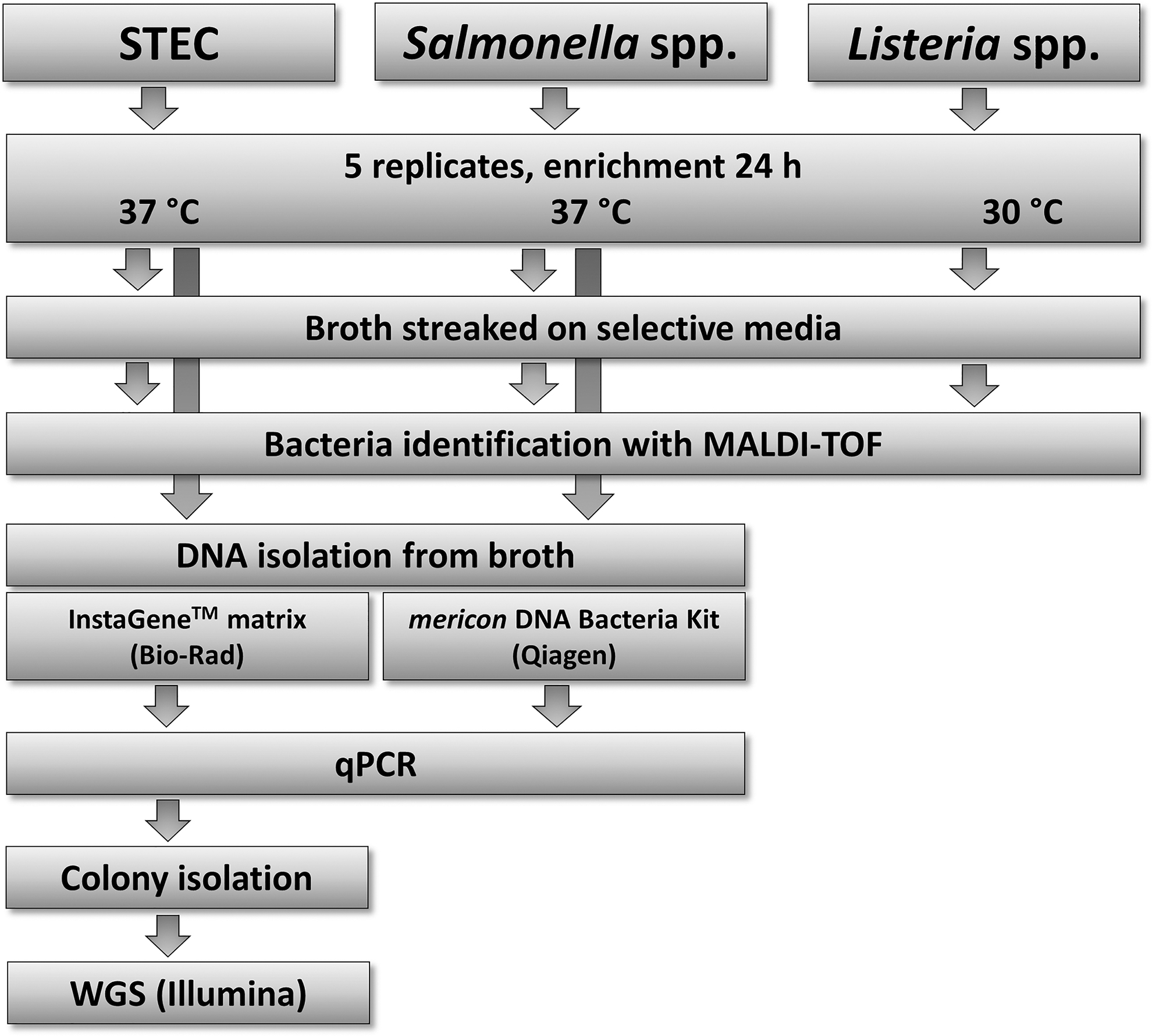
Detection scheme for STEC, Salmonella spp. and Listeria spp. STEC, Shiga toxin–producing Escherichia coli.
After the incubation period, the STEC enrichment broth was streaked on Tryptone Bile agar with X-glucoronide (TBX) medium plates and incubated at 44°C for 24 h. For Salmonella spp. isolation, 0.1 mL of the enrichment suspension was added to 9 mL of Rappaport Vassiliadis medium with soya (RVS), and 1.0–9 mL Muller-Kauffmann Tetrathionate-novobiocin (MKTTn) broth, followed by incubation of the samples for 24 h at 41.5°C and 37°C, respectively. RVS and MKTTn broth samples were further streaked on Xylose Lysine Deoxycholate agar (XLD) and Brilliant Green Phenol Red Lactose Sucrose agar (BPLS) plates and incubated at 37°C for 24 h. For Listeria spp. isolation, Half Fraser broth suspension was streaked on Agar Listeria Ottavani & Agosti (ALOA) and Oxford agar plates, as well as inoculated into 10 mL Fraser broth and incubated at 37°C for 48 h. Single colonies from ALOA agar were streaked onto Blood agar and incubated at 37°C for 24 h to detect the characteristic hemolytic activity of Listeria spp. Colonies with typical STEC, Salmonella spp., and Listeria spp. morphology from the respective selective plates as well as at least five atypical colonies (if available) were streaked on nutrient agar (NA) plates and incubated at 37°C for 24 h for further colony characterization.
Bacteria identification with matrix-assisted laser desorption and ionization time-of-flight mass spectrometry
Since atypical colonies were often observed on the E. coli, Salmonella spp., and Listeria spp. selective plates, to identify these bacteria, random colonies were transferred onto the NA plates and analyzed with matrix-assisted laser desorption and ionization time-of-flight (MALDI-TOF) mass spectrometry (MALDI-TOF) using the MALDI Compass BioTyper™ 3 database (Bruker Daltonics).
Molecular detection of STEC and Salmonella spp.
Bacterial DNA was extracted from the enrichment broth samples using InstaGene™ matrix (Bio-Rad) for STEC and the mericon DNA Bacteria Kit (Qiagen) for Salmonella spp. (Fig. 1). The presence of STEC was determined as described in ISO 13136:2012 by real-time polymerase chain reaction (PCR) with primers and probes for the STEC virulence genes (stx1, stx2, eae), using ViiA 7 Real-Time PCR System (Thermo Fisher Scientific) or Rotor-Gene Q real-time PCR cycler (Qiagen) under the following conditions: 50°C for 2 min, 95°C for 10 min, followed by 40 cycles of 95°C for 15 s and 60°C for 1 min, ending with 60°C for 30 s. Molecular detection of Salmonella spp. was performed using the mericon Salmonella spp. Kit (Qiagen) on a Rotor-Gene Q real-time PCR cycler (Qiagen) under the following conditions: 95°C for 5 min followed by 40 cycles of 95°C for 15 s and 60°C for 15 s, ending with 72°C for 10 s.
Isolation of STEC
The samples for which the presence of stx1, stx2, or eae genes was demonstrated were subjected to strain isolation to confirm that the positive PCR signals were generated from live E. coli bacteria. The enrichment broth was streaked on CT-SMAC, MAC, and TBX plates that were incubated overnight at 37°C. Single colonies were streaked on NA plates, pooled for DNA extraction, and incubated at 37°C for at least 6 h. The extraction of pooled colony DNA was performed with PrepMan™ Ultra Sample Preparation Reagent (Thermo Fisher Scientific). Pooled colonies were screened for the STEC virulence genes using the same primers and probes as described above. In the presence of positive signal from the pool, single colonies from NA were screened to determine the colony that possessed virulence genes.
Determination of E. coli serogroups
Serogroup detection was done according to the methods set by EU Reference Laboratory for E. coli (EU-RL-VTEC). Serogroups O26, O103, O111, O145, and O157 were tested with real-time PCR on Rotor-Gene Q real-time PCR cycler according to the EU-RL-VTEC Method 11 (EU-RL-VTEC, 2018), serogroup O104 was examined with PCR on ProFlex PCR System (Applied Biosystems) according to the EU-RL-VTEC Method 03 (EU-RL-VTEC, 2014), and PCR products were visualized on QIAxcel multicapillary electrophoresis instrument (Qiagen).
Illumina sequencing and data analyses
To gain a more detailed insight into the genomic profile of stx1-producing STEC isolate, a full genome sequence of that isolate was determined. DNA library was constructed with the Nextera XT DNA Library Preparation Kit (Illumina). The library was sequenced on a MiSeq System (using MiSeq Reagent Kit v3 (Illumina) and 300 bp long paired reads were obtained. Quality measures of sequences were analyzed with the FastQC program (version 0.11.8) (Andrews, 2010). For genome de novo assembly, Velvet 1.1.04 (Zerbino and Birney, 2008) was used and the whole genome sequence was obtained with 79 × coverage. The characterization of stx1-producing STEC strain was performed with the online tools VirulenceFinder 2.0 (Joensen et al., 2014) and SerotypeFinder 2.0 (Joensen et al., 2015) developed by the Center for Genomic Epidemiology of the Technical University of Denmark. The raw reads generated were submitted to the European Nucleotide Archive with the study accession number PRJEB33523.
Results
The presence of target pathogenic bacteria assessed by microbiological methods
The target pathogenic bacteria Salmonella spp. and Listeria monocytogenes were not detected in any of the tested samples according to the standard methods ISO 6579-1:2017 and ISO 11290-1:2017, respectively.
The presence of target pathogenic bacteria assessed by molecular analyses
All 45 samples were tested for the presence of STEC (ISO 13136:2012) and Salmonella spp.-specific genes using real-time PCR. Three (6.7%) samples (dried sprouts of common wheat EM-13 and EM-24, and rye EM-23) were positive for the E. coli virulence genes. Shiga toxin-coding gene stx1 was present in two samples (EM-23, EM-24), stx2 in one sample (EM-24), and intimin-coding gene eae in two samples (EM-13, EM-24), with the sample EM-24 found positive for all three E. coli virulence genes. MALDI-TOF analyses confirmed the presence of E. coli in all three of these samples. Thus, the presence of STEC virulence genes was detected in three out of seven (42.9%) E. coli-positive samples and all three positive samples originated from dried sprouts.
Samples that were positive for E. coli virulence genes (EM-13, EM-23, EM-24) were subjected to molecular detection of serogroups and strain isolation. We isolated an stx1-positive strain from sample EM-24 and determined its whole genome sequence. Genome analysis showed that the sample EM-24 contained the E. coli serotype O11:H48. In addition, by using VirulenceFinder 2.0 we determined that this strain harbored the stx1d subtype. EM-13 was found to contain the serogroups O26 and O157, but EM-23 contained the serogroup O145. However, strain isolation for these samples was not successful, therefore we were not able to confirm serogroups in colonies.
None of the samples was found to contain Salmonella spp.-specific genes according to real-time PCR.
Identification of background bacteria
Since atypical colonies were often observed on the E. coli, Salmonella spp., and Listeria spp. selective plates, random colonies were transferred to the NA plates and analyzed with MALDI-TOF mass spectrometry. Altogether, 46 different bacteria species from 22 genera and 12 families were identified (Table 3). E. coli was detected in seven (15.5%) of the samples and Salmonella spp. in one (2.2%) sample (EM-19). We did not find L. monocytogenes in any of the samples, although the presence of another Listeria genus species, Listeria innocua, was detected in two (4.4%) samples (EM-4 and EM-9). Among the rest of the bacteria detected with MALDI-TOF, the majority were environmental bacteria characteristic to soil, water, and plants, including coliform bacteria (Table 3).
Bacteria Identified in Microgreens, Baby Greens, Seeds, and Sprouts with Matrix-Assisted Laser Desorption and Ionization Time-of-Flight Mass Spectrometry
Entries in bold represent genera of coliform bacteria.
Discussion
Nowadays there is a growing interest in healthy lifestyle and the nutritional value and quality of food. Microgreens and sprouts are attractive novelty products that offer both high nutritional value and esthetic qualities (Choe et al., 2018; Paradiso et al., 2018; Benincasa et al., 2019). However, sprout and microgreen manufacturing conditions facilitate the growth of microorganisms that can pose serious food safety risks. Overall, fresh vegetables and juices were associated with 3.8% of foodborne outbreaks (5.1% of the total number of cases) in the EU in 2017 (EFSA and ECDC, 2018) and, over the years, sprouts have been implicated in several serious outbreaks in different countries (Watanabe et al., 1999; Buchholz et al., 2011; Callejón et al., 2015). Therefore, it is vital to monitor and evaluate the microbial risks arising from these products. This study characterizes the presence of pathogenic and potentially pathogenic bacteria in various types of sprouts, microgreens, and baby greens in Latvia. One of the limitations of the study was that the samples were purchased only in Riga, Latvia. However, the retail market of Riga is supplied by the local producers located in various regions of the country and thus the retail market of Riga represents the overall situation in Latvia.
In general, the target pathogenic bacteria were detected in a minority of the samples. The presence of E. coli stx genes was detected in three dried sprout samples that were prepared by drying sprouted grains at 40°C. All of these samples were produced by the same local manufacturer and distributed by one supermarket chain. We isolated the stx1-containing E. coli strain from one of the samples (EM-24). While the DNA isolated from the enrichment broth of this sample also showed the presence of stx2 and eae genes, we did not detect the presence of stx2 and eae genes in the isolated colony. Thus, we confirmed the presence of pathogenic E. coli in one (2.2%) of the analyzed samples, as well as revealed two other highly suspicious samples that harbored the STEC pathogenicity genes. Although we were not able to prove the presence of live STEC cells in these two samples and the origin of the STEC genes might be from nonviable cells that do not pose harm, the presence of STEC pathogenicity genes in these products is alarming, since according to ISO/TS 13136:2012 such results must be interpreted as a presumptive detection of STEC. The range of STEC-positive samples among EU countries reporting the results from sprouted seeds on retail market is between 0% and 0.3% for the time period of 2013–2017 (EFSA and ECDC, 2018), which is lower than in the present investigation.
DNA isolated from the enrichment broth of sample EM-13 showed the presence of different serogroups (O26, O157), whereas sample EM-23 showed O145 serogroup-specific genes. However, the isolation of STEC was unsuccessful in both cases, which could be explained by the low number of viable bacteria in the sample. To our knowledge, no cases of illness have been attributed to E. coli contamination of sprouts or microgreens in Latvia during the study period, but there has been one registered case of STEC infection in the time period from January to April 2019 (CDPC, 2019), although, to the best of our knowledge, this infection has not been linked to the consumption of sprouts.
By using MALDI-TOF we identified the presence of E. coli in 7 (15.7%) out of a total of 45 samples, including 5 dried sprout samples.
In two samples of microgreens, namely, radish (EM-4) and common sunflower (EM-9), the presence of L. innocua was detected with MALDI-TOF mass spectrometry method and in one sample of common sunflower microgreens (EM-19) the presence of Salmonella spp. was detected with MALDI-TOF mass spectrometry. The most common foodborne pathogenic bacteria of Listeria genus is L. monocytogenes, although to a much lower extent than Salmonella spp. and E. coli. However, a large U.S. foodborne pathogen study found that the prevalence of L. monocytogenes in sprouts, as well as other vegetables and fruits, was even higher than that of Salmonella spp. and E. coli (both O157:H7, and non-O157), probably due to the fact that L. monocytogenes can grow under refrigerated conditions (Zhang et al., 2018). In general, L. innocua is considered to be a nonpathogenic Listeria species; however, a recent study demonstrated that the atypical hemolytic L. innocua is virulent and closely related to L. monocytogenes (Moura et al., 2019).
Among the rest of the bacteria detected with MALDI-TOF, the majority were environmental bacteria characteristic to soil, water, and plants, including coliform bacteria (Table 3). Some of them were well-known foodborne pathogens such as Bacillus cereus (Bottone, 2010), as well as bacteria that are infectious to humans, but not typically associated with foodborne infections, including Citrobacter braakii (Oyeka and Antony, 2017), Citrobacter freundii (Whalen et al., 2007), Citrobacter youngae (Chen et al., 2013), Escherichia hermannii (Ioannou, 2019), Cronobacter sakazakii (Singh et al., 2015), Pseudomonas aeruginosa (Azam and Khan, 2019), Pseudomonas putida (Kim et al., 2012), and Klebsiella pneumoniae (Navon-Venezia et al., 2017).
Conclusions
The study results provide evidence that microgreens and seeds marketed in Latvia for the domestic production of microgreens are generally safe, however, there is some concern with regard to dried sprouts, as E. coli virulence genes were identified in three samples. Further studies are required to monitor the situation.
Footnotes
Author Contributions
I.B. designed and conducted the study, interpreted data, prepared the article; A.O. summarized data, interpreted data, and prepared the article; E.M. performed microbiological and molecular biology analyses; L.A. performed MALDI-TOF analyses; I.M. performed Illumina sequencing and data analyses; A.C. coordinated microbiological studies; L.G.-I. designed and supervised the study, interpreted data, and prepared the article.
Disclosure Statement
No competing financial interests exist.
Funding Information
This research was cofinanced by European Regional Development Fund (ERDF) (85%) and the state budget of Latvia (7.5%) under the project number 1.1.1.1/16/A/258 “Development and the application of innovative instrumental analytical methods for the combined determination of a wide range of chemical and biological contaminants in support of the bio-economy in the priority sectors of economy.”