




Abstract
Eggs are a highly nutritious food source used in a wide range of food products. In Australia, eggs are a frequent source of foodborne salmonellosis outbreaks, associated with eggshell contamination with Salmonella enterica serovar Typhimurium (ST). Despite their potentially hazardous nature, raw eggs are often used and consumed in mayonnaise, mousse, ice cream and eggnog. The aim of this study was to develop a shell egg decontamination method that removed ST contamination from the outside of an egg without impacting its usability. The decontamination method was developed by the adaptation of a temperature-controlled water bath (commonly present in kitchens and associated with the sous-vide technique) for the surface decontamination of eggs. The outside of whole eggs was artificially inoculated with two ST strains. The eggs were decontaminated by placing in a sous-vide cooker with the water heated to 57°C. The remaining viable ST present on the whole shell egg, crushed shells, internal egg contents and sous-vide water were enumerated over time by culturing onto XLD agar. The quality of the uncontaminated heat-treated eggs was determined by measuring the Haugh unit, yolk index, albumen pH, thermocoagulation, and stability of foam. A blind control study was conducted to assess the acceptability and usability of the treated eggs by chefs and food handlers for the preparation of mayonnaise. Complete decontamination of ST was achieved by treating eggs for 9 min in the sous-vide cooker (57°C). No statistically significant difference was observed in the quality of treated eggs compared with nontreated eggs using the quality measurements and acceptability score from chefs. This method provides a simple approach that can be adopted by chefs and food handlers to obtain safe eggs before the preparation of raw egg products.
Introduction
Salmonellosis is a major foodborne gastrointestinal disease that affects public health (Stephen and Barnett, 2017). According to Gibney et al. (2014), in 2010 salmonellosis was among the most common gastrointestinal diseases in Australia, with the main source identified as raw egg products (Gole et al., 2014). In Australia, Salmonella enterica serovar Typhimurium (ST) is the serovar most commonly linked with the egg-related outbreaks (De Buck et al., 2004; Firestone et al., 2007; OzFoodNet, 2009), whereas globally Salmonella enterica serovar Enteritidis (SE) is the main cause (Hendriksen et al., 2011). SE primarily contaminates the internal contents (ICs) of the eggs (Wales and Davies, 2011), whereas ST is found on the outside of the eggshell with internal contamination uncommon (De Buck et al., 2004; Martelli and Davies, 2012).
Previous studies investigating strategies for egg decontamination have focused on eggs internally contaminated with SE (Gast, 1993; Hou et al., 1996; Stadelman et al., 1996; Schuman et al., 1997; Himathongkham et al., 1999). A review conducted by Keerthirathne et al. (2017) identified only one study that investigated an egg decontamination method for ST. However, this study used eggs internally contaminated with ST (Himathongkham et al., 1999) that is not commonly observed.
In addition, the currently available egg pasteurization and decontamination processes can have variable effects on the egg proteins. This influences their coagulation, foaming, and emulsifying properties, ultimately impacting their usability and preventing chefs from using these treated eggs (Keerthirathne et al., 2017).
The aim of this study was to develop a simple decontamination method for eggs externally contaminated with ST that does not impact the usability of the eggs. A water bath method using kitchen equipment commonly used for sous-vide cooking was selected to ensure easy implementation in a commercial kitchen. A blind control study was also conducted to assess the acceptability and usability of the treated eggs by chefs and food handlers.
Materials and Methods
Two strains of ST were used for the experiment; a standard strain (STs) of ST (ATCC 53647) and a clinical isolate (STi).
Preparation of the Salmonella culture
An ST culture was prepared by introducing a typical ST colony from an XLD agar plate (Oxoid Ltd., Basingstoke, United Kingdom) into 100 mL of peptone water (Oxoid Ltd.). This was incubated for 12 h at 37°C in a shaking incubator (Innova®44, Incubator Shaker Series). After incubation, the broth culture was centrifuged at 1400 × g for 15 min and the pellet was resuspended in buffered peptone water (BPW; Oxoid Ltd.). The optical density (OD) at 600 nm (UV-1800, Shimadzu UV-spectrophotometer) was adjusted to 1 using BPW to obtain a concentration of 109 colony-forming units (CFU)/mL (Chen et al., 2011) and was serially diluted to 105 CFU/mL.
Inoculation of the shell eggs
The procedure used was adopted from Gole et al. (2014) with some modifications as stated hereunder. Washed, large, commercial eggs at least 1 month before the use-by date were used for the experiments. The eggs with dirt and cracks were discarded. An egg was immersed in the ST culture (105 CFU/mL) for 90 s and air dried at room temperature under a safety hood.
Decontamination procedure
The inoculated eggs were placed directly in the sous-vide apparatus (Duos™ Sous-Vide; Sunbeam) with water heated to 57°C (note: the eggs were not placed in a vacuum-sealed bag as is normal process for sous-vide). The temperature of the water was confirmed using a thermometer at the beginning and the end of the decontamination procedure. Eggs were heat treated for 30 s, 1, 2, 3, 3.5, 6, 6.5, 7, 8, and 9 min.
The experiment was conducted with three eggs at each time point. The experiment was repeated three times for each time point and each Salmonella strain, that is, 18 eggs (9 inoculated with STs and 9 with STi) were tested at each time point. Artificially inoculated eggs that did not undergo the heat treatment was used as the control (T = 0). Growth and/or resuscitation was recorded as positive if there was growth in any of the XLD agar plates or broth cultures tested. The results were recorded as negative if there was no growth in any of the plates or broth cultures tested.
Recovery of Salmonella after decontamination
Recovery of Salmonella after decontamination was enumerated in triplicate for each time point on XLD agar, that is, 9 eggs were processed in triplicate that was equal to 27 spread plates per each time point for each component of the egg (27 plates for intact whole egg, 27 plates for crushed shells, and 27 plates for ICs). The crushed shell and ICs of an egg were processed separately to investigate the potential movement of ST throughout the eggshell membrane. All plates and broth media were incubated (Memmert Incubator IN30; Schwabach, Germany) overnight at 37°C. Colonies with typical ST morphology were counted. The entire experiment was repeated for each Salmonella strain (STs and STi).
Intact whole egg
After the heat treatment, the intact whole egg was placed in a ziplock bag and massaged in 10 mL BPW for 1 min to dislodge microorganisms on the external surface of the eggshell (McAuley et al., 2015). One hundred microliters of this solution was spread plated on XLD agar.
Crushed eggshell
The eggs were dipped in freshly prepared 70% ethanol for 30 s and dried at room temperature to prevent live bacteria (if any) residing on the eggshell from contaminating the ICs (Gole et al., 2014). This step was conducted to determine whether the bacteria were present in the eggshell membrane or whether it had migrated into the ICs of the egg. The eggs were cracked using a sterile knife. The shells were crushed in 10 mL BPW and massaged in a stomacher for 1 min. One hundred microliters of this was plated on XLD agar.
Internal egg contents
The ICs were homogenized until a uniform suspension was obtained. Two milliliters of this solution was added to 8 mL BPW. One hundred microliters of the IC-BPW mixture was plated on XLD agar using the spread plate method.
Recovery of Salmonella after decontamination using an enrichment step
Recovery of Salmonella after decontamination was also conducted with an enrichment step to induce the recovery of possible viable but nonculturable (VBNC) cells (Reissbrodt et al., 2002) and to increase the limit of detection from 10 to 1 CFU/mL. Enrichment was conducted by adding 1 mL from each of the whole shell–BPW mixture, crushed shell–BPW mixture, and the IC-BPW mixture to 9 mL of sterile BPW separately in triplicate (i.e., 3 broths for 9 eggs = 27 enrichment broth cultures per time point per each component of the egg). Growth in the BPW was determined using a spectrophotometer and confirmed to be ST by plating onto XLD agar.
Salmonella recovery in sous-vide water
The water of the sous-vide was tested to check the viability of any Salmonella cells that may have washed off into the water during the process. One microliters of the sous-vide water was used to inoculate 9 mL of sterile BPW and this was conducted in triplicate for each time point (n = 9).
Egg quality testing
Uninoculated eggs were used to test the quality parameters. The egg quality was checked after placing the eggs at 57°C for 6.5, 9, 17, 20, and 28 min. The procedures were adapted from Hou et al. (1996) with modifications as described hereunder. The egg quality was also determined for the eggs without any heat treatment, which were used as controls. Foaming ability, foam stability, protein denaturation and albumen pH (Eutech Instruments pH700), Haugh unit, yolk index, and the difference in weight of the egg before and after the heat treatment were assessed after the heat treatment. Three eggs were used for each time point/control and each test was repeated three times (n = 9).
Each egg was carefully broken onto a leveled glass plate and the height of the egg albumen surrounding the egg yolk and the height of the egg yolk was measured using a micrometer (Mitutoyo). The height of the egg albumen was measured three times in different positions surrounding the egg yolk and the mean value was used for the calculations. The width of the egg yolk was measured using a compass.
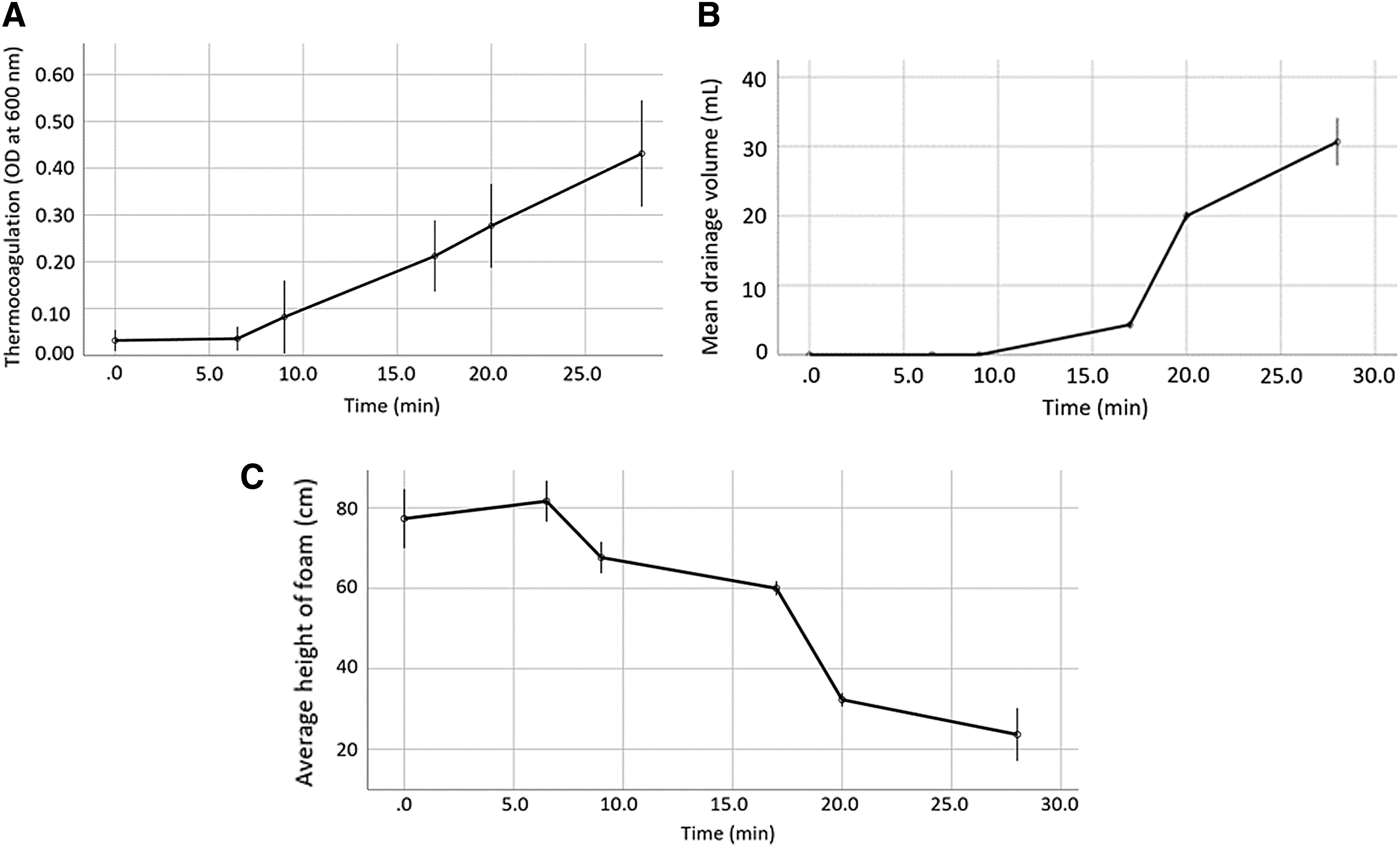
Thermocoagulation of the egg albumen after treatment was measured using a spectrophotometer by measuring the OD at 600 nm against water.
To measure foam stability and foaming ability, 100 mL of egg albumen from three eggs from each treatment was used. Egg albumen was homogenized using an electric mixer (Contempo Stick Mixer with beaker) for 3 min at lowest power. The foam was left to stand for 3 min and the height of the foam and the drainage volume were measured.
Usability of treated eggs
Ethical clearance for this part of the experiment was obtained from the Flinders University Social and Behavioural Research Ethics Committee (project No. 7795). Chefs and the food handlers from local restaurants were approached and 10 volunteers were recruited for the study.
Each chef/food handler was provided with three batches (labeled A, B, and C) of three eggs (nine in total) and asked to prepare mayonnaise using their own recipe and each batch separately. The eggs were not inoculated, but two batches had been heat treated for 9 min at 57°C and one batch was untreated. Participants were unaware which batches were treated or untreated.
Once the participants had prepared their mayonnaise, they were asked to assess the overall acceptability, texture, appearance, smell, color, and stability of the mayonnaise using a 9-point hedonic scale where 9 was “like extremely” and 1 was “dislike very much” (Yao et al., 2003).
Statistical analysis
One-way analysis of variance test was performed on SPSS software (IBM Corp. Released 2017, IBM SPSS Statistics for Windows, version 25.0; IBM Corp., Armonk, NY) to determine whether there was a significant difference in egg quality between the treated and untreated eggs with statistical significance accepted at p ≤ 0.05. Chi-square tests were performed to understand the heat resistance patterns of the two Salmonella strains used in the experiment. Kruskal–Wallis H tests were performed on SPSS software to analyze the data obtained from hedonic scales.
Results
The concentration of Salmonella cells inoculated on to the egg varied from 28 to 150 CFU/mL with an average of 74 CFU/mL, that is, 7.4 × 101 CFU/egg (n = 9) that was confirmed following the methods described in the sections Intact whole egg, Crushed eggshell, and Internal egg contents. This inoculation concentration was chosen because previous studies have demonstrated that contaminated eggs typically have between 10 and 100 CFU Salmonella per egg (Humphrey et al., 1989). Previous studies conducted by Hou et al. (1996) and Shenga et al. (2010) on egg decontamination demonstrated that 57°C was effective against SE, which is why this temperature was chosen for this study.
Decontamination of the eggs
There was a significant difference (p = 0.22) in resistance to heat between the standard strain (STs) and the clinical isolate (STi). There was no growth of STs in any of the XLD agar plates after 3.5 min at 57°C in the sous-vide water bath but enrichment of the STs confirmed the survival of Salmonella after 3.5 min. No growth of STs was observed after 6 min at 57°C after enrichment (Table 1). STi were not recovered from the eggs after 8 min in any of the XLD agar plates but the enrichment step confirmed the survival of Salmonella. Nine minutes at 57°C confirmed the complete loss of viability of the STi strain in all the XLD agar plates tested (Table 2). Salmonella was not recovered from the sous-vide water bath water after the heat treatment for 9 and 6 min for the STi and STs, respectively.
Growth of STs After Direct Plating and Enrichment
Total number of eggs processed is 72.
Nine eggs were used at each time point. The survival of Salmonella was tested in triplicate at each time point (27 spread plates per each time point were tested for each component of the eggs).
BPW, buffered peptone water.
Growth of STi after Direct Plating and Enrichment
Total number of eggs processed is 99.
Nine eggs were used at each time point. The survival of Salmonella was tested in triplicate at each time point (27 spread plates per each time point were tested for each component of the eggs).
BPW, buffered peptone water.
Impact on the egg quality
The average weight difference of the egg before and after the heat treatment was 0.02 g in all the eggs tested and the difference was not significant (p = 0.92) at 9 min at 57°C. The pH of the egg albumen with and without the heat treatment was 9.1 and 9.07, respectively, after 9 min at 57°C (p = 0.37). The average OD reading at 600 nm for the eggs without the heat treatment was 0.3, whereas the treated eggs were recorded as 0.8 against water (Fig. 1A), indicating a slight denaturation of the egg albumen but this was not a statistically significant difference (p = 0.17) when compared with the control eggs. The average egg yolk index for the control eggs was 0.45 and yolk index of the treated eggs was 0.41. The average Haugh unit of the control and the treated eggs was 79.41 and 89.45, respectively. The yolk index and the Haugh unit values were not significantly different from the values of the control eggs (p = 0.16 and p = 0.053, respectively). The average height of foam produced by the untreated eggs was 79.4 cm (Fig. 1B), whereas that of the treated eggs was 67.7 cm, which is not significantly different (p = 0.016). There was no drainage volume for the control and the treated eggs (Fig. 1C) at 9 min at 57°C.
Usability of the eggs
Chefs and food handlers rated the mayonnaise made separately from the treated eggs and the untreated eggs. There was no difference observed in the chefs' and food handlers' acceptance of the treated or untreated eggs (p = 0.73) (Fig. 2).

Clustered boxplot showing the quality according to the 9-point hedonic scale data of the mayonnaise prepared by the chefs and the food handlers using the treated and the untreated eggs. OA, overall acceptability.
Seventy percent (70%) and 65% of the participants rated the overall acceptability and the stability of the mayonnaise made with the treated eggs in the categories “like extremely” and “like very much,” respectively. There was no statistical significance between mayonnaise made with the treated and the control eggs when the appearance (p = 0.84), texture (p = 0.61), smell (p = 0.86), color (p = 0.38), and the stability (p = 0.84) was considered. Only 5% of the chefs and food handlers rated the overall acceptability of the prepared mayonnaise as “dislike extremely,” whereas 10% rated the normal eggs in the same category. The results for the stability of the prepared mayonnaise presented a similar pattern.
Discussion
The developed method inactivated STi after placing inoculated eggs in water heated to 57°C for 9 min without affecting the egg quality. In contrast, complete inactivation of STs was observed after 6 min at 57°C. Survival of the STi for a longer time period than the STs indicated that the infectious strain is more resistant to temperature. The enrichment step conducted in this study demonstrated that there was no recovery of VBNC STi after 9 min. This is important as raw eggs could be used in products (such as mousse), which could provide favorable conditions needed for resuscitation and recovery of VBNC cells (Gupte et al., 2003).
Salmonella cells in the VBNC state would not be detected using the culture technique but could subsequently recover and start replicating under favorable environmental conditions (Gupte et al., 2003; Li et al., 2014). The enrichment steps used in this study enabled the detection of any VBNC Salmonella through resuscitation and also increased the detection limit (Reissbrodt et al., 2002).
Previous studies investigating strategies for egg decontamination have focused on eggs internally contaminated with SE (Gast, 1993; Hou et al., 1996; Stadelman et al., 1996; Schuman et al., 1997; Himathongkham et al., 1999). A recent review conducted by Keerthirathne et al. (2017) identified one study that investigated an egg decontamination method for ST. However, this study investigated eggs internally contaminated with ST (Himathongkham et al., 1999), which is not commonly observed. This is the first study to look at decontamination of ST on the eggshell, which is representative of the Australian situation. However, this method may not be as effective for eggs internally contaminated with SE.
To ensure successful implementation of a food safety control mechanism it must be acceptable to chefs and food handlers. Raw eggs are used in many different food products such as mayonnaise, mousse, eggnog, and homemade ice cream. Properties such as gelatinization and emulsification of the eggs are important during the preparation of these food products (Zhao et al., 2010). The stability of the emulsion is a significant property when producing mayonnaise, which is a combination of eggs, vinegar, oil, and spices. Denaturation of the egg proteins because of external means such as heat could have an impact on its functional properties, which could affect their usability (Campbell et al., 2003). Likewise, Himathongkham et al. (1999) demonstrated cracking of the eggshell after immersion in boiling water for the decontamination of eggs internally contaminated with SE. Another study conducted by Hou et al. (1996) reported that immersion of whole shell eggs in water heated for 57°C for 25 to 30 min denatured the egg albumen.
The egg quality parameters tested indicated that the decontamination method did not impact egg quality. There were no significant differences (p > 0.05) between treated and control egg measurements for albumen pH, yolk index, and Haugh unit. These are indicators of the quality of the egg proteins and freshness of the egg and can be affected by temperature (Heath, 1977). Mayonnaise was chosen to examine the chef's acceptability (blind control study) as it has a semisolid consistency, which is stabilized by the egg yolk proteins. As such, the denaturation of the egg proteins could impact the consistency, stability, and the quality of the mayonnaise. There was no difference in the chef's acceptance of the heat treated and untreated eggs, which further supports the findings that this heat-based decontamination method does not affect the physiochemical or functional properties of the eggs.
This decontamination method used kitchen equipment commonly used for sous-vide cooking to ensure easy implementation in a commercial kitchen. This simple and rapid method can be adopted to decontaminate eggs before preparation of raw egg products. Using this method immediately before the preparation of raw egg products could help reduce the burden of salmonellosis in Australia and protect public health. This method could also reduce the possibility of cross-contamination while processing raw egg products.
Future Work
The method presented in this study provides a simple approach for the decontamination of eggs externally contaminated with ST, which is the most common strain found contaminating Australian eggs. However, future work is needed to evaluate the effectiveness of this method against other Salmonella strains found in Australia. There is also the need for future work exploring the effectiveness of the method against heat resistance-induced strains of Salmonella. This method is designed as a pretreatment to be conducted immediately before the use of an egg. Future research is needed to examine the potential consequences of this method on shelf life and the permeability of the eggshell membrane, which will be of significance if the eggs were not to be used immediately.
Footnotes
Acknowledgments
The authors acknowledge Helen Hocking of the Salmonella Reference Laboratory, Adelaide, Australia for providing the Salmonella Typhimurium infectious strain and Ann-Marie Williams the Quality Assurance Manager of Solar Eggs Pty. Ltd. for cooperating and providing the eggs used for the experiments.
Disclosure Statement
The authors declare no conflict of interests.
Funding Information
This research did not receive any specific grant from funding agencies in the public, commercial, or not-for-profit sectors.